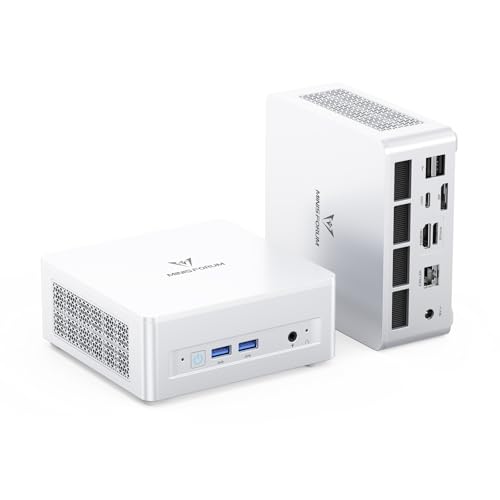
Where to buy
Check the latest price, availability and delivery on Amazon. Orders are placed on Amazon. We may earn a commission from qualifying purchases. Every product below is a barebones kit: the price buys the case, board, processor and cooler only — no RAM, no SSD and no operating system unless a review says otherwise, so budget for those parts before comparing any price here with a complete mini PC.
- Best overall for a 1440p screen: MINISFORUM UM880 Plus Barebone, Ryzen 7 8845HS, Radeon 780M — Check on Amazon
- MINISFORUM UM870 Slim Barebone, Ryzen 7 8745H, Radeon 780M — Check on Amazon
- GMKtec NucBox K8 Plus, Ryzen 7 8845HS (Without RAM / SSD / OS) — Check on Amazon
- Intel NUC 11 NUC11PAHi5 Barebone, Core i5-1135G7, 0GB RAM / 0GB SSD — Check on Amazon
- ASUS NUC 14 Essential Barebone Kit, Intel Core 3 N355 — Check on Amazon
See 1 more Amazon option
- ASUS NUC 14 Essential Barebone Kit, Intel N150 — Check on Amazon
Read the full guide ↓
Disclosure: As an Amazon Associate, reviewstook.com earns from qualifying purchases. Links to Amazon on this page are affiliate links; they cost you nothing extra. Listing details such as price and availability change often, so check the current Amazon listing before you buy.
A 1440p monitor is the screen most PC gamers actually sit in front of now, so a small, cheap box that can feed one is a reasonable thing to go shopping for. The honest answer therefore comes before any product names: no barebones mini PC under $400 plays games natively at 1440p. Not the strongest kit in this guide, not with settings on the floor, not on a lucky day. Rendering modern games at a full 2560×1440 is work for a discrete graphics card, and there is no discrete graphics card in any box below — all six picks play through integrated graphics that borrow your system memory. A listing that calls an empty mini PC a “1440p gaming machine” without explaining the next paragraph is selling you a resolution, not a frame rate.
Here is what these kits genuinely can do, and it is worth having: render the game at 1080p or lower, then upscale that image to fill the 1440p panel. Upscaling is not a consolation prize — it is how a large share of all 1440p PC gaming happens, including on far more expensive hardware. The GPU draws fewer pixels, software reconstructs the full-size frame from them, and on a typical desk monitor the result sits close to native while running at a speed integrated graphics can sustain. So every pick here is graded on how well it supports that plan — GPU class, memory bandwidth, upscaling menu, and whether it leaves a door open for an external graphics card.
The second honesty layer is the one this category never escapes, and at this budget it outweighs every benchmark: the sticker on a barebones kit is not the price of a working PC. Under $400 buys an empty box with a processor soldered inside — nothing in the memory slots, nothing in the M.2 bay, no operating system. The machine will not boot, let alone upscale anything, until you fit RAM and storage yourself. And at current component prices — with DDR5 SO-DIMM memory and NVMe storage both costing a substantial amount bought new — completing any of these kits with new parts pushes the real spend well past $400 before an external GPU is even mentioned. This guide is therefore written for the buyer these kits actually suit: someone who already owns DDR5 or DDR4 memory and a spare drive, or who wants one of these exact platforms and accepts the parts bill with eyes open. Every review sets the completion bill beside the kit itself, in the same spirit as our base guide to the category, Best Barebones Mini PC Under $400.
What “1440p Gaming” Honestly Means at This Budget
Begin with the screen’s arithmetic. A 1440p panel holds 2560×1440 pixels — about 3.7 million, roughly 1.8 times a 1080p image. Drawing every one of them, every frame, is the expensive half of gaming, and it is the half integrated graphics cannot afford in modern titles. Upscaling divides the labour: the GPU renders a smaller internal picture, and software rebuilds a 1440p frame from it. The usual quality modes render at about two-thirds of the output size on each axis — at 1440p output, an internal image near 1707×960 — while performance modes halve each axis, rendering near 1280×720 and asking the upscaler to lift more. Rendering a plain 1920×1080 and upscaling from there lands between those presets and is the setup most owners of hardware like this actually run. The exchange never changes: the lower the internal resolution, the faster the game and the softer, less stable the rebuilt image — motion, foliage, fences and fine text show it first.
Three upscaling families matter here, and your silicon decides which ones you own. FSR is AMD’s open upscaler, built into many games directly; it runs on the Radeon 780M in the three AMD kits, and because it is vendor-neutral inside a game, it can also run on the Intel picks in titles that implement it. RSR is AMD’s driver-level version — no game support needed, available on the 780M kits through the AMD driver, a touch cruder in exchange for working almost anywhere. XeSS is Intel’s entry, and its home in this guide is the NUC 11’s Iris Xe graphics. Then there is the name most buyers arrive expecting: DLSS — which belongs to NVIDIA alone, and no pick in this guide contains an NVIDIA GPU, so DLSS is on offer from none of them as they sit. When DLSS numbers are quoted for this resolution — its Quality mode rendering at roughly 1707×960 internally for a 1440p output, its Performance mode at roughly 1280×720 — they describe what an NVIDIA card would do, and an NVIDIA card can reach this guide by exactly one road: inside an external GPU dock, covered below. If DLSS is a hard requirement, let it steer the whole purchase, not a settings page.
Memory bandwidth is the quiet specification that decides whether any of this works. An integrated GPU keeps no memory of its own; it borrows system RAM and shares that RAM’s bandwidth with the processor. Two sticks in dual channel hand it roughly double the data path of one stick — which is why every serious pick here provides two SO-DIMM slots, and why the two ASUS kits, with one slot that runs single channel for life and caps capacity at 16GB, are graded as desktop-and-media machines in this gaming guide. Upscaling shrinks the pixel count the GPU must shade; it does not manufacture bandwidth, and a starved iGPU will faithfully upscale a stutter into a smoother-looking stutter. Fit a matched pair of sticks, or accept that you have bought half the graphics the chip offers.
Lastly, the single route to true native 1440p from this tier: an external GPU. A dock holding a desktop card, cabled to a kit with the right port, turns one of these boxes into the small host of a machine that renders the resolution for real. The ports are not equals. OCuLink, fitted to the UM880 Plus, carries the card’s PCIe signal with the least overhead and is the credible version of the idea. USB4 docks — the road open to the UM870 Slim and the K8 Plus — work, but tax the card with a bandwidth penalty. The NUC 11’s Thunderbolt 3 is the older, slower ancestor of the same trick. The ASUS kits have no such door whatsoever. And the cost honesty applies in full: dock and desktop card are two further purchases stacked on top of a completed PC, and since completion parts alone currently add a substantial bill for a modest DDR5 build, the eGPU conversation begins only after that bill is settled. Plan the staircase — kit, parts, then dock — before the first step charms you with its price.
In this guide
Quick Picks
In a hurry? Find your buyer type and take the kit beside it — every grade assumes the upscaling plan above, and every pick is the empty kit — check price on Amazon for each one, and read the completion notes in the reviews before comparing any kit with a complete mini PC.
| Buyer type | Pick | Why it stands out | Link |
|---|---|---|---|
| Best overall for a 1440p screen | MINISFORUM UM880 Plus Barebone, Ryzen 7 8845HS | Strongest iGPU here, dual-channel DDR5, and an OCuLink port — the only credible native-1440p door | Check on Amazon |
| Best value upscaling kit | MINISFORUM UM870 Slim Barebone, Ryzen 7 8745H | The same Radeon 780M and dual-channel memory for less money, in a slimmer box | Check on Amazon |
| Best for dual networking and displays | GMKtec NucBox K8 Plus, Ryzen 7 8845HS | Dual 2.5G LAN and two USB4 ports with the same 780M graphics — at the very top of the budget | Check on Amazon |
| Best legacy Intel wildcard | Intel NUC 11 NUC11PAHi5 Barebone, Core i5-1135G7 | Iris Xe with XeSS and dual-channel DDR4 — only worth it bought on a price dip | Check on Amazon |
| Best light-duty Intel step-up | ASUS NUC 14 Essential Barebone Kit, Intel Core 3 N355 | Eight cores for a busy 1440p desktop — a work screen, not a gaming one | Check on Amazon |
| Cheapest respectable way in | ASUS NUC 14 Essential Barebone Kit, Intel N150 | Entry-level brand-name kit for office and media on a 1440p panel, VESA mount included — check price on Amazon | Check on Amazon |
How These Picks Were Chosen
The opening filter was the definition our base guide runs on. To qualify, a kit had to be a genuine barebone as sold — case, board, processor and cooling, memory slots and drive bays empty, no operating system — with those terms stated in the listing’s own title or specification table. Complete mini PCs that Amazon search surfaces under barebones keywords were turned away however sharp their prices, and so was any listing that borrows the word while shipping memory fitted. Where one model sells in both forms, only the barebone variant’s listing was used, because landing on the wrong variant of a shared page is the most common way buyers in this category end up owning the wrong thing — a warning the reviews repeat wherever it applies.
The second filter was written for this angle alone: what can this silicon honestly do with a 1440p screen? Four things decided each grade. The integrated GPU’s class, since that fixes the ceiling on the internal render resolution it can hold. The memory layout, since dual-channel bandwidth is the ground an iGPU stands on and a single-slot board halves the machine’s graphical future on day one. The upscaling menu — FSR and RSR on the AMD kits, XeSS on the Iris Xe kit, DLSS on none of them, printed openly rather than left for buyers to discover. And the expansion door: an OCuLink or USB4 port is the dividing line between a box whose 1440p story ends at upscaling and a box that can one day host a real card and render the resolution natively.
The third filter was money, handled honestly rather than with listing-page optimism. Each review describes where its kit sits inside this budget — at the entry end, in the upper part of the band, at the very ceiling, or usually above it and worth buying only on a dip — and every linked kit points you to check the current price on Amazon, because kit and component prices move too quickly for any printed figure to stay true. Completion costs matter as much as the kit itself: memory pricing in particular is moving quickly enough that RAM and storage must be priced on the day you order, and each review weighs the finished machine against the same model sold complete. No operating system is included in any comparison here: Linux costs nothing, and a laptop-tied Windows license generally refuses to transfer, so allow for a license separately if you need Windows.
The 6 Best Barebones Mini PCs for 1440p Gaming Under $400
MINISFORUM UM880 Plus Barebone — Ryzen 7 8845HS, Radeon 780M
Who it suits: The parts-drawer owner with a 1440p monitor who wants the strongest upscaling platform an empty box can offer today — and the only kit here whose upgrade path ends at genuine native 1440p rather than at a better class of compromise.
The silicon is the best in this guide for the job: a Ryzen 7 8845HS, eight Zen 4 cores and sixteen threads boosting to 5.1GHz, carrying Radeon 780M integrated graphics — twelve RDNA 3 compute units, the yardstick every mini PC iGPU is measured by. Fed properly, this is the one chip here that can hold a 1080p internal render through esports titles and older AAA games and hand FSR a picture worth rebuilding at 1440p; heavier modern releases ask for a lower internal resolution with FSR or driver-level RSR doing the reconstruction, at reduced settings. The feeding is the memory: two DDR5 SO-DIMM slots, socketed, rated up to 96GB in total. A matched pair gives the 780M the dual-channel bandwidth it is designed around; a lone stick halves the graphics you paid for. Storage runs to two M.2 2280 PCIe 4.0 slots, and the connector panel is the enthusiast set — HDMI, DisplayPort and USB4 video outputs, a 2.5G Ethernet port, and the socket that separates this kit from the field.
That socket is OCuLink, and for a 1440p buyer it is the most consequential port in this guide. It lets the box drive a desktop graphics card in an external dock at near-native speed, which converts the UM880 Plus, alone among the six, into a staged purchase: upscale today on the 780M, and if the real thing is wanted later, a dock and a desktop card render 1440p natively — and would bring DLSS along if the card is NVIDIA’s. Dock and card are further purchases, counted as extras and never folded into the kit’s own cost — but the door exists, and on the other five picks it either charges a bandwidth toll or is absent entirely.
The money, then, stated as plainly as it can be. This barebone sits in the upper part of this guide’s budget — check price on Amazon for the linked listing before anything else. Fitted with a generous DDR5 kit and a large NVMe drive bought new, the finished machine can end up costing more than the identical UM880 Plus sold complete. Arrive with parts already owned and this is a direct route into the finest upscaling platform in the class. Arrive empty-handed and it is the expensive way to own the same computer, with an eGPU dock waiting as a third bill after that. No operating system is included either way: budget for a Windows license, or run Linux and add nothing.
- The strongest integrated graphics in this guide, with FSR inside supported games and RSR at driver level elsewhere.
- Room for two socketed DDR5 SO-DIMMs (up to 96GB) and a pair of M.2 2280 PCIe 4.0 drives.
- OCuLink alongside USB4 — the one near-native-speed eGPU path here, and the sole road to native 1440p.
Honest limitation: Even this kit upscales rather than renders 1440p, and at today’s component prices a from-scratch build lands above the cost of the same machine bought complete. The OCuLink dock and card it invites are further purchases on top of that.
Choose it if DDR5 SO-DIMMs and an NVMe drive are already in your drawer, your gaming happens on a 1440p panel, and you want the eGPU door held open. Skip it if memory and storage would be bought new — price the complete UM880 Plus first — or if native 1440p today is non-negotiable, because no barebone at this money does it.

MINISFORUM UM870 Slim Barebone — Ryzen 7 8745H, Radeon 780M
Who it suits: The same parts-drawer buyer as the UM880 Plus, with the same 1440p monitor and a simpler plan: upscale well on integrated graphics, in a slimmer box, and let the second storage slot — not a graphics dock — be the upgrade story.
Under the lid sits the Ryzen 7 8745H: eight Zen 4 cores and sixteen threads again, boosting to 4.9GHz, with the same Radeon 780M integrated graphics as its bigger sibling. The 1440p recipe is therefore the familiar one — esports and older AAA titles rendered at 1080p and rebuilt by FSR, heavier games rendered lower with FSR or RSR reconstruction and settings turned down. What makes the recipe work is, once more, the memory layout: two DDR5 SO-DIMM slots, socketed, so a matched pair runs dual channel and the 780M breathes. Storage is M.2 2280 PCIe 4.0, the listing describing a second PCIe 4.0 slot for expansion. Video leaves through HDMI, DisplayPort and USB4, networking is a single 2.5G Ethernet port, and dual-band Wi-Fi is built in. It is the same graphical heart in a tidier body with a shorter connector list — and the missing connector is the one a 1440p buyer should register.
There is no OCuLink on this box. An external GPU remains possible through a USB4 dock, but USB4 charges the card a bandwidth penalty that OCuLink largely avoids, so the Slim’s road to native 1440p is narrower and less efficient than its sibling’s. Treat upscaling as this machine’s destination rather than its first stage, and it is a very good destination for the money: it is habitually positioned a little below the UM880 Plus for identical graphics silicon — check the current price on Amazon for the linked listing. The completion maths keeps the same shape, though: at current part prices, even a modest 16GB/500GB completion adds a substantial parts bill before an operating system, and the finished machine should always be compared with the same model sold complete. One variant warning deserves its own sentence: complete UM870 Slim machines circulate on Amazon at far higher prices, so confirm the page in front of you says “barebone” and “without RAM/SSD/OS” in its title, as the linked listing does.
- The top pick’s Radeon 780M and FSR/RSR upscaling menu, in a slimmer box for less money.
- A pair of socketed DDR5 SO-DIMM slots — dual channel on offer, memory fully replaceable.
- HDMI, DisplayPort and USB4 video, 2.5G Ethernet and built-in Wi-Fi.
Honest limitation: With no OCuLink, the external-GPU path runs through USB4 docks and their bandwidth penalty — and the completion warning applies undiluted: at current DDR5 prices, a complete UM870 Slim is the cheaper finished machine.
Choose it if the parts are already yours and your 1440p plan is upscaling on integrated graphics, done properly. Skip it if a future eGPU dock figures in your thinking — that is the UM880 Plus above — or if memory would be bought new.

GMKtec NucBox K8 Plus — Ryzen 7 8845HS (Without RAM / SSD / OS)
Who it suits: Network-minded builders with a 1440p desk — the home-lab and multi-monitor crowd — who want the same 780M upscaling performance as the top two picks, plus dual Ethernet and dual USB4, and who are comfortable buying at the very ceiling of this budget.
GMKtec’s K8 Plus pairs the same Ryzen 7 8845HS and Radeon 780M as the UM880 Plus, so the gaming story needs no retelling: dual-channel DDR5 feeding the strongest iGPU class here, 1080p internal renders rebuilt by FSR in supported games and by RSR at driver level elsewhere, settings reduced in heavier titles. Memory is a socketed dual DDR5 SO-DIMM arrangement in the same up-to-96GB class as its rivals, and storage is M.2 NVMe. The differentiation lives on the connector panel: two 2.5G Ethernet ports, a pair of USB4 ports, HDMI 2.1 and DisplayPort, and a maker claim of up to four 4K displays. For a desk arranged around one 1440p gaming panel plus auxiliary screens, or a box moonlighting as a home server, that panel has no rival under $400. The twin USB4 ports also keep an external-GPU route ajar — through USB4 docks, paying the bandwidth toll that route charges, rather than through OCuLink.
The obstacle is where this barebone sits in the budget. When it dips into range it sits at the very top of this guide’s budget — the whole budget, spent on the empty box — and it spends most of its life above this guide’s ceiling, only calling on dips; check price on Amazon to see where the linked listing stands today. At that level the completion arithmetic turns severe: the RAM and storage a modest build needs carry the finished machine well beyond the kit before an operating system. The K8 Plus holds its place because its connector layout is genuinely unmatched here and its dips into this budget do happen — but as a watch-and-wait pick, not a buy-any-day one. Watch the listing, check it still reads “Without RAM/SSD/OS” (the identical model sells complete at far higher prices), and move only when the live price sits inside this budget.
- Twin 2.5G Ethernet ports — no other kit here can anchor a home lab or software router.
- Dual USB4 alongside HDMI 2.1 and DisplayPort; the maker claims up to four displays.
- The same 8845HS / Radeon 780M core, FSR/RSR menu and dual-socket DDR5 layout as the top pick.
Honest limitation: The empty box alone can eat the entire $400 budget, and it usually sits above the ceiling — a dip-only purchase whose finished cost with new parts is the steepest in this guide relative to what it is.
Choose it if dual networking or a multi-display 1440p desk is a genuine requirement and DDR5 plus an NVMe drive are already in hand. Skip it if one Ethernet port suffices — the two MINISFORUM kits hand over the same graphics while sitting lower in this budget.

Intel NUC 11 NUC11PAHi5 Barebone — Core i5-1135G7, 0GB / 0GB
Who it suits: Patient bargain-hunters with DDR4 in the drawer and a 1440p monitor, who want the classic Intel NUC platform and the only Intel upscaling story in this guide — and who are willing to wait for this kit’s price to fall into this budget instead of paying what it usually asks.
Some context, because this pick demands it: a legacy kit from the Intel era of the NUC line, built around the Core i5-1135G7 — four cores, eight threads, up to 4.20GHz, with Iris Xe integrated graphics. Iris Xe sits a generation behind the Radeon 780M and a clear step above the UHD graphics in the ASUS kits below, and it brings the Intel flank of the upscaling menu with it: XeSS in games that support it, alongside vendor-neutral FSR. Expectations should be set accordingly — the realistic plan is older and lighter games rendered at 1080p or below and upscaled to the panel, with esports-class titles the comfortable end of the range. What keeps even that plan viable is the platform’s memory design: two DDR4 SO-DIMM slots, socketed, up to 64GB, so dual channel is available — and DDR4 being the older, cheaper standard is precisely the appeal for a parts-drawer build. Storage is an M.2 NVMe slot plus a 2.5-inch SATA bay, and the connector list runs to Thunderbolt 3, Wi-Fi 6 and support for four 4K displays. Thunderbolt 3 also leaves an external-GPU route technically open, through older docks carrying a heavier bandwidth penalty than USB4, let alone OCuLink — a footnote, not a plan.
The warning label, given the size this guide requires: this kit ordinarily costs more than $400. The 0GB listing usually sits well above this guide’s budget, and buying-guide coverage tells the same story — a kit positioned above this tier, with DDR4 memory and storage still to add on top. It earns its place for one reason: it does, now and then, dip — old stock clears, sellers undercut each other, and a sub-$400 NUC11PAHi5 is a legitimate catch for the DDR4 owner who wants XeSS on the desk. North of $400 it stops being a pick in an under-$400 guide and becomes a nostalgia purchase. Check the current price on Amazon before anything else, confirm the exact variant before paying (this ASIN is the true 0GB/0GB barebone; the same model name is sold pre-fitted at higher prices), confirm the seller, and hold your price line.
- Iris Xe graphics with XeSS — the sole Intel upscaling route on offer here.
- A pair of socketed DDR4 SO-DIMM slots up to 64GB — dual channel on the cheapest memory standard to complete with.
- Thunderbolt 3, Wi-Fi 6 and four-display support, with M.2 NVMe plus a 2.5-inch SATA bay for storage.
Honest limitation: Its everyday price lives above this guide’s budget, making it a dip-only, watch-and-wait purchase. The platform is a generation old besides: DDR4 rather than DDR5, and Iris Xe graphics a long way behind the Radeon 780M kits for upscaled gaming.
Choose it if it surfaces at or under $400 while DDR4 SO-DIMMs and a spare drive sit in your drawer. Skip it if the live price stands above $400 — at that money the UM870 Slim and UM880 Plus are newer, quicker and genuinely in budget.

ASUS NUC 14 Essential Barebone Kit — Intel Core 3 N355
Who it suits: Buyers whose 1440p panel is a work screen first — many browser tabs, several office apps, a busier home server — who want eight cores in a silent, VESA-mountable box and understand that gaming is not what this kit is for.
This is the step-up edition of the ASUS kit below, and the review can stay short because the chassis, the terms and the central caveat are shared between them. The change is the processor: where the N150 offers four cores and four threads, the Core 3 N355 doubles that to eight of each, a difference you feel in desktop responsiveness, browser-heavy work and small-server duty. Triple display support means a 1440p main panel plus auxiliaries is no strain, and for documents, dashboards and 4K video the panel is driven natively all day — a desktop is not a game render. Around the chip: 2.5G Ethernet, Wi-Fi 6E, a VESA mount, and identical barebone terms — no RAM, no SSD, no operating system. It sits in the upper part of this guide’s budget — check price on Amazon for the linked listing — putting the eight-core version noticeably above its sibling in the range.
What refuses to change is the part that settles the gaming question: the memory design is identical — one DDR5-4800 SO-DIMM slot, a 16GB ceiling, single channel. Extra cores unlock neither dual channel nor capacity, and they hand the integrated UHD graphics none of the bandwidth a game render needs before upscaling even enters the discussion. No upscaler rescues a starved iGPU, so the grade is stated plainly: a strong light-duty desktop that will sit beneath a 1440p monitor, not a 1440p gaming machine in any sense this guide recognises. The completion maths is the N150’s maths with a larger first figure — the same RAM and storage the build needs carry the finished total well beyond the kit, for a machine whose complete equivalents sit at the entry end of the wider mini PC market. Choosing between the two ASUS kits therefore reduces to one question: are eight cores worth the step up within this budget to your workload? For a pure media box, no; for a working desktop or a server juggling several services at once, yes.
- Eight cores inside the same compact, quiet, VESA-mountable chassis as the N150 kit.
- Triple display support for a native 1440p desktop plus auxiliary screens, with 2.5G LAN and Wi-Fi 6E.
- It does dip within this budget from time to time — catch one and the step up to eight cores becomes much easier to justify.
Honest limitation: The single-slot, 16GB, single-channel memory ceiling carries over unchanged, so this is no gaming kit at any upscaling setting — the money buys cores, not graphics headroom. At its position in the upper part of this budget it also crowds the Radeon 780M kits, far stronger all-round machines.
Choose it if your 1440p workload is CPU multitasking in a silent box and the DDR5 stick and drive it needs are already yours. Skip it if gaming is what brought you here — for anything graphical, the AMD kits above play in a different league.

ASUS NUC 14 Essential Barebone Kit — Intel N150
Who it suits: Buyers who value a brand name, a warranty structure and silence over graphics — the home-office, media-player and always-on-server crowd with a 1440p monitor on the desk — and who understand exactly which ceiling they are accepting before they pay.
ASUS inherited Intel’s NUC line, and the NUC 14 Essential is its entry kit: a 0.56-litre box built around the Intel N150, a four-core, four-thread processor that is a desktop-and-documents chip. Judged on its real job the kit is properly finished — triple display support (a 1440p desktop is driven natively and without effort; again, a desktop is not a render), a 2.5G Ethernet port, Wi-Fi 6E and Bluetooth 5.3, and a VESA mount in the box so the finished machine can vanish behind the monitor it serves. The barebone terms are exactly as they should be — no RAM, no SSD, no OS — and its position is the friendliest in this guide: the entry-level kit in this range — check price on Amazon for the linked listing.
Two honest problems follow, and both are structural. First, the memory design: this board provides one DDR5-4800 SO-DIMM slot, a maximum of 16GB, single channel for the life of the machine. No second slot exists to grow into, and there is no path to dual channel, which permanently caps memory capacity and integrated-graphics bandwidth alike. For office work, browsing, 4K playback and light server duties under a 1440p panel that ceiling is tolerable; for gaming it is disqualifying, and no upscaling technology overturns it — upscaling shrinks the image, it does not widen the pipe the image travels through, and the Intel UHD graphics here start a long way behind the 780M kits before bandwidth is even counted. That is why this kit closes a gaming-angle guide, earning its place on price, brand and silence instead. Second, the completion cost, the starkest in this guide: completing this kit means buying a 16GB DDR5 SO-DIMM — a single stick of memory that can cost more than the whole computer at current component prices — plus a 500GB NVMe drive, for a finished total that can run well beyond a complete N150 mini PC with the same 16GB and 500GB already fitted. Arrive owning a DDR5 SO-DIMM and a small NVMe drive and this is a brand-name bargain at the entry end of this budget; arrive without them and the complete boxes are not slightly cheaper — they can be cheaper by the price of the kit itself.
- The lowest way into any respectable kit here — the entry-level position in this guide’s budget.
- 2.5G LAN and Wi-Fi 6E, triple display support, and a VESA mount inside the box.
- The NUC name with ASUS support and documentation behind it, in a near-silent 0.56L chassis.
Honest limitation: A single memory slot, a 16GB ceiling and single channel for life — and at current DDR5 prices the one stick it needs can cost more than the kit itself. This is a light-duty machine: office, media and server work on a 1440p screen, not a gaming PC, and upscaling does not make it one.
Choose it if a spare DDR5 SO-DIMM and NVMe drive are already in hand and a quiet, branded, always-on box under your 1440p monitor is the goal. Skip it if gaming is the point, or the memory would be bought new — a complete N150 machine performs the same job for far less finished money.
Comparison Table
| Product | Processor / Graphics | Memory it takes | Its honest 1440p story | Link |
|---|---|---|---|---|
| MINISFORUM UM880 Plus Barebone | Ryzen 7 8845HS / Radeon 780M | 2× DDR5 SO-DIMM, socketed, up to 96GB | Best upscaling here (FSR/RSR); OCuLink opens the native-1440p eGPU route | Check on Amazon |
| MINISFORUM UM870 Slim Barebone | Ryzen 7 8745H / Radeon 780M | 2× DDR5 SO-DIMM, socketed | Same upscaling class in a slimmer box; eGPU only via USB4, with its penalty | Check on Amazon |
| GMKtec NucBox K8 Plus | Ryzen 7 8845HS / Radeon 780M | 2× DDR5 SO-DIMM, socketed, up to 96GB class | Same upscaling class plus dual LAN and dual USB4 — bought on a dip | Check on Amazon |
| Intel NUC 11 NUC11PAHi5 Barebone | Core i5-1135G7 / Iris Xe | 2× DDR4 SO-DIMM, socketed, up to 64GB | XeSS/FSR upscaling for older, lighter games — dip-only pricing | Check on Amazon |
| ASUS NUC 14 Essential (Core 3 N355) | Intel Core 3 N355 / Intel UHD | 1× DDR5-4800 SO-DIMM, max 16GB, single channel | Native 1440p desktop and media; not a gaming kit | Check on Amazon |
| ASUS NUC 14 Essential (N150) | Intel N150 / Intel UHD | 1× DDR5-4800 SO-DIMM, max 16GB, single channel | Native 1440p desktop and media; not a gaming kit | Check on Amazon |
How to Choose a Barebones Mini PC for a 1440p Screen
- Decide which 1440p you actually mean. If the panel is for work and media with gaming on the side, nearly everything here drives it — desktops and video run at native 1440p on any pick. If the panel is for games, your plan is upscaling on the Radeon 780M kits, full stop, and every choice below follows from that.
- Insist on two memory slots for a gaming kit. Integrated graphics share system memory, and a matched pair running dual channel can be worth more gaming performance than an entire processor tier, because it doubles the bandwidth the iGPU and the upscaler draw from. Every 780M kit here provides two slots; both ASUS kits provide one, which is why they are office picks wearing a gaming guide’s clothes.
- Match the upscaler to the silicon. AMD kits bring FSR inside supported games and RSR at driver level almost everywhere else. The Iris Xe kit brings XeSS and FSR. DLSS belongs to NVIDIA hardware that none of these boxes contain — if a game you care about leans on DLSS alone and that matters to you, your answer is the eGPU route or a different computer, not a settings tweak.
- Start from the parts drawer, not the listings. A barebone only discounts hardware you already own. Take stock first — DDR5 or DDR4 SO-DIMMs, an M.2 2280 drive — and let the inventory pick the kit. DDR5 spares point to the AMD kits; DDR4 spares point to the NUC 11; an empty drawer points, honestly, to a complete mini PC instead — see Best Mini PC Under $400 and Best Mini Gaming PC Under $400.
- Run the completion sum before anything else. Kit price, plus memory, plus SSD, plus an operating system, priced today and set against the same machine sold complete. At current component prices, the memory and storage a kit needs are expensive enough, on their own, to flip the value of every kit here — check the current price on Amazon for the kit and price the parts the same day. When the finished barebone out-costs the complete machine, the barebone needs a reason beyond price to exist.
- Grade the eGPU door before you need it. OCuLink (UM880 Plus) is the credible native-1440p route; USB4 (UM870 Slim, K8 Plus) works while charging a bandwidth toll; Thunderbolt 3 (NUC 11) is the older, slower ancestor; the ASUS kits have no door at all. Dock and desktop card are separate purchases stacked on a completed PC — never let a kit’s sticker blur that staircase.
- Confirm the variant on the page before paying. Every model here also sells complete, on sibling listings and sometimes on the very same page, one click away. The title or style selector has to read barebone / no RAM / no SSD / no OS. A price that looks too good for the complete machine usually means you are looking at the barebone.
- Treat above-ceiling kits as watches, not purchases. Two picks here — the K8 Plus on an ordinary day, the NUC 11 at almost any moment — live above $400 and only visit this budget. Arm an alert, hold the line, and let the dip come to you.
Common Buying Mistakes
- Taking a listing’s word that an integrated-graphics box is a “1440p gaming PC” without asking what renders the pixels. At this budget the answer is always an upscaler working from 1080p or below — plan on that and the purchase is honest; expect native and it never will be.
- Hunting for DLSS on a machine with no NVIDIA GPU. DLSS is not a setting waiting to be enabled on AMD or Intel graphics; the menu will never appear, and no driver update changes that.
- Running a single memory stick in a two-slot iGPU machine and wondering why games crawl. The Radeon 780M and Iris Xe drink from system memory, and single channel starves them — upscaling a starved feed yields a smoother-looking stutter.
- Setting a barebone’s sticker beside a complete mini PC’s price and declaring the barebone cheaper. The comparison only exists once RAM, SSD and OS are added — and at current part prices it usually reverses.
- Mixing memory generations. DDR4 SO-DIMMs will not seat in DDR5 slots: the NUC 11 takes DDR4, everything else here takes DDR5, and one hasty order buys you a return cycle.
- Clicking the wrong variant. Barebone and complete editions of the UM870 Slim, K8 Plus and NUC 11 circulate under near-identical titles — read the style name on the order confirmation, not just the headline.
- Budgeting an eGPU dock as though it were the whole upgrade. The dock is the smaller bill; the desktop graphics card inside it is the purchase, and both sit on top of a completed PC’s cost.
- Paying everyday money for the K8 Plus or the NUC 11 inside an under-$400 plan. Both are dip purchases that usually sit above the ceiling — patience is the discount.
Final Recommendation
- Most 1440p parts-drawer builders: MINISFORUM UM880 Plus Barebone.
- 780M upscaling value: MINISFORUM UM870 Slim Barebone.
- Dual networking / multi-display desk: GMKtec NucBox K8 Plus — on a dip only.
- DDR4 owners who want XeSS: Intel NUC 11 NUC11PAHi5 Barebone — at $400 or under only.
- Busier light-duty 1440p desktop: ASUS NUC 14 Essential, Intel Core 3 N355.
- Lowest-cost branded entry: ASUS NUC 14 Essential, Intel N150.
The top two are the MINISFORUM pair, and for a 1440p buyer the fork between them is the OCuLink question: take the UM880 Plus if a future graphics dock is even a maybe, because its port carries a card at near-native speed; take the UM870 Slim if upscaling on the 780M is the entire plan and the slimmer box suits your desk. Both run the same Radeon 780M heart on two socketed DDR5 sticks, and both are honest bargains precisely when their memory and storage are already sitting in your drawer. If the budget stretches, the next rung of this exact ladder is Best Barebones Mini PC For 1440p Gaming Under $500, and the wider category lives in Best Barebones Mini PC Under $500. Readers who would rather have a finished small machine than a kit should compare Best Mini Gaming PC For 1440p Gaming Under $400, and anyone set on native rendering at this money should read Best Gaming PC For 1440p Gaming Under $400 before spending a cent. Whatever you land on, write the completion sum down, confirm the variant says the slots are empty, and check the live price before ordering.
Frequently Asked Questions
Can any of these kits really play games at 1440p?
At the panel’s native resolution, no — not in any sense worth planning a purchase around. What the Radeon 780M kits do well is render at 1080p or below and upscale to 1440p with FSR or RSR, which on a desk monitor looks close to native across most content. The very lightest legacy titles may run at native 1440p on low settings on a 780M kit, but treat that as a bonus, never the plan. True native 1440p arrives only with an external graphics card, and only the UM880 Plus carries the OCuLink port that makes that route efficient.
What internal resolution should I actually use?
Begin with 1920×1080 rendered and upscaled to the panel — the comfortable middle ground for the 780M kits. If a game still struggles, step down to an upscaler’s quality preset (an internal render near 1707×960 at 1440p output) before reaching for performance presets (near 1280×720 internal), and trim shadows and volumetric settings ahead of resolution; at this scale those cost more than they show.
Why is there no DLSS in this guide?
Because DLSS is NVIDIA’s technology and no pick here contains an NVIDIA GPU — every kit runs AMD or Intel integrated graphics. The AMD kits lean on FSR and RSR; the Iris Xe kit leans on XeSS and FSR. DLSS reaches this category only inside an external GPU dock holding an NVIDIA card, itself a further purchase stacked on a completed PC.
Does dual-channel memory really matter for upscaling?
Yes — it is the cheapest performance decision in this guide. An integrated GPU shares system memory and its bandwidth, and two matched SO-DIMMs in dual channel hand it roughly double the data path of a single stick. Upscaling reduces the pixels rendered, yet every frame still travels through that memory on its way in and out. A single-stick 780M build hands back a large share of the performance the chip was bought for.
How much does it really cost to finish one of these kits?
Add the kit, the memory, the SSD and an operating system together — that is the real figure, and it is always higher than the kit alone. A modest DDR5 completion adds a substantial parts bill on top of any kit here, plus an operating system, since none is included (Linux free; Windows a separate license purchase). Worked through honestly, a from-scratch build of a kit like the UM880 Plus — fitted with a generous memory kit and a large drive bought new — can cost more than the same machine sold complete. Check the current price on Amazon for the kit, price the parts the same day, and re-check everything on the day you order; memory is presently the most volatile component price in computing.
Is an external GPU worth it on a mini PC like this?
It is the only road from this tier to native 1440p, and through the UM880 Plus’s OCuLink port it is a genuinely good one. Whether it is worth it is arithmetic rather than enthusiasm: completed PC first, then a dock, then a desktop card — a staircase whose total should be compared honestly against a small desktop with the card inside. Over USB4 the same dock charges the card a bandwidth toll, and the ASUS kits offer no port to plug one into at all.
Which kit should a first-time builder with a 1440p monitor choose?
If DDR5 parts are already yours, the UM870 Slim: two parts to fit, the fewest extras to configure, and the strongest upscaling here once it boots — or the UM880 Plus if the eGPU door is worth the step up to you. If nothing is owned yet, the honest first build in this category is usually a complete mini PC; first-timers may also want Best Barebones Mini PC For Beginners Under $400. Space-first setups are covered in Best Barebones Mini PC For Small Spaces Under $400, and streamers in Best Barebones Mini PC For Streaming Under $400.
- Best Barebones Mini PC Under $400
- Best Barebones Mini PC For 1440p Gaming Under $500
- Best Barebones Mini PC For Beginners Under $400
- Best Barebones Mini PC For Small Spaces Under $400
- Best Barebones Mini PC For Streaming Under $400
- Best Mini PC Under $400
- Best Mini Gaming PC Under $400
- Best Mini Gaming PC For 1440p Gaming Under $400
- Best Gaming PC For 1440p Gaming Under $400
- Best Barebones Mini PC Under $500


