Where to buy
Check the latest price, availability and delivery on Amazon. Orders are placed on Amazon. We may earn a commission from qualifying purchases.
- Best overall for streaming under $2,500: Lenovo Yoga AIO 32i, Core Ultra 7 258V, RTX 4050, 32GB, 1TB — Check on Amazon
- HP OmniStudio X 32, Core Ultra 7 258V, 32GB, 1TB — Check on Amazon
- Apple iMac 24-inch, M4, 24GB Unified Memory, 512GB SSD — Check on Amazon
- Dell 27 All-in-One, Core 7 150U, MX570A, 64GB, 4TB SSD — Check on Amazon
See 2 more Amazon options
- Lenovo Yoga AIO 27, Core Ultra 7 255H, 16GB, 1TB — Check on Amazon
- HP OmniStudio X 32, Core Ultra 7 258V, 32GB, 1TB, Windows 11 Pro — Check on Amazon
Read the full guide ↓
Disclosure: As an Amazon Associate, reviewstook.com earns from qualifying purchases. Links to Amazon on this page are affiliate links; they cost you nothing extra. Listing details such as price and availability change often, so check the current Amazon listing before you buy.
Streaming from an all-in-one starts with a trade you should make with your eyes open. What the format gives a streamer is genuinely valuable: the camera, the microphone, the speakers and a large, bright screen are already built into one machine, the desk stays clean on camera, and there is exactly one power cable between you and a working broadcast desk. What it takes away is the thing a streaming tower is built around — a discrete graphics card with a dedicated hardware encoder and the cooling and upgrade room to run a game and an encode at full tilt. Only one machine in this guide has a discrete GPU at all, and it is a laptop-class RTX 4050. Every other pick encodes its stream on an integrated media engine. This guide grades all six machines on that reality, pick by pick, rather than letting a flagship price imply flagship streaming.
So set the expectation correctly before the products. A $2,500 all-in-one is an excellent one-box streaming desk for talk formats, desktop and creative streams, light and older games, and console play fed through a capture card — broadcasting at 1080p or 720p depending on the pick. It is not a machine for streaming demanding modern games at high settings while a local recording runs beside the broadcast; that workload belongs to a tower, and the final section of this guide points to the dedicated streaming-PC guides for readers whose ambitions land there. Judged as what it is — computer, 4K display, camera and peripherals in a single purchase — the flagship all-in-one is a coherent streaming buy. Judged as a substitute for a streaming tower, it never will be.
Two market facts shape the list itself. First, the verified flagship all-in-one band on Amazon is thin: near the top of this budget, manufacturer configurations largely stop and reseller “upgraded” bundles take over, so this guide stays with the real band and names its ceiling. Second, several of these listings are sold by third parties rather than by Amazon or the manufacturer, and one pick is a reseller-upgraded configuration outright. Each review says who sells the machine and what to check, because at this money the seller is part of the product. Our order follows the encoder: the Yoga AIO 32i leads on the guide’s only NVENC block; the HP OmniStudio X 32 follows on screen, camera and Quick Sync; the iMac brings the best webcam and Apple’s media engine; the Dell trades sharpness for memory and recording space; the Yoga AIO 27 pairs the strongest CPU with the tightest memory ceiling; and the second HP listing is the Windows 11 Pro route to the same flagship.
In this guide
Quick Picks
Short on time, or comparing several options at once? Each row below names a streamer type and the product that suits it, with a link to the listing.
| Streamer type | Pick | Why it stands out | Link |
|---|---|---|---|
| Best overall for streaming | Lenovo Yoga AIO 32i, Ultra 7 258V, RTX 4050 | The only NVENC encoder in this guide, behind a 31.5-inch 4K screen | Check on Amazon |
| Best screen and camera desk | HP OmniStudio X 32, Ultra 7 258V, 32GB | 550-nit 4K panel, 5MP IR camera, Quick Sync encoding, adjustable stand | Check on Amazon |
| Best webcam, simplest setup | Apple iMac 24-inch, M4, 24GB, 512GB | 12MP Center Stage camera and Apple’s hardware media engine | Check on Amazon |
| Best for recording archives | Dell 27 All-in-One, 64GB, 4TB SSD | Double the memory and four times the storage of the flagships — marketplace listing | Check on Amazon |
| Best CPU headroom per dollar | Lenovo Yoga AIO 27, Ultra 7 255H | Performance-class processor and QHD 120Hz screen, well under this guide’s ceiling | Check on Amazon |
| Best for work-managed streamers | HP OmniStudio X 32, Windows 11 Pro | HP’s 4K flagship in its Pro-OS listing — buy only at a live price under this budget | Check on Amazon |
How These Picks Were Chosen
The budget was applied as a ceiling for the whole machine, and every pick is a real Amazon.com listing priced at or under the $2,500 ceiling in the United States. Flagship all-in-one prices move constantly — several of these listings are sold by third parties rather than by Amazon or the manufacturer — so check the live price on Amazon before you buy rather than holding any review to a number printed here. The Windows 11 Pro listing of the HP OmniStudio X is the extreme case: we could not verify a stable price for that specific listing, so the guidance there is to buy it only when its live price sits at or under this budget and competitive with the Home listing above it.
For this streaming edition, the grading order changed. The first question asked of every pick is what encodes the broadcast: a discrete NVIDIA encoder, an Intel Quick Sync media engine, or Apple’s media engine — and whether that encoder works alone or shares silicon with the game you are playing. The second question is simultaneous load: streaming is a game plus OBS plus a browser full of chat and dashboards plus a local recording, all at once, so processor cores, memory capacity and recording storage are graded as streaming specifications, not office ones. That is why the soldered-memory rule bites harder here than in the base guide — memory that can never be upgraded is a ceiling your stream will find before your documents do. The third question is the built-in presentation kit: webcam resolution and tuning, microphone reality, and a screen big and bright enough to hold your game, your preview and your chat without a second monitor.
We did not use these machines ourselves. We read the manufacturer listings, specification pages and Amazon listing data, and compared panel size, resolution and brightness; processor class; memory capacity and upgradeability; storage; the documented graphics and encoder hardware; webcam and microphone provisions; stand ergonomics; and who actually sells and warranties the machine. No filter on that list matters more at $2,500 than the seller filter. Two of the six picks come through manufacturer channels with clean warranty stories; the rest arrive through marketplace or reseller listings, some of them in “upgraded” configurations the manufacturer never sold in that form. Each review flags which is which, because a 64GB Dell that Dell itself never configured is a different purchase from a 32GB HP that HP did.
The Encoder Is the Streaming Spec
Every streaming guide in this batch starts in the same place, because it is the truth the marketing skips: your audience never sees your graphics card’s frame rate — they see your encoder’s output. On a tower, that encoder is usually an NVIDIA NVENC block. In this guide, the encoder map looks like this. The Lenovo Yoga AIO 32i’s RTX 4050 laptop GPU carries a single Ada-generation NVENC encoder with AV1 encode support: a real, dedicated streaming encoder that works independently of the CPU, graded honestly as a laptop part with a single encoder block — your broadcast and a simultaneous high-bitrate local record share that one unit rather than running on separate ones. The two HP OmniStudio X listings and the Lenovo Yoga AIO 27 encode through Intel Quick Sync, the hardware media engine inside their Intel processors’ integrated graphics — a genuinely good encoder that costs the CPU almost nothing, and the correct choice in OBS on those machines. The Dell’s streaming plan is also Quick Sync, from its Core 7 processor; its entry-level MX570A graphics chip is a display and light-graphics part, and no part of this guide treats it as the machine’s streaming encoder. The iMac encodes through Apple’s media engine, which OBS on macOS uses as its hardware encoder for H.264 and HEVC.
The workflow those encoders can honestly serve is this: play light, older or esports games locally at 1080p, stream desktop, creative and talk content at full quality, or feed a console through a capture card and let the all-in-one run the broadcast. Set OBS to output 1080p for talk and desktop content, and prefer 720p at the higher frame rate for fast-moving game footage on the integrated-graphics picks, where encoder headroom is thinner. Twitch’s practical ceiling is around 6,000 kbps with constant bitrate; YouTube accepts higher bitrates, higher output resolutions and AV1 live ingest for channels that have it, which is where the NVENC and Quick Sync AV1 capability earns its keep. Nothing here streams in 4K in any meaningful sense — 4K in this guide is the resolution of the screen in front of you, not of the broadcast leaving it, and that is a platform and encoder reality, not a flaw in these machines.
One more streaming specification hides in the storage column. A local recording at broadcast bitrate uses roughly two and a half to three gigabytes an hour; at the 40–50 Mbps quality range streamers archive at, the figure is around twenty gigabytes an hour. Multiply by a month of streams and the 512GB iMac becomes the tightest recording home here, the 1TB flagships become adequate with housekeeping, and the Dell’s 4TB turns into a genuine streaming feature rather than a specification-sheet flex.
The 6 Best All-in-One PCs for Streaming Under $2,500
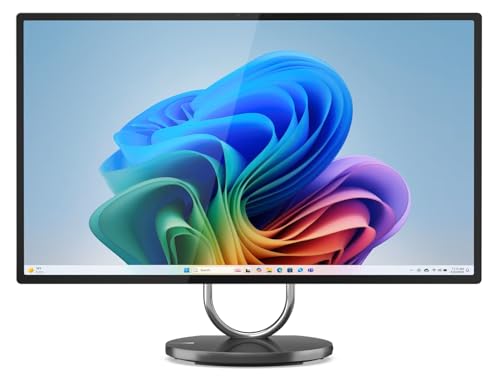
Lenovo Yoga AIO 32i, Core Ultra 7 258V, RTX 4050, 32GB, 1TB
Who it suits: Streamers who want the one all-in-one here with a real NVIDIA encoder — talk, creative and light-game broadcasts from a single big 4K desk, with a local recording running beside the stream.
Begin with the component no other pick in this guide has: an NVIDIA GeForce RTX 4050 laptop GPU with 6GB of GDDR6, and inside it a single Ada-generation NVENC encoder with AV1 encode support. For a streamer, that block is the purchase. OBS hands the broadcast to NVENC and the encode stops competing with everything else the machine is doing; the same silicon that renders your game also carries a hardware path for YouTube’s AV1 ingest, and the 6GB of dedicated video memory means OBS scenes, browser sources and the game are not all drinking from the system memory pool. Grade it honestly, though: this is a laptop card with one encoder block, so a broadcast and a high-bitrate local record share a single unit — entirely workable at Twitch’s bitrates, but not the dual-encoder arrangement of a desktop streaming card, and the card itself renders modern games at 1080p-class settings, not at the 4K of the panel behind it. Light and older games, esports titles and creative streams are its honest territory.
The simultaneous-load picture around the encoder is the best-balanced here. Intel’s Core Ultra 7 258V brings eight cores for the game, OBS’s scene compositing and the browser stack; the 32GB of LPDDR5X memory is the flagship standard and the right amount for a streaming desk; and the 1TB Gen4 SSD holds roughly fifty hours of high-quality local recordings before housekeeping begins. The presentation kit is built in: a 5MP IR webcam with Windows Hello, a 31.5-inch 4K UHD IPS screen large enough to hold the game, the OBS preview and chat in one glance, Wi-Fi 7 and Thunderbolt 4, a wireless keyboard and mouse in the box, and a 15W wireless charging pad in the base for the phone running your chat. Windows 11 Pro is installed. Check the live price on Amazon: this model sits comfortably inside this budget, and well under the premium positioning Lenovo attaches to the configuration. Judge the listing on specifications and Lenovo’s name; its Amazon feedback history is still young.
- The only NVENC encoder in this guide — Ada-generation, with AV1 encode, independent of the CPU.
- 32GB of memory and a 1TB SSD sized for a game, OBS, a browser stack and a local record at once.
- 31.5-inch 4K screen, 5MP IR webcam, Thunderbolt 4 and Windows 11 Pro in one cable-tidy package.
Honest limitation: A single laptop-class encoder block shared between broadcast and recording, gaming that tops out at 1080p-class settings, and 32GB of on-package memory that can never be upgraded — plus a standard warranty on this listing family of a one-year mail-in term.
Choose it if you stream games or creative work and want the only all-in-one here whose encoder is a discrete NVIDIA part. Skip it if your stream is talk-only — the HP below gives you a brighter screen for similar money — or if serious game streaming is the plan, which is a tower’s job at this budget.

HP OmniStudio X 32, Core Ultra 7 258V, 32GB, 1TB
Who it suits: Talk, tutorial, podcast and desktop streamers who want the best screen-and-camera desk in this guide and do not need a discrete GPU.
A talk stream is a picture of a person in front of a screen, and this pick is built for exactly that picture. The panel is a 31.5-inch 4K UHD IPS display rated at 550 nits — the brightest here — with HDR 600 support and 95% DCI-P3 coverage, so your preview, your slides and your own face on the confidence monitor all read clearly in a lit room. The camera is a 5MP IR unit with HP’s Poly Camera Pro tuning, the strongest Windows webcam in this guide, and the height-adjustable stand — a rarity among all-in-ones — lets you set the camera at eye level instead of broadcasting up your own nose, which does more for a talk stream’s look than any filter. An HDMI input means the panel can also serve as the display for a console or a laptop, and can outlive the computer inside it. Underneath, the Core Ultra 7 258V’s Intel Arc 140V integrated graphics carry Quick Sync hardware encoding, and that is the correct OBS setting on this machine: the encode runs on the media engine, the eight CPU cores stay free for your apps and browser stack, and AV1 encode is among the formats Intel’s Arc media engine handles for platforms that accept it.
The load math is flagship-grade: 32GB of memory for OBS, a browser full of dashboards and your working applications at once, and a 1TB SSD that holds local recordings at a sensible housekeeping rhythm. Check the live price on Amazon: this listing sits near the top of the verified band, and what the money buys is the screen, stand and camera rather than graphics. The seller caveat matters at this tier: this configuration’s Amazon listing has been third-party only at recent checks, so the name in the “sold by” line is a reseller, not HP or Amazon. That is not automatically a problem, but it makes the seller’s rating, the return window and the warranty path part of the purchase — check all three before you pay.
- 550-nit 4K IPS panel with HDR 600 and 95% DCI-P3 — the best stream canvas and preview screen here.
- 5MP IR camera with Poly Camera Pro tuning on a height-adjustable stand for proper framing.
- Quick Sync hardware encoding with 32GB of memory and a 1TB SSD behind it.
Honest limitation: Integrated graphics only — game streams are light titles at sensible settings — the memory is not upgradeable, and the Amazon listing is third-party sold, so the warranty path runs through the seller.
Choose it if your stream is your face, your voice and your desktop, and you want the best built-in version of all three. Skip it if you stream games seriously — that is the Lenovo above — or if a third-party seller at this price makes you uneasy.

Apple iMac 24-inch, M4, 24GB Unified Memory, 512GB SSD
Who it suits: Mac-based streamers — talk shows, podcasts, creative and desktop broadcasts — who want the best webcam in this guide and the quietest streaming desk money buys here.
The iMac’s streaming case rests on two Apple-built components. The first is the camera: a 12MP Center Stage unit that outclasses every Windows webcam in this guide and follows you as you move, which for a solo talk or podcast stream is the closest thing to a camera operator a built-in lens can be. The second is the M4’s media engine, which OBS on macOS uses as its hardware encoder for H.264 and HEVC — the broadcast runs on dedicated silicon, the 10-core CPU stays free for your applications, and the whole machine does it in silence, which matters more on a microphone than any specification: there is no fan noise to gate out of a quiet room. The 24GB of unified memory handles OBS, a browser stack and creative applications together without strain, the 24-inch 4.5K Retina display (4,480 × 2,520, 500 nits, P3 color) is the sharpest screen here per inch, and the Magic Keyboard with Touch ID is in the box. This configuration — model MD2U4LL/A, in Pink, with the same hardware sold in six other colors — is sold on Amazon by Apple itself — check the live price on Amazon: the cleanest transaction in this guide.
The limits are equally concrete, and a streamer feels two of them directly. The 512GB SSD is the smallest recording home here — at high-quality local-record rates it fills in roughly twenty-five hours of archived streams, so an external drive or a ruthless deletion habit is part of the purchase, costed in the kit section below rather than hidden. And game streaming is bounded by macOS rather than hardware: the M4’s graphics are strong, but the native Mac game library is limited, so the iMac’s game streams lean on Apple’s catalog and cloud services while its talk, desktop and console-capture streams are unrestricted. Memory and storage can never be changed, the stand tilts but does not adjust for height — budget a riser if the camera angle fights you — and ports are Thunderbolt/USB 4 only.
- 12MP Center Stage camera — the best built-in streaming webcam in this guide, with auto-framing.
- Apple media-engine hardware encoding and a silent chassis your microphone will thank you for.
- Sold by Apple on Amazon — check price on Amazon for the current figure.
Honest limitation: The smallest screen and storage here — 512GB fills fast with recordings — zero upgradeability, a tilt-only stand, and a game library limited by macOS rather than by the hardware.
Choose it if you stream talk, podcasts or creative work inside Apple’s ecosystem and want the desk that asks the least of you. Skip it if you stream Windows games, need terabytes of internal recording space, or want a big 31.5-inch canvas.
Dell 27 All-in-One, Core 7 150U, MX570A, 64GB, 4TB SSD
Who it suits: Streamers whose bottleneck is capacity — long local recordings, big clip archives, heavy multitasking — and who will trade screen sharpness to get it.
Read this pick the way its buyer should: a 27-inch Full HD touchscreen, Intel’s Core 7 150U, an NVIDIA GeForce MX570A graphics chip, and then the two numbers that dwarf everything else in this guide — 64GB of DDR5 memory and a 4TB SSD. For a streamer, that pairing solves the two quiet problems of the format. Sixty-four gigabytes means OBS, the game or desktop workload, a browser carrying chat, dashboards and music, and a recording pipeline all run at once without the machine ever swapping to disk mid-stream. Four terabytes means local recordings stop being a housekeeping chore: at high-quality archive rates that is on the order of two hundred hours of streams kept on the machine, plus the clip library and project files beside them. The 5MP webcam covers the camera requirement, Wi-Fi 6E and Windows 11 Pro are present, and a wireless keyboard and mouse are in the box. Check the live price on Amazon — this listing has consistently tracked inside this budget.
Now the streaming honesty, because this pick needs it most. Set the encoder correctly: the reliable hardware encoder in this machine is Intel Quick Sync from the Core 7 processor, and that is what OBS should use. The MX570A is an entry-level graphics chip — it drives the screen, video and light creative work, and this guide does not grade it as a streaming encoder or a gaming GPU, because it is neither. The processor underneath is efficiency-class rather than performance-class, so software x264 encoding is the wrong plan here; Quick Sync exists precisely so the CPU never has to carry the broadcast. The panel is the other trade: at 27 inches, 1,920 × 1,080 is the least sharp screen in this guide — though a streamer can note, fairly, that it matches a 1080p broadcast canvas pixel for pixel. And the transaction needs vetting: this is a marketplace listing in a reseller-upgraded configuration, since Dell’s factory specification for this model line tops out at 32GB, so a reseller fitted the larger parts and becomes your effective warranty counterparty for them. Check the seller’s history and exactly what their warranty covers before paying flagship money.
- 64GB of memory and a 4TB SSD — the simultaneous-load and recording-archive champion of this guide.
- Quick Sync hardware encoding, a 5MP webcam and Windows 11 Pro in the box.
- A marketplace listing that tracks inside this guide’s budget — check the live price on Amazon.
Honest limitation: A reseller-upgraded marketplace configuration — vet the seller and warranty — built on an efficiency-class CPU, an entry graphics chip that is not a streaming encoder, and a Full HD panel that is the least sharp here.
Choose it if recordings and multitasking are your bottleneck and you are comfortable buying an upgraded configuration from a rated marketplace seller. Skip it if you want a factory configuration with a manufacturer warranty, a 4K screen, or gaming graphics.

Lenovo Yoga AIO 27, Core Ultra 7 255H, 16GB, 1TB
Who it suits: Streamers who want the strongest processor in this guide and a high-refresh QHD desk, and who accept a fixed 16GB memory ceiling as the price of the value.
The streaming argument here is CPU. Intel’s Core Ultra 7 255H is a performance-class laptop processor — in raw CPU terms arguably the strongest chip in this guide — and CPU headroom is what a streaming desk spends: OBS scene compositing, the browser stack, chat bots and dashboards, and the game or application being broadcast all queue for it. This is also the one integrated-graphics pick with a credible software-encoding fallback: the correct OBS setting is still Quick Sync on its Intel Arc integrated graphics, which leaves the cores free, but if a platform or a filter chain ever pushes you to x264 at a fast preset, this is the machine that absorbs it best. The screen supports the work: a 27-inch QHD (2,560 × 1,440) IPS panel at 120Hz and 400 nits with 99% sRGB, on the most talented stand here — it tilts, swivels, lifts and pivots into portrait, which long-form chat and document streams genuinely use. An HDMI input lets the panel moonlight as a monitor for a console or laptop. This is the value pick of the guide — check the live price on Amazon — sitting far enough under this budget to leave real headroom for the microphone and lighting kit every streamer in this guide still needs.
The ceiling is memory, and for a streamer it is the sharpest ceiling in this guide. Sixteen gigabytes of LPDDR5X is soldered — permanent — and it is shared with the integrated graphics. A talk or desktop stream with a disciplined browser stack fits comfortably; a game plus OBS plus a browser full of tabs plus a recording is the workload that finds the limit. The webcam and speakers are good without matching the 32-inch flagships’ presentation kit. Buy this pick as the smart-money streaming desk — the strongest CPU, a high-refresh screen, the best stand, budget left over — with the memory compromise taken knowingly, not accidentally.
- Core Ultra 7 255H performance-class processor with Quick Sync encoding and the best x264 fallback here.
- 27-inch QHD IPS at 120Hz on a stand that tilts, swivels, lifts and pivots to portrait; HDMI input included.
- Priced far under this guide’s ceiling — check price on Amazon — leaving kit money free.
Honest limitation: 16GB of soldered memory, shared with the integrated graphics, is the tightest simultaneous-load ceiling in this guide and can never be raised.
Choose it if your streams are CPU-hungry — talk formats with heavy scene stacks, desktop and coding streams — and your memory discipline is good. Skip it if you know your streaming stack will outgrow 16GB; the 32GB flagships above exist for you.

HP OmniStudio X 32, Core Ultra 7 258V, 32GB, 1TB, Windows 11 Pro
Who it suits: Streamers whose machine is also a work computer under employer policy — and anyone who needs Windows 11 Pro on the best talk-streaming desk in this guide.
The hardware story is the second pick’s, retold for a different buyer: the same OmniStudio X 32, with its 31.5-inch 4K UHD IPS panel at 550 nits with HDR 600 and 95% DCI-P3, the Core Ultra 7 258V with Quick Sync hardware encoding through its Arc 140V integrated graphics, 32GB of memory, a 1TB SSD, Wi-Fi 7, the 5MP IR camera with Poly Camera Pro tuning, the height-adjustable stand and the HDMI input — in the Amazon listing that ships with Windows 11 Pro instead of Home. For a streamer, the streaming grade is identical to the Home listing’s: Quick Sync carries the broadcast, the camera and stand carry the picture, and the screen carries the preview. What Pro changes is the machine’s working life around the stream. BitLocker under company policy, Remote Desktop hosting, domain or Entra ID join and employer management tools are Pro features; if your employer has any say in this computer — or you stream from the same desk you work at, under policies that reach it — Home is often simply not an option, and this listing is not a duplicate of the pick above but the version of the flagship you are actually allowed to buy.
Two disciplines apply, and both are about the transaction rather than the silicon. First, price: we could not verify a stable price for this specific Pro listing, so check the live price on Amazon before judging it. The rule is to buy it only when its live Amazon price sits at or under $2,500 and within a sensible margin of the Home listing, since the hardware is identical and the operating system is the only difference. If the gap on the day you shop is wide, the smarter route is the Home machine plus Microsoft’s own Pro upgrade, bought separately. Second, seller: like the Home configuration, this listing’s availability runs through third-party sellers at times, so confirm the sold-by name, the warranty terms and the return window on the live page before you order.
- The 550-nit 4K HP flagship in its Windows 11 Pro form — BitLocker, Remote Desktop hosting and employer management included.
- Identical streaming hardware to the Home listing: Quick Sync encoding, 32GB, 1TB, 5MP IR camera.
- An HDMI input means the 31.5-inch panel can double as a display for a work laptop, not just for the computer behind it.
Honest limitation: The premium buys an operating-system edition rather than hardware, and since no stable price could be verified for this listing, the value question is answered entirely by the live price on the day you buy.
Choose it if your work requires Windows 11 Pro and you want it on the best big streaming desk in this guide. Skip it if Home covers your needs; the second pick in this guide is this same machine in its personal-use listing.

Comparison Table
| Product | Display | Stream encoder | Memory / Storage | Link |
|---|---|---|---|---|
| Lenovo Yoga AIO 32i | 31.5-inch 4K UHD IPS | NVENC (RTX 4050 laptop), AV1 encode | 32GB / 1TB | Check on Amazon |
| HP OmniStudio X 32 (Home) | 31.5-inch 4K IPS, 550 nits | Quick Sync (Arc 140V) | 32GB / 1TB | Check on Amazon |
| Apple iMac 24-inch M4 | 24-inch 4.5K Retina, 500 nits | Apple media engine (H.264/HEVC) | 24GB / 512GB | Check on Amazon |
| Dell 27 All-in-One (upgraded) | 27-inch FHD touch, 100Hz | Quick Sync (Core 7 150U) | 64GB / 4TB | Check on Amazon |
| Lenovo Yoga AIO 27 | 27-inch QHD IPS, 120Hz | Quick Sync (Intel Arc) | 16GB / 1TB | Check on Amazon |
| HP OmniStudio X 32 (Pro) | 31.5-inch 4K IPS, 550 nits | Quick Sync (Arc 140V) | 32GB / 1TB | Check on Amazon |
Set Up OBS Once, Correctly
Whatever pick you buy, the same half hour of setup decides whether the stream looks professional. Work through it once, in this order. Pick the hardware encoder first. On the Yoga AIO 32i, set OBS to NVENC. On the two HP listings, the Yoga 27 and the Dell, set it to Quick Sync. On the iMac, choose the Apple hardware encoder OBS offers on macOS. The single most common all-in-one streaming mistake is leaving OBS on software x264 encoding, which loads the very CPU cores your game and applications need — on every pick here except the Yoga 27, that one setting is the difference between a smooth stream and a struggling one. Set constant bitrate and a two-second keyframe interval. Around 6,000 kbps is Twitch’s practical ceiling for a 1080p broadcast; talk and desktop streams look clean well under it, and dropping to 720p at the higher frame rate serves fast game footage better than a starved 1080p on the integrated-graphics picks. Match the canvas to the content. Your screen is 4K or QHD; your broadcast is not. Run the OBS canvas at the resolution you actually output, so the machine is not scaling a 4K scene it never sends.
Then learn the three counters in OBS’s Stats window, because each one names a different problem with a different fix. Frames missed due to rendering lag mean the graphics side is overloaded: lower the game’s settings or output resolution, and cap the game’s frame rate so it stops taking resources the compositor needs. Skipped frames due to encoding lag mean the encoder is overloaded: confirm you are on the hardware encoder, step the output down from 1080p to 720p, and only then reach for faster presets. Dropped frames are the network, and no setting in OBS fixes them: lower the bitrate, and plug in an Ethernet cable. That last rule deserves emphasis in an all-in-one guide — every pick here has fast Wi-Fi, and every pick here should still stream over a wire. Wi-Fi is for the desk’s tidiness; the broadcast goes on the cable.
What $2,500 Does Not Include
Every pick in this guide includes its screen, webcam, speakers and a wireless keyboard and mouse, which is more of a streaming desk than a tower ever ships with. What none of them includes is the kit that makes a stream sound and look produced, and that kit is costed here — separately, never folded into a pick’s price. Buy the microphone first: a USB microphone — even an entry-level model — is the largest single quality jump available to any streamer in this guide, because every built-in microphone here is a meeting microphone, tuned for intelligibility on calls rather than for broadcast. Lighting comes second — a simple key light does more for your picture than any camera upgrade, including on the iMac’s excellent 12MP camera. An external webcam is an optional upgrade, not a requirement: all six picks have cameras, two of them genuinely good ones, so buy this only if you outgrow the built-in lens. Console streamers add a capture card — a name-brand USB model — since the all-in-one’s own screen cannot ingest a console’s signal into OBS by itself. A second screen for chat is the last extra: a phone or tablet you already own does the job free, and a small dedicated monitor is a comfort purchase, not a necessity. The realistic kit stays modest next to the machine itself, depending on the console question — money the Yoga 27’s under-budget positioning leaves in your pocket outright.
How to Choose an All-in-One PC for Streaming Under $2,500
- Name your stream before your machine. Talk, podcast and desktop formats are served by every pick here. Light game streaming narrows the field to the Yoga 32i first and the Quick Sync picks second. Demanding game streaming at high settings is not on this menu at any price — buy a tower.
- Choose the encoder, then the machine. NVENC (Yoga 32i) is the strongest streaming silicon here and the only discrete encoder. Quick Sync (both HP listings, Yoga 27, Dell) is the correct, low-cost workhorse. Apple’s media engine (iMac) is excellent inside macOS. Never plan a stream around the Dell’s entry graphics chip — its encoder is Quick Sync.
- Treat memory as a streaming specification. Streaming stacks — game, OBS, browser, recording — find memory ceilings that office work never does. Memory is soldered or on-package in nearly every design here, so 32GB is the buy-once number, 24GB works in the iMac’s efficient architecture, and 16GB (Yoga 27) is a compromise to take knowingly.
- Do the recording math. High-quality local records run around twenty gigabytes an hour. The iMac’s 512GB is a workflow, the 1TB flagships are a rhythm, and the Dell’s 4TB is an archive. Pick the storage your retention habit actually needs.
- Grade the camera and stand together. A streamer’s face is the product on a talk format. The iMac’s 12MP Center Stage leads, the HP’s 5MP camera on a height-adjustable stand is the best Windows framing, and a tilt-only stand at the wrong height is a daily tax — or a riser purchase.
- Check who is selling it — every time. Listings at this tier divide three ways: manufacturer-sold (Apple), Amazon-sold, and third-party or reseller-upgraded configurations (the Dell outright, the HP listings at times). A reseller upgrade can be good value, but when you buy one, the seller’s rating, history and warranty terms become part of the product you are actually purchasing. Read all three.
- Hold back the kit money. Microphone, light and possibly a capture card are not in any box here. A machine that leaves headroom in this budget, plus a proper microphone and light, out-streams a pricier machine with a built-in microphone every time.
- Wire the broadcast. Every pick has fast Wi-Fi and every pick should stream over Ethernet. Run the cable before your first stream, not after your first dropped-frame investigation.
- Think about the screen’s second life. An HDMI input — fitted to the HP flagships and the Yoga 27 — lets the panel keep working as a display for a laptop, console or mini PC after the computer inside it ages out. The iMac and the Yoga 32i offer no such path. Across a six-year ownership, that one port quietly extends what the purchase is worth.
- Keep the box and the receipt. Flagship all-in-ones ship as one large, fragile unit. Keep the packaging until you are sure the panel is perfect — dead pixels and backlight flaws are exactly what the first week’s return window is for.
Common Buying Mistakes
- Assuming a 4K screen means a 4K stream. It does not: broadcasts here are 1080p or 720p, set by the encoder and the platform, not by the panel. Buy the 4K screen for your eyes, not your audience’s.
- Leaving OBS on software x264 encoding when a hardware encoder is sitting idle in the machine. On integrated-graphics picks, that single setting causes most “my all-in-one can’t stream” stories.
- Streaming over Wi-Fi because the desk looks cleaner. Dropped frames are uglier than a cable. Wire it.
- Buying 16GB of soldered memory to save money on a streaming machine you plan to keep for six years. The saving is real; so is the ceiling, and streaming stacks reach it sooner than office work does.
- Handing over flagship money for a reseller’s capacity upgrade before checking who the seller is and who warranties the parts they fitted.
- Treating the Dell’s MX570A as a gaming or encoding GPU. It is an entry display chip; the Dell streams on Quick Sync and games lightly, whatever the graphics line in the listing implies.
- Spending the whole budget on the machine and streaming through a built-in meeting microphone. The microphone is the stream, for most formats — fund it first.
- Choosing by screen size alone. A 31.5-inch 4K panel and a 27-inch Full HD panel are different products that happen to share a category; resolution, brightness and the encoder matter as much as inches.
- Ending up with Windows 11 Home on a machine your employer’s policies require to run Pro — or, at the other extreme, paying a large premium for a Pro listing when the Home version plus Microsoft’s own upgrade would have cost less.
Final Recommendation
- Most streamers at this budget: Lenovo Yoga AIO 32i — the only NVENC encoder here.
- Talk and desktop streams: HP OmniStudio X 32 (Home) — screen, camera and stand.
- Apple households: Apple iMac 24-inch M4, 24GB, 512GB — the best webcam in the guide.
- Recording-heavy streamers: Dell 27 All-in-One, 64GB, 4TB — from a vetted seller.
- Best value: Lenovo Yoga AIO 27 — kit money left over, memory ceiling noted.
- Work-mandated Windows 11 Pro: HP OmniStudio X 32 (Pro) — only at a live price under $2,500.
Our top two for streaming are the Yoga AIO 32i, because it is the only machine here whose broadcast runs on a discrete NVIDIA encoder — big 4K screen, 32GB of memory, Windows 11 Pro — and the OmniStudio X 32, because its brighter panel, tuned 5MP camera and height-adjustable stand make it the better talk-streaming instrument when the encoder contest is settled by Quick Sync on both sides. The iMac is the right answer for the Apple question and owns the best webcam here outright. Streamers whose real bottleneck is recording space should look hard at the Dell, with the seller checks done; streamers on a smarter budget should take the Yoga 27 and spend the savings on the microphone and light. If your ambitions outgrow what any all-in-one can encode — demanding games, high settings, a broadcast and a high-bitrate record at once — the honest next step is a dedicated machine from Best Streaming PC Under $2500, and if the budget itself is the constraint, Best All In One PC For Streaming Under $1500 covers this same format a tier down. Before you order, read the sold-by line and the live price as carefully as the specification sheet — at this tier, they are part of the product too.
Frequently Asked Questions
Can an all-in-one really stream, or do I need a tower?
It can really stream the formats this guide is built around: talk shows, podcasts, desktop and creative work, light games, and console play through a capture card — at 1080p or 720p with a hardware encoder doing the work. What it cannot do is the tower’s signature trick of running a demanding modern game at high settings while encoding a broadcast and a high-bitrate local record simultaneously. If that is your format, Best Streaming PC Under $2500 is the right guide; if it is not, an all-in-one is a legitimate one-box streaming desk.
Which encoder should I actually use in OBS on these machines?
The hardware one, on every pick. NVENC on the Yoga AIO 32i, Quick Sync on the two HP listings, the Yoga 27 and the Dell, and Apple’s hardware encoder on the iMac. Software x264 encoding spends the CPU cores your game, applications and browser stack need, and on the integrated-graphics picks it is the difference between a clean stream and encoding lag. The Dell deserves a specific note: choose Quick Sync there too — its MX570A is an entry display chip, not the machine’s streaming encoder.
Should I stream at 1080p or 720p from an all-in-one?
Match the output to the content and the encoder. Talk, podcast and desktop streams look their best at 1080p and are undemanding to encode, so every pick here handles them. Fast-moving game footage on the integrated-graphics picks is better served at 720p with the higher frame rate than at a bitrate-starved 1080p — and remember Twitch’s practical ceiling is around 6,000 kbps regardless, so resolution you cannot feed with bitrate is resolution your viewers never receive.
Do I need a capture card to stream console games?
Yes, if the console is the source: a USB capture card (a name-brand USB model) takes the console’s HDMI signal and hands it to OBS, and any pick here can run that broadcast comfortably. Note the distinction the listings blur — the HDMI input on the HP flagships and the Yoga 27 lets those screens display a console directly, which is a fine way to play, but it does not put the console’s picture inside OBS. Playing on the panel and streaming the console are two different signal paths, and only the capture card serves the second one.
Is 16GB of memory enough for streaming on the Yoga AIO 27?
For a disciplined talk or desktop stream, yes — with the honest boundary that it is soldered, shared with the integrated graphics, and cannot ever be raised. A game, OBS, a browser carrying chat and dashboards, and a local recording at once is the stack that presses it. Streamers who know their setup is heavy should buy the 32GB flagships instead; streamers who keep a lean browser and a talk format can take the Yoga 27’s value with confidence. The general treatment of this tier without the streaming lens is in Best All In One PC Under $2500.
Can I upgrade the memory or storage later?
For memory, plan on no: the Lenovo and Apple picks carry it soldered or on the processor package, and the HP flagships treat it as fixed in practice. Storage is sometimes serviceable in Windows all-in-ones but rarely user-friendly, and opening a reseller-sealed machine like the Dell can complicate its warranty. The correct strategy at this tier is to buy the memory and storage you will need in year five — which is why this guide weights 32GB, and treats external SSDs as the expansion path for recording archives.
Mac or Windows — which is better for a streaming all-in-one?
By format and ecosystem, not by specifications. The iMac gives you the best camera, a silent desk and Apple’s media engine, and OBS on macOS is fully capable — but its game streaming is bounded by the Mac library and cloud services. The Windows picks run the full PC game and software catalog, and the Yoga 32i adds the guide’s only NVENC encoder. Talk and podcast streamers in Apple’s ecosystem should buy the iMac without hesitation; game streamers should buy Windows, and serious game streamers should buy a tower. Beginners weighing the whole category will find the plain-language version in Best All In One PC For Beginners Under $2500.


