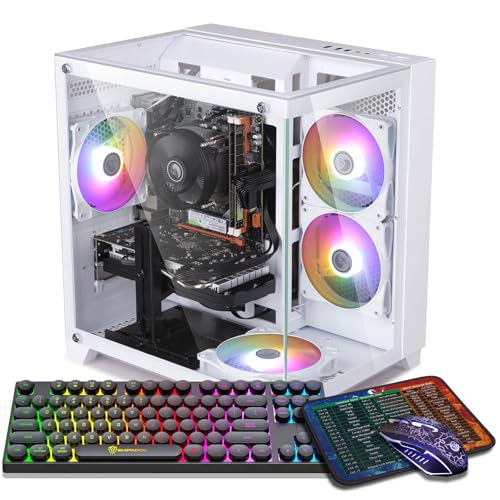
Where to buy
Check the latest price, availability and delivery on Amazon. Orders are placed on Amazon. We may earn a commission from qualifying purchases.
- Best true 1440p pick: ZER-LON Gaming PC, Ryzen 5 5500, RTX 4060 8GB — Check on Amazon
- STGAubron Gaming PC, Ryzen 5 5500, RTX 3060 12GB — Check on Amazon
- GMKtec K6 Mini PC, Ryzen 7 7840HS, Radeon 780M — Check on Amazon
- LXZ Gaming PC, Ryzen 5 5500, RTX 3050 8GB, 32GB RAM — Check on Amazon
See 2 more Amazon options
- STGAubron Gaming PC, Ryzen 5 5500, RTX 3050 6GB, White — Check on Amazon
- ZOTAC MEK Gaming PC, Ryzen 5 5500, RTX 3050, 650W Gold PSU — Check on Amazon
Read the full guide ↓
Disclosure: As an Amazon Associate, reviewstook.com earns from qualifying purchases. Links to Amazon on this page are affiliate links; they cost you nothing extra. Listing details such as price and availability change often, so check the current Amazon listing before you buy.
This search contains a quiet contradiction, and it is worth decoding before any money moves. The machines sold under the “4K gaming PC” label at this price are not native 4K machines — nothing at $700 is — but that is not actually the question most people typing this search are asking. The realistic version goes like this: you have, or are about to buy, a 1440p monitor. You are shopping the shelf of PCs that wear a “4K” badge because that shelf is where the stronger budget machines sit. And you want to know which of them will genuinely play games at 1440p — your panel’s resolution — rather than merely light it up. That is the question this guide answers, machine by machine, with the render resolution of every pick stated in plain terms.
So here is the honest core, before a single product name: at $700, native 1440p in demanding modern games is still mostly out of reach — but it is closer than the headline suggests. Two of the six picks below carry discrete GPUs that are honestly 1440p-class: they render many games natively at 2560×1440, and in heavier titles they render slightly below the panel and reconstruct upward. The other four are 1080p-class machines wearing the 4K shelf label, whose working recipe is upscaling: render lower, and let DLSS or FSR rebuild the frame to fill all 3,686,400 pixels of your screen. That distinction — the resolution your monitor displays versus the resolution your GPU actually renders — is the most important idea in this article, because every listing on this shelf blurs it on purpose.
The numbers behind the recipe are simple. When DLSS or FSR runs in Quality mode at a 1440p output, the game renders internally at roughly 1707×960 and the upscaler reconstructs the rest; drop to Performance mode and the render falls to 1280×720. A card that can render 1707×960 well is therefore a convincing 1440p card in practice — and a good Quality-mode reconstruction is difficult to tell from native in motion at a normal desk distance. Lighter and competitive titles are the honest exception to the budget’s limits: esports games are built to run on modest hardware, and several picks here can render them at or near native 1440p at reduced settings, no upscaling required. What $700 will not do — on any pick, from any brand — is native 1440p at high or ultra settings across this year’s heaviest releases. If that is the job you actually need done, the honest budget sits higher, and this guide points you at those tiers rather than pretend a $700 tower does it. Prices on this shelf also change often, so this is a buy at or under $700 list in budget terms: check price on Amazon for every pick before you buy, and treat a listing that no longer fits this budget tier as a different deal than the one reviewed.
In this guide
Quick Picks
Short on time, or comparing several options at once? Each row below names a buyer type and the product that suits it, with a link to the listing.
| Buyer type | Pick | Why it stands out | Link |
|---|---|---|---|
| Best true 1440p pick | ZER-LON Gaming PC, RTX 4060 8GB | A genuinely 1440p-class GPU, plus DLSS 3 Frame Generation for the heavy titles | Check on Amazon |
| Best for 1440p textures | STGAubron Gaming PC, RTX 3060 12GB | 12GB of VRAM keeps texture quality high at a 1440p output | Check on Amazon |
| Best small box for a 1440p desk | GMKtec K6 Mini PC, Radeon 780M | The strongest integrated graphics here; renders 1080p-class, FSR fills the panel | Check on Amazon |
| Best memory headroom | LXZ Gaming PC, RTX 3050 8GB, 32GB RAM | 32GB of system RAM and the 8GB cut of the 3050 for smoother multitasking | Check on Amazon |
| Best budget floor | STGAubron Gaming PC, RTX 3050 6GB, White | Positioned at the lowest end of this tier — check price on Amazon; the most budget-focused route onto a 1440p panel | Check on Amazon |
| Best upgrade base | ZOTAC MEK Gaming PC, RTX 3050 | 650W 80+ Gold PSU, ready for the stronger GPU that makes 1440p native everywhere | Check on Amazon |
How These Picks Were Chosen
Two filters decided this list, and the second one removed most of the shelf. The first was the budget itself, applied as a ceiling: a machine only qualifies if it belongs in the under-$700 tier — check price on Amazon to confirm it still fits that budget when you shop. The second filter was the question this search really asks: what does this machine actually render on its way to a 1440p screen? Towers built around older cards with no modern upscaling — the GTX 1660 Super and RX 580 generation — failed that test: on a 1440p panel they offer only a native render they cannot sustain in modern games, or a plain stretched 1080p image with no reconstruction to sharpen it. Integrated graphics older than the Radeon 780M failed from the other direction: they can display a 1440p desktop all day, but the games underneath the desktop would run at renders so low that a cheaper 1080p monitor would have shown them better. What survived is a short list with a clear internal ladder: two discrete GPUs that genuinely work at or near 1440p, the best integrated GPU AMD currently sells, and three entry-level RTX towers whose honest job is a 1080p-class render, upscaled well.
We did not use these PCs ourselves. We read the maker listings and specification pages and weighed the things that decide 1440p play specifically: the GPU’s rendering class, its VRAM capacity, the upscaling generation it supports, the CPU behind it, system memory, storage, and the power supply a future upgrade would inherit. VRAM deserves its own sentence here, because buyers consistently underrate it at this resolution. Games size their texture pools against the output resolution, so a PC feeding a 1440p panel feels more memory pressure than the same PC on a 1080p screen — even when the internal render is lower than the panel. That is why the older RTX 3060 with 12GB places so high in a 1440p guide despite its age: texture quality is the setting you see most on a sharp panel, and it is the first thing a small VRAM buffer forces you to surrender.
On prices, the approach is simple: this guide does not print a fixed price for any pick, because listing prices change often. For every pick with an Amazon link, check the current price on Amazon before you buy, confirm the exact configuration in the cart, and treat a listing that no longer fits the under-$700 budget as a different deal from the one reviewed. Two picks sit at the top end of this tier and deserve that check most carefully; others sit lower in the tier as a matter of positioning. One platform note applies to five of the six picks: they are built on AMD’s AM4 socket around the Ryzen 5 5500, a capable six-core processor that will not hold back any GPU here, but a socket at the end of its road — a future CPU upgrade beyond its generation means a new motherboard and memory as well. The mini PC, by its nature, upgrades its RAM and storage only. Buy any of these for what it renders on day one, plus a GPU swap where the case and power supply allow.
The 6 Best PCs for 1440p Gaming From the “4K” Shelf Under $700
ZER-LON Gaming PC, Ryzen 5 5500, RTX 4060 8GB, 16GB DDR4, 1TB NVMe SSD
Who it suits: The 1440p monitor owner who wants the real thing — native or near-native 1440p rendering in as many games as $700 can possibly cover — and is willing to check price on Amazon carefully to confirm it fits this budget tier.
This is the only pick in the guide whose GPU was designed with 1440p in its sights, and that fact shapes everything about the recommendation. The RTX 4060 renders modern games natively at 2560×1440 at high settings in a large share of the current library — not the heaviest handful of releases, but the broad middle of it — and where native gets heavy, its toolkit takes over gracefully. DLSS Super Resolution in Quality mode lowers the internal render to roughly 1707×960 and reconstructs a 1440p image that, in motion at desk distance, most players cannot separate from a native frame; that mode is this card’s heavy-game default. Beyond that, the 4060 is the only card here with DLSS 3 Frame Generation, which inserts generated frames between rendered ones to lift perceived smoothness in supported titles. Its terms deserve stating plainly: frame generation polishes a playable base rate, it does not manufacture one, and it adds a measure of input latency that competitive players may prefer to avoid. Used in its proper place — Quality mode first, frame generation second, in the single-player games where the base rate sits in the playable-but-not-smooth band — it extends this card’s 1440p reach further than anything else at the budget.
The platform around the card is the sensible specification for the class: a Ryzen 5 5500 six-core that will not bottleneck a 4060, 16GB of DDR4, a 1TB NVMe SSD, WiFi 5, four RGB fans and Windows 11 Home in a white tower. Two limits frame the pick honestly. The first is VRAM: 8GB is workable at 1440p but not generous, and in the most texture-hungry recent games you may be asked to trade texture quality from ultra to high to stay comfortably inside the buffer — the one compromise upscaling cannot reconstruct away, and the entire reason the 12GB card below earns its place. The second limit is its position in the tier. This configuration sits at the top end of this budget band, so its fit for this guide depends on the live listing: check price on Amazon and confirm it fits the under-$700 budget before you commit. When it fits that budget, it is the strongest 1440p machine in this article by a clear margin; when the current price pushes it into a higher tier, the value case changes and the next pick deserves a fresh look.
- RTX 4060 8GB — the only genuinely 1440p-class GPU here, with DLSS Super Resolution on board.
- DLSS 3 Frame Generation, unique in this guide, for smoothing heavy single-player titles.
- A balanced platform around the card: Ryzen 5 5500, 16GB DDR4, 1TB NVMe SSD, Windows 11 Home.
Honest limitation: 8GB of VRAM asks for a texture compromise in the heaviest games, and this pick sits at the top end of the tier — check price on Amazon and only treat it as an under-$700 pick when the current listing fits that budget.
Choose it if 1440p is your panel and your priority, your library is the broad middle of modern releases, and you can wait for the sale. Skip it if you check price on Amazon and the current listing no longer fits this budget tier, or your games are the texture-heaviest open worlds and you refuse to touch the texture slider — the next pick was chosen for exactly that refusal.

STGAubron Gaming PC, Ryzen 5 5500, RTX 3060 12GB, 16GB DDR4, 1TB SSD
Who it suits: Players of open worlds, big RPGs and modded games, who would rather hold texture quality high at 1440p and let the render resolution flex downward than protect the pixel count and watch surfaces turn to mud.
No other discrete card in this guide offers more than 8GB of VRAM. This one carries 12GB, and on a 1440p panel that gap stops being a trivia point and becomes the daily experience. Games allocate texture pools against the output resolution, so a 1440p screen draws more memory than a 1080p screen running the same internal render — and when the buffer runs short, the symptoms are not a graceful frame-rate dip but stutter, pop-in, and textures that arrive late or never fully resolve. The RTX 3060 12GB was the generous oddity of its generation, and in a 1440p guide that generosity is the argument: it holds high textures in games where the 4060 above must concede them, and on a sharp panel at desk distance, texture quality is most of what “this looks like a high-resolution game” actually means. Its realistic envelope is native 1440p at medium-to-high settings across a wide stretch of recent games, stepping down to DLSS Quality — that same roughly 1707×960 internal render, reconstructed — in the heaviest current titles.
The trades are just as clear, and this review will not blur them. The 3060 is a generation behind: raw rendering a step below the 4060, DLSS without Frame Generation, and ray tracing best treated as an occasional light effect rather than a setting to build a preset around. The surrounding specification is generous for the class: the same Ryzen 5 5500, 16GB of DDR4, a full 1TB SSD, WiFi 6 and Bluetooth 5.2, four RGB fans, and an RGB keyboard and mouse in the box, with a one-year warranty stated in the listing data. Its positioning in this guide is at the top end of the tier, close to the budget line. The discipline follows automatically: check price on Amazon, and when the current listing fits the under-$700 budget this is the texture-first 1440p pick; when it sits in a higher tier, the case weakens and waiting or stepping up deserves consideration.
- 12GB of GDDR6 VRAM — the only pick that holds high 1440p texture pools without flinching.
- Native 1440p at medium-to-high settings in much of the recent library; DLSS Quality for the rest.
- A complete package: 1TB SSD, WiFi 6, Bluetooth 5.2, plus RGB keyboard and mouse in the box.
Honest limitation: No Frame Generation, weaker ray tracing and a step less raw speed than the 4060 — and it only makes sense when you check price on Amazon and the current listing fits this under-$700 tier.
Choose it if your library leans open-world and story-driven, you sit close enough to a 1440p panel to see texture detail, and stutter bothers you more than a modest frame-rate gap. Skip it if you chase high frame rates in competitive titles, want frame generation, or you check price on Amazon and the current listing pushes it out of this budget tier.

GMKtec K6 Mini PC, Ryzen 7 7840HS, Radeon 780M, 32GB DDR5, 1TB SSD
Who it suits: The buyer whose 1440p monitor shares a desk with work, media and lighter gaming — and who would rather have a four-inch box that vanishes behind the screen than a glowing tower under it.
Start by separating this pick’s two jobs, because it does one perfectly and the other honestly. Displaying 1440p is effortless: the Radeon 780M drives a crisp 2560×1440 desktop, video and interface natively, over HDMI, DisplayPort or USB-C, with triple-display support in the listing. Rendering games at 1440p is where the terms get set. The 780M — twelve RDNA 3 compute units integrated into the Ryzen 7 7840HS — is the strongest integrated graphics in this guide by a wide margin, and its honest class is 1080p: esports and older titles at native 1080p with good settings, modern AAA at 1080p low-to-medium, with FSR then carrying the result up to your 1440p panel. FSR Quality at a 1440p output renders at roughly 1707×960 internally, which is within this iGPU’s reach in lighter games; in heavier ones the working modes are FSR Balanced and Performance, rendering at or below 1080p. The lightest competitive titles can also run at native 1440p at low settings. What this box will not do is native 1440p in current demanding releases — no integrated GPU at any price does that yet, and a guide that implied otherwise would be inventing a product category.
As a computer in its own right, the K6 is in some respects the best-specified pick here: an eight-core Ryzen 7 7840HS that outmuscles the Ryzen 5 5500 in the towers, a full 32GB of dual-channel DDR5 — doubly important because the iGPU shares system memory and its bandwidth, and dual-channel DDR5 is precisely what lets a 780M breathe — a 1TB PCIe 4.0 SSD with a second slot, dual 2.5GbE LAN, WiFi 6E, Bluetooth 5.2, USB4 and Windows 11 Pro, in a chassis roughly four inches square. Its positioning fits the budget without drama: it sits comfortably inside this tier rather than at its top edge — check price on Amazon to confirm the current listing before you buy. The limits are the nature of the form. There is no discrete GPU inside this box and there never will be; sustained gaming loads in a tiny chassis mean an audible fan; and support comes from a smaller brand than the tower makers. The exchange is a machine that disappears into a desk setup and plays the enormous share of most libraries — esports, indies, the backlog — on a 1440p screen without apology. If your gaming is the heaviest current releases at a close monitor, the discrete cards above are the honest tools; if your screen time is mixed, this is the pick that fits the room it will actually live in.
- Radeon 780M — the strongest integrated graphics here; native 1440p desktop, FSR-upscaled gaming.
- The strongest CPU and memory in the guide: 8-core 7840HS, 32GB dual-channel DDR5, 1TB PCIe 4.0 SSD.
- Four-inch footprint, USB4, dual 2.5GbE, WiFi 6E — a complete desk and media computer.
Honest limitation: Games render at 1080p-class and upscale — native 1440p belongs to lighter titles only, and there is no GPU upgrade path inside the box.
Choose it if your desk mixes work and play, your library leans esports, indies and older AAA, and a tower’s size and noise are real costs to you. Skip it if current heavy releases at high settings are the point of the purchase — that job starts with the two discrete cards at the top of this guide.

LXZ Gaming PC, Ryzen 5 5500, RTX 3050 8GB, 32GB DDR4, 1TB NVMe SSD, White
Who it suits: The multitasker — a game on the 1440p screen, a browser, chat and a recording or stream running beside it — whose current machine hitches not in the game but around it.
The RTX 3050 is a 1080p-class card, and this guide will not promote it beyond that. On a 1440p panel its working arrangement is an internal render at 1080p or below, reconstructed by DLSS to fill the screen: DLSS Quality, rendering around 1707×960, is a realistic mode for lighter and older titles on this card, and Performance — a 1280×720 render — is the honest mode for current heavy ones, at low-to-medium settings. Within that envelope, this particular tower is specified more thoughtfully than most of its tier. It carries the 8GB version of the 3050 rather than the cut-down 6GB, a distinction that matters at a 1440p output where texture pools are sized for the larger screen, and it pairs the card with 32GB of DDR4 system memory — double every other tower in this guide. That memory does not add one frame to the render, and this review will not pretend otherwise. What it removes is the other species of stutter: the hitch when a game, twenty browser tabs, a chat client and a capture tool together exceed 16GB and the system starts swapping to disk mid-session. On a machine whose job is feeding a big screen while other things happen on it, that smoothness is a real, daily quality — and it is this pick’s entire identity.
Two cautions attach to this listing specifically, both visible in its own listing family. First, the wider LXZ line also includes a lower 6GB/16GB configuration. Do not mistake that lesser configuration for this 32GB machine, and do not accept the lesser configuration in the cart when you intended to buy this one — check price on Amazon only after you have confirmed the style name matches this configuration. Second, this listing family’s pages mix variant information between tiles that look identical, so the discipline that applies to every pick here applies twice: on the live listing, confirm the style name reads RTX 3050 8GB and 32GB of RAM before paying. Verified that way, this is the 3050 pick for the buyer whose bottleneck is everything surrounding the game.
- The 8GB RTX 3050 — the VRAM-safer version of the card for a 1440p output.
- 32GB of DDR4 system memory — twice what any other tower here carries.
- DLSS upscaling on board, a 1TB NVMe SSD and a clean white case.
Honest limitation: The GPU remains a 1080p-class card — the memory headroom smooths the system around the game, not the render inside it, and the listing’s variants demand a careful check.
Choose it if you game with a stream, browser and chat open together, and want the 3050 tier without the 6GB compromise. Skip it if gaming is all the machine will ever do — a 3060 or 4060 tier pick spends the budget on frames instead of headroom; check price on Amazon for those picks to compare them within their tiers.

STGAubron Gaming PC, Ryzen 5 5500, RTX 3050 6GB, 16GB DDR4, 1TB SSD, White
Who it suits: The budget-first buyer whose hours go to competitive and lighter games, and who would rather stay at the lower end of the budget than buy a GPU tier their library will never touch.
This is the floor of the guide, and it is positioned like one: it sits at the lower end of this tier, well inside the budget line rather than at its top edge — check price on Amazon to confirm the current listing before you buy. What the money buys is a complete modern tower — Ryzen 5 5500, 16GB of DDR4, a 1TB SSD, WiFi 6, six RGB fans, and an RGB keyboard and mouse in the box, in white — built around the 6GB version of the RTX 3050. The review’s job is to be exact about that card on a 1440p panel. Its home territory is the games most people actually log their hours in: competitive and lighter titles, where the lightest of them can run at native 1440p at low-to-medium settings and the rest render at 1080p and present at 1440p through DLSS or the game’s own scaler — clean results at comfortable frame rates. Older AAA at a 1080p render with DLSS Quality or Balanced reconstruction is the second territory, and a perfectly comfortable one at desk distance.
The boundary is current heavy AAA, and it is a firm one. Six gigabytes is the tightest VRAM buffer in this guide, and at a 1440p output the texture pressure described earlier arrives early: expect low textures in the newest releases, internal renders at or below 1080p with DLSS Performance doing the lifting, and a settings menu that needs ten honest minutes before a big new game feels right. That does not make it a bad purchase — it makes it a purchase with a defined scope. The buyer whose library is competitive titles, Minecraft, Rocket League, a backlog of pre-2022 AAA and indie games is buying exactly enough computer: a real RTX card with DLSS, an upgradeable case, and money left over for the monitor arm or second drive. The buyer who wants this year’s flagship releases rendered properly at 1440p should hear this guide plainly: that job belongs to the picks above, or to the higher tiers linked at the end. A PC bought twice is the most expensive PC of all, and this pick counts as a bargain only against the library it can genuinely serve.
- The lowest-positioned pick in this tier — check price on Amazon for the current listing.
- A complete white tower: 1TB SSD, WiFi 6, six RGB fans, keyboard and mouse in the box.
- A genuine RTX card with DLSS — esports render natively or near it, everything else upscales cleanly.
Honest limitation: 6GB of VRAM and a 1080p-class GPU: current AAA means low textures and sub-1080p internal renders — the tightest ceiling in this guide.
Choose it if your hours go to esports, older and lighter games, and you want the most budget-focused route onto a 1440p panel — check price on Amazon to confirm it. Skip it if you buy new AAA releases at launch — this is the one pick that will have you shopping again within a year.

ZOTAC MEK Gaming PC, Ryzen 5 5500, RTX 3050, 16GB DDR4, 500GB NVMe SSD
Who it suits: The buyer thinking one purchase ahead — someone who wants a sound tower from a known graphics brand today, and a power supply that lets a much stronger GPU drop straight in when native 1440p everywhere becomes the goal.
ZOTAC is a name this shelf does not usually offer at this tier: a long-established graphics-card maker selling a complete PC, and the specification shows a builder’s priorities in the one place the no-name towers most often cut — the power supply. This MEK carries a 650W 80+ Gold PSU, where rivals in the class routinely ship unnamed units of lower wattage with no stated efficiency rating. Under today’s RTX 3050 the difference is invisible. The day you upgrade — and a tower bought for a 1440p screen is a tower that will eventually want the card that renders 1440p natively in everything — the Gold-rated 650W unit is the difference between a simple GPU swap and a GPU-plus-PSU-plus-rewire project. The machine that makes that step cheapest has a genuine claim on your money, and it is this one.
For today, the terms are the 3050 terms stated above and they are not softened here: a 1080p-class render, DLSS reconstruction up to the 1440p panel, low-to-medium settings in current games, comfortable esports and older titles — with one deliberate omission in this review that mirrors the listing itself. ZOTAC’s listing data does not make the card’s VRAM figure as plain as its rivals do, and specification material for the MEK line points to the 6GB version of the 3050; this guide does not print a VRAM number it could not verify from the listing, and you should confirm it on the live page before buying, setting your texture expectations for the tighter buffer if that is what you find. The rest of the specification is the leanest here in one respect: storage is 500GB rather than 1TB, alongside 16GB of DDR4, the Ryzen 5 5500 and WiFi 6E — the fastest wireless in this guide. Five hundred gigabytes fills quickly at modern install sizes, so budget for a larger second drive in the plan from the start. For this pick, check price on Amazon and confirm the VRAM on the live listing at the same time: when the current listing fits the under-$700 budget and the configuration is confirmed, it is the upgrade-minded buyer’s pick; when it sits in a higher tier, it is not.
- A 650W 80+ Gold power supply — the sole unit here already sized for a serious GPU upgrade.
- From ZOTAC, an established graphics brand, with WiFi 6E on board.
- Standard tower platform: the cheapest route from this guide to a future native-1440p card.
Honest limitation: The GPU fitted today is the same 1080p-class 3050 as the cheaper picks, storage stops at 500GB, and the card’s VRAM figure needs confirming on the live listing.
Choose it if a GPU upgrade is already in your future plans and you want the PSU and the brand behind you when you make it. Skip it if the case will never be opened — the STGAubron above delivers the same class of gaming today, sits lower in the tier and offers twice the storage; check price on Amazon for both to compare.

Comparison Table
| Product | GPU | VRAM | What it really does at 1440p | Link |
|---|---|---|---|---|
| ZER-LON Gaming PC | RTX 4060 | 8GB | Native 1440p in much of the library; DLSS Quality + Frame Generation for the heaviest | Check on Amazon |
| STGAubron Gaming PC (3060) | RTX 3060 | 12GB | Native 1440p medium-high with high textures; DLSS Quality in current heavy titles | Check on Amazon |
| GMKtec K6 Mini PC | Radeon 780M (integrated) | Shared DDR5 | Native 1440p desktop; games render 1080p-class, FSR fills the panel | Check on Amazon |
| LXZ Gaming PC | RTX 3050 | 8GB | Renders 1080p-class, DLSS to 1440p; 32GB RAM for heavy multitasking | Check on Amazon |
| STGAubron Gaming PC (3050) | RTX 3050 | 6GB | Esports native or near-native at low settings; the rest upscaled from 1080p or below | Check on Amazon |
| ZOTAC MEK Gaming PC | RTX 3050 | Confirm on listing | Same 1080p-class render today; 650W Gold PSU makes it the upgrade base | Check on Amazon |
How to Choose a PC for 1440p Gaming Under $700
- Separate the panel from the render. Your monitor displays 2560×1440 no matter what you feed it. The question is what the GPU renders before the image is scaled or reconstructed to fill those pixels. Judge every PC — in this guide and everywhere else — by the render it can hold in your games, never by the output number printed on the box.
- Learn the 1440p ladder. At a 1440p output, DLSS and FSR Quality render internally at roughly 1707×960; Performance renders at 1280×720. Quality is the mode where reconstruction is closest to native and the working default for the two top picks; Performance is the working mode for the 1080p-class picks in heavy games. When a guide or listing says a budget PC “does 1440p,” ask which rung it means.
- Match the GPU to the rung. RTX 4060: native 1440p in much of the library, Quality where native gets heavy. RTX 3060 12GB: native at medium-high with superior texture headroom, Quality in the newest releases. RTX 3050 and the Radeon 780M: a 1080p-class render is the plan — Quality reconstruction in lighter games, Performance in heavy ones, native reserved for esports at reduced settings.
- Count VRAM for the output, not the render. Texture pools scale with the 1440p panel even when the 3D render is lower, which is why 12GB and 8GB cards sit above 6GB cards here. On a small-buffer card, texture quality is the first setting to lower when a game stutters.
- Know your upscaling generation. DLSS on RTX hardware is the sharpest reconstruction available at this budget, and the 4060 adds Frame Generation — a smoother for a playable base rate, not a rescue for an unplayable one, and a feature competitive players may switch off for latency. FSR runs on everything, including the Radeon iGPU, and its Quality mode at 1440p is genuinely good.
- Feed the panel properly. A 1440p high-refresh monitor needs a connection that carries the full resolution at the full refresh rate — DisplayPort, or an HDMI port and cable of the right class — and the refresh rate actually selected in your display settings. Many “sluggish at 1440p” reports are a panel quietly running at a default lower refresh rate, not a GPU problem.
- Set ray tracing expectations low. At this budget, ray tracing belongs off in heavy games on every pick, with the 4060 able to sample light effects in lighter titles alongside DLSS.
- Check the current price on Amazon. Listing prices on this shelf change often, and this guide prints no fixed price for any pick. Before you buy, check price on Amazon, confirm the listing still fits the under-$700 budget, and confirm the exact configuration — that check matters more than any single small specification difference in this article.
What Is Actually Realistic at 1440p on $700?
The realistic settings picture deserves one plain summary. Esports and competitive games are the best case: they are engineered to run on modest hardware, so the top two picks render many of them natively at 1440p at strong settings, and even the 3050 towers and the 780M mini PC can hold native 1440p in the lightest titles at reduced settings, or a high-frame-rate 1080p render reconstructed upward in the rest. Older AAA games and remasters are the comfortable middle: native 1440p at medium-to-high on the 4060 and 3060, DLSS or FSR Quality from just under the panel on the remaining picks. Current heavy AAA is where the budget speaks: the 4060 works at DLSS Quality with Frame Generation in supported titles, the 3060 at Quality with its textures held high, and the 3050s and the 780M at Performance-mode renders with settings curated downward — textures first on the small-VRAM cards, shadows and volumetrics first everywhere else. And native 1440p at high or ultra settings across the newest releases appears nowhere in that summary, because at $700 it appears nowhere in reality. A PC bought with the table above in mind will not disappoint you, because it was never promised work it cannot do.
Common Buying Mistakes
- Reading “4K gaming PC” on a listing as a statement about rendering. At this price it is a statement about the output port. The render resolution is the specification that decides your experience, and listings almost never print it.
- Assuming a 1440p monitor guarantees 1440p rendering. The panel shows 1440p; the game renders whatever the GPU can sustain. A 1080p render stretched plainly to a 1440p panel looks worse than the same render on a 1080p screen — reconstruction upscaling exists precisely to close that gap.
- Judging upscaling by a paused screenshot. Freeze a Performance-mode frame and it is soft; play the game in motion and the same mode is the difference between fluid and unplayable. Assess it under the conditions you will actually play in.
- Buying the 6GB card for this year’s AAA releases because it was cheaper. VRAM is the one limit at a 1440p output that no setting fully escapes — textures are a large part of the image you are looking at.
- Switching on frame generation and expecting a rescue. It smooths a playable base rate and adds latency doing it; on an unplayable render it produces smooth-looking lag, and in fast competitive games the latency is a reason to leave it off.
- Skipping the price check. For every pick, check the current price on Amazon before you order and confirm it still fits this budget tier. Paying a higher tier’s price for this tier’s machine undermines the whole value case, whatever the specification list says.
- Skipping the variant check in the cart. Amazon’s pages in this category blend configurations — RAM, VRAM and storage differ between tiles that look the same. Read the style name on the live listing before paying.
- Forgetting the upgrade math. If native 1440p in everything is your real destination, a tower with a 650W Gold PSU and a standard case is a down payment on it; a sealed mini PC, however appealing, is a finished purchase.
Final Recommendation
- Most 1440p monitor owners: ZER-LON Gaming PC, RTX 4060 — check price on Amazon and buy it as an under-$700 pick only when the current listing fits that budget.
- Texture-heavy games at a close desk: STGAubron Gaming PC, RTX 3060 12GB.
- A mixed desk, lighter library, no tower: GMKtec K6 Mini PC, Radeon 780M.
- Heavy multitasking next to the game: LXZ Gaming PC, RTX 3050 8GB, 32GB RAM.
- Esports library, most budget-focused positioning: STGAubron Gaming PC, RTX 3050 6GB.
- A future GPU upgrade already planned: ZOTAC MEK Gaming PC.
Our top two are the two machines whose renders genuinely live at or near 1440p, because on a 1440p panel the internal render is the picture. The ZER-LON’s RTX 4060 brings the strongest rendering, the sharpest upscaling and the only frame generation in the guide — when you check price on Amazon and confirm it fits this budget, it is the most honest answer this budget has to the search you typed. The STGAubron’s RTX 3060 12GB trades a generation of features for the memory that keeps textures — the most visible component of a high-resolution image — at full quality. If your desk mixes work and lighter play, the GMKtec K6 is the pick we would put behind our own monitor; if your library is esports, the white STGAubron 3050 does the job at the lowest end of this tier. Readers who started from the shelf label itself should also see Best 4K Gaming PC Under $700, those who want this same budget aimed at native 1440p with no label confusion should see Best 1440p Gaming PC Under $700, and buyers ready to fund the real native-1440p-in-everything tier should see Best 1440p Gaming PC Under $1200. Everyone should start from Best Gaming PC Under $700 for the wider field. Set the panel’s refresh rate properly, pick the DLSS or FSR mode your card can hold, lower textures before you lower resolution — and check price on Amazon before you order.
Frequently Asked Questions
Why do “4K gaming PCs” show up in a search about 1440p?
Because at this price, “4K” on a listing is a shelf label, not a rendering claim — it means the machine can output a 4K signal, which every pick here can do. Shoppers aiming at a 1440p monitor land on this shelf because it holds the stronger budget machines, and the useful question is not the label but the render: which of these PCs actually renders at or near 1440p, and which render lower and upscale?
Can a PC under $700 really play games at native 1440p?
In a large share of the library, yes — with the right pick. The RTX 4060 tower renders many current games natively at 2560×1440 at high settings, and the RTX 3060 12GB does the same at medium-to-high with superior texture headroom. Esports titles reach native 1440p on nearly every pick at reduced settings. Where the budget’s edge shows is this year’s heaviest releases at high or ultra settings: there, even the top picks step down to a DLSS Quality render — roughly 1707×960 reconstructed — which is the honest version of 1440p at $700.
DLSS Quality or Performance — which should I use at 1440p?
Start at Quality, which renders at roughly 1707×960 internally, and step down only when the frame rate asks. Quality is where reconstruction is closest to native and is the working mode for the 4060 and 3060 in most games. Performance renders at 1280×720 and is the heavy-game mode for the RTX 3050 picks and the Radeon 780M — visibly softer on a close monitor, entirely serviceable in motion. Treat Performance as a tool for specific heavy titles, not a global default.
Is upscaling to 1440p better than just using a 1080p monitor?
With reconstruction, generally yes. A DLSS or FSR Quality image at 1440p is built from a render close to 1080p-class and then intelligently reconstructed to the sharper panel, so you gain panel sharpness in the interface, in text, and in the reconstructed frame, over what a native 1080p screen would show. What you should avoid is the worst of both worlds: a low render plainly stretched to 1440p with no reconstruction at all, which is why every pick in this guide carries modern upscaling support.
Why does an older RTX 3060 outrank newer cards here?
Because of its 12GB of VRAM. Games size their texture pools for the output resolution, so a 1440p panel creates memory pressure a 1080p screen never does, and its symptoms — stutter and late-resolving textures — are more visible on a sharp monitor than a modest frame-rate difference. It surrenders Frame Generation and outright pace to the 4060 — the reason it sits second rather than first — but in texture-heavy games it keeps settings the 8GB cards have to abandon.
What would it actually cost to game at native 1440p in everything?
As a rule of the current market, the comfortable native-1440p tier — high settings in current heavy releases, no reconstruction required — starts with the graphics class above everything in this guide, in the higher tier framed by the under-$1,200 guides linked below. That is why this guide treats upscaling as the correct technology for the under-$700 budget rather than a compromise: DLSS and FSR close most of the visible gap without stepping up to that higher tier.
Should I buy now, or wait?
Check price on Amazon for whichever pick you choose, and buy when the current listing fits the under-$700 budget and the exact configuration is confirmed. The top two picks sit at the top end of this tier, so that check matters most for them; the GMKtec K6 and the white STGAubron 3050 sit lower in the tier as a matter of positioning. In all cases, confirm the exact configuration on the live listing before paying, because this category’s variant pages are where mistakes happen.
Can I upgrade one of these to native 1440p in everything later?
The towers can, in varying degree: all five use standard enough parts to accept a stronger graphics card, and the ZOTAC MEK’s 650W 80+ Gold power supply leaves it the only one that needs no PSU swap to host a serious one. One caveat follows all five towers: the AM4 platform means a future CPU step beyond its generation brings a new motherboard and memory with it. The GMKtec mini PC takes RAM and SSD upgrades only; its graphics are fixed at the chip it shipped with, which is the price of its size and quiet.


