Where to buy
Check the latest price, availability and delivery on Amazon. Orders are placed on Amazon. We may earn a commission from qualifying purchases.
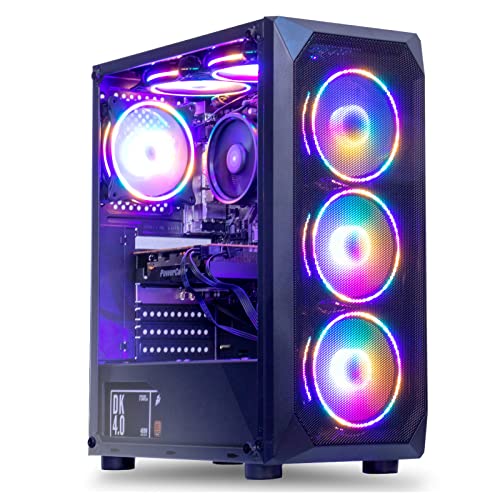
- Closest to native 1440p at this budget: MXZ Gaming Desktop, Ryzen 5 5500, GTX 1660 Super 6GB, 16GB DDR4, 500GB NVMe SSD — Check on Amazon
- Beelink SER5 MAX Mini PC, Ryzen 7 7735HS, Radeon 680M, 24GB LPDDR5, 500GB SSD — Check on Amazon
- GMKtec NucBox M6 Ultra Mini PC, Ryzen 5 7640HS, Radeon 760M, 16GB DDR5, 512GB SSD — Check on Amazon
- STGAubron Gaming PC, Ryzen 5 5500, Radeon RX 580 8GB, 16GB DDR4, 512GB SSD — Check on Amazon
See 2 more Amazon options
- GMKtec M5 Plus Mini PC, Ryzen 7 5825U, 32GB RAM, 1TB SSD — Check on Amazon
- ACEMAGICIAN AM06 Pro Mini PC, Ryzen 7 5800U, 16GB RAM, 512GB SSD — Check on Amazon
Read the full guide ↓
Disclosure: As an Amazon Associate, reviewstook.com earns from qualifying purchases. Links to Amazon on this page are affiliate links; they cost you nothing extra. Listing details such as price and availability change often, so check the current Amazon listing before you buy.
This keyword deserves a straight answer before any product names: under $500, no PC in this guide — and no PC anywhere else — renders modern games natively at 1440p well. The machines below live in the “4K gaming PC” product family because they output a 4K signal, play 4K video and carry 4K badges on their listings. Point one at a 1440p monitor and ask it to do the actual work of gaming at 2560 × 1440, and a different, smaller truth appears: the strongest pick here reaches native 1440p only in older and lighter games, the strong integrated-graphics minis do their real rendering at 1080p and upscale from there, and the cheapest boxes render lower still. That is not a reason to close the tab. It is a reason to buy with the right mental model, because a well-chosen $500 PC feeding a 1440p panel through smart upscaling is a genuinely enjoyable setup — as long as nobody sold it to you as something it is not.
The model that matters has two halves, and listings blur them on purpose. Display resolution is what your monitor shows: a 1440p panel always shows 2560 × 1440 pixels, whatever the PC sends it. Render resolution is what the graphics hardware actually computes, frame by frame, and it is the expensive half. When a game renders at 1080p and is upscaled to a 1440p panel, the panel is still displaying 1440p — it is simply filling those pixels with a reconstructed image built from a 1080p render. Modern upscaling makes that reconstruction good. FSR in its Quality mode, asked to output 1440p, renders internally at roughly 1707 × 960 and rebuilds the rest; drop to a Performance mode and the internal render falls to about 1280 × 720. From a normal desk distance, a Quality-mode upscale to 1440p is hard to tell from native in motion. That gap — between what the panel shows and what the chip renders — is exactly where this entire budget lives, and every review below grades its machine by where it honestly sits on that scale.
There is one more reason the 1440p target is kinder to this hardware than the 4K target in the sibling guide. A 1440p frame carries about 3.7 million pixels; a 4K frame carries about 8.3 million — roughly 2.25 times as many. A chip that chokes on native 4K can often sustain a respectable 1080p render, and a 1080p render upscaled one step to a 1440p panel looks markedly cleaner than the same render stretched two steps to 4K. So the honest menu at $500 is this: one tower that touches native 1440p in the right games, two modern mini PCs that render 1080p and upscale beautifully, one older tower bought as an upgrade platform, and two value minis whose 1440p story is a sharp desktop, perfect video and cloud-streamed play. And the honest price of the thing the keyword literally asks for — comfortable native 1440p in modern titles — starts around the $700–$800 prebuilt tier, which the buying sections below link to directly. If that is your real target and your budget can stretch, stretch. If $500 is the ceiling, read on: bought knowingly, these machines earn their money.
In this guide
Quick Picks
Short on time, or comparing several options at once? Each row below names a buyer type and the machine that suits it, with a link to the listing.
| Buyer type | Pick | Why it stands out | Link |
|---|---|---|---|
| Closest to native 1440p | MXZ Gaming Desktop, Ryzen 5 5500, GTX 1660 Super | The only pick that renders some games natively at 1440p; everything else upscales to the panel | Check on Amazon |
| Best integrated graphics | Beelink SER5 MAX, Ryzen 7 7735HS, Radeon 680M | Strongest iGPU here — honest 1080p rendering that upscales cleanly to a 1440p screen | Check on Amazon |
| Best modern platform | GMKtec NucBox M6 Ultra, Ryzen 5 7640HS, Radeon 760M | Zen 4, DDR5 and USB4 — the one mini with an external-GPU route to true native 1440p later | Check on Amazon |
| Best cheap tower to upgrade | STGAubron Gaming PC, Ryzen 5 5500, RX 580 8GB | A standard tower bought for its platform; a future GPU swap is what makes it a real 1440p machine | Check on Amazon |
| Best RAM and storage value | GMKtec M5 Plus, Ryzen 7 5825U, 32GB RAM, 1TB SSD | A superb 1440p desktop and media box whose light local gaming is the trade, stated plainly | Check on Amazon |
| Best budget media + cloud box | ACEMAGICIAN AM06 Pro, Ryzen 7 5800U | Budget-friendly entry in the guide — check price on Amazon; cloud services do the 1440p rendering, this box does the rest | Check on Amazon |
How These Picks Were Chosen
The $500 line was applied as a ceiling, with the pattern this corner of Amazon forces on any honest guide: prices swing weekly with sales and coupons, so check price on Amazon before you buy — and where a pick only fits the budget on sale, its review says so in plain words. Two of the six picks are sale-dependent in exactly that way. Anything whose gaming claim dissolved under inspection — a 4K badge on hardware that cannot game at any resolution — was excluded before ranking began.
Ranking followed the render-resolution scale, because at a fixed budget that scale is the whole story. First: what does the machine render natively — 1440p in some games, 1080p, or lower? Second: how good is its upscaling path to a 1440p panel — which FSR modes its graphics support, and whether the memory feeding the chip is fast and dual-channel, since integrated graphics borrow system RAM and starve on slow configurations. Third: everything else — storage sized against modern game installs, display outputs that carry 1440p at high refresh, and the upgrade path, which for the two towers means a graphics slot waiting for the card that turns them into genuine 1440p machines.
We did not use these machines ourselves. We read the maker listings and specification pages and compared graphics hardware, video memory, RAM configuration, storage and outputs. One vocabulary point governed every judgment: none of the hardware here offers DLSS. The GTX 1660 Super predates it in Nvidia’s line, and AMD’s chips use FSR instead — so every upscaling claim in this guide is an FSR or in-game-scaling claim, and any listing implying otherwise for these machines is wrong. Performance language throughout is settings-and-resolution based; this guide prints no invented frame-rate figures for any specific machine.
The 6 Picks, Graded Against a 1440p Target
MXZ Gaming Desktop — Ryzen 5 5500, GTX 1660 Super 6GB, 16GB DDR4, 500GB NVMe SSD
Who it suits: The buyer who wants to get as close to native 1440p as $500 can reach — real 1440p rendering in the games that allow it, honest upscaling in the ones that don’t — in a tower that can grow into the real thing later.
The GTX 1660 Super is the reason this machine tops the guide. It is a genuine discrete graphics card with 6GB of GDDR6 memory, and against a 1440p target it splits the game library into two honest piles. In the first pile — esports titles, older AAA games, and lighter modern releases at reduced settings — it renders at native 2560 × 1440, the only pick here that can say so. In the second pile — recent demanding releases — the sensible configuration is a 1080p internal render with FSR or in-game scaling presenting it on the 1440p panel, which at desk distance looks far better than the phrase “not native” suggests. The supporting specification is balanced for the job: a six-core Ryzen 5 5500 that will not hold the card back, 16GB of DDR4, a 500GB NVMe SSD, and a conventional tower case with six RGB fans and — the detail that matters most in two years — a graphics slot and room for a stronger card.
Its limits are a matter of record, not opinion. The 1660 Super is a 2019 design: no DLSS, no ray-tracing hardware, and upscaling that tops out at FSR quality — good, but a generation behind the best reconstruction. Its 6GB of VRAM is the harder ceiling; recent games at 1440p reach for more texture memory than that, which is precisely why the modern pile renders at 1080p internally. Then there is the price behavior, which this guide will not bury: this is a sale-dependent pick, and its live price can sit above the budget at other times — check price on Amazon before you buy. Caught at or under $500, it is the strongest answer to this keyword that exists. Sitting well above the budget, the correct move is to wait for the dip or read the $700 tier, where native 1440p stops being a negotiation. One listing quirk to check before paying: the listing’s own specification material is inconsistent about storage in one bullet (a “1T” line against the 500GB figure in the title and table) — this guide uses 500GB, and you should confirm the configuration on the live page.
- Only pick that renders lighter and older games natively at 1440p.
- Real discrete GPU with 6GB GDDR6 — a different class from every integrated chip below.
- Standard tower: the future GPU swap is the route to full native 1440p.
Honest limitation: Modern titles render at 1080p and upscale; 6GB VRAM caps textures; no DLSS; and the price only fits this guide when the listing is on sale.
Choose it if you find it at or under $500 and want maximum local rendering now plus an upgrade path. Skip it if the live price is well above $500, or you want a small, quiet box rather than a tower.

Beelink SER5 MAX Mini PC — Ryzen 7 7735HS, Radeon 680M, 24GB LPDDR5, 500GB SSD
Who it suits: The small-desk or living-room buyer who accepts the upscale bargain knowingly: the strongest integrated graphics under $500, rendering at 1080p and presenting on a 1440p panel so cleanly that most players stop caring within a week.
Grade this box by its graphics chip and its memory, because Beelink specified both correctly. The Radeon 680M — twelve RDNA 2 compute units inside the Ryzen 7 7735HS — is the fastest integrated GPU in this guide by a clear margin, and the 24GB of dual-channel LPDDR5 feeding it is a gaming specification, not a luxury: an iGPU borrows system memory for both its frame buffer and its bandwidth, and this is the configuration the chip was designed around. Against the 1440p target the verdict is precise. Native 1440p rendering is beyond it in all but the lightest titles. Its real mode is a native 1080p render — esports at high settings, older AAA at medium, recent releases at low with FSR engaged — upscaled to the panel, where FSR Quality output at 1440p is built from a render close to that size anyway, so the reconstruction has good material to work with. Add flawless 4K and 1440p video, a triple-display desktop, and near-silent manners in a box that hides behind the monitor, and the package is coherent: this is the best small machine for a 1440p screen at the price.
The compromises are structural. The 24GB of RAM is soldered LPDDR5 — generous, fast, and fixed forever; storage through the M.2 slots is the only internal upgrade this box will ever take. There is no graphics upgrade path at all, so the day the 680M stops being enough, the whole machine is replaced — tower buyers should weigh that sentence twice. On price, check price on Amazon before you buy — this is the guide’s second sale-aware pick: in budget on deal days, over it on others, and the review would rather tell you that than round it down.
- Radeon 680M graphics — a clear step above every other integrated chip in this guide.
- 24GB of fast dual-channel LPDDR5, the memory configuration an iGPU actually needs.
- Its 1080p renders upscale to a 1440p panel with the least visible compromise here.
Honest limitation: It does not render modern games at native 1440p; RAM is soldered, there is no GPU upgrade path, and the price can sit above the budget between deals.
Choose it if you want the best mini-PC gaming under $500 and your expectations are set at 1080p rendering, upscaled. Skip it if you plan to upgrade graphics later — that plan requires a tower.

GMKtec NucBox M6 Ultra Mini PC — Ryzen 5 7640HS, Radeon 760M, 16GB DDR5, 512GB SSD
Who it suits: The forward-looking buyer: a current-generation mini PC that plays the same 1080p-and-upscale game as the Beelink today, but keeps a door open — via USB4 and an external GPU — that no other mini in this guide has.
The M6 Ultra’s silicon is a generation newer than the Beelink’s: a six-core Ryzen 5 7640HS on the Zen 4 architecture, running up to 5.0GHz, with Radeon 760M graphics — eight RDNA 3 compute units backed by DDR5 memory. In real games the 760M lands close to the 680M despite the smaller unit count, which tells you where this pick sits against the target: native 1440p is not its mode either. Its honest band is strong 1080p rendering in esports and older titles, low settings plus FSR in recent ones, upscaled presentation on the 1440p panel, and perfect high-resolution video and desktop work across up to three displays. The verified configuration is 16GB of DDR5 and a 512GB NVMe SSD with dual M.2 slots, joined by dual 2.5GbE networking and WiFi 6E in a box roughly five inches square. Check price on Amazon for this 16GB configuration — it is positioned under the budget line without needing a sale.
Two warnings ride with that positioning. A 32GB variant of the same listing family sits in a higher, premium tier, far over budget; the under-$500 claim belongs to the 16GB machine alone, so the configuration in your cart is the product you are buying — check it before paying. The second point is about the feature that distinguishes this pick: USB4 allows an external GPU dock, the only way any mini PC here ever renders native 1440p for real, by borrowing a desktop graphics card later. That path costs desktop-card money on top of this purchase, and this guide counts none of it toward the $500; it is option value, honestly labeled, that the other minis do not offer. Against that, the everyday limitations are the 760M’s 1080p ceiling, 512GB of storage in an era of 100GB installs, and the same no-internal-GPU-upgrade rule as every mini PC.
- The most current platform here — Zen 4 processor, RDNA 3 graphics, DDR5 memory.
- USB4 opens the external-GPU door — a real, if extra-cost, route to native 1440p later.
- Dual 2.5GbE LAN, WiFi 6E and dual M.2 slots; 16GB configuration lists under budget.
Honest limitation: Gaming rendering is 1080p-class like the Beelink’s; 512GB fills quickly; and the 32GB variant of this listing breaks the budget — verify the configuration.
Choose it if you value the modern platform and the eGPU option over the Beelink’s extra memory. Skip it if you want the strongest integrated gaming today per dollar — the SER5 MAX edges it.

STGAubron Gaming PC — Ryzen 5 5500, Radeon RX 580 8GB, 16GB DDR4, 512GB SSD
Who it suits: The staged buyer with a 1440p monitor and a two-step plan: a working tower today at a budget-tier entry point, and a modern graphics card dropped into it later — because the later card, not this one, is the 1440p machine.
Start with the card, graded without decoration. The RX 580 is a 2017 design, and against a 1440p target it is out of its depth in modern titles: its native habitat is 1080p, where it still plays older and lighter games well, helped by a genuinely useful 8GB of VRAM for texture-heavy back-catalogue titles. At 1440p it manages low-settings experiments in old games and a perfectly good desktop and video picture — nothing more, and this review will not stretch it further. So the purchase logic here is not the card; it is everything around it. A six-core Ryzen 5 5500 that will not bottleneck a future mid-range GPU, 16GB of DDR4, a 512GB SSD, and a standard tower case with a PCIe slot — a platform, bought once, that accepts the graphics card which turns it into a real native-1440p machine. Check price on Amazon for STGAubron’s RX 580 towers — they sit in the budget tier, which is the cheapest route in this guide to that platform.
This brand carries the longest caveat list in the guide, and it has earned it. STGAubron sells many configurations under near-identical titles — different processors, cards and storage under headlines that look the same — so the exact configuration on the live listing, not the title, is what your money buys; verify it line by line and keep a record of your order. Confirm power-supply headroom on the live page too, since the future GPU plan depends on it. The RX 580’s age brings legacy driver support and high power draw for the performance returned, and its video encoder is a generation behind modern NVENC at streaming bitrates. Finally, the upgrade story is real but not cheap: the card that makes this a 1440p tower later costs more than this entire PC does today. Bought as a platform with open eyes, it makes sense. Bought because a headline said “4K,” it disappoints by Friday.
- The least expensive way into a standard Ryzen 5 tower you can upgrade later.
- 8GB of VRAM serves older titles at generous texture settings at 1080p.
- The platform — CPU, case, slot — is the actual purchase; the card is a placeholder.
Honest limitation: A 2017 GPU that does not render modern games at 1440p; legacy drivers; and the exact variant must be verified on the live listing before paying.
Choose it if the two-step plan is genuinely yours — tower today, graphics card when funds allow. Skip it if you want the best finished machine today; that is the MXZ, or one of the minis.

GMKtec M5 Plus Mini PC — Ryzen 7 5825U, Radeon Graphics (Vega 8), 32GB RAM, 1TB SSD
Who it suits: The pragmatist whose 1440p screen works harder than it plays: a media, desktop and cloud machine with double the usual memory and storage, for whom light local gaming is an acceptable, clearly stated trade.
Separate the two resolutions in this review, because this machine is excellent at one and modest at the other. As a display machine for a 1440p (or 4K) screen it is arguably the most complete box in the guide: triple high-resolution display output, a Ryzen 7 5825U, 32GB of dual-channel DDR4 and a 1TB NVMe SSD with a second slot, dual 2.5GbE networking and WiFi 6E — a specification rivals in this guide charge more for while offering less. The value case is straightforward: check price on Amazon — this pick sits comfortably and reliably under budget in the budget tier, with none of the sale-watching the top two picks demand. As a rendering machine, the honest grade drops: its integrated graphics are Vega-generation, a clear step below the 680M and 760M above, so local gaming means esports and older titles rendered at 720p to 1080p on low-to-medium settings and upscaled to the panel — the softest local picture in the guide — with modern releases belonging to cloud streaming, where the rendering happens on a server and this box’s generous RAM and storage stop mattering less than its networking, which is excellent.
Nothing here is a hidden flaw; it is a declared trade. If your evenings are video, work across a big sharp desktop, and streamed or light games, the M5 Plus gives you the most complete machine for the money in this guide. If you intend to render games locally every night, its graphics are the wrong end of this list and the guide says so without hedging. One configuration note, standard for this market: titles in this model family have appeared with closely related specifications, so confirm the 32GB and 1TB figures on the live page before paying.
- 32GB of memory and a full terabyte of storage — twice what most minis at this price include.
- Budget-tier positioning — check price on Amazon; under budget without any sale-watching.
- Triple high-resolution output and dual 2.5GbE — a complete desktop and media hub.
Honest limitation: Vega-class graphics render local games at 720p–1080p low settings; against a 1440p target, local play is the weakest here and modern titles mean the cloud.
Choose it if desktop space, media and cloud gaming matter more than local rendering power. Skip it if you game locally every night — step up to the 680M or 760M picks.

ACEMAGICIAN AM06 Pro Mini PC — Ryzen 7 5800U, Radeon RX Vega 8, 16GB RAM, 512GB SSD
Who it suits: The cheapest honest entry in the guide: a first PC for a 1440p or 4K screen whose real jobs are video, desktop work, cloud gaming and light local play — bought as the most budget-friendly entry here.
The value case starts with its budget positioning: check price on Amazon — this is the most budget-friendly pick in this guide. At this tier the hardware is a coherent light-duty package: an eight-core Ryzen 7 5800U that keeps the desktop feeling quick, Radeon RX Vega 8 graphics, dual-channel 16GB of DDR4, a 512GB NVMe SSD with a 2.5-inch expansion bay for cheap storage growth, dual LAN, WiFi 6, and triple display output across HDMI, DisplayPort and USB-C. Mounted behind a monitor it is a genuinely good media PC and an excellent cloud-gaming terminal — and cloud is where its 1440p story lives, because a streamed game is rendered on a server at resolutions this box could never compute locally, then simply decoded and displayed. Locally, expect the esports and indie catalogue rendered at 1080p on low-to-medium settings and upscaled to the panel, with older titles treated kindly and recent AAA releases out of local reach.
Its position at the bottom of the rendering order is a fact, not a slur: Vega 8 is the oldest graphics architecture in this guide, and upscaling its low internal renders to a 1440p panel shows more seams than the 680M’s work — visible at desk distance in a way the stronger picks mostly avoid. Two standing cautions for this class of machine apply. Support from value mini PC brands is thinner than from the big names, and the standard half-hour precaution for any budget mini PC — a security scan, and a clean Windows install if anything looks off — is worth taking. At this budget tier, though, the expectations are fairly set: nobody honest is claiming this renders 1440p, and as the least expensive respectable front end for a high-resolution screen, it earns its place in the guide.
- Most budget-friendly pick in the guide — check price on Amazon.
- Triple display output and a 2.5-inch bay for cheap storage expansion.
- Cloud gaming is its 1440p path: the server renders, this box displays.
Honest limitation: Oldest graphics architecture here — local renders are the softest in the guide, and modern games are a cloud conversation, not a local one.
Choose it if your screen mainly needs a quiet, inexpensive driver for video, desktop work and streamed games. Skip it if local gaming performance is why you are buying — the distance to the 680M pick decides that question.

Comparison Table
| Product | Graphics | Honest level vs a 1440p target | Link |
|---|---|---|---|
| MXZ Gaming Desktop (Ryzen 5 5500) | GTX 1660 Super 6GB, discrete | Native 1440p in older/lighter games; 1080p render + FSR in modern ones | Check on Amazon |
| Beelink SER5 MAX (Ryzen 7 7735HS) | Radeon 680M, integrated | 1080p native render, upscaled to the panel — cleanest upscale here | Check on Amazon |
| GMKtec NucBox M6 Ultra (Ryzen 5 7640HS) | Radeon 760M, integrated | 1080p class rendering; USB4 eGPU is its later route to native 1440p | Check on Amazon |
| STGAubron Gaming PC (Ryzen 5 5500) | RX 580 8GB, discrete (2017) | 1080p card; bought as a platform for a future 1440p GPU | Check on Amazon |
| GMKtec M5 Plus (Ryzen 7 5825U) | Radeon Vega 8-class, integrated | 720p–1080p low renders; best at desktop, video and cloud on a 1440p screen | Check on Amazon |
| ACEMAGICIAN AM06 Pro (Ryzen 7 5800U) | Radeon RX Vega 8, integrated | Light 1080p local renders; cloud services supply its real 1440p gaming | Check on Amazon |
How to Choose a PC for 1440p Gaming Under $500
- Separate the panel from the render. Your monitor will display 1440p no matter what. The question this budget actually answers is what the PC renders underneath — native 1440p in some games, 1080p upscaled, or lower. Choose by render resolution and the marketing stops mattering.
- Learn the two upscaling numbers. FSR Quality outputting 1440p renders internally at roughly 1707 × 960 — close enough to native that most players cannot tell in motion. FSR Performance renders around 1280 × 720, and the softness shows. Prefer picks whose native render is strong enough to live in Quality mode.
- Rank graphics hardware first, always. A discrete card, then the strongest integrated graphics (680M and 760M class), then older Vega iGPUs. CPU branding and fan counts decide almost nothing at these resolutions.
- For integrated graphics, RAM is a gaming specification. The iGPU borrows system memory, so dual-channel layout, memory speed and total pool (24–32GB beats 16GB) all move game performance. A single-stick 16GB configuration is a hidden downgrade wherever you meet one.
- Do not expect DLSS from anything in this guide. The GTX 1660 Super predates it and AMD’s chips never had it. FSR and in-game resolution scaling are the upscaling tools at this budget — plan settings around them.
- Count cloud gaming as a genuine feature of cheap PCs. A streamed game is rendered on a server; even the least expensive mini here can present high-resolution play no local hardware at this price can match. Budget for the subscription and an Ethernet cable, and the weakest picks become sensible.
- Check the outputs against your monitor. You want a connection that carries 1440p at your panel’s full refresh rate for desktop smoothness, not merely a port that lights the screen. All six picks drive high-resolution displays; several drive three at once.
- Price-check like a local. Two picks here drift above the budget line between sales. Check price on Amazon, set a price alert, buy on the dip, and confirm the exact configuration — RAM, SSD, CPU variant — in the cart, because sellers here stack multiple variants under a single listing title.
- Match storage to your library. Modern games run 50–150GB each. A 512GB SSD holds a handful of them; the M5 Plus’s 1TB, or a tower’s easy second drive, is worth real money if your library is large.
- Know the real native-1440p budget. Comfortable native 1440p in modern titles — high settings, sensible frame rates — begins around the $700–$800 prebuilt tier and improves from there. If native rendering is the actual requirement, Best 1440p Gaming PC Under $700 and Best 1440p Gaming PC Under $800 are the guides to read next, with Best 1440p Gaming PC Under $1200 above them. The rational $500 purchase, for a buyer on that road, is the one that stays useful later — a media box, a second PC, or a tower waiting for its card.
Common Buying Mistakes
- Reading “4K gaming PC” as a rendering promise. At this price the phrase describes the output signal and the video playback — the rendering happens at 1440p in the lightest cases and at 1080p or below in most.
- Assuming a 1440p monitor guarantees 1440p rendering. The panel displays whatever it is sent; a 1080p render upscaled is what most sub-$500 hardware sends, and honest listings blur exactly this point.
- Buying on CPU name alone. A “Ryzen 7” paired with old Vega graphics games far worse than a Ryzen 5 with a discrete card. The graphics line is the gaming line.
- Ignoring VRAM and shared memory. The 1660 Super’s 6GB caps texture settings in recent games; integrated graphics share system RAM, so a small or slow memory configuration quietly caps them too.
- Paying the non-sale price for a sale-dependent pick. If the MXZ or the Beelink is sitting well above the budget today, waiting for the dip or stepping up a tier beats overpaying for either.
- Buying the wrong variant. Sellers in this market stack several CPUs, RAM sizes and SSDs under a single title — what sits in your cart is the product; the headline is not.
- Judging an upscaled picture from a screenshot. Upscaling quality shows in motion, at your seating distance, on your panel. Judge it in the return window, playing your own games — not from a listing image.
- Skipping the return-window tests. Run your most demanding game, check every port and display output, and confirm the configuration matches the listing in the first days, while Amazon’s return path is open — especially with value-brand towers and mini PCs.
Final Recommendation
- Closest to the keyword’s promise: MXZ Gaming Desktop (GTX 1660 Super) — bought on sale at or under $500.
- Best small-box gaming: Beelink SER5 MAX (Radeon 680M).
- Widest future options: GMKtec NucBox M6 Ultra (USB4 / eGPU path).
- The staged upgrade plan: STGAubron Gaming PC (RX 580 tower).
- Desktop, media and value: GMKtec M5 Plus (32GB / 1TB).
- Cheapest honest entry: ACEMAGICIAN AM06 Pro.
The top two split by room and by plan. At a desk, where the monitor sits close and rendering power is the purchase, the MXZ tower is the strongest machine this budget reaches — the only pick that renders anything natively at 1440p, and the only one whose graphics slot points at the full version of that later. Where the screen is a living-room TV or the desk is small, the Beelink SER5 MAX is the better citizen: invisible, quiet, flawless at high-resolution video, and honest 1080p gaming upscaled to the panel with the least visible compromise in the guide. Both sit under the same warning: their prices cross the line between sales, so buy on the dip. Buyers who read this guide and realize their requirement is genuinely native 1440p should treat $500 as the ground floor and read upward — Best 1440p Gaming PC Under $700 is where discrete GPUs with real 1440p headroom take over, and the sibling Best 4K Gaming PC Under $500 grades this same set against a 4K panel instead. Whichever you pick, confirm the live price and the exact configuration before paying, and put every game and port through its paces while the return window is open.
Frequently Asked Questions
Can a PC under $500 really game at 1440p?
Not natively, in modern titles — that is the plain answer this guide is built on. What $500 buys is one tower that renders older and lighter games natively at 1440p, several machines that render at 1080p and upscale to a 1440p panel convincingly, and value boxes whose 1440p gaming arrives via cloud streaming. Bought for those jobs, it is a good purchase. Bought expecting native 1440p across a modern library, it cannot satisfy anyone, at any seller.
Why do these PCs say “4K” if they are being graded at 1440p?
Because “4K” on these listings describes the output signal, the video decoding and the desktop resolution — all of which they genuinely deliver — while this keyword asks how they perform as gaming machines for a 1440p screen. Those are different claims about the same hardware. This guide grades the gaming claim, and points readers whose real target is native 1440p to Best 1440p Gaming PC Under $500 and the tiers above it.
What does FSR Quality actually render when the output is 1440p?
Roughly 1707 × 960 internally, reconstructed up to the full 2560 × 1440 the panel displays. That is why Quality mode is the sweet spot at this budget: the internal render is close enough to the output that the reconstruction has real detail to work with. Performance modes render around 1280 × 720 and trade visible softness for frame rate — a fallback, not a default.
What budget buys real native 1440p gaming?
For prebuilt PCs, comfortable native 1440p in modern titles — high settings at sensible frame rates — begins around the $700–$800 tier and improves from there, driven almost entirely by graphics card class. That is a shorter climb than native 4K, which starts nearer $1,200 — one reason so many buyers settle happily at 1440p as their long-term target.
Is upscaled 1080p on a 1440p monitor actually any good?
Yes — it is the normal way this budget is meant to be used, and the one-step upscale to 1440p is gentler than the two-step stretch to a 4K panel. At a desk, a Quality-mode FSR image in motion is hard to distinguish from native for most players; the softness is there if you freeze and hunt for it. What matters more is that the frame rate holds — a smooth upscaled picture beats a native slideshow on any screen.
Mini PC or tower at this budget — which should I choose?
Choose the tower if local rendering power and future upgrades lead your list: the discrete GPU is faster today and replaceable tomorrow, and a card swap is the only sub-$500 purchase here that becomes a true native-1440p machine. Choose a mini PC if the machine lives with a TV or a small desk, noise matters, or your gaming leans on esports, older titles and the cloud. The hybrid case is the M6 Ultra, whose USB4 port allows an external GPU dock later — at extra cost this guide does not hide.
Can these PCs run a 1440p monitor properly for work and video?
Completely — this is the easy half of the keyword. Every pick outputs high-resolution signals at smooth refresh rates and hardware-decodes 4K and 1440p streaming video; the mini PCs drive up to three high-resolution displays at once. For a media-and-desktop-first buyer, the “4K” label on these machines is simply true, and the gaming caveats in this guide may never apply.
What is the first upgrade I should make later?
Tower owners: the graphics card — it is the entire distance between this guide and native 1440p, and both towers were chosen to accept one (confirm power-supply headroom on the live listing first). Mini PC owners: storage where the model allows it, and an Ethernet cable today — wired networking is the cheapest gaming upgrade in this entire guide, for local play and cloud streaming alike.


