Disclosure: As an Amazon Associate, reviewstook.com earns from qualifying purchases. Links to Amazon on this page are affiliate links; they cost you nothing extra.
A bedroom TV has different needs from a living room one: you watch from lying down, at lower volume, in dim light and often alone. This guide covers size, mounting, sound, features and settings that make a bedroom TV comfortable.
This guide is based on product listings and general TV knowledge rather than our own testing. Specs and features vary by model and year, so confirm the details on the product page.
By the Reviewstook Editorial Team. Last updated: October 31, 2026.
Choose the Right Size
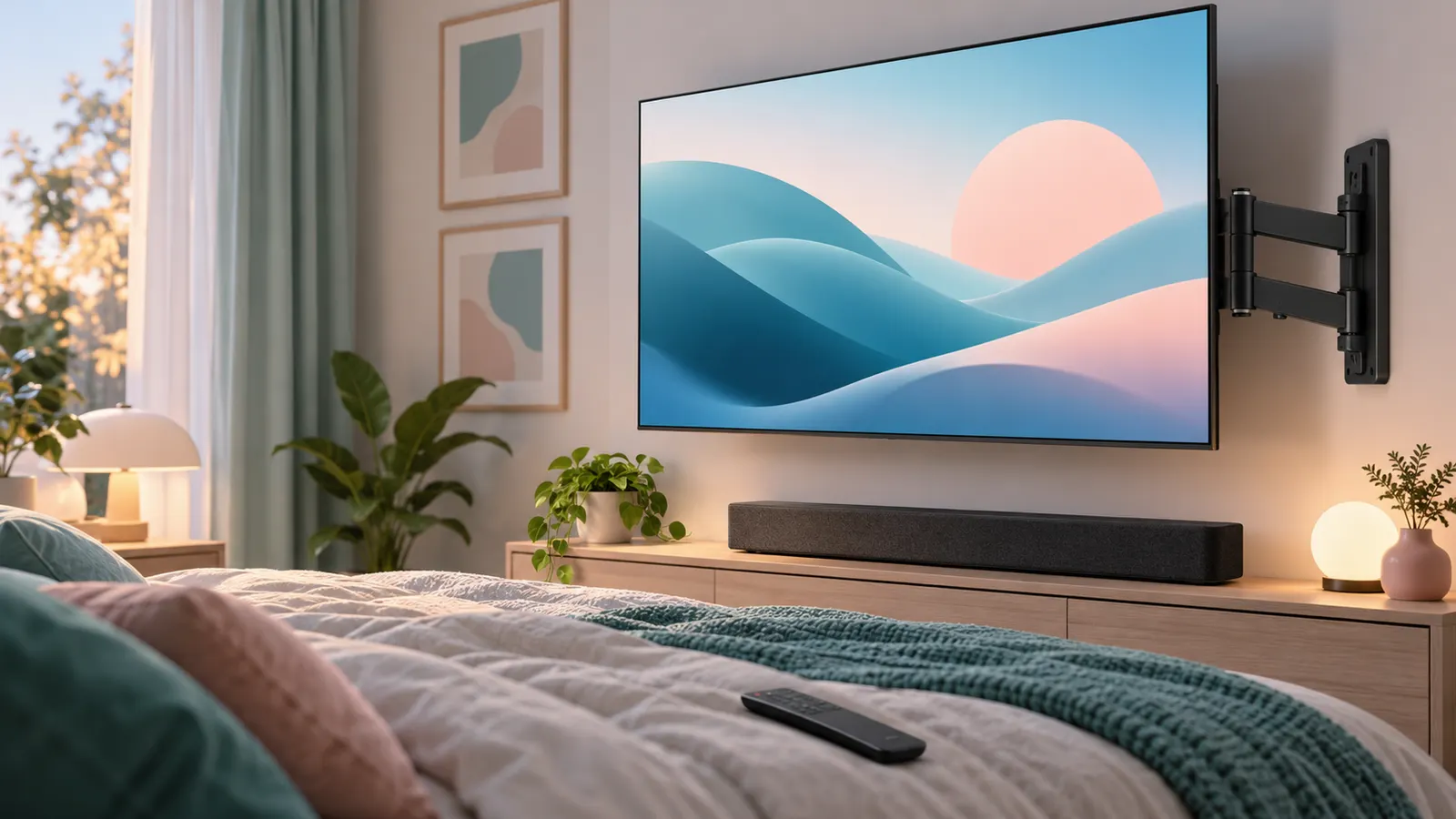
For a bed six to ten feet away, a 40 to 50 inch TV is a comfortable fit, and 32 inches suits very small rooms. Use the TV size guide to match size to distance. See our 32-inch, 40-inch and 50-inch guides.
In this guide
Resolution and Panel
4K is standard from 40 inches up. In a dim bedroom, OLED or a TV with good local dimming gives deeper blacks, but a basic LED set is fine for casual viewing. Wide viewing angles help if you watch from the side of the bed.
Mount or Stand
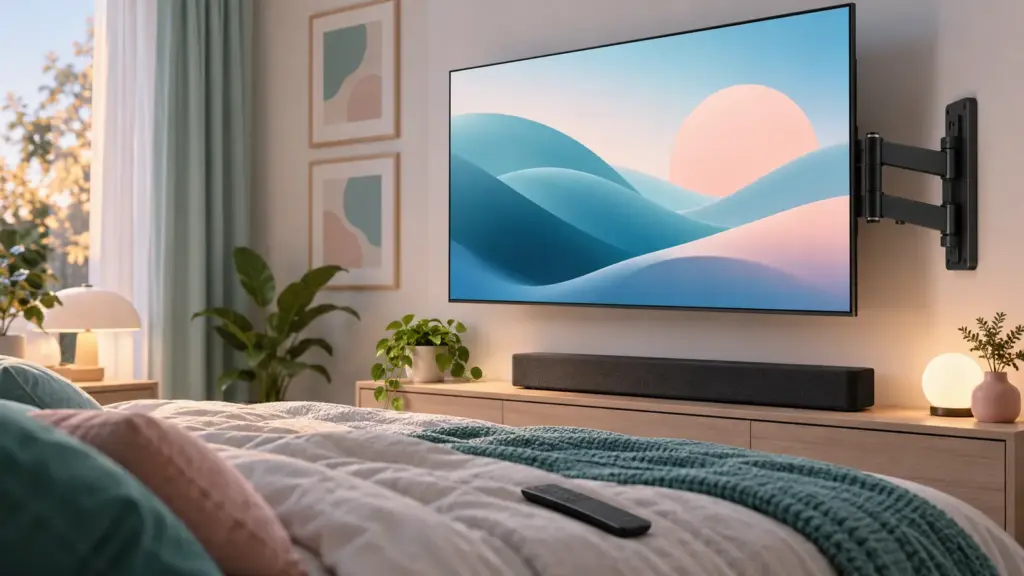
A wall mount keeps the TV off furniture and lets you set the height for viewing from bed. A tilting mount angles the screen down. See the wall mounting guide. A dresser stand is fine if the TV is at a comfortable height and secured against tipping.
Sound and Night Listening
Bedroom volume is usually low, which makes dialogue hard to hear on thin TV speakers. A small soundbar helps, or use wireless TV headphones so a partner can sleep. Look for night mode or dialogue enhancement features. See how to connect a soundbar.
Smart Features and Sleep Timer
A sleep timer turns the TV off after a set time, and an auto power-off saves energy if you doze off. A simple smart platform with fast startup is easier to live with. See smart platforms compared.
Light, Glare and Settings
Use a low brightness and a warm color setting in a dark bedroom, turn on any eye comfort or night modes and avoid placing the TV opposite a window. Turn off the standby light if it is bright, or cover it.
Quick Bedroom Checklist
- Size matched to the bed distance.
- Wall mount or secure stand, with tipping protection if you use furniture.
- Sleep timer and night or dialogue modes.
- Soundbar or headphones for low-volume listening.
- Low brightness and warm color settings for a dark room.
Viewing Angles and Eye Height When You Watch Lying Down
Watching from a bed is nothing like sitting on a sofa. Your head may rest on pillows, you may lie on your side, and your eyes sit lower and further back than in a living room. These habits change which TV traits matter. Wide viewing angles help, because the picture on some panel types fades or shifts color when seen from the side. If you often lie on one side of the bed, ask how the model looks off-center, and read reviews that discuss angle performance.
Height is the next consideration. A TV mounted too high forces you to tilt your neck upward, which gets tiring in a long viewing session. A good starting point is to put the middle of the screen near eye level when you are in your normal watching position, then adjust for comfort. Lie where you usually watch, have someone hold a cardboard cutout or a tape outline on the wall, and check the angle before drilling anything.
Think about reach and shape too. A TV that sticks out from the wall can be bumped in a small room, and one placed above a dresser may block a window or an outlet. Measure the space between bed and wall, the width of the furniture and the room for cables.
- Check the screen at the pillow position, not only when standing.
- Leave clearance behind the set for ventilation.
- Keep cables off the floor where they can be kicked or snagged.
Comfort planning at this stage saves you from remounting later.
Quiet Hours, Partners and Audio Choices
Sound is the most common complaint in bedrooms. Late-night viewing means low volume, and low volume exposes weak dialogue. Meanwhile a partner may be trying to sleep. A few practical options solve this without making the room feel like a theater.
Wireless headphones designed for TVs let you hear clearly at any level, and they keep the room quiet. Check how they connect to your set, whether they need a transmitter, and how long the battery lasts. Make sure the TV has a suitable output or that the headphones work with its Bluetooth, since not all sets support audio over Bluetooth in the same way. Check the manual before buying.
A compact soundbar is another option. Look for one with dialogue boost and a night mode that reduces loud peaks, so explosions do not wake the house while speech stays understandable. Small bars also fit on a shelf or under a wall-mounted TV. Check the connection options on both devices, and note whether the soundbar uses the TV’s remote.
Some TVs have built-in sound modes for speech clarity and volume leveling. These can help in the bedroom if you prefer not to add equipment. Turn on subtitles as a simple fix as well; many people use them in bedrooms because they work at any volume. The best choice depends on whether you share the room, how late you watch and how much space you have.
Safety, Mounting and Cable Management
A bedroom TV is near sleeping people, so secure installation matters. If you place the set on furniture, use the anti-tip hardware the maker provides or a strap kit, and confirm the furniture can carry the weight and width. Never place a TV on a dresser that is unstable or too shallow for the stand. In homes with children or pets, anchoring is especially important.
For a wall mount, check the TV’s mounting pattern and weight against the mount’s rating, and confirm that your wall type suits the hardware. Studs, masonry and hollow walls each need different fixings. If you are not confident, hire a qualified installer. A mount that holds a TV at a tilt or on an arm may need extra care, because leverage increases the load on the wall.
- Check that the mount fits the screen size and weight listed in its documentation.
- Use a level and mark the stud locations before drilling.
- Route cables through a cover or channel so they do not hang above the bed.
- Keep vents clear and avoid blocking airflow with curtains or shelves.
Power is another point. Use a surge protector from a reputable source if you plug in several devices, and avoid daisy-chaining extension cords. Place the power strip where you can reach the switch, and keep it off the floor where dust and liquids collect. These small precautions reduce risks in a room where you spend many hours asleep.
Protecting Sleep: Light, Blue Tones and Routine
A bright screen at night can make it harder to wind down. You can reduce its effect with a few settings. Lower the backlight or use an energy saving mode so the picture is comfortable in a dark room. Use a warmer color temperature in the evening, which reduces the cool, bluish cast many people find harsh late at night. Many sets also offer eye comfort or night modes, though what they do varies by maker, so check the menu descriptions.
Think about the whole room. A bright TV in a completely dark bedroom creates strong contrast that strains the eyes. A dim bias light behind the screen, or a low lamp elsewhere, can ease this. Blackout curtains also reduce glare during daytime viewing.
Habits matter as much as hardware. Set the sleep timer for a realistic time so the TV turns itself off if you fall asleep. Avoid autoplay features that start another episode, and consider turning them off in your streaming apps. Many people find it easier to sleep when they stop screen viewing for a while before bed, so you might choose to switch the TV off earlier and use audio only.
Finally, cover or dim indicator lights if they bother you. Some sets have a bright standby light, and a small piece of tape or a cover can reduce it. Keep the remote within reach of the bed so you do not need to get up.
Making a Smart Choice in a Small or Budget-Limited Bedroom
Bedrooms rarely need the biggest or most advanced TV. Because the room is small and viewing is often casual, spending on features you will not use is easy to avoid. Prioritize a screen that fits comfortably, a clear picture, simple controls and reliable sound options. After that, extras such as high refresh rates or advanced gaming features matter only if you plan to use them.
Think about what you watch. If it is mostly streaming and the news, a simple set with a good interface is plenty. If you plan to game, check the input and refresh rate support. If you use an antenna or cable, check for the right tuner and ports, and count the HDMI inputs you need for a streaming stick, console or soundbar.
Budget tiers can be described qualitatively. Entry-level sets usually cover the basics with modest contrast and brightness, which is fine in a dim room. Midrange models add better dimming, nicer processing and sometimes better sound. Premium panels offer stronger contrast and richer color, which suit people who watch films in the dark. Choose the tier that matches how much you really use the TV.
Before buying, check the return policy and the warranty, and note the signs that it is time to replace the set: a dimming or flickering backlight, lines on the screen, failing ports or an app system too slow to use. A well-chosen bedroom TV can last for years.
Working Out the Right Screen Size From Your Bed
Bedroom viewing distances are different from living room ones. Most people watch from a bed, a chair or a sofa placed a few steps from the wall, and the distance is often shorter than in a family room. Begin by measuring from where your eyes will be to where the screen will sit. That one number does more to guide your choice than any marketing label.
A larger screen is not always better in a small bedroom. A set that fills the wall can feel overwhelming and may be uncomfortable to watch at close range. As a rough guide, many people are happy with a screen that fills a comfortable portion of their field of view without making them turn their head. If you sit close, a medium size often feels more relaxed.
- Measure from the pillow or chair to the wall where the screen will go.
- Mark the screen width on the wall with painter tape to judge the scale.
- Check the clearance for a dresser, shelf or window beside it.
- Think about whether anyone will watch from the side of the bed.
Mounting Choices Compared
How the screen sits in the room affects comfort and safety. A wall mount frees furniture space, a dresser stand is simple, and a movable stand suits renters. Each option has trade-offs.
| Option | Strengths | Points to check |
|---|---|---|
| Fixed wall mount | Slim profile, saves space | Needs solid anchoring into suitable wall material |
| Tilting mount | Angle down toward the bed | Check how far it tilts and the weight limit |
| Full-motion arm | Swivels for different viewing spots | Needs a strong wall and enough reach |
| Dresser or stand | No drilling, easy to move | Needs a stable, level surface |
Check the pattern of holes on the back of the set, known as the mounting standard, and make sure the bracket you pick matches it. Wall mounting should follow the instructions from the mount maker, and if you are unsure about wall construction, hire a qualified installer. Where cables run inside walls, follow local electrical rules and consult a licensed professional.
How to Read a TV Listing Without Getting Lost
Product pages use many terms that sound similar. A short guide helps you separate what matters from what is decoration.
Panel type
Different panel types handle brightness, contrast and viewing angles differently. In a bedroom, where you may watch from the side of a bed, wide viewing angles matter.
Resolution
For small and medium screens viewed up close, sharper resolution can add clarity. For modest sizes at a distance the difference may be smaller.
Refresh rate
This describes how often the picture updates each second. It matters more for fast action and gaming than for casual viewing.
Ports
Count the HDMI inputs and note which one supports advanced features. A bedroom setup might include a streaming stick, a console and a soundbar.
Sound in a Quiet Room
Thin modern screens have limited space for speakers, so built-in sound can be modest. In a bedroom, that may be fine for dialogue at low volume. If you want a fuller sound without disturbing others, consider a compact soundbar or a headphone-friendly setup.
- Look for a headphone jack or wireless audio pairing if you watch late.
- Check for a dialogue enhancement mode that makes voices clearer at low volume.
- Consider a night mode that evens out loud and quiet moments.
- Think about where the speakers face if the set is mounted flush to the wall.
Many sets also include a sleep timer that switches the screen off after a set time. This is a convenience feature, and the manual explains how to use it.
Light, Glare and Room Setup
Bedrooms vary widely in lighting. A window opposite the screen can create glare during the day, while a dark room shows off deep blacks. Observe your room at different times and notice where reflections fall. Anti-glare coatings and brightness levels vary, so check the specification pages.
Consider a bias light behind the screen if you watch in the dark, as many viewers find it softens contrast against the wall. Blackout curtains or blinds can help in sunny rooms. Position the set so lamps and windows do not bounce light into your eyes.
Cables, Power and Tidiness
A bedroom works best when the setup looks calm. Plan where the power cord and cables will run. Use cable clips or covers rather than leaving wires loose. Avoid running cords where they can be tripped over or pinched, and keep vents on the set clear. A surge protector can be a reasonable addition, and the manual may suggest how to place the set to allow airflow.
Finally, think about the remote, streaming accounts and parental controls. Setting up profiles and screen time limits in advance prevents surprises later in a shared household.
A Pre-Purchase Checklist for the Bedroom
- Measure the viewing distance and the wall space.
- Decide on a wall mount or stand, and check the mounting pattern.
- Count the ports you need for a streaming stick, console and soundbar.
- Check the glare from windows at different times of day.
- Look for a sleep timer, night sound mode and headphone options.
Bedroom TVs and the Routines Around Sleep
A bedroom TV succeeds or fails on how it fits the wind-down routine, not on its best picture mode. The last hour of the evening is when harsh brightness, loud adverts and a glowing standby light do their damage, so judge every feature in this guide by that hour. A set that can dim smoothly to a genuinely low brightness, keep dialogue clear at very low volume, and turn itself off after you fall asleep is worth more in this room than a technically superior set that does none of those things gracefully.
Build the routine deliberately. Set the sleep timer as part of switching on, not as an afterthought when you are already drowsy. Use the platform’s profile or a simple favourites list so the path from switching on to watching is two button presses rather than a tour of menus and recommendations. If the TV offers a mode that warms the colour and lowers brightness on a schedule, enable it for the evening hours; your eyes will notice the difference on the nights you stay up later than planned.
Partners, children and shared bedrooms
Bedrooms are shared more often than living rooms, and the considerate features matter. Headphone listening, whether wired from the TV or through a remote or phone app, lets one person watch while the other sleeps, and it is worth confirming before purchase because not every set makes it easy. For children’s rooms, the priorities reorder again: a sturdy mount out of climbing reach, parental controls set before the TV is first used, a sleep timer that cannot be quietly extended, and a size modest enough that the room still feels like a bedroom rather than a cinema with a bed in it.
Placement Decisions Specific to Bedrooms
The foot of the bed is the natural screen position, but the wall there is not always available: windows, radiators and doors claim many bedroom walls. A corner mount on an articulated arm is the common compromise, and it works if the arm locks firmly and the TV returns to the same angle each night. Measure the viewing angle from the pillows, not from standing height, because a screen that looks level from the doorway can sit noticeably high from the bed.
- Test the planned height from the pillows with a taped outline before drilling; bedroom viewing is done lying back, which changes everything.
- Route cables where dressing-table items, chargers and lamps will not tug them, and keep them off the floor beside the bed.
- Check the standby light’s brightness in a dark room if you can; a small piece of the setup, but light-sensitive sleepers notice it nightly.
- Leave ventilation space behind a set mounted close to a wall, especially in small, warm bedrooms.
- If the TV shares the room with a dressing area, glare from a window behind the bed matters at weekend-morning viewing times, not just at night.
Sound at Low Volume: The Real Bedroom Test
Most TV sound is tuned for a living room at living-room volume. In a bedroom at night you need the opposite: speech that stays intelligible when the overall level drops, without sudden loud peaks from adverts or action scenes. Night modes and dynamic range compression exist for exactly this, and they are worth more than speaker wattage in this room. Test them with a dialogue-heavy programme at the volume you would use at midnight, because a set that passes that test will never disturb anyone, and one that fails it will do so every night.
If the TV’s own sound fails that test, the bedroom fixes are modest: a small soundbar with a clear voice mode, or headphones for solo viewing. Avoid placing a subwoofer in a bedroom unless the house’s structure and the neighbours’ patience both allow it; bass travels through floors at night in a way it never seems to at noon.
Waking up with the TV
Some households use the bedroom TV as part of the morning: news, weather and a gentle start. Wake-up timers and alarm features exist on some platforms, and a phone-controlled smart plug can imitate them, but set the volume and brightness for the morning scene as its own saved setup if the TV allows it. A screen that blazes into life at last night’s film settings is a poor alarm clock, while one that starts low and brightens with the room earns its place in the routine.
The Bedroom Decision, Compressed
Choose the size from the pillows, the sound by the midnight test, and the features by the wind-down routine. Get those three right and the bedroom TV disappears into the room’s life, which is the highest praise this room gives any technology. Get them wrong and even an excellent TV becomes the thing you negotiate with every night, so spend your attention there rather than on specifications that belong to the living room’s contest.
Buying the Bedroom Television Last, and Best
There is a case for buying the bedroom television last of all the house’s screens, after the main set has taught the household its lessons. By then you know your real distances, your platform loyalties, your sound tolerances and your household’s remote politics, and the bedroom purchase becomes the easiest in the house: modest where modesty serves, specific where the room demands it, and free of the anxiety that attends the main purchase. Households that reverse the order, learning their lessons on the expensive screen and buying the bedroom set in ignorance, pay tuition twice.
The bedroom also teaches the final lesson of this whole guide, which is that a television’s quality is mostly the quality of its fit. The bedroom set with the perfect height from the pillows, the whisper-clear sound, the timer set as part of switching on and the light that never glares will be described by its owners as a great television, whatever its specifications, while a finer set hung too high with loud adverts and a glowing standby light will be described as a mistake. Fit is not the soft part of buying; in the bedroom, fit is the whole of it, and the buyer who has understood that here will understand it in every room.
A note on television-free bedrooms
This guide sells the idea of choosing well, not the idea of choosing always. Some households try the bedroom television and remove it, finding the room calmer and their sleep the better for the absence, and that outcome is a success of the same kind: a decision made by the room’s real life rather than by habit. If you are undecided, borrow the experience first, a tablet on the bedside table for a month of evening news will tell you whether the room wants a screen at all, and a household that knows the answer to that question will never waste money on either choice.
Bedroom Televisions for Different Lives
The spare-room television lives the easiest life of any in the house: occasional guests, occasional duties, long sleeps between performances. It should be the simplest set you own, quick to start, obvious to operate for a guest who has never seen its remote, and modest in size for a room that must also be an office or a nursery in other weeks. This is the natural destination for a main-room television that has been replaced but still works well, and planning that hand-me-down at purchase time, choosing a respected set for the lounge, is how households end up with good televisions in every room without ever buying a bedroom set on purpose.
The teenager’s bedroom television raises the stakes in a different direction. It will be a games screen, a streaming screen and a social screen, used at hours adults consider unreasonable, at volumes adults consider negotiable. The buying virtues here are a game mode that works, headphone listening that works better, parental and account controls that were set before the set was first switched on, and a mount or stand arrangement that survives a room whose furniture rearranges itself monthly. Size should follow the room rather than the ambition; a modest screen at the right distance from a desk chair serves homework-adjacent viewing and games better than a wall of light above a bed.
The main bedroom television, for the adults whose room it is, should be bought with the most honesty of all, because its real specification is the couple’s actual habits. If the truth is twenty minutes of news and a sleep timer, a small, simple, dimmable set is the luxury choice, and money spent beyond it buys specifications that will never be exercised. If the truth is film nights in bed while the lounge hosts teenagers, then the bedroom set deserves the panel and sound attention of a second main television. Neither answer is the modest one by default; the modest thing is to buy for the life the room actually leads.
Comfort, Light and the Honest Science of Evening Viewing
Bedroom viewing happens when eyes are tired and the room is dark, which is why this room punishes brightness more than any other. A screen set for the lounge will glare in a bedroom even at the same measured output, because the surrounding darkness makes the contrast harsher. Use the gentlest picture mode the set offers at night, lower the backlight until bright scenes feel calm rather than impressive, and let a small warm lamp behind or beside the screen soften the boundary between picture and room. Viewers who make these changes usually describe the result as the television becoming relaxing, which is the bedroom’s entire brief.
Posture deserves the same realism. Watching from pillows with the neck propped at an angle is comfortable for twenty minutes and punishing for two hours, and no television fixes that; cushions, a proper reading pillow and a screen height matched to a reclined eye line do. If one partner reads while the other watches, the screen’s light spill becomes a negotiation, best solved by the dimming and lamp arrangement above and by headphones for the watcher. The bedroom television succeeds when both people in the room forget it is there, one watching it and one sleeping beside it.
The standby light and other tiny tyrannies
Small annoyances rule bedrooms: a standby light bright enough to read by, a start-up chime, a remote that must be aimed like a torch, a platform that resumes last night’s programme at last night’s volume. Hunt these at purchase and in the first week’s settings, because each is trivial alone and together they decide whether the set is loved. Many can be softened in menus, a light dimmed or disabled, a chime silenced, a start screen set to the input you actually use. The last ten minutes of setup time, spent on these details, is the best-invested time in the whole bedroom television project.
Designing the Wind-Down: A Bedroom Setup in Full
Assemble the whole bedroom philosophy into one setup, as a worked example. The screen is sized from the pillows and hung or stood so its centre meets the reclined eye line, tilted gently down. Its picture lives in the gentlest accurate mode, backlight set for the dark room, with a warm lamp behind it softening the wall. Its sound passes the midnight test, dialogue clear at a murmur, night mode one press away, headphones ready for the solo nights. The sleep timer is part of the switching-on ritual, the favourites list puts the evening’s channels two presses away, the standby light has been dimmed in the settings, and the remote lives in its one place on the bedside table.
Nothing in that paragraph is expensive, and every element of it was chosen against the room’s real life rather than a catalogue. That is the bedroom guide’s whole argument in one room: the technology of rest is mostly decisions, and decisions are free. A household that makes them deliberately will sleep in a room that happens to contain a television; a household that skips them will lie awake in a room that contains a small, bright, demanding cinema, wondering why the expensive screen feels like a mistake.
The morning after
Judge the bedroom television the morning after, not during the film. Did the room stay restful. Did the watcher fall asleep to the timer rather than to a blazing menu. Did the partner sleep through. Did the morning news arrive gently at the hour it was wanted. A bedroom set that passes its mornings has passed its real examination, and the households that learn to judge it there stop shopping for bedroom televisions, because they have understood what the purchase was for.
Bedroom Televisions in Very Small Rooms
The very small bedroom, the box room, the student room, the spare corner, compresses every decision in this guide until only the essentials survive. Distance shrinks to a metre or two, so the screen shrinks with it and the money follows it down, which is the small room’s gift: its correct television is genuinely inexpensive. What cannot shrink is the care: the height from the pillow still decides comfort, the midnight sound test still decides peace, the timer still decides whether the set serves sleep or raids it. A small room fitted with that care feels like a private cinema and a restful bedroom at once; a small room fitted carelessly feels like sleeping inside a shop display.
Small rooms also reward the television that does double duty gracefully, the screen that is a monitor for the desk in the corner by day and the bedroom set by night, with the input discipline this site’s guides describe. In a room where every object earns its place twice, that flexibility is not a bonus but the whole case for the purchase, and the buyer should test both lives during the return window rather than assuming either. The small room, honestly furnished, is the strictest examiner in this entire guide, and the set that passes it has nothing left to prove.
Two People, One Bedroom Screen: The Diplomacy Guide
Most bedroom television disagreements are not about programmes but about externalities: light, sound, timing and the moral question of the last episode watched without the other. The technology in this guide disarms most of them when it is set up as a shared instrument rather than one partner’s gadget. Agree the defaults together, the brightness ceiling for the dark room, the volume the night mode guards, the timer’s usual setting, and write no rules about content, which adults can negotiate as adults. Headphones by the bed settle the solo late sessions; the favourites list, built jointly, settles the opening skirmish of every evening; the standby light, dimmed once in the settings, settles a grievance that otherwise smoulders for years because it seems too small to raise.
What remains is the pleasant part: a screen the room agrees on, at the height both pillows voted for, showing the programmes two people actually share, in a room that stays a bedroom. Households underestimate how much of a television’s quality is this diplomacy, because catalogues cannot sell it. It is, in the end, most of what the bedroom purchase was ever about, and the couple that spends ten minutes on it during setup week will spend a decade not spending it again.
Last Considerations Before the Bedroom Purchase
Two questions, asked in the shop or on the product page, settle most bedroom purchases that the rest of this guide has not. Can this screen go genuinely dim, smoothly, without its blacks turning to grey soup, because the bedroom’s darkness will audit that ability nightly. And can its sound stay intelligible at the volume of a sleeping house, with its night tools reachable in the dark by a hand that knows the remote by touch. A set that answers both has passed the bedroom’s real entrance examination, and its other specifications can be almost anything the budget allows. A set that fails either will fail in the room’s own hours, whatever its daylight credentials, and no sale price redeems a television that glares at midnight or mumbles at it. Buy the answers to those two questions, in that order, and the rest of the bedroom guide becomes refinement rather than rescue.
The bedroom screen and the house’s quiet hours
Every house has quiet hours, and the bedroom television is their chief test. A set that respects them, dimming without drama, speaking clearly at a murmur, switching itself off into a darkness that is actually dark, becomes part of the house’s peace rather than an exception to it. That respect is not a feature to be found on a comparison table; it is the sum of the small decisions this guide has walked through, made once, in the right order, by owners who understood that the bedroom’s specification is written by the night. Make those decisions and the screen earns the room’s trust, which in a bedroom is the only review that counts.
There is one more audience for that trust: the guest who sleeps in the room when it is a spare room, the grandparent who naps there, the child who migrates there in a thunderstorm. A bedroom television set up for rest serves them all without adjustment, because its virtues, gentleness, quiet, simplicity, are universal. Buy for the room’s deepest purpose and the room will look after everyone who ever sleeps in it, which is as good a definition of a successful purchase as this guide can offer.
So let the bedroom purchase be the calmest one in the house: measured from the pillow, tested at midnight, set up for rest, and then forgotten in the best way, as the room’s evenings quietly improve around it.
Frequently Asked Questions
What size TV is best for a bedroom?
Roughly 40 to 50 inches for a bed six to ten feet away, and 32 inches for small rooms.
Do I need a smart TV in the bedroom?
Not required, but it lets you stream without extra boxes. You can add a stick instead.
Is OLED good for a bedroom?
Yes in dim rooms, since black levels are excellent.
Can I use an antenna in a bedroom?
Yes. See the antenna guide.
How high should I mount a TV above the bed?
Aim for the center of the screen to sit near eye level when you are in your usual viewing position, and avoid steep upward angles. Test with a cardboard cutout before drilling.
Can I watch TV in bed without waking my partner?
Yes. Wireless TV headphones, subtitles and a low-volume soundbar with night mode all help. Choose the option that suits how you share the room.
Is a curved or flat screen better for bedrooms?
Flat screens are the common choice and mount easily against a wall. Pick based on comfort and room layout, and check the mount compatibility.
Do I need an HDMI-ARC input for a bedroom soundbar?
It makes setup simpler because one cable carries audio back to the soundbar. Check the ports on both devices and whether other connection types are available.
Should I buy a TV with a built-in sleep timer?
A sleep timer is useful and common. Check the menu to be sure it is easy to set, since you will use it often.
How do I stop a bright standby light from bothering me?
Check the menu for a setting to dim it, or cover it with a small piece of opaque tape. Do not block vents.
Is it okay to mount a TV on a wall with only drywall?
Not without proper hollow-wall hardware rated for the load, and often it is better to find studs. If you are unsure, ask a professional installer.
Bottom Line
Choose a 40 to 50 inch TV for most bedrooms, mount it at a comfortable height, add a small soundbar or headphones and use a sleep timer.
Related Reading
- Best 32-Inch TVs
- Best 40-Inch TVs
- Best 50-Inch TVs
- What Size TV Should You Buy?
- How to Wall Mount a TV
- TV Antenna Buying Guide
- Best Wireless TV Headphones
- All TV guides