Where to buy
Check the latest price, availability and delivery on Amazon. Orders are placed on Amazon. We may earn a commission from qualifying purchases.
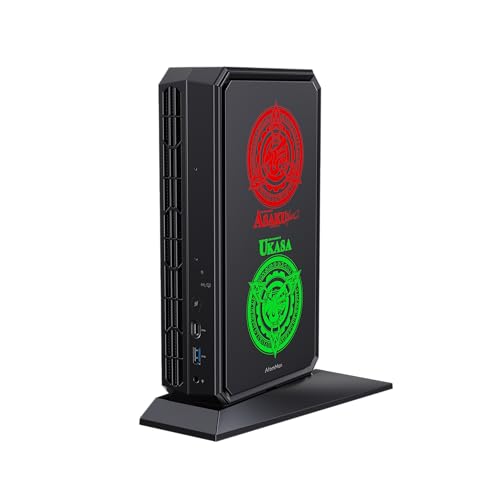
- Best for 1440p gaming: Minisforum AtomMan G7 Pt, Ryzen 9 7945HX, RX 7600M XT, 32GB, 1TB — Check on Amazon
- Beelink SER9 Pro, Ryzen AI 9 HX 370, Radeon 890M, 32GB, 1TB — Check on Amazon
- Minisforum UM890 Pro, Ryzen 9 8945HS, Radeon 780M, 32GB, 1TB — Check on Amazon
- Beelink SER8, Ryzen 7 8745HS, Radeon 780M, 32GB, 1TB — Check on Amazon
See 2 more Amazon options
- Apple Mac mini, M4, 24GB Unified Memory, 512GB SSD — Check on Amazon
- Minisforum MS-01 Mini Workstation, Core i9-13900H, 32GB, 1TB — Check on Amazon
Read the full guide ↓
Disclosure: As an Amazon Associate, reviewstook.com earns from qualifying purchases. Links to Amazon on this page are affiliate links; they cost you nothing extra. Listing details such as price and availability change often, so check the current Amazon listing before you buy.
Every mini PC in this guide can light up a 1440p monitor. That sentence is true, and it is also the trap this entire page exists to disarm. A product listing that advertises “1440p support” or “4K output” is making a claim about the cable — about what resolution the machine can send down the wire to your screen. It is saying nothing about the far harder job: drawing each frame of a game at 2560 × 1440 in the first place. Displaying 1440p is easy; every pick below does it. Rendering games at 1440p is roughly 78 percent more pixels than 1080p, every frame, forever — and in a one-liter box with integrated graphics, that is where honest machines and marketing part company.
So here is the verdict up front, because the rest of the guide is just its evidence. Of the six machines below, exactly one renders games natively at 1440p at all — the Minisforum AtomMan G7 Pt, whose discrete mobile GPU reaches native 1440p in lighter and older titles at reduced settings, and otherwise renders at 1080p and upscales like everything else here. The Beelink SER9 Pro owns the strongest integrated graphics in the category and is a genuinely good 1440p-panel machine: it renders at 1080p and lets upscaling present the result on your 1440p screen, which is the pattern most buyers at this budget will actually live with. The two Radeon 780M machines render a step below that. The Mac mini is a superb 1440p desktop that this guide does not grade as a gaming renderer at all, and the MS-01 is a workstation that drives 1440p screens beautifully and games barely at all. If your real target is native 1440p rendering across modern games, no mini PC in this budget tier does it — that job belongs to a tower, covered in Best Gaming PC Under $1200. If your target is a small, quiet machine that makes a 1440p monitor earn its keep, read on: that machine exists, and it is ranked below.
In this guide
Quick Picks
Short on time? Each row below names a buyer type, the machine that suits it and a link to its listing. The “1440p verdict” column is the honest one — it describes rendering, not output.
| Buyer type | Pick | 1440p verdict | Link |
|---|---|---|---|
| Best for 1440p gaming | Minisforum AtomMan G7 Pt, RX 7600M XT, 32GB, 1TB | The only native-1440p renderer here — lighter titles, reduced settings | Check on Amazon |
| Best integrated graphics | Beelink SER9 Pro, HX 370, 32GB, 1TB | Renders at 1080p, upscales to the panel — the strongest version of that pattern | Check on Amazon |
| Best upgrade path to real 1440p | Minisforum UM890 Pro, 8945HS, 32GB, 1TB | 1080p rendering today; its OCuLink port is a route to a desktop card later | Check on Amazon |
| Best reason to spend less | Beelink SER8, 8745HS, 32GB, 1TB | Same 780M rendering class as the UM890 Pro, for much less | Check on Amazon |
| Best 1440p desktop, not a gamer | Apple Mac mini, M4, 24GB, 512GB | Drives up to three displays; not graded as a 1440p gaming renderer | Check on Amazon |
| Best for homelab, not games | Minisforum MS-01, i9-13900H, 32GB, 1TB | A 1440p workstation desktop — the weakest graphics in this guide | Check on Amazon |
Rendering Is Not Displaying: The Distinction This Guide Turns On
Two different jobs hide inside the phrase “1440p gaming,” and a mini PC can be excellent at one while being incapable of the other. Displaying is the machine handing a finished picture to your monitor at 2560 × 1440. It costs almost nothing — a decade-old integrated GPU can do it — and it is what every “supports 1440p” and “supports 4K” badge in this category actually certifies. Rendering is the machine computing that picture, frame by frame, out of geometry, textures and lighting, sixty or more times a second. That is the expensive job, the one that decides what your games actually look like, and it is the job this guide grades. When a review below says a machine “does 1440p,” it will always say which of the two it means.
Between the two jobs sits upscaling, and it deserves a plain explanation because it is how most of these machines will serve a 1440p panel. The game renders at a lower resolution — typically 1080p — and software reconstructs a 1440p image from it for the screen. Done well, the result is visibly sharper than a 1080p feed stretched across the same panel, and it costs a fraction of native rendering. It is still not native 1440p: fine detail, distant textures and fast motion are reconstructed, not computed, and a side-by-side comparison gives the game away. The AMD machines below use AMD’s FSR upscaling for this, which works on any of their graphics hardware; this guide credits FSR as a technique without attaching resolution figures to it, because the underlying research documents none and the numbers are routinely misquoted. One technology is absent from this entire guide, and its absence is a fact about the hardware, not an oversight: none of the six machines contains an NVIDIA RTX graphics processor, so NVIDIA’s DLSS upscaling is available on none of them — not as a setting you unlock, not at any price you can add later, except via the UM890 Pro’s external-dock route described in its review. Any listing or review that implies otherwise for these models is wrong.
Two scaling facts are worth carrying into the reviews. Stretching a 1080p render onto a 1440p panel is a non-integer scale — about 1.33 times per axis — which is why a raw 1080p feed looks soft at 1440p and why upscaling software matters rather than merely enlarging pixels. A 720p render, by contrast, scales to 1440p by an exact two-times integer multiple per axis, which is why the lightest fallback settings on weak hardware can look cleaner than expected. And 4K is roughly four times the pixel workload of 1080p: nothing in this guide renders modern games there, so a 4K monitor paired with these machines is a sharp desktop with games upscaled into it, full stop. Finally, frame generation, which several of these platforms advertise: it interpolates extra frames between rendered ones to smooth motion on the display. It is a display-side comfort feature. It does not raise the resolution the game is rendered at, and this guide never counts it as doing so. The one route by which a machine below can present genuinely 1440p-rendered games is not inside any of them: cloud gaming services render the game on a server and stream the picture — a real 1440p image, but a property of the service and your connection, with a subscription and input lag attached, not of the PC you bought.
How These Picks Were Chosen
The ceiling was applied to the configured machine as it sits in the cart: each product below is a real Amazon listing for a complete, working computer — memory, storage and operating system included — selected for this guide’s budget tier in the United States. Listing prices change often, so check price on Amazon for the current figure before you buy rather than relying on any figure quoted elsewhere. Two picks need extra configuration care because barebone and namesake variants share their listings, and those warnings are stated in their reviews and repeated in the mistakes section.
On top of that foundation, this variant re-graded all six machines on 1440p criteria, in a deliberate order. First, rendering class: what resolution the documented silicon can actually compute in games, stated at class level from reviewer consensus — discrete mobile GPU, then the strongest integrated graphics, then the class below, then machines that are not gaming renderers at all. Second, the upscaling story: which picks have a credible render-at-1080p-and-upscale path, and which have a documented route to something better later. Third, display output: the physical ports each machine documents, because a 1440p panel has to plug into something and multi-monitor desks are decided by connectors, not adjectives. Configuration traps and every other caveat from the underlying research were carried across unchanged — a variant that re-angles a guide does not get to soften its honesty. The full, un-angled version of this tier, graded on general use rather than resolution, is Best Mini PC Under $1200.
We did not use these machines ourselves. We read the maker listings and specification pages, compared processors, graphics, memory type and ceiling, storage slots, ports and published dimensions, and cross-checked against independent reviews and price tracking. Graphics claims are kept at class level throughout — the 890M as the strongest integrated graphics in this category, the RX 7600M XT as a mobile GPU — and no frame-rate figures are claimed for any machine. Where sources disagreed about a specification — one pick’s storage layout is documented both ways — the review says so rather than presenting a version as settled.
The 6 Best Mini PCs for 1440p Gaming Under $1,200
Minisforum AtomMan G7 Pt — Ryzen 9 7945HX, Radeon RX 7600M XT, 32GB DDR5, 1TB SSD
Who it suits: Buyers whose priority is genuinely playing games on a 1440p monitor from a small box — the only readers for whom the word “rendering” in this guide ends happily.
The G7 Pt is the exception that defines the rule. Every other machine in this guide renders games with graphics silicon that shares a chip, a power budget and a memory pool with the CPU. This one carries a discrete Radeon RX 7600M XT with its own 8GB of GDDR6 memory, fed a full 120W — and the honest label must come with it every time: this is a mobile GPU, the class of part built for gaming laptops, not the desktop card its name resembles. Named correctly, it is still in a different rendering league from everything else here. Reviewer consensus places the machine at strong 1080p gaming with selective 1440p — and “selective” is the word to hold onto. Lighter titles, older games and esports staples can be rendered natively at 2560 × 1440, generally at reduced settings; demanding modern games join the rest of the guide in rendering at 1080p and upscaling to the panel, from a higher starting point and with more headroom. That makes this the only pick where a 1440p monitor is a gaming purchase rather than a desktop purchase with gaming upscaled into it. The processor behind the card is equally serious — a sixteen-core Ryzen 9 7945HX running to 5.4GHz, with selectable 65W and 85W modes — and the platform is built to be opened: socketed DDR5 memory upgradeable to 96GB, and storage across one PCIe 5.0 and one PCIe 4.0 slot.
The trade-offs are size and power. The body measures roughly 269 × 155 × 64 mm without its stand — about 2.7 liters, three times the SER9 Pro’s volume — and it is fed by a 300W external power brick, so the “mini” is relative: smaller than a game console, not a paperback. Check price on Amazon for the configured 32GB/1TB version before you buy, and confirm the style selector shows that complete configuration. One configuration warning, the most important in this guide: the G7 Pt is also sold as a barebone with no memory, storage or operating system, at a lower tier that can look confusingly close to the configured machine. The link here is to the configured machine. If the figure in front of you looks like the barebone’s, check the style selector before you celebrate.
- A discrete 8GB GPU at 120W — the only native-1440p rendering in this guide, honestly labeled mobile.
- Socketed memory to 96GB behind a sixteen-core Ryzen 9 7945HX.
- PCIe 5.0 plus PCIe 4.0 storage slots.
Honest limitation: Native 1440p is selective — lighter and older titles at reduced settings — not a blanket promise for modern games, and at roughly 2.7 liters plus a 300W brick it is the least mini machine here. The mobile GPU, however strong, is not the desktop RX 7600 XT its name suggests.
Choose it if rendering games at or near 1440p is the reason you are buying, and you accept a console-sized box to get it. Skip it if your 1440p monitor is mainly for desktop work — the SER9 Pro below serves that desk better for similar money — or if you are looking at a barebone listing and expecting a complete computer on delivery day.

Beelink SER9 Pro — Ryzen AI 9 HX 370, Radeon 890M, 32GB LPDDR5X, 1TB SSD
Who it suits: Buyers who want a 1440p monitor to look its best across the whole desk — crisp desktop, sharp text, and games presented on the panel as convincingly as integrated graphics can manage.
Grade this machine on the correct job and it is superb. The Ryzen AI 9 HX 370 is a twelve-core Zen 5 processor running to 5.1GHz, and its Radeon 890M is the fastest integrated graphics AMD ships in a mainstream mini PC — the silicon family that anchors premium handhelds and thin gaming laptops, here given a proper power budget and a metal chassis of about 0.82 liters (135.5 × 135.5 × 44.7 mm by the maker’s stated dimensions). For displaying, it is fully equipped: output over HDMI, DisplayPort and USB4 drives up to three screens, so a 1440p main panel flanked by secondaries is a documented configuration, not a hope. For rendering, the honest grading from the underlying research is: sensible 1080p gaming, at integrated-graphics settings. On a 1440p monitor that means the standard pattern of this guide — render at 1080p, let FSR upscale the image to the panel — executed by the strongest integrated graphics available, which is precisely why it ranks second here rather than lower: of all the upscale-to-1440p machines, this one renders its 1080p with the most headroom, holds settings the 780M pair below must trim, and leaves twelve cores for everything else. Around the chip sit 32GB of LPDDR5X memory, a 1TB PCIe 4.0 SSD, Windows 11 Pro, USB4, Wi-Fi 6 and a 2.5GbE port.
Pricing is the review’s honest complication, so check price on Amazon before you decide. This is a premium-tier integrated machine whose listing moves with the current memory shortage, so verify the live figure and the exact configuration together rather than buying on the model name alone. Two configuration warnings matter more than the price. Its LPDDR5X memory is soldered: the 32GB fitted here is permanent, a 64GB configuration exists in the range, and choosing the larger one at purchase is the only upgrade path there will ever be. And the name itself needs watching: a cheaper “SER9 Pro” built on a Ryzen 7 H 255 with weaker 780M graphics now sells under it at substantially lower prices, so an unusually low listing is a prompt to check which chip is inside, not to celebrate a bargain.
- Radeon 890M — the strongest integrated graphics in a mainstream mini PC, and the best 1080p render feeding your 1440p panel.
- Documented triple-display output over HDMI, DisplayPort and USB4.
- A metal chassis of about 0.82 liters around twelve Zen 5 cores.
Honest limitation: It does not render modern games natively at 1440p — no integrated graphics in this guide does — and the memory is soldered, so the capacity you buy is the capacity you keep. The sources also disagree about the storage layout (listing copy describes two M.2 slots; at least one detailed spec table lists one), so check the live listing if a second SSD matters to you. There is no OCuLink port for an external GPU dock.
Choose it if your 1440p life is mostly desktop, media and creative work with gaming upscaled into the panel, and 32GB will serve you for the machine’s life. Skip it if native 1440p rendering is the point — that is the G7 Pt above — or the live listing has drifted above this guide’s budget.
Minisforum UM890 Pro — Ryzen 9 8945HS, Radeon 780M, 32GB DDR5, 1TB SSD
Who it suits: Buyers playing the long game — a 1440p desk today, rendered at 1080p and upscaled, with the one documented route in this guide to genuine native 1440p later.
Grade the UM890 Pro plainly: its Ryzen 9 8945HS carries Radeon 780M graphics, a class below the SER9 Pro’s 890M, and its games render at 1080p and upscale to your 1440p panel with settings trimmed a notch further than the Beelink’s. If the story ended there it would be a worse SER9 Pro. It does not end there, because this is the only integrated machine in the guide with a native OCuLink port — the connector that lets you attach an external GPU dock holding a desktop graphics card, at which point the mini PC stops rendering with its integrated silicon and the 1440p question gets a completely different answer. That is a future purchase, not a present feature, and the costs are real: the dock, a power supply and the card itself are separate purchases on top of the mini PC, covered in the general guide for this tier. What you are buying today is the option, plus the most open platform here — two DDR5 SO-DIMM slots taking memory to 96GB, two M.2 2280 PCIe 4.0 slots taking storage to 8TB — and the most complete documented output set in the guide: HDMI, DisplayPort 1.4 and two USB4 ports driving up to four displays, alongside dual 2.5GbE networking and Wi-Fi 6E, in a chassis of about 1.1 liters (130 × 127 × 66.6 mm) that reviewers have praised for whisper-quiet cooling. As a complete Windows 11 Pro system, check price on Amazon for the current figure before you buy.
Two honest notes. The 780M is a real step down from the 890M for the games you play before any dock arrives; buyers who will never buy the dock should take the Beelink and its stronger rendering today. And the configuration warning applies here in its sharpest form: the UM890 Pro is also sold as a barebone — no memory, no SSD, no Windows — at a much lower tier than the complete machine. Both are legitimate products — but only one of them is a working computer on delivery day. The listing linked here is the complete 32GB/1TB system, and if you go looking at the barebone on purpose, add up the memory, SSD and Windows licence you will need before concluding it is cheaper — once those parts are included, the barebone route usually is not.
- Native OCuLink — the only documented route from integrated graphics to a desktop card, and real native 1440p, later.
- Socketed memory to 96GB and two SSD slots.
- Documented quad-display output: HDMI, DisplayPort 1.4 and two USB4 ports.
Honest limitation: As shipped, it renders a class below the SER9 Pro, and the native-1440p future it offers is an invoice — dock, power supply and card — not a feature in the box. The barebone version sharing this model name is a standing invitation to order the wrong thing.
Choose it if you can genuinely picture buying the dock later, or you run several screens and wired networks today. Skip it if you want the best rendering available on day one and will never open the case — that is the SER9 Pro, or the G7 Pt above it.

Beelink SER8 — Ryzen 7 8745HS, Radeon 780M, 32GB DDR5, 1TB SSD
Who it suits: Buyers who have understood this guide’s central distinction and priced it correctly — a 1440p monitor for the desktop, games rendered at 1080p and upscaled, and money kept back for the rest of the desk.
The SER8 is the control pick of this tier, the machine that prices the others, and its 1440p story is identical in shape to the UM890 Pro’s: a Ryzen 7 8745HS with Radeon 780M graphics renders games at 1080p, and FSR upscaling presents them on your 1440p panel. What it documents for displaying is complete — triple display output over HDMI, DisplayPort and USB4 — and what it adds is a measured virtue no marketing adjective can fake: Notebookcheck’s review recorded an average of about 34.6 dB(A) under full synthetic load, making it one of the quietest machines in its class by instrument. The rest of the specification reads like the tier’s checklist: 32GB of DDR5 memory, socketed and upgradeable to 64GB, a 1TB PCIe 4.0 SSD and a 2.5GbE port. Its positioning makes the argument this variant exists to make: this is the budget-friendly tier of this guide for the 32GB/1TB configuration — check price on Amazon for the current figure. If your 1440p plan is a sharp desktop plus upscaled gaming — which, per the explainer above, is the plan five of these six machines actually deliver — the SER8 delivers it for much less than the premium picks above, leaving room in the desk budget for the monitor itself. The full general guide to this tier makes the same point from the other direction in Best Mini PC Under $800‘s territory, and this machine is the bridge between the two budgets.
What you give up is specific, and it is fair to name it: the 780M is a class below the SER9 Pro’s 890M for gaming and graphics work, there is no OCuLink port — so unlike the UM890 Pro, this machine has no documented route to a desktop card later, and its upscaled 1440p is its final answer — and the CPU is a step behind the HX 370 in heavy sustained work. If those sentences describe a workload you imagine rather than one you have, the SER8 is the honest buy. One warning belongs to the listing family: several configurations sell under it, including smaller 16GB/512GB styles, so confirm the selected style is the 8745HS with 32GB and 1TB before ordering — the family makes the smaller machine easy to buy by accident.
- The same 780M render-and-upscale class as the UM890 Pro, for much less.
- Documented triple-display output over HDMI, DisplayPort and USB4.
- About 34.6 dB(A) measured under full load — quiet by instrument, not by adjective.
Honest limitation: Its 1440p gaming is upscaled 1080p rendering with no upgrade route — no OCuLink, a class below the 890M — and its listing family mixes configurations, so the style selector needs a careful look.
Choose it if your 1440p monitor is a desktop-first purchase and upscaled gaming is an acceptable, understood compromise. Skip it if you came to this budget specifically for the strongest integrated rendering — that is the SER9 Pro — or for a future dock — that is the UM890 Pro.

Apple Mac mini — M4 Chip, 24GB Unified Memory, 512GB SSD
Who it suits: Buyers whose 1440p monitor fronts a macOS desk — the polished, near-silent desktop for Apple’s software world, cross-shopped against every Windows mini here.
On the displaying side of this guide’s distinction, the Mac mini is beyond argument: this configuration — Apple’s M4 chip, a ten-core CPU with a ten-core GPU, 24GB of unified memory and a 512GB SSD, model MCYT4LL/A — drives up to three displays through three Thunderbolt 4 ports and HDMI, from a 5 × 5 inch enclosure that is effectively silent in normal use. Check price on Amazon for the current figure before you buy. As a 1440p desktop for office work, development, photo and video editing inside Apple’s software, it is arguably the best-built small computer in this guide, and its resale value years later is something no other pick can promise. What this variant will not do is grade it as a 1440p gaming renderer: the underlying research documents it as a desktop and creative machine, not a gaming one, it runs macOS rather than Windows — so the Windows game libraries most readers of a gaming guide own are a platform question before they are a performance question — and no native-1440p gaming claim is made for it here. Readers whose play happens inside Apple’s ecosystem will find it a capable casual machine; readers shopping for a gaming PC should treat it as the excellent desktop it is and look at the picks above.
The limitations are structural and permanent, and they are the reason it is the fifth pick rather than the first. Memory and storage are fixed at purchase — not soldered-and-upgradable-later, not socketed, fixed — so the 24GB and 512GB in this configuration are the machine’s final specification, and Apple’s prices for larger configurations climb steeply (the M4 Pro version sits in a higher premium tier, outside this budget entirely). The port count, while modern, is thinner than the UM890 Pro’s — one networking port, Gigabit Ethernet with 10GbE as a purchase-time option, no OCuLink, no second internal anything. Buy it for what it is — the finest small computer available to Apple buyers — and buy it in the configuration you will still want in five years.
- Near-silent M4 performance and efficiency in a 5 × 5 inch enclosure.
- Documented support for up to three displays via Thunderbolt 4 and HDMI — a complete 1440p desk.
- The 24GB configuration — check price on Amazon before you buy.
Honest limitation: It is not graded as a 1440p gaming renderer in this guide, it runs macOS rather than Windows, and its memory and storage can never be upgraded.
Choose it if your software life is Apple’s — or platform-agnostic — and you are content to fix the specification at purchase. Skip it if you need Windows gaming, plan to upgrade components, or want storage beyond what you are willing to pay Apple prices for today.

Minisforum MS-01 Mini Workstation — Core i9-13900H, 32GB DDR5, 1TB SSD
Who it suits: Homelab builders and virtualization users who happen to sit at a 1440p monitor — readers whose real question was never about games, and who deserve one honest paragraph saying so.
In a 1440p gaming guide, the MS-01’s role is to be graded accurately and then pointed at its real audience. Its Intel Iris Xe integrated graphics are the weakest in this guide: entirely adequate for driving displays — two USB4 ports plus HDMI run up to three screens, so a multi-monitor 1440p workstation desk is a documented configuration — and not a gaming proposition at 1440p or, frankly, at 1080p either. Nobody should buy this machine to render games, and this guide ranks it last for exactly that reason. What it renders instead is infrastructure: dual 10GbE SFP+ ports on an Intel X710 controller plus dual 2.5GbE — one with Intel vPro for remote management — make it a legitimate router, firewall and virtualization host out of the box; three M.2 storage slots plus a U.2 option via the included adapter, memory to an official ceiling of 64GB, and a physical PCIe slot — x16 in size, wired for x8, half-height and single-slot — that no other pick here offers at all. The processor is Intel’s Core i9-13900H, fourteen cores to 5.4GHz. For a home lab, this is not a compromise machine; it is the machine the forums build labs around, and its full case is made in the general guide for this tier.
It is also the pick where checking the live listing matters most, because its pricing moves around this guide’s budget line. Check price on Amazon for the 32GB/1TB build before you buy: the MS-01 belongs in this guide only while its live listing fits the budget, where its specification is unmatched for its audience, and it does not belong in your cart above that line. Two working limitations deserve the same plainness: testers measured 42 to 45 dB(A) under full CPU load, audible in a quiet room where the Beelinks are not, and ServeTheHome’s testing found some PCIe cards never initialize in the slot — check your intended card against owner reports before building a plan around it.
- Documented three-display output over two USB4 ports and HDMI — a proper 1440p workstation desk.
- Networking nothing else here approaches: dual 10GbE SFP+ plus dual 2.5GbE with vPro.
- A real PCIe slot, three M.2 slots and a U.2 option.
Honest limitation: The weakest graphics in this guide — a 1440p desktop machine, not a gaming renderer at any resolution — and its Amazon listing can drift above this budget, so check price on Amazon and only consider it while it fits this guide’s budget.
Choose it if you are building a lab, a fast home network or a virtualization host that happens to sit under a 1440p monitor. Skip it if games are any part of the purchase — every other pick in this guide serves you better, and the SER8 does office work for much less, more quietly.

Comparison Table
| Product | Graphics | Honest 1440p role | Link |
|---|---|---|---|
| Minisforum AtomMan G7 Pt | RX 7600M XT discrete (mobile) | Renders natively at 1440p in lighter titles; upscales the rest | Check on Amazon |
| Beelink SER9 Pro, HX 370 | Radeon 890M integrated | Strongest 1080p render, upscaled to the panel; triple-display desktop | Check on Amazon |
| Minisforum UM890 Pro | Radeon 780M integrated | 1080p render upscaled today; OCuLink route to a desktop card later | Check on Amazon |
| Beelink SER8 | Radeon 780M integrated | The same render-and-upscale class for much less money | Check on Amazon |
| Apple Mac mini, M4 | Apple M4 GPU | A 1440p desktop across up to three displays; not a gaming pick | Check on Amazon |
| Minisforum MS-01 | Intel Iris Xe integrated | A 1440p workstation desktop; not a gaming renderer | Check on Amazon |
Pairing These Machines With a 1440p Monitor
A monitor pairing is a claim about ports, so this section makes claims only where the underlying research documents them — and says so where it does not. The SER9 Pro documents output over HDMI, DisplayPort and USB4 for up to three displays; the SER8 documents the same triple-display arrangement over HDMI, DisplayPort and USB4; the UM890 Pro documents the fullest set in the guide — HDMI, DisplayPort 1.4 and two USB4 ports, up to four displays; the Mac mini documents three Thunderbolt 4 ports plus HDMI, for up to three displays; and the MS-01 documents two USB4 ports plus HDMI, for three displays. The G7 Pt’s full output list is not enumerated in the research behind this guide, so no port count is claimed for it here: check the live listing before pairing it with a specific panel, particularly if your monitor’s high-refresh mode depends on a particular connector. No monitor prices appear anywhere in this guide, deliberately — panels are a separate purchase with their own market.
Three pairing judgments follow from the rendering grades. First, a single 1440p panel is the natural desk for every pick here: the integrated machines will run its desktop at native resolution all day, and their games will arrive upscaled — a combination that looks considerably better than the same games on a 1080p screen, because the desktop, text and interface layers are all genuinely 1440p even when the 3D render underneath is not. Second, refresh rate and render resolution are independent purchases: a high-refresh 1440p panel makes the desktop and lighter games feel fluid on any of these machines, but no refresh rate changes the resolution a game is computed at, and on the integrated picks the demanding titles will still be rendered at 1080p beneath it. After connecting any new panel, set its actual refresh rate in your operating system’s display settings — panels routinely default to a lower rate than the one on the box. Third, multi-monitor 1440p desks should be planned from the documented outputs above, not from a listing’s headline: count the physical ports, match them to your monitors’ inputs, and treat any pick whose outputs are undocumented — the G7 Pt here — as a listing to read in full before ordering, not a specification to assume.
How to Choose a Mini PC for a 1440p Monitor
- Decide which 1440p you are buying: rendered or displayed. If games must be computed at 2560 × 1440, only the G7 Pt in this guide does it at all, and only selectively. If a sharp 1440p desktop with games upscaled into it is the real goal, five of these six machines qualify and the choice moves to price, noise and ports.
- Read every “supports 1440p/4K” badge as a statement about the cable. Output resolution is the displaying job. The rendering question — what resolution the game is computed at — is answered by the graphics hardware’s class, and in this guide by the verdict column of the Quick Picks table.
- Do not shop for DLSS in this category. No machine in this guide contains an NVIDIA RTX processor, so DLSS exists on none of them. The upscaling on offer is AMD’s FSR on the Radeon machines, and it is a good tool — but a listing that dresses these models in NVIDIA’s vocabulary is telling you something about the listing, not the machine.
- Settle the soldered-versus-socketed question before you fall for a benchmark. Memory in the SER9 Pro and Mac mini is fixed forever; in the UM890 Pro, G7 Pt, MS-01 and SER8 it can grow later. Integrated graphics borrow system memory, so on a machine you will keep for years, the memory ceiling is quietly a graphics decision too.
- Treat OCuLink as a purchase decision, not a spec-sheet trophy. It is the one genuine route from an integrated mini PC to desktop-card rendering — the UM890 Pro’s path to native 1440p — but the dock, power supply and card behind it add substantial extra cost. Buy the port only if you can picture actually spending that later.
- Confirm the configured style, every single time. Throughout this category, barebone versions — no memory, no SSD, no Windows — share model names and listing families with complete machines. A listing that looks far cheaper than the complete machines is usually a kit, not a deal. Check the style selector and the configuration line before ordering.
- Check the live price against the budget. Some listings here swing across the budget line, the MS-01 above all. A listing above the budget does not become an in-budget pick just because a guide lists the model; check price on Amazon and wait until the live listing fits the budget.
- Check the chip behind a familiar name. Makers reuse model names across processor generations. An H 255-based “SER9 Pro” with 780M graphics is a different, cheaper machine from the HX 370 version reviewed here — the listing title will tell you, if you read it.
- Budget the desk, not just the box. At this tier the machine is rarely the whole purchase: the 1440p panel itself, a mount, a dock or the larger memory configuration all compete for the same money, and several picks leave room for them on purpose.
Common Buying Mistakes
- Believing a “4K output” badge says anything about gaming. It certifies the displaying job only. A machine can drive a 4K desktop beautifully and render its games at 1080p — in this guide, most of them do exactly that at 1440p.
- Expecting native 1440p rendering from integrated graphics. The strongest integrated GPU in the category renders modern games at 1080p and upscales. Buying an 890M machine as a native-1440p gaming PC is buying the wrong sentence in the review.
- Hunting for a DLSS setting that does not exist. There is no RTX hardware in this guide. If a comparison chart credits any of these six machines with DLSS, the chart is wrong, not the machine.
- Counting frame generation as resolution. Interpolated frames smooth motion on the display; the game underneath is still rendered at its original resolution. Marketing that blurs the two is selling you the blur.
- Reading a mobile GPU as a desktop card. The RX 7600M XT is a laptop-class part — the strongest graphics in this guide, and still not the desktop card its name echoes. Buyers who need desktop performance need a tower.
- Ordering the barebone and expecting a computer. Throughout this category, kits with no memory, SSD or operating system share names and listing pages with complete machines — the G7 Pt and UM890 Pro both have them. Check the style before you check out.
- Buying soldered memory sized for today. On the SER9 Pro and Mac mini, the capacity in the cart is the capacity forever — and integrated graphics share that memory. If 64GB is even a possibility later, the decision happens at purchase or not at all.
- Paying over the odds in a shortage without pausing. Listing prices in this category swing widely, so a listing that looks inflated for its configuration is one to watch, not to buy.
- Ignoring the budget on swing listings. If the MS-01’s live listing sits above this guide’s budget, it is not an in-budget pick, whichever guide you read it in. Check price on Amazon before you order.
- Assuming the name guarantees the chip. Makers reuse model names across processor generations here, and a familiar name wrapped around a different processor is a different machine at a correctly different price.
Final Recommendation
- Native 1440p gaming, as far as this category reaches: Minisforum AtomMan G7 Pt.
- The best 1440p-panel machine on integrated graphics: Beelink SER9 Pro.
- Upscaled today, a real card tomorrow: Minisforum UM890 Pro.
- The same compromise for much less: Beelink SER8.
- macOS desks: Apple Mac mini, M4, 24GB/512GB.
- Homelab and networking: Minisforum MS-01 — only while its live listing fits this guide’s budget; check price on Amazon.
Our top two for a 1440p monitor are the Minisforum AtomMan G7 Pt, the only machine here that renders games natively at the resolution — selectively, honestly, and with its mobile GPU understood — and the Beelink SER9 Pro, whose 890M renders the best 1080p in the category and upscales it to your panel inside the smallest, quietest box in this guide. Between them they cover the two honest shapes of this search: rendering at 1440p where the silicon allows it, and presenting on 1440p everywhere else. If your plans include a desktop card later, the UM890 Pro’s OCuLink port is the grown-up route; if the SER8’s price is the one that fits, its compromise is identical in kind to that of premium-tier machines; and if your requirement is native 1440p across modern games rather than the selective version, the honest next step is out of the mini category entirely — Best 1440p Gaming PC Under $1200 covers the towers that do it natively, and this series’ dedicated mini gaming guide at Best Mini Gaming PC Under $1200 covers the size-first alternatives. Check the live price and the exact configuration before you order, because at this tier that homework is the whole difference between the machine you researched and the one that arrives.
Frequently Asked Questions
Can a mini PC under $1,200 really game at 1440p?
One of them can, selectively. The AtomMan G7 Pt’s discrete mobile GPU renders lighter and older titles natively at 2560 × 1440, generally at reduced settings, and upscales demanding games from 1080p like everything else here. The integrated machines — including the SER9 Pro with the category’s strongest integrated graphics — render at 1080p and present the result on your 1440p panel via upscaling. That is a good experience and an honest one, as long as nobody sells it to you as native rendering.
Is DLSS available on any of these machines?
No. DLSS is NVIDIA technology and requires an RTX graphics processor; none of the six machines in this guide contains one — they use AMD Radeon integrated or mobile graphics, Apple silicon or Intel integrated graphics. The upscaling available on the Radeon machines is AMD’s FSR. Any listing, chart or review that credits these models with DLSS is mistaken.
A listing says “supports 4K.” Does that mean it games at 4K, or at 1440p?
It means neither. Output badges describe the displaying job — the resolution the machine can send to a screen — which is why the same badge appears on machines that render games at 1080p. In this guide, nothing renders modern games natively at 4K, and only one machine renders selectively at 1440p. Treat output claims as information about your desktop, and graphics class as information about your games.
Is an upscaled 1080p game on a 1440p monitor actually better than a 1080p monitor?
For the whole desk, yes. Your desktop, text, browser and game interfaces are all rendered at the panel’s native 1440p and are visibly sharper; only the 3D scene underneath is upscaled, and modern upscaling reconstructs it well enough that most players stop noticing outside of side-by-side comparisons. The honest cost is fine detail and fast motion, where a native render still wins — which is why the G7 Pt tops this guide for readers who game first.
Which pick should drive a high-refresh 1440p monitor?
For gaming, the G7 Pt — it is the only pick whose rendering belongs on a fast 1440p panel, and even it will upscale its demanding titles. The integrated picks will drive a high-refresh panel’s desktop and lighter games fluidly, and the panel’s refresh rate is set independently of render resolution; just remember to set the panel’s actual rate in your display settings after connecting it, because monitors routinely default to a lower one.
Can I add a real graphics card to one of these later?
To exactly one of them, by the documented route: the UM890 Pro’s native OCuLink port accepts an external GPU dock holding a desktop card, which converts it into a genuine native-1440p renderer. The dock, its power supply and the card are separate purchases at substantial extra cost. The MS-01’s PCIe slot is a half-height, single-slot, x8-wired workstation slot — some cards never initialize in it, per ServeTheHome’s testing — and is not a gaming-card route. The other picks have no documented path to a desktop GPU.
Are these mini PCs quiet enough for a bedroom or a quiet office?
Mostly yes — and for one pick there is an instrument reading to prove it: independent testing recorded the SER8 at about 34.6 dB(A) under full load, while reviewers describe the SER9 Pro and UM890 Pro as quiet to whisper-quiet in normal use. The MS-01 is the exception, at 42 to 45 dB(A) under full CPU load: a workstation’s noise for a workstation’s job. True fanless silence is a separate category altogether, covered in Best Fanless Mini PC Under $1200.
- Best Mini PC Under $1200
- Best Mini PC Under $800
- Best Mini PC Under $1500
- Best Mini PC For Beginners Under $1200
- Best Mini PC For Small Spaces Under $1200
- Best Mini PC For Streaming Under $1200
- Best Mini Gaming PC Under $1200
- Best 1440p Gaming PC Under $1200
- Best Compact Gaming PC Under $1200
- Best Barebones Mini PC Under $1200
- Best Home Office PC Under $1200
- Best Workstation PC Under $1200


