Disclosure: As an Amazon Associate, reviewstook.com earns from qualifying purchases. Links on this page are affiliate links; they cost you nothing extra. Prices and availability change often, so check the current Amazon listing before you buy.
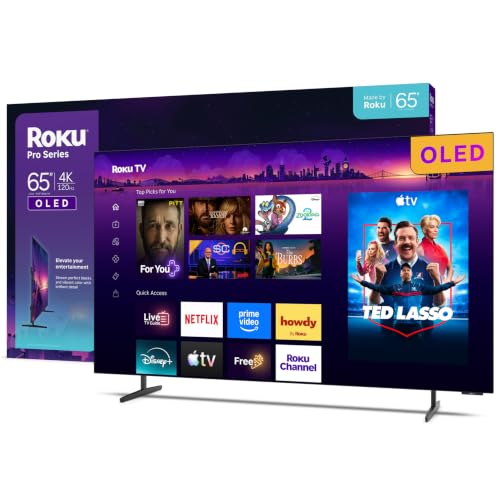
The pro series oled is Roku’s boldest television idea yet: take the Pro Series — the company’s premium line, previously built on Mini-LED — and give it an OLED panel, in 65-inch and 55-inch sizes, at 4K with a 120Hz refresh rate, Dolby Vision, and the Roku platform that remains the simplest smart TV interface most households will ever use. The 2026 Pro Series OLED models are listed as ultra-thin, flat-screen designs with a backlit voice remote, and they arrive as Amazon exclusives in the verified listings used here. This review examines what Roku’s OLED move means for buyers who want OLED picture quality without the complexity or the flagship pricing theatre of the traditional television giants, compares the two sizes, and sets the newcomer against its own Mini-LED predecessor and LG’s OLED evo C4 — the benchmark OLED line against which every value OLED claim must be tested.
Key takeaways
- The 2026 Roku Pro Series moves to OLED: per-pixel blacks and contrast join the simplest smart platform in the business.
- Both the 65-inch and 55-inch are 4K OLED at 120Hz with Dolby Vision, as listed; choose by room and viewing distance, not by specification differences.
- The previous Pro Series, a Mini-LED QLED, remains the brighter-room and value alternative within Roku’s own line.
- LG’s OLED evo C4 is the established OLED benchmark for buyers who prioritise gaming features and picture processing pedigree.
- Roku’s proposition is simplicity: a television your whole household can operate without a manual or a lesson.
In this guide
Quick picks: the four televisions in this review
- Roku Pro Series OLED 65-inch — the subject at cinema size: 4K OLED, 120Hz, Dolby Vision, Roku TV, backlit voice remote, as listed.
- Roku Pro Series OLED 55-inch — the subject at living-room size: the same OLED formula in the smaller frame, as listed.
- Roku Pro Series Mini-LED QLED 55-inch — the predecessor: 4K QLED Mini-LED, 120Hz, Dolby Vision IQ, backlit voice remote Pro, as listed.
- LG OLED evo C4 55-inch — the benchmark alternative: 4K OLED evo, AI-powered processing, Magic Remote, as listed.
Our wider television coverage frames the OLED-versus-everything question for readers still choosing a technology best OLED TVs OLED vs QLED TV guide.
How were these picks chosen?
The two OLED sizes were verified exactly as listed, as 2026 Roku TV models and Amazon exclusives, because a line that shares its name with a Mini-LED predecessor is a trap for the hurried: a Pro Series listing without the OLED designation is a different television. The predecessor is included deliberately, since its continued availability at its own tier is the value question every OLED intender should ask. The LG C4 completes the set as the market’s reference OLED — the television a value OLED must be compared against before its claims are believed. No picture measurements are invented; panel behaviour is discussed in the established terms of OLED and Mini-LED technology, and every product claim is tied to its listing.

Roku Pro Series OLED 65-inch: what does Roku’s OLED flagship feel like?
Badge: Review subject — the cinema-size OLED
- Size and resolution: 65-inch 4K OLED
- Refresh: 120Hz as listed
- HDR: Dolby Vision as listed
- Platform: Roku TV, 2026 model as listed
- Design: ultra-thin flat screen as listed
- Remote: backlit voice remote as listed
- Availability: Amazon exclusive as listed
The picture first, because OLED is a picture argument before it is anything else. Each pixel in an OLED panel makes its own light and, crucially, can switch itself entirely off, so a night scene is not a dark grey rectangle with bright spots on it but actual darkness with lights living in it. At 65 inches that quality becomes architectural: films gain the contrast they were graded for, nature documentaries acquire depth that backlit panels approximate, and the letterbox bars of a widescreen film vanish into the room’s darkness instead of glowing faintly above and below the picture. Roku’s television processing wraps that panel in a presentation tuned for the living room rather than the laboratory — vivid where families like vivid, with the Dolby Vision support that lets compatible films and series present themselves as their makers intended, discarding the one-size picture settings of older sets.
The 120Hz panel matters beyond gaming, though gaming is where it shouts. Sports — the living room’s other great use — render with the motion clarity that makes a fast break or a sweeping camera pan hold together instead of smearing, and the panel’s inherent response speed means the clarity is the honest kind, pixels actually changing rather than processing pretending. For gamers, 4K at 120Hz is the current consoles’ ceiling, and a set that accepts it natively is a set that will not be the bottleneck of a gaming setup for years.
Then there is the Roku of it all, which is the real disruption. The traditional OLED giants build magnificent panels and wrap them in interfaces that feel designed by committee — powerful, cluttered, forever rearranging themselves. Roku’s platform remains the industry’s plainest pleasure: a home screen of apps and inputs in a grid a grandparent can navigate, search that treats every streaming service even-handedly, and a voice remote — backlit in this line, so the buttons find themselves in a dark room — that answers plain speech. An OLED television is a decade-long household fixture, and the interface is the part of it your family will touch ten thousand times. Roku’s bet, and this review judges it a sound one, is that households remember interface kindness longer than they remember benchmark victories.
The ultra-thin design completes the living-room case. OLED panels need no backlight, so the set can be a blade on a stand or a picture on a wall, and at 65 inches that thinness changes the room’s relationship with the screen: it reads as a window when lit and as minimal furniture when dark, rather than as an appliance awaiting use. Plan the mounting honestly — a screen this size deserves a wall position at seated eye level and cables considered before, not after — and the television becomes the room’s calm centre.
Strengths
- True OLED contrast at a cinema size, with Dolby Vision for the films that use it.
- The Roku platform’s simplicity serves the whole household, not just its most technical member.
- 120Hz and an ultra-thin design make it equally serious for sport, games and the room itself.
Trade-offs
- OLED’s full-screen brightness in a sunlit room will trail the Mini-LED predecessor’s punch.
- Picture-processing purists may prefer the established OLED giants’ tuning and gaming extras.
- As an Amazon-exclusive line, in-store auditioning before purchase may not be possible.
Best for: film-loving households, mixed-ability living rooms, and anyone who wants OLED without the flagship giants’ complexity. / Not suited for: very bright rooms, or buyers who must see a set in person before committing.

Roku Pro Series OLED 55-inch: who should take the smaller screen?
Badge: Review subject — the living-room size
- Size and resolution: 55-inch 4K OLED
- Refresh and HDR: 120Hz, Dolby Vision as listed
- Platform and remote: Roku TV with backlit voice remote as listed
- Availability: Amazon exclusive as listed
The 55-inch carries the same OLED formula into the rooms where most televisions actually live. Its virtues are the panel’s virtues entire — the blacks, the contrast, the motion — and its argument is geometric rather than technical. At the viewing distances of ordinary living rooms, bedrooms and smaller flats, 55 inches of 4K fills the eye’s comfortable field without demanding the room reorganise itself around the screen, and the set’s thinness keeps it furniture rather than monument. Buyers stepping up from a 43- or 49-inch set will find the jump cinematic; buyers downsizing from a larger, older LED will find the picture quality’s leap disguises the diagonal’s modesty within a single film.
The size decision deserves the honesty this series applies everywhere: measure your viewing distance, and let it choose. Roughly, the closer seats in a small room belong to the 55, the family sofa at distance belongs to the 65, and no specification difference separates them to rescue a wrong geometry. The 55 is also the kinder choice for a mixed-use room where the television shares the wall with shelves, art and life — present when wanted, recessive when not, in the way OLED’s darkness makes possible.
Strengths
- The full OLED experience in the size most rooms are honestly built for.
- Identical platform and panel virtues to its larger sibling.
- Easier mounting, moving and room integration than the 65-inch.
Trade-offs
- Large-room and cinema ambitions will outgrow it; size regrets are the commonest in the category.
- The same bright-room caveat as every OLED applies.
- Per-inch value usually favours the larger set when both are on offer.
Best for: ordinary living rooms, bedrooms, and first OLED buyers upgrading from mid-size LED sets. / Not suited for: dedicated cinema rooms with distant seating.

Roku Pro Series Mini-LED: the predecessor’s honest case
Badge: Predecessor alternative — brightness and value
- Size and resolution: 55-inch 4K QLED
- Backlight: Mini-LED as listed
- Refresh and HDR: 120Hz, Dolby Vision IQ as listed
- Remote: backlit voice remote Pro as listed
The previous Pro Series remains in this review because it remains in the catalogue, and because it is the right television for a definable reader. Mini-LED backlighting behind a QLED panel produces the brightest, most daylight-defiant picture in this comparison: a sunlit room, a sports afternoon with the curtains open, a household that watches with the lights up — in those conditions the predecessor does not merely compete with OLED, it wins the room. Its Dolby Vision IQ variant even adapts the picture to the room’s ambient light, a feature aimed squarely at real living rooms rather than darkened dens. Its blacks, achieved by dimming zones of backlight, are very good and visibly not OLED’s: in a dark scene a halo can haunt bright objects, and the letterbox bars glow faintly where the OLED’s vanish.
Value completes its case. As the line’s outgoing technology it occupies the friendlier tier, and for a buyer whose room is bright and whose viewing is sport, news and series rather than cinema, the predecessor is not a compromise but the correct engineering bought at the correct moment in its lifecycle. The platform, the remote and the household manners are the family’s shared inheritance; what you are choosing between, in the end, is light made by zones or light made by pixels, and your room’s windows have a vote.
Strengths
- Mini-LED brightness owns bright rooms and daytime sport.
- Dolby Vision IQ adapts the picture to ambient light intelligently.
- The friendlier tier in Roku’s premium line, with the same beloved platform.
Trade-offs
- Blacks and contrast in dark rooms cannot match the OLED models.
- An outgoing generation, whose availability will narrow.
- Thicker and heavier than the blade-thin OLED design.
Best for: bright rooms, daytime sports households and value-led buyers. / Not suited for: dark-room film lovers, who should take the OLED and close the curtains.

LG OLED evo C4: the benchmark every value OLED must face
Badge: Benchmark alternative — the established OLED
- Size and resolution: 55-inch class 4K OLED evo
- Processor: AI-powered Alpha processing as listed
- Remote: Magic Remote as listed
- Model: OLED55C4PUA, 2024 as listed
LG has made more OLED televisions than anyone, and the C series is its beloved middle: the line where the panel technology, the processing pedigree and the gaming feature set meet at the price the enthusiast mainstream actually pays. The C4 brings LG’s mature picture processing — the product of generations spent learning what OLED panels do with poor sources, fast motion and film grain — and a gaming reputation built on low latency and comprehensive support for the features serious players enumerate. Its Magic Remote, a pointer-driven wand, divides households into those who find it liberating and those who find it fussy, and its smart platform is capable and busier than Roku’s plain grid.
Against the Roku OLED, the LG’s case is depth of specialisation: processing, gaming pedigree, a longer track record in the technology. Roku’s counter is the household itself: simplicity, an even-handed platform, and a value proposition that asks why OLED should require expertise. Neither case is dishonest, and the reader’s household — its gamers, its grandparents, its tolerance for menus — is the court that decides between them best 4K TVs for gaming.
Strengths
- LG’s mature OLED processing and the C line’s long, trusted track record.
- A gaming feature set and latency reputation that serious players respect.
- Widely available through many channels, with auditioning often possible.
Trade-offs
- A busier platform and a divisive pointer remote, against Roku’s simplicity.
- The enthusiast’s choice often carries the enthusiast’s tier.
- Households wanting one remote language for everything may prefer Roku’s neutrality.
Best for: gamers, picture purists and buyers who value an established OLED lineage. / Not suited for: households that prize interface simplicity above processing pedigree.
How do the four televisions compare?
The comparison resolves into two axes. The first is light: OLED’s per-pixel darkness against Mini-LED’s zonal brightness, decided by your room’s windows and your viewing hours. The second is philosophy: Roku’s household simplicity against LG’s specialist depth, decided by who holds the remote in your home and what they ask of it. The two Roku OLED sizes then divide by geometry alone. A buyer who can state their room’s brightness, their household’s technical patience and their viewing distance has, with those three facts, already chosen — and the remainder of this review exists to help you gather them without a showroom.
What should you check before buying an OLED television?
How bright is the room, at the hours you actually watch?
Audit your light honestly for a week before ordering. Evening viewers in curtained rooms are OLED’s home crowd. Daytime viewers facing glass are Mini-LED’s. Mixed households should weight the hours that matter most — the film nights or the match afternoons — rather than averaging the day into a fiction. Modern OLEDs are brighter than their ancestors and entirely watchable in ordinary daylight; the question is not survival but which technology flatters your dominant hour.
What size does your distance demand?
Sit where you sit and measure to the wall. At typical sofa distances the 65-inch rewards film and sport with genuine immersion, while the 55-inch serves closer seating and smaller rooms without overwhelming them. The commonest television regret is buying small, because rooms forgive size faster than eyes forgive distance — but a screen that dominates a small room’s every waking hour is its own regret, and only your tape measure can arbitrate.
What will plug into it, now and in three years?
Count consoles, players, sound systems and the streaming habits the platform must serve. A television is a decade fixture that outlives its sources; buy the inputs and the platform for the household you are becoming. If sound matters — and with pictures this good it will — plan the soundbar or system alongside the set, because television speakers, even good ones, are the industry’s universal compromise 4K vs 8K TV guide.
How will it be mounted, and who installs it?
Decide the wall, the mount and the cable path before the box arrives. Large thin panels are two-person objects with a fragility their beauty conceals; a planned installation with help, a rated mount and cables routed once, properly, is the difference between a cinema wall and a leaning anxiety. Renters should confirm what their walls and lease permit while the return window is still a theory.
How do you set up a Pro Series OLED in its first week?
Begin with placement and light: the set at seated eye level, the room’s lamps arranged so none reflects in the panel’s face, the seating at the distance you measured. Then the picture: start from the set’s film-oriented or Dolby Vision presentation for movies rather than the vivid mode it may greet you with, live with accuracy for two evenings, and adjust gently toward your taste only after your eyes have unlearned the old set’s habits. Vivid modes exist to win showrooms; they fatigue a household across a winter of evenings.
Connect your sources one at a time and name them in the interface as you go, so the home screen becomes a map of your actual life rather than a list of port numbers. Set up the voice remote with the household’s real phrases. Enable the panel-care features the set offers and let them run on their schedule — modern OLEDs maintain themselves in standby, and the owner’s whole duty is not to defeat them by switching the set off at the wall. Finally, watch the film you know best, in the dark, at the size you chose. That screening, not the unboxing, is the purchase completing itself.
What mistakes do television buyers keep making?
The first is buying the name of a line rather than its technology — in this very family, a Pro Series without the OLED designation is the Mini-LED set, an excellent television and a different one. Read the full listing title. The second is judging picture quality under showroom light on showroom settings, an examination every set is rigged to pass and none is rigged to survive at home. The third is buying size by aspiration instead of tape measure. The fourth is forgetting sound, then spending a year apologising for a magnificent picture’s thin voice.
The fifth is neglecting the household test: a television is operated by everyone who lives with it, including the least technical person in the room at 11pm. Interfaces, remotes and input-switching that fail that person fail the purchase, whatever the panel’s pedigree — which is, in the end, the strongest structural argument for the Roku sets in this review, and the one their specification sheets are too modest to make.
Final recommendation
For the film-loving household that wants OLED’s picture with a platform the whole family can drive, the Roku Pro Series OLED is the recommendation — in 65 inches where distance allows, in 55 where it does not. Take the Mini-LED predecessor if your room is bright, your viewing is daytime and sport-led, or its tier on the day makes the OLED’s premium hard to justify. Take the LG C4 if gaming depth and processing pedigree outrank simplicity in your household’s values. All four are honest televisions; the Roku OLEDs are simply the first OLEDs whose pitch is aimed at the whole household rather than at its enthusiast bedroom TV buying guide.
Frequently asked questions
Is the Roku Pro Series OLED a different TV from the older Pro Series?
Yes. The earlier Pro Series is a Mini-LED QLED television; the 2026 Pro Series OLED models use an OLED panel, with the per-pixel blacks that implies. They share the Pro name, the Roku platform and the premium position in the line, which is exactly why buyers should confirm the OLED designation in the listing title before ordering.
Should you choose the 55-inch or the 65-inch?
By viewing distance and room, not by specification, since the two share their panel formula and platform. Closer seating and smaller rooms belong to the 55-inch; family sofas at greater distance belong to the 65-inch, which is also the size film lovers regret not buying. Measure your distance, and let the tape decide.
Is OLED bright enough for a living room?
For the great majority of living rooms and viewing hours, yes — modern OLED panels are far brighter than their ancestors and entirely at home in ordinary daylight. The exception is the genuinely sun-flooded room at midday, where a Mini-LED set like the Pro Series predecessor keeps the advantage. Judge by your room’s worst hour, honestly observed.
Do you need to worry about OLED burn-in?
Modern OLED televisions carry extensive built-in care — pixel refresh cycles and shifting — that make permanent image retention a rarity in varied household use. The sensible habits are simple: vary your content, let the set run its maintenance in standby rather than cutting its power, and avoid parking a static image for days. News tickers and game interfaces in normal rotation are what the technology was built to survive.
Is the Roku platform good for gamers?
The panel’s 120Hz refresh and 4K resolution meet the current consoles’ ceiling, and Roku’s input handling is straightforward. Dedicated gaming televisions like the LG in this review offer deeper gaming-specific feature sets, which serious players should compare in detail; for the household whose gaming shares the screen with everything else, the Roku’s balance is the point.
Why is the line listed as an Amazon exclusive, and does it matter?
The verified listings present these models as Amazon exclusives. Practically, it means the purchase happens online without a showroom audition, which raises the value of the return window: install the set, watch your own content in your own light for several evenings, and let that — not a shop floor — deliver the verdict.
How far should you sit from the 55-inch and the 65-inch, and does your room light change the answer?
Measure from your eyes on the sofa to the screen, not from wall to wall, because cushions and a wall mount can shift the real distance by a foot or more. At roughly six to seven and a half feet, the 55-inch fills your view for film without forcing your eyes to chase action, and it is the more forgiving size in a brighter room because its picture is concentrated into a smaller area. At roughly eight to ten feet, choose the 65-inch: dialogue scenes hold their scale, subtitles stay effortless, and sport keeps its sense of occasion. Room light does not change those distances, but it can change which size feels right after dark. In a dim room the larger screen’s perfect blacks make letterbox bars disappear and the image feel more cinematic, while in a room with lamps reflected in the screen, the smaller set is often easier to angle away from the glare.
Should you add an external streaming box or stick, or rely on the built-in Roku platform?
For most households, start with the built-in platform alone and live with it for a few weeks before spending on another box. The Roku interface already gathers the major streaming services, live channels and your other inputs in one grid, searches across services without favouring one store, and is controlled by the same backlit voice remote that controls the television itself, so there is no second remote, no extra HDMI port used and no separate update routine to manage. An external streamer earns its place only for a specific reason: you are already invested in another ecosystem and want its library and purchases carried over unchanged, you need an app the Roku version does not offer, or you prefer that player’s voice assistant. If you do add one, connect it, check that the Roku remote still handles volume through your sound system, and keep the built-in platform as the fallback.
Dolby Vision, HDR formats and what the badges promise
A short decoder for the HDR badges scattered across this review’s listings. High dynamic range content carries brightness and colour information beyond the old standard’s limits, and the formats are the languages it speaks. Dolby Vision, supported across all four televisions here in one variant or another, is the premium language: it carries scene-by-scene instructions that tell the set how to present each moment, rather than one setting for a whole film. Dolby Vision IQ, on the Mini-LED predecessor, adds the room itself to those instructions, adapting to ambient light. The practical guidance is simple: a set that speaks Dolby Vision will show the growing library of films and series mastered in it as intended, and the differences between the variants are refinements rather than revolutions. Buyers should weight the badge as a genuine but second-order virtue — below panel, size and platform — which is where this review has consistently placed it.
The household interface argument, expanded
It is worth pausing on the platform question because reviewers chronically underrate it and households chronically live it. A television’s interface is encountered at tired hours, by visitors, by children, by grandparents, by the household member who did not read the manual because there should never have been a manual. Roku’s grid — apps as tiles, inputs as tiles, search that does not play favourites among services — is the closest the industry has come to the television as appliance: switched on, understood, forgotten. The rival platforms in this comparison are more powerful and more restless, reorganising, recommending and promoting in ways that serve their makers’ ecosystems. Neither philosophy is a trick. But over a decade of evenings, the household that chose the calm interface will have spent measurably less of its life navigating, and that calm compounds exactly like money. When two panels satisfy your eyes, let the remote decide — and audition the remote as seriously as the picture, because your hand will consult it ten thousand times.
Sound: the other half of the cinema
Every television in this review will be paired, sooner or later, with better sound than its own speakers — that is the industry’s open secret, and premium thin designs make it truer, since a blade has nowhere to keep a woofer. Plan the pairing as part of the purchase rather than as an apology after it. A soundbar is the household-friendly path: one box, one cable, dialogue that survives action scenes. A receiver and speakers are the enthusiast’s path, with a ceiling the bars cannot reach. Either way, route the television’s audio through the system once, set the set’s output accordingly, and let the Roku remote’s volume govern the whole arrangement if your equipment supports it — the one-remote household is the interface argument’s natural completion. A magnificent picture with neglected sound is half a cinema; the households that budget both halves from the start are the ones still delighted in year three.
Sport on OLED: the motion argument
Sport deserves its own paragraph in an OLED review because it is where sceptics are converted. Fast team sports stress a panel with panning cameras, fine grass detail and small moving objects, and they expose every weakness a set possesses — smeared motion, dirty-screen uniformity, processing that sharpens the ball and mangles the crowd. OLED’s per-pixel response makes motion clarity a property of the panel rather than a promise of the processor, and the 120Hz refresh gives that clarity room to breathe. The living-room consequence is a match that looks less like a broadcast and more like a window, particularly under evening light when the panel’s contrast joins the argument. Households whose year is organised around fixtures should audition any set with their own sport, in their own light, before the return window closes — the same advice this review gives film lovers, applied to the other religion.
The decade view: buying a television like furniture
Televisions are the longest-lived electronics most households own, and the purchase should be paced accordingly. Across a decade, the panel’s technology will be joined by three generations of consoles, streaming services not yet launched, and standards not yet named — which is why this review weights the durable properties so heavily: a panel with contrast that cannot date, a refresh rate at the current ceiling, a platform maintained by a company whose business is the platform, and inputs enough for sources unborn. It is also why the mid-winter promotion and the launch-week premium alike should be resisted as decision inputs: check the live listing on the day, compare it against the predecessor and the LG on that same day, and let the geometry of your room and the habits of your household — the things that will still be true in ten years — carry the verdict. A television bought that way stops being a gadget purchase and becomes what it always secretly was: a piece of the home’s furniture that happens to show films.
What about 8K, and other future questions?
Readers cross-shopping the future deserve the short answer this site gives consistently: 4K is the present’s complete resolution for living rooms, with the content, the consoles and the streaming libraries all built upon it, while 8K remains a technology in search of its library. A 4K OLED bought today is not a compromise against tomorrow; it is the mature form of the current era, bought at the moment its prices have become civilised. Spend the difference on the size your distance wants and the sound your films deserve, and the future, when it eventually broadcasts something worth watching in 8K, will find you unbothered and well seated.
The first film night: a small ceremony worth performing
New televisions are usually inaugurated accidentally, with whatever happens to be on. Do it deliberately instead. Choose the film your household knows best — the one whose dark scenes and bright ones you can recite — dim the room to its evening state, set the sound through whatever system you have arranged, and watch it whole. The differences an OLED makes are most legible against memory: the night sky that used to be grey, the face half in shadow that used to be mush, the credits that used to float on a glowing rectangle. That screening is also the household’s training session, where everyone learns the remote, the inputs and the voice commands in the warmth of a good film rather than in the cold of a setup menu. Products that will serve a decade deserve an evening’s ceremony at the start of it, and households that perform the ceremony rarely return the television.
Hold the ceremony’s standard against the deliberation that precedes it, and the choice among these four televisions becomes almost embarrassingly personal: the room you will dim, the sofa you will sit on, the hands that will hold the remote, the films you already love. The Roku Pro Series OLED was designed for exactly that personal scale — a flagship picture that does not require a flagship personality to operate it. For most households reading this, that is not the safe choice between these televisions. It is the inspired one.
Delivery day: receiving a large thin television without incident
A practical interlude that has saved more purchases than any picture setting. A 55- or 65-inch OLED arrives in a box that is itself furniture-sized, and the panel inside is at its most vulnerable before it reaches the wall. Accept the delivery with help available, inspect the box’s condition before signing anything, and keep every piece of packaging until the set has survived its first week — returns of large panels without their boxes range from awkward to impossible. Lift the panel by its frame as the maker’s guide directs, never by the screen’s face, and rest it only on the soft, flat surface the instructions bless. Power it on first while it still stands in its packaging cradle if the guide permits, and run a full-screen field of black, white and colour in a dimmed room: uniformity questions are answered in five minutes on day one, while exchanges are simple, rather than discovered across a month of evenings. None of this anticipates a problem — most sets are flawless — but a decade-scale fixture deserves a decade-scale first hour.
Energy, heat and the running costs of a big screen
A word on the unglamorous ledger. OLED panels draw power in proportion to what they show — a dark film sips, a bright sports broadcast drinks — which makes their real-world consumption kinder than a fixed-backlight set’s in the evening-heavy households that buy them. They also ask for standby power to run their panel care, which is a feature to honour rather than defeat: the pennies spent in standby are the maintenance budget of a panel expected to serve a decade. Ventilation matters more than consumption in daily practice; a thin set mounted flush still needs the breathing room its guide specifies, and a cabinet that bakes any television will shorten its life regardless of technology. Treat the set as the appliance it is — powered, ventilated, maintained by its own routines — and the ledger stays boring, which is all a household ever asks of it.
Boring ledgers and decade service are, in the end, the Roku proposition translated into ownership: a television that asks little, explains itself to everyone, and saves its drama for the screen. The Pro Series OLED adds the picture that drama deserves. Measure your room, count your light, choose your size, plan your sound — and then enjoy the rare technology purchase whose second year is better than its first week, because by then the whole household has stopped noticing the television and started simply watching it.
For upgraders: what your old set cannot tell you about this one
Most buyers of this television are replacing an LED set of respectable age, and they deserve a preview of the adjustment, because the first week with OLED has a shape. The first evening is the darkness: scenes you have watched for years reveal their shadows, and the room itself seems quieter around the screen. The second discovery is the interface, if your old set’s platform had trained you to tolerate archaeology — the Roku grid will feel less like an upgrade than like a apology finally delivered. The third is size discipline: a new set at the same diagonal as the old will look larger, because its picture fills its frame to the edges in a way older bezels never allowed, and households occasionally discover their measured distance was optimistic. Give the set its week, in your light, with your films, before judging any of it. Upgrades of this scale are not evaluated; they are inhabited, and inhabitation is the only honest review a television ever receives.
Inhabit it, then. Dim the room, cue the film you know by heart, and let the panel make its case in the only courtroom that has ever mattered for a television — your own living room, on an ordinary evening, with the people the purchase was really for sitting beside you. If the Roku Pro Series OLED wins there, as its design wagers it will, no benchmark in this review or any other will be needed to confirm the verdict.
Summary for the reader in a hurry
The 2026 Roku Pro Series OLED, in 65 or 55 inches by your tape measure: OLED contrast, 120Hz motion, Dolby Vision, and the calmest platform in the business — the household flagship. The Mini-LED Pro Series before it: the bright-room, value-led alternative that shares the platform and wins the daylight. The LG OLED evo C4: the specialist’s benchmark, for gaming depth and processing pedigree. Choose by your room’s light, your household’s patience and your sofa’s distance, verify the OLED designation in the listing, and give the winner its first film night before you judge it. That is the whole review in a paragraph; the preceding pages are merely its evidence.
Evidence weighed, the recommendation returns to the household it began with. Televisions are bought by individuals and lived with by everyone, and the Pro Series OLED is the rare flagship designed for the living-with — its picture for the film lover, its platform for the grandparent, its remote for the dark room, its thinness for the wall. Buy it at the size your room measured, feed it the sound it deserves, and let it become what the best televisions become: not the room’s gadget, but its window.
A note on buying at launch and buying later
Because these are 2026 models, some readers will be meeting them near the start of their retail lives, and launch timing deserves one honest paragraph. Early buyers pay for immediacy and accept the small uncertainties of any first production season; patient buyers inherit the corrections, the reviews of long-term owners, and the tier movements that follow a line’s first months. Neither temperament is wrong, and this review’s method — room, light, household, distance — is deliberately indifferent to the calendar, because those facts do not change with a promotion. Check the live listings when you are ready, compare the OLED against its predecessor and the LG on the same day, and buy when the comparison and the calendar agree. A television that will serve a decade can wait a month for its moment; it cannot un-wait a decade of the wrong size.
The wrong size, the wrong light, the wrong interface — those are the only lasting mistakes available in this comparison, and all four televisions in it are innocent of them when matched to the right room. Match yours, and the Pro Series OLED will do the rest: quietly, thinly, and in the dark, beautifully.
Children, guests and the television as household commons
One final test separates household televisions from enthusiast televisions, and it happens on the first weekend: a child wants a cartoon, a guest wants the match, a grandparent wants the news, and nobody wants a tutorial. The Roku sets in this review were built for that weekend — a home screen a stranger can read, a voice remote that forgives phrasing, profiles and controls that keep the household’s peace. Enthusiast sets survive the weekend too, usually with the enthusiast conscripted as permanent staff. Count the cost of that conscription honestly when you choose; it is paid in small instalments for a decade, and it never appears in a specification table. The panel may be the television’s glory, but the commons is its job, and on the evidence of its platform, the Pro Series OLED understands the job description completely.
Understands it, and — on the strength of the OLED panel now behind that understanding — elevates it. The commons with a cinema’s picture, the appliance with a flagship’s heart: that is the whole of the Pro Series OLED’s claim, and it is a claim no rival in this review quite duplicates. Households that recognise their own evenings in that sentence have found their television.
The checkout checklist for a large television
Consolidate the review into the final minute. One: the listing says OLED — not merely Pro Series — and the size matches your tape measure’s verdict. Two: the delivery path into your home fits the box, and help will be present on the day. Three: the mount or stand, the wall and the cable route are decided, with sound planned rather than postponed. Four: the household’s sources are counted and the platform will serve them all. Five: the packaging survives until the first film night has passed and the panel has shown its uniformity in your light. A buyer who can tick those five lines is not gambling on a flagship. They are installing one, and the decade of evenings that follows is the return on that single careful hour.
Gaming on the big screen: consoles, PCs and the living-room rig
The living-room gaming rig deserves its own closing analysis, because it is where this television’s specifications converge most completely. The current consoles were designed for exactly this class of set: 4K resolution, high refresh, variable refresh to smooth their performance modes, and HDR as the house standard. On a 65-inch OLED those capabilities stop being menu items and become the room’s physics — the racing game that fills your peripheral vision, the adventure whose night scenes finally look like night, the split-screen session where each player’s half of the panel remains a genuine window rather than a postage stamp. PC players bringing a tower to the sofa gain the same panel with the desktop’s flexibility, provided their seating, their input devices and their cable runs were planned with the honesty this review has preached throughout. Two cautions complete the picture. Latency modes matter: use the set’s game mode for anything competitive, since the processing that flatters films can tax inputs. And session habits matter on OLED, as this review has noted — varied content, the set’s care routines left to run, the static interface given no permanent parking place. Observed, those habits cost a gamer nothing and buy the panel its decade. The result is the living room’s oldest dream in its newest form: one screen, every machine, no compromises that the people playing can actually see.
Streaming sticks, boxes and the platform’s even-handedness
One platform virtue deserves its own section because it decides real household arguments: Roku’s search and home screen treat the streaming services as equals. When a film lives on three services, the Roku way is to show you the three doors rather than to push the one its maker owns shares in, and when a household’s subscriptions change — as they now rotate quarterly in many homes — the television’s loyalty stays with the household. Owners with existing streaming boxes should know those boxes remain welcome on the HDMI ports, and many households keep a favourite box plugged in for its own interface while the Roku platform handles the television’s daily life; the set does not punish the arrangement. Voice search across services, watchlists that follow the viewer rather than the vendor, and updates that arrive without turning the home screen into an advertisement for a store — these are the platform’s mature manners, and they are the reason Roku’s owners, surveyed in any form, tend to sound less like customers and more like residents. A television is a resident too. Choose the one whose manners you can live with for a decade, and let the panel — in this case a superb one — be the second reason rather than the only one.