Disclosure: As an Amazon Associate, reviewstook.com earns from qualifying purchases. Links to Amazon on this page are affiliate links; they cost you nothing extra.
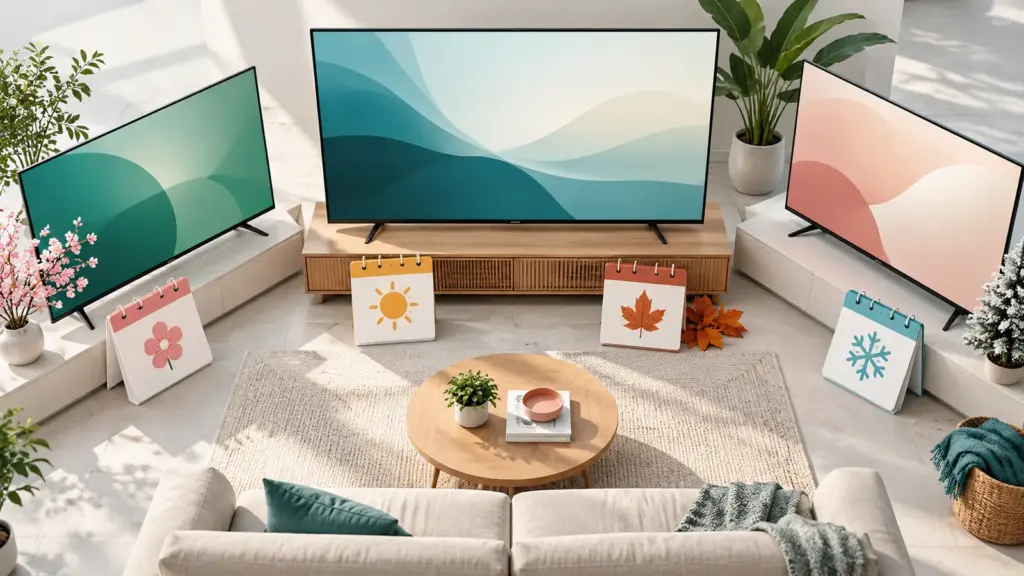
TV prices change through the year, and the right timing can save real money. No calendar is guaranteed, but several patterns repeat. This guide explains them so you can decide when to wait and when to buy.
This guide is based on product listings and general TV knowledge rather than our own testing. Specs and features vary by model and year, so confirm the details on the product page.
By the Reviewstook Editorial Team. Last updated: November 1, 2026.
The Model-Year Cycle
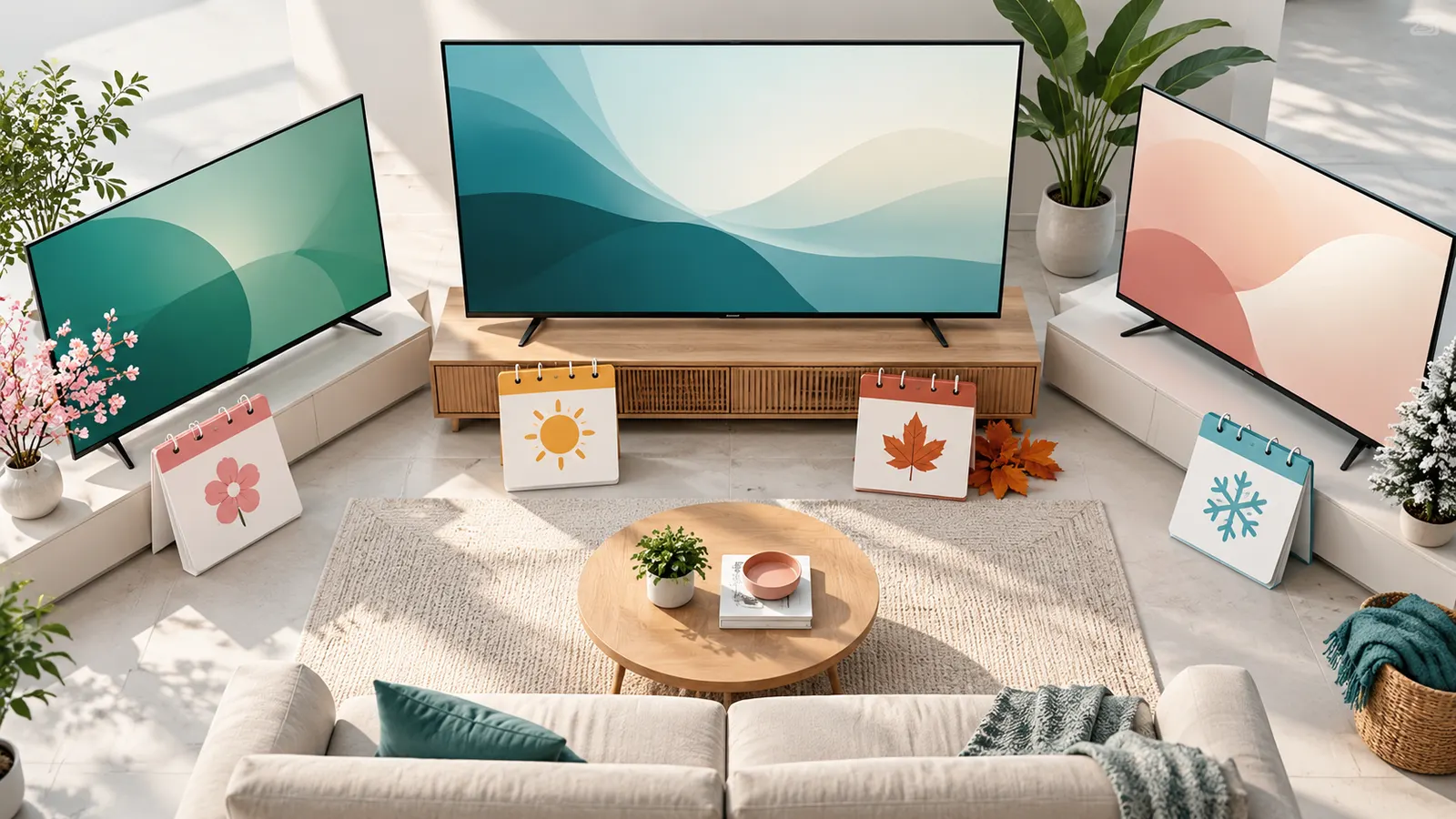
Most brands announce new TVs in the first half of the year and release them in spring. As the new models arrive, the previous year’s sets are often discounted to clear stock. If you do not need the newest features, last year’s model can be the best value.
In this guide
Seasonal Sale Events
Retailers typically cut prices around a few periods: before big sports events, during the late-year shopping season and around mid-year sales events. Discounts vary by size and brand, so use these as a guide, not a rule.
How to Judge a Deal
A sale price only matters if you know the usual price. Track a model for a few weeks, note the normal price range and compare similar models. Be careful with “was” prices that look unusually high.
Also check what is included: warranty length, return window and whether the listed model is a store-exclusive variant with slightly different specs.
Model Numbers and Variants
The same product line can have regional or retailer-specific versions that differ in panel type or features. Compare the full model number, not only the marketing name, and read the product page carefully.
When Not to Wait
- Your current TV has failed or is unusable.
- You found a deal at a price you are happy with and the return policy is flexible.
- You are buying a rarely discounted model, such as some premium sets.
Practical Buying Checklist
- Set a budget and a size range first.
- Compare two or three models in your price range.
- Check the return window and the price-adjustment policy.
- Watch for accessories you also need, like a mount or HDMI cable.
A Simple Price-Tracking Method
- Pick two or three models you would be happy with.
- Check their prices once a week for a month.
- Note the lowest and typical prices.
- Buy when one reaches the low end of its range and you are comfortable with the return window.
Prices on Amazon and other retailers can move quickly, so confirm the current price on the product page before you buy. This reviewstook.com page does not track live prices.
Common Timing Mistakes
- Waiting for a sale that never reaches your size or model.
- Buying on the first day of a new model at full price when last year’s is almost the same.
- Ignoring return policies and warranty length.
- Buying an old model with a missing feature you will want, such as HDMI 2.1 for gaming.
Timing Your Purchase by the Feature You Need
The best moment to buy often depends less on the calendar and more on what you want the TV to do. If your needs are simple, such as streaming and watching shows, many models from the current and previous years will serve you well, and waiting for a feature you will never use is not worth the delay. If you have a specific need, though, timing can matter.
Gamers, for example, may care about HDMI 2.1 ports, variable refresh rate and a low-lag game mode. Those features appear on more models each year, so a previous-year set may already include what you need, and you can compare listings to confirm. Sports fans may care about brightness and motion handling. Movie fans in dark rooms may care about black levels. Bright-room viewers need strong brightness and low glare. Write down the two or three features that matter most, and check the product listing for each candidate.
- If a feature is already on last year’s model, there is little reason to wait for the new one.
- If a feature is new and you need it, expect to pay a higher price at first.
- If you only want a bigger screen, compare sizes across models, since larger versions of the same line can be priced differently.
- Read specifications on the product page and manual, because marketing names can hide differences.
Knowing your priorities makes it easier to judge whether a discount is a good fit or just a low price on the wrong set.
Open-Box, Refurbished and Display Units
Another way to save is to look at units that are not brand new in the box. These come in several forms, and the terms vary by seller, so read the listing and the seller’s policy carefully.
- Open-box: a unit that was bought and returned, or opened and not used. Condition and included accessories can differ, so check what the seller says about the box, remote, stand and cables.
- Refurbished: a unit that has been inspected or repaired, sometimes by the maker and sometimes by a third party. Ask who did the work and what warranty applies.
- Display model: a unit used in a store. It may have been on for long hours, so ask about screen condition and warranty coverage.
The key questions are the same for each. What is the warranty, and who honors it? What is the return window? Is the model number exactly what you expect? Are any parts missing? Inspect the screen carefully on arrival for scratches, dead pixels, uneven patches and cracks, and test all ports. If anything seems wrong, return it within the window.
These options can offer good value, particularly for a secondary room, but they carry more variation than new sets. If you want the least risk, a new unit with a clear warranty may be the better choice.
Counting the Total Cost of the Purchase
A low sticker price can hide extra costs, so add up everything you need before you compare deals. A TV rarely works as a complete setup right out of the box, and the extras can change which offer is really cheaper.
- Mounting or stand: some sets come with feet, while mounting hardware is usually separate. Check the VESA pattern and weight limit.
- Cables: a high-speed HDMI cable may be needed for 4K and gaming features.
- Sound: built-in speakers are modest, and many buyers add a soundbar later.
- Delivery and installation: large screens can be heavy, and some sellers charge for delivery or setup.
- Protection plans: extended coverage may be offered. Read what it covers and for how long, and compare it with the standard warranty.
- Old TV disposal: some places charge a recycling fee or require special handling.
Make a short table in your notes with the TV price and the extras for each option. A model that costs a bit more but includes a longer return window or free delivery may be the better offer. Likewise, a bundle can be good value only if you would have bought the extra items anyway.
Always confirm the final price at checkout, since taxes and shipping may vary.
Avoiding Pressure and Misleading Offers
Sale seasons are full of urgent messages, such as countdowns, limited stock notices and doorbuster banners. Some of these are real, and some are marketing. The best defense is a plan made in advance: know your size, your features and your price range, then ignore anything that falls outside them.
Be careful with comparisons that may not be like-for-like. A sale model may have a slightly different model number from the one in reviews, with a different panel or fewer features. A bundle may include items you do not need. A strikethrough price may be inflated. Look at the full model number and compare the specifications on the product page, not just the name.
- Check the seller. Make sure the product is sold by the retailer or a reputable seller, and read the return policy.
- Be wary of deals that seem far below typical prices for the same model.
- Avoid paying extra to avoid missing out. If the offer ends, another will likely appear.
- Take a screenshot or note of the listing details in case you need them later.
- Read the fine print on financing offers, including interest and fees.
Patience protects you. If you cannot confirm the details quickly, step away and come back after you have checked.
Deciding Whether to Replace Now or Keep Waiting
The final question is whether your current TV can wait. There is no shame in keeping a set that works well, and no reason to rush if it does. Consider how it performs and whether it meets your needs.
Signs that it may be time to replace include a failing screen with lines, dark patches, flicker or severe color problems, a power or boot issue, apps that no longer run or update, broken HDMI ports, and a picture that is too dim to see in your room. A repair may be possible, but compare the cost with a replacement and consider the age of the set. If your needs have changed, for example you now have a game console or a bigger room, a new TV may help even if the old one still works.
- Test with another source and cable first, since the problem may not be the TV.
- Ask for a repair estimate before deciding, if the set is still under warranty.
- If you can wait, set a target price and a deadline, and watch the model.
- If you cannot wait, buy from a seller with a flexible return window.
- Plan how to move or recycle the old set safely.
A calm decision based on your own needs usually beats a rushed one based on a countdown banner.
Glossary of TV Shopping Terms
Retail pages and spec sheets lean on jargon, and a few words can steer you wrong if you misread them. This short glossary covers the terms that matter most when you are timing a purchase and comparing models.
- Model year: the batch of TVs a maker releases in a given year; older batches are usually replaced in spring and early summer.
- Panel type: the display technology, such as LED with local dimming, OLED or QLED; each has its own strengths.
- Refresh rate: how many times per second the screen updates; higher values suit fast motion and gaming.
- HDR: high dynamic range, a way of showing brighter highlights and deeper shadows when the content supports it.
- Local dimming: a feature that dims parts of the backlight to improve contrast.
- Open box: an item returned and resold, sometimes in new condition, sometimes with signs of use.
- Clearance: stock a store wants to move to make space for a newer arrival.
If a listing uses a term you do not know, look it up before you decide. A small piece of knowledge can save you from paying for a feature you do not need.
Matching Your Timing to Your Room and Use
The best moment to buy depends on what you plan to do with the set. Think about the room first. A bright living room benefits from a screen that handles glare well, while a dark basement suits a display with deep blacks. Then think about use: daily news, streaming, sports or games.
| Your situation | Timing thought |
|---|---|
| Big event on the calendar, such as a major sports final | Plan ahead so you are not rushing; waiting until the last week limits your choices |
| Current TV works fine | You can wait for a sale season or a model-year change |
| Current TV is failing | Compare a few models now; a stopgap can bridge the gap until a better time |
| Moving to a new home | Measure the new space first; buy after you know the layout |
| Gaming console upgrade | Check the ports and refresh rate the console supports |
If your need is not urgent, patience is your best tool. If it is urgent, a good choice today beats a perfect choice that arrives too late.
Building a Shortlist Before the Sales Begin
Sales move fast, and it is easy to be swept up by a headline. Prepare in advance by making a shortlist of three or four models that meet your needs. Write down the screen size, the panel type, the key features and the model numbers. Check the physical dimensions against your wall or stand, including the width of the stand feet.
When a sale appears, you can compare quickly rather than begin from scratch. Look at the exact model number on the listing and make sure it matches your shortlist, since retailers sometimes sell variants with small differences. Read the return policy before you buy, and keep the box and packing material until you are sure the set works well. If anything about the offer feels rushed or unclear, step back and wait for the next opportunity.
Warranty, Returns and Protection Plans
The period around a major sale can bring generous return windows, though policies differ by store. Check the length of the return period, any restocking terms, and whether returns need the original packaging. Take a photo of the set after unpacking, and test every input you plan to use within the window.
Warranty terms come from the maker, and they usually cover defects for a set period. A protection plan from the retailer is optional and varies in what it covers. Read the fine print and compare it with what your credit card or home insurance may already provide. Never buy a plan on impulse at the checkout. Keep your receipts and warranty documents in one folder, and register the product with the maker if that is offered.
Setting Up the New TV for a Good First Impression
Once the TV arrives, spend a little time on setup. Place it on a stable surface or wall mount designed for its weight and size, and follow the maker instructions for assembly. For a wall mount, use the correct bracket and, if you are unsure about the wall, ask a qualified installer.
Walk through the picture settings. Many TVs ship with a vivid mode that looks bright in a showroom but unnatural at home. Try a movie or cinema mode, adjust the backlight to suit your room, and turn off extra processing if it makes motion look odd. Update the software through the settings menu, connect only the devices you use, and set up your streaming apps. Take your time, and you will enjoy the purchase for years.
Common Timing Traps to Sidestep
Even careful shoppers fall into a few predictable traps. One is waiting for a perfect moment that never arrives, while the current set keeps annoying the household. Another is buying on the first day of an event without comparing, simply because the headline sounds exciting. A third is choosing a model because it is on sale rather than because it suits the room. A fourth is overlooking the extras: a wall mount, a sound bar or longer cables can add to the final cost and take time to arrange.
A calm approach avoids all of these. Decide your needs, set a shortlist, watch a few offers, and buy when a model on your list reaches a level you are happy with. If it does not, there will be another chance. Technology moves steadily, and a good TV bought sensibly will serve you well, whatever month it arrives.
Reading the Model-Year Calendar Like a Retailer
Television pricing follows the industry’s calendar, and understanding that calendar turns guesswork into a plan. New ranges are typically announced early in the year and reach shops through the spring. At launch, prices sit at their highest, because the newest sets carry the newest features and there is no older stock competing with them. Through the summer, prices soften gradually. The sharpest movements tend to come when retailers need the shelf space and the warehouse room for the next cycle, which is why the outgoing range often reaches its lowest prices in the weeks before and during the arrival of its replacement.
The buyer’s opportunity hides in that handover. When a new range lands, shops must decide what to do with the previous one, and the answer is usually to clear it. The catch is that clearance is uneven: popular sizes sell out early in the clearance window, while very large and very small sizes linger. If your heart is set on a mainstream size of an outgoing model, the moment the replacement is announced is your signal to start watching daily rather than weekly. If you can accept a less common size, patience is rewarded more often, because those are the sets still sitting in the warehouse when discounts deepen.
There is also a quieter pattern within each month and season worth knowing: retailers build promotions around paydays, holiday weekends and major sporting events, and manufacturers sometimes support those promotions with temporary funding that disappears when the event ends. None of this guarantees a lower price on the exact model you want, which is why the price-tracking method elsewhere in this guide matters more than any calendar. The calendar tells you when to pay attention; your own recorded prices tell you when to act.
Repair or Replace: The Decision Behind Many Purchases
A large share of TV purchases are not planned upgrades but forced replacements, and the forced buyer has a different timing problem: how long can the household manage without a set, and is repair worth considering first? A repair is usually worth pricing when the fault is simple and the set is otherwise well matched to the room, such as a failed backlight strip or a faulty power board on a mid-range set that still has the features you need. It is harder to justify when the panel itself is damaged, when the set lacks connections your other equipment now requires, or when its smart platform has stopped receiving the apps you use.
Get the repair quote before shopping seriously, because the quote frames the budget conversation. If repair costs a small fraction of an equivalent new set and returns a television you are happy with, waiting for a sales event becomes painless: you can repair, watch comfortably, and buy the replacement at the best point in the calendar rather than the worst. If the set is beyond economic repair, the same logic runs in reverse: buy the best current deal on a model you have already researched rather than paying a premium for urgency. Households that keep a short list of acceptable models, updated once a year, are never truly forced buyers, because the research is already done when the old screen goes dark.
The Total Cost of the Purchase, Not Just the Screen
Timing decisions often focus on the television’s ticket price and forget everything that travels with it. A larger set may need a new stand or a wall mount rated for its weight. A thinner set with poor speakers may push a soundbar from optional to necessary. Delivery, installation, an extra HDMI cable of the right rating, and an extended warranty if you value one all belong in the real total. A discount that looks dramatic on the screen alone can shrink once the necessary companions are added, and a slightly more expensive set that needs nothing extra can be the cheaper purchase overall.
This matters for timing because accessories follow their own sales patterns, and not always the same ones. If a promotion bundles a mount or a soundbar you genuinely need, its value may beat a larger discount on a bare set elsewhere. Read bundles carefully, though: the included item should be one you would have bought anyway, at a specification you would have chosen. A bundle built around an accessory you do not want is not a saving; it is a distraction from the price of the screen itself. List what you need before you shop, price the list as a whole at two or three retailers, and compare totals rather than headlines.
Buying for a Deadline: Moves, Events and Gifts
Sometimes the calendar is not the retailer’s but yours. A house move, a major sporting event you are hosting, or a television bought as a gift all impose a date, and the strategy changes from finding the lowest possible price to securing the right set in time at a fair one. Work backwards from the date. Allow time for delivery slots to fill, for a possible exchange if the first set arrives with a fault, and for installation if the set is going on a wall. A prudent buffer is a couple of weeks; buying the day before an event turns every small delay into a crisis and every price into a take-it-or-leave-it offer.
For gifts, the return window is the feature that matters most. Buy from a retailer whose window comfortably covers the giving date, keep the receipt accessible to the recipient, and favour models whose size suits a typical room rather than the largest screen the budget allows, since the recipient’s stand, wall and viewing distance are unknown to you. For event-driven purchases, remember that prices around major sporting tournaments are promoted heavily precisely because demand peaks; the promotion is real, but so is the pressure, and a model researched calmly in advance will serve you better than a bargain seized under time pressure in the shop.
Price Promises, Matching and the Art of Asking
Many retailers operate price-adjustment or price-matching policies, and these policies change the risk calculation of buying now. If a shop will refund the difference when its own price drops within a stated window, buying at a good price today carries less regret risk, and the value of waiting falls. Read the conditions before relying on this: windows vary, some policies exclude promotional periods or clearance stock, and matching against other retailers usually requires the rival offer to be identical, in stock and from an authorised seller.
It is also worth simply asking, politely, in store or through the retailer’s chat, whether any promotion is scheduled on the model you want or whether an expiring display unit is available. Staff will not always share future pricing, but display units and end-of-line stock are often negotiable in a way that a current model is not. If you consider a display unit, inspect it as the open-box guidance in this guide suggests, check its hours of use if the service menu allows, and make sure the warranty position is written down, since a set that has run in a bright showroom for months has lived a harder life than its age suggests.
How Long a Television Should Last, and What That Means for Timing
A modern television should give many years of service, and the practical limits are usually not the panel but everything around it: smart platforms lose app support, connection standards move on, and backlights dim gradually. This reframes the timing question. Buying the outgoing model at a clearance price is excellent value if its platform and connections will serve your household for the years you intend to keep it. It is poorer value if you will be forced into a replacement or a pile of workaround boxes in two years because an essential app or port is missing.
So judge a bargain against your realistic keeping period. Households that replace sets rarely should weight platform support, connection standards and the maker’s update record more heavily, and may find the newer model at a higher price the better long-term buy. Households happy to change sets more often can take clearance bargains with a clear conscience, because the shorter horizon makes the missing future-proofing irrelevant. Neither answer is wrong; the mistake is buying to one horizon while judging the price by the other.
More Questions About When to Buy a TV
Do new models always make last year’s model a bargain?
Usually, but not automatically. Some years bring only small changes, which makes the outgoing model excellent value. Other years bring a feature your household genuinely needs, such as a connection standard for a new console, in which case the older set is cheap for a reason. Compare the actual feature lists rather than assuming, and remember that stock of the most desirable outgoing models can vanish early in the clearance period.
Is it worth waiting for a specific sale if my TV still works?
If your current set works and meets your needs, waiting costs you nothing but time, so the answer is often yes, provided you use the wait to track prices on named models rather than drifting. Set yourself a target price based on the range you observe, and a deadline after which you will buy anyway. An open-ended wait tends to become permanent, while a defined one captures most of the saving on offer.
Should I buy the extended warranty during a promotion?
Judge the warranty on its own terms, not on the excitement of the deal. Consider the set’s price, how long you will keep it, what the warranty actually covers, and whether accidental damage is included or only mechanical failure. Promotional pricing on the television does not change that arithmetic. If you buy one, keep the documents with the receipt and note the claim process somewhere you will find it in three years’ time.
Does the size I want change the best time to buy?
Yes. Mainstream sizes are stocked deeply and discounted competitively, but they also sell out first during clearance. Very large sizes are discounted heavily at certain points because retailers need the floor space, yet the choice of models is narrower. The practical response is the same in both cases: know your acceptable models in advance, track them, and be ready to move when your size and your price arrive together.
Regional and Retailer Differences Worth Knowing
The television market does not move in lockstep everywhere. Model ranges, names and even panel specifications can differ between regions for what looks like the same television, and release dates drift by weeks or months between countries. Advice written for another market, including sale dates and model recommendations, should be treated as a pattern to look for rather than a timetable to trust. The reliable version of any timing advice is local: your retailers, your model numbers, your recorded prices.
Retailers differ in character too. Warehouse clubs tend to sell a narrow range of high-volume models, sometimes with retailer-specific model numbers, at steady competitive prices rather than dramatic promotions. Specialist electronics retailers carry the widest range and the most clearance activity at model changeover. Department stores discount around their own event calendar. Online marketplaces add a third pattern, with prices that can move daily and third-party sellers whose warranty and returns terms deserve a careful read. Knowing which pattern a shop follows tells you whether the price in front of you is that shop’s best behaviour or merely its ordinary one.
Second Screens and Bedroom Sets: A Different Clock
Not every television in the house needs the main-room strategy. A bedroom, kitchen or spare-room set is usually bought to a simpler brief: adequate size, the apps the household uses, sound that survives a duvet or a kettle. For these, the deepest discounts on premium ranges are beside the point, and the best timing is simply whenever a solid mid-range model in the right size dips, which happens far more often than the headline events suggest. These sets also make the best use of hand-me-down logic: when the main room upgrades, the old set often becomes an excellent second screen, which is another reason to time the main purchase well rather than urgently.
If you are buying several sets at once, for a new home or a rental property, ask about multi-item pricing and delivery together, and consider whether standardising on one platform across the house is worth more than squeezing each set’s individual price. One remote layout and one menu system in every room is a daily convenience that outlasts a small per-set saving.
Watching Prices Without Wasting Your Life
Price tracking works only if it is light enough to sustain. The method in this guide, a weekly check on two or three named models, takes minutes. Strengthen it slightly and it becomes powerful: record the price with the date and the retailer, note any bundle or warranty included, and keep the list somewhere you will actually see it, such as a note on your phone. When a price drops, you will know whether it is a genuine fall or a return to the usual level after a quiet rise, which is the oldest trick in promotional pricing.
Set an alert where the retailer or a price-tracking service offers one, but do not let alerts replace the shortlist. An alert on the wrong model is noise. Also decide your walk-away rule in advance: the price at which you will buy without further deliberation, and the date after which you will buy at the best available price because the household needs the set. Those two numbers convert weeks of vague watching into a decision that makes itself, which is the real prize of all this timing advice: not the perfect price, but a good price, confidently taken, with no regrets afterwards.
Environmental and Disposal Considerations When You Replace a Set
A replacement purchase includes an old television that has to go somewhere. Retailers in many regions will take the old set away when delivering the new one, sometimes as part of the delivery service; ask when ordering rather than on the doorstep. A working old set has options beyond recycling: a relative, a spare room, a local charity that accepts electrical goods, or a sale that offsets part of the new purchase. A faulty set should go through proper electrical waste channels, since panels and backlights contain materials that do not belong in household rubbish.
Timing can help here too. If the old set still works, you can choose a replacement at leisure and arrange the kindest onward home for it. If it has failed, the pressure to dispose and replace at once is how households end up paying for rushed delivery and the first available model. One more argument, if any were needed, for keeping that researched shortlist ready before you need it.
What to Do While You Wait: Preparing the Room and the Shortlist
Waiting for the right moment need not be dead time. Measure the room properly: the viewing distance, the width of the stand or the wall space, the position of sockets and the aerial point, and where sunlight falls during your main viewing hours. Photograph the back of your current setup so cable lengths and connection types are recorded. These details decide which models genuinely fit, and discovering them after a delivery is how good bargains turn into exchanges.
Use the wait to settle the questions that have nothing to do with price. Decide the size range, the two or three features that matter, the platform your household prefers, and the sound plan, whether that is the set’s own speakers, an existing soundbar or a future one. When the price moment arrives, you will be choosing between known quantities rather than researching under pressure, and you will be able to recognise the right deal in a single look at your notes. That readiness, more than any single sale date, is what separates buyers who feel lucky from buyers who were prepared.
A Brief Note on Financing and Interest-Free Offers
Large televisions are often sold with financing, and promotions sometimes make the finance the headline rather than the set. Judge the two separately. The right television at the right price is a good purchase with or without a payment plan; a payment plan does not improve a television that is wrong for the room or a price that is not genuinely low. If you use interest-free credit, note the term and the consequences of missing a payment, keep the total you will pay in view, and make sure the arrangement does not pressure you into a larger screen than the room and your shortlist called for. Retailers time these offers to the same promotional calendar as everything else in this guide, so the calm approach still applies: shortlist first, track the price, and treat the finance as plumbing, not as the prize.
The One-Page Summary to Keep
If this guide has a single practical output, it is a page of notes: your room measurements, your size range, your two or three must-have features, your shortlist of named models with their full model numbers, the typical price you have observed for each, the price at which you will buy immediately, and the date after which you will buy regardless. Keep it on your phone or pinned near the television. Update the prices weekly while you are actively looking, and glance at it whenever a promotion tempts you, because most bad purchases happen when an eye-catching discount on an unresearched model interrupts a plan that was working. With that page in hand, the calendar in this guide becomes what it should be: background knowledge that tells you when to look, while your own numbers tell you when to act.
Frequently Asked Questions
Is it cheaper to buy last year’s TV model?
Often yes. When new models arrive, older ones are frequently discounted, and the differences can be small.
Are TV prices lower in a particular month?
Prices often drop around big sales periods, but the timing and amounts vary every year.
Should I wait for the next model?
Wait only if you need a feature the new model adds or you can tolerate a delay. Otherwise a good deal now is fine.
Do prices change quickly?
Yes. Prices on Amazon and other stores can change within a day, so check the current price on the product page.
Is it worth buying an open-box TV?
It can be, if the seller explains the condition and offers a warranty and returns. Inspect the screen and ports right away, and compare the total price with a new unit.
Should I buy an extended warranty?
It depends on the coverage, the cost and the standard warranty. Read what is included and who handles claims, then decide whether it suits your situation.
How long should I track a price before buying?
A few weeks is often enough to see the usual range. If the price falls to the low end of that range and you are comfortable with the return window, it may be a good time.
Does a bigger TV always cost proportionally more?
Not always. Price differences between sizes vary by model and time of year, so compare sizes within the same line to see whether the step up is reasonable.
Can I get a refund if the price drops after I buy?
Some retailers offer price adjustment within a set period, and others do not. Check the policy before you buy, and keep your receipt.
Are store-exclusive models worse?
Not necessarily, but they may differ from the version in reviews. Compare the full model number and specifications so you know exactly what you are getting.
What should I check when the TV arrives?
Look for box damage, then test the screen, ports, remote and sound. Do this within the return window and keep the packaging until you are satisfied.
Bottom Line
Buy when a model you want is at the low end of its normal price range, and consider last year’s model if you can. Do not rely on one calendar date; use price history and the return policy.
Related Reading
- TV Buying Guide
- 4K vs 8K TVs
- OLED vs QLED vs Mini LED TVs
- What Size TV Should You Buy?
- Gaming TV Buying Guide
- All TV guides