Disclosure: As an Amazon Associate, reviewstook.com earns from qualifying purchases. Links on this page are affiliate links; they cost you nothing extra. Prices and availability change often, so check the current Amazon listing before you buy.
This epomaker th80 x review starts with the sentence its subject makes necessary: the TH80 X — the TH80 family’s screen-equipped experiment, the variant that put a small display on the proven 75% formula — has no retail listing. It cannot be bought, and so it cannot be reviewed in the ownership sense, however many photographs of it your feed has already served you. What can be done, and what this page does, is judge the X’s idea — the screen on a keyboard, and what it costs in battery, money and attention — through the two shipping boards that frame the decision its admirers actually face today in practice. The TH80 V2, the family’s current plain flagship-in-waiting: the same formula without the screen, verified here against its own live listing. And Akko’s 5075B Plus, the knobbed 75% from the rival camp whose value case every TH80 shopper eventually meets in the forums and threads. Between the idea and those two realities, the X question answers itself.
The screen deserves a fair hearing before the verdicts, because it is not a stupid idea — it is an idea with a specific arithmetic. A display on a keyboard can show connection status, battery, the active layer, the time, or a small image the owner loves, and for some desks that is a genuine delight or even a utility. But a screen is also the most expensive tenant a keyboard can host: it draws power continuously from a battery its rivals spend on weeks of wireless life, it adds cost that could have bought tuning, and it asks for a share of the owner’s attention every time it changes. The X’s question is therefore not “is a screen nice” but “is a screen worth its rent” — and rent is paid in the currencies the two shipping boards in this review spend on other things. That is the honest frame, and the sections below keep it.
For the X’s admirers specifically, this page offers the discipline this site applies to every unlisted product: the idea is discussed in full, the product is linked nowhere, and the recommendation goes to what ships. If the X lists one day, it will be reviewed here as a product — screen audited, battery measured against its claims, rent assessed. Until then, its would-be buyers are really choosing between the family’s present tense and the rival’s value, and those are the choices worth seven thousand words.
The TH80 family’s branching deserves one paragraph of map-making, because the X confuses buyers partly by genealogy. The original TH80 made the name; the V2 generation redesigned it, in plain and Pro tiers; and the X is the family’s experimental branch — the same 75% rootstock with a display grafted on, shown as a direction rather than sold as a product. Buyers who hold the map stop asking the question that generates most of the confusion — “which TH80 is the real one?” — because the map’s answer is that the V2 line is the family’s present, the Pro its depth, and the X its question mark. Question marks are interesting. They are not inventory, and a desk cannot type on one.
Key takeaways
Four properties structure the comparison: the screen’s usefulness beyond novelty, the typing sound and gasket feel of the shipping boards, battery life when a screen and lighting are fed, and value against the TH80 siblings. The handbook prices each one.
- Screen usefulness beyond novelty
- Typing sound and gasket behaviour
- Battery life with screen and RGB active
- Value versus its own TH80 siblings
In this guide
Brief verdict for Epomaker Th80 X Review
Two shipping boards carry the page’s recommendations: the family’s screen-free V2, and Akko’s value challenger. The X itself, honestly framed, has no row — there is nowhere to buy it. Detailed reviews follow, with the screen’s rent priced in the handbook behind them.
| Product | Best for | Entry |
|---|---|---|
| Epomaker TH80 V2 | Best for specialists | Confirm cost on Amazon |
| Akko 5075B Plus | Best for long sessions | Confirm cost on Amazon |
How the lineup was chosen
The lineup was chosen to make the X’s absence useful. The TH80 V2 is here because it is the counterfactual: the same family’s current board, in the same format, with the screen’s budget spent instead on the ordinary virtues — which lets the reader price the screen by what its absence buys. The Akko 5075B Plus is here because it is the other direction a TH80 shopper’s money actually travels: a knobbed, gasket-era 75% from the rival value camp, against which the whole family’s pricing must justify itself. Together they triangulate the X precisely: whatever the screen would have cost sits between the V2’s completeness and the Akko’s value, and the reader can watch both shipping boards spend that money on things that can actually be typed on today.
Criteria follow the X’s own claims. Screen usefulness beyond novelty — the head criterion, judged as a standard the shipping boards’ knobs and indicators are also held to: what does the control surface tell the hand or the eye that earns its place? Typing sound and gasket feel, because the screen’s rent is paid partly from the tuning budget and the comparison must show what the money buys elsewhere. Battery life with screen and RGB fed, the rent’s largest instalment, assessed as a principle the reader can apply to any display board. And value against the TH80 siblings, because the X, if it ever lists, will be priced inside a family whose tiers this review maps. Each shipping board was verified against its live listing before inclusion; the X is described only in the careful terms of its announcement, and linked nowhere on this page.
Detailed reviews
Epomaker TH80 V2
Best for TH80 loyalists who want the family’s current formula complete — without paying a screen’s rent
| Variant | Epomaker TH80 V2 |
|---|---|
| Class | Mechanical Keyboards |
| What its entry leads with | wireless operation, RGB lighting, USB-C connection |
| Cost | Check cost on Amazon |
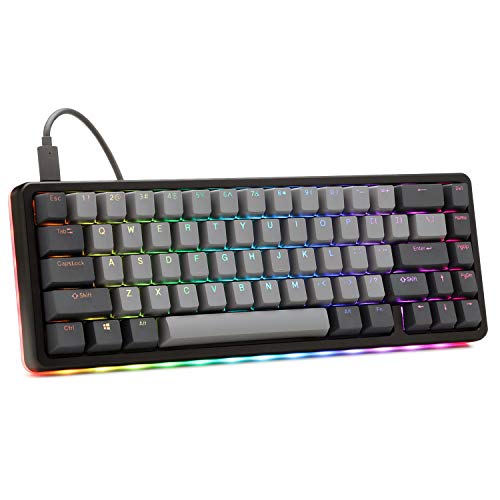
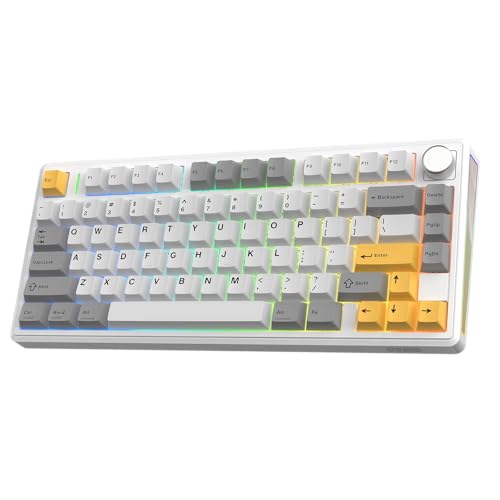
The TH80 V2 is what the family’s money looks like when it is all spent on the keyboard. The full review treatment of the V2 generation appears in this site’s V2 Pro coverage, where the plain V2 is the recommended centre of the range; here its role is the counterfactual, and it performs it completely. The 75% layout with its function row, the gasket-mounted feel tuned to the current mainstream, the tri-mode connection for the multi-machine desk — everything the TH80 name promises, present and finished, with no display drawing on the battery and no novelty line in the budget. A reader who came for the X and stays for the V2 has not settled; they have bought the same family’s substance and declined only its theatre, and the typing will not know the difference.
There is also a support argument for the plain board that screen-curious buyers underrate: the V2 sits in the centre of its family’s volumes, which is where firmware attention, accessory compatibility and community knowledge concentrate. An experimental variant, even when it ships, lives at the edge of its maker’s attention — fewer owners, fewer answers, a slower cadence of updates. The centre of a range is not the boring choice; it is the maintained choice, and maintenance, compounded over a keyboard’s years, is worth more than any single feature at the edge. Buy the centre unless the edge’s feature has passed the counted-need test with room to spare.
The battery point deserves its own emphasis in this comparison, because it is where the counterfactual bites hardest. A screen-free board’s battery is spent on exactly one thing — being a keyboard, wirelessly, for weeks — and the V2’s stamina reflects that monogamy: the charging rhythm fades into the month’s background rather than the week’s foreground. Every display-equipped board, the X included if it ships, must divide that same budget with a tenant that never sleeps, and the division is always visible in the ownership experience. Buyers weighing the screen should weigh it in weeks of wireless life, because that is the currency it will actually be paid in, long after the first photograph of the display has left the feed.
Strengths
- The TH80 formula complete, with the whole budget spent on the keyboard itself
- Battery stamina undivided by a display; charging is a monthly rhythm
- The family’s value centre, as the V2 Pro review’s sibling comparison argues
Trade-offs
- No screen, obviously — the status glance must go to the knob’s LEDs and memory
- Configuration depth stops at the family’s plain tier
- Styling is the family’s current neutrality, not an experiment
Best for: the loyalist, the battery prioritiser, the buyer who wants the formula without the theatre. Not suited for: the screen devotee — whose board, for now, is a photograph. Confirm cost on Amazon
A practical note for the X-admirer choosing the V2: the status information a screen would have shown — connection mode, battery level, active layer — is all available on this board by the older liturgies: indicator lights, a key combination, the software’s window. Spend the first week learning those liturgies deliberately, and the screen’s absence shrinks to its true size, which for most typists is a glance saved a few times a day. The owners who miss a display most are those who never learned the board’s own signals; the board was talking all along, in a smaller alphabet.
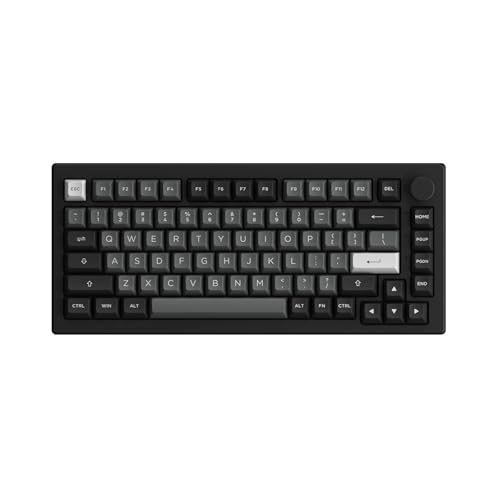
Akko 5075B Plus
Best for value-led buyers who want a knobbed 75% with a distinctive character of its own
| Unit | Akko 5075B Plus |
|---|---|
| Class | Mechanical Keyboards |
| What its listing leads with | hot-swappable switches, RGB lighting, a control knob |
| Tag | Verify expense on Amazon |
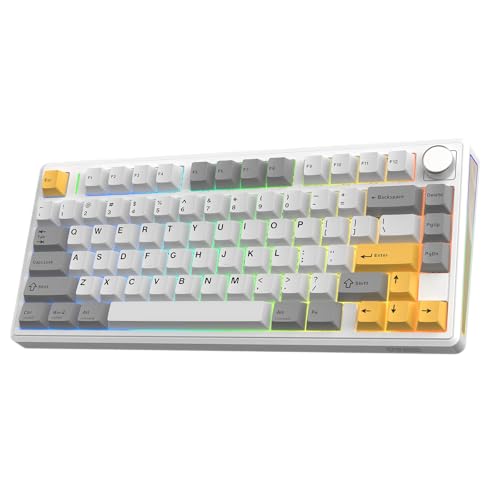
The Akko 5075B Plus is the comparison’s outside voice: a 75% board with a knob, gasket-era construction and tri-mode ambitions, from the brand that has made a speciality of giving its boards personalities — colourways, themes, a design voice that does not apologise for existing. Its case to the TH80 shopper is the value case with a twist: not merely the formula for less, but the formula with a flavour, from a maker whose boards are bought partly as objects in the way the Glyph coverage elsewhere in this cluster discusses. For the buyer who found the TH80 family’s neutrality a little airless, the Akko is the comparison’s reminder that the value tier and the personality tier can be the same tier.
Akko’s broader pattern is worth a sentence for the platform-minded: the brand has built its following on themed, characterful boards at honest prices, refreshed frequently, which makes any single model a snapshot of a fast-moving catalogue. That velocity is a virtue for the buyer who wants a face and a bargain today, and a caveat for the buyer who wants this exact board’s ecosystem to be tended for five years. The TH80 family’s slower, deeper lineage is the opposite bet. Neither bet is wrong; they are wagers on different futures, and the buyer should place theirs knowingly rather than discover, in year three, which future they had bet on.
Against the TH80 V2, the Akko’s debits are the challenger’s usual ones: a software and support ecosystem a step behind the family’s, a tuning character that leans toward its own taste — which some ears will prefer and others will file under acquired — and a lineage shallower than the TH80 name’s, which matters to the platform buyer planning years of accessories and firmware. Its strengths are symmetrical: price, personality, and a knob-and-gasket specification that concedes nothing on the shopping list. The choice between it and the V2 is therefore the comparison’s cleanest: the family’s depth and lineage, or the challenger’s value and voice. Both are honourable, and the trial week’s typing — on your desk, at your hours — is the honest arbiter between them.
Strengths
- Knobbed gasket 75% formula at a challenger’s price
- A design voice and colourway personality the TH80 family declines to offer
- Tri-mode connection covering the modern desk’s requirements
Trade-offs
- Software and support ecosystem a step behind the TH80 family’s
- Tuning character is its own taste, not the mainstream’s
- A shallower lineage for the platform-minded buyer
Best for: the value-led buyer who also wants a board with a face. Not suited for: the deep configurator, or the buyer for whom the TH80 name’s support history is the point. Check price on Amazon
If the Akko is your answer, buy its personality deliberately: choose the colourway as a decision rather than a default, because a themed board anchors a desk’s palette the way the design coverage in this cluster describes, and the anchor should be dropped where you mean to stay. Owners who choose the face consciously keep the board for years as a signature; owners who accept whatever was in stock own a stranger’s taste at a good price, which is a stranger bargain than it sounds.
Buying handbook: what genuinely determines Epomaker Th80 X Review
Screen usefulness beyond novelty
The screen criterion deserves a framework any display board can be graded with, because the category will keep producing them. A keyboard screen has four possible jobs. Status: connection mode, battery, layer — real information, needed in glances, a few times a day. Control: a surface for settings the software would otherwise host — real, but competing with the larger, better screen already on the desk. Expression: images, animations, a small canvas of personality — real in the way a desk toy is real, and honestly enjoyable. And theatre: the photograph, the product shot, the feed — real only to the audience. Grade any screen by how much of its life it spends in the first job, because status is the only one that recurs daily for years; control migrates back to the software, expression fades with familiarity, and theatre ends at the unboxing. A screen that is ninety percent status and ten percent delight earns consideration. The reverse ratio — which describes most of the category’s launches — earns a photograph and a pass.
The knob is the screen’s quiet rival in this analysis, and the comparison is instructive: a knob conveys its status by position and serves its function blind, at typing speed, without asking the eyes to leave the work. The screen asks the eyes to visit it. That asymmetry — glance versus visit — is why the mature control surfaces of other instruments are knobs, dials and detents, and why the screen’s strongest case is confined to information a knob cannot carry. Buyers should hold every display board to the question the knob asks it: what do you show that my fingers could not feel? The answers that survive the question are few, specific, and occasionally worth the rent. The rest is lighting.
Typing sound and gasket feel
The typing criterion matters doubly in a screen board’s review, because the screen’s budget is partly the tuning’s budget and the reader deserves to see what the money buys when it is spent on sound instead. Run the cluster’s standard examination on either shipping board: a paragraph at working speed for the mount’s character, then the stabilised keys pressed slowly, one at a time, graded against their neighbours. The TH80 V2 represents the family’s current mainstream — deep, quiet, cushioned; the Akko represents its own house taste, a character with more of its own opinion in it. Neither is the correct answer; both are finished answers, which is the point of the comparison. A board whose screen was bought with unfinished stabilisers has the exchange rate exactly backwards, and the listening test is how a buyer detects the direction of the trade before paying for it.
Remember the desk’s role in the duet, as this cluster’s reviews keep insisting: surface and mat compose half the acoustics, and a board judged on a showroom’s surface will re-audition itself on yours. The screen cannot help here either — it is the one component whose performance is identical on every desk, which is a neat summary of its relationship to the instrument it decorates.
Battery with screen and RGB combined
Battery arithmetic is the screen’s rent stated in numbers a buyer can reason with, even without any single board’s figures. A wireless keyboard’s cell is small; its keyboard duties are frugal; its lighting is a known indulgence owners already ration. A display adds a continuous draw of a different order — not a peak but a tenant, awake whenever the board is, showing status to a room that is usually empty. The consequence is structural and unavoidable: a screen board’s wireless life is measured in a smaller unit than its screen-free sibling’s, and the gap widens exactly as the screen is used more — brighter, busier, more expressive. Owners of display boards therefore live a charging rhythm their V2 cousins would find needy, and they live it forever, because the tenant does not age out of the lease. Price that rhythm honestly — in charges per month, multiplied by the board’s years — before deciding the screen’s information is worth it. For a status glance a few times a day, the exchange rate is the worst in the category. For the rare desk where the display genuinely works for its living, it can still be paid gladly — but it should be paid knowingly, which is all this criterion asks.
The RGB interaction compounds the arithmetic: lighting and display together can halve a wireless board’s practical stamina against either alone, which is why display boards so often live wired on their owners’ desks — the screen having quietly converted a wireless keyboard into a wired one with extra steps. If your desk’s plan was wireless freedom, the screen is not a feature on the board; it is a negotiation with the board’s founding purpose. Negotiate with open eyes.
Value against TH80 siblings
The family’s internal map, drawn fully in this site’s V2 Pro review, is the value context the X must be placed in. The plain V2 is the range’s centre: the formula complete at the friendly tier. The V2 Pro adds configuration depth and the flagship tuning for a legible premium. A screen variant, if it lists, will be priced by the same logic — the formula plus a feature premium — and the buyer should demand of it what this review demands of the Pro: that the premium buy something named, testable and exercised daily. The Pro’s depth passes that test for configurators. The screen’s status glance passes it for a far smaller population, which is why the family’s centre, and this review’s recommendation, remains the board without the display. Value is not the cheapest board; it is the board whose every premium corresponds to a use — and by that standard the V2, not the X, is the TH80 the value hunter is looking for.
The Akko’s presence in this criterion keeps the family honest from outside: any premium the TH80 name charges must survive comparison with a challenger offering the formula — knob, gasket, wireless — at a challenger’s price with a personality included. The family’s defence is depth, lineage and support, and it is a real defence; but a defence that must be made is a premium that must be justified, per buyer, per brief. That justification exercise, performed honestly, is the whole of value shopping in this category.
Epomaker Th80 X Review in concrete habits
Situation: a desk-setup curator building a photographed workspace
The curator is the screen’s best customer and deserves the scenario treated seriously rather than dismissively. In a photographed workspace, a small display is a compositional instrument: it carries the setup’s accent colour, echoes the monitor’s wallpaper, gives the desk a face. For the curator whose desk is genuinely a public surface — the streamer, the setup photographer — that function is work, and a screen board’s rent can be a business expense of the eye. The counsel this review offers that buyer is timing rather than refusal: the X cannot be bought, so the photographed desk must be composed from shipping parts today — the Akko’s personality or the TH80 family’s finish — and the screen, when it lists and is reviewed as a product, can be auditioned then against a composition that already works. Build the gallery from what exists; let the future apply for a place in it.
Scene: a hybrid worker rotating between laptop and desktop
The rotation worker is the screen’s most plausible utility case — status information is worth most to the user whose board changes machines and layers daily — and the scenario therefore deserves the honest counter: the rotation’s information needs are real but small, and they are already served by the shipping boards’ indicators, by the software’s window, and above all by habit, which after a fortnight knows which machine the board is married to today without consulting any display. The worker’s actual scarcities are battery and switching grace, both of which the screen taxes. The V2 serves this worker’s whole brief; the Akko serves it with a face. The screen would serve its smallest clause at the price of its largest. That is the scenario’s arithmetic, and it is why the utility case, examined closely, argues against the feature it seemed to favour.
Scenario: a gamer who types essays between matches
The student gamer’s double life — matches in the evening, essays at night, a small desk and a rationed budget — prices the screen most harshly of all, because every currency it costs is one this buyer is short of: money for the premium, battery for the wireless sessions, attention that belongs to the game and the page. The displays this buyer already owns — the monitor, the phone — carry every status the keyboard’s screen would duplicate, at sizes that shame it. The V2 or the Akko serves both halves of the double life completely, and the money the screen would have taken buys the essay season’s coffee or the match season’s mouse. Some features are for desks with slack in them. This scenario’s desk has none, and its verdict is the review’s in miniature.
Configuration and initially-seven days how-to
These steps apply to the shipping boards this review recommends, and to the X-admirer’s handling of the wait itself.
Step 1 for Epomaker Th80 X Review: neat or maintain the piece once past prior to deciding it is settled
Run the chosen board’s settle-check before the setup is declared finished: keycaps seated with a press around the board, the slow stabiliser listening test, the knob’s detents through a full rotation, every connection mode proven. For the buyer arriving from the X’s photographs, add the expectation check this category uniquely needs: type the first paragraph with the board’s plainness deliberately in view, and notice that the fingers are reporting a finished instrument while the eyes go looking for a screen that was never part of the typing. That noticing, done consciously on day one, is the whole adjustment — the hands settle the question the feed raised.
Step 2 for Epomaker Th80 X Review: unpack it slowly, and store every accessory safely until the setup has survived a full week
Keep the full bundle through the trial week, as with every board in this cluster — the spares are the first-aid kit, the box is the return’s completeness. The screen-curious buyer has one extra reason: the week is when the display’s absence is honestly priced, in glances not taken and charges not made, and a verdict delivered before the week has run is a verdict delivered by the photographs rather than by the desk. Let the desk speak for its full week before the packaging is pensioned.
Move 3 for Epomaker Th80 X Review: connect or match the unit only as its guidebook describes ahead of changing any setting
Connect in the documented order — wired first for the software handshake, then the dongle, then Bluetooth — before remapping anything, and learn the board’s own status liturgies in the same first days: the indicators, the battery check combination, the layer signals. This step is where the screen’s absence is formally retired as an issue, because a board whose signals are known is a board whose status is never actually missing — it is merely spelled in lights rather than letters. Owners who skip the liturgies keep a low-grade sense of missing information for months, and blame a screen they never owned for an orientation they never took.
Move 4 for Epomaker Th80 X Review: save or photograph the configuration that finally functions
Save the finished configuration — knob assignments, layer maps, the mode-per-machine note — and keep with it the dated note of the X’s announcement status, if you are following it. The pair of records is this purchase’s complete archive: what the board is set to, and what the future was promising when you chose the present. When the X eventually lists or evaporates, the note lets you grade your own decision with evidence — the rarest and most useful document a buyer can own, because it converts a season’s temptation into a permanent education.
Stage 5 for Epomaker Th80 X Review: schedule a two-week review to catch annoyances that solely repetition reveals
Calendar the verdict for day fourteen and ask this comparison’s specific questions. How many times did you actually want information the board could not give you — counted, not imagined? How did the charging rhythm compare with the one the screen’s rent would have imposed? And has the knob, the screen’s blind rival, quietly become the control your hand visits most? The counted answers are the screen question answered by your own desk, which is the only jurisdiction whose ruling matters. Cast the vote while the return option is still live and the packaging is still complete enough to honour it.
Common mistakes with Epomaker Th80 X Review
Buying it for a minor worktop it physically dominates
The screen board’s version of the size mistake is attentional rather than dimensional: a display dominates a small desk’s visual field out of all proportion to its inches, because motion and light claim the eye the way a tenant claims a room. On a compact, focused desk — the essay desk, the studio desk — a glowing rectangle at the hand’s edge is a interruption with a spec sheet. Buyers of any future screen board should audition it in the desk’s actual sightlines, at night, at working brightness, before romanticising it in daylight photographs. The board must fit the desk’s geography twice: once in centimetres, and once in glances.
Rushing the two-spell adjustment period
The fortnight’s rule protects this purchase in both directions. The screen’s admirer, typing on the plain V2, must not verdict in week one, when the feed’s photographs are still louder than the desk’s evidence; the counted glances of the how-to’s final step need their fourteen days to accumulate into data. And the hypothetical early buyer of any screen board owes the same patience in reverse: the display’s delight in week one is the novelty curve at its peak, and the battery rhythm that will define ownership has barely filed its first report. Verdicts in this category, more than any other in the cluster, belong to day fourteen — because the feature being judged is the one whose value changes fastest with familiarity, in both directions.
Leaving the ball dusty until tracking turns gritty
The maintenance mistake has a screen-board edition that writes itself: the display that becomes a dust portrait, its small glass the desk’s most visible surface and therefore its most honest reporter of neglect. But the deeper translation applies to the shipping boards too — the gasket tuning the buyer chose over the screen is a system of small tolerances that dust taxes exactly as it taxes a trackball’s bearings, and the owner who spent the screen’s rent on finish owes the finish its upkeep: the brush ritual, the seasonal clean, the mat kept vacuumed. Maintenance is how a buyer keeps faith with their own priorities; the neglected board argues, silently and daily, that the priorities were a pose.
Head-to-head: separating the lineup
TH80 V2 against Akko 5075B Plus is the shipping argument, and it resolves on lineage against voice. Choose the V2 for the family’s depth — its support history, its ecosystem, its tuning’s mainstream refinement, and the plain fact that the TH80 name’s owners are a community with years of accumulated answers. Choose the Akko for its challenger’s arithmetic and its face — the formula with personality at a price that leaves the budget room for the rest of the desk. The trial week’s typing arbitrates the ears; the five-year question arbitrates the platform; and a buyer honest about both will find the two arbiters usually agree, which is the sign the choice was really about taste all along — the one specification no review can supply.
Either shipping board against the X is the present against the photograph, and the present wins by the rule this site applies to every announcement: existence outranks promise. The X’s idea has been given its full hearing in this review — the status case, the curator’s case, the delight case — and the hearing’s conclusion is that the idea serves a narrower population than its photographs suggest, at a rent charged in the currencies every keyboard owner holds dearest. If you are in that population, your correct move is still not to wait indefinitely: it is to buy the shipping board that serves the rest of your brief, keep the dated note, and let the X apply for your desk when it has a listing, a price and a battery figure a reviewer can test. Desks are not held for applicants.
Living with the choice: upkeep and longevity
The screen-free board’s longevity is the quiet dividend of its plainness: switches swap in seconds, the battery ages on the long schedule of a cell with one job, and there is no display to dim, scratch or obsolesce its way into the board’s biography. Keep the brush ritual, the configuration record and the firmware current, and either shipping board here will serve until its owner’s taste — not its hardware — calls for a change. That is the correct order of endings for a keyboard, and it is worth stating that the screen board inverts it: a display is the component most likely to age the product around it, dating the board to its screen’s generation. Longevity, like battery, is a currency the screen spends.
For the reader still following the X, the longevity advice is archival: keep the dated announcement note with your board’s records, and grade it at each family launch. The grading habit converts waiting from a mood into a measurement, and it has a way of curing the wait itself — most folders of dated announcements, reviewed after a year of happy typing on a shipping board, read as comedies the owner is grateful to have missed. Keep typing; let the future keep its appointments in the drawer.
Final recommendation
Choose the TH80 V2 if the family’s formula is your brief — it is the X’s substance without the screen’s rent, and this review’s headline recommendation. Choose the Akko 5075B Plus if value and voice lead, and let its personality do the desk-anchoring a screen would have done, at no cost to the battery. Treat the TH80 X as this page has: a genuinely interesting idea, honestly unbuyable, whose correct price today is attention rather than money. All three verdicts assume the listening test is run, the status liturgies are learned, and the glances are counted before any of them becomes final.
The screen will keep returning to keyboards, because it photographs like the future. Let it — and let it keep auditioning, generation after generation, against the standard this review has set: information the fingers cannot feel, at a rent the battery can afford, for a population that can name its use. The board that finally passes that audition will deserve its display. Until then, the knobs have it.
A closing note for the reader who feels this review has been hard on a product they were excited about: the hardness is a form of respect, for the reader and for the idea alike. The screen concept will get its fair product review the day it can be bought, typed on and measured, and nothing in this page prejudges that review’s outcome — a shipping X with a tested battery, a sane price and a status role that survives counting could earn a recommendation here as readily as any board in the family. What this page refuses is only the pre-emptive verdict, in either direction, purchased with photographs. The idea deserves its day in the market. Until that day, the desk deserves a keyboard.
Frequently asked questions
What counts most when choosing for epomaker th80 x review?
Existence first — the X cannot be bought, so the operative choice is between the shipping boards, and it is decided by lineage against voice as the head-to-head describes. For the screen question itself, what counts is the counted need: the number of times a day you genuinely require information a knob’s position and an indicator’s light cannot carry. That number, honestly counted over a fortnight on any board you own now, is the screen’s whole market research. Buyers who count it choose calmly; buyers who imagine it buy photographs.
How much should a beginner spend for epomaker th80 x review?
At the TH80 V2’s level, or the Akko’s below it — and specifically not at a screen premium, whenever one becomes available, until the beginner’s counted need exists. Beginners are the novelty economy’s favourite customers because they cannot yet distinguish a feature’s photograph from its Tuesday. The shipping boards here are chosen partly as protection: both spend their whole budgets on the instrument, so a beginner who starts on either develops the hands and ears by which screens can later be judged. Buy the instrument first; let the display apply after your taste has references.
Which error do buyers of epomaker th80 x review regret most?
In the X’s case, the regret available today is the wait — the season spent screenless-by-choice on a failing board, holding a desk for a product with no listing, while two finished boards in its own family shipped past. It is the announcement economy’s standard injury, and this cluster’s announcement coverage exists to prevent it. When screen boards do ship, their owners’ standard regret is the battery: the feature that photographed best and charged most, in every sense. Both regrets are prevented by the same act of counting — glances, charges, weeks — performed before the purchase rather than itemised after it.
How much time does a new TH80 X need to settle in?
The shipping boards settle in the usual fortnight — layout, knob, liturgies, wireless rhythm. The arrangement in this review’s fuller sense, a shipping board on the desk and the X’s dated note in the drawer, matures at the first family launch after your purchase, when the note gets graded and the temptation gets its evidence. Owners report that single grading as the moment the announcement economy lost its power over their desk. It is a small ceremony, and this review recommends it to every reader who has ever waited for a product photograph.
When is the premium alternative in epomaker th80 x review really worth it?
Within the shipping family, the premium worth paying is the V2 Pro’s, examined in its own review: configuration depth and flagship tuning, exercised daily by the buyers they serve. A screen premium becomes worth it under the narrow conditions the handbook set — a public desk where the display works as set dressing, or a counted status need that indicators demonstrably fail — and it should be paid then without embarrassment, because a priced and argued premium is a specification. What is never worth it is the premium paid for the photograph alone, by a private desk, for a feature whose use the buyer cannot name in a sentence.
What should I confirm initially if my epomaker th80 x review purchase disappoints?
Confirm the liturgies, the configuration and the comparison, in that order. Learn the board’s indicators and battery checks properly, because most “missing the screen” disappointment is an orientation never taken. Restore the default knob and layer configuration for a day, to separate your experiments from the board. And re-run the counted-glances test, because the disappointment may be the feed’s photographs arguing with your desk’s data — in which case the data should win, and usually, given a fortnight, does. If the board still disappoints with its signals learned and its defaults restored, the disappointment is taste, and the other shipping board in this review — the family’s depth or the challenger’s voice, whichever you did not choose — is the standing remedy.
Related guides
- Epomaker Ek68 Review
- Epomaker Glyph Review
- Epomaker IFA
- Best Lenses for Fujifilm X Cameras
- Best Lenses for Fujifilm X T30 Ii
- Calibrite Colorchecker vs X Rite I1display for Monitor Calibration
Companion reading: the TH80 V2 Pro review for the family’s flagship argument, the EK68 review for the compact pole, and the IFA report for the announcement discipline in full.
One more angle: screen usefulness beyond novelty, revisited
Keep the counted-glances habit for every future control surface you are sold — the touch bar, the dial with a display, the mouse with a screen in its thumb. Count, for one ordinary week, how often the information was needed and how often it was merely available, and let the ratio price the feature before the marketing does. Control surfaces earn their place by the day, not by the demo, and a buyer with a counted week in hand is immune to the entire genre of launch theatre that screens make possible.
One more angle: typing sound and gasket tuning, revisited
Re-run the listening test whenever the desk changes — new surface, new mat, new room — because the duet is re-cast with the stage, and a board judged thin in one room may be the same board judged rich in another. Owners who re-test keep their tuning opinions calibrated to the present rather than to the purchase month’s furniture. Five minutes, twice a year, is the whole cost of knowing what your keyboard actually sounds like, as distinct from what it sounded like in the shop of your memory.
One more angle: battery life with a screen and lighting, revisited
Keep a simple charge log for whichever board you chose — dates, mode, lighting habit — for the first season. The log converts battery life from a brochure argument into your desk’s measured fact, and it becomes the ruler for every future claim, including the X’s if it ever ships with figures attached. Owners with logs buy their second wireless board with data; owners without them buy it with the same hopes as the first. A line a week is the cheapest instrumentation in the hobby.
One more angle: value against the TH80 siblings, revisited
Revisit the family’s map at each launch, because tiers are a living document: a sibling’s price move can invert a value verdict without any board changing at all. The buyer who re-reads the map annually — V2’s centre, Pro’s depth, the challengers at the gate — times their upgrades to the family’s arithmetic rather than to its announcements. Value is a subscription to attention, payable in minutes per season, and it is the only subscription in this category that reliably pays out.
One more angle: the knob as the screen’s rival, revisited
Notice, over a season of ownership, how completely the knob colonises the jobs the screen was meant to do: volume by feel, zoom by habit, the press for the binary answers. The colonisation is the market’s quiet verdict on glanceable information — most of it was never information, only orientation, and orientation is a sense the fingers hold better than the eyes. Future display boards will have to answer the knob’s incumbency, not the blank desk’s, and incumbency, in control surfaces as in politics, is the hardest opponent there is.
One more angle: what a listing would change, revisited
Define in advance what the X’s listing would need to show to reopen your decision: a battery figure a reviewer can test, a price whose premium names its use, a screen whose status role survives the counted-glances standard. Written triggers convert a temptation into a checklist, and checklists can be waited for calmly. If the listing arrives and meets them, buy with the review’s blessing and your own evidence. If it arrives and does not, the note in your drawer has just paid for itself again.
One more angle: screens across the category, revisited
Zoom out once, at the end: the keyboard screen is one instance of a category-wide negotiation between instruments and interfaces, being conducted simultaneously in mice, headsets, chargers and docks. The negotiation’s outcome will not be uniform — some surfaces will earn their displays and most will not — and the reader who has learned to price one screen, in glances and charges and years, has learned to price them all. That transferable scepticism, more than any single board, is what a review of an unbuyable keyboard can honestly sell you. It is, fortunately, free with the reading.