Disclosure: As an Amazon Associate, reviewstook.com earns from qualifying purchases. Links on this page are affiliate links; they cost you nothing extra. Prices and availability change often, so check the current Amazon listing before you buy.
Epomaker IFA coverage, done honestly, is an exercise in reading a trade show the way an editor should: separating what was physically on the stand from what was said about the future, and pricing both at their correct value. IFA — the great Berlin consumer-electronics fair — is where keyboard brands like Epomaker show their range, preview their direction and float their next designs in front of the trade. What a show appearance is not, ever, is a shop. So this page is built as a briefing with a shopping annex: it reports what Epomaker’s IFA presence tells a buyer about the brand’s direction, and it grounds every actual recommendation in the two verified, shipping boards that represent that direction in purchasable form — the TH80 V2 Pro and the EK68, both reviewed in full elsewhere on this site and summarised here against their live listings.
The discipline matters because show coverage is exactly where buying advice goes to be flattered. A stand is lit like a stage, staffed by believers, and arranged so that prototypes gleam beside production models until the casual visitor cannot tell the roadmap from the catalogue. The reader who cannot tell them apart waits for products that slip, buys current models resentfully as stopgaps, or — the saddest outcome of all — postpones a purchase that would have served them for a year, in honour of an announcement that becomes a different product at a different price. This page’s promise is narrower and more useful: what was shown, what was merely announced, what the announcements signal about where Epomaker’s range is heading, and what to buy in the meantime if your desk needs a keyboard this season rather than next.
That last clause deserves emphasis, because it is where show reports usually fail their readers most quietly. The meantime is most of life: the quarters between announcement and availability are quarters in which work is typed, games are played and wrists are either pleased or not. A report that leaves the meantime empty — all future, no present — has answered the question nobody asked. This report’s structure is the correction: the future gets its analysis, and the meantime gets two verified keyboards, either of which will still be serving when the future arrives to be reviewed in its turn.
Two framing notes before the substance. First, no prices, dates or specifications are quoted here for anything unreleased, because none exist in a form a reader could verify; where the show materials gesture at timelines, this page describes them as gestures. Second, the two shipping boards are not consolation prizes. They are the current top of the range this report discusses, verified products with reviews of their own, and the IFA story is incomplete without them — because a brand’s direction is best judged by measuring the distance between what it shows and what it already ships.
IFA itself deserves a sentence of orientation for readers who know it only as a name in headlines. It is one of the world’s oldest and largest consumer-electronics fairs, held in Berlin, where the industry’s autumn is announced: televisions and appliances take the halls’ centres, and the computing and peripheral brands take the edges where the enthusiasts walk. A keyboard brand’s presence there is a statement of ambition in itself — the fair’s audience is the trade and the general technology press rather than the hobby’s own gatherings — and what such a brand shows that audience is pitched accordingly: range, direction and polish, rather than the group-buy minutiae of the hobby’s home turf. Read the coverage with that pitch in mind and its emphases stop being mysterious.
Key takeaways
Four questions organise the report: which pieces were physically shown, how announced timelines differ from shipping ones, which prototype features are likeliest to change, and what the announcements signal about the range’s direction. The handbook takes them in order.
- Which variants were physically shown
- Announced versus shipping timelines
- Prototype functions most apt to to change
- What the announcements signal concerning Epomaker’s range
In this guide
Brief reply for Epomaker Ifa
Tools and models that genuinely assist
The purchasable present tense of the range, in one table: the TH80 V2 Pro and the EK68, both verified against live listings. Everything else in this report is direction, and is labelled as such wherever it appears, in the text and in the verdicts.
| Unit | Status | Entry |
|---|---|---|
| Epomaker TH80 V2 Pro | Checked entry | Verify cost on Amazon |
| Epomaker EK68 | Confirmed page | Check price on Amazon |
How the lineup was chosen
The lineup is the report’s thesis in miniature: two shipping boards, chosen because they mark the poles of the range the show was presenting. The TH80 V2 Pro represents the performance line — the 75% gasket board as the current generation’s complete statement. The EK68 represents the compact line — the 65% board with the knob, aimed at the smaller desk and the hobby-curious buyer. A brand’s IFA story is a story about where its poles are moving, and a reader holding both poles in view can measure any announcement against them: does the preview extend the performance line, the compact line, or promise a third pole entirely? Announcements that cannot be located on that map are usually the ones that evaporate, and the reader who maps them early will not be surprised when they do.
Criteria follow the show-report discipline this site applies to every fair. Physical presence before press language: what a visitor could touch outranks what a slide claimed. Timeline honesty: announced seasons are intentions, and the report treats them with the discount the category has earned. Prototype mutability: the features shown on pre-production hardware are ranked by their likelihood of surviving to the box, because buyers anchor on exactly the features most likely to change. And signal-reading: what the selection of shown pieces reveals about the range’s strategy, which is the durable value of a show report long after the show’s news cycle closes. Both shipping boards were verified against their live listings before inclusion; everything unreleased is described only in the terms of its showing, with its tier — touchable, object or roadmap — kept visible to the reader throughout.
Detailed reviews

Epomaker TH80 V2 Pro
Best for: shoppers who want the performance line’s current shipping flagship in a complete 75% layout
| Model | Epomaker TH80 V2 Pro |
|---|---|
| Range | Mechanical Keyboards |
| Functions named on its listing | wireless operation, RGB lighting, USB-C connection |
| Price | Check price on Amazon |
As the range’s performance pole, the TH80 V2 Pro is the board against which Epomaker’s show previews should be measured, because it defines what the brand currently means by a finished product. The specification is the current generation’s syllabus executed completely: a gasket-mounted 75% board with the function row kept, tri-mode wireless, tuned stabilisers and a typing feel that belongs to the hobby’s finished school — cushioned, quiet, deliberate. Its role in this report is partly that of a measuring instrument. When a show preview promises a leap beyond the current line, the honest reader asks: a leap beyond this? In feel, in features, in finish? The TH80 V2 Pro sets the bar the announcements must clear, and it sets it high enough that many announcements, examined against it, resolve into what they are — variations, colourways, and the ordinary annual metabolism of a range — rather than revolutions.
As a purchase in its own right, its case has been made at length in its own review on this site and can be summarised honestly here: it is the board for the buyer who wants the performance line’s substance now, in a layout that asks no compromises of a working typist, with the neutral styling that lets the rest of the desk speak. The IFA context adds one consideration in its favour that standalone reviews cannot: a flagship bought at the moment its maker is publicly investing in the line’s future is a flagship whose ecosystem — firmware attention, accessories, community knowledge — is being actively fed. Ranges are abandoned quietly at shows; this one was being celebrated, and owners feel the difference in support long before they can name it.
Measured against the stand’s direction pieces, the TH80 V2 Pro also performs one more service for the reader: it prices the future. Whatever the previews eventually ship as, they will be positioned against this board’s price and specification in their maker’s own catalogue, which means the flagship’s current value is the anchor for judging whether the future’s premium — when it finally has one — buys substance or merely newness. Buyers who note the anchor now will read the launch, whenever it comes, with a ruler in hand. Buyers who do not will read it with only the launch’s own adjectives for company, which is how launch premiums get paid.
Strengths
- The performance line’s complete current statement: gasket feel, full layout, tri-mode
- The benchmark against which the show’s previews can be honestly measured
- A flagship in a line its maker is publicly investing in
Trade-offs
- Show-season buying always risks a successor’s announcement landing soon after
- Neutral styling will not satisfy the design-led buyer the Glyph coverage serves
- Software polish sits at the hobby tier’s standard, not above it
Best for: the performance-first buyer who needs the board this season. Not suited for: the buyer whose joy is in waiting for the next announcement — a legitimate hobby, but a different one. Check price on Amazon
The show-season timing question deserves the paragraph its own trade-off raises. Buying any flagship during show season is buying under the shadow of its possible successor, and the mature response is to price the shadow rather than flee it: a current board bought now delivers a year of typing before any announced successor can ship, mature and be reviewed — and typing, unlike waiting, is the thing the purchase is for. The owners who regret show-season purchases are those who bought the announcement’s excitement rather than the product’s merits. Buy the board for the board, and the calendar cannot hurt you.

Epomaker EK68
Best for: the compact-desk buyer set on the range’s small-board pole in finished, knobbed form
| Unit | Epomaker EK68 |
|---|---|
| Family | Mechanical Keyboards |
| What its page leads with | Bluetooth connectivity, hot-swappable switches, RGB lighting |
| Page tag | Check price on Amazon |
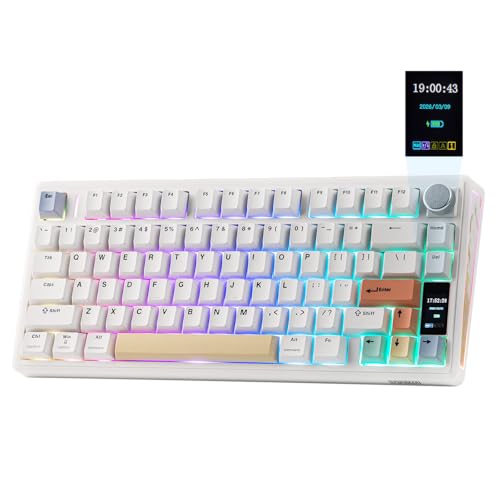
The EK68 is the range’s other pole: the compact line’s argument that the hobby’s values — gasket feel, factory tuning, a metal knob that can be taught — belong in a 65% board at a reachable price. Its full review elsewhere on this site examines it against Keychron and Royal Kludge; here, its function is cartographic. Epomaker’s show presence makes most sense read as a negotiation between this pole and the TH80’s: how much of the flagship’s finish can be carried into smaller, cheaper, more playful formats, and how far the compact line can climb before it becomes the flagship. Buyers watching the brand should watch that negotiation, because its outcome is the range’s next two years.
As the meantime purchase for the compact-desk reader, it is this report’s straightforward recommendation: the finished small board, shipping now, whose knob and tuning deliver today the experience the show’s smaller previews are promising for tomorrow. That sentence generalises across the whole report, and it is worth stating as the report’s refrain: in every category at every show, the shipping product that embodies eighty percent of a preview’s promise beats the preview, because the twenty percent it lacks is precisely the twenty percent most likely to change before the box exists.
The compact pole also carries the range’s accessibility argument, which a show report should not underrate. Flagships demonstrate what a brand can do; compact boards at honest prices demonstrate what a brand is for — the products through which most customers will ever meet it. A maker whose small boards are finished, fairly priced and supported is a maker whose ecosystem a beginner can enter without a patron’s budget, and the EK68’s presence as a pole of the IFA story says that Epomaker understands its own funnel. Judge brands by their entry products’ dignity and you will rarely misjudge their flagships.
Strengths
- The compact line’s finished statement: gasket feel and a teachable knob at 65%
- Shipping now, with the show’s compact promises already embodied in it
- Tri-mode connection and a battery sized for weeks of wireless life
Trade-offs
- The 65% layout taxes function-key-fluent work, as its full review details
- Compact-line previews may tempt its buyer toward premature upgrade thoughts
- Stock tuning is to the soft school, which not every typist shares
Best for: the small desk, the hobby-curious, the buyer who wants the promise kept today. Not suited for: the function-row professional, or the collector holding out for a show piece. Verify cost on Amazon
A note for the collector-minded reader, since shows breed them: the EK68’s special and seasonal variants, when they appear, are the range’s low-risk way to own a piece of the show’s theatre — shipping products in show colours, rather than show products in shipping promises. The collector who buys variants of proven boards owns the theatre and the instrument. The collector who waits for prototypes owns a folder of screenshots. Both are hobbies; only one of them involves typing.
Buying handbook: what genuinely determines Epomaker Ifa
Which pieces were physically shown
The first discipline of show reading is the inventory of the touchable. A piece physically shown — present on the stand, powered, typable, handled by visitors — has crossed the line from rendering to hardware, and its existence is a fact regardless of its future. A piece shown as a shell, a print or a screen has crossed only the line from idea to object-shaped claim. And a piece present only in a presentation’s roadmap slide has crossed nothing at all. When you read any IFA coverage — this page included — grade every item into those three tiers and notice how the tiers correlate with the coverage’s excitement: the press gravitates to the roadmap, because novelty lives there, while the buyer’s interest should gravitate to the touchable, because products live there. Epomaker’s stand, read by this discipline, was a range story: the shipping line present and typable, the direction pieces present in the middle tiers, the future claimed in the roadmap’s grammar.
The touchable tier has a second use: it is where a show’s real news hides. A shipping board quietly present with a revised detail — a changed switch, a new colourway actually in production — is a fact a buyer can act on, and it routinely gets less coverage than a prototype’s promise. Train yourself to ask of every show report, including this one: what could I buy differently on Monday because of what was physically there? The answers are usually small, concrete and valuable, which is the exact profile of news that ages well.
Announced versus shipping timelines
Announced timelines obey a physics of their own, and the experienced show reader applies the correction automatically. A season named at a show is the season of intention — the quarter in which the maker hopes to ship if certification, tooling, component supply and the software’s readiness all behave, which they do in the way that weather behaves. The category’s ordinary slippage carries most announcements a season or two beyond their naming, and a meaningful minority of show products are re-scoped so thoroughly in the interval that the shipping box is a relative of the prototype rather than its portrait. None of this makes announcements worthless; it makes them weather forecasts, to be used for planning wardrobes rather than weddings. The buyer’s translation rule is simple: an announced product enters your purchase decision only when it has a listing, a price and a date a retailer will stand behind. Until then it is climate, not calendar.
The rule has a corollary that protects current purchases from announcement anxiety: the value of a shipping board bought today is not diminished by a successor’s announcement, because the successor’s actual arrival — shipped, matured, reviewed, discounted from its launch premium — lies a year or more beyond the announcement that supposedly obsoleted your board. Measured in typing, that year is roughly two million keystrokes. Announcements depreciate nothing but patience, and only for those who let them.
Prototype features likeliest to change
Not all shown features are equally mortal, and ranking them is a skill this criterion exists to teach. The most mortal are the ones that cost the currencies prototypes are rich in and production is poor in: battery life, thinness, exotic materials, and any feature whose cost sits in the bill of materials rather than in the tooling — a machined case survives to production more often than a specified cell or a licensed component does. Software features shown on stage are mortal in a different way: they demo beautifully on a presenter’s script and meet the public’s thousand configurations later. The most durable shown features are the structural ones — layout, mount philosophy, the presence of a knob or a screen — because they are decisions, and decisions, once tooled, are expensive to unmake. Read a prototype as a layered document: structure is nearly news, materials are intentions, software is a trailer.
Applied to keyboard previews generally, the ranking produces a calm reader: excited by a new layout’s logic, interested in a new switch’s feel as demonstrated, politely sceptical of the battery figure on the slide, and entirely unmoved by the software suite’s stage performance. That reader will, over a decade of shows, be surprised far less often than the reader who weights every shown feature equally — and will own, at any given moment, the better keyboard, because their purchases were made from the durable layers of other people’s announcements.
What Epomaker’s IFA selection signals about the range’s direction
The durable product of a show report is the signal, and signals are read from selection: what a maker chooses to show is a portrait of what it believes its customers want next. Epomaker’s IFA selection, taken as a whole, tells a coherent story about a hobby brand consolidating — the performance line and the compact line both being pushed toward finish and completeness rather than toward novelty for its own sake, with the design-led experiments (the Glyph coverage elsewhere on this site belongs to the same current) testing how far styling can lead before the typing objects. That is the signature of a range moving from expansion to refinement, which historically is the phase in which a brand’s shipping products are at their most recommendable: the experiments have been run, the syllabus is known, and the engineering is being spent on execution.
Signals also include absences, and the trained reader notes what a stand does not contain: a category unshown is a category deprioritised, a line without a preview is a line in maintenance, and both facts matter to the buyer choosing a platform for years of accessories and firmware. Read the absences in any brand’s show presence before committing to its ecosystem, and you will rarely be surprised by a quiet discontinuation. The show is a strategy document disguised as a party; the reader who treats it as a document leaves with the strategy, while the reader who treats it as a party leaves with the hangover and a tote bag.
Epomaker Ifa in concrete habits
Scene: a show attendee comparing concepts on the floor
The attendee’s discipline on the floor is the inventory from the buying handbook, carried in the pocket: touchable, object, roadmap. Walk the stand in that order — type on everything that can be typed on, because a keyboard show rewards the hands and punishes the eyes — and let the prototypes be the dessert rather than the meal. The attendee who spends the hour in the shipping line learns the range; the attendee who spends it photographing concepts learns the marketing. Both will write home about the show, but only one of them will be able to answer, a month later, the question that matters: what should I buy? The floor is a library that lends its rarest books only to those who open them.
The attendee should also exploit the one resource no coverage can replicate: the staff’s unscripted answers. Ask the stand’s people the questions a listing cannot answer — which of these is actually in production, what changed between the last show and this one, which board the staff themselves type on — and weight the hesitations as data. Booth staff at a range stand know exactly where the roadmap’s soft spots are, and their pride, properly invited, will usually point at the shipping line’s genuine strengths rather than the prototype’s rehearsed ones. The best show reporting has always been conversation wearing a press badge.
Scenario: a buyer who needs support today, not next cycle
For the buyer whose current board is failing — the chattering switch, the dead row, the cable held together by optimism — the show’s calendar is an insult added to injury, and this scenario exists to give them permission to ignore it entirely. Buy the shipping board that fits the desk: the TH80 V2 Pro for the full-layout worker, the EK68 for the compact desk. The announced future will still be there when this board has served its years, and it will be cheaper, matured and reviewed by then. A keyboard is not a phone contract; there is no upgrade cycle to synchronise with, only a desk that needs typing on by Monday. Serve the desk.
Situation: a collector following a brand across seasons
The collector’s relationship to a show is the longest of any reader’s, and the healthiest version of it is archival: keep the shown-versus-announced columns season by season, grade last year’s promises against this year’s stand, and let the brand’s exchange rate — the ratio of its kept to its evaporated announcements — set the weight you give its future tense. Epomaker’s collectors, like every brand’s, will find the exercise converts fandom into knowledge, and knowledge into timing: the seasoned collector buys the shipping line confidently when the exchange rate is good, and waits out the roadmap when it is not. The folder of dated columns is the collector’s real collection; the boards are merely its illustrations.
There is a social pleasure in the collector’s long game that this scenario should acknowledge, because it explains behaviour the pure buyer finds baffling: the collector is not failing to buy, they are playing a longer instrument. Following a range across seasons — watching a compact line’s knob migrate toward the flagship, a styling experiment become a product family — is a narrative hobby, and its satisfactions are real. The report’s only counsel to the collector is to keep the two hobbies labelled: the narrative in the notebook, the typing on the shipping boards, and never let the story’s next chapter be the reason the desk goes without a finished keyboard in this one.
Configuration and initially-seven days how-to
These steps apply to the shipping purchases this report recommends, and to the reader’s handling of the show’s news itself.
One preliminary habit deserves stating before the steps, because show-season buyers skip it more than any other in this cluster: type your current board for one honest hour before ordering anything, and write down what actually fails you — the layout’s gap, the feel’s fatigue, the connection’s gaps, the specific keys that misbehave. The list does two kinds of work. It confirms that the purchase is a remedy rather than a mood, and it gives the new board’s trial week a checklist written by your own hands rather than by a stand’s lighting. Buyers who arrive at a flagship with a written indictment of its predecessor almost never regret the upgrade; buyers who arrive with a photograph of a prototype almost always regret something, and spend months deciding what.
Step 1 for Epomaker Ifa: neat or maintain the piece once past prior to deciding it is settled
For whichever shipping board you buy, run the settle-check before the setup is declared finished: keycaps seated with a press around the board, the slow stabiliser test on every large key, connections proven in each mode. Show-season purchases carry one extra temptation — to keep one eye on the announcements while judging the board — and the settle-check is the antidote, because it forces the judgement onto the hardware in your hands. A board that passes its checks has earned its place regardless of what any stage promised; a board that fails them should be returned regardless of how the roadmap glitters.
Step 2 for Epomaker Ifa: unbox slowly, and do not part with any accessory until the setup has survived a full week
Keep the full bundle through the trial week, as with every board in this cluster — and for the show-season buyer there is an additional reason: the announcement calendar will, with near certainty, produce a tempting headline inside your first month, and the kept box is what makes your decision reversible if the headline genuinely changes your needs rather than merely your mood. Most headlines change only the mood. The week, and the month after it, will teach you to tell the difference, and the box waits patiently while you learn.
Move 3 for Epomaker Ifa: connect or match the unit only as its guidebook describes ahead of changing any setting
Connect the board in the documented order — wired first for the software handshake, then the dongle, then Bluetooth — before remapping or updating anything. Show-season firmware is a live thing, with updates arriving as the brand’s attention peaks, and the documented order is what keeps the software’s picture of your board accurate enough to receive them cleanly. Establish the baseline day of typing on defaults, as this cluster’s every review advises, and let the configuration that follows be measured against it.
Move 4 for Epomaker Ifa: save or photograph the configuration that finally functions
Save the configuration — and, for the show-following reader, save the report’s other document too: your shown-versus-announced columns for the announcements you cared about, dated and kept with the board’s records. The pair of documents is the complete archive of a show-season purchase: what the board is set to, and what the future was supposed to look like when you bought it. Together they let you grade, at the next show, both the brand’s promises and your own judgement — the two exchange rates a wise buyer tracks.
Stage 5 for Epomaker Ifa: schedule a two-week review to catch annoyances that solely repetition reveals
Calendar the board’s review for day fourteen in the ordinary way — layer fluency, knob habits, wireless stamina — and add the show-reader’s extra question: has any announcement since the purchase actually changed what you need, as distinct from what you want to have waited for? The answer is almost always no, and hearing yourself answer it is the inoculation against the next show’s fever. Decide the board’s fate inside its return window on the typing evidence, and file the announcements for the next season’s grading.
Common mistakes with Epomaker Ifa
Waiting on a trade-show device while hearing worsens
The heading’s phrasing belongs to another category’s cautionary tale, and its keyboard translation is the mistake this report was written to prevent: deferring a needed purchase for an announced product while the current setup’s failures compound daily. A failing keyboard taxes every sentence its owner types, and the tax is paid in the currency of work and patience while the announced saviour slips its season. The discipline is identical across categories — buy the shipping help, note the announcement, revisit at the next genuine decision point — and the reader who internalises it here will find it serves at every future show, in every aisle, for every product whose future tense is prettier than its present.
Rushing the two-spell adjustment period
The fortnight’s rule applies to news as well as to keyboards: a show announcement judged in its first forty-eight hours is judged at maximum distortion, when the coverage is loudest, the prototypes gleam brightest and the shipping alternatives look dullest by stage lighting. Let the announcement age for two weeks before letting it near a purchase decision. Most announcements do not survive their fortnight as urgencies; they settle into what they always were — entries in a roadmap, to be graded at leisure. The buyer who builds the delay into their show habits buys boards; the buyer who does not buys anticipation, repeatedly, at retail.
Leaving the ball dusty until tracking turns gritty
The maintenance mistake, in its show-season form: neglecting the shipping board you own while dreaming of the announced one, until the owned board’s small degradations — the dusty switches, the drifting stabiliser — become your argument that you need the new thing. Clean the board you have before shopping for its replacement, and re-run its listening test; a remarkable share of upgrade urges are maintenance debts wearing a launch’s clothing. The announced product will still be announced next month. The board on your desk, cleaned and tuned, may quietly cancel the whole transaction.
Living with the choice: upkeep and longevity
A show-season purchase has a psychological upkeep alongside the mechanical: the announcement stream will keep arriving, each season’s stand will out-gleam your desk, and the owner’s contentment must be maintained as deliberately as the stabilisers. The maintenance is the grading habit from the how-to section — the dated columns, the exchange rate — because nothing deflates announcement fever like a written record of how the last fever’s promises matured. Owners who keep the record own their boards in peace. Owners who do not are renting their satisfaction from a trade fair’s calendar, at a season’s notice, forever.
The board itself asks the ordinary kindnesses of its class: the brush ritual, the seasonal keycap clean, the battery rhythm, the configuration record kept current. A flagship bought in a season of brand investment has the additional prospect of a long firmware life, and keeping the board updated is how that prospect is collected. Longevity, in the end, is a partnership between a maker’s attention and an owner’s, and show season is when both are at their most visible — which makes it, despite the fever, a genuinely good time to buy.
Final recommendation
Buy the present tense. The TH80 V2 Pro if your desk wants the performance line’s complete statement, the EK68 if it wants the compact line’s finished charm — both verified, both shipping, both reviewed in full elsewhere on this site. Read the IFA news as this report has: as a strategy document about a range in its refinement phase, valuable for what it signals and worthless as a reason to wait. If a preview genuinely answers a need the shipping line cannot, then wait with the columns open and the date discounted — but let that be the rare, argued exception rather than the show’s intended effect on your wallet.
The fair will come again next year, with new prototypes and the same lighting. Your desk is here now, and the keyboard on it will type roughly two million keystrokes before the next stand is built. Spend those keystrokes on a board that exists.
A last word about what this report deliberately refused to do, because the refusal is the method. It published no prototype specifications as facts, no launch dates as promises and no prices as expectations — not from coyness, but because every one of those numbers, printed, becomes a small debt the reader may spend real money against. Show coverage that prints them anyway is borrowing its authority from a future it does not control. This page would rather be useful in the present tense, with two verified boards and a disciplined reading of the direction, than exciting in a future tense it cannot underwrite. When the direction becomes inventory, this site will review it as inventory — verified, typed on, and priced — and not a season sooner.
Frequently asked questions
What counts most when choosing for epomaker ifa?
Existence, as in every announcement story this site covers. A shipping board can be typed on, judged, returned and lived with; an announced one can only be anticipated. After existence, the order runs: the desk’s layout need, which separates this report’s two recommendations; the typing feel, which the full reviews examine; and only then the show’s signals, which properly influence a platform decision measured in years rather than a purchase measured in weeks. Buyers who hold that order find shows delightful and harmless. Buyers who reverse it find them expensive.
How much should a beginner spend for epomaker ifa?
At the EK68’s level if the desk is compact, at the TH80 V2 Pro’s if it is not — and in neither case should a beginner spend a premium on a show-season limited edition whose premium buys scarcity rather than typing. Beginners are the announcement economy’s favourite customers, because they cannot yet discount a prototype’s gleam against a shipping board’s record. The two recommendations here are chosen partly as inoculation: both are the range’s substance without its theatre, and a beginner who starts on substance develops the eye that later makes the theatre safe to enjoy.
Which error do buyers of epomaker ifa regret most?
The postponed purchase — the season spent on a failing board, waiting for an announced one that shipped late, changed, or at a launch price that made the shipping alternative they skipped look like the bargain of the year. It out-regrets every product error because its cost is paid in daily friction rather than in money, and daily friction compounds. The second regret is the mirror image: the show-week impulse purchase of a current model at the peak of its hype, unresearched against the range’s own alternatives. Both are calendar errors, not product errors, which is why this report has spent its length on sequence and discipline rather than on specifications.
How long does it take to get used to a new board from the show?
The board itself: the usual fortnight of this cluster’s reviews, layers and knob and wireless settling into habit. The arrangement in this report’s fuller sense — a shipping board on the desk and a set of dated announcement columns in the drawer — takes one full show cycle to mature, because the columns only become knowledge when the next season grades them. By the second IFA, the reader who kept them reads the fair like an editor rather than an audience. That transformation, more than any single product, is what this page exists to sell, and it is free.
When is the premium alternative in epomaker ifa really worth it?
When the premium buys the flagship’s completeness for a desk that will exercise it daily — the TH80 V2 Pro’s full layout and finish for the all-day typist — rather than when it buys show-season scarcity, a limited colourway’s premium, or the feeling of owning the announcement’s nearest relative. Scarcity premiums are the show economy’s purest product: they cost the most and type exactly like the standard board. Pay for substance at show season and let the collectors pay for the calendar; your fingers cannot feel a limited edition, and they are the constituency that matters.
What should I confirm initially if my epomaker ifa purchase disappoints?
Confirm that the disappointment is the board’s and not the season’s. Run the ordinary checks — stabilisers, defaults, the wired connection — and then ask the show-reader’s question: did this board disappoint me at the desk, or did an announcement make it look disappointing by comparison with a product that does not exist? The two disappointments feel identical and have opposite remedies: the first deserves a return inside the window, the second deserves the fortnight’s patience and a re-read of the graded columns. Confirm which one you have before acting on either.
Related guides
- Epomaker Ek68 Review
- Epomaker Glyph Review
- Epomaker Th80 V2 Pro Review
- Best Keyboard And Mouse Combos for Office
- Best Wireless Gaming Keyboards for FPS
- Best Wireless Gaming Keyboards Under 100
Companion reading: the full EK68 and TH80 V2 Pro reviews, the Glyph concept coverage, the CES announcement report for the same discipline applied elsewhere, and the wider keyboard section for the rest of the desk.
One more angle: which pieces were physically shown
Keep the touchable inventory as a standing habit beyond this fair: for any product story you follow, note what could be handled, what could only be viewed, and what existed as a slide. The three tiers, dated, become the skeleton of your own coverage judgement — you will begin to notice which publications report the tiers honestly and which launder roadmap into news, and your reading list will quietly improve itself. The inventory takes two minutes per story and pays out for years.
One more angle: announced versus shipping timelines, revisited
Build the slippage table for the brands you follow: announced season against shipped season, product by product, season by season. Two cycles of the table gives you each brand’s personal exchange rate between its future tense and the calendar, a number no press release will ever print and every seasoned buyer carries in their head. Epomaker’s rate, like every brand’s, is knowable only by keeping the table — which is precisely why so few buyers know it, and why those who do are so calm at shows.
One more angle: prototype features likeliest to change
When a prototype feature genuinely matters to you — the one that would change your buying decision if it survived — write it down with its tier: structural, material or software. Then set the decision rule in advance: I will reconsider when this feature has a listing. The rule converts anticipation from a mood into a trigger, and triggers can be waited for calmly in a way moods cannot. Most prototype features that matter to a given buyer are, on inspection, one feature — and one feature with a trigger is a plan, while a show’s worth of features without one is just weather.
One more angle: what announcements signal about the maker’s range
Extend the signal-reading to the range you already own: each season’s stand tells you where your own board sits in its maker’s affections — flagship still, legacy line, or quiet twilight — and that position predicts your firmware, accessory and community future more reliably than any support page. Owners who read their own board’s signal annually are never surprised by an ecosystem’s decline, and they time their platform decisions by evidence rather than by the forum’s rumours. Your board is in the strategy document too. Read its paragraph.
One more angle: shown versus announced, revisited
The distinction generalises past trade shows into every product story of the year — the keynote, the crowdfunding page, the influencer’s early unit — and the reader who automates it becomes difficult to sell futures to. Shown means touchable by someone disinterested; announced means claimed by someone interested. Between those two definitions lies most of the disappointment in consumer technology, and a two-word habit — which one is this? — closes most of the gap. Keep asking it until it asks itself.
One more angle: announced versus shipping timelines, revisited
There is a buyer’s corollary to the slippage table that deserves its own statement: never let an announced product set the deadline for selling the board you own. The classified-ad version of announcement fever — selling the shipping flagship in the show’s month to fund the prototype’s promise — strands its author boardless or stopgapped for the exact interval the slippage table predicts. Sell when the replacement has a listing and a delivery date, and not a season before. Liquidity, like patience, is a position.
One more angle: prototype features likeliest to change, revisited
Revisit your prototype notes when the shipping version of anything you followed finally appears, and score your own past reading: which features did you weight correctly, which gleam misled you? The exercise feels like bookkeeping and functions like training — the second cycle’s reader is measurably harder to dazzle than the first’s, because they have graded their own susceptibility with evidence. Shows are an annual examination in which the syllabus is your own last year’s notes. Sit it prepared.
One more angle: which pieces were physically shown, revisited
Photographs from a stand deserve the same tiering as the pieces themselves: a photograph of a typable unit surrounded by visitors’ hands is evidence; a photograph of a lone object on a lit plinth is a portrait; a render is an illustration of a claim. Weight your excitement by the photograph’s tier and you will find your show coverage reading itself — the stories built on evidence feel different in the hand from the stories built on portraits, and the difference, once seen, cannot be unseen. That permanence is the real souvenir of learning to read a fair.
One more angle: what announcements signal about the maker’s range, revisited
Close the report where it began, with the range’s direction — and with the observation that the reader’s own direction is the one that finally matters. A brand refining its two poles is good news for the buyer whose desk matches either pole, and irrelevant to the buyer whose desk matches neither. Match first, signal second: choose the board your hands and layout describe, from the shipping shelf, and let the strategy documents accumulate in the drawer for the season when they will grade themselves. The fair is a wonderful servant of a decision and a terrible substitute for one.