Disclosure: As an Amazon Associate, reviewstook.com earns from qualifying purchases. Links on this page are affiliate links; they cost you nothing extra. Prices and availability change often, so check the current Amazon listing before you buy.
This epomaker th80 v2 pro review is about a letter and a word: the V2, which marks a redesign of one of the hobby’s best-known 75% boards, and the Pro, which marks the tier within that redesign where all the features gather. The TH80 name carries years of goodwill — the original was the board that taught a whole generation of buyers that gasket feel and tri-mode wireless did not require flagship money — and a V2 Pro therefore arrives with something to prove in both directions at once: that the redesign kept what made the name loved, and that the Pro tier’s additions genuinely earn their step up. It is reviewed here against its own sibling, the plain TH80 V2, because the most useful question in the whole comparison is what the Pro premium actually buys in practice; and against the Epomaker x Aula F75, the collaboration board that has become the value benchmark every gasket 75% board must now eventually answer to.
A verification note matters more for this board than for most, so it comes early: the TH80 V2 Pro exists in colour variants whose listings are distinct, and the board verified for this review is the black variant, against its live listing. Confirm the variant and the full model name on the listing in front of you before ordering — the TH80 family tree now has enough branches (original, V2, V2 Pro, and the Pro’s colours) that a careless click can buy a sibling while aiming at this board. The review that follows is about the V2 Pro specifically: its gasket tuning, its tri-mode implementation, its software support, and its place between the V2 below it and the F75 beside it.
The reader profiles divide cleanly. The original TH80 owner deciding whether the V2 Pro is an upgrade or a repetition. The new buyer choosing within the family — V2 or V2 Pro — with the F75 whispering from across the aisle. And the value hunter who suspects the whole Pro concept is a tax on the impatient. Each gets a direct answer below, and the answers are not all the ones the product names would prefer.
The 75% format itself is worth a sentence of context for readers arriving from the EK68’s coverage or from full-size boards. Seventy-five percent keeps the function row, the arrows and a compressed navigation presence in a footprint barely larger than a 65% — the layout that asks the fewest compromises of a working typist per square centimetre of desk. It is the format the TH80 helped popularise, and the V2 generation’s refinements land on a layout that no longer needs to argue for itself. The argument, in this review, is entirely about tiers: how much finish, depth and tuning a buyer should purchase within a format whose geography is settled. That is a more grown-up argument than most keyboard reviews get to have, and it is conducted below without a single photograph of a keycap doing the talking.
Key takeaways
Four properties decide the family’s internal argument: what the V2 generation changes over the original, the gasket tuning and stock acoustics, the tri-mode wireless implementation, and the software and VIA support. The handbook examines each in turn.
- What the V2 revision changes over the original
- Gasket tuning and stock acoustics
- Tri-pattern wireless behaviour
- Software and VIA support
In this guide
Brief verdict for Epomaker Th80 V2 Pro Review
The family argument in one view: the Pro, the plain V2 beneath it, and the collaboration benchmark beside them. Detailed reviews follow, and the handbook after them prices the differences honestly.
| Product | Best for | Page |
|---|---|---|
| Epomaker TH80 V2 Pro | Best for travellers | Check price on Amazon |
| Epomaker TH80 V2 | Best for muted spaces | Check price on Amazon |
| Epomaker x Aula F75 | Best value route | Check cost on Amazon |
How the lineup was chosen
The lineup is deliberately narrow, because this purchase decision is narrow. Buyers of the TH80 V2 Pro are rarely choosing between it and the entire keyboard market; they are choosing between it and its own sibling — is the Pro step worth it? — and between the family and the one external board that every review, forum and sound test now places in its path, the F75. A wider comparison would answer questions this buyer is simply not asking, at the cost of the questions they are. So the V2 is here in a full section with its case made at full strength, because the sibling comparison is the review’s reason to exist, and the F75 is here as the value control: the board that tells you what the market currently charges for gasket feel without a famous name on the box.
Criteria were set from the redesign’s own claims. What V2 changes over the original — the generational audit, because a redesign must be judged on its deltas rather than its inheritance. Gasket tuning and stock acoustics, the TH80 name’s core promise, tested by ear and finger rather than by the spec sheet’s foam inventory. Tri-mode wireless as implemented — switching grace, wake behaviour, stamina — because three modes are now the family’s standard and their quality is in the execution. And software with VIA support, because the Pro tier’s claim to seriousness stands or falls on how deeply the board can be configured without a proprietary struggle. Each board was verified against its live listing before inclusion, the V2 Pro in its black variant exactly as stated at this review’s opening.
Detailed reviews

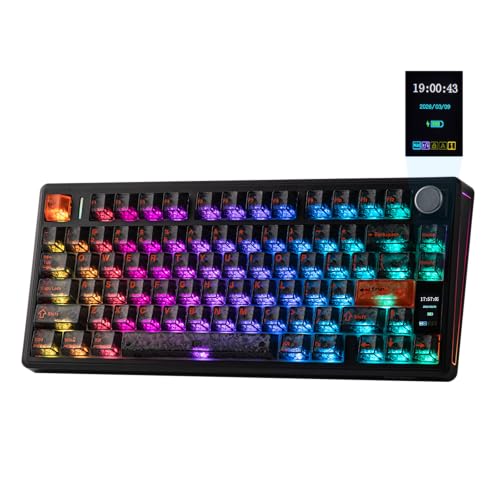
Epomaker TH80 V2 Pro
Best for: anyone who wants the TH80 formula at its most complete — tuning, wireless and configuration depth in one board
| Piece | Epomaker TH80 V2 Pro |
|---|---|
| Class | Mechanical Keyboards |
| Entry highlights | wireless operation, RGB lighting, USB-C connection |
| Listing cost | Check price on Amazon |
The V2 Pro’s first duty is to sound and feel like the flagship of its own idea, and it does. The gasket tuning is the family’s best stock effort: a cushioned, consistent bottom-out across the board, stabilisers that arrive without rattle and without the over-lubricated mush that is tuning’s opposite failure, and an acoustic character — deep, quiet, finished — that belongs to the current hobby mainstream at its most competent. Where the original TH80 introduced buyers to the gasket idea at a friendly price, the V2 Pro is what the idea looks like after years of iteration by a maker who has heard every complaint the original collected: the case resonance managed, the spacebar civilised, the whole instrument coherent. Owners upgrading from the original will hear the lineage and the progress in the same keystroke, which is exactly what a redesign owes its installed base.
The Pro tier’s substance is depth rather than decoration. The tri-mode connection is implemented completely — wired, 2.4 GHz and Bluetooth, with the switching behaviour a multi-machine desk demands — and the configuration story is the family’s strongest: proper software support with VIA compatibility, which moves the board from the proprietary-driver tier into the ecosystem where layouts, layers and macros are built with the community’s standard tools and survive any single vendor’s attention span. For the buyer who configures — the layers architect, the macro economist, the knob programmer — that support is not a bullet point but the product, and it is the clearest line between the Pro and its plainer sibling.
The debits are the tier’s eternal debits. The premium over the V2 buys depth that a set-and-forget typist will never open, and this review will not pretend otherwise in the sibling’s section. The board’s tuning, for all its competence, is tuned to the mainstream’s taste — soft and deep — and the typist who wants a brighter, crisper acoustic will find the F75’s character at least as interesting for less money. And the family’s software, VIA support notwithstanding, still asks the owner to live in two worlds — the vendor’s tools for some functions, the standard ones for others — which is the hobby tier’s ordinary untidiness rather than a scandal, but worth naming in a Pro review. Within its brief, though, the verdict is clear: this is the TH80 idea complete, and completeness is what Pro money is supposed to buy.
Completeness has a feel in the hand that deserves describing, because it is what the trial week actually tests. It is the absence of the small negotiations budget boards conduct daily: the stabiliser that must be pressed centrally to sound right, the wireless mode that must be re-introduced to a machine, the lighting that resets its mood overnight. A complete board’s owner stops managing the keyboard and simply types, and the stopping is perceptible within the first day to anyone arriving from a board that negotiated. Whether that perceptible peace is worth the tier’s premium is the sibling question — but that it exists, and that the V2 Pro delivers it, is the factual core of this section.
Strengths
- The family’s best stock gasket tuning and acoustics
- VIA-supported configuration depth beyond the proprietary tier
- Complete tri-mode implementation for the multi-machine desk
Trade-offs
- The premium buys depth a set-and-forget typist will never use
- Soft, deep tuning is the mainstream’s taste, not every typist’s
- Configuration lives across vendor and standard tools
Best for: the configuring typist, the upgrading TH80 owner, the multi-machine desk. Not suited for: the buyer who will never open the software, or the crisp-acoustic devotee. Check price on Amazon
An upgrading owner’s note, since so many readers of this review own the original: the V2 Pro keeps the family’s layout geography faithfully enough that your muscle memory transfers whole — the 75% map, the knob’s corner, the navigation cluster’s habits. What changes is everything the fingers hear rather than everything they reach for. That makes the upgrade unusually easy to judge in a trial: if the original’s sound and feel were your remaining complaints, the redesign answers them; if your complaints were about layout or size, no tuning will save this purchase, and the family’s other formats are where your upgrade actually lives.
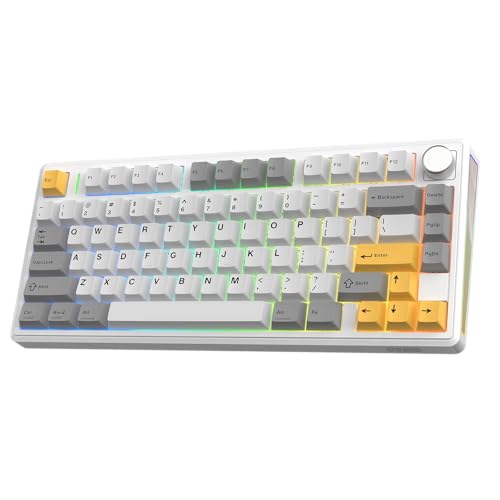
Epomaker TH80 V2
Best for: those after the V2 redesign’s core feel without paying for configuration depth they will not use
| Name | Epomaker TH80 V2 |
|---|---|
| Class | Mechanical Keyboards |
| Features named on its entry | wireless operation, RGB lighting, USB-C connection |
| Expense | Check price on Amazon |
The plain V2 is the comparison’s most important section for most readers, because it is the board most of them should buy. It carries the redesign’s core inheritance — the 75% layout, the gasket-mounted feel, the tri-mode connection, the family’s current styling — at the tier where the price stays friendly, and it surrenders, in exchange, the Pro’s depth: the configuration ceiling is lower, the finishing touches fewer, the specification’s margins thinner. For the typist whose entire software ambition is to set the lighting once and type for five years, those surrenders are not compromises at all. They are the correct specification, purchased at the correct price, and the Pro’s extra depth would be a donation to features that exist only in reviews.
Its honest limits are the ones the Pro’s section described from the other side. The tuning is good rather than the family’s best; a sensitive ear will hear the difference in a side-by-side and should ask itself whether it types side-by-side or alone. The configuration tools are the vendor’s, adequate for the ordinary remapping life. And the board shares the family’s mainstream acoustic taste, so it wins no converts from the crisp school either. None of that dents its verdict: the V2 is the value centre of its own family, and families, like markets, are healthiest when their centre is strong. Buy it without a whisper of settling — for most desks, it is not the lesser TH80. It is the right one.
Strengths
- The V2 redesign’s core feel and layout at the friendly tier
- Tri-mode connection and the family’s current styling intact
- The correct specification for the set-and-forget typist
Trade-offs
- Tuning is good rather than the family’s best
- Configuration depth stops at the vendor’s tools
- Fewer finishing touches than the Pro, by design
Best for: the majority — the working typist who wants the redesign’s feel at the sensible price. Not suited for: the layers architect, or the ear that has already heard the Pro and cannot unhear it. Check price on Amazon
If the V2 is your answer, spend the saved difference the way this cluster’s reviews always advise: on the personalisation that outlasts tiers — a keycap set in your taste, a desk mat that tunes the acoustics further, a wrist rest fitted to your posture. A V2 plus its owner’s considered accessories is a more personal instrument than a stock Pro, at a similar total, and personal instruments are the ones still on desks in five years. The tier system’s secret is that the accessories budget is where individuality actually lives.

Epomaker x Aula F75
Best for value hunters who want gasket feel and a knob with the market’s most aggressive price-to-finish ratio
| Unit | Epomaker x Aula F75 |
|---|---|
| Line | Mechanical Keyboards |
| Headline extras from its page | wireless operation, hot-swappable switches, RGB lighting |
| Page price | Confirm cost on Amazon |
The F75 is the board that changed the value conversation in this category, and its presence in a TH80 review is now mandatory: a collaboration between Epomaker and Aula that delivers the gasket-mounted, knob-equipped, tri-mode 75% formula at a price that made the whole tier recalculate. Its stock feel and sound are its legend — the board arrives with an acoustic and a cushion that owners describe in the vocabulary usually reserved for boards twice its price — and its knob and layout cover the modern desk’s requirements without theatre. For the buyer whose brief is feel per unit of money, full stop, the F75 is not merely competitive with the TH80 family; it is the argument the family must answer.
The TH80 V2 Pro’s answer, made honestly, is depth and lineage rather than feel: the VIA-supported configuration, the family’s ecosystem and support history, the tuning’s particular refinement. Whether that answer suffices depends entirely on the buyer’s configuration ambitions, which is why this review keeps returning to them as the family’s true dividing line. The F75’s own debits are the value tier’s: a software story a step behind the Pro’s, a collaboration’s less certain long-term support path, and a popularity that has made its stock situation and variant landscape occasionally chaotic. None of those dents its value case. It dents only its case as a five-year platform — which is, not coincidentally, exactly the case the Pro is selling.
Strengths
- Benchmark value: gasket feel, knob and tri-mode at an aggressive price
- Stock acoustics and cushion that punch above the tier
- The complete modern 75% formula without a famous-name premium
Trade-offs
- Software and configuration depth trail the V2 Pro’s VIA story
- A collaboration’s support path is less certain over five years
- Variant and stock landscape can be chaotic at its popularity’s peaks
Best for: the value-first buyer, the feel-per-money maximalist. Not suited for: the deep configurator, or the platform buyer planning a five-year ecosystem. Confirm expense on Amazon
F75 owners get the most from the board by accepting its philosophy whole: it is a finished instrument at a value price, not a platform awaiting investment, and its happiest owners type on it stock for years rather than chasing the Pro tier’s depth through accessories. If you find yourself pricing configuration tools and switch sets to close the gap with the V2 Pro, the gap was telling you something about your ambitions — sell the difference honestly, buy the Pro next time, and enjoy the F75 as what it is in the meantime: the best-value typing feel its generation produced.
Buying handbook: what genuinely determines Epomaker Th80 V2 Pro Review
What V2 changes over the original TH80
A redesign should be audited on its deltas, and this criterion teaches the audit for any board carrying a version number. List what the new generation claims to change — in the TH80’s case, the tuning’s refinement, the connection implementation’s completeness, the configuration story’s deepening, the styling’s refresh — and then sort the list into what your fingers and ears can verify in a trial week and what exists only in the announcement. The V2 generation’s verifiable deltas are real: the stock acoustics are a generation’s worth of complaints answered, and the Pro’s VIA support is a categorical change rather than an incremental one, because it moves the board into a different configuration ecosystem entirely. The styling delta is real but weightless — a refresh you will stop seeing in a month. Audit any V2 this way and the marketing separates itself from the engineering without any help from the reviewer.
The audit has a second half for owners of the original: which of your complaints does the delta list actually address? An upgrade is a remedy or it is a repetition, and the original TH80’s owners’ complaints were specific — tuning niggles, configuration ceilings, the ordinary wear of a beloved board. If your complaint is on the list, the V2 Pro is your remedy and the upgrade case is strong. If your complaint was the layout, the size or the switch taste, the delta list is silent, and the honest upgrade is a different board wearing the same loyalty. Version numbers reward readers who audit; they tax readers who merely ascend.
Gasket tuning and stock acoustics
The listening test from this cluster’s EK68 review applies here with the volume turned up, because acoustics are the TH80 family’s founding claim. Type at working speed, then press the stabilised keys slowly — spacebar, enter, shifts — and grade them against their neighbours: a tuned board’s large keys sound like keys, not mechanisms. Then judge the board’s character as a whole: the current mainstream taste, which the V2 Pro embodies, is deep and quiet, achieved with foam layers and gasket give, and it suits shared rooms, calls and midnight work. The opposing taste — brighter, crisper, more percussive — is not worse; it is a different instrument, and the F75’s slightly livelier character is this comparison’s nearest representative of it. Know your taste before the trial, because a board can pass every tuning test and still be tuned for somebody else’s ears.
Stock acoustics also have an environment variable that reviews understate: the desk. A board’s sound is a duet between the case and the surface, and the same V2 Pro that sounds deep on a wooden desk will sound thinner on glass and richer on a desk mat. Judge the board on your surface, or on the mat you intend to buy, and treat any review’s sound description — this one’s included — as a description of a duet you have not yet heard your half of. The mat, incidentally, is the cheapest acoustic upgrade in the hobby, and it belongs in every tuning conversation as the control that costs almost nothing.
Tri-mode wireless implementation
Tri-mode is now a checkbox; implementation is the criterion. The implementation questions are the ones this cluster asks of every wireless board: does the 2.4 GHz connection hold through a working day without drama, does Bluetooth switching between machines happen at the speed of intention rather than of negotiation, does the board wake from sleep as a keyboard rather than as a small mystery, and does the battery stamina — with your lighting habits, not the brochure’s — reduce charging to a rhythm instead of an event. The V2 Pro and V2 both implement the set completely; the Pro’s margin is in the configuration that surrounds the wireless life, the profiles and layers that travel with the user between machines. Judge the modes by a week of real rotation between your actual devices, because wireless quality is a biography, not a specification, and the trial week is when the biography’s first chapter gets written honestly.
One implementation detail separates the tiers in daily life more than any other: what the board remembers. A board that wakes on the right machine, in the right layer, with the right lighting, is a board whose owner stops thinking about connections entirely — and that invisibility, compounded over years, is worth more than any single feature in the Pro’s column. Test for it deliberately in the trial: put the board to sleep mid-rotation, wake it on the other machine, and watch whether it arrives as itself. Small fidelities, faithfully kept, are the whole luxury of a mature product.
Software and VIA support
VIA support deserves its plain explanation, because it is the Pro tier’s headline and many buyers nod at it without a picture. VIA is the keyboard community’s standard configuration tool: connect the board, and a clean interface lets you remap any key, build layers, assign macros and program the knob, with the changes living on the board itself rather than in a vendor’s cloud or a background process. Its virtues are permanence and portability — a VIA configuration survives new computers, new operating systems and the vendor’s own software roadmap — and its presence on a board is a maker’s commitment to the open standard over the captive one. The V2 Pro’s support for it is the single most concrete thing the Pro premium buys, and buyers should weigh it at its true value: not as a feature for this month, but as insurance that the board’s configurability cannot be deprecated.
The honest limits belong beside the praise. Vendor software still handles some functions on boards like this — firmware, lighting subtleties — so the Pro’s owner lives in the two-tools world described in its section. And VIA’s depth is only as valuable as the owner’s appetite for it: the configurator who builds four layers will bless it weekly, while the typist who never remaps will have bought a cathedral to store a bicycle. This criterion therefore grades the buyer’s appetite as much as the board’s support, and the sibling comparison below turns on exactly that self-knowledge.
Epomaker Th80 V2 Pro Review in concrete habits
Situation: an original TH80 owner eyeing the V2 Pro
The upgrader’s scenario is this review’s home fixture, and its method is the delta audit from the buying handbook, performed with the old board still on the desk. Write the original’s indictment honestly — the stabiliser you have meant to lube for a year, the configuration you could not build, the connection that negotiates — and hold the V2 Pro’s trial week against the list item by item. Upgrades judged this way are almost never regretted, because they were remedies purchased for diagnosed ailments. Upgrades judged by the new board’s gleam alone are regretted at the rate the gleam fades, which is to say within the season. Keep the original until the fortnight ends; a beloved board deserves the dignity of being beaten fairly, and the comparison will make the winner obvious to your own fingers.
Scene: a remote worker configuring layers for two machines
The two-machine remote worker is the Pro tier’s designed customer, and the scenario shows why: one layer for the work machine’s dialect, one for the personal machine’s, the knob reassigned per context, the wireless rotation carrying the board between them without a cable’s negotiation. The V2 Pro’s VIA depth is what makes the arrangement durable — the configuration lives on the board, so both machines meet the same keyboard — and its tri-mode implementation is what makes it daily. The plain V2 serves this worker’s typing completely and their configuration partially; the F75 serves the typing and improvises the rest. If your work is genuinely two machines with two dialects, this scenario is the one that justifies the Pro premium without apology, and you should let it.
Scenario: a value hunter comparing against the F75
The value hunter’s scenario deserves the respect of a straight answer rather than a defence of the famous name. If the brief is typing feel per unit of money, the F75 wins this scenario and the hunter should buy it with the review’s blessing. The V2 Pro enters only when the brief grows a second clause — feel, and a five-year configuration platform; feel, and the family’s support lineage; feel, and the specific refinement of the flagship’s tuning as your own ears grade it. Value is a ratio, and ratios change when the numerator grows. The hunter who can state their brief in one clause should buy the F75; the hunter whose brief has honestly grown a second clause is no longer only hunting value, and the Pro is priced for them.
Configuration and initially-seven days how-to
A configurable board’s first week is where its depth either becomes habit or becomes a menu you once visited. These steps sequence the settling-in.
Step 1 for Epomaker Th80 V2 Pro Review: neat or maintain the piece once past prior to deciding it is settled
Run the board’s settle-check before declaring the setup finished: keycaps seated with a press around the board, the slow stabiliser listening test on every large key, the knob’s detents through a full rotation, connections proven in all three modes. On the V2 Pro there is an addition: confirm the board is recognised by the configuration tools — vendor and VIA — while it is still in its return window, because a configuration flagship that cannot be configured is a contradiction that should be discovered on day one, not month two. Establish the clean, recognised baseline; everything the Pro promises is built on it.
Step 2 for Epomaker Th80 V2 Pro Review: open it up slowly, keeping every accessory to hand until the arrangement survives a full week
Keep the box, cable, dongle, spare switches and puller together until the arrangement has survived a full week. The spares are the board’s first-aid kit and the box is the return’s completeness — and for the upgrading owner, keep the original board’s box too, because the fortnight’s comparison may end with either board being sold, and a complete boxed board sells like one. The trial week is a genuine contest between a beloved incumbent and a tuned challenger; keep both contestants’ papers in order until it concludes.
Move 3 for Epomaker Th80 V2 Pro Review: connect or match the unit only as its guidebook describes ahead of changing any setting
Connect exactly as documented before configuring anything: wired first, so the software and VIA establish their picture of the board and any firmware update lands cleanly; then the dongle; then Bluetooth to each machine in turn. Only then build — and build in the order the depth deserves: the base layer’s few true remaps first, the knob’s jobs second, the additional layers last, typing a day between each storey. Owners who build the whole cathedral on the first evening cannot tell which storey creaks; owners who build it in days own a configuration they understand, which is the only kind that survives contact with a new computer.
Move 4 for Epomaker Th80 V2 Pro Review: save or photograph the configuration that finally functions
Export the finished configuration from both tools where they apply, and photograph the layer maps besides. A deep configuration is a small body of personal intellectual property — weeks of decisions encoded in a board — and it deserves the backup discipline of anything else you would hate to recreate. The record doubles as the upgrade audit for the next generation: what you built is what you will need to rebuild, and the export is the difference between an afternoon’s migration and a month’s archaeology. Store it with the box and the kit inventory.
Stage 5 for Epomaker Th80 V2 Pro Review: schedule a two-week review to catch annoyances that solely repetition reveals
Calendar the verdict for day fourteen and interrogate the Pro tier’s specific promises: has the configuration depth been used, or merely admired? Has the wireless rotation become invisible? Has the tuning, judged against the incumbent board still waiting in its box, earned the swap? Bring the delta audit from the buying handbook and mark it honestly. Let the fortnight’s evidence close the contest while a return is still possible — and if the incumbent wins, let it win without embarrassment, because a fair contest lost is information bought cheaply.
Common mistakes with Epomaker Th80 V2 Pro Review
Buying it for a minor worktop it physically dominates
The 75% board’s size mistake is rarely literal domination — the format fits most desks — but its subtler form is buying the flagship’s footprint for a desk whose life is a laptop and a notebook, where a 65% would have left room for the work itself. Measure the desk’s actual ecology before the family’s internal argument begins: if the surface’s citizens are few and small, the EK68’s pole of the range may be the correct TH80-family purchase even for the buyer who arrived wanting the flagship. The best board is the one whose size serves the desk’s whole life, and flagships are not exempt from geography.
Rushing the two-spell adjustment period
The V2 Pro’s fortnight carries a special trap for the upgrading owner: the old board’s familiarity masquerades as superiority. Every difference in the new board’s tuning registers, in week one, as a deviation from home — and home is simply the sound your ears have memorised. Judge the challenger at day fourteen, when its sound has had the chance to become a memory of its own, and judge it on the delta audit’s items rather than on the homesickness. Owners who verdict in week one return redesigns their ears were days from preferring, and then write reviews about it, which is how redesigns acquire reputations written by nostalgia.
Leaving the ball dusty until tracking turns gritty
The maintenance mistake, in the flagship’s edition: the board whose tuning the owner paid a premium for, slowly buried under the dust and crumbs that mute exactly the refinement the premium bought. A gasket board’s acoustics are a system of small tolerances, and debris is their enemy in proportion to the system’s fineness — the finer the tuning, the more it has to lose. The brush ritual, the seasonal keycap clean, the desk mat kept vacuumed: these are not chores appended to the Pro’s ownership but the subscription that keeps its headline feature in force. Owners who pay it hear the board they bought, indefinitely.
Head-to-head: separating the lineup
V2 Pro against V2 is the family’s honest argument, and it resolves on a single question: will you configure? If your honest answer is that the software will be opened twice — once for the lighting, once out of curiosity — the V2 is your board and the Pro’s premium is a donation. If your answer involves layers, macros, per-machine dialects or a knob with ambitions, the Pro’s depth is not a luxury but the product itself, and the V2’s ceiling will tax you for years. There is no wrong answer, but there is a wrong purchase for each answer, and this review exists so that the self-knowledge arrives before the checkout rather than after it.
V2 Pro against F75 is depth against value, and it resolves on the brief’s clauses as the value scenario described. One clause — feel for money — and the F75 takes the desk. Two clauses — feel plus platform, feel plus lineage, feel plus the flagship’s specific refinement — and the Pro earns its name. What neither board’s buyer should do is purchase the other’s brief by accident: the F75 owner who needed a platform will spend the difference on workarounds, and the Pro owner who needed only feel has bought a cathedral for a bicycle, however beautifully the cathedral is tuned.
Living with the choice: upkeep and longevity
The V2 Pro’s longevity is the platform argument made temporal: switches swap in seconds, the configuration lives in an open standard that will outlast any vendor’s roadmap, and the battery ages on the years-long schedule of its class if the lighting is kept sane. Keep the brush ritual and the seasonal clean, export the configuration after every significant change, and keep the firmware current — a board in a line its maker is actively refining receives its improvements as updates, and owners who skip them are declining the redesign’s continuing chapters. A flagship maintained this way does not merely last; it appreciates in fit, as the configuration deepens around its owner’s evolving work.
Expect the family’s story to continue around your board — a V3 someday, new variants seasonally — and let it, without the itch. A platform purchase is precisely a purchase that does not need its maker’s next chapter to justify itself. The V2 Pro on a well-kept desk, configured to its owner’s hand, is a finished sentence in the range’s long argument; the chapters that follow are other buyers’ beginnings, not your board’s rebuttal.
Final recommendation
Choose the V2 Pro if you configure — layers, macros, dialects, a knob with a career — or if you are the original’s owner whose indictment the delta list answers item by item. Choose the plain V2 if you type: it is the family’s right answer for the majority, and its savings belong in the accessories that personalise it. Choose the F75 if your brief is one clause long and that clause is feel for money. All three verdicts assume the delta audit is written, the listening test is run on your own desk surface, and the fortnight is served before any of them becomes final.
The TH80’s name was built by giving buyers more than the price promised. The V2 Pro keeps the promise at the tier where “more” means depth rather than discount — a different generosity, for a more grown-up buyer. Know which generosity you need, and the family’s argument settles itself.
One final consideration belongs to the reader still hovering between all three: time. The board you buy this month will be typed on through several product cycles of other people’s announcements, and its tuning, its configuration and its support will matter on every one of those days, while the launch that tempts you to wait will matter on exactly one. Choose for the ten thousand days, not for the one headline, and whichever badge from this family ends up on your desk, it will have been chosen the way keyboards deserve to be chosen — by the fingers, for the years.
Frequently asked questions
What counts most when choosing for epomaker th80 v2 pro review?
Your configuration appetite, stated honestly. It is the single variable that separates the Pro from its sibling and justifies — or dissolves — the premium, and it cannot be inferred from your enthusiasm in the shop, only from your history with the boards you have owned: did you remap, build layers, program the knob, or did you type? Buy the board your history describes. After appetite, the tuning taste decides between the family and the F75’s livelier character, and the variant check — black, in this review’s verified listing — decides whether the board that arrives is the board that was reviewed.
How much should a beginner spend for epomaker th80 v2 pro review?
A newcomer to the range should spend at the plain V2’s level until their appetite is known, because the Pro’s premium buys depth that a beginner cannot yet value and may never need. The exception is the beginner who arrives from the configuring professions — the macro-driven editor, the multi-machine developer — whose appetite precedes their typing and whose layers are planned before the box arrives. That buyer may go straight to the Pro with the review’s blessing. Everyone else: the V2 teaches the family’s feel at the friendly price, and the upgrade path remains open when the appetite declares itself.
Which error do buyers of epomaker th80 v2 pro review regret most?
Buying the tier instead of the use — the Pro bought for its name by a typist who never configures, or the V2 bought for its price by a configurator who hits its ceiling within the month. Both regrets are self-knowledge failures, and both are prevented by the history question in the first FAQ: your past boards have already voted on your appetite. The third regret is the variant error — the sibling or the wrong colour arriving through a careless listing click — which is prevented by the thirty-second model check this review opened with.
How long until a new TH80 V2 Pro feels like home?
For the new buyer, the usual fortnight: layout, knob and wireless settling into habit, the tuning’s novelty becoming home. For the upgrading owner, add the homesickness curve described in the mistakes section — the old board’s sound must fade as the reference before the new one’s can be judged — and expect the honest comparison to be possible only in the second week. Configurators should budget a third week for the deep build, done in the staged order the how-to section prescribes, because a configuration built gradually is a configuration understood.
When is the premium alternative in epomaker th80 v2 pro review really worth it?
When the premium buys the configuration platform and the flagship tuning for hands and ears that will exercise both daily — the two-machine configurator, the upgrading owner with a written indictment, the typist whose work lives in layers. It is not worth it as a name, as a colour, or as insurance against a hypothetical future appetite that your history does not predict. Premiums in this family are unusually legible — the Pro’s extra money buys named, testable depth — which makes the decision easier than in most tier systems: if you can name what you will build with the depth, pay; if you cannot, the V2 is waiting with the same surname and the better price.
What should I confirm initially if my epomaker th80 v2 pro review purchase disappoints?
Confirm the variant, the configuration recognition and the surface, in that order. Check that the board that arrived is the V2 Pro you ordered — the family tree makes the error genuinely possible. Confirm both configuration tools see the board, since a Pro that cannot be configured has failed its defining promise and belongs in a return, not in a troubleshooting session. And re-run the listening test on a desk mat before judging the acoustics, because the surface is half the duet. If the board still disappoints with the right variant, recognised tools and a fair surface, the disappointment is taste or appetite honestly discovered — and the sibling tiers in this same review are the remedy the family built for exactly that discovery.
Related guides
- Is the Razer Pro Visit V2 Vertical Worth It
- Logitech Mx Vertical vs Razer Pro Visit V2
- Razer Huntsman V2 Tkl vs Logitech G Pro Tkl
- Dt 1990 Pro Mkii
- Earfun Free Pro actually 3 Review
- Earfun Updates Air Pro roughly 4 Plus
Companion reading: the TH80 family’s other reviews including the TH80 X’s screen experiment, the EK68 and F75 coverage, and the IFA report for the range’s direction.
One more angle: what V2 changes over the original, revisited
Keep your delta audit after the purchase, because it becomes the baseline for the next generation’s claims: when a V3 is announced, your written record of what V2 actually changed — verified by your own trial — is the ruler the announcement must be measured with. Owners who keep delta audits across generations develop the rarest asset in the hobby: a personal, evidence-based exchange rate for version numbers. It will save you exactly one unnecessary upgrade per generation, which compounds into the hobby’s best return on a sheet of paper.
One more angle: gasket tuning and stock acoustics, revisited
Re-run the listening test at each season and after any desk change, because the duet of board and surface is re-cast every time the room changes — a new desk, a mat added, a move from home to office. Owners who re-test treat acoustics as a maintained system; owners who do not experience the drift as the board ageing, when it is only the stage that changed. Five minutes with the slow-press test, twice a year, keeps the flagship sounding like the flagship you audited in the trial.
One more angle: tri-mode wireless, revisited
Note which mode serves which machine in the configuration record, and revisit the note when the desk’s population changes — a new laptop, a dock, a tablet promoted to daily use. Wireless arrangements fossilise easily, and a board rotating among yesterday’s machines while today’s wait for a cable is a flagship underemployed. The note takes a line; the review of it takes a minute per change; and the board’s whole tri-mode investment is kept earning its premium only by that small administrative fidelity.
One more angle: software and VIA support, revisited
Back up the configuration after every significant build session, not merely at the setup’s end, because a deep configuration accretes — a macro here, a layer refinement there — and the export you made in the first month quietly becomes a historical document rather than a restore point. Treat the configuration like code, because it is code: version it, date it, and keep the previous export when you overwrite. The configurator’s board is a small software project wearing a keyboard’s body, and it deserves a software project’s discipline.
One more angle: the Pro tier as a five-year platform, revisited
Revisit the platform question at the board’s first anniversary: has the depth been used, has the support lineage delivered, has the configuration grown with your work? The answers grade not the board but the original decision — and they calibrate the next one, in whichever family it falls. Buyers who grade their tier decisions annually stop paying premiums for depth they admire and stop hitting ceilings they resented, because their appetite, once a guess, has become a record. That record is worth more than any single board in this review.