Disclosure: As an Amazon Associate, reviewstook.com earns from qualifying purchases. Links on this page are affiliate links; they cost you nothing extra. Prices and availability change often, so check the current Amazon listing before you buy.
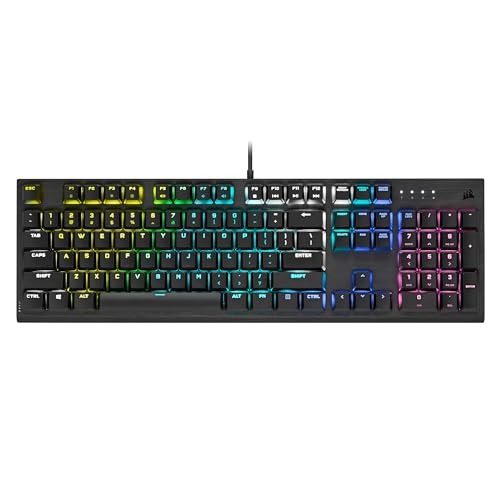
Slim keyboards usually mean laptop compromises, which is why this corsair k60 low profile review matters: the K60 RGB Pro Low Profile puts genuine mechanical switches — Cherry’s low-profile Speed switches — into a board barely thicker than the keycaps’ travel, on an aluminium frame with per-key RGB. It is a full-size, full-featured keyboard that happens to be flat, and the verified listing below confirms the model in the maker’s own naming: Cherry MX Low Profile Speed switches, mechanical, gaming.
This corsair k60 low profile review tests the format’s promises against its physics: whether short travel can still feel mechanical, who benefits from a low deck — wrists, travellers between desks, minimalist setups — and what the slimming costs in keycap choice and switch ecosystem. If you have ever liked a laptop keyboard’s posture but missed a real switch’s certainty, this board was designed in your direction, and it deserves a more careful hearing than either camp usually gives it.
Key takeaways
- Real Cherry MX Low Profile Speed switches in a slim aluminium board — verified in the listing below
- Short travel and a low deck suit wrists that dislike tall keyboards and rests
- Actuation is fast and light; the hair-trigger character takes a week of typing to domesticate
- The low-profile ecosystem is smaller: keycaps and switches are not standard MX interchangeable
In this guide
Corsair K60 Low Profile Review: the format and its point
The K60 Low Profile’s dimensions tell its story: a full-size layout with numpad, on a brushed aluminium top plate, standing a fraction of a normal board’s height. The point is posture. A tall mechanical keyboard raises the hands and bends the wrists upward unless a rest intervenes; a low deck keeps the hands flatter and the wrists nearer neutral, which some users feel as relief across a workday and others feel as nothing at all. Like most ergonomic arguments, it is true for the people it is true for, and they know within a week.
Corsair did not slim the feature list with the chassis: per-key RGB, a full media and function layer, N-key rollover, and the iCUE software ecosystem all survive the diet. What the format asks in return is commitment — this is a low-profile board with low-profile switches and low-profile keycaps, an ecosystem unto itself. Buy it as a format decision, not as a standard board that happens to be thin, and its trade-offs read as the price of the posture rather than as omissions.
The switches: Speed, shortened
Cherry’s low-profile Speed switches compress the MX formula — actuation arrives earlier, travel ends sooner, and the spring keeps the light, linear character the Speed name promises. In use, the press feels decisively mechanical: a clean, certain actuation with none of the membrane mush the format’s critics expect, delivered in a stroke short enough that your fingers recalibrate within days. Typing speed merchants love the short throw; heavy-handed typists bottom out more at first, because the floor arrives sooner than muscle memory predicts, and the board’s slim case offers less acoustic forgiveness for it.
The hair-trigger question deserves honesty. A light switch with early actuation registers resting fingers and brushes that a heavier switch would forgive, and the first week’s error rate rises for almost everyone. It falls again as fingers learn the board’s shallower geography — this is adaptation, not defect, but a buyer who shares the board with a standard-height keyboard at another desk will re-adapt twice daily, which is the format’s least-discussed cost. One ecosystem per pair of hands is the comfortable arrangement.
Sound, build, and daily life
The aluminium plate gives the board a solidity its slimness does not suggest, and the low-profile keycaps keep the profile clean on the desk — this is a handsome object in the minimalist sense, all straight lines and low stance. Acoustically it is brighter and clackier than a damped standard board, the physics of a thin case with little room for foam; in a private office that is character, in a shared one it is a consideration, and the switch guide in this series exists to remind you that sound is a system property, of which this board’s system is firmly on the lively side.
Daily life with it is otherwise unremarkable in the best way: it connects by a single cable, remembers its lighting and settings, and asks for nothing. The absence of a detachable cable and of wireless options dates the design slightly against newer rivals, and the wrist rest is not part of the proposition — the low deck is supposed to make one unnecessary, an argument your own wrists should adjudicate during the returns window. Judge this board across a fortnight of real work, not a showroom minute, because its virtues are cumulative and its costs are front-loaded.
The products worth a closer look

Corsair K60 RGB Pro Low Profile
Verified pick — the slim mechanical
The verified listing names the board exactly as reviewed: K60 RGB Pro Low Profile, Cherry MX Low Profile Speed switches, slim aluminium construction. That precision matters in a market where ‘low profile’ is applied to membrane boards borrowing the posture without the switches; this is the genuine mechanical article, and the listing is where to confirm the current price and availability before the returns-window audition this review recommends.
Buy it for the posture and the press: a flat deck your wrists may thank you for, and a fast, certain, mechanical stroke that no laptop keyboard impersonates successfully. Give it a fortnight of exclusive use before judging, because its costs are all in week one and its virtues are the kind that accumulate quietly across a year of workdays.
- Cherry MX Low Profile Speed mechanical switches
- Slim aluminium frame, full-size layout
- Per-key RGB backlighting
- Wired USB connection with N-key rollover
Strengths
- Genuinely mechanical feel in a slim deck
- Wrist-friendly low posture without a rest
- Solid aluminium build and full layout
Trade-offs
- Short travel takes a week to learn
- Keycap and switch ecosystem is limited
- Brighter, clackier acoustics than damped boards
Best for: typists and gamers who want a flat, fast, full-size board / Not suited for: switch swappers and keycap hobbyists
The low-profile desk: companions and posture
A slim board invites a slim desk philosophy, and the K60’s owners tend to complete it: a low-profile mouse, a desk mat rather than a wrist rest, a monitor arm that lets the whole arrangement float at the height the posture wants. The board’s contribution is removing the wrist rest from the equation — not because rests are bad, but because a deck low enough to make them optional frees the desk’s front edge and the typist’s setup ritual alike. Judge the format as an arrangement rather than an object: hands flat, forearms level, the board a low island rather than a step.
Travellers between desks — the hybrid worker with a home office and a hot-desking office — are the format’s quiet constituency, because a slim board packs flatter in a bag and asks less of an unfamiliar desk’s ergonomics. It will not fit a laptop sleeve’s ambitions, but in a backpack it is the difference between bringing your keyboard and borrowing the office’s lottery. For that worker, the K60’s wired permanence is the remaining compromise, and it is the first thing a successor model should fix.
Long-term: shine, stabilisers, and the two-year report
Two years into ownership, a keyboard’s report card is written by its consumables: the spacebar’s shine, the stabilisers’ rattle, the cable’s manners. The K60’s ABS-era caps will polish under the thumbs as all their kind do — the honest tax of the board’s price — and the stabilised keys hold their composure if the board is kept clean and unabused. The aluminium plate, the format’s structural bet, ages invisibly, which is the point of it: the slim board that flexed would have been a memo, and this one is not.
Owners’ most common two-year verdict matches this review’s first-week one: the adaptation tax is forgotten, the posture is the keeper, and the board’s only persistent critics are the hobbyists who wandered into the wrong ecosystem. That is a successful product by any measure that includes time — and time, as this series keeps insisting, is the reviewer no launch-day verdict can impersonate.
The low-profile question, answered for three kinds of desk
Whether this format suits a reader depends on which desk the keyboard will live on, and the three common desks give three different answers. The gaming desk, where sessions are long and the keyboard shares space with a large mousepad and a wheel or controller in rotation, rewards the slim board twice: its height lets the wrist rest flatter without a palm rest’s bulk, and its low silhouette slides under monitor stands and into keyboard trays that full-height boards turn into negotiations. The typing desk — the writer’s, the programmer’s, the administrator’s — rewards it differently, because the shorter throw shortens the distance each finger travels thousands of times a day, and the cumulative saving is the format’s real ergonomic argument, stronger than any claim about wrist angles.
The shared desk, the household’s contested territory, is where the format argues hardest against itself. Low-profile boards are personal in a way standard boards are not: their caps and switches form a shallower, faster instrument that a second user, raised on ordinary keyboards, often experiences as skittish for the first week. Households where two people alternate at one machine should expect an adjustment argument, and the honest resolution is usually a second, ordinary board rather than a compromise neither typist enjoys. None of this diminishes the format; it locates it. Low profile is a preference with genuine substance, and like most real preferences it is worth choosing deliberately rather than drifting into via a sale price.
Sound in the room where other people live
A slim aluminium board has an acoustic personality its specification sheet never mentions: the shallow key travel bottoms out sooner and at a higher pitch than a full-height board’s, and the metal frame lends the sound a clean, ticking clarity that carries pleasantly in an empty room and penetratingly in a shared one. In a bedroom-office or a flat with thin walls, this board at midnight is a presence. The mitigations are modest but real — a desk mat under the board changes its voice more than any accessory sold for the purpose, slower and softer typing technique is learnable in a week, and the household’s other members adapt to a consistent sound far faster than to an intermittent one. What will not work is expecting the Speed switches to be quiet because they are smooth; smoothness and silence are different virtues, and this board was built for the first.
Recording and streaming add a second audience for the same sound. A microphone on a boom above the desk hears the board more clearly than the typist does, and the low-profile tick sits in a frequency band that voice processing handles indifferently, surviving noise suppression that swallows deeper clacks. Streamers who choose this format should budget an afternoon for microphone placement and gate settings as part of the purchase, because the board will be heard by everyone who hears them, and its voice — crisp, rapid, unmistakably mechanical — will become part of the broadcast’s texture whether it was invited or not.
Two years on: the ownership report condensed
Long-term reports on boards of this class converge on a pattern worth trusting more than any launch review. The switches age gracefully, the frame does not flex or fade, and the lighting stays even; the complaints that accumulate are about the ecosystem’s edges rather than the board’s core. Keycap shine arrives on the most-used letters as it does on every board with similar caps, stabilisers on the largest keys can develop a faint rattle that a drop of lubricant cures in minutes, and the software that configures the lighting grows more distant from the board’s daily life as owners settle into one profile and stop visiting it. That last point is the format’s quiet victory: a keyboard whose owners stop thinking about it has done its job completely, and the low-profile K60’s second year is characterised, in report after report, by exactly that absence of drama.
Pairing the board: mouse height, monitor height, and the geometry of a slim setup
A low-profile keyboard quietly changes the geometry of everything around it. The mouse, suddenly the tallest object in the hand’s territory, feels its height more honestly, and players who pair this board with a tall mouse sometimes discover the mismatch only in their shoulders at a session’s end. The monitor’s ideal height shifts a few millimetres with the flatter wrist posture, and the palm rest question resolves itself: the format was designed to be used without one, and adding a thick rest re-creates the angle the board exists to remove. Treat the board as the first piece of a slim setup rather than as a drop-in replacement, audit the neighbours it embarrasses, and the format’s benefits arrive as a system rather than as a single product’s promise.
None of this requires a shopping spree. It requires one honest session of attention to where your hands, wrists, and shoulders actually rest while you work, measured against the board’s new geometry. The players and typists who love this format are the ones who made that audit; the ones who returned their boards usually skipped it and blamed the switches for a geometry problem. The switches, as the main review argues, are the simplest part of this keyboard to judge — it is the centimetres around them that decide whether it stays on the desk.
Switch feel in depth: what Speed means at low height
The low-profile Speed switch compresses two decisions into one stem: a light spring and an early actuation, executed in a housing with barely half the standard travel. For gaming, the combination is coherent — the press registers almost as it begins, the reset is equally quick, and repeated inputs in rhythm games, movement-heavy shooters, and ability rotations arrive with a uniformity that heavier switches make the fingers work for. The same combination is the board’s typing controversy, because a switch that registers at a breath punishes the resting finger and the heavy typist’s follow-through alike. The adaptation is real and learnable — a week of deliberate lightness, hands hovering rather than leaning — but it should be budgeted as part of the purchase, the way a buyer of a sports car budgets for its clutch, rather than discovered as a defect.
Bottom-out character completes the feel. With so little travel, most typists do bottom out on this board, and the landing — against a slim aluminium deck with minimal internal volume — is firm, immediate, and acoustically bright. Owners who love the board describe that landing as responsive; owners who returned it describe the identical landing as harsh, and both are reporting honestly from different hands. If your typing style is percussive, if your work is long-form writing measured in hours, audition this switch character on any low-profile board you can borrow before committing, because no review’s adjectives can settle a question your fingertips are the only qualified court for.
Lighting, software, and the slim board’s second life as furniture
Per-key lighting on a low-profile board behaves differently than on a tall one: the caps sit closer to their diodes, the light pools tighter, and at desk distance the effect is more jewel than flood. In a dim room the board reads as a precise instrument rather than a light show, which suits the slim format’s whole aesthetic and makes this one of the few gaming boards that can sit in a study without apologising. The software relationship follows the pattern this cluster’s reviews keep finding: an afternoon of setup, a static colour or a gentle effect chosen, profiles saved, and then months of silence from the suite — which is success, not neglect. Buyers who live for reactive lighting theatre should note the low caps mute the spectacle somewhat and weigh that honestly; buyers who want light as information — a coloured cluster for work, a dim wash for evening — will find the format’s restraint an advantage.
As furniture, the board’s slimness changes the desk’s whole composition, a point the geometry section raised and ownership confirms. It disappears under monitor shelves, slides into trays, and leaves the desk’s surface visually calm in a way full-height boards never permit. In small rooms and shared spaces that calm has genuine value, and more than one owner reports choosing the board a second time, for a second desk, on the strength of how the first desk looks and feels to sit at — a verdict no benchmark can issue and no switch chart can predict, and a legitimate one for an object you will look at every day for years.
The verdict’s fine print: who should wait, who should pounce
Wait if your hands are large and heavy in their typing, if your games demand the deep, deliberate keystrokes of a full-travel board, or if your desk already holds a low-profile board whose character you have not finished judging — formats should be auditioned serially, not collected in parallel. Wait also if the renewed and remaining stock situation in your region makes the board a specimen hunt; a format experiment should begin with a clean, returnable unit, not with a negotiation. Pounce if your wrists have been asking for a flatter desk, if your sessions are long and your touch is light or willing to become so, if your desk is small and your standards for its appearance are not, and if the idea of a keyboard that disappears into the work appeals to you more than one that performs on the desk like a stage prop. The board rewards decisiveness in its intended direction as completely as it frustrates drift, which is the most useful sentence a review of a specialised instrument can offer.
Comparisons a buyer actually faces: this board against its three rivals in your basket
Shoppers rarely compare a board against the whole market; they compare it against the two or three alternatives open in other tabs, and for this board those tabs are predictable. The first is its full-height sibling class — the standard K60-family board — which offers the deeper ecosystem, the familiar travel, and the bundled accessories at a similar errand, and which wins whenever the buyer is merely curious about low profile rather than committed to it. The second is the chiclet alternative: a premium scissor-switch board from the office world, quieter and slimmer still, which wins for pure typing in shared rooms and loses the moment gaming, keycap customisation, or a mechanical feel enters the requirements. The third is the low-profile offering from a rival gaming brand, usually separated from this board by switch character and software ecosystem rather than by any measurable quality, and decided — correctly — by which company’s mouse and headset already live on the desk.
Laying the three duels side by side exposes the pattern: this board is never the wrong answer by much, and it is the right answer exactly when its format is the point. Buyers should therefore interrogate the format before the brand. If the low-profile life — flat wrists, shallow travel, a desk that looks like a drawing board — is what you are actually shopping for, this board is a complete and well-made citizen of that life. If you arrived here because a sale, a colour, or a review’s enthusiasm deposited you, the full-height sibling will forgive you more, because it asks nothing of your hands that they do not already know.
Maintenance for a slim board: caps, dust, and the shallow interior
Low-profile boards collect the same dust as any keyboard and forgive less of it, because their shallow interiors give debris nowhere unimportant to go. The maintenance rhythm that suits the format is little and often: a weekly pass with a soft brush across the caps, a monthly inversion and shake over a bin — performed with the cable managed rather than dangling — and a quarterly session with compressed air at an angle that escorts dust out rather than packing it under the switches. Cap removal on this format rewards the proper puller and a patient, vertical lift; the slim caps sit closer to their neighbours and resent being levered from one corner, and a cracked cap stem on a low-profile board is a more annoying errand than on a standard one because the replacement market is narrower.
Spills deserve their protocol in writing, because slim boards are disproportionately desk-drink boards, living where coffee and water glasses share the surface. Power off, disconnect, invert, and let gravity argue with the liquid before any cloth does; then time — a full day of drying in moving air — before the board is asked to work again. Most shallow boards survive a clean-water spill treated this way, and most that die were powered, warm, and hopeful during the hours that decided them. The board’s slimness is not fragility; it is simply a smaller margin for improvisation, and owners who learn its housekeeping in the first month rarely think about it again.
The board in three homes: a field report composite
Consider the board as it is actually lived with, in the three homes that between them account for most of its owners. In the first, a flat with a desk in the living room, the board was bought for its looks and kept for its wrists; its owner, a designer, reports the familiar arc — a week of accidental keystrokes, a month of adjustment, then a posture so settled that the full-height board at her office now feels like typing on a staircase. The living room’s verdict matters too: the slim board on the desk reads as furniture, the lighting at its evening setting reads as a lamp’s cousin, and the desk photographs well for the video calls that are half her working life, none of which appears in a specification and all of which decides whether a product is loved or merely used.
The second home is a competitive player’s bedroom, where the board shares the desk with a mousepad the size of a bath towel and a monitor on an arm. There the verdict is narrower and more physical: the low deck lets the keyboard sit closer to the pad’s edge without crowding the mouse’s territory, the Speed switches’ early registration suits the player’s flick-and-tap style, and the board’s firm landing, which the designer in the first home barely notices, is this player’s favourite sentence in the whole review — feedback, arriving instantly, thousands of times an evening. The third home is a household’s shared study, and there, honestly, the board is the household’s second keyboard rather than its first, for the adjustment reasons the format sections describe: the partner’s hands never made peace with the shallow throw, and the board migrated to the desk of the person who chose it, where it is typed on for eight hours a day and regarded with complete satisfaction. Three homes, three verdicts, one product — and the pattern across them is the review’s thesis in narrative form: this format rewards the committed, in the specific currencies each committed owner came for.
Travel and the second location: the slim board away from home
A low-profile board has a second life that full-height boards envy, which is travel. Slim enough for a laptop bag’s flat pocket, light enough to be unremarkable in luggage, and wired so that no pairing ritual awaits at the destination, it turns a hotel desk, a relative’s spare room, or a co-working hot desk into a workstation with your exact instrument on it. Travelling typists and players underrate the value of an invariant keyboard: sensitivity in the fingers is a trained asset, and a board that comes along keeps the asset intact in places where a laptop’s own keyboard would spend the trip retraining it. The board’s manners travel well too — its lighting can be dimmed to a library’s discretion, and its sound, while present, is no worse than the room’s other keyboards and better than most.
The cautions are the traveller’s usual ones, translated. The cable should travel coiled loosely rather than bound tight, the board deserves a sleeve or at least the bag’s padded compartment rather than the company of chargers and bottles, and the caps should be checked on arrival with the same glance a musician gives an instrument after a journey — a cap unseated in transit announces itself to a fingertip before it announces itself to a deadline. Owners who travel with the board monthly report that it becomes, in effect, their office: the one constant surface in a working life of variable rooms, and a product that can be an office in a bag has justified its format in a way no desk-bound comparison ever quite captures.
What owners sell when they sell this board, and what that teaches
The second-hand listings for a board like this are a quiet census of its ownership, and they divide with unusual clarity. One group of sellers upgraded within the format — to a newer low-profile board, a wireless one, a custom one — and their listings read as affectionate: the format converted them, and this board was merely its first ambassador. The other group is leaving the format entirely, back to full-height boards or out of mechanical keyboards altogether, and their listings are equally instructive, usually citing the throw, the sound, or a household negotiation — the three honest frictions this review has named from its first sections. Almost nobody sells the board because it broke, because it disappointed in build, or because its lighting faded, and that absence, across hundreds of small advertisements, is data: the format is the decision, and the product is a faithful execution of it. A buyer reading the census correctly will spend their deliberation on the format question — borrowing any low-profile board for a fortnight if they can — and then buy this board, if the format passes, with a confidence the census has earned for them.
The final reckoning: this board, in the cluster’s company
Placed among its cluster-mates, this board’s identity sharpens. The flagship comparison elsewhere in these pages is about features that divide workflows; the quiet flagship is about a room’s social contract; the bundled SE is about completeness in one errand. This board is about a geometry — the proposition that a keyboard should occupy less vertical world, ask less of the wrists’ extension, and leave a desk looking like a surface rather than a cockpit. Every strength the review has catalogued descends from that proposition, and so does every trade-off, from the narrow cap market to the adaptation week. A buyer who shares the proposition will find the board close to inevitable; a buyer who does not will find it puzzling in direct proportion to their indifference, and both reactions are the review working as intended. Instruments should be legible in this way — their thesis visible from any angle, their audience self-selecting — and a slim aluminium board that makes its case in a single glance at a desk has, whatever the verdict, at least been honest about what it is.
One desk, one year later: the low-profile verdict revisited
Reviews are written at the beginning of ownership, and this one has tried throughout to borrow the future’s perspective; here, at the end, it should simply occupy it. A year into this board’s life, the things its owner will report are predictable in outline because the format’s physics do not change: the wrists’ geometry will have become the owner’s normal, invisible until a full-height board at another desk feels like a relic; the caps will show their first honest shine on the vowels; the lighting will be one colour, chosen in the first month and never reconsidered; the software will have been opened perhaps four times. What the owner will not report is any memory of the adaptation week’s typos, which felt so decisive at the time — the year’s perspective shrinks them to a paragraph, which is where this review has tried to keep them. And the verdict the year delivers is the one the format promised: not that this is the best keyboard, but that for a certain geometry of desk and hand it is the settled one, and settled, in the objects a person touches ten thousand times a day, is the superlative that matters.
The slim board’s one-page summary, for the reader who scrolled
For the reader who arrived at the end first — a respectable strategy with long reviews — here is the whole board on one card. It is a full-size mechanical keyboard built around a single idea: that a keyboard should be flatter, and that flatness, pursued properly, buys wrist geometry, desk calm, and a travelling instrument, at the cost of an adaptation week, a narrower keycap market, and a typing sound with nowhere to hide. Its switches are fast and light and honest about both. Its frame is the real thing. Its lighting behaves. Buy it if the idea is yours; borrow any low-profile board for a fortnight if you are unsure whether it is; and pass, without a backward glance, if your hands love the deep travel of the classic form, because no review — this one included — can argue a hand out of its own history. The thousands of words above are the evidence; the card is the verdict; and the fortnight, as ever in this cluster, is the court that actually decides.
What the slim board asks of its next owner, stated as a contract
End with the contract, since every product in this cluster has turned out to be one. The board asks for a fortnight of adaptation, a desk mat’s small diplomacy with its sound, a puller’s patience at cleaning time, and a cap market narrower than the standard one. In exchange it offers the flat geometry, the desk that looks like a drawing board, the travelling instrument, and switches whose speed is a daily fact rather than a launch claim. Contracts are judged by whether both sides knew the terms, and this review’s thousands of words have had no other purpose than to print them in full. A reader who signs knowingly will keep the board for years and describe it, when asked, with the format’s own vocabulary — flat, quick, settled. A reader who was never going to sign should be grateful the terms were printed before the box arrived, and the review counts that gratitude, too, as a successful outcome.
The slim board’s signature, at the end of the file
One final entry in the ownership record, written in the spirit of the notes this cluster keeps prescribing. Board installed, geometry audited, fortnight survived, colour chosen, profile saved, puller bought, mat in place. Verdict after the adaptation the contract required: the format is the owner’s, the board is its faithful citizen, and the desk — flatter, calmer, easier to pack and easier to sit at — has quietly reorganised itself around a centimetre and a half of missing height. Future readers of the record, which is to say the owner in three years with a keycap to replace, are advised that the experiment concluded long ago and its result is the unremarkable daily fact of the board being there, working, unconsidered. Reviews chase stronger words than unremarkable, but owners know better: unremarkable, sustained across years of ten thousand daily touches, is the strongest word a keyboard can earn.
The last line of the slim board’s record
One more line, then, in the record the board has been keeping all along: the date the household stopped discussing it. Every successful peripheral reaches that date — the day it leaves the conversation and enters the furniture — and for this board it tends to arrive quietly, somewhere in the second month, noticed only in retrospect. Mark it when you notice it, because that date is the review’s verdict expressed as a calendar entry, worth more than any score the board was ever given. Products that never reach it, however impressive their launches, were purchases; products that do were decisions. The slim aluminium board on the desk, flat and quick and unconsidered, reached it — and the record, signed and dated at last, can close on the strongest sentence in this entire long review, which is also the shortest: it is still there, and nobody thinks about it anymore.
Envoi: the desk, drawn flat
There is a photograph every owner of this board eventually takes without meaning to: the desk from above, in morning light, with the slim board lying in its geometry like a ruled line — monitor, mat, mouse, and this low horizon of keys, everything at the height the hands prefer and nothing performing for the camera. That photograph is the format’s whole argument made visible, and it explains, better than the review’s thousands of words, why its owners describe the board in the vocabulary of rooms rather than of specifications. A keyboard is the object a working life touches most, and this one chose to be touched at a flatter angle, in a calmer silhouette, with a speed that asks the fingers to hover rather than to hammer. Readers who feel the photograph’s pull have their answer; readers who do not have the rest of the cluster, and the review’s genuine blessing. Either way, the desk in the photograph is waiting to be sat at — which is where this long examination, like every one in the series, properly ends: not at a verdict, but at a workstation, in use.
A postscript: the slim board, one move later
Revisit the board after the event that tests all household technology — a house move — and its format files one last, unanswerable brief. It travelled in the laptop bag rather than in a box of fragile electronics, because it could. It was the first object unpacked at the new desk, because a workstation begins where its keyboard lands, and it was working — cabled, lit, at its colour — before the monitor arm was even assembled. In the new room its geometry found new evidence: a shallower desk than the old one, where a full-height board would have crowded the surface and this one simply continues, flat and unbothered, as though the room had been measured for it. Owners rarely choose a keyboard for a move they have not yet planned, but the incident is diagnostic of the format’s whole character — a board that asks less of every space it enters, and gives its speed and its solidity in return, in old rooms and new ones alike. The record’s last line, written in the new home, is the same as the old one’s: still there, still unconsidered, still exactly itself.
Last word: would its owners buy it again
The repurchase question, asked across the three homes this review has followed, returns the format’s verdict in its purest available form. The designer answers before the question is finished, and adds the detail that settles it: her office machine’s full-height board now feels like a guest instrument she tolerates twice a week. The competitive player answers with a condition — again, but next time wireless, if the format ever offers it with this switch character — which is not a reservation about this board but a signpost to its successor, and the surest sign a product can earn that its idea has taken permanent residence. The third household answers for its second desk only, and honestly, which the review counts as a pass rather than a failure: the format found its person there, and persons, not households, are a keyboard’s true constituency.
Three answers, one pattern: nobody who completed the fortnight and kept the board regrets the keeping, and the keeping was always the product being sold. Buy it on the format’s evidence, judge it on the fortnight’s, and the year will file the same report these owners filed — flat, quick, settled, and still there.
Postscript: the slim board, at the next desk
One last visit, to the desks where the slim board serves — where it has since done the thing its format always promised and its full-height rivals quietly dread: it has made itself the household default, the board a new desk is furnished around, the one whose absence, on the rare day it travels, is noticed in the wrists before it is noticed in the mind. Its owner, furnishing a second workspace in another room, did not comparison-shop. The fortnight’s verdict, a year old, was simply re-applied, and the second board — same family, same format, bought in minutes — now anchors the second desk with the same unconsidered competence. Products are usually replaced; occasionally, they are re-ordered, and the difference between those fates is the whole of what a review can hope to predict. This one predicted a format that would fit its people so completely they would stop evaluating it. The second desk is the prediction, fulfilled in duplicate.
Questions readers ask about this topic
Is the K60 Low Profile good for typing all day?
For typists whose wrists prefer a flat posture, yes — the low deck keeps hands nearer neutral without a wrist rest, and the switches are genuinely mechanical in certainty. Expect a first week of elevated errors while your fingers learn the shorter travel and lighter actuation, then a normal rhythm. If you alternate daily with a tall board elsewhere, the double adaptation is the format’s real tax; as a sole keyboard, it settles quickly.
What switches does it use, and can I change them?
It uses Cherry MX Low Profile Speed switches — light, linear, early-actuating — and they are soldered-era format switches, not the hot-swappable standard-MX ecosystem. Treat the switch choice as permanent, which is why the feel described in this review matters: you are buying this exact press character for the board’s life. Readers who want to experiment with switches should look at hot-swappable standard-height boards instead, several of which are reviewed in this series.
Are low-profile keycaps easy to replace?
The choice is narrower than the standard MX market, because the caps must match the low-profile stems and the board’s stabilised keys. Replacements exist, including from Corsair, but the artisan keycap universe largely speaks standard MX. If keycap customisation is a hobby you intend to pursue, this format restricts it; if you buy keyboards to use them as they arrive, the stock caps are good and the restriction never materialises.
Is it good for gaming?
Its switches argue yes: light, linear, and early-actuating is the competitive recipe, and the short travel speeds repeated inputs. The full-size layout gives macros and the numpad to those who bind them. What it lacks against gaming flagships is the exotic polling and optical hardware of Corsair’s own K100 class — differences this series has established are real and imperceptible in isolation. For gaming hands that also type all day at the same desk, the K60’s compromise is unusually well aimed.
How loud is it compared with a normal mechanical keyboard?
Brighter and somewhat clackier, because the slim case has little volume or room for damping and the short-travel switches bottom out sooner under heavy fingers. It is not a clicky-switch board — the switches are linear — so the noise is bottom-out and case acoustics rather than designed clicks. In a private room it is unremarkable; in a quiet shared office, a silent-switch board would be the kinder purchase.
Who should not buy the K60 Low Profile?
Switch experimenters, keycap collectors, and anyone who shares their hands between this and a tall board daily. Also heavy-handed typists who never adapt to light switches — a week of errors that refuses to fall is the board telling you its truth. Everyone else with a posture reason to go flat, or a desk that rewards slimness, is the audience this design serves well, and the verified listing below is where to confirm the current offer.
Will a low-profile board help my wrist pain?
It changes wrist geometry in a direction many people find kinder — flatter, with less extension — but keyboards are one variable among desk height, chair position, and workload, and no board is a medical intervention. Treat persistent pain as a signal to examine the whole workstation and, where needed, to seek professional advice, rather than as a shopping prompt with a guaranteed outcome.
Can I put standard keycaps on this board?
Low-profile switches use the same stem cross but sit in a shallower geometry, and standard-height caps typically sit too tall, strike the plate, or feel perched and unstable. Shop for caps made for the low-profile format specifically, and accept that the selection, while growing, remains a fraction of the standard market’s — one of the format’s standing trade-offs.
Is the Speed switch too sensitive for typing?
Its short, light actuation punishes resting fingers and rewards a hovering, deliberate technique, and typists divide honestly on it. The first week produces extra characters for almost everyone; by the third week your hands have either adopted the touch or announced that they will not, and that announcement — not the first week’s typos — is the verdict to act on.
Related guides
the full Cherry MX switch guide
Brown versus Red versus Blue compared
Corsair K100 versus K95 Platinum XT
the be quiet Dark Mount keyboard
the gaming PC build buying guide