Where to buy
Check the latest price, availability and delivery on Amazon. Orders are placed on Amazon. We may earn a commission from qualifying purchases.
- Best overall small form factor gaming PC for a tight space: MINISFORUM AtomMan G7 Ti, Core i9-14900HX, RTX 4070 Laptop GPU, 32GB, 1TB, ~2.55L — Check on Amazon
- ASUS ROG NUC (2025), Core Ultra 9 275HX, RTX 5070 Laptop GPU, 32GB, 1TB, ~3L — Check on Amazon
- MINISFORUM AtomMan G7 Pt, Ryzen 9 7945HX, Radeon RX 7600M XT, 32GB, 1TB, ~2.7L — Check on Amazon
- MINISFORUM AtomMan G7 Pro, Core i9-14900HX, RTX 5070 Laptop GPU, slim vertical mini chassis — Check on Amazon
- ASUS ROG G22CH, Core i7-13700KF, desktop RTX 4070 12GB, 32GB, 1TB, ~10.7L — Check on Amazon
- Cooler Master NR2 Pro, Ryzen 7 9800X3D, desktop RTX 5070 Ti 16GB, 32GB, 2TB, 18.25L — Check on Amazon
Read the full guide ↓
Disclosure: As an Amazon Associate, reviewstook.com earns from qualifying purchases. Links to Amazon on this page are affiliate links; they cost you nothing extra. Listing details such as price and availability change often, so check the current Amazon listing before you buy.
Most “small spaces” gaming guides cheat: they recommend ordinary towers and call the room the problem. This one starts from the opposite end. Every machine below was chosen because its maker publishes a real volume, and the six of them span four distinct installation classes — sub-3-liter minis that hide behind a monitor, a slim vertical box that stands on a desk like a book, a console-shaped 10.7-liter machine built for media furniture, and an 18.25-liter mini-ITX build that is honestly a small tower rather than a mini. The question this guide answers is not “which PC is fastest” but “which PC actually fits the space you have, breathes in it, and stays pleasant to live next to” — so the picks are graded on installation first: footprint, the power brick’s footprint, cable drop, airflow paths and heat, with performance graded second.
Two honesty notes before the picks. First, smallness at this budget has a hard ceiling: there is no small form factor PC with a desktop RTX 5080 anywhere near $3,000 — the one verified true-SFF desktop-5080 machine, Zotac’s Magnus One Ultra at about 11.5 liters, sits in a much higher tier well above this budget. Even the RTX 5080 Laptop GPU configuration of the ROG NUC chassis below sits above this budget. A full-size tower carrying a desktop RTX 5080 can fit within this kind of budget, so if raw graphics per dollar is the goal and the room allows a tower, the tower wins and this guide is the wrong one. Second, four of the six picks run laptop GPUs, and every one is named in full with its memory throughout — an RTX 5070 Laptop GPU carries 8GB where the desktop card carries 12GB — because in a small box the graphics can never be upgraded, and the name on the listing is the ceiling you will live with. Read it to the end before you pay for the liters.
In this guide
Quick Picks
Short on time, or comparing several options at once? Each row below names a space and the machine that suits it, with a link to the listing.
| Your space | Pick | Why it stands out | Link |
|---|---|---|---|
| Best overall for a small space | MINISFORUM AtomMan G7 Ti, RTX 4070 Laptop GPU | The smallest box here at ~2.55 liters, with full-power laptop graphics in the configured style — check price on Amazon | Check on Amazon |
| Behind a monitor / on a small desk | ASUS ROG NUC (2025), RTX 5070 Laptop GPU | Roughly 3 liters with the richest cable set in the guide — buy from ASUS’s own storefront and check the current price on Amazon | Check on Amazon |
| Workstation muscle, mini footprint | MINISFORUM AtomMan G7 Pt, RX 7600M XT | A 16-core desktop-class CPU in ~2.7 liters in the configured style — check price on Amazon | Check on Amazon |
| Slimmest desk footprint | MINISFORUM AtomMan G7 Pro, RTX 5070 Laptop GPU | Current-generation laptop graphics in an upright mini — mind the barebone listing trap | Check on Amazon |
| Living-room media furniture | ASUS ROG G22CH, desktop RTX 4070 | A desktop 4070 12GB in ~10.7 console-shaped liters, with a published 600W Gold PSU | Check on Amazon |
| Smallest box with a real desktop GPU | Cooler Master NR2 Pro, desktop RTX 5070 Ti | A desktop 5070 Ti 16GB and a 9800X3D in 18.25 liters — when its current price on Amazon sits comfortably within this budget | Check on Amazon |
How These Picks Were Chosen
Installation evidence came first. A pick had to carry a published volume in liters, taken from the maker’s stated dimensions or the chassis specification: about 2.55 liters for the G7 Ti, 269 × 155 × 64mm (about 2.7 liters) for the G7 Pt, roughly 3 liters for the ROG NUC, about 10.7 liters for the G22CH and 18.25 liters for the NR2 Pro’s NR200P Max chassis. One pick, the G7 Pro, is graded on its documented slim vertical format only, because its maker publishes no exact volume in the research behind this guide — so none is printed for it here, and its review says so. Anything whose “small” was an adjective rather than a measurement was excluded, and boxes above roughly 20 liters were judged as towers and left to the tower guides.
Within that filter, each machine was graded the way a small room experiences it. Where does the air enter and leave, and what furniture blocks it? Is the power supply internal, or is there an external brick that also needs a home with airflow? How many cables drop from the box to the desk, and can the documented ports collapse them? How much heat does the machine pour into a small room during a long session, and how audible is the cooling doing it? Only after those questions did performance enter the grading — and where the base research documents no dimension, mounting option or noise figure for a pick, this guide claims none. A note on mounting, stated once here and repeated in the FAQ: no pick in this guide has a documented VESA mount in the research behind it, so none is claimed for any of them. The behind-monitor placements discussed below mean a shelf or stand behind the screen, not a bracket bolted to it.
Every ASIN and specification was verified against a real Amazon listing or the maker’s published data. Prices in this category change often, so this guide prints no static prices — check the current price on Amazon for each pick before you decide. Where the current price is the only thing keeping a machine in budget, its review flags that and tells you to buy only when the live price fits this budget. Where a listing family mixes barebone and configured versions on one page, the review names the trap explicitly, because the costliest mistake in this category is paying configured money for a box that arrives with no RAM, no storage and no operating system.
The 6 Best Small Form Factor Gaming PCs for Small Spaces Under $3,000
MINISFORUM AtomMan G7 Ti — Core i9-14900HX, RTX 4070 Laptop GPU (140W), 32GB, 1TB, ~2.55L
Who it suits: Almost everyone with a genuinely small space. This is the machine the final recommendation points to, and the one most of the $3,000 budget should stay in the bank beside.
Start with the installation, because on this brief it is the headline: at roughly 2.55 liters the G7 Ti is the smallest complete gaming PC in this guide, a flat mini that takes less desk than a hardback book laid beside the keyboard. It asks for no special furniture — a desk corner, a shelf, the space behind a monitor on a stand — and its cooling is handled by the chassis itself rather than by a tower’s worth of case fans. What lives inside earns the footprint: an RTX 4070 Laptop GPU run at its full 140W power limit, the strongest version of that mobile part, with 8GB of GDDR6 — named as a laptop GPU, against a desktop namesake carrying 12GB — beside a Core i9-14900HX with 24 cores, 32GB of DDR5 in two SO-DIMM slots expandable to 96GB, a 1TB SSD with a second PCIe 4.0 M.2 slot waiting, and WiFi 7. For the configured 32GB/1TB style, check price on Amazon.
The placement rules are simple but not optional. Like every dense mini here, it cools itself with the air immediately around it, so it belongs in open air — on the desk or an open shelf — and not inside a closed cabinet, however well the cabinet hides it (the refusal is spelled out in the checklist below). Its power adapter needs a home on the floor or a shelf with the same consideration: the box is 2.55 liters, but the installation is the box plus its brick plus the cable drop, and planning all three is what makes a small setup feel small. On value, its size premium is the most interesting in the guide because it is minimal: a tower with an RTX 4070 SUPER — a faster, desktop card — sits in a broadly similar tier, so the G7 Ti asks little extra over a tower whose graphics are a class up, in exchange for taking 2.55 liters of room instead of forty.
- The smallest complete gaming PC in the guide, with the full-power 140W version of its laptop GPU.
- Socketed RAM to 96GB and a spare M.2 slot — the only upgrades a sealed mini can offer, present here.
- The configured style sits well within this budget, leaving real money unspent — check price on Amazon.
Honest limitation: The 8GB laptop GPU is a fixed ceiling for the machine’s whole life — the graphics can never be upgraded — and the shared listing family means a barebone style sits one careless click from the configured one.
Choose it if you want the small-space experience without the flagship tax, which is most people. Skip it if your games will choke on 8GB of graphics memory at your resolution, or if desktop-class graphics are the point and the NR2 Pro’s current price on Amazon fits this budget comfortably.

ASUS ROG NUC (2025) — Core Ultra 9 275HX, RTX 5070 Laptop GPU, 32GB, 1TB, ~3L
Who it suits: The buyer whose desk is the small space — who wants the strongest laptop graphics in a book-sized box, from a major brand, and will pay flagship money for the tidiest possible installation.
The chassis measures about 11.1 × 7.4 × 2.2 inches, roughly 3 liters, and the installation story is connectivity: dual Thunderbolt 4, six USB-A ports, dual HDMI plus DisplayPort and Ethernet mean one box can anchor a small desk without a separate dock sprawling beside it, which is how compact setups quietly stop being compact. Inside are a Core Ultra 9 275HX, 32GB of DDR5 and an RTX 5070 Laptop GPU — again named in full, because it decides what this machine is: a mobile part with 8GB of GDDR7, soldered in place, where the desktop RTX 5070 carries 12GB. It is a strong 1080p and capable 1440p-with-upscaling solution; it is not the desktop card its number suggests. A triple-fan design cools the dense chassis. This 32GB/1TB configuration is orderable on Amazon US from ASUS’s own storefront — check the current price on Amazon.
Two installation facts temper the flagship shine. The 330W external power adapter is large, and it is part of the footprint you will actually live with — the 3-liter figure describes the box, not the installation, and the brick needs floor or shelf space with air around it. And the pick is conditional in the strictest sense: third-party sellers on this same listing have been recorded asking well above the ASUS storefront tier for this configuration, so buy from ASUS’s storefront and check the current price on Amazon, or do not buy it. Owner sentiment on this model is divided — praise from buyers who received good units sits alongside reports of dead-on-arrival and failing machines — so buy from a seller whose return window you trust and stress-test the machine hard in its first two weeks, while returns are painless. Priced as a space purchase, it sits in a broadly similar tier to a full tower carrying a desktop RTX 5080; what the money buys instead is the 3-liter footprint and the brand’s support network.
- The most powerful laptop GPU that fits in a ~3L chassis, paired with a flagship mobile processor.
- Connectivity most towers would envy — the dock-free small-desk installation.
- Major-brand warranty and support standing behind a very small, very dense box.
Honest limitation: The RTX 5070 Laptop GPU has 8GB against the desktop card’s 12GB and is soldered with no upgrade path ever; the 330W brick enlarges the real footprint; and the configuration is only a sane purchase from ASUS’s own storefront at its standard tier — marked-up third-party asks have been recorded on this listing.
Choose it if flagship money for desk space makes sense to you and the ASUS storefront is the seller at its standard tier — check the current price on Amazon. Skip it if the listing in front of you is a marked-up third-party offer, or if a tower fits your room.

MINISFORUM AtomMan G7 Pt — Ryzen 9 7945HX, Radeon RX 7600M XT, 32GB, 1TB, ~2.7L
Who it suits: The buyer whose small PC works as hard as it plays — renders, compiles, encodes — and wants desktop-class CPU cores in a mini chassis at the lowest price in this guide.
The G7 Pt is the one pick whose dimensions are published to the millimeter: 269 × 155 × 64mm, about 2.7 liters — a flat box that slides onto a shelf or under a monitor stand and can be measured against your furniture before you order, which is exactly what the checklist below asks for. It inverts the usual mini-PC compromise. Its graphics are deliberately the modest half: a Radeon RX 7600M XT — AMD’s mobile part, 8GB of GDDR6, up to 120W, against the desktop RX 7600 XT’s 16GB — good for 1080p gaming and honest upscaled 1440p, and nothing beyond that. Its CPU is the extravagant part: a Ryzen 9 7945HX, a genuine 16-core, 32-thread desktop-class processor, the kind of chip that anchors a tower workstation. Around them sit 32GB of DDR5 in two SO-DIMM slots up to 96GB and one PCIe 5.0 plus one PCIe 4.0 M.2 slot — the first AMD Advantage-certified mini PC, per its maker. For the configured 32GB/1TB style on Amazon US, check price on Amazon.
For a small room, that CPU muscle has a thermal consequence worth planning for: sustained all-core work pours real heat into the space around the box, so give it open air on at least the sides its vents use, and do not tuck it into the same closed cabinet the refusal below rules out for every pick. On value the framing flips the usual question: a tower with a desktop RTX 4060 — faster gaming graphics — sits in a lower tier, so on gaming alone the G7 Pt charges a clear premium for its size and its CPU; for the buyer who renders video, runs virtual machines or compiles code between sessions, it is not a compromised gaming mini but a workstation that happens to game. The familiar Minisforum discipline applies: this ASIN belongs to a listing family that also carries a barebone style (offered on the maker’s own store, sold out when checked), so confirm the configured style on the live listing; the maker’s direct-store tier for the same configuration has sat above the Amazon tier, which makes the Amazon listing the one to catch — check the current price on Amazon rather than assuming it.
- A true 16-core desktop-class CPU — unmatched work muscle at this size and in this tier.
- Millimeter-published dimensions (269 × 155 × 64mm) you can measure your shelf against.
- RAM on sockets up to 96GB, plus two M.2 slots, one of them PCIe 5.0.
Honest limitation: An 8GB mobile GPU is the softest gaming graphics in this guide, and the shared listing family mixes barebone and configured styles — confirm which one is in the cart before ordering.
Choose it if the workload comes first and gaming is the machine’s second job. Skip it if gaming outranks work — the G7 Ti above spends the same idea on graphics instead.

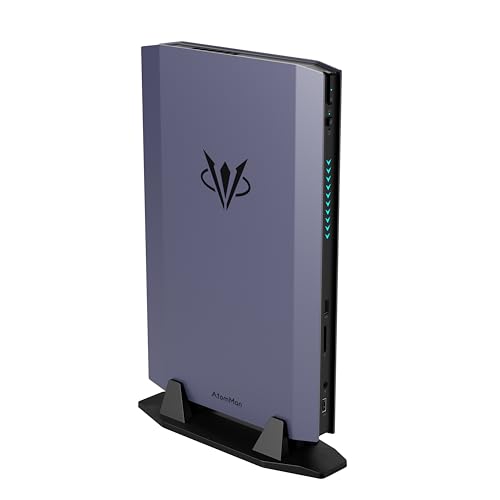
MINISFORUM AtomMan G7 Pro — Core i9-14900HX, RTX 5070 Laptop GPU, Slim Vertical Chassis
Who it suits: The buyer whose constraint is desk area rather than shelf volume — who wants current-generation laptop graphics in a tall, slim box that stands upright and takes almost no desk.
The G7 Pro’s installation argument is its shape: the slim vertical format Minisforum’s G7 line is built around stands on the desk like a book rather than sprawling across it, so the desk footprint is the machine’s narrow face. One discipline note before anything else: the research behind this guide pins no exact published volume for this chassis, so this review prints none — the shape is documented, the liters are not, and the checklist below tells you to take the maker’s listed dimensions from the live listing and measure your spot against them before ordering. Inside the upright chassis sit a Core i9-14900HX — 24 cores, boost clocks to 5.8GHz — and an RTX 5070 Laptop GPU, named in full: a mobile part with 8GB of graphics memory, a step below the desktop RTX 5070’s 12GB. Cooling is six heat pipes and dual fans; memory and storage are socketed, with two DDR5 SO-DIMM slots supporting up to 96GB and two M.2 2280 slots; connectivity runs to HDMI 2.1, USB4 and WiFi 7. At launch Minisforum positioned the configured 32GB/1TB machine in the upper part of this guide’s range and the barebone below it — check the current price on Amazon for the style you are buying.
Buried in that pricing is this pick’s trap, and it deserves the boldest print in the review: Amazon titles this very ASIN as the barebone version — “Barebone Version Without Storage/OS” — even while some marketplace mirrors of the same ASIN describe a configured unit. A barebone arrives with no RAM, no SSD and no operating system, and completing one at late-2026 component prices is not the saving it appears: 32GB DDR5 SO-DIMM kits alone have carried a substantial cost on Amazon during the memory price spike, before an SSD and a Windows license join the invoice. So the rule is procedural, not financial: before ordering, confirm on the live listing that the style you are buying is the configured 32GB/1TB machine, and if only the barebone is live, price the completion honestly — at spike component prices the configured machine is the better buy even if it looks dearer on the page. An upright mini also has an upright machine’s placement rule: it stands where it can fall, so put it where a knocked desk or a cable tug will not topple it, with its vents unobstructed.
- An RTX 5070 Laptop GPU from the current generation, alongside a 24-core flagship mobile processor.
- The smallest desk footprint of any pick — the slim vertical format stands rather than sprawls.
- Memory on sockets to 96GB and two M.2 slots — the upgrade paths the soldered NUC goes without.
Honest limitation: The style-selector trap is live on this exact listing — Amazon titles the ASIN as the barebone while mirrors describe configured units — and at current memory prices, completing a barebone can wipe out the saving that made it look cheap. No exact chassis volume is published in the verified research, so measure from the live listing.
Choose it if the live listing confirms the configured style, or if RAM and an SSD are already sitting in your parts drawer. Skip it if the version in front of you is ambiguous — at this money, ambiguity alone justifies walking away.

ASUS ROG G22CH — Core i7-13700KF, Desktop RTX 4070 12GB, 32GB, 1TB, ~10.7L
Who it suits: The living-room gamer whose small space is a TV stand — who wants a console-shaped box in media furniture with a real desktop graphics card inside it.
At roughly 10.7 liters the G22CH is four times the G7 Ti’s volume, and on a desk that would be a demerit; in media furniture it is the point. The case is shaped to sit horizontally or vertically alongside consoles, and the graphics inside are a desktop RTX 4070 with the full 12GB of memory — not the 8GB laptop part that shares its name in the picks above. The supporting cast is complete and published: a Core i7-13700KF, 32GB of memory, a 1TB SSD, and a 600W Gold-rated power supply whose wattage ASUS actually states — an internal supply, so there is no brick to hide, which in a TV stand is one less warm object to find a home for. Check the current price on Amazon — when this machine appears at a deal tier below its standard tier, that is where it turns genuinely interesting.
The furniture question needs one firm answer: media furniture with an open back or open front is a fine home for this machine; a sealed cabinet with a closed door is not, for this pick or any other in the guide. A desktop 4070 under load exhausts real heat, and a closed cabinet returns that heat to the machine’s own intakes until clocks and noise both suffer — the checklist below refuses it outright. At a deal tier the size premium is modest and legible: a tower carrying an RTX 4070 SUPER — a faster card — sits in a lower tier, so you pay a modest premium for a slightly slower card in a box under a third of a tower’s volume. At its full standard tier the value sours, so this pick carries a buy line: a deal tier is good, the standard tier only if the form factor is non-negotiable. The remaining limitations are generational: the 13700KF and RTX 4070 are previous-generation parts, the compact interior limits future GPU swaps to cards that physically fit its clearance, and 1TB of storage fills quickly with modern game installs.
- A genuine desktop RTX 4070 with its full 12GB, inside a console-style ~10.7L case.
- Internal published 600W Gold PSU: no external brick to place in the TV stand.
- Bought at a deal tier, it charges only a modest premium over comparable towers.
Honest limitation: The CPU and GPU are previous-generation parts, the tight interior admits only future cards that physically fit, and at its standard tier the premium for the shape stops looking reasonable. It must live in open-backed furniture, not a sealed cabinet.
Choose it if the machine’s home is the living room and it has to blend in there. Skip it if you are paying the full standard tier, or if your only furniture option is a closed cabinet.

Cooler Master NR2 Pro — Ryzen 7 9800X3D, Desktop RTX 5070 Ti 16GB, 32GB, 2TB, 18.25L
Who it suits: The buyer whose “small space” still fits a small tower — the SFF purist who refuses laptop graphics and wants standard, upgradeable parts in the smallest honest package that holds them.
Everything the minis compromise on, this machine refuses to — and the price of that refusal is volume: 18.25 liters in Cooler Master’s NR200P Max chassis, seven times the G7 Ti’s footprint, the largest box in this guide and still a fraction of a mid-tower. It belongs under a desk or on a deep shelf, not behind a monitor, and this guide ranks it last on the small-spaces brief for exactly that reason while respecting what the liters buy: a Ryzen 7 9800X3D, the gaming CPU other CPUs are measured against, and a Gigabyte RTX 5070 Ti that is the genuine desktop card — 16GB of GDDR7, socketed in a real PCIe slot, replaceable years from now. The rest reads like a parts list a forum would approve: 32GB of DDR5-6000, a 2TB Gen4 SSD, a Gigabyte B850I AORUS PRO mini-ITX board, an 850W SFX Gold power supply — internal, so no brick — a custom 280mm radiator cooling the CPU, and Windows 11 installed.
Installation grading cuts both ways here. The 280mm radiator needs an unobstructed exhaust path, and in a small room this machine moves more heat than any other pick — plan its corner as a warm corner, with clearance on the vented sides, and never in a closed cabinet. Roundup coverage of this exact system contributes two honest footnotes of its own: the fans are reasonable rather than silent, and among early units one arrived with a dead front USB-C port while another needed its GPU riser cable reseated after shipping — test both on day one, while returns are painless. The price catch is behavioral rather than structural: this system’s live price moves widely, from deal tiers comfortably inside this budget to peak tiers above it. The rule is non-negotiable: it belongs in this guide only when the current price on Amazon sits comfortably within this budget; at peak pricing it is over budget entirely. At a deal tier its size premium against comparable desktop-5070 Ti towers is close to zero — a rarity created by the late-2026 component price spike.
- A genuine desktop RTX 5070 Ti 16GB next to a 9800X3D — desktop parts throughout, no asterisks.
- Standard mini-ITX components throughout: upgradable, repairable, understandable.
- At a deal tier it can undercut comparable towers outright; the premium for size can drop to zero or below.
Honest limitation: The price swings violently, and at the top of its range it blows the budget it is recommended under. At 18.25 liters it is also the least small machine here by a wide margin.
Choose it if you want desktop-class graphics and upgradeability and your space fits an 18.25-liter box, and you can wait for a deal tier that fits this budget. Skip it if the asking price is drifting toward its peak, or if anything above 11 liters misses the point of your search.
Comparison Table
| Product | Volume | Graphics (named in full) | Installation notes | Price | Link |
|---|---|---|---|---|---|
| MINISFORUM AtomMan G7 Ti | ~2.55L | RTX 4070 Laptop GPU, 8GB, full 140W | Smallest box here; open air only; adapter needs a home | Check price on Amazon | Check on Amazon |
| ASUS ROG NUC (2025) | ~3L (11.1 × 7.4 × 2.2 in) | RTX 5070 Laptop GPU, 8GB, soldered | Dock-free desk via dual Thunderbolt 4; 330W external brick | Check the current price on Amazon (ASUS storefront) | Check on Amazon |
| MINISFORUM AtomMan G7 Pt | ~2.7L (269 × 155 × 64mm) | Radeon RX 7600M XT (mobile), 8GB | Millimeter-published size; 16-core heat needs open sides | Check price on Amazon | Check on Amazon |
| MINISFORUM AtomMan G7 Pro | Slim vertical, a few liters | RTX 5070 Laptop GPU, 8GB | Smallest desk footprint; confirm configured style before ordering | Check price on Amazon (confirm style) | Check on Amazon |
| ASUS ROG G22CH | ~10.7L | Desktop RTX 4070, 12GB | Console-style for media furniture; internal PSU, no brick; open-backed furniture only | Check the current price on Amazon | Check on Amazon |
| Cooler Master NR2 Pro | 18.25L | Desktop RTX 5070 Ti, 16GB, replaceable | Small tower, not a mini; 280mm radiator exhaust needs clearance | Check the current price on Amazon | Check on Amazon |
Measure Before You Buy: The Five-Step Checklist
Small-space purchases fail at the furniture, not at the checkout. Work through these five steps in order before ordering any machine in this guide.
- Step 1 — Measure the spot. Measure the actual shelf, desk corner, TV-stand bay or floor space in inches or millimeters, including its depth. Then match it against a documented size: the G7 Pt publishes 269 × 155 × 64mm, the ROG NUC about 11.1 × 7.4 × 2.2 inches, and the volume ladder runs ~2.55L (G7 Ti), ~2.7L (G7 Pt), ~3L (NUC), ~10.7L (G22CH), 18.25L (NR2 Pro). For the G7 Pro, whose exact volume is not pinned in the verified research, take the maker’s dimensions from the live listing and measure against those. If the spot cannot be measured, the pick cannot be graded — choose a pick whose size is published.
- Step 2 — Ventilation clearance. Every pick here cools itself with room air. Leave open space on the sides and top the machine breathes through, keep radiators and fan intakes off walls and curtain fabric, and apply the rule this guide does not soften: no pick in this guide goes inside a sealed cabinet. A closed door turns any of these machines’ exhaust into its intake. Open-backed media furniture is fine for the G22CH; a shut cabinet is not, for it or for any mini here.
- Step 3 — Brick address. Decide where the power lives before the machine arrives. The ROG NUC’s 330W external adapter is a substantial object that needs floor or shelf space with air around it; the laptop-style minis likewise run from external adapters that belong somewhere ventilated, not buried behind books. The G22CH and NR2 Pro carry internal power supplies (600W Gold and 850W SFX Gold respectively) — no brick, but their cases exhaust the heat instead. Either way, count the supply in the footprint and confirm a wall socket within cord reach of the spot from Step 1.
- Step 4 — Cable drop. Count what will run from the box: display cable, power, Ethernet if you wire it, USB for peripherals. A small installation stays small when the drop is short and single — the ROG NUC’s dual Thunderbolt 4 and six USB-A ports exist to collapse a desk’s worth of peripherals into one box, and the minis’ WiFi 7 (where documented) removes the network cable from the drop entirely. Route the drop before ordering so the machine does not end up exiled to wherever the cables happen to reach.
- Step 5 — Then order. Only now — spot measured, clearance confirmed, brick addressed, cables routed — place the order, and on the live listing confirm the three things that decide what arrives: the seller (the ROG NUC at list from ASUS’s storefront, not a third-party markup), the style (configured, not barebone, on the Minisforum listing families), and the current price on Amazon against the buy rules in each review (the NR2 Pro only when its live price sits comfortably within this budget, the G22CH at a deal tier).
How to Choose a Small Form Factor Gaming PC for a Small Space
- Pick the installation class before the hardware. Under 3 liters means laptop graphics and a hide-anywhere box; about 10.7 liters admits a desktop 4070 in console shape; 18.25 liters admits a desktop 5070 Ti and upgradeability. Each step up in volume is a step up in graphics class — decide from the furniture which ladder rung you are on, then shop within it.
- Read every GPU name to the end. “RTX 5070” in a small box almost always means the Laptop GPU with 8GB; the desktop card has 12GB and the desktop 5070 Ti has 16GB. In a sealed mini the graphics can never change, so the word after the number is worth a great deal and years of settings compromises.
- Start with the ceiling, not the listings. No SFF machine under $3,000 carries a desktop RTX 5080 — the verified one sits in a much higher tier well above this budget — and none carries an RTX 5080 Laptop GPU either, since that NUC configuration also sits above this budget. If desktop-flagship graphics are the requirement, buy the tower and close this guide.
- Confirm configured versus barebone before anything else. On shared Minisforum listing families the barebone style sits one click from the configured one, and its lower price buys a box with no RAM, no SSD and no Windows. With memory priced as it is in late 2026, finishing that box can out-cost the configured machine.
- Buy at a deal tier or do not buy. The NR2 Pro’s price swings widely, from deal tiers inside this budget to peaks above it, and marked-up third-party asks have appeared against the ROG NUC’s standard ASUS-storefront tier on its own listing. Fix a walk-away rule for each machine before you shop — buy only when the current price on Amazon fits this budget and the seller is the right one — and treat a missed deal as a missed deal.
- Prefer socketed memory and a spare M.2 slot. When the graphics can never change, memory and storage become the only upgrades that exist. The G7 machines’ SO-DIMM slots and second M.2 bays are longevity features; the NUC’s soldered memory fixes its horizon on day one.
- Stress-test inside the return window. Dense machines tend to fail early or not at all, and the flagship pick’s owner reports include units dead on arrival. Work the machine hard during week one, test every port, and hold onto the packaging until week three.
- Ask what the unspent money is for. Between the G7 Ti and the top of this budget sits a substantial gap — enough for a high-refresh monitor, a second machine, or savings. When the honest answer is “nothing in particular,” the flagship premium buys exactly that.
Common Buying Mistakes
- Measuring the box and forgetting the installation — the brick, the cable drop and the clearance are part of the footprint, and the ROG NUC’s 330W adapter is the standing example.
- Putting any of these machines in a sealed cabinet because it looks tidy. Every pick here breathes room air; a closed door recycles exhaust into intake until noise and throttling undo the tidiness.
- Reading “RTX 5070” on a mini PC listing and pricing it as the desktop card. The laptop part brings 8GB against the desktop card’s 12GB and a lower ceiling in every game — a shared name over different silicon.
- Paying a third-party markup on a brand-storefront listing — marked-up asks well above the standard tier have appeared on the ROG NUC’s own page. Check who is selling before what it costs.
- Clicking the barebone style by mistake on a shared listing family, then learning that RAM, an SSD and Windows at spike prices outrun what the configured machine cost.
- Buying the NR2 Pro at its peak. One name, two purchases: a system whose live price swings from a deal tier inside this budget to a peak above it is only one of those things at a time, and only the deal-tier version belongs in this guide.
- Assuming small means quiet. Dense cooling in small volumes works harder per unit of heat moved; plan placement and expectations accordingly.
- Assuming a VESA mount exists because a box is small. No pick in this guide has a documented VESA mount in the verified research — plan a shelf or stand, not a bracket.
- Spending the whole $3,000 because it is there. For most readers the right machine here is the G7 Ti, which sits well within this budget; leaving the difference unspent is not a failure of ambition.
Final Recommendation
- Most small spaces: MINISFORUM AtomMan G7 Ti — the smallest box here, well within this budget, with the rest of the budget unspent — check price on Amazon.
- Small desk, flagship brand: ASUS ROG NUC (2025), from ASUS’s storefront only, at its standard tier — check the current price on Amazon — and budget a home for its 330W brick.
- CPU-first workloads: MINISFORUM AtomMan G7 Pt — workstation cores that also game, in a millimeter-measured 2.7 liters.
- Slimmest desk footprint: MINISFORUM AtomMan G7 Pro, with the configured style confirmed before payment.
- Living-room console replacement: ASUS ROG G22CH at a deal tier, in open-backed furniture — check the current price on Amazon.
- Desktop graphics or nothing: Cooler Master NR2 Pro, bought at a deal tier inside this budget and never at peak — if your space honestly fits 18.25 liters.
Our top two are the MINISFORUM AtomMan G7 Ti, because it delivers the great majority of what this search is actually for — a tiny, complete, fast gaming PC that fits almost anywhere — at under half the budget, and the ASUS ROG NUC (2025), because at its standard ASUS-storefront tier it is the tidiest small-desk installation in the guide, with the connectivity to anchor a compact setup without a dock. Between them they frame the honest choice at this end of the category: the value mini that fits everywhere, or the flagship mini that fits beautifully. The G22CH serves the living room, the G7 Pt serves the workstation, the G7 Pro serves the narrowest desks, and the NR2 Pro serves buyers whose space fits a small tower and whose patience fits waiting for a deal tier. Readers working with a smaller budget should start with Best Small Form Factor Gaming PC Under $1500, and readers who conclude — reasonably — that the tower was the answer all along should see Best Gaming PC Under $3000. Measure the spot, clear the air, give the brick an address, route the cables, and only then order.
Frequently Asked Questions
Can I put one of these PCs inside a TV cabinet with the door closed?
No — this is the guide’s firmest placement rule. Every pick here cools itself with the air around it, and a sealed cabinet feeds a machine its own exhaust until fan noise rises and performance falls. Open-backed or open-front media furniture is a good home, and it is the placement the G22CH was shaped for; a closed door is not, for any pick in this guide.
Can I mount one of these behind my monitor with a VESA bracket?
Not on the evidence in this guide: no pick has a documented VESA mount in the verified research behind it, so none is claimed here. The sub-3-liter picks are light, flat boxes that sit happily on a shelf or stand behind a screen, which achieves the same hidden-PC result — but plan the shelf, and check the live listing’s specification section if a bracket matters to you, because that is the only authoritative source.
What size actually counts as small form factor?
No official line exists, so this guide enforced a measurable one of its own: published volumes running from about 2.55 liters to 18.25 liters. The ladder matters more than the label — below roughly 3 liters you get laptop graphics, around 10.7 liters a desktop 4070-class card fits, and at 18.25 liters a desktop 5070 Ti with standard, replaceable parts fits. Measure your furniture first, then shop the ladder.
Can you get a desktop RTX 5080 in a small form factor PC under $3,000?
No. Of every answer in this guide, this is the one to remember. Zotac’s Magnus One Ultra — about 11.5 liters, the one verified true-SFF desktop-5080 machine — sits in a much higher tier well above this budget. Below $3,000, the strongest small-box graphics are a desktop RTX 5070 Ti inside an 18.25-liter build, with laptop GPUs beneath that. At this money, desktop-5080 performance lives exclusively in towers.
Is the RTX 5070 Laptop GPU just the desktop RTX 5070 in a smaller box?
No. They share a name and a generation, not a specification. The laptop part carries 8GB of memory against the desktop card’s 12GB, runs inside a laptop power envelope, and sits soldered into machines like the ROG NUC and G7 Pro with no upgrade path. That gap is precisely why every review in this guide spells laptop GPU names out in full.
Does buying the barebone version of a mini PC actually save money?
At the moment, usually not. A barebone arrives without RAM, storage or Windows, and during the late-2026 component price spike a single 32GB DDR5 SO-DIMM kit carries a substantial cost on Amazon — before an SSD and an operating system join the bill. Own the parts already and a barebone is rational; buying them means pricing the whole completion and comparing it honestly with the configured machine.
How much do prices move on these machines?
A lot, and often. The NR2 Pro by itself swings from deal tiers comfortably inside this budget to peak tiers above it, and marked-up third-party asks well above the standard tier have appeared on the ROG NUC’s listing. That is why this guide prints no static prices: hold every pick to its buy rule, check the current price on Amazon, and let the live listing — checked for seller, style and configuration — be the only price that counts.
- Best Small Form Factor Gaming PC Under $2500
- Best Small Form Factor Gaming PC For 1440p Gaming Under $3000
- Best Small Form Factor Gaming PC For Beginners Under $3000
- Best Small Form Factor Gaming PC For Streaming Under $3000
- Best Small Form Factor Gaming PC For Small Spaces Under $2500
- Best Compact Gaming PC Under $3000
- Best Mini Gaming PC Under $3000
- Best Mini PC Under $3000


