Where to buy
Check the latest price, availability and delivery on Amazon. Orders are placed on Amazon. We may earn a commission from qualifying purchases.
- Best overall fanless mini PC under $700: UDPTCP Fanless Core Ultra 7 155H Mini PC, 6x 2.5GbE (Barebone) — Check on Amazon
- MeLE Quieter DL Business-Grade, N150, 16GB RAM, 512GB SSD, Dual 2.5GbE — Check on Amazon
- Protectli Vault Pro VP2430, N150, 4x 2.5GbE, Barebone — Check on Amazon
- Kinupute Fanless Industrial Mini PC, Core i7-1165G7, 8GB RAM, 256GB SSD — Check on Amazon
- MeLE Quieter4C N150, 16GB RAM, 512GB SSD, Triple 4K Display — Check on Amazon
See 1 more Amazon option
- Protectli Vault Pro VP2440, N150, 2x 10G SFP+, 16GB RAM, 250GB SSD — Check on Amazon
Read the full guide ↓
Disclosure: As an Amazon Associate, reviewstook.com earns from qualifying purchases. Links to Amazon on this page are affiliate links; they cost you nothing extra. Listing details such as price and availability change often, so check the current Amazon listing before you buy.
Seven hundred dollars is a strange budget for a fanless mini PC, because fanless is the one corner of computing where money stops buying speed. A passively cooled case can only shed so much heat, and that ceiling — not the chip, not the sticker — decides how fast any of these machines can run for more than a few minutes. The processors in this guide span an enormous range on paper, from a 6-watt Intel N150 to a 16-core Core Ultra 7 155H, yet every one of them is ultimately governed by the same physics: a finned aluminium box radiating heat into still air. What $700 genuinely buys in this category is everything around the processor. It buys network ports — two, four, six, even a pair of 10-gigabit SFP+ cages. It buys storage fitted at the factory instead of a barebone shell, rugged industrial cases rated for round-the-clock duty in dusty rooms, coreboot firmware, US-based support, and memory headroom. It does not buy a gaming PC, and this guide will not pretend otherwise: this keyword sits in a gaming-PC list, but the honest version of it is a silence list. If your games are retro titles, light esports at low settings, or streamed from a bigger machine, a fanless box can be the quiet endpoint on your desk. If you want native modern gaming, the same $700 spent on a fanned mini PC buys several times the graphics power, and the final section of this guide says so plainly.
Every product below was verified as genuinely fanless from the manufacturer’s own specifications, datasheets or hands-on reviews — not from a listing headline. That filter is brutal, and it should be: the mini PC market is full of machines described as “quiet” or “silent” that contain a fan you can hear across a bedroom at 2 a.m. Several well-known models were excluded from this guide precisely because their fanless status could not be verified, and they are named in the notes that accompany this article. What survived the filter is a short, honest list: one barebone with a genuinely fast processor, two ready-to-run MeLE boxes, two Protectli firewall appliances with published datasheets, and one rugged industrial desktop. Below are the quick picks, detailed reviews of all six, a comparison table, a section on the sustained-load tax that passive cooling charges every chip, the mistakes that waste money at this tier, and the questions buyers ask before putting a fanless PC on 24/7 duty.
In this guide
Quick Picks
Short on time, or comparing several options at once? Each row below names a buyer type and the product that suits it, with a link to the listing.
| Buyer type | Pick | Why it stands out | Link |
|---|---|---|---|
| Best overall | UDPTCP Fanless Core Ultra 7 155H (Barebone) | The strongest CPU and iGPU that passive cooling can buy, with six 2.5GbE ports | Check on Amazon |
| Best ready-to-run dual-LAN box | MeLE Quieter DL Business-Grade, 16GB/512GB | Two Intel I226-V ports, RAM and SSD fitted, thinner than a paperback | Check on Amazon |
| Best firewall pedigree | Protectli Vault Pro VP2430 (Barebone) | Four 2.5GbE ports, coreboot option, published datasheets and US support | Check on Amazon |
| Best industrial desktop | Kinupute Fanless Mini PC, Core i7-1165G7 | A real desktop-class CPU in a sealed metal case built for 24/7 duty | Check on Amazon |
| Best silent desktop and streamer | MeLE Quieter4C N150, 16GB/512GB | Triple 4K output, USB-C power, VESA mount, zero moving parts | Check on Amazon |
| Best for 10-gigabit networking | Protectli Vault Pro VP2440, 16GB/250GB | The only fanless box here with two 10G SFP+ ports | Check on Amazon |
How These Picks Were Chosen
The first filter was the one in the keyword: fanless, proven. A pick had to be documented as passively cooled in the manufacturer’s own material — a Protectli datasheet that says “Fanless Appliance” in the model description, a MeLE listing and spec page built around a 0dB design, a Notebookcheck report describing a passive cooling case — or in a hands-on review that opened the machine. Marketing words like “quiet,” “silent mode” or “low noise” were not enough, because in this market those words routinely describe a small fan spinning slowly. Anything we could not verify was excluded and listed in the accompanying notes, including some famous names.
The budget was applied as a ceiling on the machine as sold. Two picks are barebones that need RAM and storage before they compute anything, and their reviews note that completion cost openly instead of hiding it. One pick, the VP2440, is included for its unique port layout with an explicit rule — check price on Amazon and buy it only if the live price fits this guide’s under-$700 budget. We did not use these products ourselves. We read maker listings, datasheets, specification pages and independent reviews, and compared processors, port counts, memory ceilings, storage and firmware support. Where a maker’s own test numbers are quoted — Protectli publishes VPN throughput results for its Vaults — the review labels them as maker-published, because they are.
One more filter sat on top: honesty about the category. This guide appears among gaming PC guides, so each review states what the machine can and cannot do for games in plain terms. Integrated graphics in a sealed box is a streaming client, a retro machine and a light-esports box. It is not a 1440p gaming PC at any price, and no pick below is described as one.
The 6 Best Fanless Mini PCs Under $700
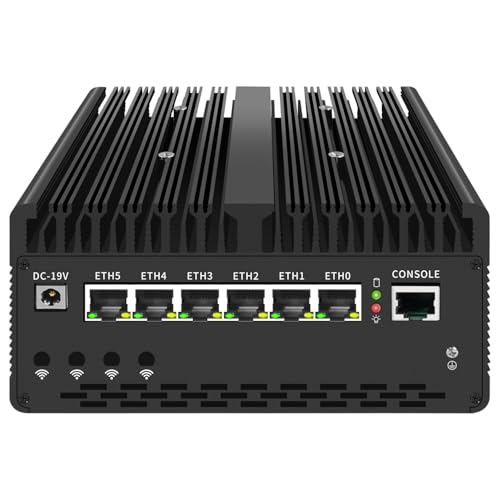
UDPTCP Fanless Core Ultra 7 155H Mini PC, 6x 2.5GbE (Barebone)
Who it suits: Homelab builders and virtualisation hosts who want the most processor that silence can buy — and who already own, or are happy to fit, DDR5 memory and an NVMe drive.
This is the outlier of the guide: a genuinely mid-range laptop processor, Intel’s Core Ultra 7 155H with 16 cores and an Arc integrated GPU of 8 Xe cores, sealed inside a passive case with no fan at all. Notebookcheck’s report on this machine describes exactly how the trick is done — a slightly larger chassis with a sizable passive heatsink design — and the supporting numbers are industrial: the system is rated for ambient temperatures from 0 to 60°C and up to 95% humidity. The port selection is the real reason it tops this guide. Six Intel I226-V 2.5-gigabit Ethernet ports plus a dedicated console port make it a firewall or router platform; a Thunderbolt 4 port, DisplayPort and HDMI outputs, a PCIe 4.0 x8 expansion slot and SIM slots for 4G/5G modem cards make it a small server that can grow. No other fanless machine in this guide — or, at this budget, anywhere we could verify — combines this CPU class with this many fast network ports.
Check price on Amazon for the barebone kit — that is the version this review covers: a motherboard, case and processor that still need DDR5 SO-DIMMs and an M.2 SSD before they become a computer. Factor in the cost of 16–32GB of memory and a 512GB–1TB drive on top of the barebone, which can push a finished machine toward or past this guide’s ceiling — we would rather flag that openly than hide it. A fully configured 32GB RAM and 1TB SSD build is also offered in a higher tier, so check price on Amazon for the exact build you are comparing. Two specification notes belong in the open. The board supports DDR5-5600, but the configured builds ship with DDR5-4800. And no Wi-Fi card is included by default in any configuration offered on Amazon, so wireless is an M.2 card you add yourself.
For games, this is the only pick whose integrated graphics deserve the word “capable”: the Arc iGPU is the strongest in this guide by a wide margin, suited to esports titles and older games at 1080p low-to-medium settings and to streaming full-quality video to several rooms. It is still integrated graphics in a sealed box with a sustained power ceiling, and it will not hold its boost clocks through a long session the way a fanned machine does. Buy it as a silent server that can also play; not as a games machine that happens to be silent.
- Core Ultra 7 155H with Arc graphics — the strongest silicon in this guide, passively cooled.
- Six Intel I226-V 2.5GbE ports plus a console port, Thunderbolt 4 and a PCIe 4.0 x8 slot.
- Industrial ratings: 0–60°C ambient and up to 95% humidity, per the maker’s specification.
Honest limitation: It is a barebone — add memory, storage and your own OS before it computes, which can carry the finished cost past this guide’s budget — and no Wi-Fi card is included.
Choose it if you want one silent box that can route, host virtual machines and still play light games. Skip it if you want a computer that works out of the box, or your budget is a hard $700 all-in.

MeLE Quieter DL Business-Grade, Intel N150, 16GB RAM, 512GB SSD
Who it suits: Anyone who wants a silent firewall, home server or Home Assistant host that works the day it arrives — RAM and SSD fitted, two proper network ports, no assembly.
The Quieter DL is a slab of metal less than an inch thick — about 6.6 by 3.7 by 0.84 inches, under a pound — whose entire top surface is the heatsink. The Business-Grade build is the one to buy, and the distinction matters enough to build a review around: it carries two Intel I226-V 2.5-gigabit controllers, the network chips that pfSense and OPNsense handle without driver drama, while MeLE’s cheaper soldered-memory builds of the same model use Realtek controllers that owners report those firewall systems failing to recognise. Inside the Business-Grade 16GB build, memory sits in a real DDR4 slot you can later raise to 32GB, and the 512GB NVMe SSD occupies the machine’s single M.2 slot. MeLE rates the box at about 6 watts at idle, which is the number that matters for a machine that never sleeps: this is a router, DNS server, smart-home hub and media server that costs almost nothing to run and makes no sound doing it. Check price on Amazon for the 16GB/512GB Business-Grade build.
The honesty notes are about stock and ceiling, not about the hardware. Stock of this exact build has been thin — it has been recorded as unavailable at times even when other builds were listed — so treat the listing as one to catch rather than one to assume. If it is out of stock, the Business-Grade 8GB/256GB build of the same machine is the sensible fallback if it is in stock — check price on Amazon for that build too — not the soldered-memory versions. The performance ceiling is the N150 itself: four small cores that handle network services, office work and 4K playback comfortably and nothing beyond that comfortably. A reviewer who tested the N100 build of this same box measured Rocket League at roughly 15–16 frames per second on default settings and around 40 at the lowest, with Fortnite choppy even at its floor; the N150 is a marginal step up, not a different class. As a games machine this is an emulation and streaming endpoint. As a silent infrastructure box, it is the most complete ready-to-run package in this guide.
- Two Intel I226-V 2.5GbE ports — the firewall-friendly controllers, on the Business-Grade build.
- RAM in a real slot (up to 32GB) and a 512GB NVMe SSD fitted; nothing to assemble.
- About 6W at idle by MeLE’s rating, in a sub-inch fanless slab with a VESA mount in the box.
Honest limitation: The N150 is an entry-level chip — network services and media, not muscle — and stock of the 16GB build has been intermittent; check you are buying the Intel-NIC Business-Grade version, not a soldered Realtek build.
Choose it if you want a silent dual-LAN box that works out of the box. Skip it if you need more than two network ports, or any real gaming performance.

Protectli Vault Pro VP2430, Intel N150, 4x 2.5GbE (Barebone)
Who it suits: Firewall and homelab builders who value documentation, firmware choice and a vendor that answers support tickets over raw specifications per dollar.
Protectli is the name-brand end of the fanless appliance market, and the VP2430 is its current four-port design: an Intel N150, four Intel I226-V 2.5-gigabit ports on their own PCIe lanes, a DDR5 SO-DIMM slot that Protectli has qualified with modules up to 64GB (Intel’s own sheet for the chip says 16GB; Protectli publishes its tested list), 32GB of onboard eMMC, and an M.2 slot for real storage. The datasheet describes it in its first line as a fanless appliance, and the platform extras are the kind that never appear on a spec grid: coreboot firmware is available as an alternative to the standard AMI BIOS, the knowledge base carries a full hardware overview and datasheet for the model, and the company publishes its own VPN test results — its WireGuard figure for this box, around 2.25 Gbps in Protectli’s own OPNsense test, is a maker number, labelled as such, but it is more than most rivals publish at all. Check price on Amazon for the VP2430 barebone. The barebone VP2430e — the same machine without the eMMC, which has replaced it in Protectli’s line — is also listed on Amazon; check price on Amazon for that variant as well.
What you are buying, be clear, is a shell with a pedigree: this listing is a barebone that needs DDR5 memory and an M.2 drive installed before it runs anything, and no operating system is included — you bring OPNsense, pfSense, Proxmox or Linux and install it yourself. That is normal for this class and a genuine barrier for anyone else. The four video outputs (HDMI, DisplayPort and two USB-C with DisplayPort) make it a workable light desktop once configured, and the N150’s integrated graphics handle 4K playback; but with the same chip as the MeLE boxes and a firewall’s soul, its gaming story is identical — retro, emulation, streaming, and light esports at low settings on a good day. Pay the Protectli premium when the machine is your network’s front door and you want a manual, a datasheet and a support desk behind it. Save the money with the MeLE or the UDPTCP if it is a hobby box.
- Four Intel I226-V 2.5GbE ports, each on its own lane — built for routing, not adapted to it.
- Coreboot firmware option, published datasheets, hardware overviews and US-based support.
- DDR5 slot qualified by Protectli to 64GB, with onboard eMMC for a lightweight boot OS.
Honest limitation: Barebone and OS-free — memory, storage and installation are on you — and the N150’s ceiling is the same entry-level ceiling as every N150 box here.
Choose it if this is your firewall and you want the best-documented, best-supported fanless platform under $700. Skip it if you want a finished PC, or more than two ports is not your problem.

Kinupute Fanless Industrial Mini PC, Core i7-1165G7, 8GB RAM, 256GB SSD
Who it suits: Buyers who need a silent machine that is a real desktop first and an appliance second — office work, point-of-sale, kiosk and light industrial control — in a sealed metal case with no fan to clog or fail.
Most fanless mini PCs pair their sealed cases with entry-level chips, because that is all a passive case was long assumed to cool. The industrial-PC makers ignored that assumption: this Kinupute puts an Intel Core i7-1165G7 — four cores, eight threads, boosting to 4.7GHz, with Iris Xe integrated graphics — inside a finned, ruggedised metal enclosure with no fan, rated by its maker for continuous duty. Check price on Amazon — the configuration covered here comes with 8GB of DDR4 memory, a 256GB SSD and Windows 11 Pro installed, which makes it the strongest complete, ready-to-run desktop in this guide: no barebone arithmetic, no OS to source. Two 2.5-gigabit LAN ports give it a second career as a router or network appliance, dual displays run over HDMI and VGA, and Wi-Fi 6 is built in — a combination none of the firewall-first boxes above quite match as an everyday computer.
The industrial trade-offs are real and worth naming. Eight gigabytes of memory is the configuration’s weak point in 2026: adequate for office suites, browsers and appliance work, tight for anything that multitasks heavily, and the 256GB drive fills quickly once a media library arrives. The i7-1165G7 is a 2020-era processor — its core counts and graphics are a generation or more behind the Core Ultra at the top of this guide — and inside a passive case it will settle to sustained speeds well below its 4.7GHz headline under long loads, because that is what sealed boxes do. Its Iris Xe graphics are the second-strongest here, good for the same light-esports and older-games territory as the UDPTCP at somewhat lower settings, and for flawless 4K desktop and video work. Kinupute also sells a sibling industrial listing with six serial COM ports for factory and legacy-equipment work; if your silence is for a workshop rather than a desk, that variant exists in the same family. For a quiet room, this is the pick that behaves most like an ordinary PC — because it is one, minus the fan.
- Core i7-1165G7 with Iris Xe graphics — desktop-class silicon in a sealed, fanless case.
- Complete and ready: Windows 11 Pro installed, Wi-Fi 6 fitted, dual 2.5GbE ports.
- Rugged metal industrial build intended for continuous 24/7 operation.
Honest limitation: Only 8GB of RAM and 256GB of storage in this configuration, on a 2020-era platform whose boost clocks a passive case cannot sustain.
Choose it if you want a silent everyday desktop with appliance-grade toughness. Skip it if you need 16GB of memory on day one or the newest platform — the UDPTCP barebone, once completed, is the stronger machine.

MeLE Quieter4C, Intel N150, 16GB RAM, 512GB SSD
Who it suits: The classic fanless buyer: a silent desk or living-room PC for office work, browsing, media and streaming, mounted behind a monitor and forgotten.
The Quieter4C is the machine that defined this category for most buyers, and the N150 refresh keeps the formula: a fanless slab — MeLE’s listing language is “true fanless passive cooling” and 0dB operation — with the whole case as its heatsink, an Intel N150 quad-core, and in this configuration 16GB of memory and a 512GB SSD with Windows 11 Pro. Check price on Amazon for the current listing. The I/O is desktop-shaped rather than firewall-shaped: two HDMI 2.0 ports plus a full-function USB-C give triple 4K displays at 60Hz, the USB-C port also accepts PD power input, and the box includes a VESA mount, auto power-on, Wake-on-LAN and PXE boot — the resume-after-power-cut behaviour that makes it a favourite for digital signage, kiosk and astrophotography duty, where the PC must come back to life unattended at 3 a.m. For streaming it is close to ideal: Quick Sync video hardware in the N150 handles 4K playback and transcodes for a home media server without a whisper, which is precisely the workload Best Fanless Mini PC For Streaming Under $700 exists for.
Set against its sibling above, the trade is ports for polish. The Quieter4C has a single gigabit Ethernet port where the Quieter DL has two 2.5GbE Intel ports, so it is the weaker firewall and the stronger desk PC. Memory on this N150 configuration is fixed rather than slotted — what you buy is what you keep — and Wi-Fi is Wi-Fi 5 rather than 6, a spec-sheet detail that matters only if your desk has no cable. The gaming verdict is the N150 verdict everywhere in this guide: retro and emulation happily, esports at low settings with modest expectations, modern titles via cloud streaming rather than local rendering. What the Quieter4C adds over cheaper fanless boxes is the 16GB/512GB configuration itself — enough memory and storage that the machine never feels like the entry-level version — in the category’s most proven fanless design. If the DL is the network person’s MeLE, this is everyone else’s.
- Triple 4K displays over dual HDMI and USB-C, in a proven 0dB fanless design.
- 16GB RAM and 512GB SSD fitted — the configuration that does not feel entry-level.
- Auto power-on, Wake-on-LAN and PXE boot for unattended 24/7 roles; VESA mount included.
Honest limitation: A single gigabit LAN port and Wi-Fi 5 date the networking, and memory is fixed on this configuration — no later upgrade.
Choose it if silence at the desk or behind the TV is the whole point. Skip it if you need dual LAN for firewall duty — that is the Quieter DL — or upgradeable memory.

Protectli Vault Pro VP2440, Intel N150, 2x 10G SFP+, 16GB RAM, 250GB SSD
Who it suits: Network builders whose internet or core switch runs at 10 gigabits — the one job in this guide where the ports, not the processor, are the performance.
The VP2440 exists because of a bottleneck: every 2.5GbE fanless box, however good its processor, stops at two and a half gigabits. Protectli’s answer keeps the same fanless Vault Pro formula and the same Intel N150, then adds two Intel X710 10-gigabit SFP+ ports alongside two I226-V 2.5GbE ports. In Protectli’s own published testing — maker figures, labelled as such — the VP2440’s WireGuard result over its SFP+ ports runs close to twice the VP2430’s, for the simple reason that the ports were the limit all along. The Amazon configuration covered here ships with 16GB of DDR5 memory and a 250GB SSD plus the 32GB onboard eMMC, with the memory ceiling at 64GB for later. Everything said about the VP2430’s platform applies: published datasheets, a hardware knowledge base, coreboot available, no operating system included, and a case with no fan in it.
This pick carries the guide’s most explicit price warning, so here it is in the review rather than the small print: check price on Amazon before you buy, and do not assume a figure from elsewhere. The rule for this pick is simple — it belongs in this guide only if the live Amazon price fits this guide’s under-$700 budget when you check it; above that, it belongs in a bigger-budget guide. A second, unusually well-documented caveat: Protectli’s own technical service bulletin TSB-2025-001 reports that VP2440 units running coreboot firmware v0.9.0 can see intermittent slowdowns on the 2.5GbE ports due to an ASPM issue, with a software workaround published and a permanent fix in development; the default AMI BIOS is not affected. That a maker publishes such a bulletin at all is the strongest argument for buying Protectli — and the detail is here so you can plan around it, firmware choice first. For gaming, nothing changes: it is an N150. Buy this for its SFP+ cages or not at all.
- Two Intel X710 10G SFP+ ports — the only 10-gigabit fanless option in this guide.
- Ships configured with 16GB DDR5 and 250GB SSD, expandable to 64GB of memory.
- Protectli’s published datasheets and support, including its own firmware service bulletins.
Honest limitation: Check price on Amazon and buy only if the live price fits this guide’s budget — and coreboot v0.9.0 on this model carries a documented 2.5GbE slowdown issue with a workaround; the stock AMI BIOS is unaffected.
Choose it if you have 10-gigabit internet or a 10G core switch and refuse to put a fan in the rack. Skip it if your network is 2.5GbE or slower — the VP2430 does that job for less.
Comparison Table
| Product | Processor | Best use | Link |
|---|---|---|---|
| UDPTCP Fanless Core Ultra 7 155H (Barebone) | Core Ultra 7 155H, Arc iGPU | Silent virtualisation host and router with real headroom | Check on Amazon |
| MeLE Quieter DL Business-Grade, 16GB/512GB | Intel N150 | Ready-to-run silent firewall and home server | Check on Amazon |
| Protectli Vault Pro VP2430 (Barebone) | Intel N150 | Best-documented four-port firewall platform | Check on Amazon |
| Kinupute Fanless Mini PC, i7-1165G7 | Core i7-1165G7, Iris Xe | Silent everyday desktop with industrial build | Check on Amazon |
| MeLE Quieter4C N150, 16GB/512GB | Intel N150 | Silent desktop, HTPC and streaming endpoint | Check on Amazon |
| Protectli Vault Pro VP2440, 16GB/250GB | Intel N150 | Fanless routing for 10-gigabit networks | Check on Amazon |
How to Choose a Fanless Mini PC Under $700
- Decide what the extra money is for before you shop. At $700, fanless money buys ports, fitted storage, build quality, firmware and support — not processor speed. If your list of wants is “faster,” a fanned PC is the honest purchase; if it is “more ports, more silence-proofing, longer duty,” you are in the right guide.
- Count network ports first; they cannot be added later. One gigabit port (Quieter4C) suits a desktop. Two 2.5GbE ports (Quieter DL, Kinupute) suit a home firewall. Four (VP2430) suit segmented networks. Six plus expansion (UDPTCP) suit virtualisation hosts, and SFP+ cages (VP2440) are the only route past 2.5 gigabits.
- Check the network chip, not just the port count. Intel I226-V controllers are the safe choice for pfSense and OPNsense. Some builds of popular models substitute Realtek controllers that those systems may not recognise — the Quieter DL’s Business-Grade builds exist precisely to avoid this, so read the exact listing, not the model name.
- Separate barebone prices from computer prices. A barebone still needs memory, storage and an operating system. Factor in the cost of those parts before comparing against a ready-to-run box, and decide whether the assembly is a pleasure or a tax.
- Plan for the sustained clock, not the boost clock. Every chip in a sealed case settles below its headline speed under continuous load. For 24/7 services that is irrelevant; for long renders, big compiles or extended gaming, it is the whole story. The physics section below covers this in full.
- Memory: buy the ceiling, not the day-one need, when it is soldered. Slotted machines (Quieter DL Business-Grade, both Protectlis, the UDPTCP) can grow. Fixed-memory builds cannot, so 16GB is the sensible floor for a machine you intend to keep on a shelf for five years.
- Give the case air. A fanless PC cools by radiating from its fins into the room. It needs open air on its finned surfaces, fins vertical where the design allows, and never a sealed cabinet, a drawer, or a stack of other warm equipment on top of it.
- Value the paperwork. Datasheets, hardware knowledge bases, published firmware bulletins and a support desk are what separate an appliance from a gadget at this price. Protectli publishes all of them; generic listings publish a title. For a box that guards your network, that difference is a feature.
- Be honest about games. If gaming is the primary job, stop here and read a fanned guide instead — Best Mini Gaming PC Under $700 is the same budget with fans and several times the graphics performance. Keep a fanless box for the games it is genuinely good at: retro, emulation, light esports and streamed play.
The Sustained-Load Tax: What Passive Cooling Really Costs
Every processor in this guide advertises two speeds: the boost clock it can touch briefly, and the speed it can hold. In a fanned PC the gap between them is modest, because the fan exists to erase it. In a fanless PC the gap is the product. A sealed case sheds heat by radiation and gentle convection from its fins, and the total it can shed continuously is fixed by its surface area and the room’s temperature — roughly the 10-to-25-watt neighbourhood for boxes of this size, whatever the chip inside could do with a fan. The Intel N150 was designed for exactly this world, with a rated TDP in the 6-to-10-watt range, which is why the N150 boxes here run their processors essentially unthrottled: the chip and the case are matched. The Core Ultra 7 155H and the i7-1165G7 are 28-watt-class chips wearing passive cases as a governor. They burst at full speed, feel wonderfully fast in short jobs, and settle — by design, not by defect — to the pace the fins allow when a load outstays the burst.
This is not a reason to avoid the faster chips; it is a reason to buy them for the right jobs. Interactive work is bursty: opening applications, loading levels, compiling small projects, scrubbing a timeline, transcoding a stream with dedicated video hardware. The UDPTCP and the Kinupute feel several times quicker than the N150 boxes at all of that, and their stronger integrated graphics are available in full for the short-to-medium sessions most play actually is. The tax falls on the marathon workloads — hour-long renders, full-speed multi-gigabit inspection with every rule enabled, a game that pins the GPU for an evening — and on placement: the same box that holds its clocks on an open shelf in a cool room will surrender them faster in a warm, closed cabinet. Ambient temperature is a specification in this category; the UDPTCP’s maker rating its case for up to 60°C ambient is the industrial version of the same fact. Buy the fast chip for burst and headroom, the N150 for perfect matching, and give whichever you choose moving air to breathe.
Common Buying Mistakes
- Believing a “quiet” or “silent” listing headline. If the maker’s own material does not say fanless, assume there is a fan; this guide excluded several famous models on exactly that evidence gap.
- Expecting $700 of fanless PC to outrun $400 of fanned PC. It will not. The premium buys silence, ports and duty rating — a fanned mini PC in a lower tier is the faster computer.
- Buying a barebone and forgetting the parts. Memory, an SSD and possibly an OS licence belong in the budget from the start, not in a second order.
- Choosing a firewall build by port count alone and landing on Realtek network controllers that your firewall OS cannot see. The chip behind the port matters as much as the port.
- Sealing the fanless PC inside a cabinet, drawer or media unit. A passive case in a closed box is an oven with a computer in it; throttling and shortened life follow.
- Paying for 10-gigabit ports on a gigabit network — or the reverse, building a 10G network around a 2.5GbE box. Match the appliance to the fastest link it will actually carry.
- Treating a fanless box as a gaming PC because it appeared in a gaming list. Its games are retro, emulated, light esports and streamed; plan the library accordingly, or buy the fanned machine.
- Ignoring stock reality on niche listings. Business-grade builds of popular models sell out for weeks; the fallback is the same model’s other fitted build, not a different machine bought in a hurry.
Final Recommendation
- Most buyers who want maximum silent capability: UDPTCP Fanless Core Ultra 7 155H (Barebone).
- Silent firewall or home server, ready to run: MeLE Quieter DL Business-Grade, 16GB/512GB.
- Firewall as infrastructure, with documentation: Protectli Vault Pro VP2430 (Barebone).
- Silent everyday desktop: Kinupute Fanless Mini PC, Core i7-1165G7.
- Silent streaming and desk PC: MeLE Quieter4C N150, 16GB/512GB.
- 10-gigabit networks: Protectli Vault Pro VP2440 — check price on Amazon and buy only if it fits this guide’s budget.
Our top two at this budget are the UDPTCP, for buyers who want the one fanless box that does not feel like a compromise — a 16-core processor, the strongest integrated graphics in the category and six fast ports, accepting the barebone homework as the price — and the MeLE Quieter DL Business-Grade, for the larger group who want silence as a finished product: fitted memory and storage, the right network chips, and a machine that disappears behind a monitor and runs a home’s services for years. The Protectli pair are the specialist’s choice, bought for firmware, documentation and support rather than specifications, and the Kinupute and Quieter4C cover the desktop and streaming ends with equal honesty about their ceilings. Buyers whose real budget is lower lose less than usual by stepping down in this category — Best Fanless Mini PC Under $500 keeps the same chips in simpler builds — and anyone whose priority quietly changed from silence to speed while reading should cross to Best Compact Gaming PC Under $700 with our blessing. Check the live price and the exact build name before you order, give the fins open air when it arrives, and a fanless PC will repay you the way it promises: by never being heard from again.
Frequently Asked Questions
Can a fanless mini PC play games at all?
Yes — the right games. Retro titles and emulation, indie games, and esports at low settings run on every machine here; the Core Ultra 7 155H and i7-1165G7 picks stretch that to older AAA games at 1080p low-to-medium settings. Modern AAA games at native settings are beyond all of them, because passive cooling caps the graphics power any sealed box can sustain. The natural partner for a fanless PC is cloud or in-home streaming: let a bigger machine render, and let the silent box put it on your screen — see Best Fanless Mini PC For Streaming Under $700.
Why doesn’t $700 buy a faster fanless PC?
Because the limit is thermal, not financial. A fanless case of this size can shed a fixed amount of heat continuously, so manufacturers pair the format with efficient chips and spend the budget elsewhere: more and faster network ports, fitted storage, rugged cases, firmware options and support. Doubling the price of a fanless box buys a better appliance, not a faster computer — for speed per dollar, a fan is the cheapest component in computing.
Will a fanless mini PC throttle or overheat?
It will throttle by design under sustained load — that is the mechanism that keeps it safe — and it should not overheat if it is placed correctly. Keep the finned surfaces in open air, out of sealed cabinets and direct sun, and the machine will run at its sustainable pace indefinitely. Industrial models in this guide are rated for ambient temperatures and 24/7 duty that no fanned consumer box would claim.
Is a fanless PC good as a firewall or home server?
It is the ideal shape for both: silent, low-power (the Quieter DL is rated around 6W at idle), no fan to fail at year three, and available with the multi-port Intel network controllers that pfSense and OPNsense prefer. That is why four of the six picks here are network-first machines. For a broader look at the always-on desktop side, Best Home Office PC Under $700 covers the fanned alternatives.
Barebone or ready-to-run: which should I buy?
Ready-to-run if the machine has a job waiting — the MeLE boxes and the Kinupute work the day they arrive. Barebone if you enjoy the build, already own DDR5 and an NVMe drive, or want to choose your own memory size and operating system, as with the UDPTCP and the VP2430. Just price the parts before comparing: a barebone’s sticker is a starting point, not a total.
How long will a fanless mini PC last?
The format removes the most common failure point in a small PC — the fan — and adds no moving parts in its place, which is why fanless boxes dominate 24/7 signage, kiosk and appliance roles. The realistic limits are dust on the fins (brush them occasionally), heat from poor placement, and the fixed ceiling of soldered configurations. Slotted-memory models like the Protectlis, the Quieter DL Business-Grade and the UDPTCP can be refreshed rather than replaced.
What if I don’t need this much machine?
Then this category rewards you: because fanless performance barely scales with price, stepping down costs little. Best Fanless Mini PC Under $400 covers the same silent idea at its simplest, and compact desks may prefer the smaller builds in Best Fanless Mini PC For Small Spaces Under $700. Spend the savings on the monitor, the mount and the cables — the parts of a silent setup you actually look at.


