Where to buy
Check the latest price, availability and delivery on Amazon. Orders are placed on Amazon. We may earn a commission from qualifying purchases.
- Best overall fanless mini PC: MeLE Quieter4C Fanless Mini PC, Intel N100, 8GB RAM, 128GB, Windows 11 Pro — Check on Amazon
- MeLE Quieter4C Fanless Mini PC, Intel N150, 8GB RAM, 256GB SSD, Windows 11 Pro — Check on Amazon
- HUNSN RJ42 Micro Firewall Mini PC, Intel N150, 8GB RAM, 128GB SSD, 4 x 2.5GbE LAN — Check on Amazon
- MeLE PCG02 Pro Fanless PC Stick, Intel N100, 8GB RAM, 256GB, Windows 11 Pro — Check on Amazon
- MeLE Quieter3Q Fanless Mini PC, Celeron N5100, 8GB RAM, 256GB, Windows 11 Pro — Check on Amazon
- ZOTAC ZBOX CI337 Nano Fanless Mini PC Barebone, Intel N100 (no RAM, storage or OS) — Check on Amazon
Read the full guide ↓
Disclosure: As an Amazon Associate, reviewstook.com earns from qualifying purchases. Links to Amazon on this page are affiliate links; they cost you nothing extra. Listing details such as price and availability change often, so check the current Amazon listing before you buy.
Start with the sentence most “gaming PC” guides will not print: a fanless mini PC is not a gaming PC in any modern sense, and this keyword sits in a gaming list only because the catalog put it there. What a fanless box actually is — and what makes it worth $400 of anyone’s money — is a computer with no moving parts at all. No fan means no fan noise, ever: not a quiet hum, not a spin-up under load, but a literal 0 dB. It also means no fan to clog with dust, no bearing to wear out, and nothing vibrating against the shelf it sits on. For a bedroom desk, a living-room TV cabinet, a recording corner, a home server that runs all night, or a telescope rig where vibration ruins the shot, that silence is not a compromise feature. It is the entire product.
The price of silence is physics, and this guide will not hide it. A fanless chassis can only shed a few watts of heat through its own skin, so every genuinely fanless mini PC is built on low-power silicon — Intel’s N100, N150 or older Celeron chips with a 6-watt-class appetite. Those chips are honest workers: they browse, stream 4K video, run office software, host home servers and play light games without complaint. They are not built for sustained heavy loads, and when you push one hard for a long time it will protect itself the only way it can, by slowing down. Throttling under a long render or a long gaming session is not a defect in these machines; it is the deal you signed. Below, every pick was verified as genuinely passively cooled — from the maker’s own specifications or a teardown review — because the word “fanless” gets abused in listings, and several popular mini PCs marketed on quietness still hide a fan inside. Where a well-known model could not be verified, it was left out, and the exclusions are named in this guide’s notes.
So what gaming does $400 of silence actually buy? Light gaming, honestly framed: older titles, indie games, retro emulation, esports games at modest settings, and — the fanless box’s secret weapon — cloud gaming, where the heavy rendering happens in a data center and the little Intel chip only has to decode a video stream, a job its Quick Sync hardware does superbly. If that menu sounds like your evenings, the six machines below are the verified best of a small category. If you wanted Cyberpunk at high settings, no fanless box at any price in this guide’s research will do it, and the honest move is a fanned mini PC or a small tower instead.
In this guide
Quick Picks
Short on time, or comparing several options at once? Each row below names a buyer type and the product that suits it, with a link to the listing.
| Buyer type | Pick | Why it stands out | Link |
|---|---|---|---|
| Best overall fanless mini PC | MeLE Quieter4C, Intel N100, 8GB/128GB | The category benchmark: true 0 dB, triple 4K output, M.2 slot for a real SSD | Check on Amazon |
| Best with the newer chip | MeLE Quieter4C, Intel N150, 8GB/256GB SSD | The 2025 refresh chip and proper NVMe storage in the same silent shell | Check on Amazon |
| Best for networking and home lab | HUNSN RJ42, Intel N150, 4 x 2.5GbE | Four Intel 2.5GbE ports in a fanless aluminum case — a silent firewall and server | Check on Amazon |
| Best for hiding behind a TV | MeLE PCG02 Pro PC Stick, Intel N100, 8GB/256GB | A whole fanless PC in a stick that plugs into the screen and disappears | Check on Amazon |
| Best budget fanless mini PC | MeLE Quieter3Q, Celeron N5100, 8GB/256GB | Previous-generation silicon, the thinnest case in the guide, a budget position | Check on Amazon |
| Best barebone for builders | ZOTAC ZBOX CI337 Nano, Intel N100 | Zotac’s fanless nano kit: you choose the RAM and SSD, it keeps the silence | Check on Amazon |
How These Picks Were Chosen
The first filter was the one this category lives or dies by: proof of no fan. A pick had to be documented as passively cooled by its maker or by an independent teardown or review — a finned or metal chassis doing the work, with no fan in the parts list. That filter is harsher than it sounds. Several of the most popular N100 mini PCs on Amazon are sold with words like “quiet” and “silent operation” in their bullets while a small fan spins inside; at least one widely sold N100 model states in its own listing copy that it has a cooling fan. Those machines may be good value, but they are not fanless, and they are not in this guide. Two respected models — a fanless ASUS business mini and a fanless MINIX box, both verified as genuinely fanless — were still excluded because we could not pin a verifiable Amazon US listing and price for them; a guide that links you to a guess helps nobody. The exclusions, with reasons, are recorded in the research notes behind this article.
The second filter was the budget, applied the way this site always applies it: every pick is a real Amazon US listing in this guide’s under-$400 budget frame — check price on Amazon to confirm the live price before you buy, rather than relying on any fixed price promise. Two picks need their asterisks up front. The ZOTAC is a barebone: the kit includes no memory, no storage and no operating system, and its review covers the finished machine honestly. The HUNSN is a firewall appliance by trade, sold in several configurations under similar names; the listing linked here is the configured 8GB/128GB version identified in independent spec research, and its review says what to check before ordering.
We did not use these products ourselves. We read maker specification pages, independent reviews and teardowns, and price-tracking records, and compared the things that decide a fanless purchase: the chip and its power budget, whether storage is fast NVMe or slow eMMC, whether memory can be upgraded or is soldered for life, the port selection, and what reviewers measured when the machine was pushed — because in a fanless box, sustained-load behavior is the specification that marketing leaves out. One structural fact shaped the whole list and deserves saying plainly: on Amazon US today, the verified fanless category under $400 is dominated by one specialist maker, MeLE, whose Quieter line was designed for exactly this job. Four of the six picks carry that badge not from laziness but because that is what verification left standing; the other two — an industrial networking box and Zotac’s barebone — cover the buyers MeLE does not.
The 6 Best Fanless Mini PCs Under $400
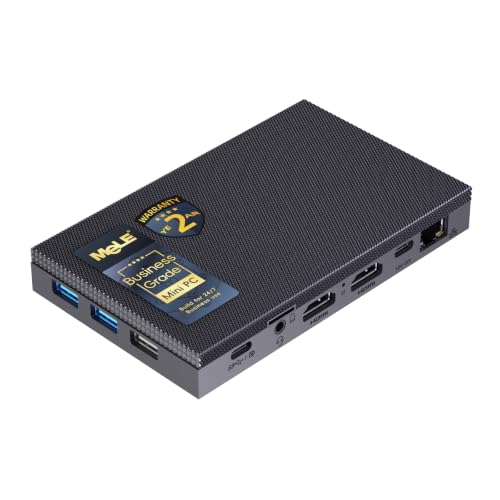
MeLE Quieter4C Fanless Mini PC — Intel N100, 8GB RAM, 128GB (Business Grade)
Who it suits: The buyer who wants the reference fanless mini PC — silent at a desk or behind a TV, dependable around the clock, with room to grow into a faster drive later.
The Quieter4C is the machine this category is measured against, and its design explains why. The whole computer is a slab about 5.2 by 3.2 inches and 0.7 inches thick, with no fan anywhere in it: heat from the Intel N100 — four cores, up to 3.4 GHz, a 6-watt-class chip — spreads into the chassis and leaves by convection. MeLE rates the result at 0 dB, and independent reviewers who have opened and stressed the machine confirm there is nothing inside that spins. What that buys in daily life is a desktop you cannot hear from a foot away, that sips power (one reviewer measured roughly 15 watts at the wall with a 4K transcoding workload and a benchmark running together, and around 10 watts in ordinary use), and that can run 24/7 without a bearing wearing out — which is why these turn up running home servers, media libraries and telescope rigs.
The port selection is the generous part: two full-size HDMI ports plus a USB-C with display output drive three 4K 60Hz screens at once, there is gigabit Ethernet, Wi-Fi 5, Bluetooth 5.1, a microSD reader, and a monitor mount in the box so the slab can live on the back of a display. This Business Grade build pairs 8GB of memory with 128GB of storage, runs Windows 11 Pro, and — the detail that matters most for longevity — keeps an M.2 slot free for a proper NVMe or SATA SSD up to 4TB. Check price on Amazon for the current listing for this exact build — pricing for this category moves over time, so confirm the live price before you buy.
The honest limitations are the category’s limitations, concentrated. The 128GB of built-in storage on this build is eMMC — noticeably slower than an SSD — and reviewers of the Quieter4C advise installing the operating system on an NVMe drive in that M.2 slot for a machine that feels quick rather than adequate; budget for the drive if responsiveness matters to you. The case also gets warm, then hot, under sustained load — owners say so in plain language — and clock speeds step down on long, heavy jobs: a reviewer running benchmarks and a drive test together saw the processor peak around 82°C and the SSD reach the low 70s. Short bursts, browsing, streaming and light games never meet that ceiling; a two-hour video render lives there. And the gaming ceiling is the N100’s ceiling: light and older titles, emulation, and streamed games — not modern AAA.
- Genuinely fanless and verified so: 0 dB, no moving parts, built for 24/7 duty.
- Triple 4K 60Hz output from dual HDMI plus USB-C, in a 0.7-inch slab with a VESA mount included.
- Free M.2 slot takes an NVMe or SATA SSD up to 4TB — the upgrade that fixes its one slow part.
Honest limitation: The included 128GB is eMMC, not SSD, and the chassis runs hot under sustained load with clocks stepping down — burst workloads fly, marathons slow.
Choose it if you want the default fanless desktop for a quiet room and will treat the M.2 slot as part of the plan. Skip it if you need storage speed out of the box with no upgrades — that is the N150 build below — or your workload is sustained and heavy, which wants a fan.

MeLE Quieter4C Fanless Mini PC — Intel N150, 8GB RAM, 256GB SSD (Business Grade)
Who it suits: The same silent-desk buyer as the pick above, who would rather get the finished configuration out of the box than open the case later — the newer chip and a real SSD, factory fitted.
In 2025 MeLE refreshed the Quieter4C around Intel’s N150, and this Business Grade build is that refresh in its most sensible configuration. The N150 is best understood as the N100 with the clocks turned up — the same four cores, boosting to 3.6 GHz instead of 3.4, with a slightly faster graphics block — so nothing about the machine’s character changes: it is still a fanless slab with no moving parts, still silent at 0 dB, still a triple-4K desktop with dual HDMI, USB-C display output, gigabit Ethernet and the monitor mount in the box. What changes is the storage line. Where the N100 build at the top of this guide boots from 128GB of eMMC, this one carries a 256GB NVMe SSD on PCIe 3.0 — the faster storage reviewers tell Quieter4C buyers to add — already installed, with the M.2 slot’s upgrade path still ahead of you when 256GB stops being enough.
Check price on Amazon for this listing before you buy — checking the live price is not a formality in this category, where listings and configurations change over time. For home-server and media duty the N150’s Quick Sync video hardware handles 4K HEVC streams the way the N100’s does — transcoding a 4K library title for a phone is exactly the bursty, hardware-accelerated work these chips are good at — and the always-on power draw stays in the same few-watts class that makes a fanless box cheaper to run than the light bulb in the room it sits in.
Two honest notes. First, the step from N100 to N150 is a refresh, not a revelation: anyone cross-shopping the two Quieter4C builds should buy on configuration and price, not on the chip name, because in the fanless chassis both are bounded by the same passive cooling and the same low stock power limit. Second, 8GB of memory is the working minimum for Windows 11 Pro with a browser’s worth of tabs, and on these builds memory is not the part you upgrade later — the storage is. If your silent-PC plans involve many containers, virtual machines or a heavy multitasking habit, the honest answer is a bigger configuration or a different machine, not this one stretched. Gaming expectations stay where the whole guide puts them: light, older, emulated or streamed.
- The refreshed N150 chip and a factory-fitted 256GB NVMe SSD — the two upgrades N100 buyers make, done.
- Same verified fanless design: 0 dB, triple 4K 60Hz output, VESA mount in the box.
- Check price on Amazon for the current listing and configuration.
Honest limitation: 8GB of RAM is a ceiling you live with rather than upgrade past, and the N150’s edge over the N100 is a clock bump, not a new class of performance.
Choose it if you want the silent MeLE experience with nothing to install and no eMMC compromise. Skip it if the N100 build above already fits your needs — the experience is near-identical in this fanless chassis.
HUNSN RJ42 Micro Firewall Mini PC — Intel N150, 8GB RAM, 128GB SSD, 4 x 2.5GbE LAN
Who it suits: The home-lab and networking buyer — someone replacing a consumer router with pfSense or OPNsense, or building a silent always-on server — who still wants a real desktop’s outputs on the same box.
Every other pick in this guide is a desktop that happens to be silent. The RJ42 is a network appliance that happens to be a desktop. Its aluminum chassis is the heatsink — the maker’s manual specifies a fanless design at 0.00 dB — and its back panel carries the reason it exists: four 2.5-gigabit Ethernet ports on Intel I226-V controllers, the chipset the open-source firewall world asks for by name. Around that, the configured listing identified for this guide pairs an Intel N150 with 8GB of DDR5 memory in a single SO-DIMM slot (upgradeable to 32GB) and a 128GB SSD, with two M.2 2280 NVMe slots and a 2.5-inch bay inside for storage growth, plus dual HDMI, DisplayPort and USB-C display outputs — enough screen support to run it as an ordinary small desktop when it is not routing the house. Check price on Amazon for the RJ42 listing and the exact configuration you are ordering.
For the right buyer this is the most capable silent box in the guide: a router, firewall, Proxmox host and light desktop in one fanless brick that draws single-digit watts at idle and makes no sound doing any of it, in a room where a rackmount anything would be absurd. The desktop side is the same N150 story as the rest of the guide — browsing, office work, 4K playback and light games are comfortable; sustained heavy work meets the passive-cooling ceiling.
The honest limitations are about fit, not quality. There is no Wi-Fi in this listing — it is a wired machine, and if it replaces your router you will need a separate access point for wireless, exactly as the independent research on this model warns. HUNSN sells the RJ42 in barebone and configured forms under near-identical names, and the wider RJ42 family includes an earlier N100 generation: check the listing’s configuration line — processor, memory, storage — against what you intended before ordering, because the name alone does not tell you which machine is in the box. And as a firewall-first appliance it arrives speaking network, not living room: expect to install your own operating system and do your own setup. That is the hobby for its intended buyer and a chore for anyone else.
- Four Intel I226-V 2.5GbE ports — the firewall-appliance specification, in a fanless aluminum case.
- Real expansion: DDR5 SO-DIMM to 32GB, two M.2 NVMe slots and a 2.5-inch bay.
- Doubles as a desktop: N150, dual HDMI plus DisplayPort and USB-C video outputs.
Honest limitation: No Wi-Fi, a setup-it-yourself appliance personality, and a model family with lookalike barebone and older-generation listings that demand a careful read before ordering.
Choose it if your silent PC is really a silent network — firewall, router or home server first, desktop second. Skip it if you want a friendly out-of-box desktop; the MeLE picks above are that machine.

MeLE PCG02 Pro Fanless PC Stick — Intel N100, 8GB RAM, 256GB
Who it suits: The buyer whose ideal computer is invisible — a stick that plugs into the back of a TV or monitor and turns it into a silent Windows PC.
The PCG02 Pro takes the fanless idea to its logical end: the whole computer is a stick. Inside is the same Intel N100 as the top pick in this guide — four cores to 3.4 GHz — with 8GB of LPDDR4 memory and 256GB of storage, cooled entirely passively; MeLE’s own manual for the line describes a fanless design for silent operation, and there is no fan in it to describe otherwise. It drives two 4K displays over dual HDMI, carries gigabit Ethernet alongside Wi-Fi 5 and Bluetooth 5.1, takes USB-C power with PD 3.0, and accepts a microSD card up to 2TB for extra storage. Check price on Amazon for this stick — pricing for this category moves, so confirm the live listing before you buy.
The use case writes itself. Behind a living-room TV it is a streaming and light-gaming box — cloud gaming services, retro emulation, indie titles — that adds zero noise to the room and zero boxes to the cabinet. Behind a bedroom monitor it is a silent second PC. In a rental or a dorm it is a computer that leaves in a jacket pocket. And because it sips power and supports auto power-on, it covers the signage and kiosk jobs its maker aims it at, which is another way of saying it is built to be switched on and forgotten.
Honesty about the stick form is required, because the compromises are structural. Storage is eMMC — 256GB of it, fixed — and there is no M.2 slot inside a stick, so the expansion story ends at the microSD slot and USB drives. Memory is soldered at 8GB. A stick also has the least metal of any pick here to spread heat into, so the sustained-load rule of this category applies with emphasis: bursty work — browsing, video, light games, streamed games — is its home, and long heavy sessions will see it warm and slower. Finally, a stick lives or dies by its ports’ placement: it needs an HDMI socket with room around it and power within reach, and the short HDMI extension in the box exists because some TVs make that awkward. Check your screen’s back panel before falling in love.
- A complete fanless Windows PC in stick form — nothing on the desk, nothing in the cabinet, no noise at all.
- Dual 4K HDMI output, gigabit Ethernet, USB-C PD power and microSD expansion to 2TB.
- Check price on Amazon — a compact stick form factor in a mid-range position for this guide.
Honest limitation: Fixed eMMC storage and soldered memory with no internal upgrade path, and the least thermal mass in the guide — sustained loads are not its job.
Choose it if the PC must vanish behind a screen and the workload is media, browsing and light or streamed games. Skip it if you will ever want to open the machine and improve it — the Quieter4C slab above is the same silence with a future.

MeLE Quieter3Q Fanless Mini PC — Celeron N5100, 8GB RAM, 256GB
Who it suits: The budget-first silent buyer — a media corner, a kitchen screen, a spare-room desk, a music endpoint — who wants true fanless operation in a budget-positioned build in this guide.
The Quieter3Q is the previous generation of the idea the Quieter4C perfected, and age is exactly what puts it in a budget position. The chassis is the thinnest here at about 18mm — a grooved plastic top over a metal base plate, the plastic chosen so the Wi-Fi antennas inside can breathe — and there is no fan anywhere in the design; the case sheds heat by convection, idling at a few watts and drawing roughly a dozen under load in independent testing. The Celeron N5100 is a four-core Jasper Lake chip boosting to 2.8 GHz, a clear step below the N100 in speed, paired here with 8GB of memory and 256GB of storage, dual full-size HDMI outputs for two 4K 60Hz screens, gigabit Ethernet, and — the detail owners actually use — a user-accessible M.2 2280 slot, so storage can grow even though the platform is old. Check price on Amazon for the exact build and seller — this previous-generation model is positioned as a budget option in this guide.
Set expectations by the chip’s age and the machine rewards you. As a media endpoint it is in its element: 4K streaming, music-server duty next to a hi-fi (the use its silence was practically designed for), browsing, documents and retro emulation all run without a whisper, because none of them ask the processor to sprint for long. Reviewers who measured it found an honest little machine that does HTPC work properly, including 4K HDR playback.
The limitations are the flip side of the budget positioning. Jasper Lake is 2021 silicon: everything is a beat slower than the N100 picks, the graphics are a generation behind, and modern game ambitions should stop at old, light or streamed. MeLE’s own materials are inconsistent about this model’s wireless — the store title for current builds lists Wi-Fi 5 and Bluetooth 5.1 while a spec table elsewhere shows Wi-Fi 6 and Bluetooth 5.2 from the earlier review units — so treat the listing in front of you, not any summary (including this one), as the authority on the exact build you are buying. And like every fanless box here, sustained heavy loads warm the case and trim the clocks; the 3Q’s smaller, older design simply arrives at that ceiling sooner.
- A budget-positioned entry to true fanless computing — check price on Amazon.
- Thinnest case in the guide at ~18mm, with dual 4K HDMI and a user-accessible M.2 slot.
- Idles at a few watts; built for media endpoints and quiet corners, and proven at them.
Honest limitation: Previous-generation Celeron performance with previous-generation graphics, plus maker documentation that disagrees with itself about the wireless spec — verify the exact build on the listing.
Choose it if silence matters more than speed and the job is media, browsing or a light desk. Skip it if you want newer performance — when the newer machine fits your needs, take the newer machine.

ZOTAC ZBOX CI337 Nano Fanless Mini PC Barebone — Intel N100 (No RAM, Storage or OS)
Who it suits: The builder — someone with a spare DDR5 stick and SSD on the shelf, or who simply wants to choose their own parts — who wants a name-brand fanless kit as the foundation.
Zotac’s C-series nano line has been the fanless specialist’s other badge for years, and the CI337 is its current N100 entry: the listing’s own title says “Fanless Silent,” the Intel N100 sits in a passively cooled nano chassis with HDMI and DisplayPort outputs, and what arrives is a barebone — the computer minus memory, storage and operating system, which the listing states plainly. Check price on Amazon for the barebone kit — that listing covers the kit alone, not a complete working PC, and this review will not pretend otherwise.
Here is the honest completion picture. To the barebone kit you must add a DDR5 SO-DIMM memory stick, an M.2 SSD, and an operating system — a Windows license is a separate consideration, Linux is an alternative — and only then does the CI337 become a computer. For the builder with compatible parts already in a drawer, that parts-on-hand situation is the barebone bargain at its best. In return for the assembly you get choices the sealed picks deny you: your capacity, your drive, your OS, and Zotac’s long-running nano hardware lineage instead of a marketplace brand.
The limitations are the mirror of the freedoms. There is no Windows license in the box and no software support story beyond the hardware; if anything in the build misbehaves, the troubleshooting is yours. The appeal changes if you are buying premium parts new to fill it — consider the whole basket before ordering, not after. And the performance ceiling is the same one this entire guide lives under: an N100 behind passive cooling is a light-work, media and light-gaming machine, and no choice of SSD changes that. Buy the CI337 for the building, not for a benchmark.
- A fanless N100 kit from Zotac’s specialist C-series — check price on Amazon for the barebone kit.
- You choose the memory, storage and operating system; ideal for parts already on the shelf.
- HDMI and DisplayPort outputs in a passively cooled nano chassis with no fan to fail.
Honest limitation: The barebone listing is not a complete computer — RAM, SSD and OS are all extra, and the value depends on the parts you already have or choose to add.
Choose it if you have compatible parts waiting or enjoy speccing your own machine. Skip it if you want to unbox and compute — every other pick in this guide is the finished article.

Comparison Table
| Product | Chip | Best use | Link |
|---|---|---|---|
| MeLE Quieter4C (N100, 8GB/128GB) | Intel N100 | The default silent desktop, with an M.2 upgrade path | Check on Amazon |
| MeLE Quieter4C (N150, 8GB/256GB SSD) | Intel N150 | Newer chip and real SSD storage, nothing to install | Check on Amazon |
| HUNSN RJ42 (N150, 4 x 2.5GbE) | Intel N150 | Silent firewall, router and home server | Check on Amazon |
| MeLE PCG02 Pro Stick (N100, 8GB/256GB) | Intel N100 | A PC that disappears behind the TV | Check on Amazon |
| MeLE Quieter3Q (N5100, 8GB/256GB) | Celeron N5100 | Cheapest verified silence, for media corners | Check on Amazon |
| ZOTAC ZBOX CI337 Nano (barebone) | Intel N100 | A fanless kit for builders with parts on hand | Check on Amazon |
How to Choose a Fanless Mini PC Under $400
- Verify the silence, not the adjective. “Quiet” and “silent operation” in a listing can still mean a fan inside. Genuinely fanless machines say fanless in the maker’s specifications, show a finned or all-metal chassis in teardown photos, and have no fan in the parts list. If you cannot confirm it from the maker or a teardown, assume there is a fan.
- Match the chip to the job, honestly. The N100 and N150 are the current sweet spot: four cores, hardware 4K video decode, enough for browsing, office work, media servers and light games. The older Celeron N5100/N5105 generation costs less and does media duty well, but everything is a step slower. Nothing in this category — at any configuration — is a modern AAA gaming chip.
- Read the storage line twice. eMMC and NVMe SSD are both called “storage” in listings and feel nothing alike: eMMC machines boot and load noticeably slower. Either buy the SSD configuration, or buy a machine with a free M.2 slot and treat adding a drive as part of the purchase.
- Ask what is soldered. In thin fanless designs, memory is often fixed for life. If your plans might grow — more containers, more tabs, a server role — buy the memory you need on day one, or pick a design with a SO-DIMM slot.
- Plan for heat like an adult. A fanless case is a heatsink that sits in your room’s air. Give it clearance on all sides, keep it out of sealed cabinets and direct sun, and expect the case to feel warm under load — warm is the design working. Sustained heavy workloads will slow any of these machines down; if your main job is long renders or long gaming sessions, buy a fanned PC and put it further away.
- Count the screens and the wires. These boxes drive two or three 4K displays, but the port mix varies — HDMI count, USB-C display output, Ethernet speed (gigabit vs 2.5GbE) and Wi-Fi generation all differ per model, and makers’ summaries sometimes disagree with their own spec tables. Verify the exact build on the exact listing.
- Account for the whole machine. A barebone listing excludes memory, storage and an OS; a stick purchase may also need the second screen cable you will want. Check price on Amazon for the complete configuration you actually need, and consider the finished, working build as a whole.
- Let silence rank the shortlist. If two machines both do your jobs, the fanless one wins the bedroom, the studio and the living room by default — that is the entire point of the category. Spend on the configuration, not on chasing performance the cooling cannot sustain.
What “Gaming” Honestly Means on a Fanless Mini PC
Because this keyword lives in a gaming catalog, the gaming section deserves its own honest page rather than a footnote. The integrated graphics in these chips — Intel UHD Graphics with 24 execution units — were designed for video and desktop work, and they game accordingly. What runs well: retro emulation, which is a natural fit (classic consoles ask very little and a silent box by the TV is the dream host); indie and older PC titles, the back-catalog games that were undemanding when they were new; esports games at modest settings and resolutions, where low detail is how competitive players run them anyway; and point-and-click, strategy and puzzle libraries that never needed a graphics card. What does not run: modern AAA releases at native resolution and respectable settings. No configuration in this guide changes that sentence, and any listing for an N100 box that shows a blockbuster game on its banner is showing you a screenshot, not a frame rate.
The fanless twist matters too. Even the light games above ask the chip to work continuously, and continuous work is what passive cooling meters out: a title that starts smooth can soften as the chassis heat-soaks over a long session. Short and medium sessions of light games are fine; marathon sessions are where the physics collects its fee. The category’s real gaming superpower is different in kind: cloud gaming. Services like GeForce NOW and Xbox Cloud Gaming render the game remotely and stream it as video — and video decode is the one thing these Intel chips do at a flagship level, with dedicated Quick Sync hardware sipping watts. A fanless box streaming a cloud game at 1080p is silent, cool-running and genuinely playing a modern AAA title; it is simply not rendering it. If your connection is good and your library lives in the cloud, a silent stick can be a better living-room gaming machine than a loud tower. If your library is local and modern, it cannot, and this guide would rather lose the sale than the reader.
Common Buying Mistakes
- Buying a “quiet” mini PC that turns out to have a fan. The most common mistake in this category: the listing said silent, the teardown shows a blower. Verify fanless from the maker or a teardown before paying.
- Expecting gaming-PC performance from a 6-watt chip. Fanless means low-power silicon; buyers who wanted a small gaming rig and bought silence return one of the two. Decide which you actually want.
- Ignoring the eMMC compromise. A fanless box that feels sluggish usually is not CPU-bound — it is booting from eMMC. Buy the SSD build or budget the M.2 drive.
- Sealing the heatsink in a cabinet. A fanless PC in a closed TV unit is an oven with a computer in it. Airflow around the case is the cooling system; do not furniture it away.
- Comparing a barebone listing to finished PCs. The ZOTAC barebone is not directly comparable to a complete box until you account for the parts on your shelf and the parts you still need. Consider the whole build.
- Buying the wrong twin. This category is full of lookalike listings — barebone vs configured, N100 vs N150 generation, eMMC vs SSD builds under one model name. Read the configuration line of the exact listing, every time.
- Assuming more expensive means more gaming. Within this guide, extra money buys storage, memory, ports and newer silicon — never a graphics tier. The gaming ceiling is set by the chips, and it does not move with configuration.
- Forgetting the room. A fanless PC’s one job is to be unheard in a quiet space. If the machine will live in a noisy office next to a server rack, the silence premium buys you nothing — a fanned box gives more performance per dollar there.
Final Recommendation
- Most buyers: MeLE Quieter4C, Intel N100, 8GB/128GB.
- Buy-it-finished buyers: MeLE Quieter4C, Intel N150, 8GB/256GB SSD.
- Home-lab and networking: HUNSN RJ42, 4 x 2.5GbE.
- Living rooms and second screens: MeLE PCG02 Pro PC Stick.
- Tightest budgets: MeLE Quieter3Q.
- Builders with parts on hand: ZOTAC ZBOX CI337 Nano barebone.
Our top two are the two Quieter4C builds, because they are the category’s center of gravity: verified fanless, triple 4K output, an M.2 future, and a configuration that fits this guide’s budget frame — check price on Amazon for each build. Take the N100 build if you are happy adding an SSD later; take the N150 build if you want the newer chip and the fast drive already fitted. The HUNSN is the specialist’s pick — nothing else here routes a network — and the PCG02 Pro is the one to buy when the computer itself must disappear. The Quieter3Q and the Zotac kit serve the two kinds of bargain: yesterday’s silicon, finished and cheap, or today’s silicon as a kit for people with parts. Readers who mainly want a silent media and light-gaming box for a small room should also see Best Fanless Mini PC For Small Spaces Under $400, first-time buyers should see Best Fanless Mini PC For Beginners Under $400, and anyone whose real job is streaming video — as a viewer or a host — should see Best Fanless Mini PC For Streaming Under $400. Verify the fanless claim, read the storage line, check the live price, and the silence will take care of itself.
Frequently Asked Questions
Is a fanless mini PC really completely silent?
Yes — that is the definition that matters. A genuinely fanless PC has no fan and no other moving parts, so it produces no mechanical noise at all: 0 dB. (A hard drive would spoil that, which is why every pick here is solid-state.) What you give up for that silence is cooling headroom, which is why these machines use low-power chips and slow down under long, heavy loads.
Can a fanless mini PC play games?
Light ones, honestly listed: retro emulation, indie and older titles, esports games at modest settings, and cloud gaming services, which these chips handle beautifully because the game is rendered remotely and the PC only decodes video. Modern AAA games rendered locally are beyond every machine in this guide — that is a property of the low-power chips that make fanless cooling possible, not a flaw in any single model.
What about 1440p gaming on a fanless mini PC?
Rendered locally, no — 1440p gaming needs graphics power an order of magnitude beyond a 6-watt integrated GPU, and no fanless mini PC at this budget (or several times it) changes that. Streamed, yes: cloud services will happily send a high-resolution stream, and these boxes will decode and display it in silence. Readers researching that angle specifically should see Best Fanless Mini PC For 1440p Gaming Under $400 with exactly that distinction in mind.
Will a fanless mini PC overheat?
It will get warm — the case is the heatsink, so warmth is the cooling working as designed. What it will not do is damage itself: the processor manages its temperature by reducing clock speeds, which is why sustained heavy workloads slow down rather than fail. Keep the case in open air, out of sealed cabinets and sunlight, and a fanless box will run for years; reviewers have run these machines as 24/7 servers without drama.
Why do so many “silent” mini PCs still have fans?
Because “silent” in marketing usually means “quiet at idle,” and a small fan at low speed is genuinely hard to hear across a room — until it spins up, ages, or clogs. The fanless category exists for buyers who need the guarantee, not the approximation: bedrooms, studios, listening rooms, always-on duty. If a listing does not say fanless in the maker’s own specifications, it has a fan.
Is 8GB of RAM enough in a fanless mini PC?
For the jobs these machines are for — browsing, office work, media playback and serving, light games — yes, with the understanding that Windows and a modern browser are not shy. It is not enough for heavy multitasking, many virtual machines or large creative projects, and in several picks here the memory cannot be upgraded later. Buy the configuration your workload needs on day one.
Fanless mini PC or a cheap fanned mini PC?
Same chips, different bargain. A fanned N100 or N150 box typically costs less for the same configuration and holds its full speed indefinitely under load, at the price of a small amount of fan noise. The fanless box costs a little more, stays silent forever and has one less part to fail. Choose by room: quiet rooms and always-on duty favor fanless; desks in noisy spaces and sustained workloads favor the fan — and buyers leaning that way should see Best Fanless Mini PC Under $500 for the next configuration step, or the wider mini PC guides on this site.


