Where to buy
Check the latest price, availability and delivery on Amazon. Orders are placed on Amazon. We may earn a commission from qualifying purchases.
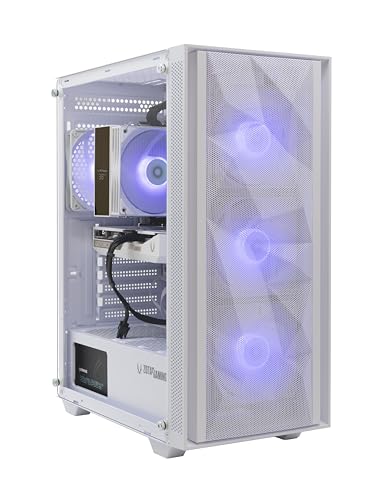
- Best white 1440p build: ZOTAC MEK Gaming PC, Ryzen 5 9600X, RTX 5060 White Edition, 16GB DDR5, 1TB NVMe — Check on Amazon
- Skytech Archangel, i5-14400F, RTX 4060, 32GB DDR5 RGB, 2TB SSD, White — Check on Amazon
- Thermaltake LCGS Quartz i1460, i5-14400F, RTX 5060, RGB ToughRam, White — Check on Amazon
- Skytech Shiva, Ryzen 5 5600X, RTX 4060 Ti, White In Win 101 Case — Check on Amazon
See 2 more Amazon options
- ZER-LON Gaming PC, Ryzen 5 5500, RTX 4060, White, RGB Fan x4 — Check on Amazon
- STGAubron Gaming PC, Ryzen 5 5500, RTX 3050 6GB, White, RGB Fan x6 — Check on Amazon
Read the full guide ↓
Disclosure: As an Amazon Associate, reviewstook.com earns from qualifying purchases. Links to Amazon on this page are affiliate links; they cost you nothing extra. Listing details such as price and availability change often, so check the current Amazon listing before you buy.
This keyword makes two promises, and the prebuilt market fudges both. Promise one is the color: plenty of “white” gaming PCs are ordinary black builds shipping in a pale case, with nothing behind the glass documented as white at all. Promise two is the resolution: any PC here can be cabled to a 1440p monitor and will fill the screen, because putting a finished picture on a panel is easy — but rendering games at 2560×1440 is roughly 78 percent more work per frame than 1080p, and most of these machines do not do it natively. So each pick is graded twice, in the open. The white grade (complete, partial or case-only) comes from what the listing’s spec block documents, never from its photographs. The 1440p verdict (native, upscaled or display only) comes from the card’s rendering class. Where the grades pull in opposite directions — a gorgeous white build that cannot render the resolution, a true 1440p card whose color nobody will guarantee — the review names the conflict instead of smoothing it over.
The verdicts in brief: one pick, the Skytech Shiva, carries the only card here that renders mainstream games natively at 1440p. The two RTX 5060 systems split the difference — native rendering in lighter titles, DLSS upscaling carrying the heavier ones. Both RTX 4060 systems are 1080p-native hardware that reaches 1440p output through upscaling, title by title. The cheapest pick, on an RTX 3050 6GB, is graded display only: it will make a 1440p desktop look crisp all day and should never be bought to render games at that size. The color story runs in parallel: compared with equivalent plain systems, the white premium at this budget tends to be modest, and just one pick puts its card’s color in writing. Quick picks with both grades attached come first, then the definition of honest 1440p, six full reviews, a comparison table, and the white premium considered pick by pick.
In this guide
Quick Picks
Short on time, or comparing several options at once? Each row below names a buyer type and the system that suits it, with both grades — how white it verifiably is, and how it honestly handles 1440p — stated up front.
| Buyer type | Pick | White grade | Honest 1440p verdict | Link |
|---|---|---|---|---|
| Best white 1440p build | ZOTAC MEK, Ryzen 5 9600X, RTX 5060 White Edition | Complete (case + card documented) | Upscaled in heavier titles; native in lighter ones | Check on Amazon |
| Best showpiece and capacity | Skytech Archangel, i5-14400F, RTX 4060 | Partial (case, fans, RGB memory) | Upscaled — a 1080p-native card negotiating 1440p | Check on Amazon |
| Best current-generation value | Thermaltake LCGS Quartz i1460, RTX 5060 | Partial (case, cooler, RGB memory) | Upscaled in heavier titles; native in lighter ones | Check on Amazon |
| Best graphics card | Skytech Shiva, Ryzen 5 5600X, RTX 4060 Ti | Partial (white case, RGB fans) | Native — the tier’s true 1440p card | Check on Amazon |
| Best budget white build | ZER-LON AOV4060, Ryzen 5 5500, RTX 4060 | Case-only | Upscaled — a 1080p-native card negotiating 1440p | Check on Amazon |
| Cheapest full white presentation | STGAubron White, Ryzen 5 5500, RTX 3050 6GB | Case-only (plus lit peripherals) | Display only — a 1080p machine, not a 1440p renderer | Check on Amazon |
How These Picks Were Chosen
The $1,200 ceiling was applied to the whole system, not the headline: every pick is a real Amazon listing positioned within the budget in the United States. Check the current price on Amazon before you buy, because listings move, and pay particular attention to the systems that sit near the top of the budget. Listings whose white claim fell apart on inspection were cut, however strong the hardware: a “white” page whose own spec block described a black machine, or a white edition that turned out to be a weaker configuration wearing the name, did not survive the filter.
Nobody on this side of the page has hands-on time with these systems. The grading rests on maker listings, specification pages and manuals, read closely — and for this keyword close reading is the whole method, because both halves of the claim live in the fine print. For the color, the white layer was logged separately from the hardware: case color and panel construction, whether the card is a named white edition or an unnamed brand, whether memory and cooler are documented as white or RGB, and how the lighting is controlled. Silence in the spec block is reported as “not documented,” never filled in from a render, because renders routinely show coordination the shipped box does not promise. For the resolution, each card was placed by rendering class under the next section’s definition: full 2560×1440 rendering credited only where the silicon honestly sustains it, upscaling labeled as upscaling wherever it does the lifting, and no credit for merely lighting up a 1440p panel.
Three further filters shaped the final six. Completeness: credit accrues for each major visible component documented in white or RGB and drains for each one left unspecified, so a pale shell around an unnamed black card lands as a partial build and is called one. Hardware floor: looks never outrank the graphics card, which is why the weakest card admitted is the RTX 3050 6GB — present solely as the cheapest full white presentation on Amazon, and tagged a 1080p machine at every mention. Platform: DDR5 systems with an upgrade path score for it, while finished DDR4 platforms are identified as finished.
Rendering at 1440p Is Not Displaying 1440p
Everything in this guide hangs on one distinction, so it is worth a section of its own. A 1440p monitor makes two unrelated demands. The first is display: take a finished 2560×1440 image and put it on the panel. The desktop, a streamed video, a game’s final frame — every machine here, cheapest included, handles that without breaking stride. The second demand is rendering: the graphics card itself has to compute that image, shading roughly 3.69 million pixels for every single frame. A 1080p frame carries about 2.07 million pixels, so native 1440p rendering means around 78 percent more work per frame — and the jump is not a tidy doubling, since 2560×1440 is 1.33 times 1920×1080 on each axis, a fractional step that upscaling technology exists precisely to bridge.
DLSS is the bridge fitted to every card in this guide. Rather than compute the full frame, the card renders at a reduced internal resolution and reconstructs a 1440p image from it. NVIDIA’s published scaling factors put the internal renders, for 1440p output, at about 1707×960 for DLSS Quality, about 1485×836 for Balanced, and 1280×720 for Performance. Sit with that last number: DLSS Performance wearing a “1440p” label is internally a 720p-class render. These modes look genuinely good, and this guide recommends them where they fit — but they are reconstruction, not native rendering, and a listing that advertises the output size without the mode is selling the frame, not the work. DLSS is credited here only where the hardware supports it: all six picks run NVIDIA RTX cards with Tensor cores, so the technology is legitimately available on every one; what varies is how much of the picture is computed versus rebuilt. AMD’s FSR, the cross-vendor alternative, is mentioned only in general terms, with no internal-resolution figures attached, because the verified research behind these picks documents none for it.
Two consequences follow through every review. First, memory: upscaling lightens the rendering load but cannot invent texture detail the card discarded for want of VRAM, so each pick is also graded on its texture budget — at 1440p output the 8GB cards have a quiet ceiling no upscaling mode raises, and the 6GB card’s is lower. Second, 4K: no pick here is a native 4K gaming machine, and 4K is refused as a gaming target for all six. The 4K figures appear only to extend the lesson one size up — at 4K output, DLSS Quality renders internally at about 2560×1440 and Performance at about 1920×1080, meaning a “4K Performance” picture is internally a 1080p render. If that reads as a surprise, it is the section’s point: the resolution on the box describes the frame’s dimensions, not the size of the job.
The 6 Best White Gaming PCs for 1440p Under $1,200
ZOTAC MEK Gaming PC — Ryzen 5 9600X, GeForce RTX 5060 Twin Edge OC White Edition, 16GB DDR5, 1TB NVMe
Who it suits: The buyer who wants the white build to survive scrutiny — card, case and paperwork all agreeing — on a current platform, and who is comfortable that demanding games at 1440p will arrive through DLSS rather than native rendering.
Begin with the paperwork, since this pick is the guide’s standard for it. Of the six listings here, this is the only one whose own product information names a white-edition graphics card: a ZOTAC GAMING GeForce RTX 5060 Twin Edge OC White Edition carrying 8GB of GDDR7, mounted in a white case behind a seamless tempered-glass panel. The listing states the color outright as white and identifies the card by model (MEKA5060A9600XWR1); ZOTAC’s description of the machine as a clean white build is, for once in this category, something the spec block backs up. The supporting presentation is restrained: a tower air cooler with a temperature display, 120mm fans, an easy-clean magnetic grill and a built-in digital display. Beneath it sits hardware as current as anything in the guide — a Ryzen 5 9600X on the AM5 platform, 16GB of DDR5, a 1TB NVMe SSD, a published 650W 80 Plus Gold power supply, Wi-Fi 6E and Bluetooth 5.3, Windows 11 Home — covered by a one-year complete-system warranty plus a three-year GPU warranty through ZOTAC USA. Even here, one limit from the base research stands: neither motherboard color nor cable sleeving is individually documented, so the contract covers the case and the card, the two biggest surfaces in the window, while board and cabling remain unspecified rather than assumed white.
Honest 1440p verdict: native in lighter titles, upscaled in heavier ones. The RTX 5060’s natural home is 1080p; at 1440p it renders lighter games at the full resolution and hands heavier ones to DLSS, with Quality reconstructing the output from an internal render near 1707×960 and the lower modes stepping down from there. Supported titles add DLSS 4 multi frame generation, which this guide consistently treats as a display-side feature: it lifts the frame rate you see without cutting input latency, so it smooths presentation rather than adding rendering power. Set against the Shiva below, this is not the tier’s native-1440p machine. Judged on its own terms it is a current-generation system that will drive a 1440p monitor persuasively across most of the current catalog, with the upscaling declared instead of disguised. Pricing strengthens the case in qualitative terms: for the most completely documented white build here, the premium over an ordinary RTX 5060 system is modest — check price on Amazon to see where it sits today. A caution from the base research is worth repeating: a different ZOTAC MEK configuration circulates in some roundups, so confirm on the live listing that what is in the cart is the 9600X with the white-edition card.
- The graphics card’s white edition is named in the listing’s product information — contracted, not a brand lottery.
- AM5 platform with a Ryzen 5 9600X, DDR5, Wi-Fi 6E and a published 650W Gold supply.
- DLSS 4, including multi frame generation in supported titles, over honest native rendering in lighter games.
- Three years of GPU warranty alongside the one-year system warranty, serviced in the US.
Honest limitation: Memory sits at the tier’s 16GB floor, board color and cable sleeving go undocumented, and heavy games at 1440p output are reconstructed rather than natively rendered.
Choose it if a verifiably complete white build on a platform with a future is the purchase, and upscaled 1440p in demanding titles is an acceptable trade. Skip it if native 1440p in mainstream games is non-negotiable — the Shiva owns that ground — or if 32GB of memory and 2TB of storage are needed from day one, which is the Archangel’s brief.

Skytech Archangel — Intel Core i5-14400F, GeForce RTX 4060, 32GB DDR5 RGB, 2TB SSD, White
Who it suits: The buyer chasing the brightest white showcase in the tier plus capacity that ends the upgrade conversation — who has first absorbed that this machine’s 1440p picture is an upscaled one.
On specification, nothing else in the guide is as generous: an Intel Core i5-14400F, 32GB of DDR5-5600 RGB memory, a 2TB NVMe SSD and a published 650W Gold power supply, in a white tempered-glass case with four RGB ring fans and, on the current edition, a mesh front. The documented white layer is the case together with the lit memory and fans, and that combination photographs bright and coordinated because those are precisely the parts Skytech specifies. The capacity argument deserves emphasis: with 32GB DDR5 kits costing a meaningful amount on their own, a system shipping with 32GB and 2TB installed deletes the two upgrades every other pick here eventually queues for. Skytech assembles in the USA, with a one-year parts and labor warranty and lifetime free technical support.
Both gradings then apply their discounts. For color, the build is partial: Skytech’s “GPU brand may vary” clause covers the RTX 4060, leaving its maker and finish uncontracted, so the single largest object behind the glass may turn out black. For resolution, the identical card fixes the ceiling from the other side — it is 1080p-native silicon with 8GB of memory, and at 1440p output it works title by title, rendering lighter games natively while DLSS Quality or Balanced reconstructs the demanding ones, with that 8GB texture budget quietly trimming detail settings at this output size regardless of mode. That profile does not make it a poor partner for a 1440p monitor; it makes it an upscaling machine, and it should be purchased under that description. Check the current price on Amazon before judging it: set against plain RTX 4060 systems in this tier, the bulk of what you pay is accounted for by the doubled memory and storage. Color costs little here; capacity is the line item.
- 32GB of DDR5 RGB memory paired with a 2TB SSD — twice the capacity of any other pick in the guide.
- White glass case, four RGB ring fans, and a mesh front on the current edition.
- Published 650W Gold power supply, US assembly, and lifetime free technical support.
Honest limitation: “GPU brand may vary” leaves the biggest component in the window uncontracted for color, and the card itself is 1080p-native hardware that meets 1440p through DLSS rather than native rendering in demanding games.
Choose it if the showcase look and never-outgrown capacity are the priorities, with 1440p expectations honestly set to “upscaled and good-looking.” Skip it if an unguaranteed card color would grate every time you pass the desk — take the ZOTAC — or if native 1440p rendering outranks capacity, which is the Shiva’s exchange.

Thermaltake LCGS Quartz i1460 — Intel Core i5-14400F, GeForce RTX 5060, 16GB RGB ToughRam, 1TB NVMe, White
Who it suits: The buyer who wants current-generation graphics and the tidiest lighting control in the guide inside a white chassis, with strong value in its class — and accepts DLSS as the route to 1440p in demanding games.
Because Thermaltake assembles this system from its own catalog, the coordination is structural rather than cosmetic. Reviews and roundups covering this exact configuration verify a white chassis with a 3mm tempered-glass side panel, a full-length power supply cover, a mesh front, an ARGB tower air cooler and RGB ToughRam memory, with all lighting driven through the motherboard’s software — a single ecosystem, the arrangement that survives later component changes best. The specification pairs an Intel Core i5-14400F with an RTX 5060 on 8GB, 16GB of DDR4-3600 ToughRam, a 1TB NVMe SSD and a published 600W 80 Plus Gold power supply, with Wi-Fi and Windows 11 fitted.
Honest 1440p verdict: native in lighter titles, upscaled in heavier ones — unavoidably the ZOTAC’s profile, since the card class is the same. Lighter games render at the full 2560×1440; heavier ones lean on DLSS, Quality rebuilding the frame from an internal render around 1707×960, with DLSS 4 multi frame generation in supported titles counting as displayed smoothness rather than reduced latency. Two qualifications complete the picture. The platform runs DDR4 on LGA1700: serviceable, with cheaper memory expansion than DDR5, yet a closed generation offering no processor path worth planning around — the opposite of the AM5 ZOTAC above. And the white grade is partial along a particular seam: chassis, cooler and memory are documented light-colored or RGB, while the card’s finish is nowhere named in the listing material, so plan on a standard card until the live page says otherwise. Storage expansion also wants a pre-purchase check, as configuration coverage describes a single populated M.2 arrangement; confirm the live listing if a second SSD figures in your plans. What closes the argument is value: check price on Amazon — this is positioned as an accessible door into a current-generation white system in the guide, without a large white premium against comparable plain 5060 machines.
- White chassis, ARGB tower cooler and RGB ToughRam unified under motherboard lighting control.
- RTX 5060 with DLSS 4 in the guide’s top class.
- Published 600W Gold power supply behind a full-length cover, keeping the interior tidy.
Honest limitation: A finished DDR4/LGA1700 platform, a graphics card whose color the listing never documents, and demanding 1440p titles delivered by upscaling rather than native rendering.
Choose it if current graphics, one-software lighting and strong value in the class are the draw. Skip it if upgrade headroom matters — the AM5 ZOTAC brackets it on that side — or if the card’s color must be guaranteed in writing, which only the ZOTAC offers.

Skytech Shiva — AMD Ryzen 5 5600X, GeForce RTX 4060 Ti, 16GB DDR4, 1TB NVMe, White
Who it suits: The buyer who puts the graphics card ahead of the color — who wants this guide’s one authentic native-1440p system, housed in a properly white case, and who buys machines whole rather than as upgrade projects.
The case for the Shiva fits in a breath: alone among the six, it carries an RTX 4060 Ti, inside the In Win 101 — a white mATX mid-tower in tempered glass that has served as a small-form showcase for years — finished with three RGB fans and a high-performance ARGB air cooler. Everything behind that headline is previous-generation hardware executed properly: a Ryzen 5 5600X, 16GB of DDR4-3200, a 1TB NVMe SSD, a published 600W Gold power supply, 802.11ac Wi-Fi and Windows 11 Home, assembled in the USA under a one-year parts and labor warranty with free technical support.
Honest 1440p verdict: native. Against the explainer’s definition, this is the only pick that clears the bar without qualification: in mainstream titles the 4060 Ti computes the full 2560×1440 frame itself, all roughly 3.69 million pixels, instead of rebuilding the picture from a smaller internal render. DLSS, frame generation included where titles support it, sits on top as spare headroom rather than serving as the mechanism that makes the resolution reachable. The practical difference shows up in settings menus: on the guide’s 4060 and 5060 systems, switching DLSS off in a demanding game collapses the 1440p experience, whereas here it merely spends margin. Respect the 8GB memory budget at this resolution — native rendering is not a license for every texture setting — but within these six, this card’s 1440p claim is the one that survives inspection intact.
What is traded away is platform and paperwork. AM4 with DDR4 is a closed road: the 5600X remains a capable gaming chip, yet any future processor step starts with a replacement motherboard and memory, so the Shiva is a finished object by design. Its white grade stops at partial, because while the case is documented white and the fans are RGB, Skytech’s “GPU brand may vary” reservation leaves the 4060 Ti’s finish uncontracted — a black card inside the white In Win is a possibility to accept before ordering, not after. Pricing demands vigilance: check the current price on Amazon and confirm any coupon is applied in the cart before judging value. Positioned well within the budget, nothing in the tier matches its graphics for the money; positioned at the very top of the budget, the case is much weaker, so walk away if it sits at the ceiling without a deal applied.
- RTX 4060 Ti 8GB — the sole card in the guide that renders 1440p natively.
- White In Win 101 tempered-glass case, three RGB fans and an ARGB air cooler.
- Published 600W Gold power supply and US assembly.
Honest limitation: A finished AM4/DDR4 platform with no worthwhile upgrade path, an uncontracted card color, and pricing that can depend on a coupon being live at checkout.
Choose it if rendering performance at 1440p is the whole point and the platform’s age is irrelevant because you replace systems rather than upgrade them. Skip it if a later processor upgrade is part of the plan, or if the coupon has lapsed and the listing sits at full price.

ZER-LON Gaming PC (AOV4060) — AMD Ryzen 5 5500, GeForce RTX 4060, 16GB DDR4, 1TB NVMe, White
Who it suits: The buyer who wants genuine RTX 4060 hardware behind white glass well within the budget, and who reads both of this guide’s gradings at face value: case-only white, and 1440p by upscaling.
What earns the ZER-LON its place is that the budget door into this guide does not ask you to surrender the graphics card. The specification — Ryzen 5 5500, RTX 4060 with 8GB, 16GB of DDR4, a 1TB NVMe SSD, Wi-Fi 5, Windows 11 Home, in a white case with four RGB fans — matches the hardware class of systems here positioned higher in the budget. Its positioning reflects a smaller brand’s discount: check price on Amazon — against plain black RTX 4060 systems in this tier, the color premium tends to be small, among the smallest in the guide, which is why this machine displaces prettier systems running weaker cards.
Honest 1440p verdict: upscaled — 1080p-native hardware negotiating the resolution. Natively, the RTX 4060 is a 1080p renderer; at 1440p output it proceeds title by title, holding native rendering in lighter games and reconstructing demanding ones through DLSS from internal renders in the Quality range around 1707×960 and below, while its 8GB of memory trims texture detail at that frame size. Owned with that understanding, it is a reasonable way to run a 1440p monitor on a budget. Mistaken for the native article — the Shiva’s territory — it will disappoint. The rest of the grading follows the same pattern of defined limits. White execution rates case-only: the shell and its four RGB fans are specified, while nothing behind the glass, from card finish to cabling, is documented anywhere, so budget for a standard black interior and treat anything else as a bonus. The AM4/DDR4 platform is finished, Wi-Fi 5 trails the dearer picks’ Wi-Fi 6 and 6E by a generation, and the power supply goes unpublished in the verified listing data, capping any sensible GPU upgrade plan until the delivered unit’s label can be read. Taken together, the machine is precisely defined rather than disqualified: a white 4060 system priced like a black one, from a smaller brand with a thinner paper trail.
- Full RTX 4060 specification positioned like a plain system — little color premium over plain equivalents.
- White case with four RGB fans and a 1TB NVMe SSD fitted as standard.
- 16GB of memory and Windows 11 Home in the box, ready to run.
Honest limitation: Case-only white grading with no interior color documented, on a finished AM4/DDR4 platform with Wi-Fi 5, an unpublished power supply, and 1440p reached through upscaling instead of native rendering.
Choose it if the budget is firm and the RTX 4060 matters more than interior coordination or native rendering. Skip it if the complete-white look is what the money is for — that purchase is the ZOTAC — or native 1440p is, which is the Shiva.

STGAubron Gaming PC, White — AMD Ryzen 5 5500, GeForce RTX 3050 6GB, 16GB DDR4, 1TB SSD, RGB Fan x6
Who it suits: The buyer whose purchase is really the desk presentation — case, fans and lit peripherals reading as one white setup for the least money in the guide — whose screen happens to be 1440p while the gaming itself is honestly 1080p: esports, older titles and lighter modern games.
As presentation per dollar, nothing here touches it. Six RGB fans fill the white case, the most in the guide, and an RGB keyboard and mouse ride in the box, so the setup reads coordinated from the day it lands. Underneath sit a Ryzen 5 5500, 16GB of DDR4, a 1TB SSD, Wi-Fi 6 and Bluetooth 5.0 under Windows 11 Home. Its positioning makes it the cheapest entry by a wide margin — check price on Amazon. As room furniture that also plays games — a first setup for a younger player, a backdrop machine for a streaming room — the presentation is legitimately the product.
Honest 1440p verdict: display only. Here the guide’s central distinction stops being academic. The RTX 3050 6GB will run a 1440p monitor indefinitely — desktop, video and the Windows interface will look every bit as sharp as on the Shiva, because displaying the resolution costs almost nothing. What it cannot do is render games there: the card belongs a full class below the guide’s 4060 systems, working at medium-to-high settings at 1080p with DLSS already doing real work in modern titles, and its 6GB is the tightest texture budget here. Force a 1440p output in a demanding game and the internal render slides down the DLSS scale toward the 720p class — in plain terms, a 1080p machine presenting on a 1440p panel, which is how it is labeled throughout this guide. The remaining notes are equally direct: the white execution covers case and peripherals while card and board finishes go undocumented; the brand’s power supply is unpublished in the verified data, limiting upgrade planning; and sibling research on this listing family found its storage descriptions contradicting themselves between headline and body text, so the delivered configuration merits a check against the order on arrival. Bought as the cheapest complete white presentation with a 1080p card inside, it is a fair product. Bought in expectation of 1440p gaming, it will fall short by exactly the amount the spec sheet predicted.
- Six RGB fans plus an RGB keyboard and mouse in the box — the fullest white presentation per dollar in the guide.
- Positioned well below every other pick, undercutting them by a wide margin.
- Wi-Fi 6 and Bluetooth 5.0, a generation ahead of the ZER-LON above.
Honest limitation: The RTX 3050 6GB is a 1080p card a full class below the guide’s 4060 systems — it displays 1440p without rendering games there — interior finishes are undocumented, and the delivered configuration should be verified on arrival.
Choose it if the white desk presentation is the purchase, the gaming is 1080p esports and back-catalog, and the 1440p panel is there for desktop sharpness. Skip it if modern AAA titles at 1440p are the intent — every system above this one exists for that buyer.

Comparison Table
| Product | Graphics card | White grade | Honest 1440p verdict | Best use | Link |
|---|---|---|---|---|---|
| ZOTAC MEK, 9600X, RTX 5060 | RTX 5060 8GB, white edition | Complete (case + card documented) | Upscaled in heavier titles; native in lighter ones | The genuine all-white build on a current platform | Check on Amazon |
| Skytech Archangel, 14400F, RTX 4060 | RTX 4060 8GB, brand may vary | Partial (case, fans, RGB memory) | Upscaled — 1080p-native card, DLSS at 1440p | Showpiece looks with 32GB and 2TB capacity | Check on Amazon |
| Thermaltake Quartz i1460, RTX 5060 | RTX 5060 8GB, color undocumented | Partial (case, cooler, RGB memory) | Upscaled in heavier titles; native in lighter ones | Current-gen value with synced lighting control | Check on Amazon |
| Skytech Shiva, 5600X, RTX 4060 Ti | RTX 4060 Ti 8GB, brand may vary | Partial (white case, RGB fans) | Native in mainstream titles | Strongest graphics card, true 1440p rendering | Check on Amazon |
| ZER-LON AOV4060, RTX 4060 | RTX 4060 8GB, color undocumented | Case-only | Upscaled — 1080p-native card, DLSS at 1440p | White 4060 system at a black-system price | Check on Amazon |
| STGAubron White, RTX 3050 6GB | RTX 3050 6GB, color undocumented | Case-only (plus lit peripherals) | Display only — a 1080p renderer | Cheapest complete white desk presentation | Check on Amazon |
The White Tax, Priced in Resolution Currency
Since color is charged for, it helps to think about the premium in qualitative terms — then convert the answer into the currency this keyword trades in, rendering class. Compared with equivalent plain systems in this tier, the white ZER-LON in the same card class carries a small premium — money that buys the finish and alters the picture not at all, both machines upscaling to 1440p identically. Check price on Amazon for the Shiva in the RTX 4060 Ti class: its white premium tends to be the guide’s largest, attached, perhaps not coincidentally, to its only native-1440p card. The ZOTAC MEK, the most completely white machine here, sits squarely amid plain RTX 5060 system positioning, with little premium for the finish. The Archangel can look like the steepest premium until its specification is read, at which point the doubled memory and storage absorb the difference and the color component shrinks to nearly nothing. The lesson is twofold. Within the $1,200 budget the white premium is generally modest compared with the swings between deal events — timing matters more than color, so check the current price on Amazon. But no amount of premium buys a rendering class: the distance between upscaled and native 1440p here is a graphics-card step, from the 4060 class to the 4060 Ti, decided by the card rather than the color chart.
How to Choose a White Gaming PC for 1440p Under $1,200
- Settle which 1440p you mean before shopping. Native rendering at the full 2560×1440 is one pick in this guide, the RTX 4060 Ti system. Upscaled 1440p through DLSS is what the RTX 5060 and RTX 4060 systems honestly provide, and it looks good. Display only is the RTX 3050 pick. Listings will not draw these lines for you, so draw them yourself first.
- Grade the white from documents, not images. Decide whether you are paying for a complete build, a partial build or a case, then audit the spec block for which of the case, graphics card, memory and cooler it actually names as white or RGB.
- Read “GPU brand may vary” as “GPU color unguaranteed.” Model and memory are promised under that clause; maker and finish are not. If a black card behind white glass would spoil the build for you, a named white-edition card in the spec block is the only exit from the lottery.
- Make every DLSS claim carry its internal resolution. For 1440p output, Quality renders internally near 1707×960, Balanced near 1485×836, and Performance at 1280×720. A seller quoting the output size with no mode attached is quoting the frame’s dimensions — and Performance, whatever the reconstruction quality, is a 720p-class render underneath.
- Treat VRAM as a texture ceiling that upscaling cannot raise. Reconstruction lightens the rendering load; it does not restore detail dropped for lack of memory. The 8GB cards cope at 1440p output with sensible texture settings, while the 6GB card remains a 1080p part under any mode.
- Pair the monitor using documented outputs only. The research behind this guide records no per-pick port inventory and no refresh ceiling, so none is claimed here — verify the exact outputs on the live listing, and match the panel to the rendering class you bought: a high-refresh 1440p monitor earns its price behind the native and strong upscaling picks and is wasted resolution in front of a display-only machine.
- Split the premium into color and capacity before judging it. A white system may cost more for its finish or for carrying twice the memory and storage. The Archangel is the second species; know which species you are paying for.
- Weigh the platform’s remaining life. The AM5/DDR5 pick accepts tomorrow’s processors and memory. The AM4 and LGA1700/DDR4 systems are closed generations — sound value bought whole and cheap, a trap bought as a starting point.
- Check the power supply line before sketching upgrades. Published Gold units — 650W in the ZOTAC and Archangel, 600W in the Quartz and Shiva — tell you what the machine can grow into. An unpublished supply means the upgrade budget opens with a flashlight and the label on the delivered unit.
- Check the current price on Amazon, not the headline. These listings move between deal events, and some picks can sit near the ceiling at list. Check price on Amazon, set a walk-away point within the $1,200 budget, and let the deal arrive on your schedule.
Common Buying Mistakes
- Trusting the photograph. Listing images present coordinated white interiors that the shipped configuration does not always guarantee; the spec block is the agreement, the picture an aspiration.
- Trusting the resolution badge. Filling a 1440p screen is displaying; rendering games at that size is a question about the graphics card, and only one card in this guide answers it natively.
- Paying complete-build prices for a case-only build. A pale shell over a standard black interior is a fair product at the lower end of the budget and a poor one at the top of it.
- Skimming past “GPU brand may vary” on the one purchase where color is the entire point. On a white build, that clause settles what the window will look like.
- Allowing the case to pick the card. The most beautiful white system in this guide, fitted with an RTX 3050, remains a 1080p machine; paint renders nothing.
- Counting DLSS Performance as 1440p gaming. At 1440p output its internal render is 1280×720 — a legitimate mode for lighter cards, and a mislabeled foundation for a purchase.
- Treating a coupon figure as the price. A coupon only counts if it is clipped and applied in the cart, so the cart total is the number to judge — check the current price on Amazon.
- Expecting white to stay uniformly white. Plastics and cable sleeving yellow at different rates under heat and light, so a build that starts matched may drift — a cosmetic risk no warranty answers for.
- Skipping the arrival inspection. Variant drift is routine in this market; confirming card, memory and storage against the listing costs nothing while the return window is open and plenty afterward.
Final Recommendation
- The genuine white build: ZOTAC MEK with the RTX 5060 White Edition.
- True native 1440p: Skytech Shiva — check price on Amazon and confirm any coupon in the cart.
- Showpiece plus capacity: Skytech Archangel.
- Current generation with strong value: Thermaltake LCGS Quartz i1460.
- White on a budget: ZER-LON AOV4060.
- Cheapest full presentation, 1080p gaming: STGAubron White.
The top two divide along the keyword’s own fault line. The ZOTAC MEK alone contracts the entire color promise — a white-edition card inside a white case, on the platform with the longest runway — and its 1440p account is the honest modern one: native where titles are light, DLSS where they are heavy, with a modest complete-white premium. The Shiva inverts the trade, accepting a partial white grade and a closed platform for the only native-1440p card in the guide; when it is positioned well within the budget it serves the buyer whose games and monitor outrank the furniture. Between them, the two honest shapes of this search are covered: white executed completely with upscaled 1440p, and 1440p executed natively with white executed partially. Budget-bound buyers are served by the ZER-LON, which puts real 4060 hardware behind white glass for black-system money. Readers on a tighter ceiling should also see Best White Gaming PC Under $800, and those who prize lighting over color can compare Best RGB Gaming PC Under $1200. Whichever direction you take: grade the white from the spec block, the resolution from the card, and check the current price on Amazon before you buy.
Frequently Asked Questions
Can these PCs actually play at 1440p?
In three different senses, depending on the pick. Natively — the card computing the full 2560×1440 frame — only the Shiva’s RTX 4060 Ti, in mainstream titles. Convincingly, via reconstruction: the RTX 5060 systems render lighter titles natively and upscale the heavier ones through DLSS, and the RTX 4060 systems negotiate the resolution the same way from a 1080p-native base. Not at all, in the rendering sense: the RTX 3050 system drives a 1440p desktop but plays its games at 1080p. None of the six renders 4K natively.
Is DLSS Quality actually rendering at 1440p?
It is not, and the verdicts in this guide are built on that answer. For a 1440p output, DLSS Quality computes an internal frame of about 1707×960 and reconstructs the full-size image from it. The result sits close to native in quality and is a perfectly legitimate way to play — the upscaling picks are recommended on exactly those terms — but the internal render falls roughly a megapixel short of the genuine article, and in demanding titles on the 4060-class cards the working mode slips to Balanced or Performance, which render lower again.
Is a white gaming PC more expensive than a black one with the same parts?
Somewhat, though by less than the marketing implies. Compared with equivalent plain systems in this tier, the white versions here range from price parity to a modest premium, varying by model and by day. Timing moves pricing further than color does: swings between deal events are normal for these listings, so check the current price on Amazon when you compare. One caution when comparing — a white system may also cost more because it carries additional memory and storage, which is a capacity premium wearing a color premium’s clothes.
What makes a white build “complete” rather than just a white case?
The paper trail. A complete build’s listing names the case, the graphics card and the memory or cooler as white or matching RGB. A partial build names the case and some lit components while leaving the card’s finish open. A case-only build names the shell and nothing behind it. In this guide the ZOTAC MEK is the sole pick whose product information contracts a white-edition card; the Skytech systems’ “GPU brand may vary” reservation leaves the window’s largest component unguaranteed.
Will a white PC stay white?
Largely, if expectations are realistic. Painted steel cases hold their finish well. White plastics, fan frames and cable sleeving can yellow gradually under heat and light, and because materials age at different rates, a build that begins uniform may drift out of match. No warranty covers the cosmetics, so treat drift as the aesthetic’s honest long-term cost — case-only builds carry the least of it, having less white to drift.
What should I check when the PC arrives?
Every item the listing documented, while returning it is still free. Verify the graphics card’s model and memory, its finish if one was specified, the memory capacity and stick count, the storage size, and the power supply label — checking each against the spec block rather than the photographs. Integrators revise components under a shared model name as a matter of routine, and delivery day is the only moment a discrepancy costs you nothing to fix.
- Best White Gaming PC Under $1200
- Best White Gaming PC Under $800
- Best White Gaming PC Under $1500
- Best White Gaming PC For Beginners Under $1200
- Best White Gaming PC For Streaming Under $1200
- Best White Gaming PC For Small Spaces Under $1200
- Best Gaming PC Under $1200
- Best Prebuilt Gaming PC Under $1200


