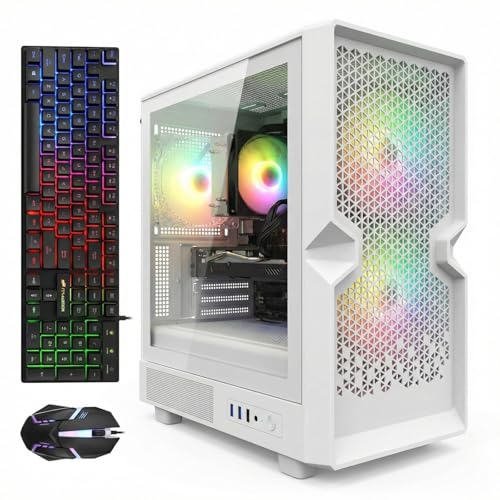
Where to Buy the White Gaming PCs in This Guide
All six systems below are sold on Amazon. Prices here churn weekly, and two picks carry a strict buy-only-within-the-$500-budget rule, so check the current price on Amazon before you check out.
- Best overall white tower: STGAubron Gaming PC Desktop, White (Core i7, RX 580 8GB, 32GB RAM, 512GB SSD)
- Best hardware, deal-watch pick: suevery Desktop Computer, White (Core i5-12400F, RTX 3050 6GB, 32GB RAM, 1TB SSD)
- Best-looking white case: LXZ Gaming PC Desktop, Sea View Room White (Ryzen 5 5600GT, 16GB RAM, 1TB SSD)
- Strongest integrated graphics in a white tower: LXZ Desktop PC, White (Ryzen 7 5700G, 16GB RAM, 512GB SSD)
- Best performance per dollar (not white): Beelink SER5 MAX Mini PC (Ryzen 7 7735HS, Radeon 680M, 24GB RAM, 1TB SSD)
- Cheapest route to real gaming (not white): GMKtec M6 Mini PC (Ryzen 5 6600H, Radeon 680M, 32GB RAM, 1TB SSD)
Affiliate disclosure: reviewstook.com is a reader-supported site. When you buy through links on this page, we may earn an Amazon commission at no extra cost to you. It never changes which products we pick: every system below earned its place on verified specifications and two honest grades — one for how white it actually is, one for what it can honestly do at 1440p.
First, the Part Nobody Selling a “1440p” PC Under $500 Wants to Say
Start with the sentence this entire guide hangs on: no gaming PC under $500 — white or otherwise — renders demanding modern games natively at 1440p. Not one of the six machines below does it, and no competitor’s roundup can sell you one that does, because the hardware for comfortable native 1440p play costs more than this entire budget on its own. Any listing that implies otherwise is trading on a confusion this guide exists to clear up: the difference between a PC that can display 1440p and a PC that can render games at 1440p.
Every machine here can light up a 1440p monitor. Your desktop, your browser, your video streams, and your older games will all sit on a 2560×1440 panel looking sharp. That is displaying. Rendering is the heavier job: the graphics hardware drawing each frame of a game at the panel’s full resolution — roughly 78 percent more pixels than 1080p, every frame, dozens of times a second. At this budget the realistic pattern is the reverse of the marketing: games render at 1080p or below, and something — an upscaler, or the panel itself — stretches that render up to fill the 1440p screen. Done well, that looks genuinely good. But it is not native 1440p, and this guide will not let you believe otherwise.
So each pick below carries an honest 1440p verdict alongside its whiteness grade, using three labels. Native, lightest titles only: undemanding games drawn at the panel’s real resolution, settings down. Upscaled: the working mode is a render below 1440p, lifted to the panel by an upscaler the hardware actually supports. Display only: a sharp 1440p desktop, but games at 1080p or lower, full stop.
The white half of the brief is just as unforgiving: most budget towers are black, most white towers come from small brands with thin documentation, and the strong white machines from bigger brands start well above this budget. Two of the six picks below are not white at all — the strongest gaming hardware verified at this budget, included and labeled as escape hatches for readers who decide frames beat color. Housekeeping, once: prices at this end of the market move weekly, in a year when component prices have spiked, so this guide prints no static prices — check the current price on Amazon before you buy. Two picks are only worth buying at or under the $500 budget even though they have been seen above the line or unverified inside it; each review states its rule. Follow the rule, not the headline.
In this guide
Quick Picks: The Six Systems at a Glance
Best overall white tower — STGAubron White, Core i7 / RX 580 8GB / 32GB / 512GB. The only white tower with a discrete graphics card verified inside this budget — check price on Amazon — with keyboard and mouse in the box. Verdict: native 1440p only in the lightest titles at low settings; a 1080p render upscaled is the working mode. The compromises are a 2017 card and a listing that never cleanly states which i7 generation you are buying.
Best hardware, if the price behaves — suevery White, Core i5-12400F / RTX 3050 6GB / 32GB / 1TB. The only genuinely modern white tower near this budget, and the only pick with DLSS — the closest thing here to a real 1440p answer. It has been seen over the budget line, so the rule is hard: check the current price on Amazon, buy only when it sits at or under the $500 budget, and walk away above it.
Best-looking white build — LXZ Sea View Room White, Ryzen 5 5600GT / 16GB / 1TB. A white panoramic glass case with seven addressable RGB fans — check price on Amazon — the prettiest machine in this guide. Verdict: display only. There is no discrete card, so you are buying a gorgeous, upgradable AM4 platform whose path to real 1440p runs through a future graphics card.
Strongest integrated graphics in white — LXZ White, Ryzen 7 5700G / 16GB / 512GB. The 5700G’s Vega 8 is the strongest integrated graphics fitted to any white tower here, with eight Zen 3 cores behind it. It renders the lightest titles natively at 1440p at low settings and upscales the rest from 1080p. We could not verify this configuration inside the budget — its higher-spec sibling sits well above the line and has sold out — so the hard rule applies: check the current price on Amazon and buy only at or under the $500 budget.
Best performance per dollar, wrong color — Beelink SER5 MAX, Ryzen 7 7735HS / Radeon 680M / 24GB / 1TB. Check the current price on Amazon. The Radeon 680M is the strongest graphics in this guide: 1080p is its home territory, native 1440p reaches only the lightest titles at low settings, and everything else arrives upscaled. Its whiteness grade is zero — a dark mini PC, here for readers who conclude frames beat color.
Cheapest real gaming, wrong color — GMKtec M6, Ryzen 5 6600H / Radeon 680M / 32GB / 1TB. The same 680M graphics and the same 1440p verdict as the Beelink, at the lowest price point in this guide — check the current price on Amazon. Matte black and tiny — and the room it leaves in the budget goes a long way toward the white 1440p monitor itself.
How We Chose These Six (and What We Rejected)
We began with every white or white-listed gaming desktop we could find on Amazon at or near $500, then verified each candidate against its actual listing — color field and configuration. Anything we could not verify was rejected outright or carried with an explicit buy-only rule. At this tier the rejected list is most of the market.
The whiteness grading. Every pick is graded on three layers. Layer one is the case: actually white per the listing’s own spec block, not merely photographed under bright light. Layer two is the graphics card shroud, where a discrete card exists: true white GPUs are premium parts that none of the towers here document, so the cards inside should be assumed standard dark shrouds unless the listing photos prove otherwise. Layer three is peripherals: whether the box includes a keyboard and mouse, and whether they continue the theme.
Rejected: white towers that never reach $500. STGAubron’s own white line shows the cliff. Its white GTX 1660 Ti tower (16GB, 512GB) and its white RTX 3050 6GB tower are good machines, both sitting above this guide’s ceiling. ZER-LON’s white RTX 4060 tower sits well above this budget. ViprTech’s white Stryker 1.0, a white build with a GTX 1660 Super, also sits above it. LXZ’s white 5700G in its 1TB, 650W configuration sits above the line and has sold out, and its white 5600G tower sits above it too. The pattern is consistent: step above this budget, and white towers with modern or near-modern discrete cards exist; at $500 and below, they do not — which is also why nothing in this guide renders modern games natively at 1440p.
Rejected: white in name only. Several listings surface in white-PC searches and fail the color check. STGAubron’s i5/RX 550 tower (ASIN B0BRL5PF1L) shows up in budget roundups constantly, but its spec block reads Color: Black. The 512GB variant of STGAubron’s white-model-number 3200G tower is likewise the black variant; its white 1TB variant exists, but we could verify no price for it. A white HP all-in-one runs an Intel N100 with 8GB of RAM and 128GB of storage — a fine kitchen computer, not a gaming PC.
Rejected: the white mini PC that does not exist. We looked hard for a true-white mini PC with Radeon 680M graphics at this price. It is not there. The GMKtec M6 and its Ultra sibling are matte black; Minisforum’s small 680M machines are silver, with no current listing we could pin; the Beelink and ACEMAGIC 680M minis are dark grey and black. So the 680M class is represented by its two best verified members, graded zero for whiteness.
The white tax, measured. Wherever a true black/white pair exists, both sides were priced. The cleanest pair is STGAubron’s i7/RX 580 tower: the white version carries 32GB of RAM, while the black sibling — same CPU class and card — carries 16GB, and the white version did not cost more than the black one despite the extra memory. On the one pair we could verify end to end, the white tax at this tier is effectively zero — you pay for the configuration lottery, not the color. Higher tiers behave differently — white editions of cards and cases carry real premiums there — and the suevery is an exception too, since its black-configured equivalents undercut it.
Rendering at 1440p Is Not Displaying 1440p
A 1440p monitor shows 2560×1440 pixels — about 3.69 million, against 1080p’s 2.07 million. Rendering a game at 1440p therefore asks the graphics hardware to do roughly 78 percent more pixel work per frame than rendering the same scene at 1080p, and at this budget that gap is the whole story: hardware that plays a game comfortably at 1080p has no 78 percent of spare capacity waiting around. There is a second, quieter problem: 1440p is not an integer multiple of 1080p — each axis scales by about 1.33×, not a clean 2× — so a plain 1080p image stretched to fill the panel lands between pixels and softens. That is why upscaling technology matters so much at exactly this resolution, and why which upscaler a machine supports is a hardware fact, not a settings preference.
DLSS is NVIDIA’s upscaler, and it runs on Tensor cores — silicon that exists only in RTX-branded cards. In this guide, exactly one pick has it: the suevery’s RTX 3050. When this guide credits DLSS figures, they are NVIDIA’s published ones. At 1440p output, DLSS Quality mode renders about 1707×960 internally — roughly a 1080p-class render. DLSS Balanced renders about 1485×836. DLSS Performance renders about 1280×720 — a 720p render wearing a 1440p badge. When a seller calls a machine “1440p” because DLSS Performance exists, the render underneath can be 720p.
FSR is AMD’s upscaler, and it is the one the other five picks can use: it runs on the RX 580 and on Radeon integrated graphics alike. This guide credits FSR generically — the correct tool for these machines — and prints no internal-resolution figures for it, because none are documented for these listings. What FSR cannot do is give the AMD picks DLSS: the RX 580 is a 2017 Polaris card that predates Tensor cores entirely, and Vega and 680M integrated graphics have none either — so where a pick lacks DLSS, this guide denies it explicitly. One more ceiling matters: VRAM is the budget upscaling cannot rebuild — an upscaler cannot restore texture detail the card never loaded. The RX 580’s 8GB is the most generous allowance here, the RTX 3050’s 6GB the tightest, and the integrated picks share system memory.
And 4K? Refused, set-wide, as a gaming target. Native 4K rendering is further beyond this hardware than native 1440p is: even on the suevery’s RTX 3050, DLSS Quality at 4K output renders about 2560×1440 internally and DLSS Performance at 4K about 1920×1080 — the “4K” picture would be built from a 1440p or 1080p render, and the other five picks have no DLSS at all. Several machines here can drive a 4K display for desktop work and video; none is a 4K gaming PC. Monitor pairing, kept honest: a 1440p monitor is still a sensible buy alongside any pick in this guide — for desktop clarity today, and because a monitor outlives the PC under it; the LXZ towers in particular are one graphics card away from using the panel properly. The base research for these listings documents no per-pick port counts or refresh ceilings, so this guide claims none; the exact outputs on the configuration you order are a live-listing check, and refresh-rate promises belong to the monitor’s spec sheet.
The Detailed Reviews
1. STGAubron White (Core i7, RX 580 8GB, 32GB RAM, 512GB SSD) — Best Overall White Tower
Who it suits: the buyer who wants a white tower with a real discrete graphics card inside this budget — and who points it at a 1440p monitor with realistic expectations: esports and back-catalog gaming on a white desk, where the panel is 1440p and the renders mostly are not.
Whiteness grade: case yes, card undocumented, peripherals yes. The spec block states Color: White; the case is a white tower with three RGB fans, and the box includes an RGB keyboard and mouse — the theme carried further than any other pick manages. Behind the glass, though, the RX 580’s shroud color is undocumented, and RX 580s at this price are dark cards: expect a white shell around a two-tone interior.
What you are actually getting. An Intel Core i7 (up to 3.9GHz per the listing), a Radeon RX 580 8GB, 32GB of RAM, a 512GB SSD, WiFi 6, Bluetooth 5.0, and Windows 11 Home, sold by STG USA — check the current price on Amazon before you buy.
Its honest 1440p verdict: native in the lightest titles only; upscaled the rest of the time. The RX 580 is a 2017 card whose home is 1080p: esports titles like Fortnite, Valorant, Rocket League, and Minecraft run capably there at medium-to-high settings, and the lightest render natively at 1440p with settings turned down. Everything heavier: render at 1080p and upscale to the panel with FSR — supported here, credited generically, no figures documented. DLSS is denied, explicitly: Polaris predates Tensor cores, so any source crediting this machine with DLSS is inventing hardware. No ray tracing, no frame generation. Its one 1440p asset is the guide’s largest VRAM pool — 8GB — so textures hold up better than on the 6GB RTX 3050.
The honest limitation: the listing never says which i7 you are buying. One spec field reads “Core i7 4th” — a 2014-era Haswell platform — while the headline says only Core i7 up to 3.9GHz, and deal coverage flags the same ambiguity. A 4th-gen i7 still plays esports fine with an RX 580, but the platform is a dead end. Buyer reports across STGAubron’s related models include Wi-Fi instability, shutdowns, and early failures: buy with Amazon’s return window as your safety net, stress-test hard for two weeks, and verify the 32GB configuration — siblings wear 16GB.
- Pros: only verified discrete-GPU white tower under $500; 32GB RAM at a tier where 16GB is standard; 8GB VRAM — the guide’s largest texture budget; keyboard and mouse included
- Cons: CPU generation ambiguous, possibly 2014-era; RX 580 is 2017 hardware — no DLSS, no ray tracing, no frame generation; 512GB fills fast; brand reliability reports are mixed
Choose it if white is non-negotiable, your library is esports and older titles, and an upscaled picture on a 1440p panel is a trade you accept knowingly. Skip it if you want DLSS or a platform with years of upgrades in it — its modern rival is the suevery below, if its price cooperates.

2. suevery Desktop, White (Core i5-12400F, RTX 3050 6GB, 32GB RAM, 1TB SSD) — Best Hardware, Deal-Watch Only
Who it suits: the patient buyer who cares most about the 1440p half of the brief. If you can watch a listing and strike when it dips, this is the only white tower near $500 whose internals belong to the current era — and the only machine in the guide whose upscaling story is genuinely strong.
Whiteness grade: the strongest claim in the guide, partially documented. The listing (series SUV9W3) states Color: white, advertises a pure white theme across the whole machine, and fits five RGB fans in a white case with WiFi 6 — the most complete white presentation of any tower here. One honesty caveat: the listing does not separately document the RTX 3050’s shroud color, so treat “pure white theme” as the seller’s framing and check the listing photos for the card before you buy.
What you are actually getting. Intel’s Core i5-12400F — six 12th-generation cores, still a legitimately good gaming CPU — with an RTX 3050 6GB, 32GB of DDR4, and a 1TB NVMe SSD. Every element is a class above the STGAubron, and this is the only tower in the guide with a sane upgrade story.
Its honest 1440p verdict: the guide’s only real upscaling route — and still not native for demanding games. The RTX 3050 is an entry card whose home resolution is 1080p, and this guide will not promote it past that. What it uniquely owns here is DLSS, because it is the only Tensor-core card in the set. Used honestly, that changes the 1440p conversation from “no” to “with help”: lighter titles render natively at 1440p at reduced settings, and demanding ones run through DLSS — Quality building the 1440p picture from an internal render of about 1707×960, Balanced from about 1485×836, and Performance, reserved for the hardest games, from about 1280×720. The ceiling is memory: 6GB of VRAM is the tightest texture budget in this guide, so at 1440p output expect textures a notch below what the STGAubron’s 8GB allows.
The honest limitation: the price. This tower has been seen over this guide’s budget, and no enthusiasm changes that. The rule admits no exceptions: buy the suevery white tower only when the live price on Amazon reads at or under the $500 budget. Above the line it breaks the brief; inside it, nothing else in this guide comes close.
- Pros: only modern platform in the guide (12th-gen i5); the guide’s only DLSS card — the strongest 1440p upscaling story here; 32GB RAM and 1TB NVMe as standard; strongest white presentation of any tower
- Cons: often seen over budget — check price on Amazon and buy only within the $500 budget; pricing is volatile; 6GB VRAM caps textures at 1440p output; GPU shroud color not separately documented; small brand with a thin track record
Choose it if you can wait for a dip and want the white tower whose 1440p picture is upscaled by the best technology in the guide. Skip it if you must buy today at a verified under-$500 price; that is the STGAubron above, or the LXZ below when the panoramic look matters more than a discrete card.

3. LXZ Gaming PC, Sea View Room White (Ryzen 5 5600GT, 16GB RAM, 1TB SSD) — The Look, Bought as a Platform
Who it suits: the buyer whose priority is honestly the aesthetic — a white panoramic-glass showpiece for a white desk — and whose gaming today is light enough, or whose upgrade plans are firm enough, that buying a platform instead of a finished gaming PC makes sense. Sold by Romiromi on Amazon — check the current price on Amazon.
Whiteness grade: the best in the guide. The Sea View Room case is a white panoramic design — glass arranged to display the interior rather than hide it — with seven addressable RGB fans fitted, per the seller’s listing copy. The interior caveat flips here: with no discrete card, there is no dark GPU shroud breaking the theme; the visible interior is the board, the cooler, and the fans. No peripherals are included, so the theme stops at the case.
What you are actually getting. A six-core Zen 3 APU — the Ryzen 5 5600GT — with 16GB of DDR4 (headroom to 64GB, per the listing), a 1TB NVMe SSD, and integrated Radeon Vega 7 graphics. That is the point of the pick: the AM4 platform, the case, and the storage are a foundation. Buyer feedback agrees: owners praise the machine and note that integrated graphics limit gaming until a card goes in. The most important component in this box is the empty PCIe slot.
Its honest 1440p verdict: display only. The Vega 7 renders games at 1080p low or 720p; esports and older titles are its territory. On a 1440p panel, everything it plays arrives upscaled — FSR is available to it and is the right tool, credited generically with no figures — a 1080p-class render stretched across a 1440p desktop. There is no DLSS: Vega graphics have no Tensor cores, and no setting unlocks what the silicon does not carry. The day a discrete card goes into that empty slot, this case becomes a genuine 1440p candidate; until then, buy it for how it looks and what it becomes.
The honest limitation: as shipped, this is the least capable gaming machine among the towers, and it sits at the top of this budget: top-of-budget money for a case, a platform, and integrated graphics, when the STGAubron above delivers a discrete card and double the RAM inside the same budget. The modest power delivery in towers of this type also caps how ambitious a future GPU upgrade can be without a PSU swap — check the listing’s stated wattage before planning around a hungry card.
- Pros: best white presentation in the guide — panoramic glass, seven ARGB fans; check price on Amazon; 1TB NVMe storage; AM4 platform with RAM headroom and an empty GPU slot
- Cons: integrated Vega 7 only — display-only at 1440p as shipped; upgrade cost still ahead of you; modest power supply limits GPU choices; no included peripherals carrying the theme
Choose it if the white showpiece look is the point and a GPU upgrade within the year is genuinely in your budget. Skip it if day-one gaming strength is the priority — every other pick here out-games it as shipped.

4. LXZ Desktop, White (Ryzen 7 5700G, 16GB RAM, 512GB SSD) — Strongest Integrated Graphics in a White Tower
Who it suits: the buyer who wants a white tower and the best no-graphics-card gaming available in one — and who plays esports, indie, and older titles rather than new AAA releases, on a 1440p panel or with plans for one.
Whiteness grade: case yes, interior standard. For this LXZ-R7pro configuration, the spec block states Color: White — a white case with glass presentation. With no discrete card fitted, no dark shroud interrupts the theme — the same accidental purity as the 5600GT machine, in a more conventional tower than the panoramic showpiece.
What you are actually getting. The Ryzen 7 5700G brings eight Zen 3 cores and sixteen threads, with Radeon Vega 8 integrated graphics — a step up from the 5600GT’s Vega 7 and the strongest integrated graphics fitted to any tower in this guide — plus 16GB of DDR4 and a 512GB NVMe SSD, on a 400W power supply. The eight cores make this the best productivity machine among the white towers; the upgrade path mirrors the 5600GT pick — an empty slot and a modest PSU.
Its honest 1440p verdict: native only at the lightest end; a 1080p renderer the rest of the time. The Vega 8 handles the esports catalog at 1080p low-to-medium settings more comfortably than the Vega 7, and the lightest of those titles will render natively at 1440p with settings turned down. Everything beyond that: render at 1080p and let FSR present it on the panel — credited generically, no figures attached. DLSS is denied, explicitly: Vega integrated graphics carry no Tensor cores, so no driver, setting, or listing claim can give this machine NVIDIA’s upscaler. No ray tracing, and new AAA titles are a low-settings negotiation even at 1080p.
The honest limitation: this exact 512GB configuration could not be verified inside the budget, and the surrounding evidence is not encouraging. The 1TB, 650W version of the same model sits well above this budget and has since sold out. The 512GB version may dip into budget, but “may” is not a price, and we do not print one we did not see. The rule is the same as the suevery’s, for the opposite reason: buy this LXZ 5700G white tower only when its live price on Amazon reads at or under the $500 budget. Above that, the STGAubron’s discrete card wins the comparison outright.
- Pros: strongest integrated graphics in a white tower (Vega 8); eight Zen 3 cores — best multitasking and productivity of the white picks; real GPU upgrade path
- Cons: this configuration not verified inside the budget — strict buy-only-within-the-$500-budget rule, so check price on Amazon; display-class at 1440p beyond light titles; 512GB storage is the tier’s floor; 400W PSU caps upgrades
Choose it if your games suit an APU, you value the eight-core CPU for work alongside play, and the live price is at or under the line when you check. Skip it if the day’s price is over $500 — a dipped suevery is then the better white buy, and the minis below are the better buy at any price.

5. Beelink SER5 MAX (Ryzen 7 7735HS, Radeon 680M, 24GB RAM, 1TB SSD) — The Performance Escape Hatch
Who it suits: the buyer who came in wanting white and 1440p, read the four reviews above, and decided they actually want the best gaming $500 buys. It is the resident Radeon 680M pick from the plain under-$500 tier — check the current price on Amazon.
Whiteness grade: zero. The SER5 MAX is a dark mini PC that will not match a white desk setup. What it offers instead is disappearance: small enough to mount behind the very 1440p panel it is driving, out of sight entirely.
What you are actually getting. A Ryzen 7 7735HS with Radeon 680M integrated graphics — twelve RDNA 2 compute units that outrun every Vega system in this guide by a wide margin — 24GB of LPDDR5 RAM, and a 1TB SSD. There is no GPU upgrade path: the 680M is the beginning and end of its graphics story, and that finality is the trade for the size and the price.
Its honest 1440p verdict: the strongest graphics in the guide, and still an upscaler at 1440p. The 680M’s home territory is 1080p: esports there with real headroom, and mainstream titles at low-to-medium settings that the Vega machines cannot attempt. At 1440p, native rendering reaches only the lightest end of a library at low settings; the working mode for everything else is a 1080p-class render presented on the panel, with FSR — supported on this hardware, credited generically — doing the lifting. DLSS is denied here too, explicitly: RDNA 2 integrated graphics have no Tensor cores. Even so, its upscaled picture starts from the strongest 1080p render here — the best 1440p-panel experience in the guide per dollar.
The honest limitation: it fails the brief. This is a guide to white gaming PCs; the Beelink is not one. It earns its place anyway, because hiding the best-performing option at the budget over a technicality of color would serve the headline instead of the reader. If performance per dollar is the point, start here — the white towers are the compromise.
- Pros: strongest graphics in the guide (Radeon 680M) — the best upscaled 1440p picture per dollar here; 24GB RAM and 1TB SSD; check price on Amazon; tiny, quiet, mountable out of sight behind the monitor
- Cons: not white — fails the brief outright; no DLSS (no Tensor cores); no graphics upgrade path, ever; 24GB memory is soldered, never expandable; laptop-class CPU in a desktop comparison; no included peripherals
Choose it if frames beat color and you want the strongest all-round gaming this budget verifies. Skip it if a white setup is the actual goal; then the STGAubron is your discrete-card answer and the LXZ 5600GT your showpiece.

6. GMKtec M6 (Ryzen 5 6600H, Radeon 680M, 32GB RAM, 1TB SSD) — The Value Anchor
Who it suits: the buyer who wants 680M-class gaming for the least money possible and treats the white requirement as a preference rather than a rule.
Whiteness grade: zero, and not close. The M6 is matte black — independent reviews describe the finish in exactly those terms — and there is no white variant.
What you are actually getting. The Ryzen 5 6600H carries the same Radeon 680M graphics as the SER5 MAX, plus 32GB of RAM and a 1TB SSD, at the lowest price point in this guide — check the current price on Amazon. Against the Beelink’s 7735HS, the 6600H gives up two CPU cores; the graphics — what games actually feel — are the same silicon. Same gaming class as pick five at a lower price point — savings that go toward the white 1440p monitor and peripherals around a black box the size of a paperback.
Its honest 1440p verdict: identical to the Beelink’s, because the graphics silicon is identical. Native 1440p only at the lightest end of a library at low settings; a strong 1080p render upscaled to the panel — via FSR, credited generically — for everything else; DLSS denied, explicitly, for the same reason as every AMD pick here: no Tensor cores. What differs from pick five is not the picture but the arithmetic: at its lower price point, this is the only pick that leaves real room inside the budget for the 1440p monitor itself.
The honest limitation: same as the Beelink, squared. It is not white; beyond storage and memory service there is no upgrade path; and its CPU is the weaker of the two 680M minis for productivity. Its pricing is the most volatile in the guide, so the value case depends on catching it at the lower end of its range. At its regular price point it is merely good; at its deal positioning, it is the smartest buy on this page for anyone whose commitment to white is negotiable.
- Pros: Radeon 680M gaming at the lowest price point in the guide — check price on Amazon; 32GB RAM and 1TB SSD; leaves budget for the white 1440p monitor and peripherals themselves
- Cons: matte black — the opposite of the brief; no DLSS (no Tensor cores); six-core CPU trails the Beelink; no GPU upgrade path; value case depends on deal pricing
Choose it if you want the most gaming per dollar and can build the white theme around the desk — monitor included — instead of inside the case. Skip it if the PC itself must be white; picks one through four exist for that.

Comparison Table: All Six Picks Side by Side
| Pick | CPU | Graphics | RAM / Storage | Whiteness grade | Honest 1440p verdict | Price |
|---|---|---|---|---|---|---|
| STGAubron White | Core i7, up to 3.9GHz (generation not cleanly stated; one spec field reads “Core i7 4th”) | RX 580 8GB (discrete) | 32GB / 512GB SSD | White case + included RGB keyboard & mouse; GPU shroud undocumented | Native in lightest titles at low settings; 1080p render + FSR upscale otherwise; no DLSS | Check price on Amazon |
| suevery White | Core i5-12400F | RTX 3050 6GB (discrete) | 32GB DDR4 / 1TB NVMe | “Pure white theme” per listing; GPU shroud not separately documented | Only DLSS pick: lighter titles native at reduced settings; DLSS Quality (≈1707×960 internal) for demanding games | Check price on Amazon — buy only at or under the $500 budget |
| LXZ Sea View Room White | Ryzen 5 5600GT | Radeon Vega 7 (integrated) | 16GB DDR4 / 1TB NVMe | Best in guide: white panoramic glass case, 7 ARGB fans | Display only: renders at 1080p low or below, upscaled to the panel | Check price on Amazon |
| LXZ 5700G White | Ryzen 7 5700G | Radeon Vega 8 (integrated) | 16GB DDR4 / 512GB NVMe | White case per spec block; no discrete card to break the theme | Native only at the lightest end at low settings; 1080p render + FSR upscale otherwise; no DLSS | Check price on Amazon — buy only at or under the $500 budget (higher-spec sibling above budget, sold out) |
| Beelink SER5 MAX | Ryzen 7 7735HS | Radeon 680M (integrated) | 24GB / 1TB SSD | Zero — dark mini PC | Strongest graphics in the guide; native only at the lightest end; 1080p render + FSR upscale; no DLSS | Check price on Amazon |
| GMKtec M6 | Ryzen 5 6600H | Radeon 680M (integrated) | 32GB / 1TB SSD | Zero — matte black mini PC | Same verdict as the Beelink — same graphics silicon; the savings fund the 1440p monitor itself | Check price on Amazon — lowest price point in the guide |
How to Choose a White Gaming PC for 1440p Under $500
Decide what “white” has to mean before you shop. Three standards hide inside the same search term. Standard one — a white case — is met by four of our picks. Standard two is a white build — white case, light interior components, white cabling — and at $500 essentially nothing meets it, because white graphics cards and white motherboards are premium parts that do not appear in budget towers. Standard three is a white setup — case plus white monitor, keyboard, mouse, and desk accessories — achievable at this budget only by spending less on the PC itself (the real argument for the GMKtec M6 at a deal price) or by accepting the STGAubron’s included peripherals as a head start.
Then decide what “1440p” has to mean, just as carefully. If it means a 1440p monitor on the desk and a sharp desktop, every pick here qualifies today. If it means games rendered natively at 2560×1440, at this budget it means lightest titles only, on some picks, at low settings — and for demanding modern games it means coming back with more money, in any color. The useful middle position is a 1440p panel fed by the best upscaled render you can afford: genuinely good today, and better still the day a stronger card goes into an LXZ tower.
Rank graphics before everything else, and match the upscaler to the silicon. The ladder here is strict: the RTX 3050 (suevery) and RX 580 (STGAubron) are discrete cards that play real games at 1080p; the Radeon 680M (both minis) is the strongest integrated graphics, a half-step below them; the Vega 8 and Vega 7 (the LXZ towers) are a full step below that. And if DLSS matters to you — at 1440p output it is the most valuable graphics feature in this guide — exactly one pick has it, because DLSS lives on Tensor cores and only the suevery’s RTX card carries them; every AMD pick here upscales with FSR instead.
Price the black sibling before paying any white tax. Our one verified pair — STGAubron’s i7/RX 580 in white with 32GB, against its black 16GB sibling — shows the tax at this tier is roughly zero: the white version carried double the memory without costing more than the black one. Make it a habit: find the same configuration in black, compare like for like on RAM and storage, and refuse to pay a meaningful premium for color alone at this budget.
Treat configuration drift as the default, and plan the second purchase. Budget listings change components under a stable title: the STGAubron family sells the same headline configuration with 16GB and 32GB under different listings, and LXZ sells the 5700G with 512GB and a 400W supply and with 1TB and 650W under one model name. Before ordering, read the spec block on the live listing — RAM, storage, color, and the exact display outputs if you are pairing a specific monitor — and screenshot it; if what arrives differs, that screenshot is your return case. Every tower also has a known next purchase (a graphics card for the LXZ pair, PSU check first; storage for the 512GB machines); the minis have none.
Common Mistakes When Buying a White “1440p” PC
Believing the render — either kind. Listing photography for white PCs is shot bright, and interiors are often rendered rather than photographed: a “white build” in the hero image can be a white case around entirely standard dark components, and the spec block’s color field certifies the case and nothing else. The same trick runs in the other direction with resolution: a photograph of a game on a 1440p monitor proves the machine can display 1440p, which was never the question.
Reading “1440p ready” as “renders at 1440p.” At this budget the phrase almost always means one of three weaker things: the machine can output to a 1440p display, an upscaler can target 1440p from a much smaller render, or an old game once ran at the resolution. All three can be true of a machine that renders your library at 1080p or below.
Assuming DLSS is a setting, not silicon. DLSS requires Tensor cores. The RX 580 does not have them; Vega and 680M integrated graphics do not have them; no driver update will add them. Choose an AMD pick knowing its upscaler is FSR, full stop.
Buying integrated graphics for AAA games because the case was pretty. The LXZ 5600GT is the best-looking machine in this guide and the weakest tower for gaming, and at 1440p it is a display device until a card goes in. Panoramic glass does not render frames. If new releases are your library, your shortlist is the discrete-card picks and the 680M minis, in whatever color they come.
Ignoring the power supply, and skipping the stress test. Both LXZ towers ship with modest wattage — 400W is documented on the 5700G configuration — so a GPU upgrade that ignores the PSU becomes two upgrades; check the stated wattage on the live listing and plan the card around it. And whatever you buy, run games, updates, and Wi-Fi hard during the return window: buyer reports on the STGAubron family include early failures.
Final Recommendation
If you are buying a white gaming PC for a 1440p setup under $500 today, buy the STGAubron White. It is the only pick that satisfies the brief at once — white case, discrete graphics, peripherals in the box, inside the budget — check the current price on Amazon — and its 1440p story is the honest budget one: the lightest titles rendered natively, everything else rendered at 1080p and upscaled. Verify the 32GB configuration on the STGAubron White listing, stress-test on arrival, and it will run a white-desk esports and back-catalog setup exactly as promised.
If the 1440p half of the brief matters more than buying today, wait for the suevery: the best machine in this guide by a generation and the only one with DLSS — and it has been seen close enough to the line that a routine sale settles it, at which point it becomes the recommendation. If the look is the whole point and a GPU upgrade is already budgeted, the LXZ Sea View Room White is the showpiece. And if this guide has clarified that performance matters more than color, the Beelink SER5 MAX and the GMKtec M6 at its deal positioning are waiting in black, with the strongest graphics this budget buys — the M6’s lower price point leaving room toward the white 1440p monitor itself. Color adds zero frames; at this budget, upscaling adds the rest. Spend on both deliberately.
Frequently Asked Questions
Is any PC in this guide a true native-1440p gaming PC? For demanding modern games, no — and neither is anything else verified under $500, in any color. Native 1440p rendering appears here only at the lightest end of a library: esports and older titles at low settings on the discrete-card picks and the 680M minis. Everything else renders at 1080p or below and is upscaled to the panel — a good picture, honestly labeled, but not native.
What is the difference between displaying 1440p and rendering at 1440p? Displaying means the machine can send a 2560×1440 signal to a monitor — desktop, video, and interface all sharp; every pick here can do that. Rendering means the graphics hardware draws each game frame at all 3.69 million of those pixels, roughly 78 percent more work per frame than 1080p’s 2.07 million — the job this budget cannot fund for modern games.
Is DLSS Quality actually rendering at 1440p? No. On the one pick here that supports DLSS — the suevery’s RTX 3050 — DLSS Quality at 1440p output renders about 1707×960 internally and reconstructs the rest; Balanced renders about 1485×836, and Performance about 1280×720. The output is a 1440p picture and, at Quality, a convincing one; the render underneath is not 1440p.
Can the AMD picks use DLSS instead of FSR? No. DLSS runs on NVIDIA Tensor cores, and no AMD hardware in this guide — not the RX 580, not the Vega 7 or Vega 8, not the Radeon 680M — carries them. Their upscaler is FSR, which works well and asks for no special silicon. Any listing that attaches DLSS to those machines is wrong about the hardware.
Should I buy a 1440p monitor for one of these PCs? Yes, with the right expectations: a monitor outlives the PC beneath it — the LXZ towers become genuine 1440p machines the day a discrete card goes in. And check the exact outputs on the live listing of the configuration you order: this guide documents no per-pick port counts, because the base research for these listings does not either.
How much is the white tax under $500? Effectively zero, on the one direct pair verifiable end to end — STGAubron’s i7/RX 580 tower: the white 32GB version did not cost more than its black 16GB sibling. At this budget, configuration differences matter more than color.
Can I get a white graphics card in a PC under $500? Not in any verified prebuilt we found. White-shrouded graphics cards are premium parts, and none of the towers here document one — the cards inside should be assumed standard dark shrouds. A full snow build means a higher budget, or a self-build with a white-edition card bought separately.
What should I check on the listing before ordering? Five fields: the color field in the spec block (case color is all it certifies), the RAM capacity (16GB and 32GB versions of the same headline configuration both exist), the storage size, the power supply wattage if you plan a GPU upgrade, and the exact display outputs if you are pairing a specific monitor. Screenshot the spec block at order time; the screenshot is your evidence if the delivered machine differs.
Keep Reading
- Best White Gaming PC Under $500 — this guide’s sibling: the same field graded on color alone
- Best 1440p Gaming PC Under $500 — the 1440p brief with no color filter
- Best Gaming PC For 1440p Gaming Under $500 — every route to a 1440p panel at this budget
- Best Gaming PC Under $500 — the plain under-$500 guide
- Best Prebuilt Gaming PC Under $500 — every prebuilt route at this budget
- Best 1080p Gaming PC Under $500 — ranked purely by 1080p capability
- Best White Gaming PC For 1440p Gaming Under $400 — the white 1440p brief on a tighter budget
- Best White Gaming PC For 1440p Gaming Under $700 — where white towers with stronger cards begin
- Best White Gaming PC Under $400 — the white brief under $400
- Best White Gaming PC Under $700 — the white tier with modern mid-range graphics
- Best White Gaming PC Under $800 — the next white tier up
- Best Mini Gaming PC Under $500 — the 680M mini PC field in full
- Best Compact Gaming PC Under $500 — small-footprint alternatives
- Best White Gaming PC For Beginners Under $500 — the same field for first-time buyers
- Best White Gaming PC For Streaming Under $500 — the white field graded on encoders instead
- Best Gaming PC Under $700 — what the next $200 buys


