Disclosure: As an Amazon Associate, reviewstook.com earns from qualifying purchases. Links on this page are affiliate links; they cost you nothing extra. Prices and availability change often, so check the current Amazon listing before you buy.
This smart water leak detector buying guide starts with the sentence every buyer in this category needs tattooed on the decision: a smart water leak detector warns you about water; it does not stop the water. Everything in this guide — the types, the picks, the criteria — flows from that single fact. You are buying time and information: the minutes between a hose bursting and a human closing a valve, and the knowledge of exactly where the water is. Bought well, those minutes are among the cheapest protection in home ownership. Bought carelessly — wrong alert channel, wrong spots, dead battery by year two — the same device is a plastic puck of false confidence. This guide exists to put you in the first group.
Key Takeaways
- Choose the alert architecture first — alarm-only, Wi-Fi or hub — because it decides whether anyone learns about the leak in time.
- Count your spots before you count features: water heater, washing machine, dishwasher, refrigerator line, sinks and toilets on finished floors.
- Point sensors guard spots; sensing cables guard lines. Match the sensor shape to the shape of your risk.
- Freeze sensing is worth having anywhere pipes can freeze; it is the bonus feature owners end up valuing most.
- Whatever you buy, the system only works if you test it periodically and your household knows where the main shutoff valve is.
In this guide
Smart Water Leak Detector Buying Guide: What It Does and the Main Types
The core mechanism never changes: metal contacts wait for water to bridge them, and the device reacts. Everything else — and there is plenty — is variation in how far the warning travels and how much floor the sensor watches. Understanding the main types is most of the purchase, because the types fail in different ways and suit different houses.
Type One: Alarm-Only Pucks
The simplest form: a battery puck with a built-in siren and no connection to anything. Water touches the probes, the puck shouts, and anyone within earshot becomes the response team. Strengths are real — the lowest cost per spot in the category, zero setup beyond placement, no network to fail, no app to maintain. The limitation is absolute: an empty house hears nothing. Alarm-only is a complete solution for homes that are occupied most of the time and a partial one for everyone else. Many owners use these as the coverage layer — one under every sink and behind every toilet — beneath a connected backbone at the highest-risk spots.
Type Two: Wi-Fi Sensors
Wi-Fi models connect directly to your router and push alerts to your phone anywhere, with no hub to buy. They suit one to three high-risk spots in homes with strong Wi-Fi reaching those spots — a condition worth verifying, because leak spots (basements, utility rooms, behind appliances) are often exactly where Wi-Fi is weakest. Battery models trade battery life for that direct connection; mains-powered models with a probe on a lead remove batteries from the equation but need an outlet near the risk. Every Wi-Fi sensor shares one maintenance truth: change your router or password and the sensor goes silently offline until re-provisioned, so a reconnection check after any network change belongs in your routine.
Type Three: Hub-Based Systems
Hub systems give each sensor a low-power, long-range radio link to a dedicated hub, and the hub talks to the internet. The payoff is the category’s best combination of reach and battery life: sensors stay reliable in basements, garages and far bathrooms, batteries last far longer than Wi-Fi equivalents, and adding a sixth or tenth sensor is trivial. The costs are the hub itself — one more box, bought once — and commitment to one maker’s ecosystem and app. For large homes, multi-storey homes, landlords and anyone planning whole-house coverage, owner experience across the category says this is the architecture that ages best.
Type Four: Ecosystem Sensors
Some sensors exist as citizens of a wider security system — the flood-and-freeze sensor that joins an alarm platform is the archetype. If you already live in that system, adding water coverage is cheap, coherent and monitored through the app you already watch. If you do not, the sensor is not a standalone product at all, and buying it without its base station is the category’s most common purchasing mistake. Ecosystem sensors also commonly add freeze sensing, since the platform already thinks in terms of home protection rather than single gadgets.
Type Five: Cable Sensors
Cable designs replace the point with a line: a sensing cable that detects water anywhere along its length, laid along a baseboard, behind a run of appliances or around a water heater. One cable device can cover what would take three or four pucks, and it covers the gaps between pucks too. Cable systems tend to be deliberate, mid-to-premium purchases for specific geometries — boiler rooms, appliance walls, long cabinet runs — rather than whole-house defaults, and they pair naturally with pucks guarding the point risks elsewhere.
Top Picks at a Glance
| Pick | Badge | Type | Tier | Best For |
|---|---|---|---|---|
| YoLink Water Leak Sensor | Best Overall System | Hub-based | Mid | Large homes, basements, whole-house coverage |
| Govee Water Sensor | Best Local Alarm | Alarm / gateway | Entry–Mid | Occupied homes, kitchens and bathrooms |
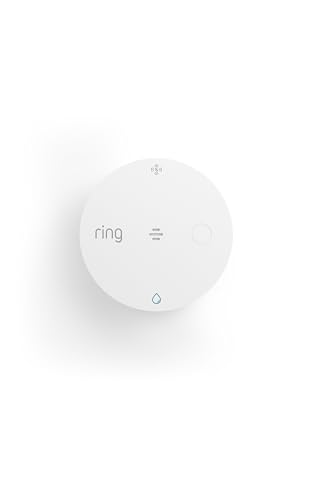
| Ring Flood & Freeze Sensor | Best for Ring Homes | Ecosystem | Mid | Households already running Ring Alarm |
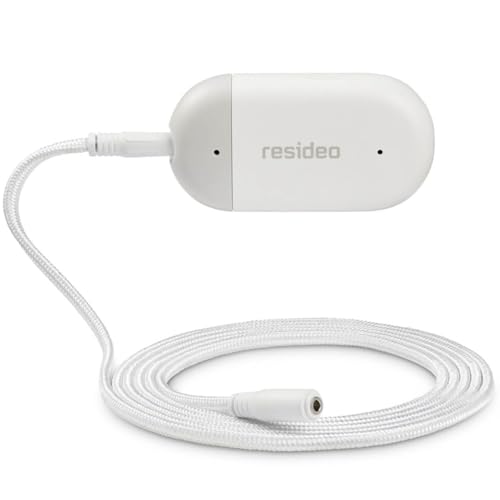
| Resideo WiFi Water Leak Detector | Best Cable Coverage | Wi-Fi cable | Mid–Premium | Appliance runs, boiler rooms, cabinet lines |
| D-Link Wi-Fi Water Sensor | Best No-Battery Pick | Wi-Fi plug-in | Mid | Owners who will not maintain batteries |
| X-Sense Water Leak Sensor Alarm | Best for Blanket Coverage | Alarm sets | Entry | Many spots on a budget, occupied homes |
Badges here are qualitative and architecture-based, not lab rankings — in a category this dependent on your house, the “best” sensor is the one whose alert path, power story and shape match your risk map. The mini-reviews below give each pick its honest best-for and not-suited-for, and smart water leak detector reviews shows the ownership patterns behind these badges. One structural note before the detail: many real installations combine rows of this table rather than choosing one. A hub backbone at the heater and laundry with alarm pucks under every sink is not indecision — it is the architecture the owner evidence endorses most often, because it puts connected money where catastrophe lives and cheap coverage where frequency lives. Read the table as a kit of parts for your own map, not as a podium.
Which Alert Will You Actually Hear?
This is the first buying question, and it is about your life, not the device. Picture the leak at three moments: midday on a workday, 3 a.m. on a Tuesday, and the middle of a two-week holiday. A siren wins the 3 a.m. scenario in an occupied home and loses the other two by default. A phone push wins midday and the holiday — provided someone empowered to act is within reach of the property, or a neighbour holds a key. A hub with a loud base or speaker announcement strengthens the in-home scenarios; a system whose alerts can reach more than one person strengthens all of them. Be brutally honest here, because this answer eliminates whole types: frequent travellers and empty-house weekdays point to connected systems; always-someone-home households can take the entry-tier sirens and spend the savings on covering more spots. And whatever channel you choose, rehearse it once: trigger a test alert and confirm it reaches the human it is supposed to reach, at the volume and on the device they actually carry. Add the awkward fourth moment while you are at it — the leak during the party, the barbecue, the house full of guests and noise — because sirens compete with life, and a phone buzzing in a pocket has won more real-world alerts than any specification sheet admits. The alert you will actually hear is the one that survives your loudest, sleepiest and emptiest hours simultaneously.
How Much Coverage Do You Need?
Count spots, not rooms, and count them by walking the house with fresh eyes. The non-negotiables in almost every home: the water heater (in its pan or at the overflow edge), behind the washing machine between the supply hoses, under the kitchen sink beneath the trap, and beside the dishwasher’s connections. The second ring: the refrigerator’s ice-maker line, behind every toilet on a finished floor, under bathroom sinks above finished space, and at the sump pit if you have one. The third ring, by exposure: HVAC condensate points, water softeners and filtration units, aquarium equipment, and plumbing in unheated spaces where freeze risk lives. Most homes land between five and eight real spots. That count drives the economics: at five-plus spots, hub systems and alarm sets usually beat premium singles on total value, and the right question becomes cost per covered spot rather than cost per device. Under-buying coverage is the category’s most documented regret — owners almost never write “I covered too many places.” One more counting rule, learned from those same owners: count the spots you cannot see without moving something. The sensor behind the washing machine and the one inside the vanity cabinet are the easiest to skip precisely because placing them takes effort, and they guard two of the highest-frequency leak sources in the house. If a spot is annoying to reach, that is evidence it would also be discovered late without a sensor — which makes it more deserving of coverage, not less.
Point Sensor or Sensing Cable?
Match shape to risk. A point puck watches the few centimetres around its probes and suits compact, predictable pooling: a heater pan, a sink cabinet’s low corner, the floor behind a toilet. A cable watches a line and suits spread-out risk: the wall behind a washer and dryer pair, a boiler room perimeter, a run of kitchen cabinets sharing one long floor. Drips from above argue for pucks with top contacts — the classic under-sink trap drip lands on the sensor, not beside it. Wide, flat risks argue for two pucks rather than one heroic placement, because water follows slope and seams in ways that routinely embarrass single-sensor optimism. When a spot matters and its geometry is awkward, the cable is usually the grown-up answer, which is why the Resideo-style design exists; when the geometry is a simple low point, a puck is cheaper, simpler and just as effective.
How Will It Be Powered, and Who Maintains It?
Power is a maintenance contract you sign at purchase. Battery pucks on hub radios sip power and can run for very long stretches, with the app warning you well ahead — the lowest-effort battery story in the category. Battery Wi-Fi sensors spend more energy on their connection and need more frequent attention. Mains-powered probe models delete the battery question and add an outlet question. Alarm-only pucks warn with a chirp, which works only if someone hears and correctly interprets it. None of these is disqualifying; all of them fail in the same household — the one that never decided who checks. Assign the job, tie the test to an existing ritual (smoke alarm checks, seasonal clock changes), keep spare cells of the right type in the house, and the power question answers itself for years. If you know, honestly, that nobody will do any of this, weight the mains-powered and long-life hub options heavily — buy the maintenance profile you will actually keep. And whatever profile you choose, write the battery type and the install date on a label on each sensor. Two years from now, in a dark utility room, that label is the difference between a two-minute swap and a shopping trip taken while a sensor sits dead in a drawer.
Do You Need Freeze Sensing Too?
If any of your plumbing runs through unheated or exterior-wall spaces — and in cold climates, most homes qualify — freeze sensing deserves a place on your criteria list. A sensor that warns when temperatures near pipes fall toward freezing converts the worst leak in the catalogue, the burst pipe, from a discovery into a preventable event: you get hours to add heat, open cabinet doors, drip a tap or call for help. Owners consistently undervalue this feature at purchase and praise it afterwards, which is the signature of a feature worth buying on purpose. Place freeze-capable sensors at the cold spots themselves — basement rim areas, crawl spaces, garages, exterior-wall cabinets — which may not be your highest leak spots, and let that dual map inform how many sensors, and which models, you choose.
How to Prioritise by Use Case
The family home, occupied daily. Prioritise coverage count and in-home loudness, then connected alerts at the two catastrophic spots. A realistic build: alarm sets under sinks and behind toilets, a hub or Wi-Fi sensor at the water heater and behind the washer. The frequent traveller’s home. Prioritise the alert path above all — connected sensors everywhere that matters, alerts reaching a second person, and a serious look at an automatic shutoff valve, because an alert with nobody able to act is information without protection. The landlord’s portfolio. Prioritise alerts that reach you, not just the tenant: hub systems with owner-side notifications, sensors at heater and laundry in every unit, and the response steps written into the tenancy paperwork. The cold-climate home. Prioritise freeze sensing at vulnerable plumbing plus leak coverage at the heater; your worst-case scenario is a burst, not a drip, and the buying order should say so. The finished-basement home. Prioritise the utility area like it is already flooding: connected sensor at the heater, coverage at any basement bathroom and laundry, and no alarm-only devices as the sole defence of finished space.
The Picks in Detail
YoLink Water Leak Sensor — Best Overall System
The hub pick for buyers covering a whole home. Its long-range, low-power radio answers the two structural weaknesses of Wi-Fi sensors — reach and battery appetite — and the system scales from two sensors to a full map without changing apps or habits. Best for: large or multi-storey homes, deep basements, landlords, anyone planning five-plus spots. Not suited for: buyers who want a single sensor and no hub, or who refuse any ecosystem commitment. Tier: mid, with the hub as a one-time entry cost that makes each additional sensor economical. Check price on Amazon once linked, and confirm the hub requirement on the listing.
Govee Water Sensor — Best Local Alarm
The loud-puck pick, with probes arranged to catch both pooling water and drips from above — the under-sink geometry most pucks miss. Standalone versions are pure local alarm; gateway versions add the phone alert, and the listing in front of you decides which you are buying, so read it as if the distinction matters, because it does. Best for: occupied homes, kitchens and bathrooms, buyers who want the room itself to announce the leak. Not suited for: empty-house protection in its standalone form. Tier: entry to mid depending on configuration.

Ring Flood & Freeze Sensor — Best for Ring Homes
The ecosystem pick: water and low-temperature sensing folded into the Ring Alarm platform, alerting through the app and system the household already monitors. Best for: existing Ring Alarm homes adding water coverage with zero new habits. Not suited for: anyone without that base system — it is an add-on, not a standalone. Tier: mid as an add-on. Confirm current system requirements on the listing, since platform requirements are the detail most likely to differ between generations.
Resideo WiFi Water Leak Detector — Best Cable Coverage
The geometry pick: a Wi-Fi detector whose sensing cable traces the line water would travel — behind appliance runs, along boiler room floors, under cabinet walls — with leak and freeze alerting through Resideo’s app. Best for: linear risks, owners already in the Resideo/Honeywell Home comfort ecosystem, deliberate single-spot excellence. Not suited for: buyers wanting many cheap spots covered at once. Tier: mid to premium, justified when one cable genuinely replaces several pucks.
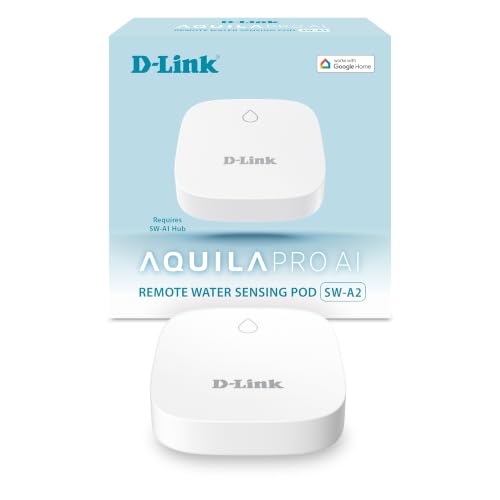
D-Link Wi-Fi Water Sensor — Best No-Battery Pick
The maintenance pick: a mains-powered Wi-Fi unit with the probe on a lead, so there is no battery to neglect, and alerts flow through the app with a local alarm alongside. Best for: laundry and utility spots with a handy outlet, owners who know battery discipline is their weak point. Not suited for: spots with no outlet within lead-reach, or homes wanting coverage independent of mains power. Tier: mid. Verify the current model and app support on the listing before buying.
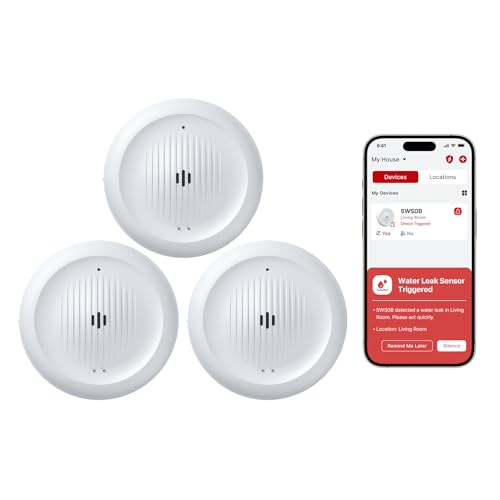
X-Sense Water Leak Sensor Alarm — Best for Blanket Coverage
The coverage pick: alarm-forward pucks, often in sets and in base-station configurations that relay alarms within the home, priced so that covering every sink and toilet stops being a financial decision. Best for: occupied homes wanting maximum spots per purchase, and as the coverage layer under a connected backbone. Not suited for: as the only protection for homes that stand empty. Tier: entry — the value is in the count.
First Setup and Care Essentials
Setup day decides the next five years, and it is short: place each sensor at its spot’s low point (cable along the risk line), name it by location in the app, wet-test every probe and watch the full alert path fire — siren, push, hub announcement — from the rooms where your household actually lives. For hub systems, site the hub centrally and elevated; for Wi-Fi, reboot the router once and confirm every sensor reconnects. Then do the two things that separate protected homes from equipped ones: walk every adult to the main shutoff valve and have them turn it once, and put the test rhythm in a calendar tied to an existing habit. Care thereafter is minutes per season — a wet test, a glance at battery status, probes wiped clean of dust and detergent residue — plus a reconnection check after any network change and a placement re-audit whenever an appliance is replaced. The full ownership balance is laid out in smart water leak detector pros and cons, and the step-by-step decision walk is in how to choose a smart water leak detector.
Mistakes to Avoid
Five mistakes account for nearly every bad outcome in this category. Buying the alert channel your lifestyle cannot hear — sirens for an empty house, a single phone push for a household that silences phones at night. Placing for tidiness instead of water flow, beside the appliance rather than at its low point or in its pan. Buying an ecosystem sensor without its base system. Covering the two famous spots and stopping, leaving sinks, toilets and the refrigerator line — the slow-drip majority — unwatched. And installing without testing, then never testing again, so the first real leak doubles as the system’s first real trial. A sixth mistake belongs to the research phase: comparing models by features while ignoring architecture. Two sensors with identical feature lists and different alert architectures are different products in every way that matters at 3 a.m. Round out your wider protective layer with the neighbouring guides — smart door locks, door and window alarms and Wi-Fi smart plugs, the last of which some owners use to cut power to a leaking appliance remotely — and close the value question with is a smart water leak detector worth it.
The Physics Underneath: How Detection Actually Works
It helps to understand the small physics of what you are buying, because placement mistakes are usually physics mistakes. A point sensor’s probes are electrodes waiting for a conductive bridge; ordinary tap water conducts well enough, so even a thin film across the contacts triggers the alert. That sensitivity is a gift and a trap: a gift because slow seeps announce themselves early, a trap because condensation on a cold line in humid weather can occasionally bridge probes and cry wolf — the fix is a small placement adjustment, not a different product. Water’s other habit is obedience to slope: it runs along the lowest path, follows seams and wall plates, and pools at low points that are not always where intuition puts them. The single most effective placement technique in this guide costs nothing: pour a cup of water where a leak would start and watch where it goes, then put the sensor there. Cable sensors sidestep some of this by watching a whole line, which is why they forgive imperfect slope knowledge. Finally, remember what detection is not: a sensor cannot smell moisture inside a wall, hear a pinhole spray behind an appliance, or watch a spot it is not touching. Coverage thinking — multiple cheap certainties over one expensive hope — is the engineering principle of the whole category. A related trap deserves naming, because it catches tidy-minded buyers: the sensor placed on a raised lip, a mat or a scrap of cardboard “to keep it clean” may sit above the first millimetres of a leak indefinitely. Sensors belong on the bare, low surface where water itself will arrive — dust and all.
Smart Home Integration: What It Adds and What It Does Not
Because these devices carry the word “smart,” buyers reasonably ask what the smart layer contributes beyond the alert. In practice it contributes four things of unequal value. Remote alerting is the giant: the difference between a leak known about at noon and a leak discovered at six. Alert history and check-in monitoring are the quiet second: a system that reports each sensor’s health lets you notice a silent device before a leak does. Freeze warnings, on equipped models, are the third, and in cold climates may outrank everything else. The fourth — routines and integrations, sirens that also flash lights, announcements through speakers, a smart plug cutting power to a suspect appliance — is genuinely useful in designed setups and entirely optional in practice. What the smart layer does not contribute is judgement: no integration decides whether the alert matters, finds the shutoff, or dries the floor. Buy integration for the alert path and the health monitoring; treat routines as a bonus your future self may enjoy configuring on a quiet weekend, not as a reason to choose one architecture over another.
Thinking About Budget in Tiers, Not Prices
Prices move too fast for a guide to print them honestly, so think in the tiers the category actually sells. The entry tier buys local certainty: alarm pucks in sets, covering many spots for households that are home to hear them. The mid tier buys reach: a hub system or a small set of Wi-Fi sensors, alerts that travel to phones, batteries that last, and the beginnings of a system rather than a scattering. The premium decisions in this category are seldom a luxury puck; they are coverage decisions — a cable unit for the one long risk line that matters, freeze sensing across vulnerable plumbing, or the step beyond sensing altogether to a plumber-fitted automatic shutoff valve for a home that stands empty. Allocate in that order: alert path first, catastrophic spots second, blanket coverage third, refinements last. A budget spent in that order protects; the same budget spent in reverse order decorates. And hold a small reserve for the second purchase the first one will teach you to want — the extra two sensors for the spots your walk-through missed, bought within the same architecture so the system stays one app and one habit.
Three Worked Examples: Specifying Real Homes
The three-bed house with a finished basement. Risk map: heater and laundry in the basement, kitchen above, two bathrooms. Specification: a hub backbone — one sensor in the heater pan, one behind the washer — chosen because basement Wi-Fi is unreliable and the finished space below-grade is the most expensive floor in the house to flood. Alarm pucks under the kitchen sink, beside the dishwasher and behind both toilets as the coverage layer, with a freeze-capable sensor near the basement’s exterior-wall plumbing. Response plan: alerts to both adults’ phones, shutoff valve labelled in the utility area, test day tied to the seasonal clock change. The small flat, always occupied. Risk map: one bathroom, a kitchen with a dishwasher, a washer in a closet. Specification: no hub, no ecosystem — a loud alarm puck under the sink with top-and-bottom probes for the trap drip, one behind the washer, one beside the dishwasher, and a Wi-Fi sensor added only if the occupants’ work pattern changes to long days away. The money not spent on architecture goes to covering every spot the small map has. The holiday home, empty for weeks. Risk map: everything, unattended, in a cold climate. Specification: connected sensors at the heater, laundry and every bathroom, freeze sensing at the vulnerable runs, alerts reaching the owner and a local contact — and the honest centrepiece, a plumber-installed automatic shutoff valve, because this is the home where an alert alone cannot close the distance. The sensors remain essential: they tell the valve’s story in locations, and they catch the slow drips a valve may never notice.
Reading a Listing Like an Engineer
Listings in this category are written to sell, but the facts you need are in them if you read with a checklist. Find the alert sentence first: does this exact configuration — not the brand, not the family — send phone alerts, or does it only sound locally, and is a gateway or hub required to unlock the connected behaviour? Find the power sentence: battery or mains, and if battery, how are you warned as it fades — app notice, chirp, or silence? Find the probe sentence: contacts underneath only, or top contacts too, or a cable, and how long is the cable or lead? Find the requirements sentence: base station, hub, specific app, specific Wi-Fi band — and treat any requirement you do not already own as part of the price in money and effort. Find the environment sentence: is the device meant for indoor use at the temperatures your basement or garage actually reaches? Every disappointment pattern in owner reviews maps to one of these five sentences having been skipped. Read them, and the marketing adjectives can say whatever they like; you will already know what you are buying.
When the Right Answer Is a Shutoff Valve
This guide sells sensors, and it would be dishonest not to mark clearly where sensors stop being the answer. Escalate to an automatic shutoff valve — a motorised valve on the main line, typically fitted by a plumber, that closes the water when a linked system detects a leak or abnormal flow — when any of these is true: the home stands empty for days or weeks at a time; the laundry or a bathroom sits above finished living space where minutes of full-pressure flow mean structural damage; the property is a rental where response depends on others; or a previous leak has already taught you the cost of a slow response. The valve is a different category with a different budget and a professional installation, and it pairs with sensors rather than replacing them — sensors give the valve local intelligence and catch the slow seeps beneath a flow system’s notice. If your situation matches the list, buy the sensors in this guide as the valve’s companions, and let is a smart water leak detector worth it help you weigh the total picture before committing.
Your Installation Day, Hour by Hour
Buyers who follow a sequence finish installation in one short session and trust the result. Hour zero is the walk: revisit every spot on your map, pour the cup of water at the ambiguous ones, and finalise placements before opening boxes. Next, the backbone: hub placed centrally and powered, or Wi-Fi confirmed at the worst spot with your phone as the scout. Then sensors, one at a time: place, name by location, wet-test, confirm the alert end-to-end, photograph the installation. Then the household layer: every adult finds and turns the main shutoff, alert recipients are confirmed on real phones, and the response steps — fixture valve first, main valve if unsure, towels and fans, then diagnosis — are said out loud once, together. Finally, the future layer: test rhythm entered in a calendar against an existing habit, spare batteries bought and stored where the sensors’ owner will find them, hose ages noted and any suspect hose scheduled for replacement, because the best leak is still the one that never starts. An hour, perhaps ninety minutes, and the system stops being a purchase and becomes a property of the house.
Draw Your Own Coverage Map Before You Spend Anything
The highest-value page in this guide is one you write yourself. Take fifteen minutes and sketch your home’s water: where it enters, where the shutoff lives, and every place it is heated, stored, pressurised or drained. Mark the heater, the washer, the dishwasher, every sink, every toilet, the refrigerator line, the softener or filter if you have one, the sump if you have one, and any pipe run through cold space. Now grade each mark with two letters: L for likelihood, drawn from the appliance’s age and connections, and C for consequence, drawn from what is beneath and around it — finished floor, ceiling of a room below, stored belongings, or bare concrete. The double-high marks are your backbone spots and deserve connected sensors. The high-likelihood, low-consequence marks are perfect for entry-tier pucks. The low-likelihood, high-consequence marks — the upstairs bathroom is the classic — deserve a connected sensor and a place in the shutoff-valve conversation. This little map, drawn once, converts the rest of the purchase from browsing into specification: you will know your count, your architectures and your priorities before a single product page tries to rearrange them for you.
Support, Longevity and the Five-Year View
A leak sensor is a five-to-ten-year resident of your home, so buy the maker’s staying power as well as the device. Connected products live inside apps and cloud services; the questions worth asking are whether the maker actively maintains its app, whether the product line is current or a leftover, and whether the system functions locally in any useful way if the internet drops. Alarm-only devices are nearly immortal by comparison — no service to retire — which is a genuine, if unglamorous, argument in their favour for the coverage layer. For hub systems, the hub is the longevity bet: one device whose health carries the whole map, worth placing somewhere powered, dry and undisturbed. None of this requires pessimism; it requires remembering that the sensor you install this year must still be testable, battery-compatible and alert-capable in the year it finally earns its keep, which — if the category does its job — is a year you cannot predict and will barely remember preparing for.
A Final Word Before You Buy
If this guide has done its work, you are no longer shopping for a gadget; you are specifying a small system with a map, an alert path, a power story and a household drill attached. That is the correct frame, and it is also the whole secret of the category: the homes that leak sensors protect are the homes where someone thought for an hour before buying and for five minutes each season afterwards. Keep the companion pieces close as you decide — the deep-dive smart water leak detector review for the category’s behaviour in real scenarios, and smart water leak detector pros and cons for the unvarnished balance sheet — then buy once, place carefully, test immediately, and go back to not thinking about water at all. That, in the end, is the product.
Buying Occasions: Renovations, Move-Ins and After the First Leak
When you buy shapes what you should buy. The move-in purchase is the happiest: the house is empty, every spot is reachable, hoses and valves can be inspected as you place sensors, and the coverage map can be completed in one pass — if you are moving, this guide’s full programme is cheapest and easiest right now, before furniture hides the evidence. The renovation purchase is the strategic one: floors open and appliances out are the moment to place sensors in the spots that will be unreachable for a decade, to run a cable along a soon-to-be-hidden line, and to have the plumber who is already on site quote the shutoff valve while access is free. The after-the-first-leak purchase is the emotional one, and it deserves a kind word and a firm one: the kind word is that nearly every well-protected home in the owner evidence started exactly here; the firm one is to resist buying in a panic the first architecture that ships fastest. A leak has just shown you your home’s real risk map — which appliance, which floor, how fast the damage moved, who responded. Buy for that map, with the alert path your household actually demonstrated, and the second leak — the one this purchase exists for — will meet a house that is ready for it.
Before You Buy: The Smart water leak detector Fit Audit Most Shoppers Skip
A buying guide earns its keep in the checks it makes you do before money changes hands, and this is the check most shoppers skip with a smart water leak detector: verifying the fit in your own home, on your own routine, rather than in a showroom or a listing photograph. Work through what follows with a tape measure, your phone and ten quiet minutes in the room where the smart water leak detector will live.
Judge a leak detector by its sensing method and its alarm path: a probe that reaches the exact low point where water collects, a sounder loud enough to be heard through a closed door, and alerts that reach your phone when you are away. Battery life and how the detector reports a dying battery decide whether it protects you in year three. Crawl the spaces you fear most, under sinks, behind the washing machine, beside the water heater, and find where water would actually pool first; that low point, not the convenient spot, is where the sensor belongs. Check the network signal in those utility corners, which are often the weakest in the house.
Under a kitchen sink crowded with pipework, a slim probe on a lead reaches the drip point a puck-style sensor cannot touch. Beside a water heater or in a basement, a detector whose alert reaches your phone while you travel turns a disaster into a manageable repair. Near an aquarium, sump or laundry tray, a detector paired with an automatic shutoff valve is the combination that truly limits damage. Use this as a pre-purchase audit: any model still standing after these checks has earned its place on your shortlist, and any model that fails one should be dropped without regret, however strong its other features look.
Apply all of this to the listings in front of you. When a listing such as the YoLink Water Leak Sensor, Govee Water Sensor and Ring Flood & Freeze Sensor catches your eye, resist judging it by its headline claim and instead run the checks above against it: does its stated role match the room you measured, does its control path suit your household, and does the maker’s own guidance support the job you have in mind. A model that answers those questions cleanly on paper usually answers them cleanly in the home, and one that dodges them in the listing will dodge them on your wall, shelf or desk as well.
Detectors only sense water that reaches them; a slow leak inside a wall or under a floor may run for a long time before any surface sensor knows. Condensation and mopping splash cause false alarms in bathrooms and utility rooms, and repeated false alarms teach households to ignore the real one. If a detector alarms with no visible water, check for condensation, a damp floor from mopping and a probe resting in a low damp spot. If alerts stop arriving, test the detector with a damp finger on the contacts and check its battery and network status in the app.
- Measure the space and note the constraint that most limits your choice for your smart water leak detector.
- Confirm the control path works for everyone in the household, not just the buyer for your smart water leak detector.
- Check what still works when the home network is down for your smart water leak detector.
- Read the maker’s guidance for your exact room and load type before ordering for your smart water leak detector.
- Plan where accessories, chargers or spares will live from day one for your smart water leak detector.
- Keep the return window in mind and schedule your own checks inside it.
If the sounder seems faint, move the unit out from behind appliances; sound blocked by a cabinet is sound wasted. Test each detector with a little water on its contacts every few months, replace batteries on the maker’s schedule rather than after a failure, wipe contacts clean of dust and corrosion, and re-walk your risk spots after any plumbing work.
Finish the audit by writing down the one requirement you will not compromise on and the one feature you are willing to drop. A shortlist built on that honesty is short, and choosing from it stops feeling like a gamble.
It also helps to think in seasons rather than in days. A smart water leak detector that seems ideal in the week it arrives may face different light, different temperatures, different routines and different demands a few months later, and the models that age well are the ones chosen with that longer view in mind.
Keep the household in the loop as you decide. The person who did not choose the smart water leak detector is usually the person who discovers its most annoying habit first, and a two-minute conversation before buying can surface the objection that saves a return.
Frequently Asked Questions
How many leak sensors does a typical home need?
Most homes land between five and eight: water heater, washing machine, under the kitchen sink, dishwasher, refrigerator line, and behind toilets and under sinks on finished floors, plus freeze-prone plumbing spots in cold climates. Count by walking your own plumbing, not by bundle size. Owners consistently report wishing they had covered more spots, not fewer, so when the count is borderline, round up.
Is a hub-based system worth it over Wi-Fi sensors?
For one or two spots in a small home with strong Wi-Fi, usually not — direct Wi-Fi sensors are simpler. For whole-home coverage, larger or multi-storey houses, weak basement signal or long battery life, the hub earns its place: owner experience favours hub radios for reach and battery longevity, and expansion becomes cheap. The deciding factors are your home’s size, your worst spot’s signal and your total spot count.
Can a leak detector replace an automatic shutoff valve?
No — they solve different halves of the problem. A detector informs; a shutoff valve intervenes. If your home stands empty for long stretches, has an upstairs laundry, or has already suffered one serious leak, budget for a plumber-installed shutoff valve and use sensors as its location-aware companions. For occupied homes with a rehearsed response, sensors alone are a rational, widely used level of protection.
Where does a sensing cable beat a point sensor?
Wherever the risk is a line rather than a spot: behind a washer-and-dryer run, along a boiler room floor, beneath a wall of cabinets, around a large water heater installation. A cable detects along its whole length, closing the gaps between pucks. For compact, predictable pooling — a heater pan, a sink cabinet’s low corner — a point sensor is simpler and equally effective.
Do I need freeze sensing on my leak detector?
If any plumbing runs through unheated spaces, exterior walls, crawl spaces or garages in a climate with real winters, yes — treat it as a primary criterion, not a bonus. A low-temperature warning can arrive hours before a pipe bursts, while there is still time to act. Place freeze-capable sensors at the cold spots themselves, which are not always the same as your highest leak-risk spots. While you are thinking about cold, insulate the pipes themselves as well: sensing tells you the danger is coming, insulation delays or prevents it, and the two together are the closest thing this category offers to a complete freeze strategy short of re-routing the plumbing.
What should I check on the listing before buying any model?
Four things: whether a hub or base station is required and whether it is included; which alert channels the exact configuration offers (siren only, app push, or both); the power source and how low-battery warnings are delivered; and the current app and support status for connected models. Requirements and configurations change between generations and bundles, and the current listing — not a review, including this one — is the final authority. Add a fifth check if the sensor will live somewhere cold or damp: confirm its intended operating environment matches the spot, because a device specified for comfortable indoor rooms may not love a crawl space in January, and the time to learn that is before it is guarding your pipes, not during the cold snap it was bought for.
Related Reading
Decide the architecture, count the spots, then let the picks fall where they may — the order matters far more than the brand ever will.
smart water leak detector review
smart water leak detector reviews