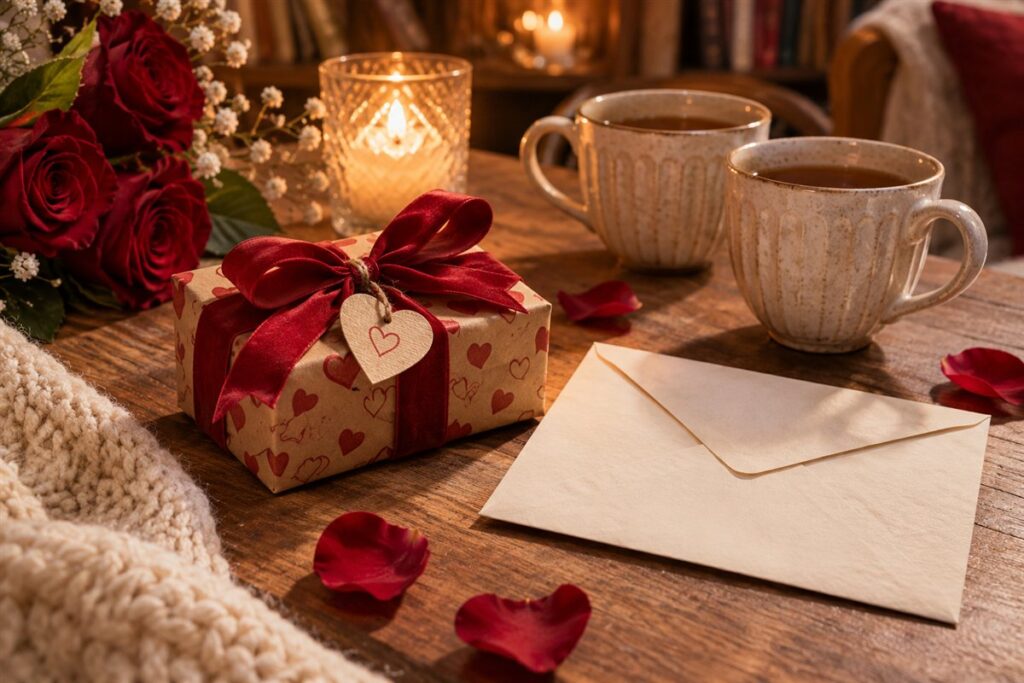
The most romantic gift is not a specific object; it is any gift that passes four tests: it shows attention, carries emotion, creates atmosphere and is given with presence. A handwritten letter in a candlelit room can beat a lavish present delivered in a hurry. Use the tests below to judge any idea.
Test 1: Does It Show Attention?
Romance grows from being noticed. A gift is romantic when it proves that you listened, for example by referring to something said weeks ago.
- Mention a small detail, like the way they take their tea.
- Choose a gift linked to a place they love.
- Use their words in your card.
In this guide
Test 2: Does It Carry Emotion?
A romantic gift says something about how you feel. Words are the clearest way to do this.
- Write what you feel in plain language.
- Pick one story that shows it.
- Read it aloud or hand it over in private.
Test 3: Does It Create Atmosphere?
Setting turns a gift into a moment. Soft light, quiet music and uninterrupted time lift even a simple gesture. A framed photograph placed beside a candle, or an album opened to a favorite page, transforms a table into a small scene.
Test 4: Is It Given With Presence?
Give the gift when you can be fully there. Put phones away, make eye contact and let your partner respond without rushing. A gift handed over while distracted loses much of its power.
Romantic Ideas That Pass the Tests
| Idea | Attention | Emotion | Atmosphere |
|---|---|---|---|
| Handwritten letter read aloud | Specific memories | Direct | Quiet evening |
| Recreated first date | Shared detail | Nostalgic | Familiar place |
| Photo album with captions | Chosen moments | Warm | Shared browsing |
| Sunset walk with a printed photo | Favorite spot | Peaceful | Natural light |
Setting the Scene Step by Step
- Choose a quiet space where you will not be interrupted.
- Soften the lighting with lamps or candles, taking care with open flames.
- Put on music your partner enjoys at a low volume.
- Place the gift within reach but out of sight until the right moment.
- Pause before handing it over and say a sentence about why you chose it.
Romance often lives in these small pauses. When you slow down, your partner can feel the care behind each choice, and the gift becomes only one part of a warm memory.
Learning What Your Partner Values
A gift lands well when it fits the person, so the first job is to understand what they value. People tend to feel appreciated in different ways. Some respond most to words, others to time together, others to thoughtful objects, helpful actions or physical closeness. If you are unsure which applies to your partner, think about how they react to different gestures. Do they keep notes you wrote? Do they light up when you plan a day out? Do they notice small practical favors?
Listen over the weeks before the day. Keep a private note on your phone and jot down things they mention: a place they want to visit, a song they love, a memory they smile at. These details are the raw material for a personal gift, and having them written down means you are not scrambling for ideas the night before.
You can also ask friends or family for a nudge, as long as you keep it discreet. Avoid copying what other couples do. What looks romantic on a social feed may feel hollow if it does not match your partner’s character.
Finally, be honest about your own strengths. A gift that suits your abilities will feel more natural, and that ease is part of what makes it feel sincere.
Planning the Evening as a Timeline
A good moment is rarely accidental. A simple timeline helps you avoid the common problems of rushing, forgetting something or running out of time. Start by deciding the shape of the evening: where you will be, how long it will last, and what the key moment is. The gift may be one beat in a longer experience.
Work backward from the key moment. If you plan to read a letter at a quiet dinner, think about when you will cook or collect food, when you will set the table, and when you will get ready. Leave a buffer of time for delays, because things always take longer than expected.
If you are going out, book ahead. Popular venues fill quickly around this date, so reserve early, check cancellation rules and confirm the booking a day before. Consider transport, weather and what you will do if plans change.
Prepare a fallback. If rain ruins a walk, can you move the same idea indoors? A flexible plan lets you stay calm, and calm is a gift in itself. Keep the schedule loose enough that there is room to enjoy being together.
Choose a day for the dinner or walk that suits both schedules, rather than forcing the event onto a night when either of you will be tired.
Writing Words That Sound Like You
For many people, the hardest part of a romantic gift is writing. The trick is to stop trying to sound poetic and start trying to sound like yourself. A plain sentence with a true detail beats a grand phrase that could be on any card.
A simple structure can help. Begin with a specific memory, such as a moment when you realized how much they matter. Add one thing you admire about them. Finish with a hope for the future, even a small one, like looking forward to a trip or an ordinary Sunday.
Write a rough draft first, then read it aloud. If a line feels awkward in your mouth, change it. Cut anything that sounds borrowed. Keep it short enough that you can say it without losing your nerve, but long enough to include a real detail.
Use good paper and legible handwriting if you can, but do not worry about perfection. A crossed-out word shows effort. If handwriting is hard for you, a typed note, a voice message or a short recorded video can carry the same warmth. What matters is that the words are yours.
If a letter feels too exposed, try a shorter format first, such as a few lines tucked inside a book they are reading, which keeps the same honesty with less pressure.
Thoughtful Choices When You Do Buy Something
A purchased item can pass the four tests, provided it is chosen with care. Start from your notes about what they like, not from a list of popular gifts. Ask whether the item connects to a shared memory, supports something they enjoy, or solves a small problem they have mentioned.
Check practical matters before buying. Consider size, allergies, preferences and what they already own. If the gift is something to wear or use, confirm that you are choosing the right type, and look at the seller’s return or exchange policy so a mistake is easy to fix. For flowers, plants or food, think about how long they last and whether your partner will enjoy them or feel obliged to care for them.
Presentation matters too. Wrap the item simply, or put it with a handwritten note that explains why you chose it. The explanation turns an object into a message.
Be wary of gifts that signal a wish to change the other person, or that reflect your tastes more than theirs. Also avoid anything that feels like a test. The aim is for them to feel known and cared for, not judged.
Consider small touches that show listening, such as the right size, their favorite flavor or an item from a place you once visited together.
After the Day: Keeping the Feeling Going
Valentine’s Day is one date, but the feelings you express are meant to last. The day after, check in. Ask what they enjoyed, and listen without defending your choices. If something did not land, treat it as information for next time and not as a failure.
Keep a memento of the day. A ticket, a photo or the note itself can be stored in a small box. Some couples write a short line each year in the same notebook, creating a record that grows more meaningful over time.
Carry one idea from the evening into ordinary life. If a quiet, phone-free hour was special, schedule another one next month. If the letter was moving, send a short note on a random weekday. Small repeated gestures often matter more than a single large one.
If your partner was not able to celebrate in the same way, perhaps because of work, health or distance, adapt. A video call, a mailed letter or a delayed celebration can still be meaningful. The goal is connection, and connection does not depend on a date on the calendar.
Finally, remember that quiet days count too, so a calm ordinary dinner a week later can carry the same warmth without needing a special occasion to justify it.
Why Romance Is Personal, Not Universal
People often search for the single most romantic present as though there were a universal answer, but romance depends on the person receiving it. For one partner, a handwritten letter read aloud by candlelight is unforgettable. For another, a day spent hiking a favorite trail together feels far more intimate than any wrapped box. The most romantic gift is the one that tells your partner, clearly and kindly, that you know them well. Treat generic lists as a source of sparks for your own ideas rather than as a menu to order from.
Begin with a quiet look back over the last few months. What made your partner light up? What did they mention wanting to try, see or revisit? Those small details are the raw material of a romantic gesture.
Gestures Built Around a Shared Memory
Memory-based gestures work because they carry a story only the two of you share. Recreate the place of your first date, with the same drink or dish, and add a small twist such as a note tucked into the menu. Frame a ticket stub, a map of a trip or a photograph that captures a happy moment. Collect a few small objects from your time together and present them in a simple box with a handwritten label for each. The effort lies in remembering, not in spending.
- Return to a place that matters to you both.
- Gather three or four small keepsakes with a story.
- Write the date and a short line on each one.
Gifts of Time and Attention
In busy lives, undivided attention is a rare gift. Plan a phone-free evening, cook a meal together with music, or give a coupon-style promise for a long morning in bed with breakfast. Offer to take over a chore that your partner dislikes for a month. These gestures say that you value their comfort and happiness. Make the offer concrete and follow through, because a promise kept is more romantic than a lavish present quickly forgotten.
Choosing Between a Surprise and a Shared Plan
Some people adore surprises, while others feel anxious when they do not know what is coming. If you are unsure, offer a gentle hint such as asking them to keep an evening free and wear comfortable shoes. If your partner loves planning, invite them to co-create the day, perhaps by each choosing one activity. Either way, a little consideration of their temperament keeps the experience warm instead of stressful.
| Partner style | Approach | Example |
|---|---|---|
| Loves surprises | Plan a hidden itinerary | A mystery walk with notes at each stop |
| Prefers knowing | Share the plan, keep details secret | Tell them the evening, not the dish |
| Introverted | Keep it private | A candlelit meal at home |
| Adventurous | Try something new together | A first lesson in a new activity |
Small Rituals That Turn the Day Into a Story
Rituals give an evening shape. Light a candle when you sit down, play the song that was playing when you met, or raise a toast with a short sentence of thanks. Take a moment to say one thing you appreciate about your partner and invite them to do the same. Rituals take seconds and cost almost nothing, yet they turn an ordinary meal into something you will both recall for years.
Handling Practical Details Gracefully
Romance falls apart when logistics fail. Book tables early, confirm times, charge your phone, and check transport. Prepare a plan B for weather. Tidy the space if you are hosting, and handle small chores in advance so that the evening flows. Dress comfortably yet thoughtfully, and be present rather than checking messages. Careful preparation creates the calm in which tenderness can show.
- Confirm bookings a day before.
- Prepare a simple backup plan.
- Arrange small details such as music and lighting.
- Leave your phone out of reach.
When You Do Choose to Buy Something
If you want a physical gift, choose items that connect to the person, such as a book from a favorite author, a piece of art by a local maker, or an item for a hobby they love. Quality and thought matter more than size. Include a note explaining your choice. Avoid items that create obligations, such as a gadget that requires a lengthy setup, unless you know it is welcome.
Keeping the Warmth Beyond One Evening
The day itself is only a moment. Carry the feeling forward with small acts in the following weeks: a message in the middle of the day, a surprise coffee, an unplanned walk together. Romance thrives on regular attention rather than annual spectacle. If the day does not go perfectly, laugh about it and move on. What your partner will remember is that you tried, with care and sincerity.
Romance for Different Seasons of a Relationship
What feels romantic changes as a relationship matures. Early on, playful and low-pressure gestures feel exciting, because they build closeness without weight. After several years, partners often value feeling known: a gesture that shows you remember a small detail, like the way they take their coffee or a song they loved at nineteen. In long marriages, recreating the early days or finally doing something postponed for years can feel deeply moving. Match the scale and tone of your gesture to where you are together, and avoid copying what you see online without thinking about whether it fits you.
Writing a Letter That Lands
A letter can be the heart of a romantic gesture. Begin with a specific memory, because details make feelings believable. Describe what you admire about your partner in plain words, mention how they have changed your life, and end with a hope for the future. Write by hand if your handwriting is readable, take your time and read it aloud once before sealing it. Do not worry about eloquence. Sincerity matters more than polish, and a few honest lines can move someone more than pages of borrowed phrases.
- Choose a quiet time to write without interruptions.
- Recall three specific moments you treasure.
- Say what each one taught you about your partner.
- Close with a simple promise or hope.
Creating Atmosphere at Home
Home can be wonderfully romantic with a bit of effort. Dim the overhead lights and use candles or warm lamps, taking care with flames and following normal fire safety. Set the table with your best plates, put on music you both love, and prepare a meal that is special without being stressful. Tidy the room before your partner arrives so that the atmosphere is calm. Silence phones for the evening. A cozy setting lets conversation flow and brings back the feeling of dates early in the relationship.
Gifts That Support a Shared Hobby
If your partner enjoys cooking, hiking, music or reading, a gesture connected to that interest shows you pay attention. Plan a cooking evening based on a recipe they have wanted to try, pack a picnic for a favorite trail, or find a quiet corner of a bookshop and choose a book for each other. Presenting something that deepens an existing passion is thoughtful, and it gives you both a shared experience to enjoy.
| Shared interest | Romantic idea |
|---|---|
| Cooking | Prepare a multi-course meal together |
| Outdoors | Sunrise or sunset walk with a thermos |
| Music | Create a playlist of your story |
| Reading | Read a chapter aloud to each other |
Mistakes That Drain the Romance
Certain choices undermine the mood. Choosing something that suits your taste rather than theirs sends the wrong message. Leaving everything until the last minute makes the gesture look careless. Posting about it online before your partner has enjoyed the moment can feel like performing. Expecting a certain reaction creates pressure. Aim for sincerity, prepare in good time and let your partner respond in their own way.
When Distance Gets in the Way
Couples living far apart can still share an evening. Schedule a video call with a shared meal, watch the same film at the same time, or exchange handwritten letters that arrive on the day. Send a small parcel with items connected to your memories. Plan the next meeting in advance so that the day feels like a stepping stone toward being together.
Why the Most Romantic Gift Is Usually a Proof, Not a Purchase
Ask people to describe the most romantic gift they ever received and a pattern emerges: the object is rarely the point. What they describe is proof, proof that they were known, remembered and thought about when no one was watching. A first edition matters because someone remembered a sentence spoken years earlier. A plain meal matters because it recreated the evening of a first meeting. Even grand gestures derive their power from specificity; a trip is romantic because it is to the place she mentioned once, not because it is far away. This is encouraging news for everyone, because proof is available at every budget and in every circumstance, including distance, illness and exhaustion.
It also explains why copying another couple’s celebrated gesture so often falls flat. The gesture’s romance lived in its fit to that particular person’s history, and transplanted to your partner it becomes theatre without meaning. Borrow structures freely, the letter, the recreation of an early date, the day built around a favourite thing, but fill them with your own shared material. The structure carries the romance only when the content could belong to no one else.
Recreating an Early Memory, Carefully
Recreation is one of the strongest romantic forms because it says that your shared history is treasure worth revisiting. Done well, it honours the original without pretending time has stood still. Recook the first meal, but cook it better than you could then. Return to the first walk, and notice together what has changed in the place and in you. Play the music of the year you met while you do something ordinary, and let the contrast between then and now do the emotional work. The point is not nostalgia for its own sake; it is the demonstration that the beginning still matters to you now.
Choose memories your partner also loves, which sounds obvious and is often missed. A moment that was magical for you may have been ordinary, or even stressful, for them. If you are unsure, drop a gentle question weeks ahead about favourite early memories and listen to the answer; the recreation then arrives as a surprise built on confirmed ground, which is the best kind.
Romance for Partners Who Are Practical, Shy or Sceptical
Not everyone receives grand romance comfortably. Practical partners feel loved when life gets easier; shy partners feel loved in private and slightly panicked in public; sceptical partners distrust anything that smells of a script. For all three, the most romantic gift is romance translated into their own dialect: the problem quietly solved, the evening for two with no audience, the gesture so specific to them that no script could have produced it. A partner who fixes the thing that has annoyed her for months, and says simply that he wanted her mornings easier, has often out-romanced the dozen-rose traditionalist.
The lesson generalises: romance is not a genre of object but a quality of attention. Once you know how your partner actually experiences being loved, the tests in this guide become easy to apply, because every candidate gift can be asked the same question: will this land in the way she or he can receive it?
Keeping Romance Alive in Ordinary Weeks
Valentine’s Day concentrates romance into one date, but the couples who seem most romantic in February are usually practising small versions all year. The habits are unglamorous: remembering the small thing mentioned in passing, bringing home the favourite snack without a reason, sending the photograph you took because it reminded you of them, defending one evening a week against the calendar. A grand Valentine’s gesture from a partner who is absent all year reads as compensation; a modest one from a partner who is attentive all year reads as a summary.
If your ordinary weeks need work, let this year’s gift be the start of a habit rather than a peak to apologise for the rest. One small ritual, repeated, such as a Sunday walk or a note on the first of each month, will do more for how romantic your partner finds you than any single February production, and next year’s gift will be easier because the material of attention will already be accumulating.
More Questions Worth Asking
Can a gift be romantic if it is also useful?
Absolutely, when the usefulness is personal. A useful gift chosen from close observation, the exact tool for her project, the thing that fixes his daily annoyance, carries the message that you study his or her real life. Romance and usefulness only conflict when the useful item is generic, chosen for anyone, with no story attached.
How do I be romantic when we are going through a hard patch?
Scale down and be sincere. Hard patches are not improved by theatrical spending, which can feel like avoidance. A honest letter that names the difficulty, appreciates what is still good, and promises something specific and small is often the most romantic available act, because it chooses the relationship with open eyes rather than decorating over it.
What if my partner finds Valentine’s Day itself unromantic?
Move the romance, keep the meaning. Some people dislike the day’s commercial pressure but love being celebrated on a date that is privately theirs: the anniversary of meeting, the first day of spring, an ordinary Tuesday declared your own. A partner who listens to that preference and acts on it has already passed the most important romantic test, which is hearing the person rather than the calendar.
Is writing my own words really better than a bought card’s verse?
For romance, yes, almost always. Bought verse is written to fit everyone and therefore fits no one. Three plain sentences about your actual partner, a memory, a quality, a hope, will move them more than polished generalities, because only you could have written them. If starting is hard, begin with the words I keep thinking about, and let the sentence finish itself.
The Role of Timing and Anticipation
Romance benefits from anticipation the way a meal benefits from an appetite. A small hint given days ahead, keep Friday evening free, or a note that says something is planned, lets your partner enjoy the gift twice: once in imagination and once in fact. Anticipation also flatters, because it proves the day was thought about before it arrived. The hint should promise tone rather than content; revealing everything removes the pleasure, while total secrecy suits only partners who genuinely love surprises.
Timing inside the day matters too. A gift given in a rush between obligations loses half its effect, while the same gift given in a protected half hour, with phones down and nowhere to be, lands fully. If your day has no protected half hour, creating one is itself a romantic act, and often the one your partner would choose if asked.
What to Do When the Romantic Plan Goes Wrong
Restaurants close, deliveries fail, weather ruins walks. The romantic response to a collapsing plan is not frantic repair but graceful improvisation, because your partner is watching how you treat the day more than how the day treats you. Laugh, state the new simple plan, and protect the two essentials: unhurried time together and the words you meant to say. Couples remember botched grand plans fondly for decades when the improvisation was warm, and the story of the ruined evening often becomes more romantic in retelling than the flawless version would have been.
Romantic Words for People Who Freeze When Writing
The blank card defeats more romantic intentions than any budget. If writing freezes you, borrow structure rather than phrases. The first movement is a memory: last spring, when you, and one concrete detail. The second is appreciation aimed at a quality in action, not a compliment about appearance: I rely on the way you, followed by an example. The third is a wish or promise with a date or a plan inside it, because vague forever-promises evaporate while a named intention glows. Three movements, three or four sentences each, and the card is written, in words that could belong to no other couple.
Write it the day before, in pencil if ink feels too final, and read it aloud once to hear whether it sounds like you. Cross out anything that sounds like an advertisement. Leave one imperfect, genuine sentence exactly as it came; partners treasure the sentence that clearly cost effort more than the polished ones. If handwriting is truly impossible, a printed note you wrote yourself still counts fully, because the romance is in the authorship, not the penmanship.
The Most Romantic Gift at Each Length of Relationship
In the first year, romance is discovery, and the most romantic gift shows you have been paying close attention to a person you are still learning: the book by the author they mentioned once, the plan that repeats your best early date with one upgrade. Between two and five years, romance is recognition of the life being built: the gift that honours their effort, supports their project, or recreates the moment the relationship turned serious. In long relationships, romance is continuity with renewal: the tradition kept and varied, the letter that proves you still study this person after all these years, the plan that says the future still interests you.
Notice what does not change across the stages: attention is the currency at every length. Notice also what must change: the content. A tenth-year gift copied from the first year says you stopped looking, while a first-year gift delivered in year ten, rediscovered and remade with everything you now know, can be the most romantic move available to anyone.
Testing Your Idea Against the Four Tests, Honestly
Before committing, run your leading idea through this guide’s four tests and score it in writing. Attention: could this gift be given, unchanged, to someone else? If yes, sharpen it until it could not. Emotion: what exactly will they feel in the first ten seconds, and can you name it? Atmosphere: where and when will it be given, and does that setting help or merely happen? Presence: will you be rushed, distracted or watching a clock at the moment of giving? A gift that passes three tests strongly will succeed; a gift passing all four usually becomes a story the couple tells for years, which is the real definition of the most romantic gift anyone can give.
Small Daily Evidence: The Foundation Under Every Grand Gesture
Romantic gifts succeed or fail partly on evidence gathered outside the day itself. A partner who is listened to in October believes the letter in February; a partner whose small remarks vanish all year hears even a beautiful letter as a performance. If you want next year’s gift to land as the most romantic yet, the work begins in ordinary weeks: put the phone down when they are telling you something, remember the detail and act on one of them occasionally without being asked. These are not techniques layered over a relationship; they are the relationship, and the gift is simply its most concentrated expression.
This is also why the most romantic gift is so hard to fake or to buy at the last minute in a panic. What is being given, underneath the object, is proof of a year of attention, and proof cannot be manufactured in an afternoon. The encouraging side is that attention is free, renewable and available in every circumstance, including the busiest and poorest seasons of a shared life.
Romance After Many Years: What Changes and What Does Not
Long-married couples sometimes fear that romance has an expiry date, as if it belonged to the young. What the evidence of happy long relationships actually shows is a change of register: less theatre, more depth. The most romantic gift at year twenty is often the one that says I still see you, not the household manager, not the co-parent, not the colleague in the business of the family, but you, the person I chose, whose particular pleasures and weariness I still study. A gift aimed at the person inside the roles, an experience from before the roles existed, a letter addressed to who she was at the start and who she is now, can land with a force that younger romance rarely matches.
Keep one early ritual alive if you possibly can, however small, because continuity gives long romance its unique power: the ability to feel all the years at once. And add one new thing each year, however modest, because renewal is the other half of the story, the proof that the relationship is still going somewhere rather than only commemorating where it has been.
The Romantic Power of Being Reliable
Reliability rarely appears in lists of romantic qualities, yet it underwrites all of them. The partner who said they would handle something and did, who arrives when promised, who remembers the appointment and the anniversary and the small preference, builds the trust inside which romantic gestures can actually be received. A grand surprise from an unreliable partner creates a complicated feeling, pleasure crossed with the knowledge that ordinary life cannot count on the same person. A modest gift from a thoroughly reliable one glows, because it is continuous with everything else the receiver knows.
If you suspect your romantic life needs work, audit reliability before shopping. Choose one ordinary promise and keep it perfectly for a month. The change in how your gestures land will teach you more about romance than any purchase, and it will make this year’s gift, whatever it is, pass the presence test of this guide almost automatically.
When Distance, Duty or Illness Shrinks the Day
Some years the most romantic gift must survive severe constraints: a deployment, a hospital stay, a newborn, a house move on the same weekend. The principles hold at miniature scale. Attention: one detail that proves you thought about their actual situation. Emotion: words that name what this season is like for them. Atmosphere: whatever small pocket of calm can be defended. Presence: full attention for whatever minutes exist, with the phone in another room. Couples who protect these four things at miniature scale often remember such years with surprising tenderness, because the gift proved it did not depend on circumstances being kind.
How Music, Scent and Place Do the Atmosphere’s Work
Atmosphere, the third test in this guide, is built from senses that cost little and register deeply. Music chosen from your shared history rather than from a generic romantic playlist tells the story of the evening before a word is spoken. Scent, a favourite meal cooking, flowers she actually likes, the soap or candle associated with a place you both love, reaches memory faster than sight does. Place matters most of all: the room where you first lived together, the bench from an early walk, even a corner of your present home arranged deliberately with a cloth, candles and the good glasses. A partner who walks into a space that has been prepared recognises the intention instantly, and intention, once again, is the substance being given.
Prepare the atmosphere early enough to be calm inside it yourself. A host who is still frantically arranging when the moment arrives gives their partner a performance of stress rather than an experience of care. Everything in this section can be ready an hour ahead, and the hour of calm that follows is part of the gift to both of you.
The Morning After: Carrying the Feeling Into the Year
What a couple does with a romantic day afterwards decides how long it lasts. Talk about it once, specifically: what landed, what you each remember most. Save the physical traces, the card, a photograph, a note of the menu or the route, in the place where your shared records live. And convert one element into a small recurring habit, the walk repeated monthly, the letter answered, the dish entering the household’s repertoire. A Valentine’s Day that seeds a habit keeps giving in instalments all year, and the next one begins from warmth rather than from a blank page and a deadline.
What Children Learn From Watching Romance Done Well
In households with children, Valentine’s Day is also a lesson being taught without a classroom. Children watch whether their parents notice each other, whether words are written and kept, whether a day can be made special with attention rather than only with money. A modest, thoughtful celebration in front of children is therefore doubly valuable: it gives the couple their moment, often in the margins of family life, and it gives the children a working model of how affection is maintained between adults, which they will carry, mostly unconsciously, into their own relationships. You do not need to perform for them or explain the lesson; children absorb the texture of what they repeatedly see, and a household where parents are visibly kind, attentive and occasionally romantic on purpose is teaching the curriculum simply by living it.
Include children where inclusion is natural, the shared breakfast, the card they help to make, the walk the whole household takes, and keep a small part of the day for the couple alone. Both halves matter: the witnessed affection and the evidence that the couple’s bond has its own protected place in the family’s life.
Can a routine gift become romantic if it is repeated?
Yes, repetition with variation is one of romance’s oldest engines. The same walk taken every year acquires the weight of all its previous versions; the same dish cooked each February becomes a sentence in a language only two people speak. The condition is that each repetition must contain one fresh element, a new route segment, a new ingredient, a new thing said, so the ritual stays alive rather than embalmed. Couples who master this balance stop needing novelty from shops, because their own history manufactures it.
Is a shared hobby gift romantic or just practical?
It is romantic when the hobby is genuinely shared or genuinely admired, because the gift then says I want more of the life we have together, in object form. Choose the version of it that creates time together rather than equipment apart: the two places on the course, the route you will walk with the new map, the ingredients for the dish you will learn side by side. A hobby gift that schedules the giver into the picture passes this guide’s presence test by design.
What is the most romantic thing to do the day before?
Prepare, visibly or invisibly, so that the day itself can be slow. Lay out what the morning needs, write the card while you are rested, confirm the one arrangement that matters, and then stop, because a partner who arrives at Valentine’s Day calm and present has already given something most productions forget to include. Anticipation handled this way also gives you a quiet evening to notice that you are looking forward to it, which is a romantic feeling in its own right.
FAQ
Do romantic gifts have to be expensive?
No. Attention and atmosphere count for more than cost.
What if I am not good with words?
Keep it short. Three honest sentences can be more moving than a polished speech.
How far ahead should I start planning?
A few weeks gives you time to notice details, book venues and prepare any handmade items. Reservations at popular places are best made early.
What if my partner dislikes big gestures?
Choose something small and private, such as a note or a quiet evening at home. The four tests still apply at any scale.
Can a long-distance couple use these ideas?
Yes. A mailed letter, a shared video call with candles at both ends, or a gift timed to arrive on the day can all show attention and emotion.
What if the plan goes wrong on the day?
Stay calm and adapt. A fallback idea, such as moving a walk indoors, keeps the evening warm, and your attitude matters more than the plan.
Is it better to give a surprise or ask what they want?
It depends on your partner. Surprises can delight, but asking about general preferences avoids mismatches. A mix of the two often works well.
Should I take photos of the evening?
A few photos are a nice keepsake, but avoid making the phone the center of the evening. Put it away for the key moment.
How can I make a simple gift feel special?
Add a specific detail, such as a remembered phrase or place, and present it with your full attention. Specificity makes a small gift feel personal.
The Short Version
A romantic gift shows attention, carries emotion, creates atmosphere and is given with presence. A letter, a photo album or a recreated first date can meet all four. Choose what suits your partner.
Related Guides
- Romantic Valentine's Day Gift Ideas for Your Girlfriend, Her Way
- Unexpected Valentine's Day Gift Ideas for Your Girlfriend
- Valentine's Day Gift for Your Husband: Useful Yet Sentimental
- Valentine's Day Gift Ideas Your Partner Is Sure to Adore
- Great Valentine's Day Gift Ideas by Category: A Simple Overview
