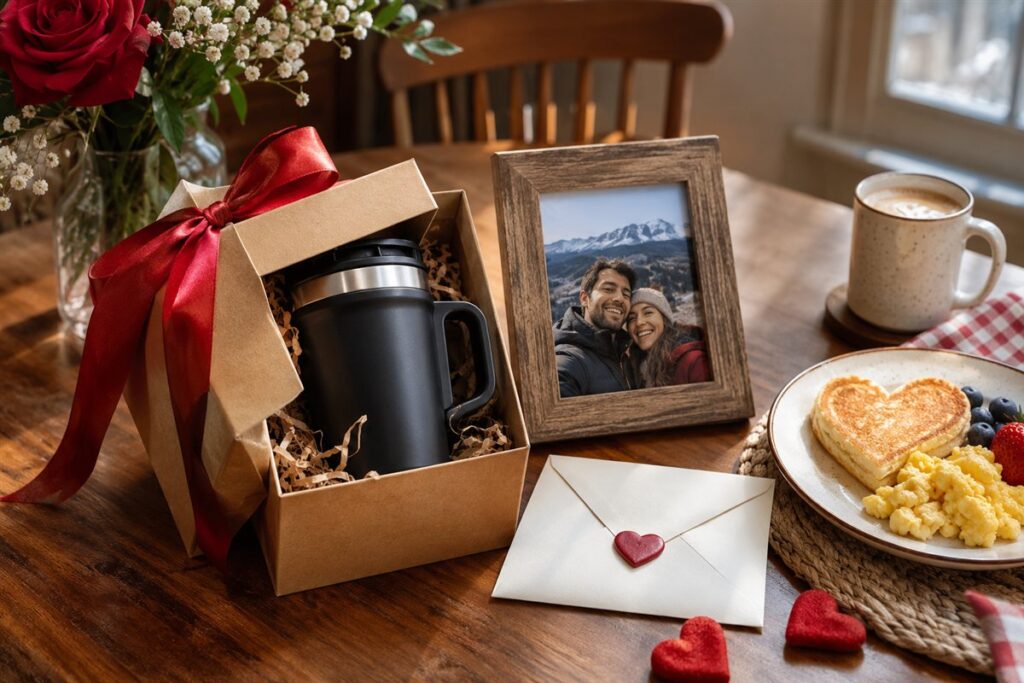
The strongest Valentine’s Day gift for a husband combines something he can use with something that reminds him of you. After years together, a practical gift alone can feel routine, and a purely sentimental one may sit in a drawer. Pairing the two covers both.
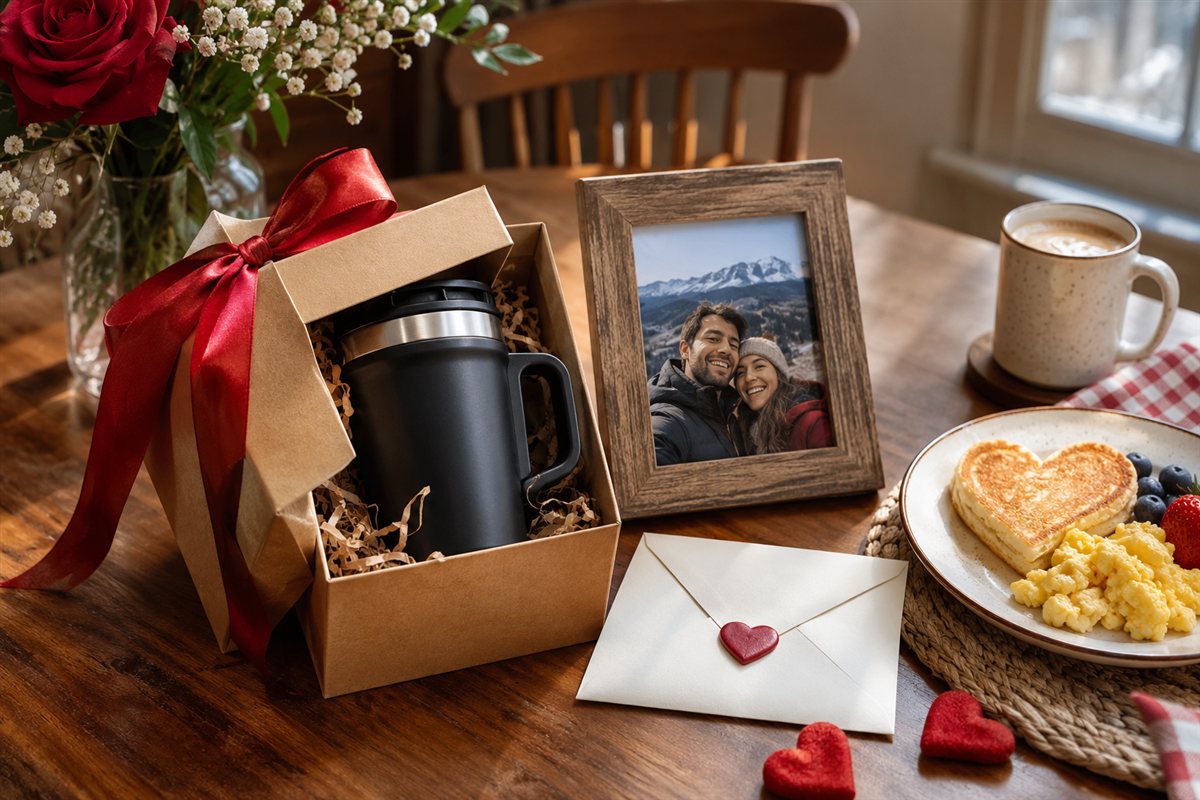
Why Pair Useful With Sentimental
A husband often values reliability and routine. A useful gift shows you notice his daily life, while a sentimental element shows you also see the person behind it. Together they say, “I pay attention, and I appreciate you.”
In this guide
Pairing Ideas
| Useful element | Sentimental element |
|---|---|
| Something for his morning routine | A note tucked beside it |
| An item for his hobby | A photo of a day he enjoyed doing it |
| A desk or work accessory | A small framed picture of the family |
| A shared meal he loves | A card listing five reasons you appreciate him |
Build the Gift in Four Steps
- Observe his week. What does he use or complain about most?
- Choose a useful item or service that eases that, after checking what he already has.
- Add a sentimental piece, such as a photo, a letter or a short list.
- Present both together so the link is clear.
Experience Options
- A relaxed evening at home with his favorite dishes and no chores.
- An outing connected to his interests, like a game, a drive or a hike.
- A morning of rest while you handle the usual tasks.
Photo-Based Keepsakes for Him
Husbands often appreciate photo gifts more than they admit. A framed family picture for his desk, a small album of recent trips or a print of a favorite moment can be practical because it is displayed daily. Pick photos where he is relaxed and smiling, and allow time for printing and delivery.
Writing the Note That Ties It Together
The note is what connects a useful item to a sentimental feeling. Keep it grounded in daily life. You might mention how he handles the early mornings, how he fixes things without being asked, or how he makes the house feel steady. Then say what you appreciate in one plain sentence. Husbands often keep notes like this for years, tucked inside a drawer or a wallet. Because it takes only a few minutes to write, it is one of the easiest parts of the gift and one of the most lasting.
Reading His Habits Before You Shop
The best useful gifts come from observation, not guesswork. Spend a week noticing small things: what he reaches for each morning, what he repairs with tape, what he complains about during the commute, and which items are worn out but still in use. These details point to needs he may not bother to fix himself, because replacing everyday things rarely feels urgent.
Look at the places where he spends the most time. If he works at a desk, check whether his chair, lamp or cable setup is awkward. If he drives a lot, think about the car. If he cooks on weekends, look at the tools he uses. A gift that improves a daily routine gets used often, and that repeated use is what keeps the sentimental note alive.
- Check what is broken, worn or missing before you buy anything new.
- Ask a friend or family member who knows his habits if you are unsure.
- Look at what he already owns so you do not duplicate it.
- Note sizes, models or preferences that you may need to confirm on the product listing.
If you are unsure about a particular item, choose a version that is easy to return or exchange, and keep the receipt details handy in case something does not fit his routine.
Useful Gift Categories That Suit Many Husbands
Instead of naming specific products, think in categories and then narrow down by his taste. Personal care and grooming items suit men who like routine and neat habits. Kitchen and drink tools suit men who enjoy cooking or coffee. Work and travel accessories suit those who commute or carry a bag daily. Hobby supplies suit men with a clear interest, whether that is fishing, woodworking, gaming, running or gardening.
- Daily comfort: better socks, a soft robe, a good water bottle or a supportive cushion.
- Work and travel: a sturdy wallet, a tidy cable organizer or a bag that holds what he actually carries.
- Home and tools: small tools he would not buy himself, or storage that clears clutter from his corner of the house.
- Hobby upgrades: consumables and accessories for something he already enjoys, rather than a whole new hobby.
- Health and rest: items that help him wind down, such as a good book or a comfortable pillow.
Choose quality over novelty. A plain item that works well will be used long after a flashy one is forgotten. Check materials, care instructions and the return policy on the listing before you commit.
Making the Sentimental Part Count
The sentimental element does not need to be elaborate. It needs to be specific. A photo works best when it connects to a real memory, such as a trip, a milestone or an ordinary day that turned out well. A written list should use details only you would know, like the way he hums while cooking or the time he drove through bad weather to pick you up.
Presentation matters too. Place the sentimental piece where he will find it at the right moment, perhaps inside the box, under the useful item or on his pillow. Avoid overloading him with too many sentimental pieces at once, which can feel heavy. One strong note usually does more than several small ones.
- Use real memories rather than generic romantic phrases.
- Keep the message short enough to read in a minute.
- Print photos at a quality that suits the frame or card.
- Add a date to the note so he can look back on it later.
If he is private or reserved, a handwritten card he can read alone is often better than a spoken speech. If he enjoys playfulness, add an inside joke to lighten the tone.
Matching the Gift to His Personality
Husbands differ a great deal, and the same gift can land very differently. A man who values efficiency may like something that saves him time. A man who values rest may prefer a day without tasks. A man who loves tradition may enjoy something tied to family or shared rituals. A man who enjoys projects may like supplies for something he can build or fix.
Think about how he usually reacts to gifts. If he tends to say he needs nothing, choose a consumable or an experience that does not add clutter. If he enjoys opening presents, wrap the useful item and the sentimental note separately so there is a small sequence to enjoy. If he dislikes fuss, hand it over quietly and keep the evening simple.
- The practical type: lead with the useful item and keep the note brief.
- The sentimental type: lead with the note or photo and let the useful item support it.
- The busy type: give time, such as an evening with no chores or screens.
- The hobbyist: choose something that improves what he already does, after checking compatibility with his current gear.
When you are unsure, favor warmth over cleverness. He is more likely to remember how the day felt than the exact object.
Avoiding Common Gift Mistakes
One frequent mistake is buying something you wish he would use rather than what he will use. A gift meant to change his habits can feel like criticism. Another is choosing a household item that mainly benefits you, which can feel unbalanced on a day meant for him. A third is leaving everything to the last day, which limits choices and removes the chance to personalize.
Budget is also worth thinking about in advance. A plan that fits comfortably within your shared finances feels better than a stretch that causes stress later. Tiers can be described simply: a low-effort option built around a note and a shared meal, a middle option adding a useful item, and a fuller option adding an outing or a larger purchase. Any of these can work when they are chosen with care.
- Check sizes, compatibility and delivery times well before the day.
- Keep gift receipts or return details for anything wearable or technical.
- Do not tie the gift to a joke at his expense.
- Do not skip the personal note because the item seems enough on its own.
After the day, pay attention to what he uses and mentions. That feedback will make next year’s choice much easier.
Gifts for Different Types of Husband
Every husband has a different relationship with gifts, and knowing his style makes your choice easier. Some men love surprises and appreciate a gift that arrives with a flourish. Others dislike fuss and prefer something quietly thoughtful that they can enjoy in their own time. Some value experiences over objects, while others get real joy from a well-made item they will use for years. Think about how he reacted to past presents, which ones he mentioned afterward and which ones ended up in a drawer.
It can help to sort him into a few broad types, remembering that most people mix several. The practical man enjoys tools, gear and items that solve a problem. The sentimental man treasures photographs, letters and shared memories. The adventurer would rather have tickets, a trip or a new activity. The homebody appreciates comfort, food and an evening in. Choose the type that fits him most, then blend in a touch of another for variety.
Gift Ideas Sorted by His Interests
| If he loves | Useful idea | Sentimental touch |
|---|---|---|
| Cooking and food | A quality kitchen tool or a set of spices | A handwritten recipe from a family memory |
| Fitness and outdoors | Gear that suits his sport or hobby | A framed photo from a trip you took together |
| Reading and learning | A book on a topic he enjoys | A note on the first page about why you chose it |
| Music | Headphones or a record from a favorite artist | A playlist of songs that mark your story |
| Home projects | A tool he has been wanting | A small plaque or label with a private joke |
| Coffee or tea | A better brewing tool or a good blend | A mug with a memory printed on it |
Use these as seeds. The best gift will often combine something from the first column with a personal gesture, which is what turns a nice present into a memorable one.
Planning a Gift on a Tight Budget
A thoughtful gift does not depend on spending a lot. Time, effort and attention often matter more than the cost. You might cook his favorite meal, assemble a small basket of his favorite snacks, make a photo book from your phone pictures or write a list of reasons you value him. Handmade items carry a warmth that shop-bought items rarely match, and they show that you invested yourself.
If you do want to buy something, set a sensible limit in advance and stay within it. Look for items that are useful but not already in his possession, and avoid buying something just because it is on display. Wait until you have a clear idea of what he would actually appreciate. A modest gift chosen with insight will beat an expensive gift chosen in a hurry.
Building a Small Evening Around the Gift
The setting in which you give a gift shapes how it is received. A few small touches can turn a simple exchange into a lovely evening. Cook a meal he likes, or order from a place you both enjoy. Put away phones for an hour, light a few candles if it is safe to do so, play music from the early days of your relationship and give your gift at a calm moment, not while he is rushing out the door. Make time to talk about what you appreciate in each other.
- Choose a time when you will not be interrupted.
- Prepare the food or drinks in advance, so you are not stuck in the kitchen.
- Have the gift wrapped or presented with care, even if the wrapping is simple.
- Say a few words before he opens it, explaining why you picked it.
Gifts That Say Thank You for Everyday Support
Many husbands do small things every day that go unnoticed: driving, fixing, cooking, handling paperwork, taking care of children or pets. Valentine’s Day is a good chance to acknowledge that. A gift that recognizes his daily effort feels meaningful because it shows you see him. You could give him a day off from a chore he dislikes, a certificate for a massage or a quiet afternoon to himself, or a written note listing the things he does that make your life better.
Consider pairing a modest present with a promise of help. For instance, offering to take over a task he usually does for a month is a gift that shows understanding. Mean it, and follow through.
Presenting Your Gift With Words
Words give a gift its meaning. A short card or letter can make even a small item feel important. Mention a specific moment from the past year, something he did that made you proud or grateful, and tell him what you look forward to. Avoid generic phrases, and write in your own voice. If writing feels difficult, use a simple structure: one memory, one thing you love about him and one hope for the future. Three sentences are enough.
Mistakes to Sidestep
- Buying something that you want for yourself and calling it a gift for him.
- Choosing an item that adds to his chores or obligations.
- Forgetting size, color or compatibility details.
- Leaving everything until the final day and rushing.
- Making comparisons with what others receive.
- Expecting a particular reaction and feeling hurt when it differs.
Ordering, Wrapping and Timing
If you order online, allow plenty of time for delivery, especially around busy dates. Check return options in case an item does not suit. Wrap the gift neatly, or use a reusable bag or box that he can keep. If you plan to hide it at home, choose a spot he does not visit often. On the day, keep your plan flexible, as unexpected events can shift your schedule. What matters is that he feels cared for, not that everything goes exactly to plan.
Afterward, ask whether he enjoys the gift and how you can make next year’s even better. Over the years, you will learn what lights him up, and gift-giving will feel less like a test and more like a continuing conversation.
If You Are Not Together on the Day
Work schedules, travel and distance sometimes keep couples apart on Valentine’s Day. That does not have to spoil it. Choose a gift that can travel well, such as a letter, a small parcel or a digital surprise like a shared playlist, a video message or a photo album you build together online. Arrange a call or a meal at the same time, even if you are in different places, and make a plan to celebrate properly when you reunite. The anticipation can add to the pleasure.
If he is the one traveling, a note hidden in his luggage can be a lovely surprise. If you are the one away, ask a friend to deliver a small gift while you stay in touch by phone. What matters is the message that you are thinking of him.
Gifts That Grow With the Years
Some gifts become more valuable with time. A yearly photo book, a letter written each February and kept in a box, or a collection that grows, such as a set of records, a bottle of something to open on an anniversary, or a series of small prints, builds a shared story. After a decade you will have a treasure that no single purchase could match. Keep it small, and keep the habit simple enough to sustain. Even a one-page note each year, saved in the same envelope, becomes precious.
- Choose a format you can repeat easily.
- Store the items somewhere safe and dry.
- Date everything, so future you can see how the story unfolded.
- Let him contribute too, so the collection becomes a shared record.
When you look back through these keepsakes on a quiet evening years from now, you will see how your lives changed, and the gift will have become a record of the two of you rather than a single object.
What Husbands Actually Remember
Ask husbands, years later, about the Valentine’s gifts that stayed with them, and a pattern emerges that gift guides rarely predict. The expensive objects are remembered politely; the gifts that are described with real warmth are the ones that demonstrated close knowledge — the replacement for the tool he had cursed for a year, the book by the author he mentioned once, the evening arranged around the food he loves and never orders because it seems indulgent. Being known, it turns out, is the luxury most husbands are not accustomed to receiving, because the world asks them what they want and accepts nothing as the answer. A gift that proves his wife has been quietly noticing carries a charge out of all proportion to its cost.
This is why the useful-plus-sentimental formula at the heart of this guide works so reliably for husbands in particular. Purely sentimental gifts can leave a practical man unsure where the gift lives in his life; purely useful ones can feel like household procurement wearing a bow. The pairing solves both problems: the useful part earns its place in his days, and the sentimental part — the note, the photograph, the engraved line — tells him the usefulness was chosen with love rather than by a shopping list. Neither half is decoration on the other. Each is the other’s explanation.
Listening in the Months When Nothing Is Being Planned
The raw material for such gifts is gathered in ordinary conversation, and it has a short shelf life unless it is recorded. Husbands drop their clues in a particular dialect: complaints. The boot that hurts, the bag that is falling apart, the subscription he let lapse and misses, the restaurant he drove past slowly — complaints are wishes with the optimism removed, and a wife who keeps a small private list of them holds, by February, a menu of gifts guaranteed to land. Add the enthusiasms too: the topic he explains at length, the skill he watches others perform with envy, the era or team or craft he returns to. Two columns, complaints and enthusiasms, updated through the year, will outperform any amount of last-minute inspiration.
Useful Gifts by the Life He Actually Lives
The useful half of the gift should be chosen from his real routines rather than from a generic portrait of husbands. The man who cooks needs different things from the man who commutes, who needs different things from the man whose kingdom is a workshop or a garden. Walk mentally through his ordinary week and find the friction in it: the object he uses daily that is worn, inadequate or borrowed; the small task that reliably annoys him; the pleasure he rations because the equipment is poor. A gift that removes daily friction is used with gratitude hundreds of times, and each use is a small renewal of the occasion.
Quality is the multiplier here. A useful gift should usually be the good version of an ordinary thing rather than a novelty: the excellent version of what he already uses communicates respect for his actual life, while novelty items — however amusing on the day — tend to begin their journey to the back of a drawer within the month. If you are choosing between a joke gift and the superior version of his everyday carry, choose the everyday carry, and put the joke in the card where jokes belong.
Experience Gifts for Men Who Say They Want Nothing
The husband who insists he wants nothing is often reporting, accurately, that he wants no more objects — and experiences answer him perfectly. A lesson in something he has watched with envy, a day built around his enthusiasm, tickets held in an envelope with the date already agreed with his calendar: these give him the pleasure without the storage, and they give you both a shared memory, which objects rarely manufacture on their own. The craft is in the choosing: pick the experience he would talk himself out of booking — too indulgent, too frivolous, too much trouble to arrange — because gifts exist precisely to overrule that inner accountant.
The Sentimental Half, Done in a Way He Can Receive
Sentiment lands best with many husbands when it is specific, brief and private. A note that names particular things — not you are wonderful but the morning you drove through the storm to fetch my parents, the way you taught our son to tie his shoes — gives him something solid to hold, and brevity respects the fact that long declarations can embarrass a man who feels things deeply and expresses them briefly. Privacy matters too: sentiment delivered in front of an audience may be received with a joke that looks like indifference and is actually self-defence. Give the note with the gift, in a quiet moment, and let him read it at his own pace.
Photographs work the same way. The framed photograph that succeeds on a husband’s desk is rarely the formal portrait; it is the candid one where everyone is laughing at something real, or the place that means something, or the two of you in the early days looking improbably young. Choose the image that starts a story when a colleague asks about it, because that retelling, repeated across years, is the gift continuing to give.
Involving Children Without Handing Them the Whole Gift
Children’s contributions can deepen a husband’s gift immeasurably when they are framed as additions rather than substitutes. A drawing, a dictated sentence in the card, a small made thing presented alongside your gift gives him the family’s love in two registers at once. What does not work is allowing the children’s charming efforts to become the entire gift by default while your own choice quietly disappears — he notices, even when he gallantly says otherwise. Plan both parts deliberately, help the children with theirs, and let the two arrive together as the coordinated act of love they are.
Timing, Secrecy and the Day Itself
Husbands are famously difficult to surprise in shared homes, partly because useful gifts are often bulky, ordered or difficult to hide. Use the infrastructure of ordinary life: delivery to a workplace or a neighbour, storage inside the luggage, the boot of the car, the toolbox he never opens because the good one replaced it. And choose the moment of giving for privacy and ease rather than for ceremony — the quiet of the morning before the house wakes, or the evening after the day has discharged its duties, suits the useful-sentimental gift perfectly, because its pleasures are domestic ones.
If the day itself is crowded with work and obligations, do not force the celebration into its margins and call the result a failure. A small, real moment on the day — the card, the note, one part of the gift — and the full celebration moved to the nearest unhurried evening is a trade most husbands would choose every time, because what he wants from the occasion is not a date observed but an evening that feels like the two of you. That, in the end, is the standard every idea in this guide should be judged by: not how impressive the gift looks, but how accurately it says that his ordinary life is seen, valued and shared.
Reading the Results: How to Know the Gift Worked
A wife curious about whether her gift landed has better evidence available than the thank-you of the moment, which politeness guarantees regardless. Watch the following fortnight. A gift that worked gets used without being prompted, mentioned to others without being asked about, and given a place — on the desk, in the routine, in the stories he tells. A gift that missed gets thanked warmly and then enters the household’s quiet storage, physical or conversational. Neither outcome requires a verdict conversation; both are legible to an attentive observer, and the observation, noted without resentment, is the research that makes next year’s gift better. Couples who read each other’s gifts this way — as information offered in good faith — improve at a rate that leaves the annual guessers permanently behind.
And when the gift has clearly worked, notice which half did the work. Sometimes the useful object is the triumph and the sentiment was the wrapping; sometimes a modest object is carried for years purely because of the sentence that arrived with it. Knowing your husband’s ratio — how much of his pleasure is in the using and how much in the meaning — is the single most valuable piece of gift intelligence a wife can hold, because it sets the proportions of every future gift more accurately than any guide’s general formula, this one included.
The Anniversary of a Gift
There is a small, lovely practice worth adopting: notice the gift on its anniversaries of use. The tool still in his hand a year later, the book now lent out with evangelical pressure, the photograph faded a degree by the sun it has lived in — a sentence acknowledging any of these costs nothing and lands like a second gift, because it tells him his pleasure was seen and remembered. Gifts are usually treated as events; treated as continuing stories, they keep giving long after their wrapping is forgotten, and a marriage that narrates its gifts kindly is practising, in miniature, the attention that the whole of this guide exists to recommend.
A Closing Word on Knowing a Person
Everything recommended here — the lists of complaints and enthusiasms, the useful object chosen from his real week, the brief true note, the season of the marriage respected — is a technique in service of one untechnical thing: a husband who feels known by the person who knows him best. That feeling cannot be bought at any tier, which is precisely why it is the most valuable gift in the catalogue of any marriage. The techniques matter only because feelings need vehicles, and a well-chosen object with the right words is the vehicle that has carried this particular feeling reliably for as long as gifts have been given. Choose the vehicle with care, write the words with honesty, and trust the cargo — it has an excellent record of arriving.
What to Give the Husband Who Gives You Everything
Some wives face a particular version of the puzzle: a husband whose generosity all year — the absorbed tasks, the quiet provisions, the problems solved before they were mentioned — makes any single gift feel like a small coin against a large account. The answer is not to attempt repayment, which misunderstands the economy of a marriage, but to aim the gift at acknowledgement. Such a husband does not need objects; he needs evidence that the invisible work is visible. The gift that names it — the note that lists, specifically and with dates, what he carried this year, paired with something chosen purely for his pleasure rather than his usefulness — reverses the household’s usual flow for one day, and men who spend their lives being the reliable ones describe that reversal as the most affecting gift they receive. Let him be the one who is looked after, thoroughly and on the record, and the size of the parcel becomes irrelevant.
Practical form matters here: the acknowledgement should be written, because spoken thanks evaporate and written ones are reread; and the pleasure should be entirely his, chosen from his enthusiasms rather than from the household’s needs, because a man who is always buying for the house deserves one object a year that answers to nobody’s requirements but his own delight. Those two elements together — the record and the indulgence — make a complete answer to the hardest brief in this guide.
The Gift of Being Asked
There is one more instrument, so simple it hides: ask him, properly, once a year, what he would actually like — and then believe the answer. Husbands’ stated wishes are often audited down by their own modesty in the telling, so listen for the item mentioned twice, or mentioned with a laugh that covers seriousness, or mentioned as a joke about what he would buy in another life. That item, given without the usual domestic negotiations about whether it is sensible, carries a charge out of proportion to its cost, because it proves the question was real. Asking is not a failure of imagination. Done once, listened to properly and acted on completely, it is one of imagination’s most reliable instruments — and the husbands who receive its results rarely describe the gift as unromantic. They describe it as being heard, which is the substance romance is made of.
His Face at the Moment: A Last Practical Word
All the planning in this guide converges on a few seconds: his face when the gift is opened. Arrange those seconds with the same care as the gift — privacy enough for an honest reaction, time enough that he need not perform gratitude at speed, and your own attention fully present rather than half on the next stage of the day. Then let the moment be his. Do not narrate the gift’s virtues, do not apologise for its imagined shortcomings, do not ask whether he likes it in words that require a performance in answer. Watch, enjoy, and let the fortnight’s evidence, described earlier, deliver the verdict in its own time. The givers who master that restraint give their gifts the best possible chance of being received as they were intended — which is to say, as love, in a box, from the person who knows him best.
Gifts Between the Big Occasions
A marriage’s gift economy does not run on Valentine’s Day alone, and the husband who feels known in February usually feels known in the small change of the whole year: the favourite thing appearing in the shopping without being asked for, the book passed across with the words you would like this and no occasion attached, the problem quietly researched before he raised it a second time. None of these is a gift in the wrapped sense, and all of them are the substance that the wrapped ones merely celebrate. If this guide has a final piece of strategy, it is to let February be the exhibition of a year-round practice rather than a substitute for one — because a husband can tell the difference between a celebration of being known and an attempt to purchase the appearance of it, and he can tell it in the first ten seconds.
The practice costs almost nothing, which is its beauty and its rebuke. It costs attention: the list kept, the complaint remembered, the enthusiasm noticed in passing and honoured months later. Couples who run their marriages on that currency find the formal occasions becoming easier every year, not harder, because the raw material is always in stock. The ones who rely on the occasions themselves find each February a little more like an examination. Choose the currency. It spends better in every month of the year.
What He Will Tell the Others
There is a small, telling epilogue to every well-chosen husband’s gift: the version of it he tells to his friends, his brother, his colleagues when the subject of Valentine’s Day does its rounds. Listen, if you ever hear it, to what the story contains. It will rarely mention the object first. It will mention the noticing — she remembered, she had been listening, she found the exact one — and the object will appear as the evidence in a story about being known by his wife. That story, told with pride in rooms you will never enter, is the gift’s true final form, and it is manufactured entirely by the qualities this guide has recommended from its first page: attention, accuracy, and words that tell the truth briefly. Aim for the story he will tell, and the gift will aim itself.
The Two of You, Next Year
Close the guide by looking at the only metric that finally matters. Next year, when this occasion returns, the two of you will be a year further into the project of knowing each other — a year of complaints and enthusiasms, hard weeks and good ones, all of it raw material. The gift you give then is being researched now, in the ordinary attention of ordinary days, whether you conduct that research deliberately or let it slip past unrecorded. Keep the list. Write the note. Choose from his real life and say the true thing briefly. Do that, and each year’s gift becomes easier and better than the last — which is to say, the gift-giving becomes what it was always meant to be: not a test the marriage sets you, but one of the ways the marriage expresses itself.
Gifts for the Husband at Different Ages of a Marriage
The right gift changes as a marriage does, and noticing the change is itself a form of attention. In the early years, when everything is still being furnished — the home, the routines, the shared jokes — useful gifts build the common life and sentimental ones name it, and almost any honest effort lands because the territory is new. In the middle years, when time is the scarcest substance in the house, gifts of time and relief rise in value above all objects: the weekend genuinely off, the task silently absorbed, the evening defended against the calendar. In the later years, when the house is full and the needs are few, gifts of memory and health and shared experience come into their own — the revisited place, the gathered photographs, the plan that gets two busy grandparents onto a train together.
None of this is a rule, and your husband’s own signals outrank any scheme. But a wife who asks which season of marriage she is buying for will rarely buy the gift meant for a different season, and that mismatch — the furnishing gift in the year he craved rest, the novelty in the year he craved significance — is the commonest quiet failure in long-married gift-giving. The calendar of a marriage is a real thing. Buy for the year you are actually in.
When Money Is Tight and When It Is Not
In tight years, the useful-sentimental formula proves its worth, because it scales down without collapsing: the small, excellent version of the thing he uses daily, paired with the note that costs nothing and says everything, is a complete gift at almost any budget, and its completeness is visible. What tight years punish is pretence — the strained purchase that brings its anxiety with it. In generous years, the corresponding discipline is aim: abundance tempts givers toward the impressive rather than the accurate, and a husband can tell the difference. Let generous years buy quality, rarity and time rather than size, and the gift will keep the intimacy that tight years taught you.
The Gift He Gives Himself Permission to Want
There is a particular category worth hunting for deliberately: the thing he wants but cannot justify to himself. Husbands of a certain temperament run an internal audit on every personal purchase and veto the ones marked indulgent, which leaves a standing list of vetoed desires known to anyone who listens — the lesson, the instrument, the trip to the place, the beautiful version of the ordinary tool. A Valentine’s gift drawn from that vetoed list has a unique effect: it tells him his desires are legitimate and witnessed, and it relieves him of the guilt of choosing them himself. If you hear the phrase some day attached to anything this year, write it down. Some day is your department.
FAQ
What if he insists on no gifts?
Honor the spirit of that and choose something modest, like a letter and a shared evening.
Should the children be part of the gift?
If you have children, a drawing or a short message from them often delights fathers and costs nothing.
What if I do not know what he needs?
Observe his week and look for things that are worn, broken or awkward. You can also ask a close friend or relative, or choose a shared experience instead of an object.
How can I make a simple gift feel more special?
Add a short handwritten note tied to a real memory and present it with some care. The personal detail matters more than the price of the item.
Is an experience better than a physical gift?
Neither is always better. Experiences leave memories and no clutter, while a useful object is a daily reminder. Many people combine one of each.
What if we are on a tight budget?
Focus on time and thought. A home-cooked meal, a letter and a small useful item he needs can feel more meaningful than something costly.
Should I involve other family members?
It can help if he values family, for example with a message from the children or a family photo. Keep it light so it does not become a production.
How far ahead should I start planning?
Start early enough to allow for delivery and printing, since personalized items often take longer. Check the listing for shipping estimates.
What if he already has everything he wants?
Consider consumables, upgrades to things he uses daily, or an evening designed around his favorite food and activities.
The Short Version
Combine a useful item or experience with a sentimental touch such as a photo or note. Observe his routine, choose with care and present both together. That pairing keeps the gift both appreciated and remembered.
Related Guides
- How to Surprise Your Husband on Valentine's Day, Step by Step
- Romantic Valentine's Day Gift Ideas for Your Girlfriend, Her Way
- Unexpected Valentine's Day Gift Ideas for Your Girlfriend
- Valentine's Day Gift Ideas Your Partner Is Sure to Adore
- Great Valentine's Day Gift Ideas by Category: A Simple Overview
