
An unexpected gift works when the surprise lies in the timing, the setting or one small twist, not in the size of the gift. If she expects flowers, give something else, or give them in an unusual place. Below are ways to create the unexpected without losing the personal touch.
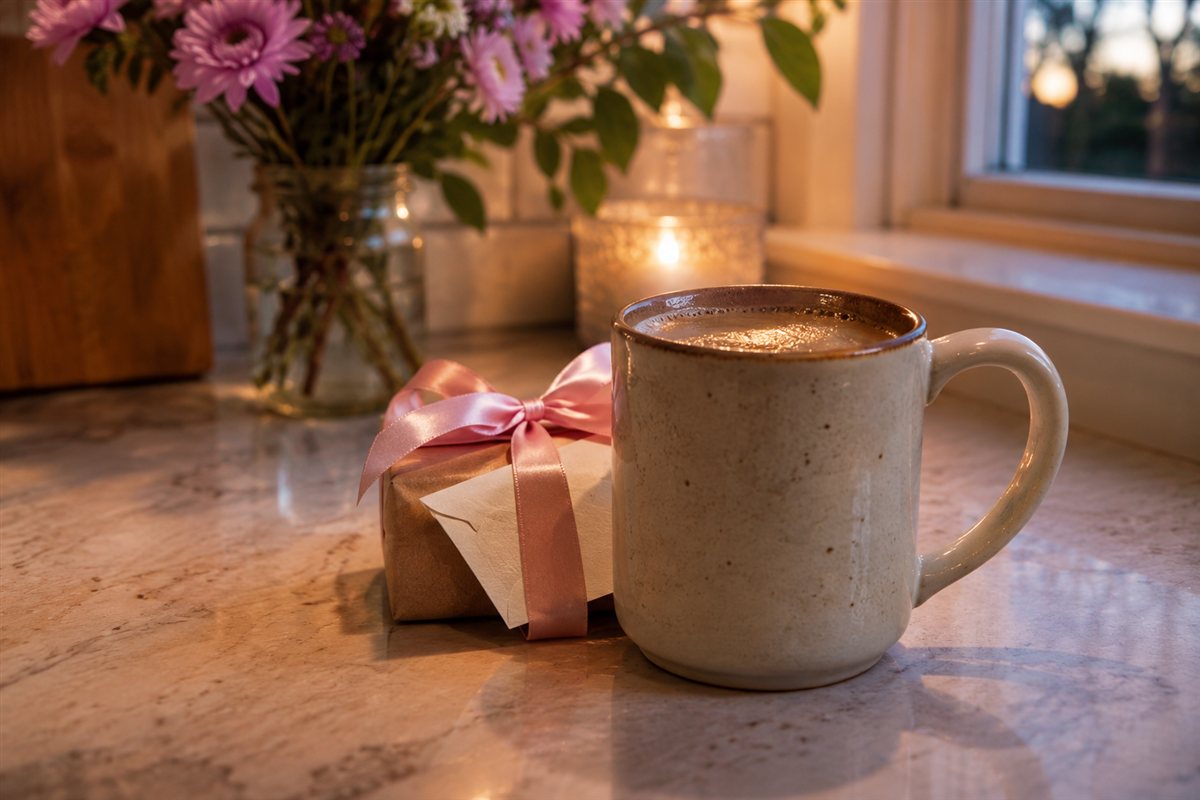
Surprise Through Timing
Changing when you give the gift can matter more than what it is.
- Give it a day early, or a day later than she expects.
- Send a small piece at several moments during the day, like a three-part series.
- Hide a note in a place she will not check until the evening.
In this guide
Surprise Through Setting
- Choose a place linked to a memory, like where you first talked for hours.
- Bring her there on a casual pretext, such as a walk.
- Prepare a blanket, a thermos of her favorite drink and a framed photo of that place.
- Take a quiet picture together before heading home.
Surprise Through a Twist on the Familiar
Take an ordinary gift and change one aspect.
- Instead of a bouquet, give a single flower with a tiny printed photo attached.
- Instead of a card, write on the back of a favorite picture.
- Instead of dinner out, bring a picnic to her workplace or home.
- Instead of a purchased item, record a short voice message and play it at an agreed time.
Match the Surprise to Her Personality
| Her style | Good surprise | Avoid |
|---|---|---|
| Private and calm | Quiet note and a personal photo gift | Public displays |
| Social and lively | Small gathering with close friends | Anything too secretive to enjoy |
| Adventurous | Short day trip with a hidden destination | Overpacked schedules |
| Sentimental | Memory-based keepsake | Generic items |
Keep It Kind
Unexpected should never mean uncomfortable. Avoid surprises that put her on the spot, involve heights, crowds or attention she dislikes, or interrupt something important. Consider her schedule and mood, and have a plan B ready.
A Sample Unexpected Day
To see how the pieces fit, imagine this plan. In the morning, she finds a short note in her bag. At lunchtime, a message arrives with a photo of the first place you met. In the afternoon, you suggest a walk and lead her to that very spot, where a small picnic is waiting. In the evening, you hand her a framed copy of the photo with the date on the back. None of these steps is large, yet together they feel like a thoughtful story. Adjust each part to her tastes and your schedule.
Gathering Clues Without Spoiling the Surprise
The best unexpected gifts feel personal, and personal comes from paying attention. The trick is to learn what she would love without asking directly, because a direct question gives the surprise away. A few weeks before the day, begin listening for clues and writing them down in a note on your phone.
Listen to what she mentions in passing. A comment about a cafe she wants to visit, a book she saw, a class she would like to take or a song she keeps replaying is a hint. Notice what she lingers over in shops, what she saves or sends you online and what she complains about, such as cold hands on a morning commute or a worn-out bag. Complaints can point to practical gifts she will use daily.
Ask her friends or family for ideas, but choose carefully who you trust and keep the question vague, such as asking what she has been into lately. Look at how she spends free time and what small luxuries she avoids buying for herself. Those are often ideal gifts, since they feel generous without being extravagant.
Keep her preferences in mind. Some people love attention and public gestures, while others prefer a quiet evening. Some value objects, and others value time. Her love language, if you know it, is a useful guide, though do not rely on a label alone.
- Keep a running note with dates and what she said.
- Avoid direct questions that reveal the plan.
- Check practical details, such as allergies, sizes and dietary needs, before buying anything.
The more you notice in advance, the less guessing you do on the day.
Thoughtful Gifts at Any Budget Level
An unexpected gift does not have to cost much, and a higher cost does not guarantee a better reaction. It helps to think in broad budget tiers and decide what the money should accomplish.
At the low-cost end, effort and detail matter most. A handwritten letter that names specific memories, a playlist of songs tied to moments you shared, a printed photo in a simple frame or a small homemade treat shows thought. A scavenger hunt of notes around the house, ending in a small present, turns a modest gift into an event.
At a moderate level, you can combine a small purchase with an experience. A favorite snack and a movie night with her pick, a plant or flowers she would not expect with a note, or a booked class or workshop for two are good examples. Choose something she can use again afterward, such as a book from an author she mentioned, so the gift lives beyond the day.
At a higher level, think about a day trip, a night away, a meaningful piece of jewelry or a hobby item she has wanted. Spend more only if it suits your situation and the relationship, and avoid anything that would put you under financial strain or make her uncomfortable about the cost. A gift that is far above your usual pattern can create pressure.
- Set the budget first, then look for ideas inside it.
- Pair a small item with a personal gesture so the gift feels complete.
- Check return policies for purchased items.
Surprises When You Are Apart or Short on Time
Not every couple can spend the day together, and an unexpected gesture can be especially welcome across distance. The principle is the same: make her feel thought of at a moment she did not expect.
For long distance, a package that arrives on or just before the day works well. Fill it with a few small items that tie to her interests, plus a handwritten note. Add a numbered set of envelopes she opens one at a time, each with a memory or a small gift. Arrange a video call with a twist, such as a shared meal ordered to her door while you eat the same dish, or an online activity you do together, such as a virtual museum tour or a game. Send a voice message or a short video montage of friends and family wishing her well, with her permission from those involved.
For busy schedules, bring the surprise to her routine. Leave a note in her bag or coat, arrange for her favorite coffee to be delivered to work, or pick her up from an event and take her somewhere simple she did not expect. A short, well-timed gesture is often better than a long plan she has no time for.
Check the delivery dates early if you are sending anything by post, and have a backup plan in case of delay. Use tracking if offered, and send a message the day before so she is not caught off guard.
- Order early and confirm the address.
- Time the reveal to a moment she will be free to enjoy it.
- Keep a digital backup, such as a message with the same note.
Building the Surprise Around Shared Interests
When you are stuck for ideas, return to what the two of you enjoy. A surprise that grows out of a shared interest feels natural and avoids the generic feeling of a typical holiday gift.
If she loves food, plan a tasting evening at home with a few dishes or desserts from different places, or a mini cooking challenge with an ingredient she likes. If she enjoys the outdoors, organize a sunrise walk with a flask of her favorite drink, or a picnic in a spot with a view. If she is creative, set up a small art or craft session, with supplies laid out and a project to try together. If she loves music, arrange tickets to a local show or make a listening evening with her favorite albums. If she reads, create a cozy reading nook with a new book, a blanket and a note inside the cover.
For pet lovers, a visit to an animal-friendly cafe or a small gift for her pet shows that you notice what she values. For travelers, a map with places marked for future trips or a small guide book to a place you plan to visit is a gift that carries a promise.
Think about the follow-through too. A gift connected to a shared plan, such as booking a class together or planning a trip, gives you both something to look forward to after the day itself has passed.
- Pick one interest and build everything around it.
- Keep the plan flexible in case the weather or her mood changes.
- Add one personal detail, such as a note about why you chose it.
When a Surprise Goes Wrong and How to Recover
Even a careful plan can go wrong. A delivery is late, a restaurant is full or she simply does not react the way you hoped. How you respond matters more than the problem itself.
First, stay calm and keep the focus on her enjoyment, not on the plan. If a delivery is late, explain with a smile and show her what is coming. If the venue changes, make the substitute part of the story. A cheerful tone turns small setbacks into shared jokes. If she seems tired or stressed, scale back and offer a quiet alternative, such as a simple meal at home.
Second, read her reaction without taking it personally. Some people need a moment to take in a surprise, and some are shy about attention. If she seems uncomfortable, change the pace and ask softly what she would like. Remember that a surprise is for her happiness, not for proving something.
Third, have a plan B. Keep a simple backup, such as a favorite takeaway, a movie or a walk, and keep any reservation details or phone numbers handy. Choose gifts with a clear return or exchange option when possible.
Finally, afterward, ask what she liked best and what she would change. That feedback helps you plan next time, and it shows that you care about getting it right.
- Prepare a backup for every important part.
- Stay flexible and let her mood set the pace.
- Say thank you to anyone who helped, quietly and sincerely.
Begin With What She Actually Notices
The most memorable gifts come from paying attention. Before you browse for ideas, spend a week noticing small things she mentions: a show she wants to finish, a place she has always wanted to visit, a hobby she keeps putting off, a snack she buys when she is tired. Write these down in your phone notes. The best unexpected gift is often a quiet response to something she said weeks ago.
Surprise does not have to be expensive or dramatic. It can be as simple as arranging the details of an ordinary evening so that she feels seen. A gift that shows you listened often beats a grand gesture that could belong to anyone.
- Check her recent messages and conversations for casual wishes.
- Ask a close friend or sibling for a hint, without giving the game away.
- Think about what she complains about, since a small fix can be a thoughtful gift.
- Consider what she does for others and give her a break from it.
Ideas Sorted by Her Personality
| She enjoys | Unexpected idea |
|---|---|
| Cozy evenings in | A planned night with her favorite food, a playlist and no phones |
| Adventure | A mystery outing with only the departure time revealed |
| Creative projects | A set of quality supplies for a craft she has mentioned |
| Reading | A book chosen for a reason, with a note inside the cover |
| Cooking | A cooking session where you handle shopping and cleanup |
| Music | A hand-made playlist and a ticket to a local show |
These are jumping-off points. Adapt them to your own relationship, your schedule and her comfort with surprises. Some people love a plan kept secret, while others prefer to know what is coming.
Experiences That Feel Personal
Experiences can be more lasting than objects because they become shared memories. They also avoid the question of whether something will fit or suit her taste.
A home-made evening
Cook a meal together or for her, set the table with candles, and put your phones in another room. The effort shows more than the menu.
A small trip
A local day trip, a picnic at a favorite spot, or a walk to a place that matters to the two of you can be memorable without being elaborate.
A class or workshop
Pottery, dance, cooking or painting sessions let you do something new together. Check availability well ahead of time.
A memory book
Print a few photos, add short notes and place them in a simple album. It takes little but means a lot.
Presentation: Making Any Gift Feel Unexpected
How you give a gift changes how it feels. Hide a note in a coat pocket, leave a small item on her desk, or tuck a message into a book she is reading. Spread a few small gestures through the day instead of putting everything into a single moment.
- Write a short, honest note describing why you chose the gift.
- Choose wrapping that suits her taste, even if it is simple.
- Pick a moment when she can enjoy it without rushing.
- Keep a backup plan in case weather or timing interferes.
Mistakes to Avoid
A few missteps can spoil a good idea. Avoid gifts that carry hidden messages about her appearance or habits. Do not surprise her with plans that conflict with her schedule or comfort. Avoid last minute shopping when you can, since time pressure shows. And resist comparing your gift to what others do, since her opinion of you matters more than any trend.
- Do not choose something that creates pressure or obligation.
- Do not ignore her stated boundaries or preferences.
- Do not overspend to impress; thoughtfulness matters more.
- Do not forget the card or note, which often becomes the keepsake.
If you are unsure, a combination of a small gift and a sincere note is almost always welcome. Keep the focus on her, and let the rest follow naturally.
A Simple Plan for the Week Before
Preparation takes pressure off the day itself. A week ahead, settle on your main idea and book anything that needs a reservation. Five days out, order or collect any items so delivery delays cannot surprise you. Two days before, confirm timings and prepare a backup option. The day before, wrap or pack everything and set out your notes.
- Choose one main gesture and one small extra.
- Make any bookings and confirm them.
- Order items early and keep the receipt.
- Check her schedule discreetly.
- Prepare the note, the card or the playlist.
Having a plan also leaves room to be present on the day, which she will notice more than any object.
Gifts That Work for Long-Distance Couples
If you live apart, the surprise can still land. Send a package timed to arrive on the day, schedule a video call with a shared activity such as cooking the same recipe or watching the same film, or arrange for a local delivery of something she enjoys. A handwritten letter feels special in a world of messages. Plan around time zones and check that she will be home to receive any delivery.
Low-Pressure Ideas for Early Relationships
When you have not been together long, aim for warm and light. A small, thoughtful item tied to something she told you, a shared meal at a place she mentioned or a hand-written note are all easy to receive. Avoid anything that implies more commitment than you both have discussed. The aim is to make her smile and feel appreciated, not to apply pressure.
The Difference Between a Surprise and an Ambush
Not every unexpected gift is a welcome one, and the line between them is worth understanding before you plan anything elaborate. A surprise delights because it shows the giver was paying attention; an ambush overwhelms because it puts the receiver on stage, unprepared, in a situation designed around the giver’s enjoyment of the reveal. The test is simple to state and worth applying to every idea in this guide: imagine the moment from her side. Is she dressed as she would wish, in company she would choose, free to react honestly? If any answer is no, redesign the moment rather than abandoning the gift, because the gift is rarely the problem — the staging is.
Public surprises deserve particular care. A grand gesture in a restaurant or in front of family can be glorious for someone who loves an audience and quietly miserable for someone who does not, and the giver’s enthusiasm is not evidence about which she is. Her history is. Think of how she has reacted to attention at birthdays and celebrations past, and let that record, not your hopes, set the scale of the stage. The most successful unexpected gifts are usually unexpected in content, not in exposure: she did not see the gift coming, but she receives it in circumstances where she feels entirely herself.
Surprise for the Partner Who Plans Everything
Some partners manage their calendars, their wish lists and their celebrations with cheerful thoroughness, and surprising them requires a different art. The openings are in the margins of their system: the thing they would never buy themselves because it seems indulgent, the upgrade to a plan they have already made, the small luxury adjacent to their hobby that their practicality keeps vetoing. Surprising a planner with evidence that you noticed what their system excludes is often more touching than any grand gesture, because it shows attention to the person rather than to the occasion.
Timing offers another opening. A gift given a day early, or discovered in an ordinary place on an ordinary morning, sidesteps the ceremony a planner has already scripted in their head. The unexpectedness lives in the when and the where rather than the what, which suits partners who find big reveals stressful but small delights delicious. Many of the ideas in this guide can be re-staged this way with no loss — indeed, with a gain in intimacy.
Unexpected Ideas Built From Ordinary Materials
The most charming unexpected gifts often cost little, because their value is in the noticing. A book by an author she mentioned once, months ago, in passing. Her favourite childhood sweet, tracked down and presented without ceremony. A playlist of the songs from the year you met, with a note explaining one choice. A framed print of a photograph she took and was proud of, which you had saved when she shared it. Each of these says the same sentence in a different language: I listen to you when you are not asking for anything. That sentence is the true gift, and it cannot be bought at the last minute at any price.
Repetition, done knowingly, becomes its own surprise. The same small gift given every year — always a particular flower, always a particular chocolate, always a new entry in a growing collection — builds a private tradition whose pleasure compounds. The first year it is a gift; the third year it is a story; the tenth year it is part of the architecture of the relationship. If you find an idea in this guide that lands especially well, consider quietly adopting it as a tradition rather than exhausting yourself inventing novelty annually. Consistency, chosen, is not a failure of imagination.
The Gift of Removing a Burden
One category of unexpected gift is chronically underrated: taking something off her plate. The chore she hates, quietly done for a month. The appointment she has been meaning to book, booked. The drawer, the inbox, the car service, the leaking tap — handled, without announcement, and revealed only by its absence of worry. For partners whose love language is acts of service, such a gift can outweigh anything wrapped, because it improves her ordinary days rather than decorating one special one. Present it lightly — a note in a card, a single sentence — and resist itemising your efforts, which converts generosity into bookkeeping.
Planning Backwards From the Day
Unexpected gifts fail more often in logistics than in imagination, so plan backwards from the moment of giving. Fix the moment first: when, where, and in what circumstances will she receive it? Then list everything that must be true for that moment to happen — the item ordered and arrived, the booking confirmed, the accomplice briefed, the hiding place secure — and give each item a date at least a few days earlier than feels necessary. Delivery estimates are optimistic, printers jam, and friends forget; a plan built with slack absorbs all three without the giver’s stress leaking into the celebration.
Have a understudy ready for the fragile elements. If the centrepiece is a delivery, know what you will do if it does not arrive: a card describing it, beautifully, converts a logistics failure into an anticipation gift, and is remembered kindly when handled with humour. If the centrepiece is a place, have a second place. The goal is not pessimism; it is the calm that comes from knowing no single failure can sink the day, and calm in the giver is the atmosphere in which surprises feel safe rather than frantic.
Hiding Things From Someone You Live With
Shared homes make secrecy a craft. Order to a workplace or a friend’s address when a parcel’s timing is uncertain. Use neutral calendar entries for planning errands. Keep receipts and confirmations in a folder she has no reason to open, digital or otherwise, and remember that shared accounts and shared devices leak secrets innocently — a delivery notification on a shared tablet has ended more surprises than any interrogation. If she does discover something, protect the remainder: confirm nothing, change the staging, and let the surviving elements carry the surprise. A partially discovered gift, given with good humour, loses very little.
When the Relationship Is New, Old or Complicated
Calibration matters more than creativity. In a new relationship, the unexpected gift should be small, thoughtful and easy to receive — its message is attention, not intensity, and a gift that implies obligations she has not agreed to will make the surprise feel like pressure. The ideas in this guide scale down gracefully: one perfect small thing, given casually, says everything that is safe to say at this stage and leaves room for the relationship to grow into larger gestures.
In long relationships, the risk runs the other way: not pressure but predictability, two people exchanging the agreed gifts on the agreed day. Here the unexpected gift’s job is to demonstrate that attention has not retired. It need not be large; it needs to be specific to who she is now, not who she was when you met, because nothing says I still see you like a gift that reflects her current passions, projects and pleasures. And in complicated seasons — illness, grief, a hard year at work — scale the surprise to her capacity: quiet, useful, undemanding gifts land best, and the grand gesture can wait for a year with more room in it.
The Ethics of the Well-Meant Surprise
A surprise is an exercise of small power — you know something she does not, and you control the moment of revelation — and power, even affectionate power, deserves a moment of ethical attention. The questions are simple. Is the surprise for her delight or for your applause? Would she choose this moment, this audience, this scale, if she could see the plan? Does the surprise create any obligation she has not agreed to — a public answer, a performed reaction, a debt of gratitude out of proportion to the relationship? A plan that survives those questions is clean, and you can execute it with a whole heart. A plan that fails one is not necessarily to be abandoned; it is to be redesigned until it passes, because the redesign is usually a matter of audience, timing or scale rather than of the gift itself.
Particular care belongs to surprises that involve other people’s participation in her life — her workplace, her family, her friends — because those surprises borrow her relationships as stage machinery. Colleagues enlisted to deceive her, however sweetly, are spending her professional credibility; family enlisted likewise are spending her trust. Keep such borrowings tiny, brief and certain of a happy landing, or do not borrow at all. The surprise she retells with delight almost never required anyone to lie to her for a week.
When She Says She Does Not Like Surprises
Believe her. This sentence, offered by some partners with complete sincerity, is not a challenge to your ingenuity but a piece of self-knowledge to be honoured — and honouring it is itself the most attentive gift available. What such partners usually dislike is not delight but ambush: the loss of control, the audience, the performed reaction. Within that boundary, a whole gentle territory remains open — the gift she did not expect in content, given in circumstances she finds entirely comfortable; the small thing appearing in a familiar place; the plan she knows about in outline whose details still hold their pleasures. Call it the expected surprise, and do not underestimate it: for the partner who dislikes surprises, it is not a lesser version of the thing. It is the thing itself, correctly understood.
Surprise as a Habit of the Relationship
The deepest version of everything in this guide is not an annual event but a habit: small, unoccasioned evidence of attention, spread across the ordinary year. The coffee that appears the way she likes it on a hard morning. The article sent with no comment because it was obviously for her. The errand quietly absorbed. Couples who practise this find that Valentine’s Day becomes easier rather than harder, because the day is no longer required to prove in fourteen hours what the year has not shown. It becomes a celebration of an existing condition — two people paying attention — and the unexpected gift, when it comes, is simply the habit wearing its best clothes. Build the habit, and the day will take care of itself.
Surprises for the Calendar’s Other Days
Everything in this guide generalises, and it is worth claiming that territory before closing. Birthdays are the obvious second home of the unexpected gift, but the method shines brightest on the unmarked days, when no occasion obliges anyone and a surprise is therefore pure signal. The random Tuesday gift — small, specific, unexplained by any calendar — carries a message no scheduled celebration can match: I was thinking of you when nothing required me to. Keep a small reserve for such days: the thing spotted in a shop window in March that is so exactly her it cannot wait for February. Buy it, hide it, and deploy it on the greyest ordinary day you can find. Its effect will recalibrate your sense of what the Valentine’s gifts need to do, because they will no longer be carrying the whole year’s evidence alone.
Anniversaries of private significance — the day you met, the day of the delayed train, the day of the first small apartment — are another territory where the unexpected gift outperforms the public calendar’s offerings. These dates belong to the two of you alone, which makes any surprise staged on them automatically intimate. Note them in the same private place you keep her clues, and let one of them, each year, receive the gift that February’s crowds made impractical. Couples who cultivate their private calendar find that the public one loses its power to disappoint, because the relationship’s real celebrations are happening on schedule — theirs.
A Final Test Before You Commit to Any Plan
Run every plan in this guide through one last filter, the simplest in the whole collection: imagine describing the moment to her best friend, the one who knows her nearly as well as you do and has no investment in flattering you. If that imagined friend nods — yes, that is exactly her, that will land — proceed with confidence. If the friend winces, even slightly, believe the wince. It costs nothing, it takes ten seconds, and it has saved more surprises than any other technique in this guide, because it forces the plan out of the giver’s head, where it was always going to work, and into the receiver’s world, where it actually has to.
What Unexpected Really Means
Strip the whole subject down and the unexpected gift is not about novelty at all. It is about evidence — evidence that attention was paid when nothing was being asked, that a person was known in their specifics rather than their category, that the giver’s inner life includes a running, affectionate file on the receiver’s pleasures. Objects and experiences are just the delivery mechanism for that evidence, which is why the small and specific so reliably defeats the large and generic. Give the evidence, in whatever wrapping your life allows, and the surprise will take care of itself — this year, and in all the ordinary years after, which is where surprises go to become a way of life.
Surprise Ideas That Cost Time Instead of Money
The richest vein of unexpected gifts is denominated in hours rather than in currency, and it deserves a final mining before this guide closes. Learn the thing she does badly and hates — the software, the instrument’s first steps, the language’s opening phrases — well enough to give her a genuine head start, presented as a small course of your own making. Restore the thing that has been broken in plain sight: the photograph album disintegrating in its box, transferred and printed; the garden corner that defeated her, cleared and planted while she was away; the bicycle, the radio, the chair with the wobbling leg, returned to service without announcement. Do the research she has no time for — the trip fully planned to the last train, the family history chased through records, the options for the big decision laid out in one clear document. Each of these is a gift of the scarcest substance in modern life, given in the form she most needs it, and each is unexpected in the deepest way: nobody else was going to do it.
Present time-gifts with the same care as objects, because invisible labour can be overlooked even by its beneficiary. A short note that says what has been done and where its results live — the album is on the shelf, the itinerary is in the envelope, the garden is through the kitchen door — converts quiet effort into a received gift without converting it into a invoice. The line to walk is between invisible and itemised: name it once, warmly, and then let it be enjoyed.
The Surprise That Is a Person
One category stands apart for its power and its risk: the surprise that is a person — the friend flown in, the sibling at the door, the parent on the doorstep with a cake. When it works, nothing else in this guide is in its league, because the gift is not a thing or an experience but a restoration: someone she loves, present, whom distance had made theoretical. When it misfires — wrong weekend, wrong state of mind, a guest who becomes a responsibility — it misfires at scale. Undertake it only with the person’s own enthusiastic collusion, a genuine knowledge of her calendar and state, and a host’s plan for the guest that does not quietly transfer the work to her. Done with that care, it is the surprise she will describe for the rest of her life, usually in one sentence, with the door and the face in it.
Keeping the Game Worth Playing
A final maintenance note for couples who adopt surprise as a tradition: protect its lightness. The moment surprises become audited — compared year to year, scored against a friend’s, owed in rotation — the game curdles into obligation and both players start losing. Surprise works because it is gratuitous, in the old sense of the word: unowed, unearnt, freely given. Keep it that way by refusing all bookkeeping, including your own private ledger of who surprised whom best. Give when the idea is true, receive when it comes with open hands, and let the years accumulate without a table of standings. That is how a Valentine’s tactic becomes, across a life together, simply the way two people are with each other — which was the destination of every idea in this guide from the first page.
Unexpected Gifts for Particular Kinds of Partners
General advice sharpens when it is aimed. For the partner who is a maker — who cooks, builds, sews, gardens or codes — the unexpected gift that lands is the one that feeds the making: the ingredient she has never justified buying, the tool one grade above the one she uses, the workshop with the practitioner she admires. Such gifts say you take her serious pleasures seriously, which is a deeper compliment than romance sometimes manages. For the partner who is a collector, the gift is the missing piece, and the surprise lies in your having learned the collection well enough to find it — research is the romance there.
For the partner who is overwhelmed — new parent, new job, hard year — the unexpected gift should reduce the world’s weight rather than add to its inventory: time, rest, help, one beautiful convenience. For the partner who is adventurous, give a door: the first lesson, the entry, the map, the date in the diary that commits you both. For the partner who is sentimental, give evidence: the preserved thing, the recorded story, the photograph rescued from a phone and given a frame. Match the surprise to the person she currently is, and the ideas in this guide will sort themselves almost without effort.
The Colleague-and-Friend Boundary
A practical caution for surprises arranged through other people. Friends and colleagues who help with a surprise become keepers of her information — her schedule, her tastes, sometimes her address — and they should be chosen and briefed with that in mind. Ask for the smallest help that works, share the least detail that suffices, and thank your accomplices in a way that closes the loop, so no one is left holding her personal details or an unfinished role in your romance. The best accomplices are the ones she would have chosen herself.
Surprises That Become Stories
There is a difference between a surprise that is enjoyed and one that is retold, and the difference is usually a single vivid detail: the hiding place, the clue, the thing that went slightly wrong and was rescued with laughter, the words in the card she quotes. When you plan, ask yourself what the story of this gift will be when she tells it in a year. If the honest answer is that you bought something nice, consider adding the one detail that makes it tellable — not bigger, not more expensive, just more specific. A gift with a story attached appreciates over time; a gift without one is slowly absorbed into the general furniture of life.
This is also why the small, imperfect, handmade and personal surprises so often out-retell the grand ones. The grand gesture’s story is about its scale, and scale impresses strangers; the personal surprise’s story is about the two of you, and it warms the teller every time. Aim for the story you would rather hear her tell.
Keeping a Surprise Journal
Couples who enjoy this game keep, in effect, a shared mythology, and you can help it along by recording your side: a private note of what you gave, how the moment went, and what she said. Read it before planning the next occasion. You will find your own patterns — the hiding places you reuse, the categories you over-buy, the scale at which she is happiest — and correcting your own patterns is the fastest route to surprises that feel fresh to her rather than merely effortful to you. The journal also becomes, in time, a small history of attentiveness, which is a romantic document in its own right.
FAQ
How do I surprise someone who guesses everything?
Change the pattern. Send plans that look like a normal evening and add the surprise late.
Can a small surprise be enough?
Yes. A well-timed note or a thoughtful detail can outshine a large gift.
How do I find out what she likes without asking?
Pay attention to what she mentions in passing, what she saves online and what she lingers over in shops. Keep notes over a few weeks. You can also ask a trusted friend a vague question about her recent interests.
What if she says she does not want anything for Valentine's Day?
Take her words seriously, and choose something small and low pressure, such as a note, a shared meal or a short walk. Avoid large or public gestures. A modest, personal gesture usually respects both her wish and your care.
Can I surprise her if we live far apart?
Yes. Send a package timed to arrive on or just before the day, arrange a shared meal over video or put together a set of messages from friends. Check delivery times early and have a backup message ready.
How much should I spend?
Spend what suits your situation. Effort and detail often matter more than cost, and a modest, well-chosen gift can outshine a costly generic one. Avoid anything that would cause financial strain.
What if the surprise is not well received?
Stay calm, ask gently what she would prefer and adjust. Some people need time to take in a surprise. Having a simple backup plan helps turn the evening around.
Is a handmade gift better than a bought one?
Neither is automatically better. Handmade gifts show effort, and bought gifts can solve a real need. The best option is the one that fits her tastes and your skills.
How far ahead should I plan?
A few weeks is a good window. It leaves time to gather clues, order items, book places and arrange backups. Last-minute plans can still work if you keep them simple.
The Short Version
Surprise her through timing, setting or a small twist on something familiar. Fit the style to her personality and keep it comfortable. The unexpected part gets attention, but the personal part is what she remembers.
Related Guides
- Romantic Valentine's Day Gift Ideas for Your Girlfriend, Her Way
- Valentine's Day Gift Ideas Your Partner Is Sure to Adore
- Great Valentine's Day Gift Ideas by Category: A Simple Overview
- Valentine Gift for Girlfriend: Online Shopping Tips and Timing
- How to Wish Your Girlfriend a Happy Valentine's Day Sweetly
