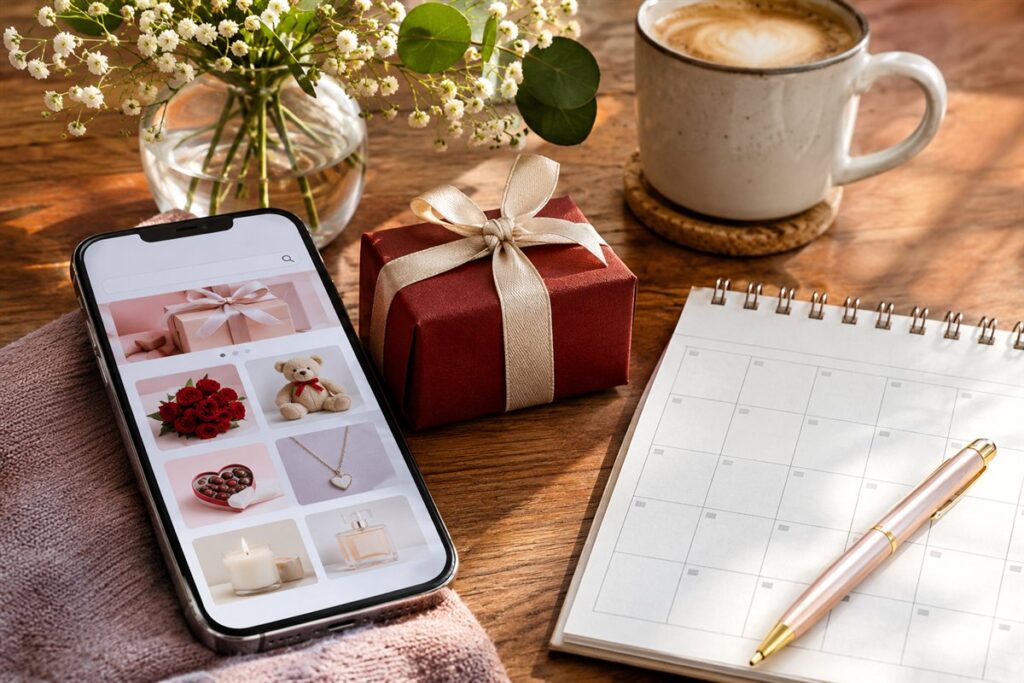
Shopping online for a Valentine gift works best when you decide what you want first, then check delivery timing before you order. The convenience is real, but so are the risks of delays and mismatched expectations. These tips keep the process calm and the result personal.
Decide Before You Browse
Browsing without a plan can lead to endless scrolling. Spend ten minutes first deciding on a category and a feeling.
- Choose a category: keepsake, experience, flowers, book or photo-based item.
- Decide the feeling: playful, romantic, grateful or nostalgic.
- Write down two personal details you want included, such as a date or a name.
In this guide
Order Checklist
- Read the full description, including size, materials and what is included.
- Look at several photos and any customer images, if available, to judge the real look.
- Check the estimated delivery window and add a safety margin of several days.
- Confirm whether the seller allows returns or exchanges, and what the conditions are.
- Check any personalization limits, such as character counts or image sizes.
- Verify the delivery address and the recipient’s availability on the day.
Photo Gifts: Extra Care
If you order prints, albums or framed photos, the quality of the original image matters. Choose pictures that are sharp and well lit, and avoid heavy cropping. Many services show a layout view of the order; use it to confirm that faces and edges are not cut off. Allow additional time, since made-to-order items usually take longer than ready stock.
Plan for Delays
| Risk | What to do |
|---|---|
| Late delivery | Order early and prepare a handwritten backup note |
| Wrong item or size | Check the order confirmation right away |
| Damaged parcel | Inspect on arrival and contact the seller promptly |
| Missed delivery | Choose a trusted address or a delivery time window |
Add Your Own Touch
- Write the card yourself instead of using a printed template.
- Pair the online purchase with a small homemade element, such as a playlist or a note.
- Deliver it with a little ceremony, even if it arrived in a plain box.
Keep a simple record of what you ordered, with confirmation messages saved in one folder and a note of expected arrival dates. If anything looks wrong, you can act quickly. Calm organization is a gift to yourself on a day that can otherwise feel hectic.
Judging a Seller Before You Pay
With an online order you cannot hold the item, so the seller becomes your main source of trust. A few checks take only minutes and can save you from a disappointing parcel on February 14.
Start with how clearly the listing is written. A trustworthy page names the materials, gives measurements, explains what is included and states the production and shipping time separately. Vague descriptions, copied stock photos with no real images and missing size details are reasons to slow down. Look at the seller’s contact options and policies: is there a clear way to ask a question, and are return and refund rules easy to find in plain language?
Read customer comments for patterns rather than single opinions. One unhappy buyer may be an outlier, but repeated mentions of late delivery, poor packaging or items that look different from the photos tell you something. Pay particular attention to comments from people who bought around holidays, since seller capacity can be stretched then.
- Send a short question before ordering and see how quickly and clearly the seller replies.
- Check whether personalized items can be returned, since many sellers do not accept returns on made-to-order goods.
- Use a payment method that offers buyer protection, if you have one, and keep the receipt.
- Be wary of any listing that pressures you with countdown timers instead of giving clear information.
Sizing and Fit: Getting Details Right Without Guessing
Sizing is where many online gifts go wrong, especially jewelry, clothing, slippers and anything meant to be worn. Because exchanging after Valentine’s Day can be awkward, aim to get the size right before you order.
The least intrusive route is to look at things she already owns. Check the size label on a similar item at home, or measure something that fits her well, and compare with the seller’s size chart. Remember that sizing differs between sellers and regions, so use the chart on the specific listing rather than your general sense of size. If a listing says an item runs small or large, believe it and adjust.
When you are not sure, favor gifts that do not depend on fit. Books, framed photographs, a plant, a handwritten collection of memories and food items avoid the issue entirely. Adjustable or one-size designs can also reduce risk, and a gift receipt or a clear exchange policy gives you a safety net.
If you do buy something sized, ask yourself whether you can tell her it is exchangeable when you hand it over. Saying “we can swap it if it is not right” removes pressure for both of you. Also check whether the exchange policy covers the shipping cost, which varies by seller.
Presentation When the Gift Arrives in a Plain Box
Online orders often arrive in shipping cartons that look nothing like a gift. Presentation is where you can make the moment feel considered, and it is easy to plan in advance.
Begin by opening the parcel as soon as it arrives, not on the day itself. This lets you check the contents, confirm they match the order and spot damage while there is still time to contact the seller. Keep the packaging neat in case you need to return anything.
Then plan simple wrapping. Plain paper, a ribbon and a small tag in your own handwriting look more personal than many store-bought gift bags. If the item is fragile, wrap it with soft material inside and keep the outer layer simple. If the seller offers gift wrapping or a gift message, check what the message looks like and how many characters are allowed, since you may prefer a handwritten card instead.
- Remove price slips and invoices from the box before wrapping.
- Add a card that mentions one specific memory.
- Choose a calm moment to give it, rather than a rushed one.
- Take a quick photo of the moment later, if she is comfortable with that, to keep as a memory.
Setting a Budget and Choosing Within It
A clear budget stops online browsing from drifting upward, since there is always a slightly nicer version a click away. Decide your limit before you open any shop page, and include delivery, personalization and wrapping in it, as these extras can change the total.
Think of gifts in qualitative tiers. At the simplest level are low-cost, high-effort gifts: a handwritten letter, a curated playlist, a printed photo with a note. In the middle are small keepsakes and treats chosen with her tastes in mind, such as a favorite book edition or a framed print. At the top of your own range are larger items or planned experiences that need booking, which are worth the extra care only if you are confident they suit her.
What matters more than the tier is the match. A modest gift that reflects a private joke or a shared trip often means more than an expensive item chosen quickly. If you feel tempted to overspend to compensate for last-minute shopping, pause and ask whether time or thought could do the same job instead.
Finally, compare total cost, not just item price. Shipping, taxes and import charges for items from abroad may apply, and these vary by country and seller, so check the checkout summary before you confirm.
After the Order: Tracking and Backup Plans
Once you have ordered, your job shifts to monitoring. Save the confirmation message and the tracking details in one place, and check progress every day or two. Treat the estimated delivery window as an estimate, not a promise.
If the status stalls, contact the seller early rather than waiting until the last minute. Most sellers respond more flexibly when there is still time, and an early message may allow an expedited option or a replacement. Keep your messages short and factual, with your order number and the date you need the item.
Prepare a backup that does not depend on the parcel. This could be a handwritten letter, a planned dinner, a short walk to a place you both like or a small treat from a nearby shop. If the main gift arrives late, you can still celebrate on the day and present the gift afterward with a note explaining the delay. Many people find a thoughtful backup more memorable than a perfectly timed parcel.
- Set a personal deadline a few days before the date to decide whether to switch to the backup.
- Check who will be home to receive the parcel and whether a neighbor or pickup point is an option.
- Keep the packaging until you are sure she is happy with the gift.
Protecting Yourself While Shopping Online
Online shopping is convenient, but a few habits keep you safe. Use sellers you recognize or that have clear contact details, return policies and customer service information. Be wary of offers that seem too good to be true, and of sites that ask for unusual payment methods. Check that the web address begins with the secure prefix and that the site looks professional. Read reviews from other buyers with a critical eye, looking for patterns rather than single comments. Keep records of your order confirmation and any messages with the seller. If something goes wrong, you will have the information you need to ask for help.
Use payment methods that offer buyer protection, and avoid sharing more personal information than needed. Do not click on links in unexpected messages claiming to be about your order; go to the seller’s site directly instead.
A Simple Order Timeline
| When | What to do |
|---|---|
| Three weeks before | Collect ideas and decide on a theme |
| Two weeks before | Shortlist items and check delivery estimates |
| Ten days before | Place the order, especially for personalized items |
| One week before | Track the order and prepare backup options |
| Three days before | Check that the parcel is on track and prepare wrapping |
| The day | Present the gift with a note |
Allow extra time for shipping, because delays are common around popular dates.
Making Online Gifts Feel Personal
A gift ordered online can feel as personal as one chosen in a shop if you add your own touches. Write a card by hand, wrap the gift carefully, and add a small item such as a photograph or a favorite snack. Choose products that can be customized with a name, a date or a short message. Think about the story behind the gift and share it in your note. Mention why you chose it, what it reminds you of, or what you hope it will bring. These small additions turn a parcel into a message.
- Choose items with personal meaning.
- Avoid generic messages.
- Include a handwritten note.
- Plan the moment of giving.
Handling Returns and Exchanges
Before you buy, read the return policy. Look at the time allowed, who pays for return shipping and whether personalized items can be returned. If you are unsure about size or color, choose something easy to exchange. Keep the original packaging until the gift is accepted. If a problem arises, contact the seller early and explain clearly. Keep a calm, polite tone and share photos if needed. Good sellers want satisfied customers and will usually help.
Dealing With a Late or Damaged Parcel
Even careful planning can fail. If your parcel is late, contact the seller and the carrier, and check whether a replacement can arrive in time. Have a backup ready: a simple card, a local bouquet, a meal you can cook. Be honest with your girlfriend if necessary, and explain that the gift is on the way. Often, the effort and humor you show in a mishap is remembered fondly. If the item arrives damaged, take photos and contact the seller promptly.
Staying Within Your Means
A good gift does not require overspending. Decide on a comfortable limit, and look for items that fit it. Compare options across a few sellers, and consider shipping costs and delivery time. Resist pressure from advertising that suggests you must spend a lot to show love. Thoughtfulness and creativity matter more than cost. If you want to give more, consider adding time and attention, such as a planned evening.
Gift Ideas Sorted by Her Interests
When you are stuck, work from what she already enjoys instead of browsing at random. A short list of her habits usually points to a good direction.
| If she loves | Think about |
|---|---|
| Reading | A book from a favorite author, with a handwritten note inside the cover. |
| Cooking or baking | A useful kitchen tool or a set of ingredients for a dish she wants to try. |
| Travel | A small organizer, a map print or a journal for trip memories. |
| Music | A record, a playlist card or accessories for her favorite listening spot. |
| Self care routines | Items that match products she already uses, so you avoid guessing at preferences. |
| Art and crafts | Quality supplies or a framed print of something she admires. |
Questions to Ask Yourself Before You Click Buy
- Would she use or enjoy this next month, or only on the day itself?
- Does it fit something I have noticed her mention or admire in the past few weeks?
- Is the seller clear about delivery times, returns and what is included in the box?
- Do I have a backup plan if the parcel is late, such as a card, a handwritten letter or a planned evening?
- Have I checked sizes, colors or personal details twice?
Mistakes That Spoil a Thoughtful Gift
Choosing something for yourself. It is easy to pick a gift that reflects your own taste. Picture her opening it and ask whether it suits her.
Leaving everything to the last week. Popular items sell out and carriers get busy before the holiday. Order early and keep the tracking details handy.
Skipping the message. A simple card in your own words often means more than the gift. Write it in advance so you are not hurrying.
Overlooking the packaging. If the box looks plain, wrap the item or add a ribbon so the moment feels special.
A Gentle Reminder About Expectations
A good gift shows that you pay attention. It does not need to be large or elaborate. Spending time on the details, the timing and the words that go with it will usually matter more than the item itself.
Writing the Card
Many people freeze when they face a blank card. Keep it simple. Name one thing you appreciate about her, one shared memory and one thing you look forward to doing together. Three or four honest sentences are plenty. Read the message aloud once to make sure it sounds like you, and check spelling before you write it in pen.
Planning the Day Itself
The gift is more enjoyable when it fits into a pleasant plan. Think about a quiet dinner at home, a walk somewhere you both like, or simply an unhurried morning together. If you choose a restaurant or an activity that needs a booking, reserve it early, since popular places fill up fast around the holiday.
- Decide who will handle the booking and confirm it a day or two before.
- Keep a note of the time the parcel is expected, so you are home to receive it.
- Have a small backup item, such as flowers or a favorite snack, in case something goes wrong with delivery.
- Choose a time to hand over the gift when neither of you is rushing.
Handling Different Relationship Stages
The right gift depends on how long you have been together. In a new relationship, something modest and thoughtful is usually better than a grand gesture, which can feel overwhelming. For a long partnership, a gift that recalls a shared memory, such as a framed photo of a trip, can carry more meaning than something expensive. When you are unsure, think about how she likes to celebrate. Some people enjoy a surprise, while others prefer to know what is coming and look forward to it.
Whatever you choose, be sincere. A gift chosen with care and given with a kind word is rarely a mistake.
Reading a Product Page Like a Detective
Online gift shopping rewards readers. A product page contains far more information than its headline and photographs, and the difference between a gift that delights and one that disappoints is often sitting in the sections shoppers skip: the full description, the specifications, the list of what is actually in the box. Photographs can mislead innocently — a product shot without scale, a lifestyle image showing accessories that are sold separately — while the written details quietly tell the truth about size, material and contents. Before any gift is ordered, read the page the way you would read a contract you intend to sign, because in effect you are signing one.
Reviews deserve the same detective treatment, read for patterns rather than verdicts. A scatter of complaints about the same specific thing — a clasp, a smell, a size that runs small — is information. A general glow of praise with no specifics is weather, not climate. Look for reviewers who describe the same use you intend: bought as a gift, for a partner, opened on the day. Their reports about packaging, arrival condition and the recipient’s reaction are worth more to you than any amount of commentary about features you do not care about.
Photographs, Sizes and the Scale Problem
More online gifts disappoint on size than on any other attribute, because screens abolish scale. Jewellery photographs as sculpture and arrives as a whisper; a hamper photographs as a feast and arrives as a snack. The defence is numerical: find the stated dimensions, then measure something comparable at home — an existing necklace, a book, a fruit bowl — and compare honestly. Sellers who provide dimensions beside a hand or a coin in photographs are doing you a service; sellers who provide no dimensions at all are telling you something too, and it is not reassuring.
Timing the Order Around Real-World Friction
The order timeline in this guide assumes deliveries behave, and around Valentine’s Day they often do not. Weather, volume and simple error all stretch estimates in the same fortnight when every other partner in the country is ordering too. The experienced response is not merely to order early, though you should, but to choose what you order with delay in mind: prefer gifts whose value survives arriving on the thirteenth rather than the fourteenth only if the fourteenth is guaranteed, and keep the card, at least, in your own hands and handwriting, so that the day’s essential message never depends on a courier.
Click-and-collect and local pickup options deserve more use than they get from gift buyers. A gift collected in person cannot be left on a doorstep, signed for by a neighbour, or delayed in a depot across town, and collecting it gives you the chance to see it before she does — the single greatest quality-control advantage the high street ever had over the internet. Where a seller offers both, the small effort of collection buys a large reduction in risk during the busiest delivery week of the romantic year.
Gift Options at Checkout: What Is Worth Selecting
Checkout gift options are a mixed blessing and should be chosen deliberately. Gift wrapping from a large retailer is usually competent and anonymous — acceptable for a gift being sent directly, rarely a substitute for your own wrapping when the gift passes through your hands. The gift message, by contrast, is precious when the parcel goes straight to her: write it fully, with her name and complete sentences, and read it as she will read it, on a small printed slip, possibly before she has opened anything. Hide-prices options and gift receipts are simple kindnesses that cost nothing; select them always, because a price tag discovered inside a gift is a small, avoidable puncture in the moment.
Personalisation Ordered Online: Extra Checks
Personalised gifts ordered online carry a double risk — the product can disappoint and the personalisation can be wrong — and both risks are managed at the proof stage. If the seller shows a preview, study it letter by letter rather than glancing at it: names, dates and apostrophes are where errors live, and an error you supplied is rarely refundable. If no preview exists, type the inscription into a plain document first, read it aloud, and paste it into the order rather than typing it fresh into a small box under time pressure. Photographs for photo gifts deserve the same care: send the highest-quality version you have, check how it will crop, and be wary of busy backgrounds that will fight the product’s design.
Order personalised gifts earlier than everything else, because they cannot be reordered inside the final week if something is wrong, and choose sellers who state their production time separately from their delivery time. The two numbers together are the real timeline, and a seller who merges them into one cheerful estimate is asking you to carry their uncertainty. A week of slack on a personalised order is not caution; it is the difference between a gift and an apology.
Digital Gifts Done Properly
Digital gifts — subscriptions, experiences booked online, classes, memberships — are sometimes treated as the thoughtless option, which is unfair to the good ones. A digital gift chosen from real knowledge of her interests, presented in a card that explains why this, why her, why now, carries the same weight of attention as any object. What makes digital gifts feel thin is presentation, not format: a forwarded confirmation email is not a presentation. Print the essential detail, fold it into a card, pair it with one small physical token if you like, and the gift arrives with the ceremony it deserves.
After She Opens It: The Quiet Half of Online Shopping
The work of the online gift buyer continues after the reveal, in ways the recipient never sees. Keep the order confirmations until you are sure nothing needs exchanging, and note the return windows in your calendar rather than trusting memory, because the busiest fortnight is exactly when such details slip. If something needs returning, handle the logistics yourself and completely: a gift that generates errands for its recipient has failed in its final duty, whatever its other virtues.
Finally, let each year’s shopping teach the next. Note which sellers delivered beautifully and which caused the midnight anxieties, which categories survived the post and which arrived diminished, and how much slack your timeline actually needed. Online gift shopping is a skill with a learning curve, and the partners who become known for wonderful gifts are usually not the ones with the largest budgets — they are the ones who kept the notes.
A Pre-Order Checklist You Can Run in Two Minutes
Consolidate the whole guide into the pause before you pay. Read the item’s full title and description once, slowly, as if proofreading — because that is what you are doing. Confirm the variant: size, colour, edition, quantity, and whose name or initials appear anywhere in the order. Confirm the address as if you had never seen it before, including the small fields where old details hide. Confirm the date arithmetic: production time plus delivery time, counted in working days where the seller counts them that way, landing at least two days before you need the gift in your hands. Then look at the total cost once, complete with delivery, and ask the only budget question that matters: knowing everything, would I still choose this? Two minutes. Every item on that list corresponds to a real way that real Valentine’s gifts have failed, and the pause that prevents all of them costs less time than one message to a seller’s support desk.
After paying, do the second two minutes: save the confirmation where you keep such things, note the expected date in the calendar you actually look at, and write — in the card, while the intention is fresh — the words that will accompany the gift. Cards written in the calm after ordering are better than cards written in the scramble after delivery, and the gift will arrive to find its words already waiting, which is a small rehearsal of the whole philosophy of this guide: the thought done early, so the day itself can be all feeling.
Shopping for Two Households and Other Complications
Some years ask more of the online shopper: gifts travelling to two addresses, a partner between homes, a celebration split across a distance. The method survives complication if each gift is treated as its own small project with its own confirmation, date and backup, rather than as lines in one heroic order. Separate orders fail separately, which is a virtue; combined orders fail together, at the worst moment, in ways that take the good gifts down with the delayed one. Keep the projects separate, keep the notes together, and the logistics of a complicated year become merely several simple years running in parallel.
The Habit That Makes Next Year Easy
Close the season with the five-minute act that separates the perennially calm gift buyer from the annual improviser: write the debrief. Which seller earned your trust and which spent it. How many days of slack your timeline truly needed. What she said when she opened it, in her words, while you still remember them exactly. What you would buy again, what you would never risk again, and the idea that occurred to you too late this year and belongs at the top of next year’s list. File it where February will find it. Online shopping for someone you love is a skill, and skills compound exactly this way — one honest debrief at a time.
Building Your Own Trusted Seller List
Over several seasons, the calm online gift buyer accumulates an asset no marketplace can sell: a personal list of sellers who have performed. The shop that wrapped beautifully, the maker who communicated like a professional, the retailer whose delivery estimate was honest to the day — these names, kept in the same place as your debrief notes, convert each February from a research project into a selection exercise. Building the list costs nothing beyond the habit of recording outcomes, and it compounds: by the third year, most of your categories have a proven first choice, and the risky experiments can be reserved for the gifts where novelty genuinely matters and time is genuinely available.
Prune the list as ruthlessly as you build it. One serious failure — the missed date explained badly, the quality that embarrassed you — should move a seller to the bottom regardless of earlier service, because gift buying has no tolerance for repeat offenders: the occasions are too few and too important. A short list of the proven, honestly maintained, is worth more than a long memory of the merely adequate, and it is the closest thing this unglamorous subject has to a professional secret.
Teaching the Household the System
If others in your household shop for occasions too, share the infrastructure without sharing the secrets: the folder where confirmations live, the calendar where delivery dates are noted, the list of trusted sellers. A household that runs its gift logistics as a system stops losing parcels, duplicating gifts and discovering deadlines at midnight, and the calm that produces is itself a kind of gift to everyone in it. Keep only the contents of your own surprises private; the machinery can be gloriously public, and should be, because machinery shared is machinery maintained.
The Parcel on the Step: A Closing Image
Every idea in this guide converges on one small scene: a parcel arriving, intact and on time, into the hands of someone who will open it and feel, correctly, that they were thought about carefully and in advance. Nothing about that scene is accidental. It is the product of a seller chosen with a detective’s eye, an order read like a contract, a timeline built with slack, a confirmation checked like a document and a card written in calm rather than in scramble. Do those unromantic things, in February and in every month where someone you love has an occasion, and the romance will keep arriving — on time, undamaged, and exactly as described.
Returns Without Regret: A Graceful Protocol
Since some gifts will need to go back, learn the graceful protocol now, while no feelings are involved. The giver owns the return — its postage, its forms, its queue at the counter — entirely and without commentary about the gift’s reception. The receiver’s only duties are honesty, delivered kindly and promptly, and care with the packaging until the decision is made. Agree, as a couple and in advance of any particular gift, that returns are logistics rather than verdicts: a wrong size is a wrong size, and the mature handling of it is itself a small proof of the relationship’s health. Couples who can return a gift cheerfully together can survive most of what retail can offer them.
There is a timing craft too. Raise the exchange while the window is open and the stock still exists, not after a month of the gift sitting in its box as a silent monument. The prompt, kind sentence — I love that you chose it, and I would wear it constantly in the other colour — converts a potential sore spot into a shared errand with a happy ending, often on the same day. What poisons returns is never the returning; it is the silence that precedes it, in which a small sizing problem grows into a symbol. Speak early, drive together, and let the corrected gift begin its real life unburdened.
The Gift Receipt Drawer
Keep one unglamorous household institution this guide has quietly assumed throughout: a single place — a drawer, a folder, an envelope in the kitchen — where gift receipts and order confirmations live until their occasions have fully passed. Every adult in the house should know where it is. It will be used rarely and thanked extravagantly each time, usually at the exact moment a return window is about to close. Institutions like this are the load-bearing walls of calm gift-giving, invisible in every celebration photograph and responsible for more of them than any ribbon.
What Good Online Gift Buying Really Is
Look back over the whole subject and a simple shape emerges. Good online gift buying is ordinary care, applied at a distance: reading carefully, choosing a trustworthy counterparty, counting days honestly, checking the paperwork, keeping the receipts, writing the card in calm. None of it is glamorous and all of it is love in its administrative form — the form that determines whether the feeling actually arrives. The internet did not change what a gift is. It changed where the care has to be applied: less in the choosing of the shop, more in the reading of the page; less in the carrying home, more in the counting of days. Apply the care where the system now needs it, and the oldest transaction in the world — one person honouring another with a chosen thing — works as reliably through a courier’s van as it ever did through a pair of hands.
One Final Habit: The Standing Wishlist
There is a companion habit to the debrief that makes online gift buying easier in every month, not only February: the standing wishlist, kept privately, added to whenever she mentions, saves or sighs over anything across the year. It need not be formal — a single note, a folder of screenshots, a list in the back of a diary. Its power is timing. Most gift failures are not failures of taste but of the calendar: the perfect thing was seen in September and forgotten by February, or discovered on the tenth of February with a delivery estimate that laughed at the fourteenth. A standing list abolishes both failure modes at once, because the choosing has already happened, gradually and without pressure, across the whole year. When the occasion arrives, you are not shopping. You are simply collecting on your own attentiveness — which is the calmest, kindest position a gift buyer can occupy, and the one this entire guide has been quietly steering you toward.
Comparing Sellers Beyond the Star Display
Two sellers can offer the same gift at the same apparent terms and be entirely different propositions, and the differences are visible if you know where to look. Read how a seller describes delivery: precise dispatch windows and named carriers signal a business that has its logistics in order, while vague promises of fast shipping signal hope. Read the returns page before the product page; a seller who explains returns plainly, with addresses and timeframes, is telling you they expect to still exist next month. Check whether the business has a real presence beyond the marketplace listing — its own site, a history, a way to reach a human. None of this requires expertise, only the habit of spending three of your shopping minutes on the seller rather than entirely on the product.
Photographs offer their own evidence. A seller using the manufacturer’s images is normal; a seller whose images are inconsistent in style, watermarked by others or visibly lifted from unrelated listings is telling you the goods may not match any of them. Descriptions copied wholesale from elsewhere, with specifications that contradict the title, suggest a listing assembled rather than a product understood. In gift buying, where the object carries a message, these small evidences of care or carelessness in the seller predict the care taken with your parcel more reliably than any badge on the page.
Marketplaces, Makers and the Middle Ground
Where you buy shapes what can go right and wrong. Large marketplaces offer protection schemes, predictable delivery and easy returns, at the cost of anonymity and sameness. Independent makers offer distinctiveness and a human story, at the cost of slower timelines and returns that depend on one person’s goodwill. Neither is superior; the craft is matching the channel to the gift. A standard gift needed reliably belongs on the protected channel. A distinctive gift with time in hand belongs with the maker — ordered early, communicated with courteously, and received with the understanding that a person, not a warehouse, is fulfilling it. Many thoughtful buyers split the difference across the year, and their gifts show the benefits of both.
Security Habits for Gift Season
The Valentine’s rush is also a season for fraud, because criminals know that hurried, emotional shoppers click quickly. Keep the habits that cost nothing: reach retailers through addresses you type or have saved, not through links in unexpected messages; be suspicious of prices that undercut every other seller by a margin that makes no sense; pay by methods that carry buyer protection rather than by transfer; and check that order confirmations come from the seller you actually used. A gift bought from a fraudulent listing fails twice — the money and the day — and the five minutes of caution that prevent it are the least romantic and most loving minutes in this entire guide.
Account hygiene belongs in the same paragraph. Use the account you already have with a retailer rather than creating duplicates in a hurry, keep its delivery addresses current — last year’s address is a real and recurring cause of Valentine’s parcels visiting former homes — and confirm, before the busy fortnight, that the payment method on file is the one you intend. These are dull checks. They are also the difference between a gift that arrives and a story that begins with the words you will not believe what happened.
The Confirmation Email Is a Document
Treat every confirmation as a document to be checked, not a receipt to be filed unread. Verify the item, the variant, the inscription if any, the address and the promised date, because errors are correctable in the first hours and expensive later. Keep confirmations in one folder until the season closes and every gift is accounted for. The buyer who can produce a confirmation in thirty seconds resolves problems in one message; the buyer who cannot spends the busiest week of the year reconstructing what they ordered from memory and hope.
FAQ
How early should I order?
As early as you can. Several days of buffer for ready items and more for personalized ones is a sensible approach.
Can an online gift feel personal?
Yes, if you choose it with her tastes in mind and add a handwritten message.
Is it risky to buy a personalized gift online?
The main risks are production time and limited returns. Read the seller's policy, double-check spelling in the preview, and order well ahead of the date.
What should I do if the gift arrives damaged?
Take photos of the item and packaging, and contact the seller promptly with your order number. Policies vary, so check the listing for how damage claims are handled.
Should I pay extra for express shipping?
It can help when you are close to the date, but delivery windows are still estimates. Read the seller's terms and confirm whether the faster option guarantees a date or only speeds processing.
Can I send the gift directly to her address?
Yes, but make sure someone will be there to receive it and that she is not surprised by an unexpected parcel. Some sellers let you add a gift note and hide the price.
How do I avoid buying something she already has?
Notice what she uses daily and avoid obvious duplicates. If you are unsure, choose a personal item such as a framed memory or a handwritten collection rather than a general product.
What if the gift does not arrive in time?
Use your backup plan, such as a note and a shared activity, and present the gift when it arrives. Explaining the delay lightly usually goes over better than apologizing at length.
Is a digital gift acceptable?
It can be, particularly for long-distance couples. A personal message, a shared playlist or a booked online activity works best when paired with something she can hold, like a printed card.
The Short Version
Decide the category and feeling first, follow a simple order checklist, allow for delays and add a handwritten note. Online shopping is a tool; your attention to her is what makes the gift matter.
Related Guides
- Romantic Valentine's Day Gift Ideas for Your Girlfriend, Her Way
- Unexpected Valentine's Day Gift Ideas for Your Girlfriend
- How to Wish Your Girlfriend a Happy Valentine's Day Sweetly
- Unique Valentine's Day Gifts for Your Girlfriend: Clue Method
- Elegant Valentine Gift Ideas for Her That Feel One of a Kind
