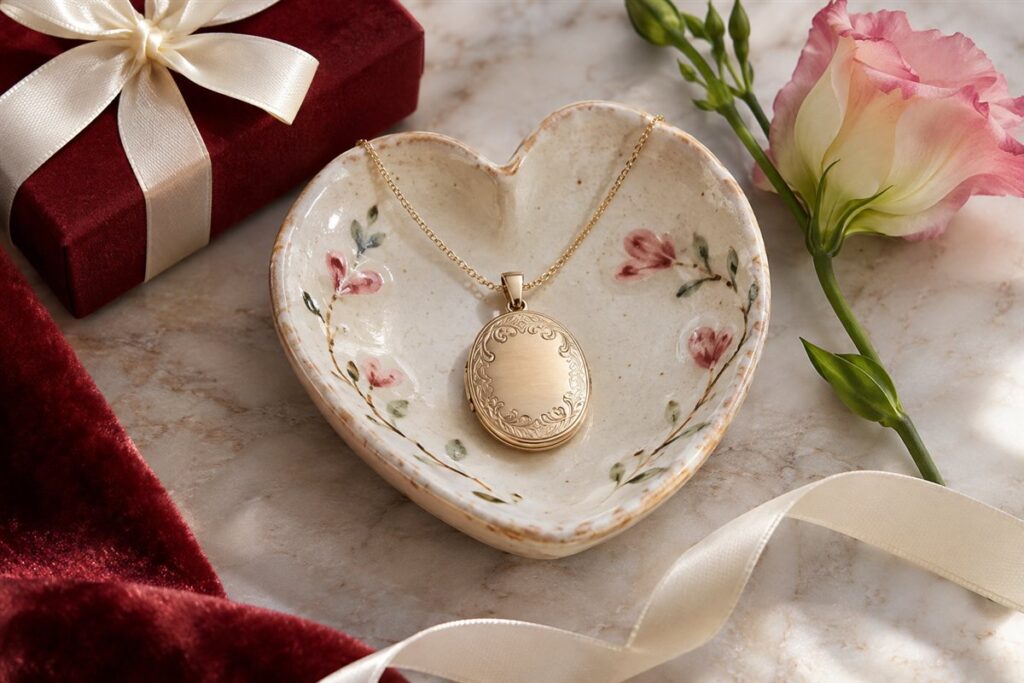
A gift feels elegant and unique when it reflects her specifically, not when it comes from an hard-to-find shop. Refinement shows in the details: a considered choice, quiet presentation and a message that only you could write. Here is how to build that, step by step.
Why Personal Detail Beats Rarity
People often search for something nobody else could find, but a rare item that does not match her taste still misses. A common item chosen with real knowledge of her feels far more special. Elegance is about restraint and fit, so think about her style, her routines and the objects she already treasures.
In this guide
Categories That Suit an Elegant Tone
- Framed photography: A single portrait or landscape from a place you visited, printed on good paper and set in a simple frame, looks refined on any wall or desk.
- A handwritten letter: Use quality stationery and write by hand. It costs little effort beyond time and sincerity.
- An evening out: A quiet dinner, a concert, a gallery visit or a ballet can feel more luxurious than any object.
- Books and stationery: A beautiful edition of her favorite novel, with a note on the first page, is lasting and personal.
- Keepsake boxes and albums: A small linen-bound photo album with ten carefully chosen pictures can become a family heirloom.
How to Choose Step by Step
- List three things she loves, such as flowers, music or travel.
- Note her taste in colors and materials. Does she prefer warm neutrals, bold tones or simple black and white?
- Choose a gift category from the list above that fits those notes.
- Decide on one personal element: a date, a quote, a photo or a place name.
- Plan the presentation with equal care.
Presentation Matters
Presentation can raise an ordinary gift to an elegant one. Choose wrapping in a restrained palette, add a ribbon, and keep the card short but specific. Hand the gift over at a calm moment rather than in a rush. If you are ordering prints or albums, look at the paper types offered and check the sizing options so the image is not cropped unexpectedly.
Gifts Built Around Shared History
The most distinctive gifts are made from things only the two of you share. A map of the place where you first met, a list of songs that marked different years, or a small book of dates and places can carry more meaning than any object bought off a shelf. The goal is not to impress with effort, but to show you remember. Choose details that she will recognize instantly, and let the design stay calm.
Start by collecting material. Look through photos, messages, tickets, menus and notes from trips. Pick a few that tell a short story. Resist the urge to include everything, because a restrained selection feels more elegant than a crowded one. A single page with three or four carefully chosen items can say more than twenty.
- A timeline of important dates, set in simple typography on good paper.
- A playlist printed on a small card, with a short note about why each song matters.
- A small collection of photographs from one day, arranged in a modest frame.
- A handwritten list of reasons, tucked into a book she loves.
Check printing options before you order. Look at the paper choices, available sizes and the proofing process, and allow time for corrections. Read the shop’s delivery estimate carefully so the gift arrives before the day.
Experiences Instead of Objects
A shared experience can feel more refined than an item, because it creates a memory rather than another thing to store. The key is to match the experience to her tastes. A quiet evening of live music suits someone who loves sound. A morning at a botanical garden suits someone who enjoys nature and photography. A cooking class suits someone who likes to learn and share. Think about what she would choose if time and money were no object, then scale it to something you can do well.
Plan the details with care. Book ahead, check opening hours, and think about transport, weather and what she will wear. A smooth experience feels thoughtful, while a rushed one can feel stressful. Bring a small keepsake, such as a printed ticket in a card, so the day has something to hold afterward.
- A gallery visit followed by a quiet coffee and conversation.
- A sunrise or sunset walk to a place that matters to you both.
- A home dinner cooked from a recipe that you made together before.
- A small trip to a place she has mentioned wanting to see.
Take a few photographs, and print one later as a follow-up gift. That ties the experience back to a physical memory without feeling forced.
Choosing Materials and Craftsmanship
If you choose an object, quality of material and craft becomes the sign of elegance. Look for simple forms, natural materials and careful finishing. A well-made leather notebook cover, a solid wood frame, a ceramic dish, or a linen-covered album feels lasting. Avoid items with loud logos or heavy decoration, which can feel less refined.
When buying online, read product descriptions carefully. Look for the materials, dimensions and care instructions, and check the shop’s return policy. Compare photographs with written details, since lighting can change how a color appears. If you can, buy from a maker who shows their process, because handmade work often varies slightly and that is part of its charm.
- Check the stitching, joins and edges in close-up photographs where available.
- Choose neutral colors that suit many settings if you are unsure of her taste.
- Think about how she will use the item daily, and whether it is practical.
- Avoid sizes you cannot verify, such as rings or clothing, unless you have confirmed them discreetly.
For personalized items, double-check spelling and dates before confirming the order. Mistakes in engraving or printing usually cannot be fixed, so proofread twice and ask someone else to read it too.
Writing the Note That Completes It
A short note often matters more than the gift itself. It gives the object a meaning and turns a purchase into a message. You do not need to be a poet. Plain, specific sentences are more convincing than elaborate phrases. Mention one memory, say what it meant to you, and say what you look forward to. Keep it to a few lines.
Write a draft first, then read it aloud. If a sentence sounds like something you would not say, change it. Remove clichés and replace them with a detail only you would know. Write the final version by hand on good paper, and take your time so the handwriting is neat.
- Begin with a specific moment, such as a conversation or a place.
- Say what you noticed or appreciated about her then.
- Describe what has changed or grown since.
- End with a simple wish or plan for the future.
Choose a card or paper that matches the tone of the gift. A plain card in a soft color works better than a bright one with printed greetings. Place the note where she will find it naturally, such as inside the cover of a book or tucked under the ribbon.
Timing, Delivery and Avoiding Last-Minute Stress
An elegant gift can be spoiled by a rushed process. Start early, at least a few weeks before the day, especially if you plan to order printed or personalized items. Check production time and shipping time separately, because a shop may need several days to make an item before it ships. Account for weekends and possible delays, and consider choosing a faster delivery option if the date is close.
Prepare a backup plan. If an item does not arrive in time, have a simple alternative such as a handwritten letter or a planned evening out. That way the day stays pleasant. Keep order confirmations and contact details in case you need to ask the seller about a problem.
- Order personalized items first, since they take longest.
- Check the return and exchange policy before you buy.
- Keep the gift hidden somewhere safe and plan how you will wrap it.
- Choose the moment to give it, ideally calm and private.
On the day, avoid distractions. Put phones away and give her your attention. The way you hand over the gift, with a few words about why you chose it, is part of the present. Let her open it at her own pace, and enjoy her reaction without hurrying to explain everything.
Learning Her Taste Without Asking Directly
The most graceful gifts come from quiet observation, and you can gather a surprising amount of information in a few weeks without ever raising suspicion. Pay attention to what she reaches for when she is relaxed: the mug she always chooses, the scarf she wears on cold mornings, the book left open on the arm of the sofa. Those small repeated choices tell you more than any wish list.
Listen for offhand remarks too. A comment about a bakery she passed, a sigh over a lost earring, or a wistful mention of a trip she never took can become the seed of a gift. Keep a running note on your phone so nothing slips away before February arrives.
Clues worth writing down
- Colors she wears often and colors she never touches.
- Whether she prefers simple lines or ornate detail.
- Things she admires in shop windows but never buys for herself.
- Hobbies she mentions with a spark in her voice.
- Small frustrations, such as a worn bag strap or a cracked case, that you could quietly solve.
If you are still unsure, ask a close friend or a sibling one casual question rather than ten. Their answer, combined with your own notes, usually points toward something that feels considered rather than random.
Gift Types Compared by Effort and Lasting Value
Before you commit, it helps to see how different kinds of presents behave once the day is over. The table below is a general guide, not a rulebook, and your own circumstances will shift the balance.
| Gift type | Personal feel | Planning needed | Lasts beyond the day |
|---|---|---|---|
| Handwritten letter with a keepsake | Very high | Moderate | Yes, often for years |
| Jewelry with a meaningful detail | High | High | Yes |
| Framed photograph or print | High | Moderate | Yes |
| Experience such as a dinner or a class | High | Moderate | As a memory |
| Flowers with a custom note | Moderate | Low | Short term |
| Consumables such as tea or chocolate | Moderate | Low | Short term |
Notice that planning effort and personal feel tend to rise together. A modest item chosen with care often beats a grand gesture that required nothing more than a quick search.
Building a Small Gift Set Around One Idea
A single object can feel lonely, while three connected pieces can tell a story. Choose one theme and let each item echo it. If she loves the evening hours, you might pair a soft throw, a candle with a scent she already enjoys, and a handwritten card describing a quiet night you would like to share. If she adores gardens, a small pot, a packet of seeds for a flower she has mentioned, and a pair of well made gloves make a charming trio.
Keeping a set elegant rather than crowded
Restraint is the difference between refined and overwhelming. Limit yourself to three pieces at most, keep the color palette tight, and let one item carry the emotional weight while the others support it. Avoid filler such as novelty trinkets that exist only to make the box look full.
Think about how the pieces will be opened, too. Placing the card on top, so she reads your words first, sets the tone before she sees anything else. Wrapping each item in the same paper and tying them with a single ribbon color gives the set a unified look without extra expense or fuss.
Mistakes That Make a Gift Feel Generic
Even thoughtful people slip into habits that flatten a present. Recognizing them in advance saves you from a polite but lukewarm reaction.
- Chasing rarity for its own sake. An obscure item she has no connection to is still just an item.
- Copying a trend. What fills every social feed this month will feel dated by spring.
- Ignoring practical fit. Check sizes, allergies, and whether she already owns something similar.
- Letting the packaging do the work. Beautiful wrapping cannot rescue an impersonal choice.
- Leaving everything to the final week. Rushed decisions rarely sound like her.
A useful test is to imagine describing the gift to a friend. If your explanation centers on where you found it, rethink. If it centers on why it suits her, you are on the right track.
Long-Distance and Last-Minute Variations
Distance does not rule out elegance; it simply changes the format. A carefully timed parcel arriving on the morning of the day, with a note telling her not to open it until evening, can create anticipation across any number of miles. A shared video call with a meal you each prepare from the same recipe turns two kitchens into one table.
If time is short, narrow your focus rather than widening it. Pick one thing you know she loves, such as a particular flower, a favorite sweet, or a book by an author she admires, and give it with a sincere, specific message. Specificity reads as effort even when the schedule is tight.
Quick fixes that still feel considered
- A printed photo from a day you both remember, placed in a simple frame.
- A playlist built from songs tied to your shared moments, with a short note for each track.
- A reservation at a place she once mentioned, presented in a handwritten invitation.
Matching the Gift to Her Personality
Elegance looks different depending on who receives it. For a private, reflective person, a gift that invites quiet time, such as a beautifully bound notebook, a well made pen, or a small piece of art for her desk, will feel more welcome than anything loud. For someone sociable and warm, think of items that encourage sharing: a set of fine glasses for evenings with friends, or a hamper designed around a picnic you will enjoy together.
A creative woman may appreciate tools that respect her craft, while a practical one may light up at an upgrade to something she uses daily and has quietly put up with for years. A traveler might value a slim travel case or a map print of a place you want to visit together. In each situation the principle is the same: choose something that supports the life she already leads rather than one you imagine she should lead.
Three personalities, three directions
- The reflective reader: a beautiful edition of a favorite book with a short inscription on the first page.
- The host: serving pieces, linen napkins, or a tray she can use whenever guests arrive.
- The adventurer: a keepsake that fits in a bag, paired with a plan for your next outing.
Working With a Modest Budget Gracefully
Spending less does not have to look like spending less. What signals refinement is coherence and care, and both are free. Limit the number of items, choose a single good quality piece instead of several mediocre ones, and put your energy into the message and presentation.
Consider making part of the gift yourself. A homemade dessert served on a table you have set with candles, a framed handwritten poem, or a small bound book of memories can feel more luxurious than something bought off a shelf. Combine one handmade element with one purchased detail, such as a single stem of her favorite flower, and the result feels balanced.
Timing also helps. Planning early gives you room to compare options, wait for sensible offers, and avoid rushed purchases that cost more in stress than they save in time. Write down what you can afford, then look for the most personal expression within that boundary. A limit often sharpens creativity, and she is far more likely to remember the thought than the figure.
Small Rituals That Elevate the Moment
How the gift is given can matter as much as what it is. Choose a quiet moment when neither of you is rushing, turn off the television, and let her open things at her own pace. A few simple rituals can lift an ordinary evening into something she will recall.
- Set the table or the room with soft lighting before she arrives.
- Offer a small toast or a warm drink as you sit down together.
- Read your note aloud, or leave it for her to read in private, depending on her temperament.
- Share a memory connected to the gift before she unwraps it.
- Leave the rest of the evening unplanned so the moment can breathe.
Afterward, consider taking a simple photograph of the two of you with the gift. Years later, the image will bring back the feeling of the occasion far better than the object alone.
A Short Checklist Before You Finalize
Run through these points a few days ahead, while there is still room to adjust.
- Does the gift reflect something I have noticed about her, not just something that looks nice?
- Have I confirmed size, color, and compatibility with what she already owns?
- Is there a handwritten element, however brief?
- Will it arrive or be ready with a comfortable margin?
- Have I checked the return or exchange policy in case I need to change my mind?
- Does the presentation match the tone I want, calm and unhurried rather than flashy?
An elegant gift rarely announces itself. It earns its place through attention, patience, and a small number of well chosen details, all of which are entirely within your reach.
How Elegance Actually Works in a Gift
Elegance is often mistaken for expense or formality, when in practice it is restraint plus precision: fewer elements, each chosen exactly. An elegant gift rarely tries to say everything at once. It picks one true thing — her love of a particular flower, the city where you met, the author she rereads, the colour she reaches for — and expresses it cleanly, without garnish competing for attention. That is why elegant gifts photograph modestly and land deeply: the value is in the fit, and fit is invisible to anyone who does not know her.
This also explains why copying a luxury list so often disappoints. The list supplies objects; elegance requires a match between object and person. A scarf in the precise shade she wears, chosen because you noticed, will outrank a famous label in a colour she never touches. Before you shop, write down three specifics about her — a taste, a habit, a small luxury she denies herself — and let those three lines do the choosing. Retailers are excellent at selling what is generally desirable; your job is the much narrower one of what is desirable to her.
The role of quality she can feel
Where elegance does touch cost is in materials and finish, because she will handle the gift long after the day. Natural fibres that soften rather than pill, paper with weight, metal with a clean edge, chocolate that tastes like its ingredients — these register in the hand before the eye. You do not need the finest version of anything; you need the version without the small cheapnesses — the scratchy seam, the flimsy box, the scent that smells synthetic at close range. One well-finished object beats a hamper of almost-nice things, because elegance is partly the absence of almost.
Occasions Within the Occasion: Matching the Gift to the Moment
Valentine’s Day contains several different moments, and an elegant gift knows which one it belongs to. A gift given in the morning, before the day begins, sets a tone and suits something she will carry or wear through the day. A gift at dinner suits ceremony — something revealed, unwrapped, responded to across a table. A gift left for the evening’s end suits intimacy and reflection: the letter, the book, the small object with a history. Choosing the moment first prevents the common muddle of a breakfast gift with a black-tie soul, or a grand object handed over in a car park because the day never offered it a stage.
If you are celebrating across distance, the moment must be built rather than found. Agree a time to open together by video if that suits you both, or let the gift arrive with instructions that create the pause — a note on the outside asking her to open it somewhere quiet, with tea, after work. Elegance survives postage perfectly well; what it cannot survive is being opened absent-mindedly between errands. A sentence of staging from you protects the gift’s whole purpose.
When the relationship is new
Early elegance is lightness with good taste. Choose something small, beautiful and easy to receive — a single variety of flower she mentioned, a slim book of poems or essays in her field of interest, fine chocolates from one maker rather than a mountain of mixed sweets. Avoid heirlooms, inscriptions of permanence and anything that requires her to perform gratitude beyond the moment. The elegant new-relationship gift leaves her smiling and free, which is exactly the feeling that makes a second season of gift-giving more likely.
When you have been together for years
Long relationships earn the right to depth. This is where the gift built on shared history belongs: the first-edition hunt, the restoration of something she owns and loves, the experience that revisits a place with meaning, the piece commissioned from a maker whose work she admires. Elegance here is not novelty but recognition — proof that the years have been noticed and catalogued with affection. Keep one element of surprise in reserve, though; a gift that is entirely predictable, however perfect, loses the small electricity that makes the day feel different from a birthday.
The Note Is Part of the Gift, Not Its Packaging
For an elegant gift, the note carries unusual weight, because restraint in the object invites expression in the words. Write it by hand if your hand allows, on plain card, in ink. Say the specific thing: not that she is wonderful in general, but the moment this year when she was, in particular, and what it meant to you. Specificity is the note’s version of quality materials — it cannot be faked, substituted or bought at the last minute, and she will keep the card long after she has finished the chocolates.
Length matters less than temperature. Three true sentences outrank a page of borrowed ardour, and a touch of humour, if humour is your shared language, keeps elegance from stiffening into ceremony. End with an invitation rather than a declaration where you can — to the dinner, the walk, the trip the gift hints at — because the best elegant gifts open a door instead of closing a performance. Then stop writing. The urge to add one more paragraph is the note’s version of over-wrapping.
Presentation details that register
Wrap simply and well: plain paper that suits the object, one ribbon, no novelty print unless the joke is truly hers. Remove price tags and any branding that shouts. If the gift has a natural partner — the book and the reading light, the flowers and the vase she already owns cleaned and ready — arrange for the partner silently rather than explaining it. Elegance in presentation is mostly the removal of friction between her and the object: nothing to untangle, nothing to decipher, nothing to pretend to like.
Learning Her Taste All Year, Without Turning It Into Surveillance
The elegant givers are not more talented; they keep a small, kind record. When she admires something in a window, mentions a maker, lingers on a page, or says she has always wanted to try something, note it in your phone in her words. By February the list chooses the gift for you, and the choice carries a year’s evidence that you listen. Keep the note factual and affectionate — this is a memory aid for generosity, not a dossier — and let it include dislikes too, which are just as valuable: the scent that gave her a headache, the style she laughed at, the flower she is allergic to.
The same record rescues you in years when money or time is short, because it is full of small true things. The elegant gift in a lean year is the modest item from the list, beautifully presented, with a note that proves the noticing never stopped. She will not measure the gift against other years; she will measure it against whether she feels known, and the record is how you keep answering yes.
Three Elegant Directions, Compared Honestly
The object, the experience and the gesture each carry elegance differently. An object endures and can be revisited daily, but risks missing her taste in a way that sits visibly on a shelf. An experience cannot miss in the same way and creates shared memory, but leaves nothing to hold and depends on dates, energy and weather aligning. A gesture — the arranged morning, the recreated first date, the day quietly reorganised around her ease — costs the least and risks the most sentimentality, succeeding entirely on execution. Choose by her current season of life: the exhausted year calls for the gesture or the experience that restores; the year of building a home together suits the object that will live in it; the year of distance suits the object that travels and stays.
Combining two is allowed and often best — a small object that announces an experience, a gesture that ends with a letter — provided the combination stays legible. The moment a gift needs explaining, elegance has left the room.
A Worked Example From Ordinary Materials
Picture a giver with a small budget and a partner who loves mornings, old bookshops and the colour green. The gift becomes: a slim second-hand hardback by her favourite essayist, found in the right shop over two weekends of looking; a card on plain stock naming the morning last autumn when she read aloud in the kitchen; the book wrapped in brown paper with a green ribbon, left beside the kettle she uses first. Nothing in the list is luxurious. Everything in it is hers. That is the whole theory of this article executed for the price of a sandwich, and it will be kept on the shelf — and in the story she tells — long after grander gestures blur.
Finally, let the day itself be elegant in the small sense: unhurried, attentive, free of phones at the table and free of scorekeeping about whose gesture was grander. The gift is one sentence in the day’s conversation. Make the whole conversation kind, and the sentence will be quoted for years.
Elegance on a Modest Budget, Without Apology
A small budget disciplines elegance beautifully, because it forbids the volume strategy entirely. Spend the whole amount on one thing done properly: the single variety of flowers arranged well, the slim hardback instead of the pile of paperbacks, the one maker’s chocolate instead of the mixed mountain. Then invest the savings in the free elements — the handwritten note, the chosen moment, the tidy presentation — which are, not coincidentally, the elements recipients describe years later. Never apologise for the gift’s size in the card or aloud; apology instructs her to see smallness where she would otherwise have seen precision.
If money is genuinely tight, the gesture route is your elegance: a morning reorganised so she wakes slowly, her favourite breakfast made properly, a walk to a place with meaning, a letter that says the year’s true things. Executed with care, a gesture outperforms objects at many times its cost, because what it spends — attention, time, forethought — is the currency elegance was always denominated in.
When to break the rules of restraint
Restraint is a default, not a law. If her joy is abundance — if she lights up at armfuls, exuberance and more — then elegance means abundance executed with taste: many flowers of one kind rather than a jumble, a table full of her favourite foods rather than random plenty. The principle underneath never changes: everything chosen, nothing random. Follow her delight, not the rulebook, whenever the two disagree.
Underneath every technique in this guide sits one disposition: pay attention all year, choose once with confidence, present with calm. Elegance is not a budget or a brand. It is the visible shape of being known by someone who bothered.
FAQ
How do I find something that feels one of a kind?
Build it from your shared history. A photo from a trip, a line from a song you both love or a recipe you cooked together cannot be found in a shop, which is exactly why it feels unique.
Should an elegant gift be expensive?
No. Care, fit and presentation matter more than cost. A modest gift chosen with insight is more refined than a lavish one chosen at random.
What if I do not know her taste well?
Pay attention to what she already wears, reads and displays at home. You can also ask a close friend or family member for quiet hints, and choose neutral, well-made items.
Is a handmade gift more elegant than a store-bought one?
Not automatically. Care, taste and fit matter most. A simple handmade item can be lovely, and a carefully chosen purchased item can be just as thoughtful.
How early should I order a personalized gift?
Order as early as you can, ideally several weeks ahead, because making and shipping can both take time. Check the shop's stated timelines.
How do I wrap a gift elegantly?
Use plain paper in a muted color, a simple ribbon and a short handwritten card. Keep the folds neat and avoid too many decorations.
Can an experience gift work if we live far apart?
Yes. You can plan a shared virtual evening, send a package with ingredients for a meal, or schedule a visit. The key is to prepare in advance and give it your full attention.
Should I include flowers?
Flowers can complement a gift, but choose them to suit her taste and any allergies. A small, simple arrangement often feels more refined than a large bouquet.
What if the gift arrives late?
Have a note or a small stand-in ready, and tell her the gift is on its way. A sincere explanation and a thoughtful plan usually mean more than the timing.
How do I make a simple gift feel elegant rather than plain?
By precision at every small step: the right variety rather than the generic bunch, the card written for her rather than printed with a slogan, the wrapping plain and neat, the moment chosen rather than accidental. Plainness becomes elegance when every detail agrees with every other detail and all of them point at her specifically. If you can only improve one element, improve the note — it is the cheapest part of the gift and the one she will reread.
Is jewellery a safe elegant choice?
It is safe when it matches what she already wears: the same metal family, the same scale, the same level of ornament. Look at her everyday pieces before you shop, and buy within that language — a variation she will recognise as hers rather than a statement she must adapt to. Avoid sets that decide her whole look at once, and be cautious with anything that imitates a more significant piece’s role. Jewellery chosen by observation is elegant; jewellery chosen by price band is a gamble wearing a nice box.
What if her taste is more playful than classic?
Then elegance means honouring her playfulness with the same precision: a beautifully made version of the whimsical thing, chosen in her colours, finished properly, presented with restraint. Elegance is not a style imposed on her; it is the quality of the choosing and the making. A witty, well-crafted object that fits her humour exactly will feel far more elegant to her than a solemn classic that belongs to someone else’s Valentine’s Day.
How early should I start for a commissioned or personalised gift?
Earlier than feels necessary. Makers work to order books that fill well before the day, and personalisation adds stages — proofs, curing, engraving, posting — each with its own delay. Begin the conversation as soon as you have the idea, confirm the delivery date in writing, and have a graceful understudy gift in mind in case the piece slips. A personalised gift that arrives a week late with apologies is a story; the same gift planned early is a triumph.
Can an elegant gift be an experience rather than an object?
Yes — often the most elegant option of all, because it leaves no clutter and creates the memory directly. Choose an experience with the same specificity as an object: the restaurant tied to your history rather than the famous one, the concert of music she loves rather than the prestigious one, the class in the skill she keeps mentioning. Present it beautifully — a card describing the plan, the date held, the details handled — so the experience arrives as a gift rather than as a suggestion she must organise.
What should I avoid if I want the gift to feel refined?
Avoid volume as a substitute for thought: oversized arrangements, baskets of unrelated items, and anything whose main quality is that there is a lot of it. Avoid slogans printed on objects, novelty items that mock the occasion, and gifts that require her to display affection publicly on demand. Above all, avoid the last-minute grab whose only message is the date. Refinement is mostly subtraction, and the bravest elegant move is often to give less, better.
Should I ask her friends or family for ideas?
Yes, selectively: one person who knows her taste and can keep a confidence is worth more than a committee. Ask narrow questions — which of two directions suits her better, whether she already owns the thing, what size or scent she prefers — rather than open ones that invite a generic answer. And keep the final choice yours; a gift that smells of consultation loses the intimacy that makes it elegant, even when the advice was excellent.
What if she says she wants nothing?
Believe the spirit rather than the letter. Most people who say it mean they want no fuss, no waste and no obligation — not that they want to be unremembered. Answer with the lightest elegant form: a single flower, a note, a small experience of time together, given without ceremony. Honouring her stated wish while quietly marking the day is itself an elegant act, and it will be remembered as one.
Almost incidental — but chosen, still, with love.
Give her that, and the object in the box becomes almost incidental to the gift she actually receives.
Elegance, in the end, is simply care that has learned good manners.
Do that, and the gift almost chooses itself — because by February, the answer is usually sitting in your notes, waiting to be wrapped plainly and given calmly at exactly the right moment of the day.
Trust this order of operations: notice all year, decide once, write the note by hand, choose the moment, and then let the gift speak without commentary, defence or apology of any kind.
How do I choose between flowers and a lasting object?
Choose flowers when the moment matters most and her delight in them is real; they are the elegant gift of pure present tense, and their brevity is part of their honesty. Choose the lasting object when you have found the specific thing — the one that fits her taste so precisely it deserves permanence. If you are torn, a small lasting object with a single stem alongside it lets each do its own work without either shouting.
What is the most reliably elegant gift of all?
The one that could only have been chosen for her, by someone who had been paying attention — whatever it happens to be. If you cannot yet name such a thing, that is not a shopping problem; it is information about where to aim your attention between now and next February, and the notes habit described above is how the answer arrives.
Is it elegant to give money or a voucher?
Usually it reads as administration rather than affection, however generous the amount, because it hands the choosing back to her. The exception is the voucher with a story: credit with the specific maker she loves, presented with a note naming the piece you hope she will choose and why you thought of her wearing it. That framing keeps your attention inside the gift while leaving her the final say, which some recipients genuinely prefer.
How do I recover if the gift misses?
Gracefully and without making her manage your disappointment. If she is lukewarm, let the moment pass lightly, keep the receipt’s options open without announcing them, and file the lesson in your notes for next year. A miss handled with humour and no sulking is barely remembered; a hit followed by neediness is remembered worse than a miss. Elegance includes how you behave after the wrapping comes off.
How do I wrap flowers or other awkward shapes elegantly?
Let the florist’s plain paper and a single ribbon do the work rather than fighting the shape with boxes and bows; awkward objects wrapped simply look intentional, while awkward objects wrapped elaborately look apologised for. Carry them upright, present them stem-first with the note visible, and have the vase ready if the flowers are coming home. The elegance is in the handling as much as in the wrapping.
The Short Version
For an elegant Valentine gift, choose something that fits her taste, add one personal element and present it with care. Framed photography, a handwritten letter or a quiet evening out are all strong options. Uniqueness comes from knowing her, not from searching for rarity.
Related Guides
- Romantic Valentine's Day Gift Ideas for Your Girlfriend, Her Way
- Stunning Valentine Gifts for Her: Presentation Ideas That Wow
- Unexpected Valentine's Day Gift Ideas for Your Girlfriend
- Layered Valentine Gift Ideas to Unwrap Slowly, Step by Step
- Personalised Valentine Gift Ideas: Names, Dates and Photos
