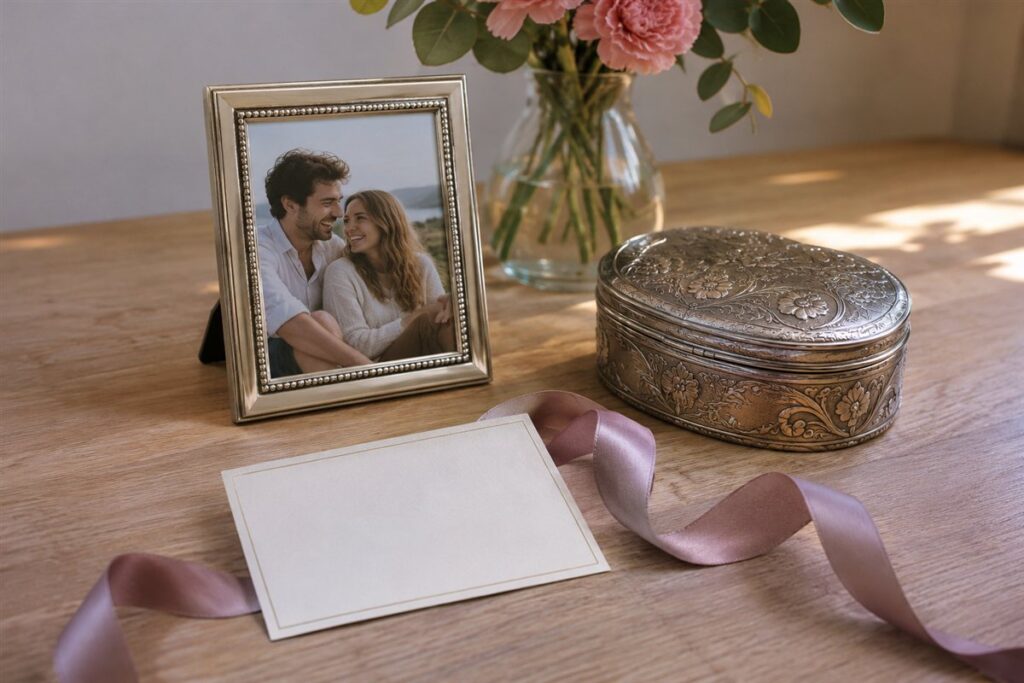
Personalised gifts work when the customisation says something real, such as a meaningful date, a shared place or a picture you both love. Adding a name alone is rarely enough. Here are the main personalisation types and how to get each one right.
Type 1: Names and Initials
These are the simplest and the most common. Use them sparingly and choose a format that suits her taste.
- Check the spelling of any name twice, including nicknames.
- Use a simple font; very ornate styles can be hard to read.
- Consider initials for a subtle effect.
In this guide
Type 2: Dates and Coordinates
A date or a set of map coordinates can mark a first meeting, a trip or a proposal. They are subtle, and only the two of you know the meaning. Confirm the date format you prefer and double-check the numbers before ordering.
Type 3: Photos
Photo-based gifts are among the most personal. Choose pictures with these traits:
- Sharp focus and good light, since blur is more visible in print.
- A clear subject, so details are not lost at smaller sizes.
- Both of you looking natural.
- Room around the edges, so cropping does not cut faces.
Options include prints, framed pictures, albums or a series arranged as a collage. Check the sizes and layouts offered and look at the layout view before you confirm.
Type 4: Words and Voice
- A short poem or a lyric that matters to you both, handwritten.
- A letter in your own handwriting, placed in a frame.
- A recorded message saved for her to play when she likes.
Choosing the Right Type
| She is | Choose |
|---|---|
| Subtle and private | Dates, initials or coordinates |
| Sentimental | Photos and albums |
| Literary or musical | Words, lyrics or voice |
| Lighthearted | Playful names and inside jokes |
Timing and Quality
Made-to-order items need production time, so order early and keep a handwritten note as a backup. Proofread everything, since errors are hard to fix after printing.
Avoiding Common Slips
- Do not crowd a small item with too many lines of text.
- Check that a photo is large enough for the print size you choose, since small images can look soft when enlarged.
- Ask a friend to read the final text before you confirm.
- Keep a copy of your chosen wording and images in case you need to reorder.
Matching the Gift to the Person
A personalised gift lands best when it reflects how the receiver actually lives. Before choosing a format, think about what they use every day, what they display and what they keep private. Someone who works at a desk may enjoy a small item that sits near the screen, while someone who travels may prefer something that fits in a bag. A person who dislikes clutter may value a slim print or a digital keepsake over a bulky object.
Think about their taste in style as well. Some people love bold, decorative items, and others prefer quiet, minimal designs. If you are unsure, look at what they already wear, display or buy for themselves, and choose in the same spirit. Notice the colors in their home and wardrobe, and choose materials that match.
- Ask yourself whether they like public gestures or private ones.
- Consider whether they will use the gift or keep it as a memory.
- Think about how they feel about having their name or face on things.
- Ask a close friend or relative for a hint if you are stuck.
The more the gift fits their routine and taste, the more personal it feels, even when the customisation itself is small.
Checking Materials and Print Quality
Personalised items vary widely in how they are made, so read the product listing carefully. For engraved or printed items, find out what material is used, how the design is applied and how it is likely to wear. Printed surfaces may fade or scratch with use, while engraving tends to be more lasting, but details vary by product, so check the listing rather than assuming.
For photo products, ask about the paper or surface, the print size and whether a proof is shown before production. Colors on screen can look different in print, so a preview helps. If the seller lists a minimum resolution for uploaded images, follow it. Low-resolution pictures may look soft or pixelated at larger sizes.
- Look at customer photos if the seller provides them, with the caution that lighting varies.
- Check care instructions, such as whether an item can be washed or must be kept dry.
- Check the size in measurements, not only in descriptive terms.
- Ask about packaging, especially for fragile items.
A simple, well-made piece is usually better than an elaborate one with poor finish.
Ordering Timelines and Delivery
Personalised items are usually made to order, so they take longer than ready-made gifts. Production time is separate from shipping time, and both can lengthen during busy periods around Valentine’s Day. Check the seller’s stated production time, the delivery estimate and any cutoff for guaranteed delivery.
Plan backward from the date. Allow time for proofing, corrections and any delay. If the seller offers a preview, review it quickly to avoid losing days. Think about what happens if something goes wrong: do you have time to reorder, or a simple backup gift?
- Order early rather than waiting for the last week.
- Confirm the delivery address and whether someone will be there to receive the parcel.
- Keep the order confirmation and contact details.
- Ask whether tracking is provided.
If the timeline is tight, consider a digital option, such as a printable file or a message, and add a small physical item that you can obtain quickly. That way the gesture is on time even if the main gift arrives later.
Presentation and the Moment of Giving
How you present a gift adds to its meaning. A plain box with a handwritten note can feel more personal than elaborate wrapping. Choose a note that explains why you picked the customisation, such as the memory behind a date or the story of a photo. A sentence or two is enough, and speaking from the heart matters more than perfect phrasing.
Think about timing and setting. Some people enjoy a surprise at breakfast, while others prefer a quiet moment in the evening. Avoid giving something deeply personal in front of a crowd unless you know the receiver would like that. If the gift includes a photo or message, consider how private it is.
- Wrap the gift in a way that protects it.
- Keep the receipt or order details in case of problems, but do not include prices.
- Prepare a backup plan if delivery is late, such as a handwritten card to hand over.
The moment of giving is about attention. Put your phone away, give the person time to open it and listen to their reaction.
Avoiding Awkward or Regrettable Personalisation
Because personalised items cannot easily be resold or returned, take care to avoid choices that you or the receiver might regret. Be cautious with text that may become awkward later, such as references that depend on a certain stage of a relationship, or jokes that only land once. Choose wording that you would be comfortable seeing in a year.
Consider privacy. Items that show full names, addresses, birth dates or location details may reveal more than intended if displayed in a public place or shared in photos. Initials or symbolic details can carry the same meaning with less exposure.
- Proofread twice, and ask someone else to check spelling and numbers.
- Check the cancellation and return rules before paying.
- Avoid using other people’s photos without their consent.
- Do not choose a design that clashes with the receiver’s style just because it was popular.
If you are unsure, pick a gift with a flexible element, such as a replaceable photo insert or a plain engraving, which lets the receiver adapt it as their taste or circumstances change.
Begin With the Person, Not the Product
The strongest personalised gifts begin with a clear picture of the person who will receive them. Think about what they collect, what they quietly love and what they would be amused or moved to see. A gift that shows you have paid attention often matters more than the item itself. Jot down a few memories: the place of your first trip, a song you both know, an inside joke or a nickname used only at home. Those details are the raw material for something that cannot be bought off a shelf.
Consider their taste too. Some people enjoy bold, visible gifts, while others prefer something small and private that sits in a drawer or on a bedside table. If you are unsure, lean toward understated. A quiet, thoughtful object rarely misses, while a very showy one can feel awkward. Ask a close friend or relative for guidance if you cannot decide, but keep the surprise.
Comparing Personalisation Types at a Glance
The table gives a quick view of what suits which situation. Use it to narrow the field before you browse.
| Type | Works best when | Watch out for |
|---|---|---|
| Names and initials | You want something simple and elegant | Spelling mistakes and awkward fonts |
| Dates and coordinates | A moment or place matters to you both | Wrong digits or wrong format |
| Photos | A shared memory is vivid and well photographed | Low quality images and bad crops |
| Words and voice | You can write or record something honest | Over-long text and cliches |
| Handmade or custom crafted | You want a one-of-a-kind item | Long production times |
Working Out a Realistic Timeline
Personalised gifts take longer than ordinary ones, because they are made after you order. Production, quality checks and delivery all add days, and a busy season stretches the schedule further. Look at the seller’s stated production time and delivery estimates, then add a generous buffer. If the item is for a date that cannot move, order early and keep your order confirmation handy.
A simple working-back plan
- Decide on the date you want the gift in your hands, a few days before the occasion.
- Subtract the delivery time stated by the seller.
- Subtract the production time as well.
- Allow extra days for proofing, corrections and unexpected delays.
- Order by the date you reach, or choose a quicker option if you are late.
If you are running out of time, switch to something you can finish yourself, such as a handwritten letter or a printed photo in a simple frame.
Proofing Every Detail Before You Pay
Most disappointments with personalised items come from errors that could have been caught. Read your text out loud, slowly, and then ask someone else to check it. Confirm spellings of names, the format of dates and the placement of any punctuation. Look at the proof image the seller provides, and zoom in on every edge. Check that the design fits the item’s shape and that nothing is cut off.
Think about the font as well. Fancy scripts look lovely in small amounts, yet they can be hard to read at small sizes. A clean font is often a safer choice for names and dates. If an order form lets you add notes, state your requests clearly and keep them short. Take a screenshot of your final design before you confirm, so you have a record if a problem arises.
Keeping the Message Honest and Warm
Words on a gift carry weight, so choose them with care. Avoid generic lines that could belong to anyone. Instead, use something only the two of you would understand: a short phrase, the name of a favourite place or a line from a shared song. A few well-chosen words usually feel warmer than a long paragraph.
Remember that gifts can be seen by others. If the item will sit in a public place, such as an office desk, think about whether the text suits that setting. A very intimate message might be better on the back or the inside. Tone matters too: humour can be lovely, but check that it matches the person’s sense of fun.
Gifts That Grow Over Time
Some gifts become more meaningful each year. A photo book that you add to annually, a jar of notes opened on each anniversary or a charm bracelet that gains a new charm every year invites you to continue a tradition. These ideas turn a single gift into a shared habit.
- A yearly letter kept in a box and read on the same day.
- A collection of tickets, maps and postcards from places you have visited together.
- A recipe book of meals you have cooked as a pair.
- A playlist or a set of voice notes saved and added to.
Such gifts ask for time rather than money, and they often mean more than expensive objects.
Presentation That Adds to the Surprise
How you give a gift shapes how it is received. Choose wrapping that matches the person, whether that is simple paper with a ribbon or a handmade card tucked inside. Pick a quiet moment, free from distractions, and let them open it without rushing. If the gift has a story, tell it briefly, without over-explaining.
Consider adding a small handwritten note. Even a single line about why you chose this gift gives it extra depth. If the item arrives late, do not panic: present the order confirmation or a picture, and promise the real thing soon. Honesty and warmth almost always smooth a delay.
Sensitive Situations and Gentle Alternatives
Not every relationship is ready for a deeply personal gift. In a new relationship, a very intimate item can feel like pressure. In a long relationship, a gift that repeats an old joke may feel stale. Think about where you are and aim for something that suits the stage you are in. Light, playful gifts suit early days, while meaningful keepsakes suit long partnerships.
If you are shopping for someone who values privacy, avoid putting full names or sensitive details on visible items. If the person dislikes clutter, choose a consumable gift, such as a custom-labelled food item or a printed experience voucher. Finally, keep receipts and read the seller’s terms on returns, since personalised products often cannot be exchanged once made.
Occasion-by-Occasion Ideas
Different stages of a relationship call for different kinds of gift, and matching the idea to the moment keeps it from feeling forced. Each of the ideas below can be adapted to your own story, so treat them as prompts rather than rules.
Early days
Keep things light and warm. A small item with a shared joke, a printed photo from a recent outing or a handwritten card feels sincere without being heavy. Avoid anything that implies far more commitment than you have discussed.
A first anniversary
A date-based keepsake works well here, such as a framed print of the night sky from a special evening or a small piece of jewellery engraved with a short phrase. Add a note recalling the moment you remember best.
Long partnerships
By this point, the best gifts often show how well you know each other. A book of memories, a map marking every place you have lived or visited together, or a recording of family voices can carry great meaning.
A long-distance relationship
Think about gifts that bridge the gap, such as matching items, a shared playlist, a care package with local treats or a set of letters to open on particular days. Include something that smells or feels familiar, because small sensory details can comfort someone far away.
Budget Planning Without Losing the Meaning
A thoughtful gift does not need a big budget. Decide a comfortable limit before you begin, then see where the money does the most good. A well-framed photograph, a custom-made card and a favourite meal cooked at home can create a richer evening than a costly object bought in a hurry.
When you do buy a personalised product, compare what is included. Some sellers offer free proofs or gift packaging, while others charge extra for small changes. Check delivery costs, and read the policy on mistakes, so you know what happens if the seller makes an error. Spending a little on quality materials, such as solid wood, good paper or proper metal, often pays off more than adding extra features.
- Set a limit and stick to it.
- Compare two or three sellers, including their proofing options.
- Put the budget into the part of the gift that gets used or seen most.
- Keep one inexpensive handmade element, like a note, in every gift.
Handmade Personal Touches You Can Add Yourself
Even when you buy the main gift, a personal touch from your own hands makes it feel complete. Write a short letter describing three moments you treasure. Create a small collage of tickets and photographs. Record a short voice message and place a printed code or card that leads to it. Press a flower from a place you both love and tuck it into a card.
These touches require little skill and no expensive tools. What matters is sincerity and detail. Instead of saying that you are happy to know the person, mention a specific afternoon, a phrase they said or a small habit you adore. Specific memories feel more real than general praise, and they give the person something to keep and reread long after the day has passed.
Packaging and Delivery Choices
If you send the gift by post, consider where it will arrive and whether the recipient will be there to receive it. A surprise can be spoiled if it lands on a doorstep when the person is not at home, or if it is opened by someone else. Ask about delivery tracking and choose a signed-for service when available. If the gift is going to a workplace, check whether that is acceptable.
Look at how the seller packs items, since fragile pieces need padding. Opening the gift in a plain box is fine, so long as the item inside is protected. When you wrap it yourself, keep a small amount of paper and ribbon ready in case the original packaging is plain. If you travel with the gift, carry it in your hand luggage to avoid crushing, and keep any delicate engraving away from rough handling.
Choosing Words That Will Still Mean Something in Ten Years
An inscription is the longest-lived part of any gift, and it deserves to be chosen with a decade in mind. Fashions in phrasing date quickly: the joke that is everywhere this year will need explaining in five years, and the nickname of the moment may not survive the relationship’s next chapter. The inscriptions that age well are built from the permanent materials — names, real dates, real places, and short statements that were true when written and will stay true. When you are choosing between a clever line and a true one, choose the true one. Cleverness is a garnish; truth is the meal, and personalised gifts are kept for the meal.
Brevity is the other protection. Engravers and printers charge by space, but the real argument for few words is that few words can be perfect. A long inscription multiplies the chances of an error, a crowding, a phrase that reads awkwardly aloud. If the message you want to send is long, the gift is the wrong vessel for all of it: put the short, permanent sentence on the object and the long, living one in the card. That division of labour — object for permanence, card for eloquence — produces personalised gifts that feel composed rather than crammed.
Dates, Coordinates and the Stories They Carry
Dates and coordinates work as personalisation because they are passwords to shared memory: meaningless to strangers, complete to the two of you. Choose the reference with care. The date everyone celebrates is safe; the date only the two of you would choose — the first conversation, the delayed train, the ordinary Tuesday that turned out to be the beginning — is better, because its privacy is the point. If you use coordinates, use a place that still exists in the form you remember, or accept that a changed place adds a bittersweet note you may not intend. And double-check the figures with the same rigour as a name: a transposed digit in a coordinate points at the wrong town, and the error will be engraved with total confidence.
Photographs on Gifts: Choosing the Image That Prints Well
Not every beloved photograph makes a good printed gift, and the difference is technical before it is sentimental. Printing processes compress detail, soften contrast and shift colour, so the images that survive best are clear, well lit and simple in composition: faces large in the frame, backgrounds uncluttered, no vital detail lurking at the edges where cropping will eat it. A photograph that lives happily on a bright phone screen may be too dark, too small or too busy for a mug, a cushion or a canvas, and the seller’s cheerful assurance that any photo will do should be read as marketing rather than as advice.
Ask, where the service allows, for the print area to be shown on your actual image before you pay, and view that preview at the size the finished object will be. Faces that will print at the size of a coin need to be chosen for expression rather than detail. Group photographs, so tempting for family gifts, are the hardest of all to print well on small objects; a two-person image with space around it will almost always give the recipient more pleasure than a crowd reduced to specks. If the perfect moment exists only in a group shot, consider the larger formats, where every face keeps its dignity.
Rights, Consent and Other People’s Photographs
A quiet word about photographs of other people. Printing a partner’s own photograph for them is straightforward; printing photographs that include friends, colleagues or children deserves a moment’s thought about whether everyone pictured would be comfortable as a gift. Children in particular cannot consent, and a personalised item featuring someone else’s child should be cleared with the parents first, however warm the intention. These are small courtesies that cost a single message and prevent the particular awkwardness of a gift that has to be explained to a third party.
Materials and Making: Reading a Listing Like a Craftsperson
Two listings can show near-identical photographs of a personalised item and deliver objects of very different quality, because the differences live in the materials and the method, which photographs conceal. Learn the vocabulary of the category you are buying: whether a design is engraved, etched, printed or vinyl-applied decides how it will wear; whether a wooden item is solid or veneered decides how it will age; whether metal is plated or solid decides whether the inscription outlives the finish. Sellers of well-made things usually describe their methods proudly and precisely. Vague listings that dwell on feelings and omit methods are asking you not to ask, and you should ask — or buy elsewhere.
Care instructions are a quality signal hiding in plain sight. A maker who tells you how the piece should be cleaned, kept and handled is a maker who expects it to be kept — which is the whole premise of a personalised gift. A listing with no care information may still be fine, but it has missed the chance to prove it thinks in years. For gifts intended to be used daily — keyrings, wallets, kitchen pieces — this matters doubly, because daily use is a harsh examiner and only honest materials pass it gracefully.
The Handmade Premium, Judged Fairly
Handmade personalisation costs more and takes longer, and the premium buys specific things: a human checks your inscription, small irregularities give the piece its individuality, and the maker can often accommodate the unusual request — the odd spelling, the foreign alphabet, the symbol with private meaning — that automated services reject. Judge the premium by those benefits rather than by romance. If your personalisation is standard and your timeline is tight, a good automated service serves you better. If your message is unusual or the object will be handled daily for years, the maker’s hands are worth their price.
When Personalisation Is the Wrong Choice
For all its power, personalisation has cases where it subtracts rather than adds, and a thoughtful buyer knows them. Do not personalise what she may need to exchange — clothing of uncertain size, technology she may want in a different specification — because the inscription that makes a gift unreturnable also makes a wrong choice permanent. Do not personalise in the first weeks of a relationship at a scale that assumes a shared history you have not yet built; a small, light inscription is charming, while a declaration engraved in metal can feel like a contract presented for signature. And do not personalise a joke at her expense, however affectionate, on an object designed to be kept: jokes are for cards, which can be laughed at and put away, not for objects that must be lived with.
The alternative in each case preserves the intention without the risk. Personalise the card, the wrapping or an accompanying small keepsake, and let the main gift stay exchangeable, proportionate or kind. Thoughtfulness is the goal; engraving is only one of its instruments, and the buyer who knows when not to use it will produce, over the years, the gifts that are kept longest.
The Personalised Gift as an Heirloom in Miniature
It is worth pausing on why these objects, of all gifts, are the ones found in drawers and boxes decades later when houses are cleared and lives are reviewed. A personalised gift cannot be absorbed into the general stock of things, because it fits no one else; it cannot be regifted, rarely sells, and so it survives — carrying its names and dates forward into a future the giver will not see. That survival is the gift’s deepest property, and it argues for a certain seriousness at the ordering screen: the words you choose may be read by grandchildren. Choose them the way you would choose words for any small monument — few, true, and kind — and choose the object as its plinth: sound enough to carry them for as long as they deserve to be carried.
This is also why the humblest personalised objects often outlast the grandest. The engraved keyring that was carried daily for thirty years is worn to a shine no cabinet piece achieves, and its inscription, softened by a life of pockets and doors, has been read by use itself. If you want your gift to become an heirloom, do not aim at grandeur. Aim at usefulness in good materials, with true words, and let time do the ennobling — it is better at it than any of us.
A Final Proofreading Ritual
End with the ritual this guide recommends above all others, because it guards everything else. Before you pay for any personalised gift, read the inscription three times in three ways: once as typed, checking each character; once aloud, listening for the phrase that sounded fine silently and clumsy spoken; and once as the recipient, imagining the object in your own hands on the morning it is given. Three readings, one minute, and the commonest disasters of the entire category — the wrong date, the misspelled name, the joke that curdles — are quietly prevented. Personalisation rewards the careful out of all proportion to the effort, and there is no cheaper minute in the whole of gift-giving than that one.
What You Are Really Giving
Strip the category to its essence and a personalised gift is a sentence made solid: someone thought about a specific person, at a specific time, and left evidence. The names and dates are only the grammar of that sentence. Its meaning is the attention behind it, which is why a modest object, exactly right, moves people more than a splendid one that could have been given to anyone. Keep that hierarchy in view through every choice in this guide — the person first, the words second, the object third — and your personalised gifts will do what the best of them have always done: outlast their occasion and go on saying the sentence, in a drawer, on a shelf, in a hand, for years.
Group Gifts With One Inscription
Personalisation has a social form worth mastering: the group gift, where several givers share one object and its inscription must carry them all. The craft is in the words’ democracy — names ordered by a principle nobody has to negotiate (alphabetical is the peacemaker), a message that speaks in one voice rather than as a committee’s minutes, and a date that anchors the occasion. Agree the exact text in writing among the givers before ordering, character by character, because group gifts fail on the unexamined assumption that everyone meant the same spelling of the same sentiment. One person should own the order, one person should proof it, and they should not be the same person — the four-eyes principle that professional engravers use applies with equal force to friends buying a tankard.
The presentation of a group gift deserves the same coordination. Decide who gives it, when, and what is said, so the object is not produced awkwardly by a crowd each waiting for another to speak. One voice, one sentence of explanation, and then the object in the recipient’s hands: that is the form, and it lets a gift from many people feel like a gift from a single, organised affection — which is what the group intended all along.
When the Personalised Gift Is for a Child
Gifts personalised for children carry a special responsibility, because the object may be kept long after the child has views about it. Choose inscriptions the adult will not be embarrassed to own: the name and date in a clean design outlast the cute phrase by decades. Consider, too, that a child’s inscribed possessions are identifying objects in the world; many parents prefer that a child’s full name not be displayed on items carried in public, and a thoughtful giver respects that instinct by keeping public-facing personalisation to initials or a first name, saving the full form for objects that live at home. It is a small consideration that costs the gift nothing and shows the parents that the giver thinks like a guardian as well as a celebrant.
The Shelf Test
Here is the final judgement this guide offers, to be applied at the moment of ordering. Picture the object on a shelf — or in a hand, or on a keyring — in ten years’ time, in a home you cannot foresee, among objects you cannot imagine. Ask whether the words will still be true, whether the materials will still be sound, whether the design will still be quiet enough to live beside whatever surrounds it. If the picture holds, order with confidence. If it wobbles — if the joke dates, the finish peels in the imagination, the message presumes a future that may not arrive — return to the choices and simplify until the picture steadies. Ten years is the personalised gift’s natural lifespan. Buy for the shelf it will actually sit on, and it will still be there, saying its sentence, when a decade has passed.
Repairing, Replacing and Re-Giving Personalised Pieces
Objects that are kept for decades eventually need care, and personalised pieces deserve a small doctrine of repair. When an inscription fades, a finish wears or a clasp fails, the first call should be to the original maker if they can be found — they know the materials, may hold records of the piece, and usually regard a returning object as a compliment rather than a nuisance. If the maker is gone, a local craftsperson in the relevant trade can often do more than owners expect, and the repair itself becomes part of the object’s story: the keyring re-engraved by a second hand, the box re-lined, the bracelet’s inscription deepened where a life of wear had softened it. Repair, done well, does not diminish a keepsake’s authenticity. It extends the biography the object was always accumulating.
And when a personalised piece is truly lost — left in a hotel, taken in a theft, destroyed in one of life’s accidents — the giver holds a power worth knowing about: the gift can be given again. A replacement that arrives with a card acknowledging the loss, carrying the same words in the same hand of the maker, is among the most affecting gestures available to a long relationship, because it says the sentence was not a one-time performance but a standing truth. Keep your order records for the pieces that matter most. You are not archiving paperwork; you are keeping the means of resurrection.
The Inscription You Choose for Yourself
One last exercise, offered to any reader who has spent this guide choosing words for other people: imagine the inscription you would choose for an object of your own — the few words, the date, the place you would want carried for a decade. The exercise is surprisingly revealing, because it shows you your own hierarchy of what lasts: whose name, which day, what sentence you believe will still be true. Keep the answer. It is useful self-knowledge, it makes you a more honest judge of inscriptions for others, and if the right person ever asks what you would like engraved, you will be one of the rare people who can actually tell them.
Kept, in Every Sense
The personalised gift succeeds when it is kept — kept in use, kept in sight, kept in the story a person tells about their own life. Everything in this guide has served that single outcome: the person chosen before the product, the words chosen for a decade, the characters proofed as if the object were already precious, the materials judged by whether they deserve the message they carry. Do those things and the object in the parcel stops being merchandise with a name on it. It becomes what the category, at its best, has always promised: a small, durable piece of evidence that on a particular day, a particular person was thought about exactly — and that the thought was made to last.
Personalisation for Other Occasions: Borrowing the Method
Everything in this guide transfers, and it is worth saying how, because a buyer who learns personalisation at Valentine’s Day owns a skill for the whole calendar. Birthdays take the date-based types and give them a yearly rhythm — the gift that adds an entry each year becomes a collection with a story. Anniversaries are the natural home of coordinates and shared references, where the private geography of a relationship can be mapped one gift at a time. Weddings call for names and dates in their most formal register, and for restraint: the couple will receive many inscribed objects, and the one that survives is the useful, beautiful one, not the tenth decorative one. New baby gifts personalised with a name and birth date are kept for lifetimes, which argues for the best materials you can manage, since the object may be handled by the grown child it celebrates.
The method’s core survives every transfer: begin with the person, choose the type of personalisation that matches how they keep things, verify every character as if the object were already precious, and divide the message between the permanent few words on the object and the fuller words in the card. Master that sequence once and the occasions stop mattering — you become, in the eyes of everyone who receives from you, simply a person whose gifts are kept.
Building a Small Personal Archive of References
Serious gift-givers keep an unglamorous asset: a note, somewhere private, of the references that matter — the dates, the places, the spellings, the inside phrases, the photographs already used and the ones in reserve. It takes minutes to start and seconds to consult, and it prevents the two classic personalisation failures: the misremembered date engraved forever, and the same photograph given twice in different frames. Update it when a new place or phrase joins the relationship’s mythology. In time it becomes a small map of a shared life, and there are worse things to keep in a drawer than that.
Judging the Finished Object When It Arrives
Inspect a personalised gift the moment it arrives, while remedies still exist. Read the inscription aloud, letter by letter, against your order — do not trust a glance, because the eye autocorrects familiar names. Check the workmanship where the personalisation meets the object: clean edges, even depth, no stray marks. Check the object itself as you would any purchase. If something is wrong, contact the seller at once, with a photograph of the fault and your order details together; makers and services correct genuine errors far more readily than disappointed buyers expect, but only within the window before the occasion makes correction pointless. This is the final argument for ordering early: it converts even a mistake into a story with a happy ending, rather than into an apology delivered on the day.
FAQ
Are personalised gifts returnable?
Policies vary, and custom items are often limited. Read the seller’s terms before ordering.
How much text is too much?
Less is usually more. A short line or a single date leaves room for the gift to breathe.
How early should I order a personalised gift?
As early as you can, because made-to-order items need production time plus shipping. Check the seller's stated cutoff for delivery before Valentine's Day.
What if I do not have a high quality photo?
Choose a gift that does not depend on photo detail, such as initials or a date. Otherwise, check the seller's resolution advice and use the sharpest image available.
Is engraving better than printing?
It depends on the product and the maker. Check the listing for how the design is applied and how it wears.
Can I personalise a gift for someone far away?
Yes, but allow extra time for shipping and confirm the address. A digital gift or a message can bridge any delay.
How do I choose between a subtle and a bold design?
Think about the receiver's taste and where the item will be displayed. Subtle designs suit private people, while bolder ones suit people who like statements.
What should I write in the card?
Mention why you chose the customisation, such as the memory behind a date or photo. A few sincere sentences are enough.
Can I get a refund on personalised items?
Policies vary because items are made to order. Read the seller's return and cancellation terms before you buy.
The Short Version
Choose the personalisation type that suits her: names, dates, photos or words. Keep the design simple, proofread carefully and order early. A meaningful detail beats a crowded layout.
Related Guides
- Elegant Valentine Gift Ideas for Her That Feel One of a Kind
- Romantic Valentine's Day Gift Ideas for Your Girlfriend, Her Way
- Unexpected Valentine's Day Gift Ideas for Your Girlfriend
- Layered Valentine Gift Ideas to Unwrap Slowly, Step by Step
- Valentine's Day Gift Ideas Your Partner Is Sure to Adore
