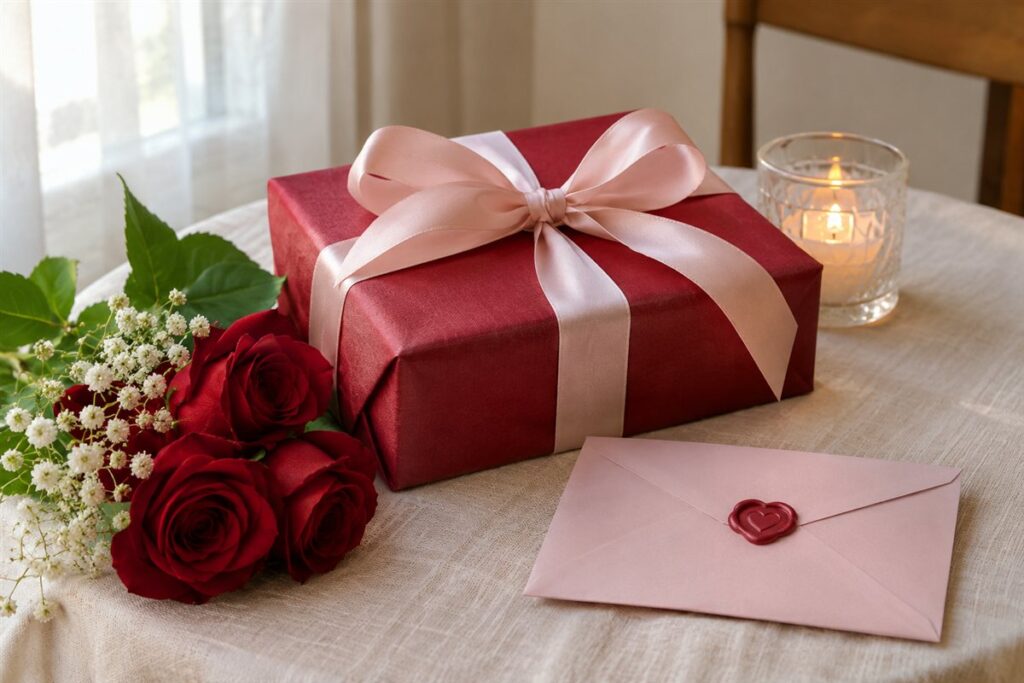
A Valentine gift looks stunning when the presentation, the setting and the moment of giving all work together. Even a modest gift gains impact when it is staged with care. This guide focuses on the visual side: wrapping, setting and the photo you may want to take afterward.
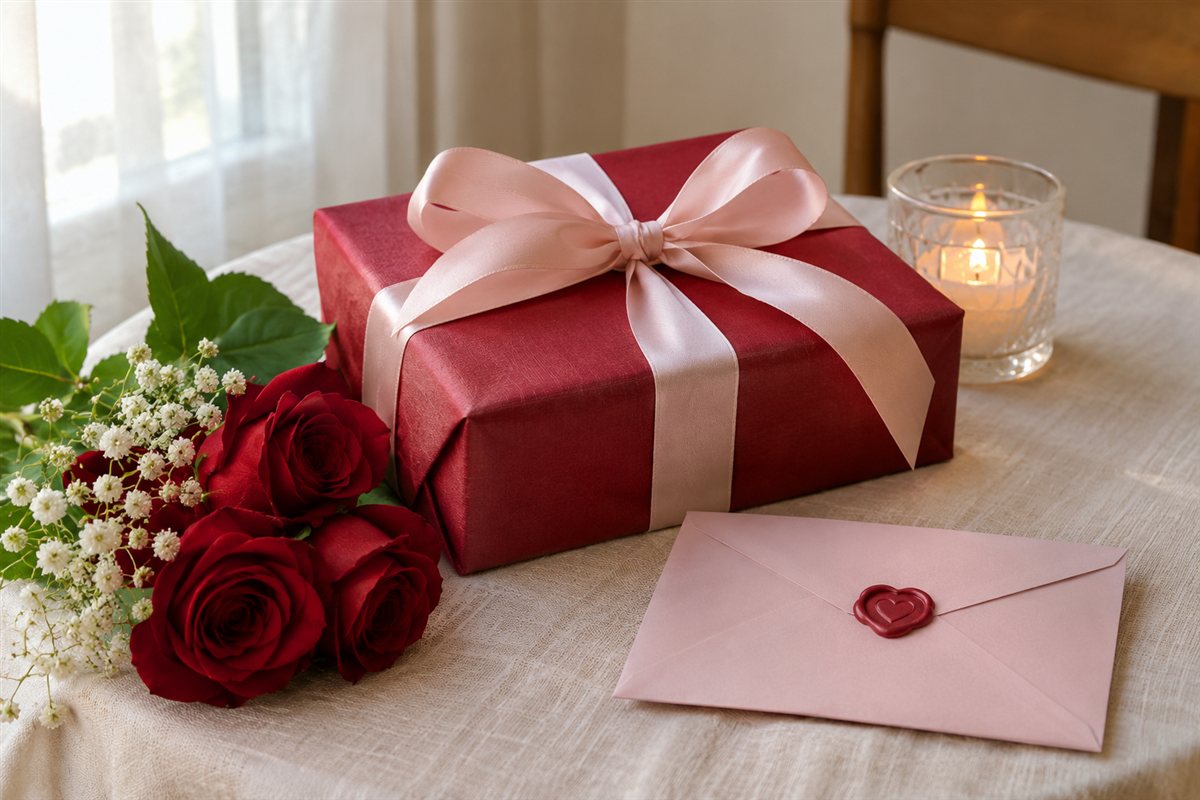
Choose a Visual Theme
Pick two or three colors and stay with them across the wrapping, card and any flowers. A restrained palette looks deliberate, while mixed colors can look cluttered.
- Soft neutrals: Cream, beige and a touch of gold for a calm look.
- Classic reds: Deep red with white for a traditional feel.
- Her favorites: Use the colors she wears or chooses for her home.
In this guide
Layered Wrapping Steps
- Wrap the gift in plain paper with sharp, tidy folds.
- Add a ribbon in a contrasting shade and tie a neat bow.
- Slide a small sprig of greenery or a dried flower under the ribbon.
- Attach a handwritten tag with her name, not just a printed one.
- Place the gift on a clean surface with soft light before presenting it.
Staging the Moment
Setting matters as much as the object. Dim the room a little, add a few candles if you like and place the gift where she will discover it, such as on her pillow, beside her coffee cup or on the table after dinner. Natural light from a window in the evening makes everything look warmer. Keep distractions, like loud screens, out of the scene.
Gift Types That Look Beautiful
| Gift type | Visual strength | Presentation tip |
|---|---|---|
| Framed photo | Instant focal point | Lean it against a wall with flowers beside it |
| Flowers | Color and texture | Remove excess leaves and tie with simple twine |
| Photo album | Rich, personal detail | Leave it open to a favorite page |
| Letter | Intimate, quiet | Use a good envelope and seal it with a sticker |
Capturing the Moment
If you want a photo of her opening the gift, ask first. Some people love the memory, others find it awkward. Use natural light, keep the frame simple and capture her reaction rather than the wrapping. A candid picture can become your next gift.
Keep one rule in mind: leave some space. A single well-placed gift with a card looks more striking than a crowded table of small items.
Lighting the Scene With Simple Sources
Light changes how everything looks, from the color of the wrapping to the expression on her face. Before you stage anything, think about the time of day and where the light will come from. Soft window light in the late afternoon is flattering and requires no equipment. If the gift will be given in the evening, a few warm lamps placed at different heights are more flattering than a bright overhead light, which flattens colors and creates harsh shadows.
Candles and string lights add atmosphere, but use them safely. Place candles on stable, heat-resistant surfaces away from curtains, paper and wrapping, and never leave them unattended. Battery-powered candles and lights give a similar glow without the risk and are a sensible choice around flowers and paper. Choose warm tones rather than cool white ones, since warm light makes reds, golds and skin tones look richer.
Think about reflections and clutter. Glass frames and glossy surfaces catch light and can hide the gift behind glare, so angle them slightly or move the lamp. Clear the background of anything distracting, such as cables, laundry or screens. If you plan a photograph, place the gift near a window and use a white sheet or card to bounce light into shadows. Avoid using direct flash, which can bleach colors and create harsh edges. Test the setup an hour or two before, adjusting lamps and positions, so that when the moment arrives you only have to switch on the lights and step back.
Flowers and Greenery: Choosing and Caring for Them
Flowers are a classic part of presentation, and a little care keeps them looking fresh. Choose blooms that match your palette and the recipient’s taste. Some people dislike strong scents or have allergies, so ask quietly or choose lightly scented varieties. Seasonal flowers are often fresher and easier to find, and a smaller bunch of one or two types usually looks more elegant than a mixed bundle.
Check freshness before you buy. Look for firm stems, healthy leaves and buds that are just beginning to open, and avoid flowers with brown edges or slimy stems. At home, trim the stems at an angle, remove leaves that would sit below the water line and place them in clean water as soon as possible. Keep them away from direct sun, heat sources and ripening fruit, which gives off gas that shortens flower life. Change the water every day or two and recut the stems if you can.
For presentation, wrap the stems in paper or fabric and tie them with twine or ribbon that matches your palette. A vase is a gift in itself, so consider including one if she may not own a suitable one. Dried flowers and greenery last longer and need no water, which can suit a framed arrangement or a keepsake box. Hide any plastic packaging, and remove price labels. If you are delivering flowers, think about timing and storage: they should not sit in a hot car or on a doorstep. When possible, keep them in a cool place until the moment you give them.
Writing a Card That Adds Warmth
A card or note is often what a person keeps longest, so it deserves some thought. Pick paper that suits your palette and feels substantial. A plain card with a handwritten message looks more personal than a heavily decorated printed one. Write with a pen that does not smudge, and practice on scrap paper first if your handwriting is uneven.
The strongest messages are specific. Instead of general phrases, mention a memory, something she did recently or a quality you admire. Two or three sentences of this kind can say more than a page of generalities. Keep the tone natural and true to how you speak, since forced poetry can sound awkward. If you struggle to start, finish the sentences: I noticed that you, I am grateful for, and I look forward to.
Consider length and placement. A short note tucked under the ribbon invites her to read it first, while a longer letter in an envelope can be saved for later. If you include a quote or a line from a poem, make sure it fits her taste. Check spelling and names, as mistakes in a written card are hard to fix. Sign it by hand. If you are far away, a card can be mailed ahead, or a handwritten note photographed and sent, though a physical card still has more impact. Keep a copy of what you write, or at least remember it, so you can build on it next year.
Displaying and Keeping the Gift Afterward
A gift that looks stunning on the day should also last. Think about how it will live in her home after the evening ends. Framed photos need a place on a shelf or wall, and a small easel or hook can make this easier. Check that the frame suits her style and the size of her space. If you choose a photo album, add a short note on the first page so it feels complete.
Protect keepsakes from damage. Prints fade in direct sunlight, so suggest hanging them away from bright windows, and consider frames with protective glazing. Paper goods such as letters and cards should be stored flat or in a box, away from moisture. Dried flowers are delicate, so place them where they will not be knocked over and keep them dry.
Include practical details. If the gift needs care, such as a plant or a fragile item, attach a small card with instructions. Keep receipts or gift receipts if the item may need to be exchanged, and tell her that you will not mind if she wants to swap it. If you took a photo during the moment, share it only with her permission, and consider printing one for a future album. After the day, offer to help her display the gift, which turns a single moment into an ongoing sign of thought. Keeping a small box of cards and mementos from each year can become a gift in itself.
Budget-Friendly and Eco-Friendly Presentation
Beautiful presentation does not depend on spending a lot. Many striking effects come from materials you already have or can find cheaply. Brown kraft paper looks elegant with a simple ribbon, and fabric offcuts, scarves or tea towels can be used as reusable wrapping in the style of furoshiki. Pages from old books or maps, newspaper in a restrained palette and plain tissue paper all create texture at low cost.
Natural materials add charm. Sprigs of rosemary, eucalyptus or pine, dried orange slices or a leaf from your garden make a tag or decoration without buying extras. Twine, cotton ribbon and paper tags are easy to recycle or compost, while glitter, plastic ribbon and some foil papers are not. If you want a sparkle, consider a single metallic accent rather than covering everything.
Reuse what you can. Save gift bags and boxes from previous years, and iron ribbons that have creased. A glass jar or tin can hold a small gift and be reused afterward. If you buy new, check the packaging label to see whether the paper can be recycled, and avoid items with plastic coating. Focus your spending on one element that matters, such as good flowers or a quality card, and keep the rest simple. A tidy fold, a straight bow and a handwritten tag matter more than expensive materials. Presentation shows attention, and attention costs very little.
Which Stunning Valentine Gift for Her Should You Choose?
Choose the gift that matches how she likes to receive attention: a framed photo for a lasting keepsake, flowers for color and a sense of occasion, a photo album for shared memories, or a letter for quiet, personal words. The guide’s gift types each do a different job.
- If she is sentimental and keeps mementos: go for the framed photo or the photo album, both of which hold memories she can revisit.
- If she loves a visual surprise: choose flowers, which bring color and texture to the room the moment she sees them.
- If she values words more than objects: write a letter, and present it in a good envelope so it feels special.
- If she dislikes clutter or has a small home: a letter or a single bunch of flowers takes almost no space.
- If you want something that lasts beyond the week: a framed photo can stay on a shelf for years.
- If you want to tell a longer story: an album lets you add pages and captions for different moments.
You can also combine two. A small bunch of flowers beside a handwritten letter is simple, looks deliberate and does not feel crowded. As the guide suggests, one well-placed gift with a card usually looks better than a table covered in small items.
If you are unsure, think about what she has admired lately, what she keeps on display and how she reacts to attention in public. Her habits tell you more than any trend.
What Should You Check Before Buying a Valentine Gift for Her?
Check size, delivery time, what is included and the return terms before you pay, because small oversights are the most common way a good gift goes wrong. A short checklist takes only a few minutes.
- Size and fit: measure the shelf or wall for a frame, and check the frame’s dimensions against your photo.
- What is included: see whether the vase, wrapping, card or hanging hardware come with the item, or must be bought separately.
- Delivery timing: read the estimated arrival on the listing and allow extra days, so the gift is not rushed or late.
- Allergies and scent: if she is sensitive to pollen or strong fragrance, pick lightly scented or dried flowers.
- Photo quality: use a sharp, well-lit photo for framing or an album, and check the resolution requirements on the listing.
- Return and exchange terms: confirm what happens if the item arrives damaged or does not fit.
- Care needs: flowers need water and cool air, prints need protection from sunlight, and some materials need gentle cleaning.
Do this before you start wrapping. It is far easier to fix a problem when you have several days left than on the evening itself.
Also think about where the gift will go. A beautiful frame with no obvious spot may end up in a cupboard, whereas one chosen for a particular wall or shelf becomes part of her home.
How Do You Match a Gift and Its Presentation to Her Personality?
Match the style of the presentation to her taste: calm and simple for a minimalist, rich and warm for someone who loves color, and playful for someone who enjoys humor. The aim is for the gift to look like it was chosen for her, not copied from a template.
Start with her surroundings. Look at the colors in her home, her clothing and the objects she keeps. The soft neutrals, classic reds or her favorites mentioned earlier are only starting points, and the best palette is usually the one she already surrounds herself with.
Think about how she handles attention. Someone who enjoys a dramatic reveal may love candles, a staged table and an evening plan. Someone who is shy may prefer a quiet moment at home with a gift handed over simply. A private gesture often means more to a reserved person than a public one.
- For a practical person, add a useful detail, such as a vase with the flowers or a stand for the frame.
- For a creative person, choose textured paper, hand-drawn tags or a slightly unusual arrangement.
- For a traditional person, classic wrapping with a neat bow and a handwritten card works well.
- For a busy person, keep the setup quick to enjoy and easy to carry.
Presentation is a way of showing you paid attention. Small, specific touches, such as her favorite flower or a line from a shared memory, do more than expensive materials.
Is Spending More on a Valentine Gift Worth It, and Who Should Skip Certain Gifts?
Spending more is rarely what makes a gift feel stunning; care, fit and thought matter more. A modest gift that suits her will beat an expensive one that does not.
That said, a higher budget can buy real advantages. A better frame protects a photo and looks sharper on a wall. Fresh, well-chosen flowers last longer and look fuller. A good card stock feels substantial. If you plan to spend a little more, put it into the one element she will see and touch most.
Each gift type also has honest downsides:
- Flowers fade within days, so they suit the moment more than the long term.
- Framed photos need wall or shelf space and can clash with her decor.
- Albums take time to prepare, and a rushed one can feel unfinished.
- Letters depend on your honesty and effort, and a generic message can fall flat.
Who should skip a particular choice? Skip strongly scented flowers if she has allergies, skip a large frame if she lives in a tiny space, and skip a public reveal if she dislikes being the center of attention. It is also wise to avoid anything that requires her to feel obliged to display or keep it.
If your budget is tight, favor handwriting, a single stem and tidy wrapping. As the budget section above explains, careful folds and a straight bow show attention at very little cost.
What Is the Best Way to Plan the Final Week Before Valentine’s Day?
The best approach is to decide on the gift early, order or prepare it with spare days, and rehearse the staging once before the evening. A calm plan removes stress and lets you enjoy the moment.
- Several days ahead: confirm the gift has arrived or is ready, and check it for damage.
- Three days ahead: write your card, wrap the gift and set it somewhere safe and cool.
- The day before: pick up flowers if you are buying them locally, trim the stems and keep them in water.
- The afternoon of: tidy the space, set the lights and place the gift where she will find it.
- Just before: light candles safely or switch on battery lights, and put your phone away.
Keep a backup option ready, such as a small card and a few stems, in case a delivery is delayed. That way the evening still feels thoughtful.
Avoid over-planning the dialogue. A short, sincere sentence and a hug are better than a rehearsed speech. Afterward, offer to help her display the gift, and keep the wrapping, ribbon or tag if she would like a memory of it.
When you are ready, compare the gift types above, check the listing for size, delivery and what is included, then choose the one that fits how she likes to be surprised and use the buttons above to continue.
Reading Her Style Before You Choose Anything
Every presentation decision in this guide works better when it starts from observation rather than from a catalogue. In the weeks before Valentine’s Day, notice the details she has already chosen for herself: the colours she wears most, whether her jewellery is bold or barely there, whether her home style leans tidy and minimal or warm and layered, the kinds of places she photographs and shares. Those preferences are a design brief written in her own taste, and a gift presentation that follows it will feel personal even when the gift itself is simple. A minimalist will feel most honoured by restraint — one beautiful object, clean wrapping, a single stem — while a romantic maximalist will delight in layers, abundance and ceremony.
Notice, too, how she likes to receive attention. Some people glow when a moment is staged publicly; others find an audience embarrassing and would treasure the same moment privately. Presentation that ignores this difference can undermine a thoughtful gift, because the memory she keeps will be of discomfort rather than delight. If you are unsure, choose the private version: a beautifully arranged moment at home is rarely wrong, and it can be shared with others later, in photographs, on her terms.
Clues From Past Celebrations
Birthdays, anniversaries and holidays past are a quiet archive of what worked. Which gifts does she still use, display or mention? Which were received politely and never seen again? The pattern in those answers is more reliable than any hint list, because it records her real reactions rather than her polite ones. Pay special attention to presentation moments she has praised in others — a friend’s proposal story, a scene in a film, a table setting at a restaurant — since people often reveal their own wishes most clearly when admiring someone else’s.
Building the Scene in the Right Order
A staged gift moment succeeds when it is assembled in the order the eye will travel. Start with the largest element — the setting itself: a cleared table, a made bed with the gift resting on it, a chair by a window with morning light. Then place the gift as the clear centre of that setting, because a scene with two competing focal points reads as clutter rather than ceremony. Add supporting elements last and sparingly: flowers, a candle, a drink, a card propped where it will be seen second. Each addition should pass a simple test — does this make the gift more visible or less? If less, it belongs somewhere else.
Timing the light is part of the build. A scene staged for the morning should sit where the day’s first light will find it; an evening scene should be tested with the lamps you will actually use, because candlelight that looks golden in person can photograph dim and orange, and a gift that looks mysterious in a dark room may simply look hidden. Rehearse the reveal the day before if the moment matters: stand where she will stand, look at what she will see, and adjust anything that draws the eye away from the gift.
Small Rituals That Make It Memorable
Memory attaches to ritual more than to expense. A short handwritten note read aloud, a favourite song playing as she enters, the same flowers you gave the first year, coffee made the way she likes it waiting beside the gift — these repeatable, personal touches are what turn a presentation into a tradition. If this Valentine’s Day begins a ritual you can repeat and vary in future years, its value compounds: she will remember not just the gift but the growing series of moments, each one referencing the others.
Photographs belong in this category when handled gently. One or two pictures of the scene before she arrives, and perhaps one of her reaction if she enjoys that, preserve the moment without turning it into a performance. Put the phone away after that. A presentation experienced through a screen by the person who staged it is only half experienced, and she will notice the difference even if she never mentions it.
Presentation for Different Kinds of Gifts
Different gifts ask for different staging, and matching the method to the object prevents the common error of beautiful wrapping around an experience or an elaborate scene around something that needed simplicity. Jewellery and small precious objects reward concealment and reveal: a small box, carried in a pocket until the right moment, or nested inside a larger, plainer box for a beat of misdirection. The smallness is the drama, so the setting should be calm and close — across a table, not across a room.
Experiences cannot be wrapped, so their presentation is a promise made tangible: a card that describes what is coming, a small related object that hints at it, an itinerary folded into an envelope with the date circled. The craft lies in giving enough detail to build anticipation without surrendering every surprise. Flowers and food, by contrast, are the presentation — they should be given fresh, at their best hour, arranged rather than merely delivered, because their beauty is perishable and the staging window is short.
When the Gift Is Delivered Rather Than Handed Over
A delivered gift can still feel staged if you choreograph what you can control. Arrange the delivery for a time when she will be home to receive it rather than finding a box on a step hours later. Follow it within the hour with a call or a message that supplies the words the courier cannot. If the service offers a gift note, write it as carefully as a card — complete sentences, her name, no abbreviations — because for a delivered gift, that note carries the whole emotional weight of the presentation, and a dashed-off line wastes the one channel you have.
Recovering Gracefully When the Plan Slips
Deliveries run late, flowers wilt early, restaurants lose bookings, and candles refuse to stay lit. A presentation plan with a small reserve of grace survives these accidents, and the reserve is mostly attitude: the moment is about her, not about your production. If the flowers arrive in the wrong colour, present them with a laugh and the story rather than an apology spiral. If the gift is delayed, give the card and the promise on the day, beautifully, and let the object follow — a well-handled delay often becomes part of the story she retells fondly.
What not to do is narrate every problem. Explaining at length how hard the gift was to find, how much trouble the wrapping caused, or what went wrong with the courier transfers your stress into her celebration and quietly asks her to comfort you. Keep the machinery invisible. The single exception is honesty about anything that affects her — a gift that needs exchanging, a booking that changed — and even then, present the solution first and the problem second, briefly.
The Morning After: Keeping the Glow
How a gift is treated after the day quietly determines how it is remembered. Help her find the right place for it, photograph it in its new home if she likes, and notice it in the following weeks — a compliment when she wears it, a question about the book, a plan made around the experience. A gift that disappears into a drawer the next day fades from the story of the relationship; a gift woven into the following weeks becomes part of it. The presentation, in other words, does not end with the reveal. It ends when the gift has found its place in her ordinary life, which is where the best gifts were always headed.
What to Do With the Photographs and Keepsakes Afterwards
A beautifully presented gift generates its own small archive — the card, the ribbon, the photograph of the scene, perhaps the flowers pressed between book pages — and deciding what becomes of it is the final act of presentation. Some couples keep a box for exactly this: the year’s card goes in, a ribbon is saved, and the box becomes a stratigraphy of celebrations that can be opened on difficult days to considerable effect. If she is the keeper type, start or feed that box deliberately. If she is not, photograph the scene, keep the card yourself, and let the rest go without ceremony; honouring her relationship with objects matters more than building an archive she never asked for.
The gift itself may also need a small aftercare plan that presentation thinking should anticipate. Flowers need their water changed and their stems trimmed if they are to last the week; a plant needs its place chosen; a delicate object needs its home found rather than its box kept. Helping with that settling-in — quietly, in the days after, without turning it into a project — completes the gift’s journey from your hands into her life, which is where presentation was always trying to deliver it.
When She Presents to You: Receiving as a Skill
There is a reciprocal art that this guide should not omit, because the giver of this year’s presentation is usually also a receiver. Receive her gifts the way you hope yours are received: with attention to the choices embedded in them, with the card read properly rather than skimmed, with the object given its place promptly and visibly. Partners learn how to give to each other partly from how their giving is received, and a household where both people are skilled receivers slowly becomes a household of excellent givers. The presentation you stage in February teaches; the reception you give teaches back, and the two lessons together are the real curriculum.
The Presentation Audit: Five Questions for Next Year
When the day is over and you are deciding what to repeat, ask five questions of the presentation you built. Did the setting make the gift more visible, or did it compete? Did the timing suit her energy, or yours? Was there one element too many, and which? Did the words — card, note, the thing said aloud — carry their share, or did the objects have to do all the work? And did the gift settle into her life afterwards, or is it still looking for its place? Five honest answers, written down, are a better design brief for next year than any guide, including this one, because they describe the only audience that matters, in the only room where your presentations will ever be staged.
Presentation for the Woman Who Has Everything
Every giver eventually faces the recipient whose home, wardrobe and shelves seem complete, and presentation is the answer to that puzzle, because presentation cannot be bought off her own shelf. For such a recipient, shift the weight of the gift from the object to the moment: a modest thing she will enjoy, staged with the full care this guide describes — the setting built, the light timed, the card written from real knowledge — becomes an experience she does not already own. What she has everything of is objects. What nobody has a surplus of is the feeling of being celebrated with this much attention to detail, and that feeling is manufactured entirely from presentation.
The same logic rescues the giver whose budget is small in a year when hers is not. Presentation is the great equaliser of gift-giving: its materials are time, observation and care, which are distributed without regard to income. A giver who cannot compete on objects and refuses to compete on presentation has declined to play the one game they could win outright. Play it. The woman who has everything will tell you, if you watch her face rather than her shelves, that she did not have this.
Learning From Her Own Presentations to You
She has been teaching you her taste in presentation all along, in the gifts she gives: whether she wraps elaborately or hands things over in the bag from the shop with a grin, whether the card is the main event or an afterthought, whether she stages or improvises. Those are not just her habits; they are her values, demonstrated. A presentation that honours her values — ceremony for the ceremonial, joyful informality for the informal — will feel right to her in a way that a technically perfect staging in a foreign style never quite does. When in doubt, present to her in her own language, spoken with your accent. That is the whole art, and it cannot be learned from any shelf of other people’s gifts.
The Long Game: Becoming Known for This
Couples build reputations with each other over years, and the giver who invests in presentation is building one of the kindest: the reputation of someone whose gifts are events, whose February can be looked forward to, whose attention to detail has become part of how the relationship feels from inside. That reputation, once established, does half the work of every future presentation, because anticipation becomes your collaborator — she begins the day already pleased. Guard the reputation by never staging carelessly what you once staged with care; consistency is its substance. And enjoy the building of it, because of all the crafts a relationship offers to practise, this is among the most pleasant: it consists entirely of paying close attention to someone you love, and then showing your working.
A Note on Sincerity, Which Presentation Cannot Replace
One caution belongs at the end of a guide about staging: presentation amplifies what is underneath it, and it cannot substitute for it. A gift chosen carelessly and staged magnificently will be remembered as exactly that — beautiful wrapping around an absence — and she will know the difference within a sentence of the card. The order of operations in this guide was never accidental: know her, choose for her, then present what you chose with all the craft you have. Craft in the service of knowledge is romance. Craft in the place of knowledge is theatre, and she did not fall in love with a theatre. Keep the order right and the staging will do what it promises.
With that said, do not let the caution make you timid. Most givers err in the opposite direction — a genuinely thoughtful gift handed over with so little ceremony that its thoughtfulness never becomes visible. The middle path is the whole teaching of this guide: real knowledge, honestly chosen, beautifully shown. Walk it this year and the morning will take care of itself.
Presentation Ideas Matched to Where She Will Receive Them
The setting of the reveal should shape the presentation as much as the gift does. A gift given at home can use the full vocabulary of this guide — staging, layers, light, ritual — because you control the room. A gift given in a restaurant must survive travel, wait discreetly through a meal and reveal itself across a table without disturbing neighbouring diners, which argues for compact, self-contained presentation: the beautifully wrapped small box, the card with real words, the flower that arrives with dessert by arrangement with the staff. A gift given at her workplace, if that is genuinely welcome, needs restraint above all — presentation that delights her without making her the office spectacle — and a gift sent to a family home where she is staying needs to honour the household’s rhythms as well as hers.
Travel gifts — given in a hotel, a rented cottage, another city — benefit from portable ceremony: a ribbon, a card and one beautiful local addition bought on arrival, such as flowers from a market near where you are staying. Trying to transport an elaborate staging across distance usually ends with crushed wrapping and a giver too frazzled to enjoy the moment. Let the place contribute the scenery, and let your contribution be the thought and the timing.
Morning, Evening and the Character of the Hour
The hour changes what presentation can do. Morning gifts have freshness on their side: light, flowers and breakfast make a natural stage, and the whole day afterwards is coloured by the opening. Morning suits gifts meant to be used that day — something to wear, something to carry, the first instalment of a day you have planned. Evening gifts have intimacy and candlelight, and suit the precious, the personal and the sentimental, which benefit from the day’s noise having fallen away. Neither is better, but they are different instruments, and choosing between them deliberately — rather than by when the delivery happened to arrive — is one of the easiest improvements a giver can make.
Teaching Yourself Presentation: A Small Annual Review
Presentation is a learnable craft, and like all crafts it improves fastest with review. After the day, while the memory is fresh, note three things: the moment as she experienced it, judging by her face rather than your hopes; the element that worked hardest, which is often the smallest; and the element you would cut next year, because almost every staging has one piece too many. Keep the note with next year’s card supplies. Givers who do this for a few years develop a recognisable personal style — not copied from guides like this one, but distilled from their own successes — and a style of one’s own is what turns presentation from a performance into a signature.
It is also worth collecting, across the year, the raw materials of next year’s presentation: the ribbon worth keeping, the box of perfect proportions, the photograph that belongs in a frame, the sentence she said in October that belongs in February’s card. Presentation assembled from a year’s quiet gathering has a depth that no amount of shopping in the final week can imitate, because its materials are memories as much as objects. That, more than any technique in this guide, is the secret of the givers whose Valentine’s mornings look effortless: the effort was real, but it was spread across a year of paying attention.
FAQ
Does presentation matter more than the gift?
They work together. A thoughtful gift deserves care in presentation, and a good presentation lifts a simple gift.
How do I wrap an awkward shape?
Use a box or a gift bag with tissue paper, then add a ribbon and tag for polish.
What if she does not like surprises?
Tell her something is planned, or give a smaller gift in a relaxed setting. The presentation can still be tidy without a dramatic reveal.
Are candles safe to use in a gift setup?
Yes, with care. Use stable holders, keep them away from paper and fabric and never leave them unattended. Battery candles are a safer alternative.
How long do cut flowers last?
It varies with the variety, freshness and care. Trim stems, use clean water, keep them cool and away from heat and fruit, and change the water regularly.
What if my handwriting is poor?
Write slowly, use a good pen and practice first. A neat, honest note is better than a printed one, and clear printing is perfectly fine.
How can I wrap something without much paper?
Use fabric, a gift bag or a box with tissue. Reusable cloth wraps look elegant and can be kept.
Should I include a gift receipt?
It is a good idea for clothing or items that may not fit. Tell her she is free to exchange it.
Can I stage the moment at a restaurant?
Yes, but check with the venue about candles or decorations and keep the setup small. A card and one well-chosen gift are usually enough.
What is the most memorable Valentine gift for a woman?
The most memorable gift is usually the one that shows you noticed something specific about her. A framed photo of a shared moment or a handwritten letter often lasts longer in memory than a generic purchase. Choose by her habits and tastes rather than by price.
How far in advance should I order a Valentine gift?
Order as early as you comfortably can, ideally a week or more ahead, so there is time for delivery, checking and wrapping. Read the estimated arrival on the listing and add a margin. Fresh flowers are the exception and are best bought a day or so before.
Should I give flowers and another gift together?
Yes, if it suits her taste, but keep the combination simple. Flowers with a card or a small framed photo look balanced, while many small items can feel crowded. One main gift with one supporting piece is a good rule.
What color wrapping works best for Valentine gifts?
Pick two or three colors and stay with them. Soft neutrals, classic red and white, or her own favorite shades all work. Plain paper with a contrasting ribbon looks neat and lets the gift stand out.
How do I make a simple gift look special?
Focus on tidy folds, a straight bow, a handwritten tag and calm lighting. A clean surface and a little space around the gift make it look deliberate. Presentation costs little but shows care.
Is it better to give a gift in the morning or the evening?
Evening is popular because you can stage soft light and have time together, but morning can be lovely if she enjoys a quiet start. Choose the time when you can both relax without rushing.
What if the gift arrives late or damaged?
Contact the seller right away and check the return or replacement terms on the listing. Keep a backup, such as flowers and a handwritten note, so the day still goes well. You can present the main gift later with an explanation.
The Short Version
Stick with a small color palette, wrap neatly, add a handwritten tag and stage the moment with soft light. Choose gifts with visual presence, such as framed photos or flowers, and capture the memory if she is comfortable.
Related Guides
- Elegant Valentine Gift Ideas for Her That Feel One of a Kind
- Romantic Valentine's Day Gift Ideas for Your Girlfriend, Her Way
- Plan a Wonderful Valentine's Day: Lovely Ideas for the Whole Day
- Unexpected Valentine's Day Gift Ideas for Your Girlfriend
- Layered Valentine Gift Ideas to Unwrap Slowly, Step by Step
