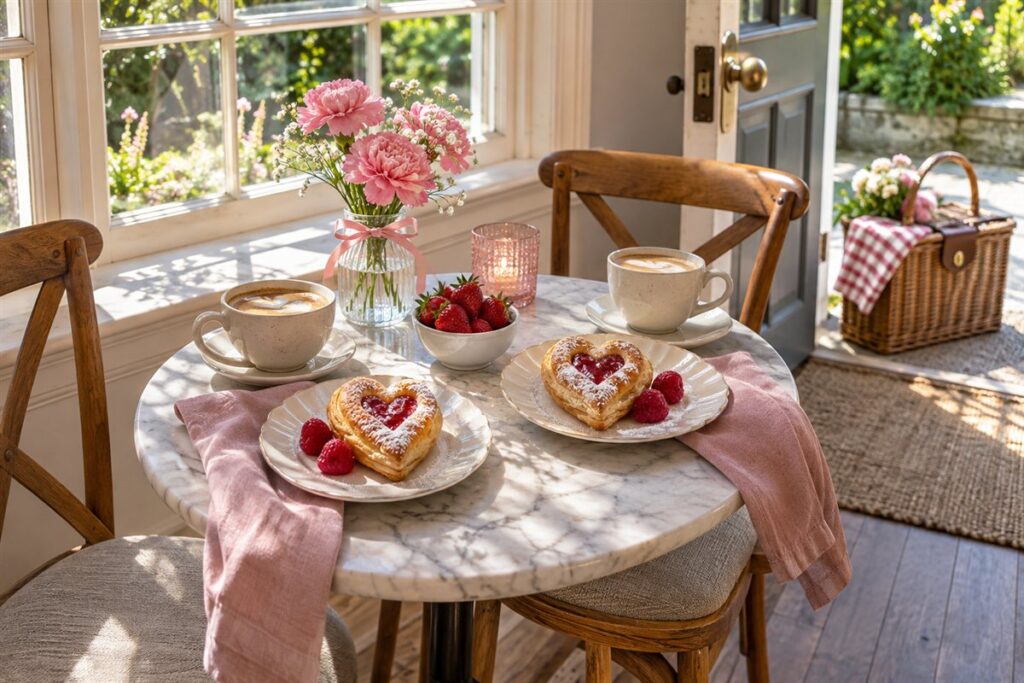
A wonderful Valentine’s Day does not depend on one grand gesture. It comes from a few well-placed moments spread across the day, each one simple and thoughtful. Use the timeline below as a menu and choose only the parts that suit you both.
Morning: Set a Warm Tone
The first hour of the day shapes the mood. A small gesture here tells your partner they were on your mind before the day got busy.
- Leave a short handwritten note where they will find it.
- Make breakfast, or bring their usual coffee order.
- Send a message that mentions one specific thing you appreciate.
In this guide
Midday: A Moment Apart or Together
If you are both busy, a midday surprise keeps the feeling going. If you are free, share a relaxed lunch or a short walk.
- Choose a place that has meaning, such as where you had your first coffee.
- Put phones away for twenty minutes or so.
- Take one picture of the two of you, to print later.
Afternoon: The Gift Moment
This is a natural time to give a gift when nobody is tired or rushed. Options that work across many tastes include a framed photo, a small album, a book with an inscription, or tickets to a future event. If you are wrapping something, keep the wrapping simple and add a card with two or three honest sentences.
Evening: Shared Time
- A home-cooked meal with a table set for two.
- A quiet restaurant booked in advance, since popular places fill up on this date.
- A movie night with favorite snacks and a blanket.
- A walk after dinner, with time to talk.
Tips for Making the Day Run Smoothly
- Book reservations and order items early so there are no last-minute surprises.
- Choose one or two main moments instead of filling every hour.
- Keep a spare plan in case the weather or schedules change.
- Remember that being relaxed together matters more than perfect execution.
After the day, consider keeping a small memory of it. Write a few lines in a notebook about what you did and what made you laugh, and add one photo if you took any. Next year you can read it together, and the day becomes part of your shared story rather than a single evening that fades. Small rituals like this build a collection of memories that grows more valuable over time.
Tailor the Day to Your Partner’s Personality
The same schedule will not suit every person. Someone who loves quiet may feel drained by a packed itinerary, while someone social may find a night in a little flat. Before you plan, think about how your partner usually enjoys time and affection, and let that guide the structure.
- The homebody: Favor comfort. A slow breakfast, a favorite film and a home-cooked dinner give them space to relax. A soft blanket or a book they have wanted to read makes a good gift.
- The adventurer: Choose an activity, like a hike, a day trip or a class. A small experience gift fits better than an object.
- The sentimental one: Words and memories matter. Write a longer letter, gather photographs or recreate a meaningful first date.
- The practical one: Useful gifts show care. Something that solves a daily annoyance, paired with a thoughtful note, can mean more than a showy gesture.
- The private one: Avoid public displays. Keep surprises between the two of you, away from an audience.
Notice what your partner praised or complained about in recent weeks. A mention of wanting to try a new recipe, a worn-out mug or a place they have never visited is a clue. Write these down during the year so you are not scrambling in February. If you are unsure, ask a close friend or simply ask your partner what a good day would look like. Many people appreciate being asked, and the conversation itself becomes part of the gift.
Planning a Dinner at Home That Feels Special
A meal at home avoids crowds, noise and booking stress, and it can feel more personal than a restaurant. The key is to plan simply so that you are not stuck in the kitchen while your partner sits alone.
- Choose a menu that you have cooked before. Special occasions are a poor time to test a complicated recipe.
- Pick dishes you can prepare mostly ahead, such as a slow-cooked main, a cold starter or a dessert that sets in the fridge.
- Check for allergies and dislikes in advance, and have an alternative for any course.
- Shop a few days early, because popular ingredients can sell out around the date.
- Set the table before you cook: clean cloth, candles in safe holders, napkins and a simple centerpiece.
- Plan the music and lighting so that you can dim the lights and press play as you sit down.
Keep the kitchen tidy as you go, so that the end of the evening is not a heap of dishes. Serve in small portions so that you can enjoy dessert, and take breaks between courses to talk. If cooking is not your strength, assemble a tasting plate with cheeses, fruit, bread and a few treats. If you drink alcohol, offer a non-alcoholic option as well. The goal is a relaxed table with you present, not a flawless performance.
Going Out Without the Stress
Restaurants and venues are busy on this date, and many offer limited menus or fixed seating times. A little preparation prevents disappointment.
- Book early. Reserve as soon as you decide, and confirm a day or two before. Ask about cancellation terms.
- Read the details. Check whether there is a special menu, a time limit on your table or a deposit, and whether it suits your dietary needs.
- Consider the off-peak option. If the evening is crowded, celebrate on a nearby day when it is calmer, or choose an earlier or later sitting.
- Plan the journey. Allow extra time for traffic, parking or transport, and have a backup if a taxi or ride is hard to find.
- Prepare a plan B. Know a second place nearby in case the first runs late or turns out to be unsuitable.
- Dress for comfort. If you will walk, wear suitable shoes, and take a coat in case the weather turns.
Outside of dinner, consider other outings: a gallery, a concert, an evening walk, or a sunrise breakfast. Choose something that gives you time to talk. Arrive a little early, silence your phones and avoid scheduling anything stressful straight after. If something goes wrong, take it in stride; a laugh over a mishap often becomes a favorite memory.
Celebrating When You Are Not With a Partner
Not everyone has a romantic partner on this date, and a wonderful day does not require one. If you are single, apart from your partner or simply prefer a different style of celebration, there are plenty of ways to make the day warm.
Spend time with friends or family. A shared meal, a game night or a movie marathon turns the date into a celebration of friendship. Write notes to people who have supported you and tell them what they mean to you. This costs almost nothing and tends to be remembered.
Treat yourself kindly. Cook a favorite dinner, take a long walk, visit a bookshop or start a project you have been postponing. Keep the day free from comparison with social media, where curated images make everything look grander than it is. If the date brings difficult feelings, plan a gentle routine and reach out to someone you trust.
For long-distance couples, schedule a video call with a shared activity, send a letter that arrives in time and plan the next meeting, even if it is months away. Having something to look forward to eases the distance. Whatever your situation, the point is to notice and nurture the connections you value.
Talk About Expectations Before the Day
Many Valentine’s disappointments come from unspoken expectations. One person may want a big evening while the other assumes it is just another night. A short conversation a week or two ahead can prevent hurt feelings.
- Ask what each of you would enjoy, and whether you want to exchange gifts at all.
- Agree on a rough level of spending so that neither of you feels awkward about the difference.
- Discuss whether you prefer privacy or company, a surprise or a shared plan.
- Be honest if you dislike the holiday, and find an alternative way to mark the relationship.
- Check the calendar for work, study and family commitments that might clash.
If the day does not go as planned, avoid blaming each other. Sick children, late trains and missed bookings are common. Pause, reset and find a way to enjoy what remains, perhaps by moving the celebration to the weekend. Afterward, share what you each enjoyed most and what you would change next time. Those small conversations help you plan better years ahead and show that you value each other’s experience, not just the event.
Pick a Budget Level and Plan Around It
A lovely day does not depend on how much you spend. Deciding on a comfortable limit in advance removes pressure and helps you choose ideas that fit. Think of three broad levels and mix elements from each as you like.
| Level | What it can include | Mood |
|---|---|---|
| Nearly free | A handwritten letter, a walk, a home-cooked breakfast, a playlist of shared songs | Personal and warm |
| Modest | Flowers from a local market, a favorite dessert, a movie night with snacks, a small keepsake | Cozy and thoughtful |
| Special occasion | A restaurant booking, a day trip, a framed print, a short overnight stay | Memorable and polished |
Whatever level you choose, put effort into the details. A modest dinner with a neat table and a personal note often feels richer than an expensive outing that was booked in a hurry. Discuss the topic gently if you are unsure what your partner would like, or simply pay attention to hints they have dropped in recent weeks.
How to Write a Note That Actually Lands
A short, sincere message can be the most treasured part of the day. Many people freeze at the blank page, so here is an easy framework.
- Open with a specific memory. Mention a small moment, such as the rainy afternoon you shared an umbrella or the night you laughed until midnight.
- Name what you value. Be concrete: their patience, their humor, the way they greet you after a long day.
- Say what you look forward to. A trip, a quiet weekend, or simply more ordinary days together.
- Close warmly. A simple line in your own voice is better than a borrowed quotation.
Write by hand if you can, on plain paper or a plain card, and hide it somewhere unexpected, such as a coat pocket, a book or the bathroom mirror. Keep it to a few sentences. Honesty matters more than polish, and a note that sounds like you will mean more than anything copied from a card rack.
Ideas for Couples Who Love Pictures
Because many of us carry a camera everywhere, pictures can become part of the day itself. Plan a small photo walk together, choosing a park, a market or a quiet street. Agree on a few themes, such as favorite colors, small details or candid moments, and take turns photographing each other and the surroundings.
Afterward, choose three or four favorites and make something simple from them. You might print a small set, put them in a card, or fill a thin album over the coming months. A framed photograph of a shared day can sit on a desk or shelf long after flowers have faded. If you do not enjoy being photographed, try photographing places and objects that mean something to you both instead, such as the door of your first apartment or the cafe where you first talked for hours.
Easy photo date prompts
- Find something red, something round and something that makes you smile.
- Photograph each other’s hands doing a favorite activity.
- Capture the same view in morning light and evening light.
- Make a portrait of your shadows together.
Valentine’s Day When You Have Children or Live With Others
Life does not pause for romance, and shared households need a flexible plan. If you have children, include them in part of the day, perhaps with heart-shaped pancakes or a family card-making session, then arrange a quiet window later for the two of you. A relative, friend or trusted sitter can help with the evening, or you can plan a late dessert once the house is calm.
If you live with roommates or relatives, small private gestures work well, such as a note on the pillow, a hot drink delivered in the morning, or a short walk after dinner. Respecting everyone’s space keeps the day relaxed. Talk about the plan a few days ahead so there are no surprises that clash with another person’s schedule.
Long Distance and Different Time Zones
Distance can make the day feel lonely, but it also invites creativity. Send a small parcel ahead of time with a handwritten letter, a favorite snack and a photograph. Arrange a video call and share the same meal or dessert, even if you are in different kitchens. Watch a film together by pressing play at the same moment while chatting by message, or choose a book and read a chapter aloud.
When time zones differ, pick a time that suits both people rather than forcing one to stay up very late. A day-long exchange of short voice messages can feel more intimate than a single hurried call. Plan how you will meet next, even loosely, because shared anticipation lifts the mood.
Common Planning Mistakes and Easy Fixes
- Leaving bookings to the last minute: popular places fill up. Reserve early or choose a home alternative.
- Overpacking the schedule: too many activities create stress. Choose two or three highlights.
- Ignoring preferences: some people dislike public attention or surprises. Choose gestures that match their personality.
- Comparing with social media: other people’s posts show only highlights. Do what suits you both.
- Forgetting the practical details: allergies, transport, weather and closing times can spoil a nice plan.
A Gentle Countdown Checklist
- Two weeks before: decide on the general plan and budget level, and book anything that needs a reservation.
- One week before: choose or make the gift, write your note and check dietary needs.
- Two days before: shop for food, flowers or supplies, and confirm times.
- The day before: tidy the space, prepare what you can, and charge your camera or phone.
- The day itself: be present, put devices away at key moments, and enjoy the time together.
After the day, take a few minutes to talk about what you each enjoyed most. Those answers are the best guide for next year, and they turn a single date into a growing tradition of small, thoughtful gestures.
Small Rituals That Can Carry Into the Rest of the Year
The most meaningful part of a special day is often the habit it begins. Instead of treating February as a single burst of effort, use it to try a ritual you could keep. A weekly walk without phones, a monthly dinner cooked together from a new recipe, or a jar where you drop notes about good moments all create warmth that lasts far longer than flowers.
Pick just one idea and make it easy. If it needs a long preparation, it will fade by spring. A ritual that takes ten minutes and requires no money is more likely to survive a busy month. Put it on the calendar, and let the other person suggest changes so it feels shared rather than assigned.
Rituals worth trying
- A Sunday morning breakfast with no screens.
- A photograph taken together on the same bench every season.
- A shared playlist where each person adds a song each week.
- A short evening check-in about the best part of the day.
Handling Disappointment Gracefully
Even careful plans can go wrong. The restaurant may be late, the weather may turn, or a gift may miss the mark. How you respond matters more than the hiccup itself. Take a breath, laugh if you can, and shift to a backup plan. Keep a simple fallback in your pocket, such as a favorite takeout meal, a film you both love, or a walk to a nearby dessert shop.
If your partner seems let down, listen without defending. Ask what would have made the day better and note the answer for next time. If you feel let down yourself, say so kindly and early rather than carrying quiet resentment through the evening. Remember that the point of the day is connection, and a calm, patient mood is itself a gift.
When the day is over, rest. Tidy up together, play a quiet song, and thank each other for the effort. Often the simple moments at the end of the evening are the ones you will recall most warmly.
Designing the Day Around Energy, Not Just Events
A wonderful day is less a list of bookings than a shape: energy rising and resting in the right places. Most failed Valentine’s Days fail by shape — a huge morning effort that leaves everyone tired by lunch, a long empty afternoon with the evening’s pressure building inside it, or a grand finale attempted by two people too exhausted to enjoy it. Design the arc first. One warm opening, one shared pleasure in the middle of the day, one unhurried peak in the evening, and genuine rest in the gaps. Three good things with air around them beat seven good things stacked like luggage.
Protect the transitions, because days are lost in them: the drive across town in traffic, the queue, the outfit change that becomes a crisis. Choose places near each other, allow more time than the map suggests, and build one deliberate pause — a coffee, a bench, a walk with no destination — between the day’s acts. Couples remember transitions as part of the story, and a day whose journeys were calm feels luxurious at any budget, while a day of rushing feels cheap at any price.
The morning sets the emotional weather
Whatever else the day holds, its first hour teaches both of you what kind of day this is. A rushed, distracted morning announces that Valentine’s is an obligation being discharged; a morning with one small, deliberate kindness — the favourite breakfast made properly, the card where the kettle is, ten unhurried minutes together before the world starts — announces that the day is being given rather than endured. You do not need a grand gesture at dawn. You need evidence, early, that thought happened before the day began.
Planning for the Partner You Have, in the Life You Are Living
Generic Valentine’s plans assume a couple with free time, free money and no one else in the house. Real plans start from your actual circumstances and treat them as ingredients rather than obstacles. A season with a new baby produces a different wonderful day — shorter, home-based, built around food, rest and one hour that belongs to the two of you — and it can be more moving than any restaurant marathon, because it says we are still us inside this enormous change. A season of tight money produces the picnic, the cooked feast, the letter, the walk to the place with meaning. A season of distance produces the synchronised ritual across time zones. The day succeeds when it fits the life; it fails when it imitates someone else’s.
Ask, a few days ahead, the unfashionable question: what would actually make you happy this year. Partners are not puzzles to be solved in secret at all costs; many will tell you plainly — a quiet day, a particular restaurant, no fuss, a fuss — and believing them is a form of respect that surprise-planning sometimes tramples. Keep one element back as your own contribution, by all means, but build the day’s skeleton from their stated wishes rather than from the internet’s.
Including children, family and the rest of real life
If the day includes children or family, design their part deliberately instead of letting it happen to the romance. A family celebration in the morning — the cards, the pancakes, the small gifts for grandparents — can be genuinely lovely, and it clears the emotional ground for the couple’s own time later, which then needs no guilt to protect it. Arrange the handover, the sitter, the grandparents’ visit with the same care as the dinner booking. The couples who manage this well treat the whole household as the day’s cast and themselves as its final act, rather than pretending the household away and resenting its existence by evening.
Food: The Day’s Most Reliable Pleasure, Planned Like It Matters
More Valentine’s memories are carried by meals than by any other element, so give food the planning seniority it earns. Decide early which meal is the day’s hero — it does not have to be dinner; a magnificent breakfast or a long, lazy lunch can carry the day while leaving the evening free for a walk, a film and an early night, which many couples privately prefer. Book or shop for the hero meal first, and let the day’s other eating be simple and unstressful, so nobody arrives at the main event already tired of restaurants or cooking.
At home, cook within your proven repertoire and add one flourish — the good bread, the special dessert, the bottle saved for an occasion — rather than attempting an ambitious new dish under romantic pressure. Set the table like you mean it: cloth, candles, the nice glasses, phones elsewhere. A familiar meal served with ceremony beats an experimental one served with apologies, every February, in every kitchen.
The gift moment, placed with intention
Give the day’s gift at a moment with air around it — not in a doorway, not mid-argument with traffic, not as an afterthought at midnight. The natural slots are after the hero meal, during the deliberate pause, or at the day’s quiet end, when there is time to react, to read the card properly and to let the moment register. If the gift is an experience or a plan, its moment can be earlier, so the day itself can lean toward it with anticipation. Placement is free and it doubles the gift’s value; spend the thought.
The Day After, and Why It Belongs in the Plan
Plan one small kindness for the day after: the flowers moved to fresh water, the leftover dessert for breakfast, the photograph printed or sent, the message that says yesterday was lovely and names why. The day after is where Valentine’s either evaporates or becomes part of the relationship’s furniture, and a two-minute act of continuity is all it takes to choose the second. It also rescues imperfect days: a celebration that wobbled can be closed warmly the next morning, and the closing is what both of you will remember when the details blur.
Keeping a tiny record
Write three lines somewhere — what you did, what landed best, what you would repeat — while the day is fresh. Next February will thank you, because couples repeat their successes accidentally and their failures deliberately; a record turns both into knowledge. Over years, those three lines become a small private history of how the two of you celebrate, which is a surprisingly moving document to own.
Wonderful on a Workday: The Compressed Edition
When the day is a workday, compress rather than cancel: the card and the good coffee in the morning, one message at midday that is a real sentence rather than an emoji, and an evening that begins the moment work ends — the favourite takeaway ordered ahead, the table set before they are home, the plan kept small and entirely achievable. A compressed day executed completely beats an elaborate one abandoned by Thursday tiredness. And if even the evening is consumed, move the celebration to the nearest weekend without a whisper of apology; the date is a convention, the attention is the substance.
Three Complete Days, for Three Kinds of Couples
For the couple with young children and no evening sitter: let the day begin with the family ritual — heart-shaped toast, cards exchanged across the breakfast table, the children included in the conspiracy of kindness — then claim the afternoon nap window for a proper lunch at home together, cooked or delivered, with the table set and the phones off, and end after bedtime with the film, the dessert and the gift in the quiet house. Nothing about the day apologises for the children; everything about it protects one hour that belongs to the adults they also are.
For the couple in a long-distance season: synchronise ruthlessly and simply. Wake to the message that was scheduled with love, open parcels together on a call at the hour the time zones allow, eat the same meal in two kitchens, watch the same film with a shared start, and end with the letter — written, not typed, posted days earlier to land inside the week. Distance removes the table; it cannot remove simultaneity, and simultaneity, arranged with care, is a surprisingly complete substitute for presence on a single day.
For the couple who have done this forty times: let the day quote itself. Recreate the first Valentine’s you can both remember — the same food, the same walk, the card that says what has changed and what has not — and add one new thing, small and deliberate, so the tradition stays alive rather than embalmed. Long couples do not need novelty or scale; they need the pleasure of recognition, and a day built as a quotation of their own history delivers it in every hour.
And when the day is done, resist grading it. Wonderful was never a score; it was the feeling, sometime around the hero meal or the quiet end, that the two of you had been properly celebrated by the only people qualified to do it. If that feeling visited even once, the day worked.
Weather, Contingencies and Other Acts of Reality
Every outdoor plan deserves an indoor understudy, chosen in advance so a grey sky triggers a swap rather than a collapse: the picnic becomes the floor picnic by the window, the garden walk becomes the gallery, the rooftop drink becomes the bar you both like near home. Decide the understudy while the sun is shining and your judgement is calm, and write it into the plan itself. Couples who pre-decide their plan B spend the rainy morning smiling; couples who improvise it spend the morning negotiating, which is a poor way to begin a celebration.
The budget, set like adults and then forgotten
Agree the day’s rough budget early — with yourself if it is your gift, together if the day is shared spending — and then stop counting. A budget decided in advance is freedom, because every choice inside it can be made on pleasure rather than arithmetic. The day’s wonder has never correlated with its cost; it correlates with fit, timing and the absence of financial anxiety humming underneath the romance. Set the number, honour it, and spend the rest of your attention on each other.
Build the day from your real life, shape it around your real energy, and let one true sentence be said in it somewhere. That is the whole recipe; everything else is garnish, and garnish is optional.
FAQ
What if we both work all day?
Concentrate the effort on the morning and evening. A note at breakfast and a simple dinner together can be enough.
Do we need to leave the house?
No. Many people enjoy a cozy night in more than a crowded outing. Choose the setting that suits your partner.
How far ahead should I plan?
Two to three weeks is comfortable for bookings and orders, and a month is better if you want something personalized or shipped. Last-minute plans can still work, but options are fewer.
What if my partner dislikes Valentine's Day?
Respect that and skip the traditional gestures. A quiet acknowledgment, a favorite meal or a small act of kindness on another day shows you care without the pressure.
How do I plan something special on a tight schedule?
Choose one meaningful moment, such as a handwritten note and a shared meal. Prepare what you can the night before, and keep the rest flexible.
Is it okay to celebrate on a different day?
Yes. Many couples choose a nearby day to avoid crowds or conflicting commitments. What matters is the attention you give each other.
What should I do about dietary restrictions at a restaurant?
Tell the restaurant when you book, and check the menu in advance. Have an alternative plan if they cannot accommodate you.
Can I surprise someone who dislikes surprises?
It is better to share the plan or at least the general outline. A pleasant surprise for one person can feel stressful to another, so respect their comfort.
How do I plan a wonderful day when we are both exhausted by life generally?
Make rest the plan rather than the reward. A slow morning with no alarm, one excellent meal you did not have to cook or travel far for, an afternoon with permission to do nothing, and an early night in good company is a genuinely wonderful Valentine’s for two tired people — and it will be remembered with gratitude rather than as one more performance survived. Cut every element that requires energy you do not have, without apology; the day serves the couple, never the reverse.
What if our tastes for the day are completely different?
Alternate pleasures and say so cheerfully: their kind of morning, your kind of evening, one shared thing in the middle you both honestly like. Difference handled openly becomes part of the day’s charm — couples often discover that watching a partner enjoy their favourite thing is its own pleasure. What does not work is silent sacrifice, which curdles by evening, or a compromise day designed to offend nobody and delight nobody. Take turns being delighted instead.
How far ahead should I book restaurants and experiences?
As early as the good places allow, because Valentine’s demand is concentrated into a single evening and the best tables and tickets go first. If you are reading this late, pivot rather than despair: the hero meal can move to lunch, to the day before or after, or home, where no booking is required and the cooking is yours to schedule. A wonderful day is portable across dates in a way a reservation is not.
Can a wonderful Valentine’s Day be spent entirely at home?
Entirely, and for many couples preferably. Home removes travel, queues, noise and other people’s ceremonies, and it lets the day be shaped exactly to the two of you: the cooked feast, the film you have been saving, the bath, the board game, the early night. The work is in the marking — decorate one corner, dress a little, keep phones away, let the day feel set apart from ordinary evenings at home. Intention, not location, is what makes a day an occasion.
What should I do about social media and phones during the day?
Agree a light rule in advance — photographs at set moments, phones away at meals, no posting until the day is done — so nobody spends the celebration curating it for an audience. Take the pictures; they matter, and future you will want them. But take them in bursts and then put the device down, because a day experienced through a screen is remembered like a screen. The person across the table is the audience this performance is for.
How do I end the day well?
Deliberately, at a natural crest rather than by collapse: a last small ritual — the walk home, the final drink, the card reread, the plan for one ordinary pleasure next week — that closes the day like a good chapter. Say the simple thing if it is true: that you had a wonderful day, and name the part you will remember. Days end better when they are ended, and couples who close celebrations consciously carry them further into the ordinary weeks that follow.
What if my partner has to work all day and evening?
Bring the day to the edges of theirs: the morning card and breakfast, a delivery of the favourite lunch or the flowers to the workplace if that is welcome there, and the celebration itself rescheduled in writing — a date in the card — rather than left vague. Being remembered inside a hard day is its own romance, and the promised date, kept, becomes the real Valentine’s with interest.
How do I handle it if the day goes wrong despite planning?
Laugh early, adapt visibly, and protect the evening’s core — the two of you fed, unhurried and kind to each other — at the expense of every other element. The closed restaurant, the rain, the ruined surprise are raw material for the story you will tell about this year, provided nobody’s disappointment is allowed to become blame. Couples remember how a bad day was handled together far longer than they remember a smooth one.
Together, always.
Enjoy every hour.
Happy Valentine’s, truly.
Completely, comfortably, memorably so.
It will suit you both.
Yourselves, at your best, all day.
Now go and have it, exactly as yourselves.
That is the day this guide has been wishing you, in detail, since its first paragraph.
Easy, and — once the morning kindness has landed and the day has found its shape — genuinely, memorably wonderful.
Decide to enjoy it first, together, and every other decision in this long guide becomes startlingly easy to make.
Host them well this year: early kindness, a hero meal, air around the good moments, one true sentence, and a warm ending. The rest of the recipe writes itself around two people who have decided to enjoy the day.
Deliberate wonder sounds like a contradiction until you have planned one of these days and watched the planning disappear into the pleasure, leaving only the pleasure visible — which is, in the end, the definition of hosting someone you love.
Stumble well, then — and write the three lines afterwards, so that next year’s stumbling can be even more deliberate, and even more wonderful.
They hide there still, in every kitchen and on every bench, waiting for two people with a loose plan and a whole day of goodwill to stumble into them on purpose.
So decide the shape, book the hero meal, place the card where the kettle is, and let the rest of the day be gloriously unscripted. The unscripted hours, held inside a kind structure, are where the day’s best moments have always hidden.
Scale is negotiable; attention is not. A tiny day with full attention will beat a grand one running on autopilot in every year of a relationship, including — especially — the years when autopilot would be easiest to excuse.
Meet each other inside the day, then, at whatever scale your season allows — that meeting, reliably repeated year after year, is what the word wonderful has meant in this article from its first line to this one.
What if only one of us cares about Valentine’s Day?
Then the one who cares plans, and the one who does not care participates with genuine goodwill — which is itself a love language, and should be received as one. The caring partner scales the day to something the other can enjoy rather than endure; the indifferent partner shows up fully for that scaled version, without irony. Many couples run happily for decades on exactly this treaty, because what is being celebrated is not the date but the willingness to meet each other inside it.
How can we make next year’s day easier to plan?
Leave yourself the three-line record described above, keep the card you received, and note the one thing your partner said they loved most — in their words, not your summary. Next year’s planning then starts from evidence instead of from the internet, which is the entire difference between couples who dread February and couples who find it easy.
What are the best small rituals to build into the day?
The ones that can survive repetition: the same breakfast, the card in the same hiding place, the walk to the same bench, the song that has become the day’s. Rituals are how a celebration becomes a tradition, and traditions are what couples actually treasure at year ten — not the memory of any single grand gesture, but the small shape that returns each February and says we are still doing this, still us. Start one this year, however tiny, and let it accrue.
Should we exchange gifts in the morning or evening?
Morning gifts set the day’s tone and can be worn, carried or enjoyed throughout it; evening gifts crown the day and suit the private, reflective kind. Many couples split the difference — a token in the morning, the main gift after dinner — which gives the day both an opening and a crest. Choose by the gift’s nature rather than by rule, and tell no one that there is a rule.
Is it worth celebrating if we have been together for decades?
Especially then. Long couples are the ones most at risk of letting the day pass as administration, and the ones with the richest material — decades of shared jokes, places and rituals to draw on. A long-relationship Valentine’s needs no scale at all; it needs only the evidence that the noticing never stopped, which is the most romantic evidence there is.
The Short Version
Treat the day as a sequence of small moments: a morning note, a shared lunch or walk, a gift in the afternoon and a calm evening. Plan ahead, keep it simple and let your partner set the pace.
Related Guides
- Romantic Valentine's Day Gift Ideas for Your Girlfriend, Her Way
- Unexpected Valentine's Day Gift Ideas for Your Girlfriend
- Valentine's Day Gift Ideas Your Partner Is Sure to Adore
- Great Valentine's Day Gift Ideas by Category: A Simple Overview
- Elegant Valentine Gift Ideas for Her That Feel One of a Kind
