Disclosure: As an Amazon Associate, reviewstook.com earns from qualifying purchases. Links to Amazon on this page are affiliate links; they cost you nothing extra.
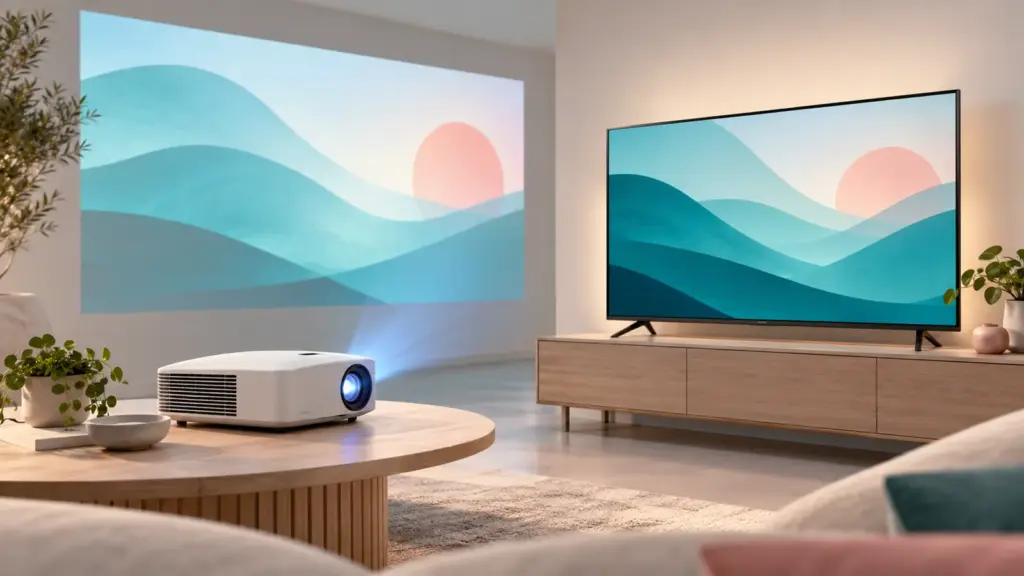
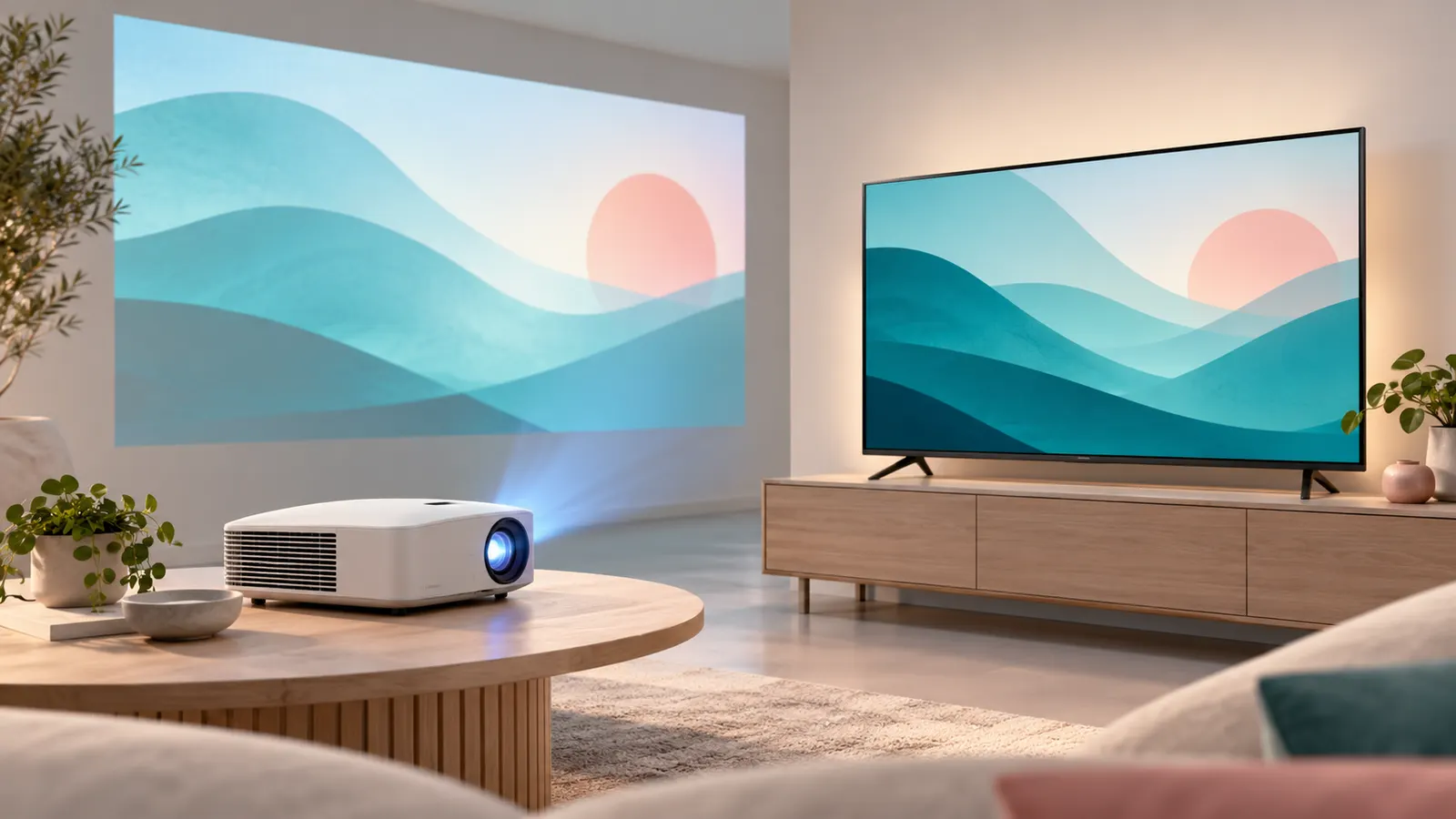
Both can work in a living room if you plan the space.
Last updated: November 2, 2026.
Size and cost
Projectors win on big screens. See screens.
In this guide
Brightness
TVs win in lit rooms.
Setup
Projectors need mounting. See mounts.
Picture Quality in Different Rooms
A TV makes its own light, so it stays bright and punchy even when the room is lit. A projector reflects light off a screen or wall, so room lighting directly affects contrast and color. In a dark room, a projector can look cinematic; in a bright living room, the picture can look washed out unless the projector is bright and the screen is suited to ambient light.
Think honestly about when you watch. If most viewing happens in the evening with controlled lighting, a projector is realistic. If you watch during the day or with lights on, a TV is the safer choice. Wall color matters too: dark walls reduce reflected light and help a projector picture, while light walls can bounce light back and lower contrast.
Screen Size, Viewing Distance and Seating
The main advantage of a projector is a very large image from a device that is small and easy to store. A TV of the same screen size costs more and takes more space. But bigger is not always better. A screen that is too large for the room makes it uncomfortable to watch, and your eyes have to move around the picture.
- Measure the wall and seating distance first.
- Check how far from the screen the projector must be placed.
- Consider the size of the people and furniture in the room.
A moderately large TV can be more comfortable in a small room than an oversized projected image. Choose a size you can see comfortably from your usual seat.
Everyday Convenience and Features
TVs are generally simple: turn on and watch, with built-in apps, tuner options and sound. Projectors can take longer to start and may need adjustment, and the sound from internal speakers is often modest. Many projector users add a streaming device and speakers.
Look at the whole package. A projector setup may include a screen, a mount, cables and audio, while a TV needs a stand or wall mount. Check the inputs you need, such as HDMI ports for consoles or streaming devices. Fan noise on a projector can be noticeable in quiet scenes, and that is worth reading about in buyer feedback. If you want a device that works the moment you press a button, a TV usually wins.
Gaming, Sports and Movies
Different content favors different devices. Movies in a dark room are the projector’s strongest case. Sports and daytime viewing often favor a TV for brightness and motion clarity. For games, look at input lag and refresh rate details in the listings, because some projectors respond more slowly than TVs. Some have game modes that help.
If you play fast action games, check for the specs that matter to you rather than assuming. If you host movie nights or like a big-screen event, a projector can make things feel special. A mix is also possible: a TV for everyday use and a portable projector for occasional movie nights, which you can set up when needed.
Long-Term Costs and Upkeep
Consider the total cost over time, not only the purchase. Projectors may need replacement lamps, depending on the light source, and filters need cleaning. A screen or mount adds cost. TVs have few ongoing needs, though they may use more power at large sizes.
Think about durability and space too. A TV is a fixed object that needs a place on the wall or a stand. A projector can be stored away and brought out when needed, which is useful in a multi-purpose room. Ask yourself how often you will use it, how much setup you will accept, and which compromise bothers you least.
Who Each Option Suits
Before comparing specs, it helps to picture the person using the screen. Some households lean clearly one way, and the choice is easy once you name your habits.
- A projector suits you if: you mostly watch in the evening, can control the light, want a very large image, and are happy with a little setup.
- A TV suits you if: you watch at all hours, with the lights on, want to press one button and go, and prefer a simple, fixed setup.
- Both may suit you if: the TV handles everyday viewing and a projector comes out for movie nights, sports events or gaming sessions.
Think too about who else uses the room. Children, guests and housemates may not want to adjust a screen or close curtains every time. A TV is easier for everyone to operate. A projector tends to reward the person who enjoys setting things up and who watches in a consistent way. If the room doubles as a dining area or office, ask whether the projected image and its screen will get in the way when you are not watching.
The short version is that the decision is about your lifestyle and your room, not about which technology is better in the abstract. Write down your three most common viewing situations and test each option against them.
A Practical Room Checklist
A quick audit of the room answers most of the question. Walk through these points with the lights on, then again with them off.
- Windows: how much daylight comes in, and can curtains or blinds block it fully?
- Wall color and finish: pale walls reflect light back into the picture, while darker, matte walls help a projected image.
- Ceiling and wall access: can you mount a projector or run cables without drilling into something you should not?
- Seating: where do people sit, and how far are they from the wall where the picture will be?
- Furniture: will shelves, doors or sofas block the beam or the view?
- Power and inputs: are there outlets near the place you plan to put the device, and enough HDMI inputs for your consoles and players?
If most of these answers are favorable, a projector becomes realistic. If several are not, such as a bright room with large windows and light walls, a TV will probably give you a better picture with less fuss. This kind of audit is free and often settles the question faster than reading more reviews. It also reveals hidden costs, like a mount or extra cables, that are easy to overlook.
Audio and Connections to Plan For
Sound is easy to forget until the first movie. Projector speakers tend to be modest, and many flat-panel TVs have slim speakers too, so a soundbar or speaker system helps with either choice. The difference is where the audio comes from and what you can connect.
Check the following on whichever device you consider:
- HDMI inputs: count your devices, such as a console, a streaming box and a player, and make sure there are enough ports or plan for a switch.
- Audio outputs: look for an optical port, a headphone output, an ARC-capable HDMI port or Bluetooth, and see which your sound system needs.
- Lip-sync: wireless audio can lag slightly behind the picture, so read the manual for delay adjustment.
- Built-in apps: on both TVs and projectors, app support varies and may change over time, so a separate streaming device keeps things flexible.
With a projector, the speakers are often placed across the room from the screen, which can make dialogue sound disconnected from the picture. Placing a soundbar or speakers near the screen helps. With a TV, wall mounting can hide cables, but it can also make access to ports harder, so connect devices before you hang it. Whichever route you take, plan the cable paths before you buy.
A Dedicated Theater or a Shared Living Room
The same device behaves very differently in a purpose-built room and in a busy family space. A dedicated theater room is the easiest place for a projector to shine. You can control the light, paint the walls dark, mount the projector permanently and set up proper seating and sound. In that setting, the large image and the cinematic feel are often the main reasons people choose one.
A shared living room is a harder place. People walk through, someone wants the lights on, and the room has other purposes. A TV fits that reality well, because it is bright, ready at once and stays out of the way when off. If you still want a projector for such a room, consider these approaches:
- Use a pull-down or retractable screen that disappears when not needed.
- Choose a short-throw model so people are less likely to cross the beam.
- Treat the projector as the evening and weekend option, and keep a TV or monitor for quick viewing.
- Accept that very bright daytime viewing will never match a TV.
A good test is to ask how often you would actually do the setup. If the answer is rarely, the TV is probably the better purchase for the main room.
Eye Comfort and Viewing Habits
Comfort over a long session depends on how you view as much as what you view on. A TV emits light directly toward you, while a projected image is reflected from a surface. Many people find reflected light gentler in a dim room, but individual comfort varies, and the best check is your own experience.
A few habits help with either choice:
- Do not watch in complete darkness. A small, soft light behind or beside the screen reduces the strain from a bright picture in a dark room.
- Take breaks. Look away from the screen at times, especially during long gaming or movie sessions.
- Adjust brightness to the room. A picture that is too bright in a dim room can feel harsh, so use a picture mode and brightness setting suited to the lighting.
- Sit at a comfortable distance. Neck and eye strain increase when the image is too large for the seat or placed too high.
- Keep the screen clean. Dust and smudges are more visible on a bright picture.
If you wear glasses or have specific vision needs, try both types in a shop or in a friend’s home if you can. If you have concerns about eye health, a professional is the right person to ask rather than a buying guide.
Making the Final Decision
When the comparison still feels close, use a simple scoring approach. List the things that matter most to you, such as picture in daylight, size of the image, ease of use, noise, budget, and space. Rate each option on those items in your own words: strong, fair or weak. The pattern usually shows a clear winner.
Here are some common outcomes:
- Choose a TV if you value quick, bright, everyday viewing and want little setup or upkeep.
- Choose a projector if the room can be darkened and a big picture is the main reason you want something new.
- Choose both if you can afford the space and cost, and want the best of each.
Before you commit, check the return policy on whichever you buy. Projectors in particular are easier to judge once they are in your own room, with your own light and wall. Give yourself a week of real use, then decide. If you find yourself avoiding the setup or squinting at a dim picture, a TV is probably the better fit. If you keep wishing the screen were bigger, the projector is worth the effort.
Living Room Scenarios: Which Screen Wins Where
Choosing between a projector and a television gets easier when you place the decision inside a specific room. Think about the walls, the windows, the furniture and the people who share the space, because those factors shape the result more than any spec comparison.
A bright room with large windows. A television holds its picture in daylight far more easily. A projector can still work if you can darken the room with curtains, but expect to give up casual daytime viewing.
A dedicated movie corner. Here a projector shines. With controlled light, a big image across a wall or screen feels like a small cinema, and you can put the equipment away or hide it when guests visit.
A small apartment. A projector can save a wall from a permanent black rectangle, and it can double as a way to watch from bed. However, you need a surface that is flat and light in color, plus a spot for the projector at the right distance.
A family room used all day. Kids, news, sports and background shows tend to suit a television, since it turns on quickly and needs no room preparation.
| Situation | Leans toward |
|---|---|
| Daytime viewing, lots of light | TV |
| Evening movies in a dim room | Projector |
| Wall space is limited | Projector |
| Quick on-and-off use | TV |
Practical Details People Forget Until Installation Day
Projectors need more planning than the box suggests. You must know the throw distance, which is how far the unit sits from the wall to fill a given image size, and the maker’s manual or listing gives these figures. Short-throw models fit near the wall, while standard ones need a longer gap and often a ceiling mount or a stable table.
Sound is another consideration. Many projectors include only modest speakers, so plan to connect a soundbar or powered speakers. Cable runs matter too: an HDMI cable that reaches across the room, plus power for both the projector and the sound system, must be routed neatly and safely. For ceiling mounting, follow the maker’s instructions and use a licensed professional if you are unsure about structural fixings.
Finally, think about upkeep. Projector lamps and filters, where applicable, need attention according to the manual, whereas a television mostly asks for a dusting. Weigh those habits against the thrill of a very large image before you decide.
One last test: stand where you would sit and imagine the screen during a normal evening. Picture the lights, the reflections on the wall or glass, and how many people will watch. If you can see yourself drawing curtains and setting up each time without annoyance, a projector will suit you. If that routine already sounds tiring, a television is the calmer choice, and nobody wins prizes for taking the harder path.
The Middle Path: Hybrid Setups People Actually Live With
The comparison is usually framed as a duel, but many satisfied households refuse the duel entirely and split the jobs. The most durable pattern is a modest television for the room’s daylight life — news with breakfast, children’s programmes, the match with the lights on — and a projector that descends, literally or figuratively, for the evening’s main event. A pull-down screen installed in front of the television is the classic version: by day the room is ordinary, by night the screen covers the TV and the room becomes a cinema, and neither device resents the other.
The reverse hybrid also works: a projector as the main screen in a light-controlled room, plus a small television or monitor in the kitchen or bedroom for casual viewing the projector would make into a ceremony. What both patterns share is honesty about frequency. The everyday device is chosen for convenience, the event device for scale, and the household stops asking one screen to be brilliant at two opposite jobs. If your scoring exercise earlier in this guide produced a near-tie, a hybrid is not indecision — it is the tie resolved correctly.
What changes as the years pass
The two technologies age differently, and the household that plans for it stays happier. A television’s picture is essentially fixed at purchase: it will look the same in year five as in year one, until the day it fails outright. A projector evolves — its lamp or light source dims gradually, which the owner can restore, while its streaming side can be renewed completely by replacing an inexpensive stick rather than the machine. Households that hate replacing big objects often prefer the projector’s renewable path; households that hate maintenance prefer the television’s silence. Neither preference is wrong, but knowing yours in advance is worth more than any single specification on either box.
The Hidden Differences Nobody Mentions in the Shop
Three differences rarely appear in comparisons, yet owners mention all three within a month. The first is warm-up and wind-down: a television is instant in both directions, while many projectors take a little time to reach full brightness and ask for a cooling pause before being unplugged or packed away — trivial in a fixed installation, genuinely annoying in a portable one used daily. The second is the room’s social geometry. A television gathers people around a fixed, glowing point that also serves as the room’s furniture anchor; a projector leaves the wall blank all day and turns the room toward an event, which some households find restful and others find oddly empty. The third is glare behaviour: a glossy television screen mirrors windows and lamps back at the viewer, while a matte projection surface mostly does not — so a room can be “too bright” for a projector yet still produce a more comfortable television-free picture in the evening than a reflective panel does.
Children change the arithmetic in a way specifications ignore. A television is a large, fragile, finger-height object that attracts touching, throwing and the occasional toy collision; a ceiling-mounted projector is physically out of reach, and its “screen” is a wall that cannot be cracked. Households with toddlers sometimes choose projection for reasons that have nothing to do with picture quality, and they are not wrong. Pets argue the other way for portability — a projector on a table is one cat away from a shifted picture — which is why the fixed-versus-portable decision inside the projector camp matters as much as the headline choice between the camps.
Renting, moving and the shape of your next five years
A television is bought for a wall; a projector is bought for a habit, and habits move house more easily. Renters who cannot drill, households expecting to move, and anyone whose next home is unknown get more from the technology that packs into a box and re-emerges in an afternoon. Conversely, a settled household building a room for a decade can exploit the television’s permanence — or the projector’s fixed installation — without compromise. Ask which of those households you are during the period this purchase must serve, and the comparison often settles itself before picture quality gets a vote.
Frequently Asked Questions
Can a projector replace a TV?
In a dark room.
Do projectors need a screen?
A screen helps.
What about sound?
Add speakers.
Can a projector work in a bright room?
It can with a bright projector and a screen made for ambient light, but contrast will usually be lower than a TV in the same room.
Is a projector better for movies?
In a dark room, many people prefer it for the large image. In bright rooms, a TV is often more comfortable.
Do projectors have good built-in sound?
The speakers are usually modest. Many people add a soundbar or speakers. Check the audio outputs on the listing.
Are projectors good for gaming?
Some are, but input lag varies. Look for a game mode and read the specs for response details.
What is the ideal wall for a projector?
A smooth, light, neutral wall works best if you have no screen. A dedicated screen usually gives a better result.
Which uses less maintenance?
A TV generally needs less. Projectors may need filter cleaning and lamp or light-source replacement, depending on the type.
Can I use a projector and a TV together?
Yes. Many households use a TV for everyday use and a projector for movie nights. Make sure your devices have enough HDMI inputs.
Which is easier to set up, a projector or a TV?
A TV is usually easier. You place it, plug it in and watch. A projector needs a position, a screen or wall, focus and alignment, and sometimes a mount.
Is a projector good for a small room?
It can be, especially a short-throw model, but the room must have enough distance for the image size you want. Measure first and check the throw ratio in the manual.
Will a projector work on a colored wall?
It will work, but colors can shift and the picture may look duller. A light, neutral, smooth wall or a proper screen gives the most accurate result.
Can a projector be used as a computer monitor?
Often yes through HDMI, though text sharpness and brightness depend on the model and the room. Check the resolution and input details before relying on it for work.
Do TVs or projectors use more electricity?
It varies with the model, size and settings. Check the energy information in each listing or manual rather than assuming, and compare similar screen sizes.
Should I get a TV and a projector for the same room?
It can work well if you have the space. Use the TV for daily viewing and the projector for movie nights. Make sure you have enough inputs and a place to store the projector.
What is the biggest mistake people make when choosing?
Ignoring the room. Buying a projector for a bright space, or a very large screen for a small room, leads to regret. Measure and think about lighting first.
How do I test a projector before committing?
Buy from a seller with a clear return policy, set it up in your actual room at the time of day you normally watch, and use it for about a week. Return it if the picture or setup does not suit you.
Which is better for watching sport with friends?
It depends on the hour and the room more than on the sport. A big match in the evening, curtains drawn, crowd on the sofa: the projector’s scale turns it into an occasion, and sport’s bright, high-contrast pictures forgive projection’s weaknesses. The same match on a sunny afternoon with the doors open belongs to the television, which holds its picture without asking the room to change. Households that host often should choose for the gatherings they actually host, at the hours they actually happen.
Which is better for a bedroom?
The bedroom splits households. A television is simpler, instant and easy to watch from bed at any hour, and its modest sizes suit the room. A projector offers the ceiling trick — projecting above the bed for lying-flat viewing — and disappears completely when off, which some people find far more restful in a room meant for sleep. If the bedroom is also where you fall asleep to programmes, the television’s sleep timer and instant-on win; if it is an occasional cinema, the projector makes it a better one.
Which holds its value or lasts longer?
A television typically serves until it fails or its smart platform ages out, at which point the whole object is replaced. A projector’s light source is a consumable by design — replace it and the machine is restored — while its streaming side renews with an inexpensive external device, so a well-kept projector can remain current longer than a television of the same year. Against that, the projector asks for the upkeep the FAQ above describes. Longevity belongs to whichever pattern of care matches your temperament.
Can a projector be the only screen for a family with children?
It can, and some families love the deliberateness it creates: viewing becomes an event with a beginning, rather than a background that is simply on. The honest cautions are practical — daytime programmes in a bright room will look washed out, the setup ritual must be simple enough for every caregiver, and a ceiling mount keeps the hardware safe from small hands. Families who choose it successfully almost always keep the setup permanently installed, so “watching something” is one button, not a project.
Which is better for older viewers or guests who struggle with technology?
The television, and it is not close. One remote, one button, a picture that appears — that simplicity is a feature money cannot add to a projector afterwards. A projector household with regular older guests usually ends up leaving the system set up and switched to a single input, effectively imitating a television, which works but concedes the point. Choose for the least technical person who will use the room regularly, not the most enthusiastic.
What if I mostly watch news and everyday programmes?
Then the television’s case is overwhelming: instant on, bright in daylight, legible text, no setup, no darkness required. Using a projector for background everyday viewing spends its light source’s life on the content that benefits least from scale. The projector earns its place on the content where size transforms the experience — films, sport, events, games — and a household honest about its proportions of each will rarely choose wrong.
Which is better value at the same total budget?
Compare systems, not boxes. At a given total spend, the television buys a complete, finished product — panel, sound, apps, stand — while the projector budget must be shared with a screen, a mount and sound before the picture exists. At modest budgets that sharing usually makes the television the better finished result. As budgets rise, the projector’s economics invert: image size grows almost free, while a television of equivalent size costs dramatically more, so the larger your target picture, the more decisively the projector wins the value argument.
Does a projector work for video calls or working from home?
As a display, yes — a laptop connected by HDMI shows documents and calls at a scale a monitor cannot match, and some people love presenting to themselves this way. The cautions are brightness in a lit working room, text sharpness at your model’s native resolution, and the fan during calls. As a second, occasional big display it is a delight; as a primary work monitor in a bright room, most people return to a conventional screen within a month.
Which would you choose for a dedicated cinema room?
The projector, without much hesitation, and the rest of this site exists largely to help build exactly that room. A dedicated space removes every projector weakness — light is controlled, installation is permanent, sound is proper, seating is fixed — and leaves only its strength, a picture at a scale no television in the same budget approaches. The television’s virtues are convenience virtues, and a dedicated room has no use for them.
Can I start with one and add the other later?
Easily, and in the order that suits your life: most households start with the television, because it serves every day from the first evening, and add the projector when the appetite for a cinema night proves real. Starting with the projector and adding a television later works too, usually when a portable projector reveals how much the household enjoys big pictures but resents the ritual for everyday viewing. There is no wrong order — only the wrong expectation that one device must win permanently.
Which is kinder to a small electricity budget?
At the same image size there is little contest — but the two are rarely compared at the same size, which is the point. A modest television sips power; a projector producing a far larger picture uses more, while a very large television uses more still. Compare the energy figures in the listings for the actual sizes you are choosing between, and remember that hours matter as much as watts: the device left on as background all day dominates the bill whichever technology it is.
What do people most often say a year after choosing each?
Television owners rarely mention the television at all, which is its triumph: it disappeared into the household’s life. Projector owners talk about evenings — the films, the matches, the garden screening — because the projector remained an event-maker rather than a utility. Neither report is a complaint; they are the two products keeping their original promises. Choose which sentence you would rather say in a year, and you have usually chosen correctly.
Is a very large TV a substitute for a projector?
At the largest sizes the two converge in price shock from opposite directions: the television’s cost climbs steeply with every extra span of panel, while the projector’s image grows by simply moving it back. A very large TV does deliver the scale with television convenience, and for a bright, busy room it may be the right extravagance. But most households find the projector reaches their dream size at a fraction of the total system cost — which is why the dream-size question, asked honestly, ends more comparisons than any other.
Which is better for a home I am furnishing from empty?
The projector tempts, because an empty room is the one moment installation is effortless — but furnish for the life first and the screen second. Live in the room for a few weeks with a borrowed or existing small screen, learn where the light falls at your viewing hours and where people naturally sit, and then let those facts choose. Empty rooms lie about how they will be used; a month of living tells the truth, and both technologies reward the truth equally.
Does the choice affect what sound system I should buy?
Somewhat. A television usually sits where the sound should come from, so a soundbar beneath it is a natural, tidy pairing. A projector’s sound must be planned independently of the machine’s location — the bar or speakers belong at the screen, the projector somewhere else entirely — which adds cable planning but frees you to place proper speakers without a panel in the way. Either way, budget for sound: both technologies ship with speakers that flatter neither films nor music.
Which produces less waste and clutter in the room?
The projector, when it is not in use: a blank wall and a small machine on a shelf, against a television’s permanent dark rectangle and stand. Households that prize a calm, uncluttered room often underestimate this until they live with both states. The exception is a projector setup left half-assembled — screen down, cables out, tripod standing — which is worse than either; the projector’s tidiness is earned by putting it away or installing it properly, not automatic.
What if my room will change within a year or two?
Favour the adaptable technology. A projector re-aims at a new wall in an afternoon and its image resizes to the new room; a television carries its fixed size and mounting into whatever comes next. If a move, a renovation or a growing family will redraw the room soon, the projector’s flexibility is worth real money — and if the change is distant or unlikely, ignore this and choose for the room you have.
Is the difference smaller than it used to be?
Yes, from both directions: televisions have grown larger and cheaper per inch, while projectors have grown brighter, quieter and easier to set up, with long-life light sources removing the old lamp anxiety. The remaining differences are the durable ones — light behaviour, size economics, setup ritual — and those are properties of physics and furniture, not of this year’s models. Decide on the durable differences and your choice will still look right when the next generation of both arrives.
What is the fastest way to decide if I am still torn?
Borrow or buy-with-returns a projector and live the full ritual for one weekend in your real room: set it up on Friday, watch your real content at your real hours, pack it away or leave it installed on Sunday, and notice which parts of the ritual you resented and which you secretly enjoyed. The decision almost always makes itself during that weekend, because the comparison stops being about specifications and becomes about your own behaviour — and your behaviour, unlike a specification sheet, does not exaggerate.
Which is better for a student or a first flat?
A portable projector is hard to beat: it moves between bedroom wall, living-room ceiling and a friend’s garden without a van, needs no furniture to sit on, and leaves no holes when the tenancy ends. A small television is the safer all-rounder if the flat’s main room is bright and the viewing is mostly everyday programmes. Students who host film nights choose the projector and forgive it everything; students who watch the news with breakfast choose the television and never think about it again.
Can the wrong choice be fixed later without starting over?
Mostly, yes, and that should lower the pressure on the decision. A television household can add a portable projector for events without disturbing anything; a projector household can add a modest television for daylight duty and keep the cinema intact. The only genuinely sunk costs are permanent installations — ceiling work, fixed screens — which is one more reason to live with the portable version of your choice first, and commit the builders only when the habit has proven itself.
What question should I ask myself last?
Not “which is better?” but “which evening do I want?” Picture the ordinary Tuesday and the special Saturday, in your room, with your people. The technology that serves both pictures with the least friction and the most pleasure is your answer — and if the two pictures point at different technologies, you have not failed the decision; you have discovered that your household is one of the hybrid ones this guide describes.
Bottom Line
Choose by room light and screen size.
More Projectors Guides
- Projector Screen Buying Guide for Beginners
- Best Projectors for Home
- Best Projectors for Movie Rooms
- Best 4K Projectors for Movies and Gaming
- Best Mini Projectors for Bedrooms and Trips
- Best Portable Projectors for Movies and Camping
- Best Projectors for Outdoor Movie Nights
- Best Portable Projector Screens for Backyards