Disclosure: As an Amazon Associate, reviewstook.com earns from qualifying purchases. Links to Amazon on this page are affiliate links; they cost you nothing extra.
Speakers come as powered (active) or passive, and the choice affects what else you need to buy. Powered speakers have a built-in amplifier and plug into a source. Passive speakers need a separate amplifier or receiver. This guide explains the pros and cons so you know what to pick.
This comparison draws on product information and general audio knowledge, not our own testing.
By the Reviewstook Editorial Team. Last updated: October 31, 2026.

What Powered Speakers Are
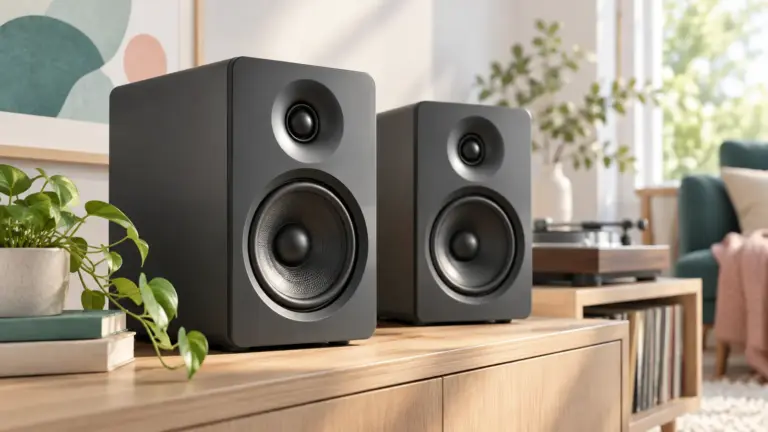
Powered speakers have the amplifier inside. You connect them to a source such as a computer, TV or turntable with a preamp and plug them into a wall outlet. Everything is matched by the maker, so setup is simple. See our bookshelf speakers and computer speakers.
In this guide
What Passive Speakers Are
Passive speakers rely on an external amplifier or receiver. This gives you freedom to choose the amplifier and upgrade it later, and passive speakers are common in home theater and hi-fi setups. They need speaker wire; see our speaker wire gauge guide.
Cost and Complexity
Powered speakers can be cheaper overall because there is no separate amplifier to buy. Passive systems cost more up front but can be easier to expand and repair. Count the whole system, not just the speakers.
Sound Quality
Neither type is inherently better. A well-designed powered speaker has an amplifier matched to its drivers, while a passive speaker can be paired with a high-quality amplifier. The best result comes from good components and placement.
Flexibility and Upgrades
With passive speakers you can change the amplifier or speakers independently. Powered speakers are locked to their built-in amplifier. If you like to experiment, passive is more flexible.
Placement and Connections
Powered speakers need power at each speaker (or at one, with a wire to the other). Check inputs such as Bluetooth, RCA, optical and USB. For turntables see speakers for turntables and how to connect speakers to a turntable.
Which Should You Buy?
- Desk or small room, simple setup: powered speakers.
- Home theater or hi-fi, upgrading over time: passive speakers with a receiver.
- Turntable listening: powered speakers with a phono input or a preamp.
Matching an Amplifier to Passive Speakers
Buying passive speakers means taking responsibility for the match between speaker and amplifier. Three numbers on the spec sheets are worth reading: impedance, sensitivity and power handling. Impedance, measured in ohms, describes how hard the speaker is for an amplifier to drive. Sensitivity tells you how loud the speaker plays with a given input, so a more sensitive speaker needs less power for the same volume. Power handling is the range of amplifier output the speaker is designed to accept.
Your amplifier or receiver should list the impedance range it supports and the power it delivers into each. If the amplifier does not suit the speaker’s impedance, it may run hot, shut down or sound strained. Check the manuals for both, and when the numbers are unclear, ask the maker or retailer.
- Make sure the amplifier is rated for the impedance of your speakers.
- Choose enough power for your room and listening level, with some headroom so peaks are not clipped.
- Remember that driving an amplifier into distortion at high volume can harm speakers, even with modest power.
- If you use a receiver with several channels, check whether the stated power applies with all channels in use.
- Check for the connections you need, such as speaker terminals that suit your wire, and enough outputs for the number of speakers.
This matching work is the main reason powered speakers feel easier. The maker has already paired the amplifier and drivers, so you do not need to do the arithmetic. If numbers and ohms do not interest you, that is a good sign that powered speakers suit you.
Inputs, Wireless Features and Future Use
Connections decide how useful a speaker pair is on day one and years later. Powered speakers often include a mix of inputs, such as analog RCA, a headphone-style jack, optical, USB and Bluetooth. A few include network streaming or a connection for a TV. Passive speakers have no inputs of their own; their features come from the amplifier or receiver, which may offer a wider choice but at a different cost.
Think about what you will plug in now and in the future. A TV, a computer, a phone and a turntable can all need different inputs. If you want to connect a turntable directly, check whether the speakers or the amplifier have a phono input, or whether you will need an external preamp. For a computer, USB audio can be convenient, but check the listing to see which type is supported.
- Wireless audio is handy, but delay can be noticeable with video, so check the listing for a low-delay option or use a wired connection for TV.
- Count the inputs you need and add one extra for later.
- For desktop use, look for a front-facing volume control and headphone output within reach.
- Check whether a remote is included or whether you must adjust levels on the speaker.
- If the speakers use a wired link between the two cabinets, confirm that the length reaches your layout.
Passive systems are easier to extend in a specific sense: you can swap the amplifier to get new inputs without changing the speakers. Powered ones can add functions with external adapters, though not every model supports this. Read the manual before assuming that a feature can be added later.
Room Size and Speaker Position
Where speakers sit often matters more than which type you chose. A large, powerful speaker in a small room can sound boomy, while a small speaker in a big room may run out of loudness. Match the speaker size and output to the space and the distance you sit from them.
For stereo listening, place the speakers and your listening position roughly in an equilateral triangle, with the tweeters at ear height. Angle them slightly inward toward you. Keep speakers away from walls and corners if possible, since close surfaces boost bass and can make it muddy. If the speaker is designed to sit near a wall, the manual will say so; ports on the rear can be sensitive to this.
- On a desk, raise speakers on stands or pads so the tweeters aim at your ears, not at the desk surface.
- On shelves, avoid enclosed cabinets that trap sound, unless the speaker is built for it.
- Use isolation pads or stands to cut vibration into furniture.
- Soft furnishings, rugs and curtains can reduce echo in a bare room.
- Move speakers a little at a time and listen, since small changes often fix a surprising amount.
Powered speakers need an outlet nearby; passive speakers need cable runs to the amplifier. Plan both before you buy, and consider cable routing so wires are safe from walking paths. A tidy setup often sounds better because you will be willing to place the speakers correctly.
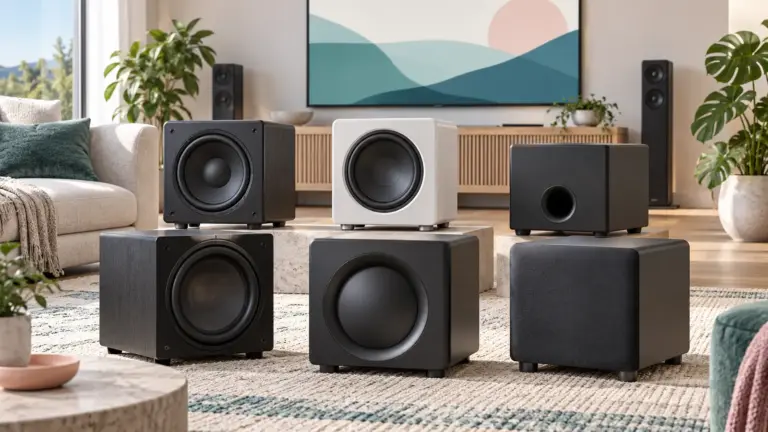
Subwoofers and Growing a System Over Time
Many people begin with a pair of speakers and later want more bass or more channels. Both types can grow, but in different ways. Many powered speakers have a subwoofer output, which lets you add a separate bass unit to the pair. Check the listing for this output and what kind of subwoofer it expects. Passive systems usually grow through the receiver, which can feed a subwoofer and extra speakers if it has the outputs.
When adding a subwoofer, the goal is to blend it so it supports the speakers, not overwhelm them. Start with the level low and raise it slowly, and try different positions. A subwoofer placed in a corner can sound stronger but boomier than one placed along a wall. Adjust any crossover control so the sub covers the low range and the speakers handle the rest, following the manuals.
- Decide first whether you need more bass or just cleaner bass; small speakers may simply be limited by size.
- Check the available outputs on the speaker or receiver before buying a subwoofer.
- For a home theater, plan the number of channels you want and whether the receiver can drive them.
- Think about neighbors and shared walls, because low frequencies carry.
- Keep the budget balanced: an excellent subwoofer cannot fix poor main speakers.
If you expect to build up a multi-channel system slowly, passive speakers with a capable receiver give a clear path. If you want a compact setup that stays compact, powered speakers are often the tidier answer.
Reliability, Repairs and How Long They Last
Passive speakers contain drivers, crossovers and a cabinet, and few electronic parts to fail. With sensible use, they can last a long time, and the amplifier can be replaced without touching them. Faults tend to come from damaged cones, worn surrounds, loose connections or blown drivers, which are often repairable or replaceable by a qualified technician.
Powered speakers add an amplifier and power supply to the cabinet. That means more components inside one box, and if the amplifier fails you may have to repair or replace the whole speaker. On the other hand, the amplifier is matched and protected for the drivers, which reduces the risk of a mismatch. Check the maker’s warranty terms, how repairs are handled and whether parts are available.
- Keep vents clear on powered speakers, since the amplifier needs airflow.
- Turn off or unplug during storms or long absences, following the maker’s guidance.
- Avoid running at maximum volume for long periods or into audible distortion.
- Check cables and connectors for fraying, loose terminals or crackling when moved.
- Keep liquids and dust away from the drivers.
Signs that it is time to repair or replace include persistent crackling or buzzing, a driver that no longer moves, sound from only one speaker, a hot smell, or a hum that appears even with no input. Try other cables and sources first to isolate the fault, then consult the warranty or a technician. If you buy used, ask about the condition of drivers and electronics, and request a return option when possible.
A Short Glossary of Speaker Terms
Speaker listings are full of abbreviations, and a few of them decide whether a pair will work in your setup. Here are the ones worth knowing before you compare models.
- Impedance: a measure, in ohms, of how much a speaker resists the signal from an amplifier. Passive speakers list it so you can check compatibility with the amplifier’s instructions.
- Sensitivity: how loud a speaker plays for a given amount of power. A higher figure means it needs less power to reach a comfortable volume.
- Driver: the moving part that makes sound. Most speakers combine a larger woofer for lower notes with a small tweeter for higher ones.
- Line level input: a standard connection that carries a weak signal from a source such as a phone, a turntable preamp or a streamer. Powered speakers accept it directly.
- Speaker level output: the stronger signal sent from an amplifier to passive speakers through speaker cable.
- Crossover: circuitry that divides the signal between drivers so each handles the right range of notes.
If a term on a product page is still unclear, the maker’s manual is the best reference, and it often explains exactly which connections each model supports.
A Checklist Before You Choose
Whether you lean toward powered or passive speakers, a few honest questions will point you toward the better fit. Answer them on paper, because a written list is harder to ignore than a passing thought.
- What will you play music from: a phone, a computer, a television, a turntable or a stack of existing hi-fi gear?
- Do you already own an amplifier or receiver, and does it have free speaker outputs?
- How much desk, shelf or floor space can you give the speakers and any extra boxes?
- Will the speakers sit close to you on a desk or fill a larger living room?
- Do you want to add a subwoofer, a streamer or more speakers later?
- How many power sockets and cable runs can your layout handle neatly?
If most answers describe a simple, compact setup, powered speakers usually suit you. If you already own an amplifier or like the idea of mixing components over the years, passive speakers deserve a closer look.
Common Mistakes to Avoid
Choosing between the two types is easy to get wrong in a few predictable ways. Watch for these.
- Buying passive speakers without an amplifier in mind. They cannot play on their own, so the cost of a matching amplifier belongs in your plan from day one.
- Assuming powered means plug and play with every source. Check the input types on the back panel so your source can connect without adapters.
- Ignoring the cable run. One powered speaker usually needs a signal link to its partner, and sometimes a wall socket on each side.
- Judging by size alone. A larger cabinet does not always sound better in a small room, where bass can become muddy.
- Overlooking placement. Even good speakers sound poor when pushed into a corner or hidden behind furniture.
Most of these mistakes are inexpensive to prevent. A few minutes with the back-panel photos and the manual can save a return.
Which Type Suits Which Situation
This table summarizes how the two types usually line up with common setups. It is a rough guide, not a verdict.
| Situation | Often a good fit | Reason |
|---|---|---|
| Desk setup with a computer | Powered | Fewer boxes and cables, simple connection. |
| Existing amplifier or receiver | Passive | Uses the gear you already own. |
| Small apartment | Powered | Compact footprint with no extra components. |
| Growing home audio system | Passive | Parts can be swapped or upgraded one at a time. |
| Television and music together | Either | Depends on available inputs and cable routes. |
Whichever route you choose, read the connection details in the listing carefully and keep the manual handy for setup. If you are unsure about wiring a receiver or connecting gear safely, follow the maker’s instructions or ask a qualified installer.
How to Read a Speaker Listing
A good listing tells you how a speaker connects, not only how it looks. Scan the specification section in this order and you will learn most of what matters in a minute or two.
First, find the input list. Words such as RCA, 3.5 mm, optical, USB, Bluetooth and balanced describe the ways a source can connect. Make sure at least one matches your equipment. Second, look for a phrase such as active, powered or built-in amplifier. If it is missing and you see binding posts instead, you are looking at a passive pair that needs a separate amplifier. Third, read the frequency response and power figures as general hints, and remember that the numbers are measured under the maker’s own conditions.
Finally, glance at the box contents. Some pairs include the cable between the two speakers, a remote or a power adapter, while others leave them out. Customer photos of the rear panel can be more useful than marketing images, because they show exactly where the sockets and switches sit.


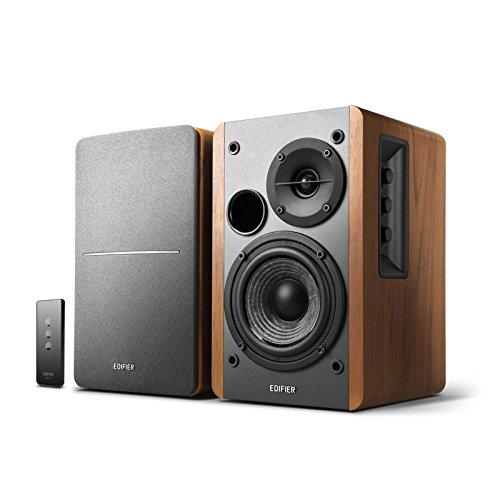
Ready to Buy? Start Here
If this guide helped you decide what to look for, these products are a place to start.


As an Amazon Associate we earn from qualifying purchases. Prices and availability are shown on Amazon.
The True Cost of Each Route, Counted Honestly
Comparisons between powered and passive speakers often cheat by counting only the speaker price on one side. Count the whole system instead. A passive setup needs the speakers, an amplifier or receiver, speaker wire, and usually stands or a suitable surface. A powered setup needs the speakers, the cables for your sources, and the same stands or surface. At modest budgets the powered route frequently wins on total cost because the amplification is built in and matched to the drivers at the factory. At higher budgets the comparison flips around: a separate amplifier bought once can serve several successive pairs of passive speakers over many years, spreading its cost across upgrades the powered route cannot reuse.
Running costs differ a little too. Powered speakers draw mains power at each speaker and sip a standby amount when idle, which is small but real across a house full of them. A passive system’s amplifier is one box to feed and one box to switch off. Neither difference should decide the purchase on its own, but both belong in an honest count, especially for a system that will be left on around the clock in a living room.
The hidden cost is space and cabling. Powered speakers need a mains socket within reach of each cabinet, which quietly rules out some placements in older rooms with few outlets. Passive speakers need only the wire run, which can go almost anywhere. Before falling for either route, stand in the room with a tape measure and check where the cables of each kind would actually go. That five-minute exercise settles more real-world choices than any specification.
Upgrade Paths: How Each System Grows With You
A passive system grows piece by piece. You can replace the amplifier and keep the speakers, replace the speakers and keep the amplifier, add a subwoofer, add a streamer, or move the whole set to a bigger room and add power to match. Each step is a separate, reversible decision, and the second-hand market for amplifiers and passive speakers is deep, which keeps both buying and selling prices civilised. For a hobbyist who enjoys the journey as much as the destination, this modularity is the entire point.
A powered system grows differently: by addition rather than substitution. You add a subwoofer, add a better source, or add a second pair in another room. The speakers themselves are a fixed partnership of cabinet, drivers and amplification, so a true upgrade usually means a new pair. That is a genuine limitation, but it comes with a compensating virtue: the pairing you bought was engineered to work together, so there is no mismatch to diagnose and no amplifier pairing to research. Many listeners happily trade upgrade theatre for that certainty.
Think, then, about your own history. If you have owned the same equipment contentedly for years, the powered route’s fixed nature will never trouble you. If you change one component every year or two and enjoy it, a passive system will keep you entertained and a powered one will eventually feel like a wall. Neither answer is the sensible one in the abstract; each is sensible for a particular person.
Choosing Room by Room Rather Than House by House
The desk is powered-speaker territory for most people. Space is short, the listening distance is fixed, sources are a computer and a phone, and a separate amplifier steals the very desk area the speakers were bought to save. A passive system earns its place at a desk only when it is built around a compact amplifier and a listener who specifically wants that flexibility. In the bedroom, the same logic applies with a premium on simplicity: a powered pair that wakes, connects and plays without ceremony gets used, while a rack of separates in a bedroom often gathers dust.
The living room is the contested ground. If the speakers share duty with a television, a receiver-based passive system brings proper source switching, a remote that controls everything, and an easy path to surround sound later. If the living-room system is for music first, with the television served by its own soundbar, a good powered pair is cleaner, cheaper and entirely sufficient. The deciding question is how many sources must meet at the speakers, because switching and control, not sound quality, is where the two routes genuinely diverge in daily life.
For a dedicated listening room, the passive tradition still rules, mostly because that room exists to be improved over time. Yet even there, high-quality powered designs have earned respect by removing amplifier-matching from the equation. The honest summary is that the room’s job, the number of sources, and your appetite for tinkering decide the route, and sound quality alone, at any given total budget, rarely does.
Failure Points, Repairs and Living With Each Type
Every system eventually needs attention, and the two routes fail differently. In a passive setup, faults isolate neatly: a silent channel can be chased by swapping speaker cables, then speakers, then amplifier channels, until the guilty box identifies itself, and that box alone goes for repair or replacement. In a powered setup, the amplifier lives inside the speaker, so an electronic fault usually means the pair, or at least the powered cabinet, goes away for service, and you are without music meanwhile. Against that, powered speakers have fewer interconnects to loosen and fewer settings to knock astray, so they tend to need attention less often in the first place.
Heat and dust deserve a thought for powered designs. An amplifier inside a cabinet needs the ventilation its maker designed, so resist burying powered speakers in enclosed furniture or stacking items on top of them. Keep passive speakers’ terminals clean and tight, and an amplifier’s vents clear, and both routes will serve for many years.
When buying second-hand, the calculus sharpens. Used passive speakers are a low-risk pleasure because there is little inside them to fail. Used powered speakers deserve more caution: ask about age, standby behaviour and any hum or hiss at idle, and listen before you buy if you can. None of this argues against powered speakers; it argues for buying each type with its own failure pattern in mind.
Sound Character: Does One Route Sound Better?
It is the question underneath every powered-versus-passive debate, and the honest answer is that neither route owns sound quality. A well-designed powered speaker benefits from amplifiers chosen for its exact drivers, often one amplifier per driver with the crossover handled before amplification, which is an elegant arrangement a passive system cannot easily copy. A well-designed passive system benefits from the enormous choice of amplifiers, including designs no speaker maker would build into a cabinet, and from crossovers built with components that would never fit a powered speaker’s budget or space. Both roads reach excellent sound; they simply distribute the engineering differently.
Where listeners do hear consistent differences, they are usually hearing specific products rather than the principle. A particular powered pair may be voiced warmly, a particular passive pair brightly, and swapping either changes the impression entirely. This is why the advice throughout this article keeps returning to total budget and use case: at the same total spend, the two routes land close enough in quality that convenience, flexibility and upgrade appetite should decide. Anyone who tells you one route always sounds better is selling the other route’s products.
One practical listening note applies to both. Judge speakers with the sources and in the room you will actually use, at the levels you actually listen at. A passive pair that sings on a dealer’s powerful amplifier may be ordinary on the modest one in your budget, while a powered pair sounds the same in the shop and at home because its amplifier travels with it. That consistency is a quiet, genuine advantage of the powered route for buyers who cannot arrange home trials.
A Decision Checklist You Can Run in Five Minutes
Answer five questions and the choice usually makes itself. First, how many sources must connect? One or two sources point to powered; a rack of sources points to an amplifier at the centre. Second, do you already own a working amplifier or receiver you like? If so, passive speakers put your money where it shows. Third, how likely are you to change or upgrade parts within a few years? Likely points to passive, unlikely points to powered. Fourth, how much space and how many mains sockets can the system honestly claim? Tight answers favour passive speakers with one amplifier to plug in, or powered speakers where sockets sit beside each cabinet, and the room itself will tell you which.
Fifth, who else uses the system, and how do they feel about it? A household that wants one remote and one volume control will use a receiver-based passive system happily and a purist two-box arrangement reluctantly, while powered speakers with simple controls suit a household that plays music from phones and wants no ceremony at all. Technology that the whole household enjoys gets played; technology that only its owner understands gets admired. Choose for the listeners you have.
If the checklist still ties, choose the route with the lower total cost for the performance you need and keep the change for music, stands and room treatment. Ties are genuinely common between these two mature approaches, and the tie-breaker of spending less while enjoying it sooner is a respectable one.
Living With the Choice: Two Households, Two Right Answers
Consider a listener in a small flat who plays music from a phone and a laptop, owns no other audio equipment, and rents a place where the system must fit on one sideboard. For this listener the powered route is not a compromise; it is the obviously correct architecture. Two speakers, two power leads, one cable, and music fills the flat within the hour of the boxes arriving. There is nothing to match, nothing to configure beyond pairing, and when the listener moves, the whole system travels in one box and works in the next flat the same evening. A passive system would add an amplifier competing for the sideboard, wire to run, and decisions that listener never wanted to make.
Now consider a listener with a turntable, a television, a games console and a shelf of equipment gathered over years, who enjoys reading about amplifiers and has a birthday tradition of upgrading one component. For this listener the passive route is equally obviously correct. The receiver at the centre switches every source with one remote, the speakers can be upgraded when the tradition demands it, and the turntable’s phono stage, the console’s surround sound and the television’s late-night listening all live in one coherent system. A powered pair would strand most of that equipment and answer questions this listener was not asking.
Most real households sit between those portraits, which is why this article refuses to crown a winner. The useful exercise is to locate your household honestly on the two scales that matter: how many sources must meet at the speakers, and how much pleasure you take in changing components. High source counts and high tinkering pleasure point one way; low counts and a preference for appliances that simply work point the other. Sound quality, the thing buyers assume decides it, is the one factor that at equal total budget rarely does.
There is also no shame in the hybrid ending most homes reach. A passive system where the serious listening happens, powered speakers where convenience matters, each doing the job it is shaped for. The routes in this comparison are tools, not teams, and the best-equipped household is the one that deploys each where it belongs.
Whichever route you take, take it completely. A powered pair starved of a decent source, or passive speakers hung on an amplifier chosen as an afterthought, both underperform their promise. The route matters less than the care taken along it, which is the closest thing this long-running debate has to a settled conclusion.
Standby, Controls and the Small Frictions of Daily Life
Specifications never mention the frictions that decide whether a system gets used, so consider them here. Powered speakers wake in different ways: some sense a signal and spring to life, some need their own remote or a hand on the volume knob, and some stay on permanently. A pair that takes a noticeable moment to wake can clip the first syllable of a doorbell notification or a television announcement, a tiny irritation repeated daily. Passive systems wake with their amplifier, which usually means one power button or one remote for everything, and that singleness is a real, if unglamorous, virtue in a shared living room.
Volume control tells a similar story. With powered speakers fed by a television or computer, two volume controls often exist, one at the source and one at the speaker, and households end up chasing which one is low. The tidy habit is to fix the speaker’s volume at a healthy level and control listening level from the source remote alone. With a passive system the amplifier owns the volume by design. Neither arrangement is difficult, but the powered route asks you to establish that one small discipline, and the passive route does not.
None of these frictions appears in a review’s measurements, yet they are what owners mention after a year. When you choose between the routes in this article, picture the system’s most ordinary Tuesday evening, not its finest hour, and ask which arrangement your household would operate half-asleep. That picture is worth more than a row of specifications.
A Short Word on Hybrids and Middle Paths
Between the two pure routes sit hybrids worth knowing about. Some amplifiers are small enough to live behind a television or on a desk while still driving passive speakers properly, giving a system the passive route’s flexibility at something like the powered route’s tidiness. Some powered speakers accept enough inputs and offer enough control to serve as a small system’s centre rather than its entirety. These middle paths suit households whose source count or space sits exactly between the two camps described in this guide, and they are worth considering before concluding that neither pure route fits. The checklist in this article still arbitrates: count the sources, count the sockets, and let the room decide.
Frequently Asked Questions
Can I use passive speakers without an amplifier?
No. They need an amplifier or receiver.
Are powered speakers worth it?
Yes for simple setups and small spaces.
Do powered speakers need power cables?
Yes, at least one, because they contain an amplifier.
Can I connect powered speakers to a receiver?
Sometimes, using a line-level output from the receiver, such as a preamp or zone output. Do not connect speaker-level outputs to line-level inputs. Check both manuals.
Why do my powered speakers hiss when nothing is playing?
A faint hiss can come from the amplifier or from a high volume setting on the source. Lower the speaker volume and raise the source level, and try a different cable or input. If the noise is loud, check the warranty.
Do speaker cables really change the sound?
Cable thickness matters for longer runs, because thin wire adds resistance. For typical home distances, a properly sized, well-connected cable is what counts. Check your speaker and amplifier guidance for gauge advice.
Do powered speakers have to be left on all the time?
No. Many have standby or auto-off features, but the behavior varies. Check the manual to see how yours handles power and whether it draws power in standby.
Can I use one pair of passive speakers with two amplifiers?
Not at the same time in most setups. Connect them to one amplifier output, or use a switch designed for the purpose, and follow the amplifier's instructions to avoid damage.
Will bigger speakers always sound better?
Not necessarily. Larger cabinets can reach lower bass, but in a small room they may sound boomy. Match size to room and listening distance, and consider placement.
Is Bluetooth good enough for music?
For casual listening it is convenient and often fine. For critical listening or video, a wired connection avoids compression and delay. Check which wireless formats the speakers support.
Can I start powered and move to passive speakers later?
Yes, and nothing you buy for a powered setup is wasted. Your sources, stands and listening habits carry over, and the powered pair can move to a desk, bedroom or kitchen where its simplicity is ideal. What does not carry over is amplification, since the passive route needs its own amplifier or receiver. Many households end up happily mixed: a passive system in the main room and powered speakers everywhere else.
Which type is better for a first proper music system?
For most first systems, powered speakers are the easier recommendation, because the amplifier is matched to the speakers, the wiring is minimal, and the whole budget goes into one well-chosen pair. Choose the passive route first only if you already own a suitable amplifier, have been given one, or know you want to build and change a system over time. The best first system is the one that gets set up quickly and played every day.
Do powered speakers work in a home cinema setup?
They can, with limits. A powered pair handles stereo television and film sound very well through a television’s output, and some ecosystems add centre and surround options of their own. A traditional receiver with passive speakers remains the more flexible route for a full surround layout, with proper bass management and source switching. Decide by the layout you truly intend to build, not the one you might build one day.
Which type is easier to take when moving house?
Powered speakers, comfortably. A pair, their power leads and one signal cable re-establish music in a new room within minutes, which matters on moving day. A passive system needs its amplifier, wire runs re-measured and re-routed, and connections remade, which is an afternoon rather than a minute. Frequent movers and renters should weigh that difference honestly, because a system that is easy to set up is a system that actually gets set up.
Bottom Line
Choose powered speakers for a simple, all-in-one setup and passive speakers if you want to build and upgrade a system. See our best bookshelf speakers for picks.
Related Reading
- Soundbar Buying Guide: Channels, Atmos, HDMI ARC and Subwoofers
- 6 Best Soundbars for TV
- 6 Best 2.1 Computer Speakers with Subwoofer: PC and Gaming
- 4 Best 4×6 Car Speakers: Pioneer, Kicker, Pyle
- 4 Best 5.25-Inch Car Speakers: Pioneer, Kicker, BOSS
More Speaker Guides
- Best Record Players with Speakers
- Best Speakers for Turntables
- How to Connect Speakers to a Turntable
- Best Powered Bookshelf Speakers
- All speaker guides