Where to Buy These Deals
Every pick in this guide links to its Amazon listing. Prices move hourly during Black Friday Week, so always check the live price on the listing before you check out — the price you see at checkout is the price that applies. This page contains affiliate links to reviewstook.com. If you buy through them we may earn a commission at no extra cost to you. Deal prices below are dated sightings from our research, not promises.
Mesh WiFi Black Friday Deals: The Short Version
Mesh Wi-Fi is the single most satisfying home-network upgrade most people can make: one network, every room, no extender juggling, no dead zones. Amazon Black Friday Week runs Nov 19–30, 2026; Black Friday is Nov 27; Cyber Monday is Nov 30 — and mesh systems are among the most reliably discounted products of the entire event, which makes this the right week to buy and the easiest week to buy wrong.
Wrong how? By comparing coverage numbers that are maker claims as if they were measurements, by buying a 2-pack price while reading a 3-pack review (every pack size is a different Amazon ASIN with its own price), and by paying for a Wi-Fi generation your devices cannot use — or skimping on the one they can. This guide fixes all three. Six verified systems span Wi-Fi 5 budget mesh through Wi-Fi 6, Wi-Fi 6E and Wi-Fi 7, each with its real ASIN, a dated price sighting from our research — spotted at the price shown on Nov 19, 2026 — and an honest limitation. Coverage figures are always attributed to the maker, because your walls will have the final say. And because prices move hourly during this event, every section repeats the only advice that matters: check the live price before you buy.
In this guide
Quick Picks: 6 Deals Worth Your Attention
| Deal | Best for | Sighted price | Link |
|---|---|---|---|
| TP-Link Deco S4 AC1900 Mesh Wi-Fi System (3-Pack) | Apartments and smaller homes that need mesh coverage on a tight budget | Spotted at $119.99 on Nov 19, 2026 | Check on Amazon |
| TP-Link Deco X55 AX3000 Wi-Fi 6 Mesh System (3-Pack) | Most families — the Wi-Fi 6 sweet spot of price, coverage and ports | Spotted at $149.96 on Nov 19, 2026 | Check on Amazon |
| Amazon eero 6+ AX3000 Mesh Wi-Fi System (3-Pack) | Buyers who want the simplest setup and a built-in smart-home hub | Spotted at $199.99 on Nov 19, 2026 | Check on Amazon |
| TP-Link Deco XE75 AXE5400 Tri-Band Wi-Fi 6E Mesh System (3-Pack) | Homes ready for 6 GHz — Wi-Fi 6E devices and cleaner backhaul | Spotted at $226 on Nov 19, 2026 | Check on Amazon |
| TP-Link Deco BE25 BE5000 Wi-Fi 7 Mesh System (3-Pack) | Early Wi-Fi 7 adopters who want 2.5G ports without flagship pricing | Spotted at $249.99 on Nov 19, 2026 | Check on Amazon |
| Google Nest Wifi Pro Wi-Fi 6E Mesh System (3-Pack, Snow) | Google Home households that value design and zero-subscription simplicity | Spotted at $307.01 on Nov 19, 2026 | Check on Amazon |
Spotted prices were recorded during research for this guide on Nov 19, 2026, the opening day of Amazon Black Friday Week. Check the live price on every listing — a deal that has drifted back to full price is not a deal anymore, and several of these products cycle between sale and list price several times during the event.
How These Deals Were Chosen
Every system here had to pass an identity test, a price test and a generation test. Identity: the exact pack configuration and ASIN had to be verifiable in Amazon listing data surfaced through search results, retailer pages or price trackers — because in mesh Wi-Fi, a ‘3-pack’ and a ‘single node’ of the same model are different products with different ASINs, and mixing them up is how shoppers end up with one node and a great ‘discount’. The ASINs in this guide are the 3-pack listings named in each heading, verified as such in our sources.
Price: each system needed a current-season dated sighting from retail tracking, retailer listings or deal reporting, recorded in the sources file. We state a percentage off only where a source published both the deal price and the reference price it is measured against. Generation: we verified the Wi-Fi standard model by model — 5, 6, 6E or 7 — and, just as importantly, what that label does and does not include, such as the BE25 being dual-band Wi-Fi 7 with no 6 GHz radio. Node counts, port speeds and backhaul options were checked against maker specifications. Systems that could not be verified on all three tests did not make the guide, whatever their badges claimed.
1. TP-Link Deco S4 AC1900 Mesh Wi-Fi System (3-Pack)
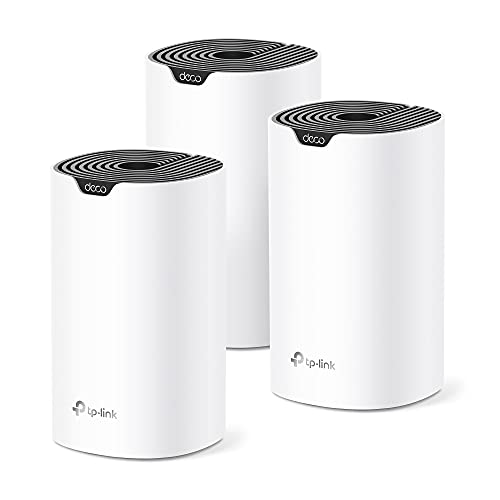
The TP-Link Deco S4 is the mesh system that proved whole-home Wi-Fi did not have to be expensive, and at a sighted price under $120 for three nodes it remains the budget anchor of this guide. It is a dual-band Wi-Fi 5 (AC1900) system: three identical nodes blanket a home in a single network name, devices roam between nodes automatically, and the dead zone in the back bedroom — the reason you are reading a mesh guide at all — is the problem it exists to solve. TP-Link rates the 3-pack for coverage up to 5,500 sq. ft.; that is a maker claim under ideal conditions, and real coverage depends on walls, floors and node placement, but for apartments and small-to-medium houses three nodes is generous headroom.
Each node has two gigabit Ethernet ports, so the node by the TV can hard-wire a streaming box or console, and the system supports wired Ethernet backhaul if your home has cabling. Setup and management run through the Deco app, parental controls and basic QoS are built in, and it works with Alexa for simple voice control of guest Wi-Fi. There is no subscription required for core functions, which matters in a category where some rivals paywall security features.
The honest trade is the Wi-Fi generation. Wi-Fi 5 lacks the efficiency improvements of Wi-Fi 6 — OFDMA and better handling of many simultaneous devices — so in a home packed with dozens of smart devices all chattering at once, the S4 works harder for the same result. For a household whose internet plan is a few hundred megabits and whose devices are a normal mix of phones, laptops, TVs and smart plugs, you will not feel the missing generation day to day. Gamers chasing the lowest latency and homes with gigabit-plus plans should step up to the Wi-Fi 6 picks below.
As a Black Friday buy, the S4’s job is simple: it is the price floor for real mesh. If the live price sits at or below our $119.99 sighting, it is an easy recommendation for smaller homes. If newer Wi-Fi 6 systems like the Deco X55 below are within $30 of it during the event, the newer technology is worth the small stretch — which is exactly the kind of comparison the live prices, checked on the day, should decide.
Deal details: Spotted at $119.99 on Nov 19, 2026 — the last observed offer recorded Nov 18, 2026 for this exact 3-pack ASIN. No percentage is claimed because our source did not publish a paired list price. Check the live price; at or near $119.99 this remains the budget mesh benchmark.
Honest limitation: This is Wi-Fi 5 (802.11ac), not Wi-Fi 6. It will not hold back a typical broadband connection, but it leaves modern phones and laptops without Wi-Fi 6 efficiencies, and its app-based management offers fewer controls than newer Deco models.
Check on Amazon · See the current deal price · View this deal on Amazon
2. TP-Link Deco X55 AX3000 Wi-Fi 6 Mesh System (3-Pack)
If one mesh system in this guide deserves the ‘buy this one’ label for most homes, it is the Deco X55. It is a dual-band Wi-Fi 6 (AX3000) system — 2,402 Mbps on 5 GHz plus 574 Mbps on 2.4 GHz in maker ratings — sold here as a 3-pack (ASIN B09PRB1MZM; single and 2-pack versions are different ASINs with different prices, so verify the pack size on the listing). TP-Link rates the 3-pack for up to 6,500 sq. ft. of coverage and up to 150 connected devices; treat the square footage as a maker claim, but the device count reflects what Wi-Fi 6 is genuinely good at — handling the modern pile-up of phones, laptops, TVs, consoles, cameras and smart-home gear without the slowdowns older systems show.
The hardware detail that sets the X55 apart at this price is ports: three gigabit Ethernet ports on every node. That means wired backhaul in any room with cabling, plus spare ports for a desktop, console or network printer wherever a node lands. AI-driven mesh roaming, the Deco app for setup, parental controls and HomeShield basic security round out a package with no subscription needed for the essentials.
Where does it fall short? It is dual-band, so the wireless backhaul between nodes shares spectrum with your devices. In most houses, with nodes placed well, you will never notice. In a large home with thick walls and no Ethernet, a tri-band system with a dedicated backhaul band will hold speeds better at the far node — that is the XE75’s pitch below. The X55 also tops out at gigabit ports, so multi-gig internet plans cannot be fully used over wired connections.
Black Friday math favors the X55 strongly. Our sighting of $149.96 sits below its $195.29 reference price and within sight of its tracked historical low, which is what a real event deal looks like. Check the live price: at or under $150, buy it for any small-to-large home on a sub-gigabit plan. Only step up if you know you need tri-band backhaul or 6 GHz — and if you do, the next two picks are waiting.
Deal details: Spotted at $149.96 on Nov 19, 2026, against a $195.29 reference price in the same retail tracking — that pairing works out to roughly 23% below the reference, and price trackers also recorded a historical low of $132.98, so you can judge the live price against both anchors. Check the live price before buying.
Honest limitation: Dual-band only: there is no dedicated backhaul band, so node-to-node traffic shares the same radios as your devices. Wired backhaul fixes this if you have Ethernet runs; without them, very large homes will get more from the tri-band XE75 below.
Check on Amazon · See the current deal price · View this deal on Amazon
3. Amazon eero 6+ AX3000 Mesh Wi-Fi System (3-Pack)
The eero 6+ is the mesh system for people who do not want to think about their mesh system. Amazon’s eero line is famous for a ten-minute, phone-guided setup and an app that manages the network quietly in the background, with automatic updates and TrueMesh roaming that simply works. This 3-pack (ASIN B08ZK2BHP2) is dual-band Wi-Fi 6 rated AX3000, supports internet plans up to a gigabit, and eero rates it for coverage up to 4,500 sq. ft. — a maker claim, and a more conservative one than some rivals print, which is to eero’s credit. It handles 75+ connected devices in eero’s rating.
Two features distinguish it from the TP-Link picks. First, each eero has a built-in Zigbee smart-home hub, so compatible lights, locks and sensors can connect without another bridge — genuinely useful if your smart home is growing. Second, eero’s software polish: band steering, SQM for latency-sensitive traffic, and a guest network are all a tap away, and the system doubles as a Thread border router for Matter-era devices. The trade is depth: there is no web interface, port configuration is basic, and the richest features live behind eero Plus.
That subscription is the honest limitation to weigh. Core routing, updates and the Zigbee hub work without paying anything extra, forever. But if you want the advanced security scanning, content filters and detailed insights eero advertises, budget for eero Plus after the trial. Hardware is similarly streamlined: two auto-sensing gigabit ports per node, no USB, no multi-gig port — fine for gigabit plans, a ceiling for anything faster.
During Black Friday Week the eero 6+ at our $199.99 sighting — against a $299.99 list in tracking data — is priced to compete directly with systems that lack its polish. Check the live price and the exact model name, because eero 6, 6+ and Pro 6E listings sit side by side at different prices. If simplicity is your priority and the live price holds near the sighting, this is the mesh your least technical family member will never call you about.
Deal details: Spotted at $199.99 on Nov 19, 2026, against a $299.99 list price in price-tracking data — a pairing that works out to about a third below list. Tracking data also shows this 3-pack has averaged well above $200, so the sighting is a genuine event-level price. Check the live price, and confirm the listing is the 6+ (not the older eero 6) before checkout.
Honest limitation: Advanced features — detailed security, content filtering, activity insights — sit behind the eero Plus subscription, and each node has only two Ethernet ports with no USB. Network tinkerers who want deep manual control will find the app-only approach restrictive.
Check on Amazon · See the current deal price · View this deal on Amazon
4. TP-Link Deco XE75 AXE5400 Tri-Band Wi-Fi 6E Mesh System (3-Pack)
The Deco XE75 is where this guide steps into Wi-Fi 6E, and the ‘E’ adds something real: a third radio band at 6 GHz. In this tri-band AXE5400 system, that band does double duty — it gives Wi-Fi 6E laptops and phones a clean, uncongested lane, and it can serve as a dedicated backhaul highway between nodes, so your devices on 5 GHz are not competing with node-to-node traffic. TP-Link rates the 3-pack (ASIN B0B88T5RDY) for coverage up to 7,200 sq. ft., a maker claim that assumes good placement; the honest translation is ‘large homes, comfortably’.
Around the radios, the XE75 is a mature Deco: AI-driven mesh that learns your environment, the Deco app for setup and parental controls, HomeShield security features, and three gigabit Ethernet ports per node for wired backhaul or wired devices. It supports up to 200 devices in TP-Link’s rating, and it plays well with Alexa. Like all Deco systems, the pack size defines the ASIN — this guide’s price and link are for the 3-pack; the 2-pack and single are separate listings.
Temper expectations on 6 GHz physics. The higher band carries more data with less interference, but it fades faster through walls and floors, so node placement matters more, not less, and in a sprawling house you may dedicate 6 GHz to backhaul and still lean on 5 GHz for far rooms. And if none of your devices speak Wi-Fi 6E yet, your immediate gain is the backhaul benefit alone — real, but worth pricing against the X55 above, which costs notably less.
At our $226 sighting, the XE75 asks a modest premium over Wi-Fi 6 systems for a genuinely newer capability, and Black Friday Week is exactly when that premium compresses. Check the live price, confirm ‘XE75’ and ‘3-Pack’ on the listing, and buy it if your home has — or will soon have — 6E devices and you want backhaul that does not steal from your devices. Pure value shoppers should compare its live price with the X55’s on the day; the gap decides.
Deal details: Spotted at $226 on Nov 19, 2026 for this 3-pack ASIN in retailer tracking around the start of Black Friday Week. No paired list price was published in our source, so no percentage is claimed — judge the live price against the $226 sighting and against the Wi-Fi 6 picks above.
Honest limitation: The 6 GHz band has shorter range through walls than 5 GHz, and only Wi-Fi 6E/7 devices can use it as a client band — older gear sees no direct benefit. Each node has gigabit ports only, so multi-gig plans are capped on wired connections.

Check on Amazon · See the current deal price · View this deal on Amazon
5. TP-Link Deco BE25 BE5000 Wi-Fi 7 Mesh System (3-Pack)
The Deco BE25 is the most interesting pricing story in this guide: a Wi-Fi 7 mesh system (BE5000) sighted at $249.99 for a 3-pack. Wi-Fi 7’s headline features are here where they count — Multi-Link Operation (MLO), which lets compatible devices use multiple bands simultaneously for lower latency and better reliability, 240 MHz channels on 5 GHz in TP-Link’s rating, and 4K-QAM for denser data encoding. TP-Link rates the 3-pack for coverage up to 6,600 sq. ft., a maker claim as always, and each node carries two 2.5-gigabit ports — the first ports in this guide that can actually move a multi-gig internet plan or a fast NAS connection at full speed.
Be precise about what BE5000 means, because this is where Black Friday shoppers get misled: the BE25 is dual-band Wi-Fi 7 (2.4 + 5 GHz). There is no 6 GHz radio. Its Wi-Fi 7 benefits are protocol benefits — MLO, wider channels, better efficiency — not new-spectrum benefits. For most homes that is a fine trade: 5 GHz is where your devices live, MLO backhaul between nodes is a real improvement, and the 2.5G ports future-proof the wired side. But if your heart is set on the 6 GHz band itself, this is not the box, whatever the ‘Wi-Fi 7’ badge suggests.
Day to day, the BE25 behaves like a modern Deco: app setup, AI roaming, HomeShield, VPN support including wired backhaul over those 2.5G ports, and capacity for a large smart home. Wi-Fi 7 clients (recent flagship phones and laptops) get the most from it; Wi-Fi 6 devices simply see a strong, well-managed network. As with every pick here, the 3-pack is its own ASIN (B0DKVDZXSN) — singles and 2-packs are different listings.
Value judgment: at the $249.99 sighting, the BE25 costs only slightly more than the Wi-Fi 6E XE75 while offering newer protocols and much faster ports, which makes it the forward-looking buy of the guide — provided the live price holds. Check the live price, and if it has drifted far above the sighting, the XE75 and X55 reassert themselves. If it holds, this is the system to buy once and keep through your next two phone upgrades.
Deal details: Spotted at $249.99 on Nov 19, 2026 — the last observed offer recorded Nov 18, 2026 for this exact 3-pack ASIN. That is Wi-Fi 7 hardware at a price Wi-Fi 6E systems occupied a year ago. Check the live price; no percentage is claimed as our source published no paired list price.
Honest limitation: Dual-band Wi-Fi 7: there is no 6 GHz band at all, so the BE25’s Wi-Fi 7 gains come from MLO and wider 5 GHz channels rather than new spectrum. Homes specifically wanting 6 GHz should buy the XE75 or BE63 class instead.
Check on Amazon · See the current deal price · View this deal on Amazon
6. Google Nest Wifi Pro Wi-Fi 6E Mesh System (3-Pack, Snow)
The Nest Wifi Pro is Google’s Wi-Fi 6E flagship: a tri-band AXE5400 system with 2.4, 5 and 6 GHz radios, managed entirely through the Google Home app, in hardware designed to sit on a shelf rather than hide behind the TV. This guide covers the 3-pack in Snow (ASIN B0BCQSYPZB), which Google rates for coverage up to 6,600 sq. ft. across the three nodes — a maker claim, subject to the usual walls-and-placement reality. Each node is identical, any can be the router, and the system supports Matter and Thread for the modern smart home.
Google’s pitch is subtraction. There is no subscription — every feature, from guest network to family Wi-Fi scheduling to security updates, is included for the life of the product, a pointed contrast with rivals’ paywalled extras. Setup is the simplest in this guide alongside eero’s, the app is genuinely pleasant, and the 6 GHz band gives 6E devices a clean lane while easing backhaul congestion. For households already living in Google Home with Nest speakers and displays, the integration is seamless.
The subtractions cut the other way for enthusiasts. Two gigabit Ethernet ports per node is the minimum viable count, there is no 2.5G option for multi-gig plans, settings depth is deliberately shallow, and — the compatibility trap to know before buying — Nest Wifi Pro cannot be combined with older Google Wifi or original Nest Wifi points in one mesh. If you own those, this is a replacement, not an expansion, and the old hardware’s resale or hand-me-down value should factor into your Black Friday math.
At our $307.01 sighting the Pro is the premium pick in this guide, priced above the XE75 that matches its Wi-Fi class. What the premium buys is design, Google integration and the no-subscription promise. Check the live price — and check it per color, since Google’s color ASINs drift independently during events. If it dips toward the $299 level tracking has recorded, Google households should not hesitate; at well above it, the XE75 delivers the same Wi-Fi generation for less.
Deal details: Spotted at $307.01 on Nov 19, 2026 in price-tracking data for the Snow 3-pack (tracking also recorded a $299 sighting in September 2026 and a $399.99 high). Check the live price and the color — Snow, Linen, Fog and Lemongrass are separate ASINs and can be priced differently on the day.
Honest limitation: Only two 1 Gbps Ethernet ports per node, no multi-gig option, and it cannot mesh with older Google Wifi or Nest Wifi hardware. Google Home app management is simple by design, which power users will find limiting.
Check on Amazon · See the current deal price · View this deal on Amazon
Comparison Table
| Product | Type | Sighted price | Standout point | Link |
|---|---|---|---|---|
| TP-Link Deco S4 AC1900 Mesh Wi-Fi System (3-Pack) | Wi-Fi 5 (AC1900) mesh, 3-pack | Spotted at $119.99 on Nov 19, 2026 | Full 3-node mesh for the lowest sighted price in this guide | Check on Amazon |
| TP-Link Deco X55 AX3000 Wi-Fi 6 Mesh System (3-Pack) | Wi-Fi 6 (AX3000) mesh, 3-pack | Spotted at $149.96 on Nov 19, 2026 | Three gigabit ports per node and Ethernet backhaul at a midrange price | Check on Amazon |
| Amazon eero 6+ AX3000 Mesh Wi-Fi System (3-Pack) | Wi-Fi 6 (AX3000) mesh, 3-pack | Spotted at $199.99 on Nov 19, 2026 | Built-in Zigbee hub and the most hands-off app experience in the guide | See deal section above |
| TP-Link Deco XE75 AXE5400 Tri-Band Wi-Fi 6E Mesh System (3-Pack) | Wi-Fi 6E (AXE5400) tri-band mesh, 3-pack | Spotted at $226 on Nov 19, 2026 | A whole extra 6 GHz band for backhaul and 6E devices | See deal section above |
| TP-Link Deco BE25 BE5000 Wi-Fi 7 Mesh System (3-Pack) | Wi-Fi 7 (BE5000) dual-band mesh, 3-pack | Spotted at $249.99 on Nov 19, 2026 | Wi-Fi 7 with Multi-Link Operation and dual 2.5G ports per node | See deal section above |
| Google Nest Wifi Pro Wi-Fi 6E Mesh System (3-Pack, Snow) | Wi-Fi 6E (AXE5400) tri-band mesh, 3-pack | Spotted at $307.01 on Nov 19, 2026 | No subscription for full features, and hardware you will not hide in a closet | See deal section above |
The first two rows carry direct links for quick comparison; every other pick is linked three times in its own deal section above and once in the Quick Picks table, so you are never more than a scroll away from the live listing.
How to Shop Black Friday Without Overpaying
Buy the pack size in the listing, not the headline. Every price in this guide is for the 3-pack ASIN named in its section. On the live listing, confirm ‘3-Pack’ is the selected option before checkout — Amazon pre-selects variants, and a 1-pack at a ‘deal’ price is how Black Friday mesh regret happens.
Discount coverage claims by your construction. Maker coverage figures assume open space. Brick, concrete, metal ducting and multi-story layouts all shrink real coverage. If your home is large or masonry-built, favor tri-band systems or plan on wired backhaul rather than trusting the biggest number on the box.
Match the Wi-Fi generation to your devices and plan. Wi-Fi 6 is the value sweet spot for most homes. Wi-Fi 6E pays off if you own or will soon own 6E devices, or want dedicated backhaul. Wi-Fi 7 is a forward-looking buy. And no mesh system outruns your internet plan: a 300 Mbps plan gains nothing from multi-gig ports.
Anchor on sightings, not strikethroughs. Compare the live price with the dated sightings in this guide and their sources. A system ‘40% off’ a list price it never sells at can still cost more than a rival at full street price. Check the live price at checkout, too — event pricing can change while an item sits in your cart.
Common Mistakes
Extending an incompatible system. Nest Wifi Pro does not mesh with older Google Wifi or Nest Wifi hardware; eero generations mostly cooperate but Deco and Orbi never mix brands. If you are expanding an existing mesh, buy the same family — or accept that Black Friday is your moment to replace, not extend.
Placing nodes where the old router died. Mesh works by placement: nodes belong halfway toward the dead zone, in the open, not in cupboards or behind TVs. Three well-placed nodes beat four badly placed ones at any Wi-Fi generation.
Paying a subscription by accident. Core routing is free on every system here, but eero’s advanced features sit behind eero Plus. Know which advertised features are paywalled on your chosen system before the trial expires mid-December.
Ignoring wired backhaul. If your home has Ethernet runs, a system with plenty of ports (Deco X55, BE25) will outperform a pricier wireless-backhaul system. If it does not, tri-band is your best wireless substitute. Buy for the house you have.
Chasing the newest badge for old devices. Wi-Fi 7 and 6E benefits accrue to devices that support them. A house full of Wi-Fi 5 and 6 gear on a modest plan gets nearly everything it needs from the Wi-Fi 6 picks at half the premium picks’ prices.
Final Recommendation
For most homes, the decision is refreshingly simple: buy the TP-Link Deco X55. Wi-Fi 6, three well-ported nodes, a sighted price under $150 — it is the system we would put in a family member’s house without a second thought. Budget tighter? The Deco S4 remains real mesh for remarkably little money. Simplicity first? The eero 6+ is the set-and-forget choice.
Step up only with a reason: the Deco XE75 if you want the 6 GHz band and dedicated backhaul, the Deco BE25 if you want Wi-Fi 7 protocols and 2.5G ports at a midrange price, and the Nest Wifi Pro if your home runs on Google and you value a subscription-free, shelf-worthy design. Whichever you choose, confirm the 3-pack ASIN, check the live price against our sightings, and place the nodes with care — placement, not badges, is what your family will actually feel. Start with our top pick here: check the top pick on Amazon.
FAQ
When do these mesh deals run?
Amazon Black Friday Week runs Nov 19–30, 2026, with Black Friday on Nov 27 and Cyber Monday on Nov 30. Mesh systems are discounted throughout the window and often reappear at similar prices on Cyber Monday, so check the live price across the event rather than assuming day one is the only chance.
How many nodes do I actually need?
As a rough guide: one node per 1,500–2,000 sq. ft. of real-world coverage in typical construction, fewer in open-plan homes, more in masonry or multi-story layouts. All six picks here are 3-packs, which suit most houses; apartments often need only two nodes, and the third becomes a spare or a gift. Maker coverage figures are claims under ideal conditions — treat them as upper bounds.
Wi-Fi 6, 6E or 7 — what is the practical difference?
Wi-Fi 6 improves efficiency with many devices on 2.4 and 5 GHz. Wi-Fi 6E adds the 6 GHz band: cleaner spectrum and a dedicated backhaul option, usable only by 6E devices. Wi-Fi 7 adds Multi-Link Operation and wider channels; note the Deco BE25 in this guide is dual-band Wi-Fi 7 with no 6 GHz radio, while the XE75 and Nest Wifi Pro offer 6E with 6 GHz. Buy the generation your devices can use within the system’s lifetime.
What is backhaul, and why does it matter?
Backhaul is the traffic between mesh nodes. Dedicated tri-band backhaul (XE75, Nest Wifi Pro) reserves a band for it; dual-band systems share spectrum with your devices; wired Ethernet backhaul (supported by the Deco picks) is best of all where cabling exists. It decides how much speed survives at the far node.
Are the prices guaranteed?
No. Prices here are dated sightings from research — spotted at the prices shown on Nov 19, 2026 — with sources in the accompanying file. Event prices move hourly. Always check the live price on the listing, for the exact pack size and ASIN, before you buy.
Can I mix these systems with my existing router or extenders?
You can run a mesh system behind most modems (bridge mode may be needed to avoid double NAT), but mesh nodes only mesh within their own family and brand. Extenders do not join a mesh network. If you own older mesh hardware, check the compatibility notes in each deal section — the Nest Wifi Pro, for example, cannot combine with older Google systems.
Keep Reading
More guides on reviewstook.com that pair well with this one:
- Best Home Office PC For 1440p Gaming Under $500
- Best Home Office Computer Desks
- Inkjet Vs Laser Printer For Home
- Best Smart Humidifiers
- Best Gaming PC Under $1500