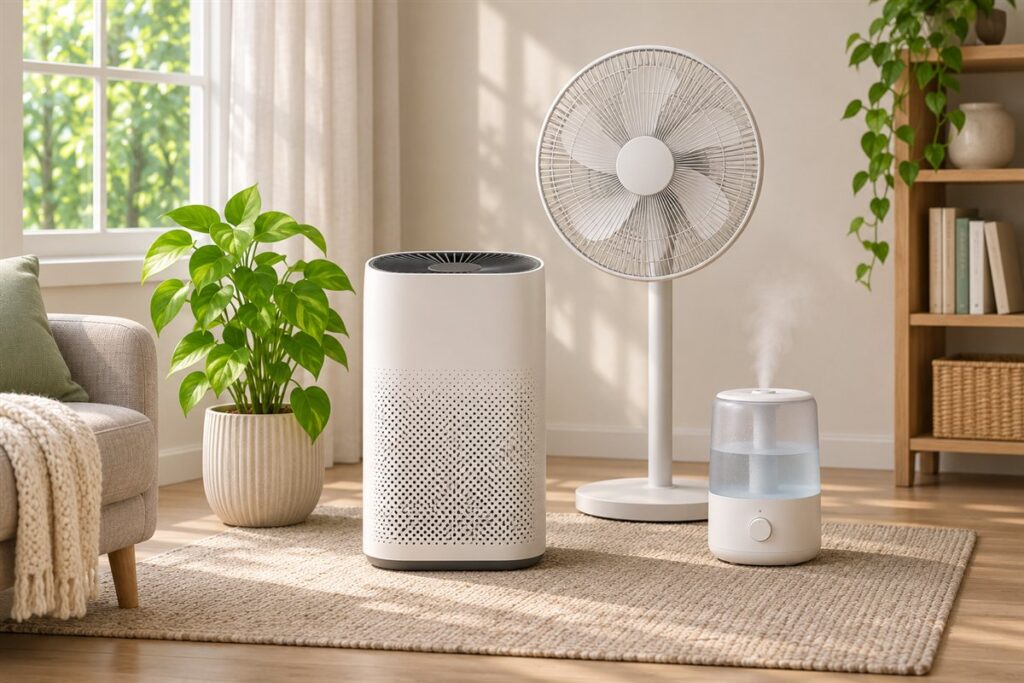
A smart humidifier adds app, schedule or voice control to a familiar room appliance. We have not used these products ourselves, so this guide relies on general knowledge and the maker’s descriptions rather than personal experience. We focus on construction and features, and we do not make claims about health outcomes.
Think about the room first. A small bedroom, a large living area and a desk corner each call for a different tank and output level. The table below lists the main factors, and the specs table that follows helps you line up candidates against your own space, your cleaning habits and the way you like to manage connected devices at home.
Remember that any humidifier asks for regular upkeep, and a smart model is no exception. Water, minerals and moisture all take a toll on parts over time, so wide openings and simple components matter. The app is a pleasant extra, but it should never be the only reason to choose one unit over another, so weigh it last. Read the maker’s cleaning guidance before you buy, not after.
As an Amazon Associate we earn from qualifying purchases. Links on this site are affiliate links, and they do not change the information we give.
In this guide
Quick Picks
| Pick | Product | Best For |
|---|---|---|
| Best Warm and Cool Mist | Levoit LV600S Smart Humidifier | Homes that want both mist types in one unit |
| Best for Bedrooms | Levoit Classic 300S Smart Humidifier | Quiet overnight running with a long runtime |
| Best App Control | Dreo HM713S Smart Humidifier | Humidity tracking, schedules and cleaning reminders |
| Best for Large Rooms | GoveeLife Smart Humidifier 2 Lite 6L (H7149) | Big spaces that need long, sensor-led running |
| Best Cool Mist Top Fill | Dreo HM524S Smart Humidifier | Simple top-fill design with app and voice control |
Our Picks
1. Levoit LV600S Smart Humidifier — Best for warm and cool mist
The LV600S covers the mist-type row of the checklist more completely than most: it produces both warm and cool mist from the same 6-liter top-fill tank, so one unit can follow seasonal preference instead of locking you into a single mechanism. Levoit’s listing rates coverage at up to 753 square feet, which points it at living areas rather than a desk corner. A built-in humidity sensor feeds an auto mode that holds a target level, and the VeSync app adds schedules, remote control and Alexa or Google Assistant voice commands. Top filling means you pour water in from above instead of carrying a dripping tank to a sink, and a sleep mode dims the display and quiets operation for bedrooms. An essential oil tray is built in for scent. As the guide stresses, the app does not replace upkeep, so plan on the regular tank rinsing any ultrasonic unit needs.
View Levoit LV600S Smart Humidifier on Amazon
2. Levoit Classic 300S Smart Humidifier — Best for bedrooms
The Classic 300S is the established bedroom choice in Levoit’s smart line: a 6-liter top-fill tank that Levoit rates for up to 60 hours of running on low and coverage up to about 505 square feet, so refills become a weekly habit rather than a nightly one. The built-in humidity sensor supports an auto mode with a customizable target, and the VeSync app handles schedules and remote adjustments, with Alexa and Google Assistant voice control on top. A 360-degree nozzle lets you aim the cool mist away from walls and bedding, which matches the placement advice in the care tips above. Sleep mode turns the display and night light off for dark rooms, and the wide top opening doubles as cleaning access, the upkeep factor the guide tells you to check first. An aroma pad tray is included for essential oils. It only makes cool mist, so if warm mist matters, look at the LV600S instead.
View Levoit Classic 300S Smart Humidifier on Amazon
3. Dreo HM713S Smart Humidifier — Best app control and tracking
The HM713S leans hardest into the smart side of this category. Its 6-liter tank produces warm or cool mist for up to 60 hours per fill by Dreo’s figures, and a built-in humidity sensor lets the unit hold a target level on its own. The Dreo app goes beyond on/off scheduling: it shows real-time humidity, keeps a 30-day trend history and sends cleaning reminders, which speaks directly to the guide’s point that upkeep is where humidifiers succeed or fail. Voice control works through Alexa and Google Assistant, and an ambient indicator light changes with the room’s humidity status so you can read conditions at a glance. A 12-hour timer covers set-and-forget running. Top-fill access keeps refills simple, and the tank opening is sized for reaching in during cleaning. Pick it if the app layer is a feature you will actually use rather than a novelty.
View Dreo HM713S Smart Humidifier on Amazon
4. GoveeLife Smart Humidifier 2 Lite 6L (H7149) — Best for large rooms
GoveeLife’s 6-liter model is aimed at bigger spaces that defeat small desktop units. The top-fill tank is rated for up to 60 hours of cool mist per fill, and a built-in humidity sensor drives an auto mode that adjusts output to hold your target instead of running flat out. Control runs through the Govee Home app, where you can set schedules and timers, and the unit also works with Alexa for voice commands. An essence diffuser tray adds scent if you want it, and the maker positions the noise level for bedroom-friendly running despite the large-room brief. The wide top opening helps with the cleaning access the guide flags, since a 6-liter tank you cannot reach into quickly becomes a chore. It is a cool-mist-only design, so households set on warm mist should step to a hybrid model, but for set-and-forget coverage of a large room it fits the brief well.
View GoveeLife Smart Humidifier 2 Lite 6L (H7149) on Amazon
5. Dreo HM524S Smart Humidifier — Best straightforward top-fill design
The HM524S is Dreo’s cool-mist counterpart to the HM713S: the same generous 6-liter top-fill format and up to 60 hours of runtime per fill by the maker’s figures, minus the warm-mist hardware, which keeps the design simpler. Control is shared three ways, through the Dreo app, touch controls on the unit and Alexa voice commands, and a built-in sensor supports automatic humidity holding rather than fixed output. A soft night light is built in for bedrooms and nurseries, and the ultrasonic mechanism is the quiet type the guide’s noise row points you toward. The top opening is wide enough to refill from a jug without removing the tank, and that same opening is your cleaning access, so the regular rinse-and-dry routine stays realistic. Choose it if you want the large-tank, app-controlled format and know you will only ever run cool mist.
View Dreo HM524S Smart Humidifier on Amazon
What to Look For
| Factor | Why it matters | What to check |
|---|---|---|
| Tank capacity | A bigger tank means fewer refills. | Maker’s capacity and stated run time |
| Mist type | Cool and warm mist units have different upkeep. | Mechanism description and nozzle design |
| Humidity sensing | A built-in sensor lets the unit adjust itself. | Target setting range and display |
| App and voice | Remote control adds convenience. | Supported assistants and schedule options |
| Noise | A unit in a quiet room should not be distracting. | Maker’s sound figure and night mode |
| Cleaning access | Wide openings make regular upkeep easier. | Tank opening width and removable parts |
| Fill method | Top fill or removable tank changes daily use. | Handle design and weight when full |
Setup and Care Tips
- Place the unit on a level, water-resistant surface away from electronics.
- Empty and rinse the tank regularly, following the maker’s instructions.
- Use the type of water the maker recommends.
- Set schedules in the app so the unit does not run when no one is home.
- Let all parts dry before storing the humidifier.
Mistakes to Avoid
- Choosing a small tank for a large room.
- Leaving water standing in the tank for days.
- Placing the unit directly against a wall or on carpet.
- Skipping the cleaning access check before buying.
- Expecting the app to replace regular upkeep.
Ultrasonic, Evaporative and Warm Mist: How the Mechanisms Differ
Every humidifier does the same basic job, which is to put water vapor or fine droplets into room air, but the way it gets there changes noise, upkeep and running cost. Knowing the three common designs makes the picks above easier to read, because a product description often hides the mechanism in a single phrase.
Ultrasonic cool mist
An ultrasonic unit vibrates a small metal disc at a very high frequency, which breaks water into a fine mist that a fan or nozzle pushes out. There is no heating element and no wick, so the units tend to be quiet and cheap to run. The trade-off is that whatever is dissolved in the tank water leaves with the mist. In hard-water areas that can show up as a white film on nearby furniture, and it is the reason makers talk so much about water type. Several of the tanks in this guide are described as ultrasonic, and the same rule applies to all of them: the cleaner the water, the less residue.
Evaporative designs
An evaporative humidifier pulls room air across a wet wick or filter, and the water evaporates into the airflow. Minerals stay behind in the wick instead of reaching the air, which is a real advantage if your tap water is hard. The costs are a fan that is usually louder than an ultrasonic disc and a replacement filter that needs to be bought on a schedule. Output also slows on its own as the room approaches a higher humidity level, which some people see as a built-in limit. Few of the smart models in this category use this design, so if you want it, check the specification carefully before you assume the app features come along with it.
Warm mist
A warm mist unit heats water before releasing it. Boiling or near-boiling water has a different set of cleaning habits, because scale builds on a heating element or plate and needs descaling rather than just rinsing. It also puts a hot surface and hot water in the room, so tip-over behavior, child access and placement matter more. People who like warm mist often cite the feel of a room in winter or the habit of adding a few drops of a manufacturer-approved scent. The hybrid units in this guide let you choose, which can make sense if you are not sure which you will prefer after a season of use.
Sizing a Humidifier to the Room
A coverage figure on a product page is a ceiling, not a promise. Makers usually calculate it for a tightly closed room with a certain ceiling height and a certain starting humidity, so your actual result depends on the air leaks and moisture sources in your own home. Treat the number as a way to rank candidates against each other rather than a guarantee.
- Measure the room. Multiply length by width for square footage, then note the ceiling height. Rooms with high ceilings or open archways behave like larger rooms than the floor area suggests.
- Count the leaks. Older windows, a fireplace, a bathroom fan or a doorway into a hallway all let humidified air escape. A bedroom with the door shut is the easiest case; an open-plan living area is the hardest.
- Match output to the season. Dry winter air with heating running calls for more output than a mild shoulder season. A unit that can step down matters more than one that can only run flat out.
- Look at the run time at the setting you will use. Hours per fill quoted on low may fall sharply on the high setting. If you plan to run on medium, that is the number to estimate.
It also helps to put a separate hygrometer in the room. A cheap one costs little and gives you a second opinion on the humidity reading. Built-in sensors sit close to the unit, so their reading can run higher than the rest of the room, especially in the first hour after a run starts. Placing the humidifier a few feet from a wall and the hygrometer across the room gives a more honest picture of what the space is doing.
For comfort, indoor humidity is often kept somewhere in the middle range commonly recommended for homes, roughly 30 to 50 percent. Going well above that can lead to condensation on cold windows and damp corners, which is the opposite of what you want. That is one more reason an auto mode with a target setting is useful: it stops output when the room reaches the number you chose.
Water, Mineral Dust and Scale
Water is the quiet variable behind most complaints about humidifiers. The tank is a warm, still, damp space, and what you put in it affects both the air and the machine.
- Follow the maker on water type. Some makers allow plain tap water and some recommend distilled or demineralized water, particularly for ultrasonic models. Warranty language can depend on this, so read it.
- Hard water leaves white dust. The dust comes from minerals carried out with the mist. If you see it, try a different water source before blaming the machine.
- Descale on a schedule. Vinegar-based cleaning is commonly suggested for scale, but only use whatever the manual approves for the parts involved. Some plastics and seals dislike certain cleaners.
- Do not leave water sitting. A tank that is half full for a week while the unit is off is the situation the cleaning instructions are written to prevent.
- Dry before storing. When the season ends, empty, clean and dry every part, including the base, before you put it in a box.
Filters and cartridges deserve a line of their own. Some units include a small demineralization cartridge or a filter pad, and those are consumables. Before you buy, find the replacement part, check whether it is sold separately and think about whether you will remember to change it. A smart reminder in an app can help, but it only works if you open the app.
What the Smart Layer Actually Does
The app, voice assistant support and scheduling make up what separates these models from a plain humidifier. They are useful, but they come with the usual connected-device caveats, and it is worth thinking through a few of them before you decide that smart is worth the extra money.
Network and ecosystem
Most connected appliances in this class join a 2.4 GHz Wi-Fi network during setup, and some have trouble if your router merges 2.4 and 5 GHz under one name. Check the listing for the supported band, and know your router settings before you start. Voice support also varies by model: one unit may work with Alexa only, another with Alexa and Google Assistant. If your household runs on Apple Home, do not assume it is supported just because the app looks polished.
What happens when the network drops
Good designs keep the humidifier doing its job when Wi-Fi fails. Look for a unit that stores its schedule on the device and has physical controls, so a router reboot or an app update does not leave you with a dead machine. Remote features like cloud-based voice commands depend on the maker keeping servers running, which is a reasonable thing to consider for a product you expect to use for several winters.
Automation worth setting up
Three automations give most of the benefit. First, a schedule that turns the unit on before bedtime and off after you wake. Second, an auto target based on the built-in sensor so output follows the room. Third, a routine that stops the unit when you leave the house. Beyond these, extra widgets are mostly a matter of taste.
Questions to Ask Before You Order
These questions are the ones worth answering from the listing and the manual before you commit. If you cannot find an answer, that tells you something too.
- Which water does the maker recommend, and what does the warranty say about hard water?
- Is the tank opening wide enough to get a hand or a brush inside?
- How loud is the unit on its lowest setting, and does the display turn off in sleep mode?
- Does the app require an account, and does it work with the voice assistant you already use?
- Which parts are consumable, and are replacements sold separately?
- What is the stated run time at medium output, not just at the lowest setting?
- Does the unit shut off automatically when the tank runs dry?
- Where will it sit, and is that surface water-resistant and away from electronics?
If most of those have clear answers, the purchase is usually a safe one. If several are vague, move to the next candidate. A smart humidifier you can clean easily, fill without fuss and leave to hold a target level is better than a fancier model whose tank is awkward to reach, so let the practical answers decide between models that otherwise look alike.
Humidity in the Home: What You Are Actually Managing
A humidifier manages comfort, and it helps to be clear about what that means in practice. Indoor air dries out most in heating season, when cold outdoor air is warmed and its relative humidity falls, and the results people notice are dry skin and eyes, scratchy throats on waking, static shocks, creaking wood and houseplants that crisp at the edges. A humidifier addresses the dryness itself; it is not a medical device and it does not treat conditions, so if anyone in the home has a health concern, that conversation belongs with a clinician, with the humidifier as a comfort measure alongside, chosen and run sensibly.
Measure before you humidify. A simple hygrometer, or the reading on the humidifier itself treated as a rough guide, tells you whether the room needs moisture at all, because homes differ enormously: a flat with drying laundry and many occupants may sit comfortably while a draughty, heated house parches. Aim for the comfortable middle band that building guidance commonly describes, and treat both extremes with suspicion, because air that stays too humid for too long invites condensation, mould and dust mites, trading one problem for a worse one. The households that succeed with humidifiers are the ones steering by measurement rather than by feel.
Placement shapes the result. A humidifier works on the room it sits in, not the whole home, so place it where the dryness matters, usually the bedroom for night comfort or the room where people spend their evenings. Keep it on a stable, water-tolerant surface, away from direct contact with wood furniture and electronics, with space around its outlet so the mist disperses into the room rather than soaking the nearest wall or curtain. A tray or mat beneath it is cheap insurance against the drips that refilling always eventually produces.
The Daily and Weekly Cleaning Rhythm That Makes or Breaks It
Every humidifier in this guide shares one truth: the machine is only as good as its cleaning rhythm, because a device that holds standing water in a warm room will grow things in that water if it is neglected. The daily habit is small: empty and rinse the tank, let it dry where your model’s guidance allows, and refill with fresh water rather than topping up yesterday’s. Topping up feels efficient and is the single most common ownership error, because it keeps old water, and everything growing in it, in circulation indefinitely.
The weekly habit is a proper clean and descale following the maker’s instructions, with the brushes and solutions they specify, paying attention to the base, the mist outlet and any small parts where deposits gather. Vinegar soaks are the classic descaling approach for many models, but follow your manual rather than folklore, because seals and sensors differ. Rinse thoroughly after any cleaning agent; the next tank of water should carry nothing but water into the room’s air.
Filters and wicks, on models that use them, are consumables with a lifespan, not lifetime parts. A tired wick humidifies poorly and harbours odour; a clogged filter strains the fan and the output. Note the replacement rhythm in your calendar when you buy the machine, keep a spare if your household depends on the humidifier nightly, and treat a musty smell as a stop signal: switch off, clean thoroughly, replace what is due, and only then run it again. A humidifier that smells of anything but water is telling you its rhythm has slipped, and the fix is always cleaning, never fragrance added to the tank unless the maker explicitly designs for it.
Water Choices and the White Dust Question
Tap water varies, and ultrasonic models in particular can turn hard water’s minerals into a fine white dust that settles on furniture and shows up in the air readings of any nearby monitor. If you see that dust, your options are simple: use distilled or demineralised water as many makers suggest, use any demineralisation cartridge the model supports and replace it on schedule, or choose an evaporative design for that room, since evaporative models leave minerals behind in the wick rather than launching them. None of these answers is wrong; the dust is information about your water, and each household picks the response that suits its budget and patience.
Storage of water and the machine matters in the off-season. When the humidifier goes away for summer, clean and descale it first, dry every part completely, and store it dry, because a machine put away damp will greet you in autumn with exactly the smell you least want in a bedroom. The same applies to spare tanks and parts. A dry start each season is the foundation of the whole cleaning rhythm, and it costs one careful afternoon a year.
Be thoughtful about additives. Oils, scents and antibacterial products should only go in a humidifier if the maker explicitly designs a place for them, because oils foul wicks and sensors, residues build in tanks, and what disperses into a room’s air is breathed by everyone in it, including children and pets. The cleanest-smelling humidifier is a clean humidifier running plain water, and anything beyond that should be a deliberate, manual-approved choice rather than an experiment.
Bedrooms, Children and Night-Time Running
The bedroom is where most smart humidifiers earn their keep, and night running has its own disciplines. Place the unit where its mist will not fall directly on bedding, because damp bedding is the opposite of the comfort you bought, and where its display can be dimmed or turned away, since a bright humidity readout at eye level is a small but real sleep disturber. Use the smart features for what they are good at here: a schedule that starts the machine before bedtime so the room is ready, and a target humidity the machine maintains quietly rather than a maximum-output blast all night.
In children’s rooms, add the ordinary safety layer: the unit out of reach, its cord managed so it cannot be pulled, warm-mist models considered with particular care because of their hot surfaces and steam, and the tank kept scrupulously clean because children’s breathing zones deserve the strictest version of the rhythm. Teach older children that the humidifier is not a toy and its tank is not a water game, the same calm category as a kettle or an iron, respected rather than feared.
Noise belongs in the bedroom calculation too. Ultrasonic models are usually the quietest, evaporative models carry a fan’s murmur, and either can develop rattles as parts age or sit unevenly. Test the machine where it will sleep, on its night setting, before the return window closes, and position it on a surface that does not amplify vibration. A humidifier that improves the air while degrading the quiet has solved the wrong problem, and bedrooms are where that trade is judged most honestly.
Smart Features That Earn Their Keep, and Those That Do Not
The genuinely useful smart features are unglamorous: a built-in humidity sensor that holds a target without overshooting, scheduling that matches the household’s day, a low-water shutoff that protects the machine and your attention, and alerts that tell you when the tank is empty or a filter is due. These features serve the cleaning-and-comfort rhythm rather than decorating it. Judge a smart humidifier first on how well it performs that quiet loop for a week without you thinking about it.
App control earns its place in specific moments: adjusting the bedroom machine from downstairs, checking a child’s room level without opening the door, turning the unit off when you will be away. Voice control is pleasant and minor. What none of the smart layer can do is clean the tank, change the wick or notice that the machine has been running against a closed door all day; the fundamentals remain yours. Buy the smart features as a servant to the rhythm, and be wary of any model whose intelligence is mostly a light show.
Connectivity brings the usual responsibilities. Keep the app account protected, update the device when updates arrive, and consider what happens if the maker abandons the app: the machine should still run perfectly from its own controls, holding a target humidity with its onboard sensor. A humidifier is a multi-year appliance in a way a gadget is not, so favour the model whose core job survives its software, and treat the connected layer as a bonus with a possible expiry date.
Sizing, Output and the Honest Limits of One Machine
A humidifier’s room rating describes ideal conditions, and real rooms with draughts, high ceilings and doors standing open ask more of it. If a machine runs at full output around the clock and the room’s humidity barely moves, it is undersized for that space or the space is losing moisture faster than any single unit should fight, and the better answer may be a second unit in the second room that matters rather than a hero machine failing in the hall. Equally, an oversized unit in a small bedroom can overshoot into damp if its controls are crude, which is why a model with a trustworthy sensor and gentle low settings suits bedrooms even when its maximum output looks excessive.
Watch the room’s response, not the machine’s effort. Condensation on windows is the house telling you the balance has tipped: a little on the coldest mornings in deep winter is common, but persistent streaming windows and damp sills mean the target is too high for the building, and the answer is to lower the target and improve the room’s airing, not to push through. Wooden instruments, books and the building itself all prefer the steady middle to either extreme, and they reward the household that steers for it.
Seasonal strategy completes the picture. Start the machine when heating season starts rather than when throats complain, run it most where people sleep, rest it as spring returns, and clean it before storage as described. A household that treats humidity as a seasonal rhythm, like opening windows in summer or bleeding radiators in autumn, gets the comfort without the drama, and the machine lasts for years because it is cared for as an appliance rather than ridden like a remedy.
Troubleshooting Odours, Weak Output and Strange Noises
A musty or sour smell has one overwhelming cause: the cleaning rhythm has slipped, and the cure is a full clean and descale, a fresh wick or filter if yours are due, and a few tanks of plain water run in a ventilated room before the machine returns to a bedroom. Do not mask the smell with scented additives; find it, clean it and shorten the interval that allowed it. If a thorough clean does not cure it, inspect the hidden places, under the base cover, inside the mist channel, wherever your manual shows deposits gathering.
Weak output divides into supply and demand. On the supply side: an empty or poorly seated tank, a wick that has hardened with minerals, a fan inlet furred with dust, or a sensor that believes the room is already humid because the machine sits in its own mist. That last fault is a placement problem disguised as a machine problem, and moving the unit so its sensor samples the room rather than its own output cures it in a minute. On the demand side, a room suddenly harder to humidify may have changed, a window left open, a new draught, heating running hotter, and the machine is reporting the house faithfully.
Noises develop character with age: a new rattle is often a part seated slightly wrong after cleaning, a hum that grows suggests a fan working against dust, and gurgling at refill is usually air finding its level and is harmless on most designs. Work through seating, cleaning and surface in that order, with the machine unplugged for anything beyond a wipe, and consult the maker before opening anything the manual does not invite you to open. Most humidifier faults are maintenance wearing a disguise, which is good news, because maintenance is entirely within your power.
Buying Once, Buying Calmly
Choose in this order: the mechanism that suits your water and your tolerance for its particular upkeep, the size that suits the room where it will actually live, the sensor and controls that hold a target without fuss, and only then the connected features. Read owner reports with a filter for cleaning honesty, because the pattern in this category is unmistakable: owners who clean on rhythm praise almost any decent machine, and owners who do not, condemn almost every machine eventually. The reviews are often diaries of maintenance disguised as verdicts on engineering.
Budget for the consumables and the routine, not just the box: wicks or filters across a season, possibly demineralised water if your supply is hard and you choose an ultrasonic model, and the few minutes a week the rhythm takes. A household unwilling to spend those minutes should choose the design whose upkeep is simplest for them, because the best humidifier is the one whose care fits the life it enters. There is no shame in that calculation; there is only the predictable result of ignoring it.
Get that match right and a smart humidifier becomes one of the home’s quiet successes: winter mornings without the parched waking feeling, rooms that feel kind rather than dry, wood and plants and people all more comfortable, maintained by a machine you think about for five minutes a week. That is the whole promise of the category, and it is kept not by the smartest model but by the best-kept one.
Humidifiers and the Rest of the Home: Plants, Wood and Instruments
A steadier humidity quietly protects more than people. Wooden furniture, floors and doors swell and shrink with the air’s moisture, and the cracks, sticking doors and creaking joints of a heated home are often humidity stories rather than age stories. Pianos and wooden instruments are the most sensitive residents of all, and their owners have measured room humidity for generations; a smart humidifier in the instrument’s room, steered by a reliable hygrometer and kept to a steady target, is a legitimate part of an instrument’s care, provided the machine never mists directly onto the wood itself.
Houseplants make the benefit visible. Many common houseplants come from humid forests and spend heated winters slowly desiccating, showing it in brown leaf edges and stalled growth. Grouping plants together in the humidified room, away from the machine’s direct output, gives them the gentle end of the comfort band that people enjoy too. Watch for the opposite failure in a plant corner: still, damp air against a cold wall is where mould finds its opportunity, so keep air moving lightly and leaves off cold glass.
Books, artwork and stored clothing prefer the same steady middle as everything else in this guide, which is the reassuring conclusion: you do not need a different humidity for each resident of the home. One measured, moderate target, held steadily through the heating season, serves skin, sleep, pine and paper alike, and the humidifier that holds it, cleaned on rhythm and placed with care, is looking after the whole household in a way its modest appearance never advertises.
A First Fortnight With a New Humidifier
Give a new machine a structured fortnight. In the first days, run it in the room that needs it most, measure morning and evening, and learn how fast the room responds and how fast it falls back when the machine stops. Note the tank’s real endurance against your household’s nights, because a tank that empties at four in the morning will wake someone, either with dryness or with a beep, and it is better discovered in a test week than assumed from a specification.
In the second week, practise the whole rhythm once, early, before it is due: empty, rinse, descale lightly, dry and refill, timing yourself honestly. If the routine takes far longer or feels far more awkward than you expected, that is decision-grade information while returns are still possible, because you will perform that routine all winter. Set the reminders, in the app and in your own calendar, for the weekly clean and the filter’s life, and write the model’s consumable names in your home file so a midwinter reorder takes a minute.
At the fortnight’s end, judge by the mornings. If the room wakes kinder, the machine runs quietly, the windows stay clear and the rhythm has proved livable, you have bought well and can stop researching. If any of those failed, the failure names its own fix, placement, target, size or upkeep, and you can act on it precisely. A humidifier is a simple machine whose success is a habit, and a fortnight is all it takes to know whether the habit and your household fit each other.
FAQ
Is a bigger tank always better?
Not necessarily. Larger tanks reduce refills but are heavier to carry and clean. Match the size to your room and to how often you are willing to fill it.
What does the app add?
Typically schedules, remote on and off, and humidity readings. It is a convenience layer, so check the supported assistants and network requirements before relying on it.
What humidity level should I set a smart humidifier to?
Many guides suggest keeping indoor humidity roughly between 30 and 50 percent, and lower during very cold weather to limit window condensation. Start near the middle of that range, watch for fogged glass or damp corners, and adjust the target in the app from there.
Do ultrasonic humidifiers leave white dust?
They can. Ultrasonic units release dissolved minerals along with the mist, so hard tap water may leave a white film on nearby surfaces. Using the water type the maker recommends, such as distilled or demineralized water, usually reduces it. Evaporative designs trap minerals in the wick instead.
Will a smart humidifier still work if my Wi-Fi goes down?
It depends on the model. Many units keep running with local controls and may hold saved schedules, but app control and voice commands stop until the network returns. Check whether the listing mentions on-unit buttons and stored schedules before you buy.
How often should I clean a humidifier tank?
Follow the maker’s schedule, but a common routine is to empty, rinse and dry the tank every few days and do a deeper clean with an approved cleaner about weekly. Never leave water sitting for long periods, and dry every part before storing the unit.
Can I use essential oils in any humidifier?
No. Only use scent in a unit that has a dedicated tray or pad meant for it, and follow the maker’s guidance. Adding oils directly to a tank not designed for them can damage plastic parts and void the warranty.
The Short Version
A smart humidifier is easiest to live with when its tank, controls and cleaning access fit your routine. Compare the specs, plan for regular upkeep and choose what suits your room. Keep the cleaning routine realistic, since the best unit is the one you will maintain.
Related Guides
- How to Choose the Best Whole House Humidifiers: A Buyer's Guide
- How to Choose the Best Smart Dimmer Switches: A Buyer's Guide
- How to Choose the Best Smart Light Switches: A Buyer's Guide
- 10 Best Humidifiers: Cool Mist and Warm Mist (2026)
- 6 Best Guitar Humidifiers: Soundhole and Case Types (2026)