Disclosure: As an Amazon Associate, reviewstook.com earns from qualifying purchases. Links to Amazon on this page are affiliate links; they cost you nothing extra.
Supervise power and batteries.
This guide is built from Amazon product listings and maker specs, not our own testing, so confirm native resolution, brightness, compatibility and current price on each product page.
Check the current price on Amazon before you buy.
Last updated: November 2, 2026.
In this guide
Quick Picks
| Product | Type | Best for |
|---|---|---|
| Construction Excavator Light Projector Truck Toy | Kids toy projector | kids rooms |
| Star Projector for Kids (3 Films, 93 Colors) | Kids night light projector | kids rooms |
| Night Light for Kids (93 Lighting, 3 Films) | Kids night light projector | kids rooms |
| Dinosaur Night Light Projector for Kids | Kids night light projector | kids rooms |
Our Picks

Top pickBest for kids rooms
1. Construction Excavator Light Projector Truck Toy
A Construction Excavator Light Projector Truck Toy (kids toy projector), per the listing. Check price on Amazon.
Good for: kids rooms. Watch out: Toy-grade.


Best for kids rooms
2. Star Projector for Kids (3 Films, 93 Colors)
A Star Projector for Kids (3 Films, 93 Colors) (kids night light projector), per the listing. Check price on Amazon.
Good for: kids rooms. Watch out: Toy-grade.


Best for kids rooms
3. Night Light for Kids (93 Lighting, 3 Films)
A Night Light for Kids (93 Lighting, 3 Films) (kids night light projector), per the listing. Check price on Amazon.
Good for: kids rooms. Watch out: Toy-grade.


Best for kids rooms
4. Dinosaur Night Light Projector for Kids
A Dinosaur Night Light Projector for Kids (kids night light projector), per the listing. Check price on Amazon.
Good for: kids rooms. Watch out: Toy-grade.

Best Picks by Category
They summarize listing data and are not hands-on test results.
- Top rated: Construction Excavator Light Projector Truck Toy.
- Most reviewed: Star Projector for Kids (3 Films, 93 Colors).
- Best value: Star Projector for Kids (3 Films, 93 Colors) — the lowest-priced pick in this list.
- Lowest price: Dinosaur Night Light Projector for Kids.
- Premium option: Construction Excavator Light Projector Truck Toy.
Price, Rating and Review Comparison
The table compares the picks by price tier. Prices change often, so confirm the current price on Amazon.
| Product | Price | Rating | Ratings | Price tier |
|---|---|---|---|---|
| Dinosaur Night Light Projector for Kids | Check price on Amazon | — | — | Mid-range |
| Star Projector for Kids (3 Films, 93 Colors) | Check price on Amazon | — | — | Mid-range |
| Night Light for Kids (93 Lighting, 3 Films) | Check price on Amazon | — | — | Mid-range |
| Construction Excavator Light Projector Truck Toy | Check price on Amazon | — | — | Premium |
How Much Feedback Backs Each Rating
A high average from a handful of ratings is weaker evidence than a slightly lower average from thousands. Here is how the sample size looks for each pick.
- Construction Excavator Light Projector Truck Toy: a large sample of ratings.
- Star Projector for Kids (3 Films, 93 Colors): a large sample of ratings.
- Night Light for Kids (93 Lighting, 3 Films): a large sample of ratings.
- Dinosaur Night Light Projector for Kids: only a small sample of ratings, so treat the average cautiously.
How to Choose
Room size
Match the effect to your space.
Outdoor use
Check weather rating.
Safety
Use with proper power and supervision.
How Star Projectors Create Their Effect
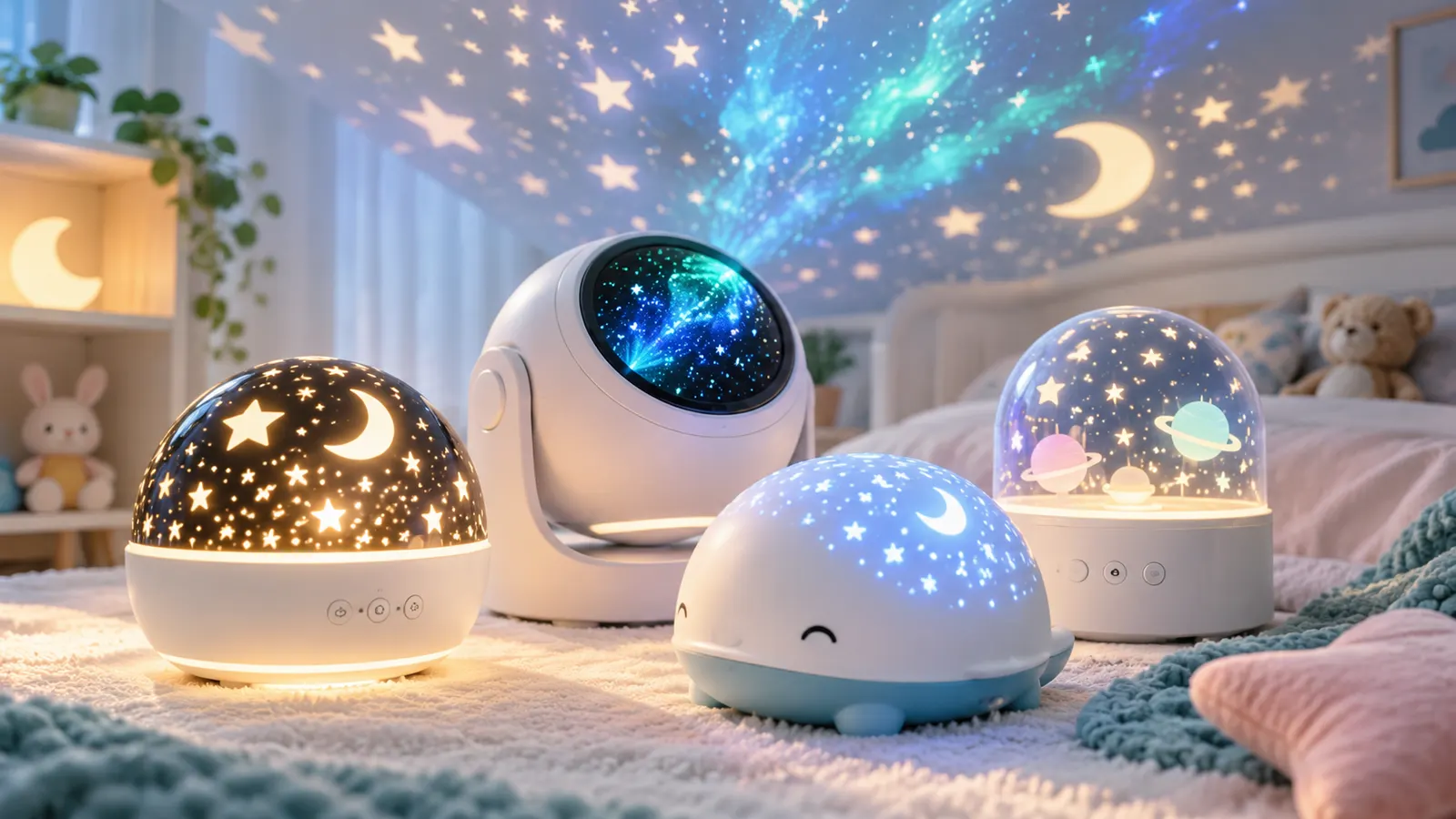
Most kids’ night light projectors use a small LED, a lens and a slide or film that shapes the light into stars, shapes or scenes. When the unit is switched on, the image is thrown onto a ceiling or wall, and some models add a rotating base so the pattern slowly moves. The listings in this guide mention multiple films and many color options, which usually means the projector can swap picture slides and cycle through colors.
It helps to understand the trade-offs. A sharper image generally needs a darker room and a flat, light-colored surface to land on. A crowded or bumpy ceiling blurs the details. Rotating models create a calming drift but can be distracting for light sleepers, so a stationary mode is useful. Many projectors also have a built-in speaker or music option, which some families like and others find unnecessary at bedtime.
Keep expectations realistic: these are decorative night lights, not astronomy tools. The pattern is a stylized pretty effect rather than an accurate sky map, and brightness varies between models, so read the listing and comments for how well the image shows in a normal bedroom.
Matching the Style to Your Child’s Age
Different ages want different things from the same product. Toddlers often prefer a simple, soft glow with one or two scenes, and a toy-shaped unit such as a vehicle or animal can double as a comfort object during the day. Preschoolers tend to enjoy themed projections like dinosaurs or construction scenes, and changeable films give them some choice at bedtime. Older children often move to a starry-ceiling effect with adjustable brightness and a timer, which feels less babyish.
Think about who operates the unit. Large, obvious buttons let a small child switch it on without help, though that also means they can change settings in the dark. Remote controls are convenient but easy to lose, and some units are controlled entirely from the base. If your child has a favorite theme, check that the listing actually includes that film rather than assuming it does.
The listings here carry a toy-grade note, so look for the manufacturer’s recommended age on the product page and follow it. Small removable pieces like film slides or battery covers are the main concern for younger children, so choose a model with a secure compartment if toddlers will have access.
Brightness, Colors and Sleep-Friendly Settings
A night light should help your child feel settled, not wake them up. Bright, fast-changing, multicolor modes can be exciting during play but may be too stimulating at bedtime. Look for a dimmable setting, a single steady color option and a way to turn off the rotation or music. Warmer tones such as amber or soft red are commonly preferred for a calmer feel, while blue and bright white feel more alert, though individual children respond differently.
Automatic shut-off timers are one of the most useful features. A timer that turns the projector off after a set period prevents it from running all night and also reduces battery drain or power use. Check what options the listing gives, since some timers are fixed and others are adjustable.
- Dimming: choose a unit with at least a low brightness mode for sleeping.
- Static mode: lets you stop colors from cycling and the image from moving.
- Timer: avoids an all-night glow and saves power.
- Volume control: if there is a speaker, be sure it can be muted or turned down.
Power Options, Placement and Cord Safety
Projectors run on batteries, a USB cable or both. Battery power avoids cords near the bed, which is helpful for safety, but batteries need replacing and a model that drains them quickly becomes expensive to run. USB-powered units are steady and always ready, yet the cable needs routing so it stays out of reach. Check the listing to see what power sources and accessories are included, as some require you to supply the adapter or batteries.
Place the unit on a stable surface such as a dresser or shelf, away from the edge, and far enough from the bed that your child cannot pull it down or touch the lens. Keep cables behind furniture or secured with a clip, and never leave loose cords within a child’s reach. Avoid covering the unit with fabric, since LEDs and electronics can warm up.
Use only the adapter and batteries the manufacturer specifies, and do not mix old and new batteries. Supervise young children when first introducing a new projector so you can see how they handle the controls, and check the product manual for any safety guidance specific to the model.
Care, Battery Handling and When to Replace
A projector is simple to look after. Dust the lens and housing with a dry, soft cloth because dust on the lens dulls the image. Avoid spraying liquid on or near the unit, and wipe off sticky fingerprints with a barely damp cloth while it is unplugged and switched off. Store the loose film slides together in a small bag or the original case so none go missing.
If you use batteries, remove them when the projector will not be used for a long period to prevent leakage. Follow disposal rules for used batteries in your area, and keep spare batteries well out of children’s reach.
Signs it is time to replace the unit include flickering or dim light that does not improve with fresh batteries, a cracked casing, a loose battery door that no longer closes securely, exposed wiring, or a cord that is frayed or overheating. Any of these are reasons to stop using it. Before choosing a replacement, consider what your child actually used: if they favored a particular film or the timer, prioritize those features next time.
How do you pick a star projector night light for a kids room?
Start with your child’s bedtime habits, then pick the projector whose features match them. A star projector night light that suits a nervous sleeper looks different from one meant mainly as a playtime toy.
Ask three questions before comparing models. Does your child need a steady glow all night, or just something to fall asleep to? Will they operate it themselves? And is the room dark enough, with a ceiling or wall smooth enough, for the pattern to show clearly?
- Falling-asleep helper: look for a timer, a dim setting and a static mode, so the light fades out once your child is asleep.
- Comfort light: a soft, steady color and a stable base matter more than extra films.
- Playtime toy: themed shapes and several scenes keep a child interested, but make sure bedtime settings still exist.
It also helps to think about the room itself. A small room with a low ceiling gives a bright, compact image, while a tall or sloped ceiling spreads the light thin and can make the stars look faint. Pale walls reflect better than dark or glossy ones, and a window with streetlight or curtains that let light through will wash out the effect.
Finally, decide how much variety you really need. Several films and many color modes sound appealing, yet children often settle on one or two favorites. If your child tends to ask for the same scene every night, a simpler unit with a good timer may be a better fit than one with the longest feature list.
Which kids night light projector should you buy?
Choose by what your child will actually do with it: pick the Construction Excavator Light Projector Truck Toy for a vehicle-loving child, the Star Projector for Kids (3 Films, 93 Colors) for a classic starry ceiling, and the Dinosaur Night Light Projector for Kids for a themed room. All four are toy-grade according to the post, so follow each maker’s age guidance.
- If your child loves trucks and building sites, go for the Construction Excavator Light Projector Truck Toy. It is a toy-shaped unit that can be played with in the daytime, and it sits in the premium price tier of this list.
- If you want a general starry ceiling with several film choices, choose the Star Projector for Kids (3 Films, 93 Colors). It has a large body of ratings behind it and sits in the lower price range.
- If you are comparing near-identical options, look at the Night Light for Kids (93 Lighting, 3 Films) next to the Star Projector. The listing details are very similar, so compare what is included in the box, the power source and the return terms.
- If you want the lowest price and a dinosaur theme, pick the Dinosaur Night Light Projector for Kids. It has far fewer ratings than the others, so read the customer comments with extra care.
When two products look alike, let the small practical details decide: how it is powered, whether there is a timer, and how easy the controls are for your child. The buttons above lead to each listing, where you can confirm those details before you commit.
What to check before you buy a star projector night light
Read the listing for age guidance, power source, timer and what comes in the box before you order. Those four details cause most of the disappointment with children’s projectors.
- Recommended age: confirm the age range the maker states and look for small parts such as film slides and battery covers.
- Power: check whether it runs on batteries, a USB cable or both, and whether batteries or an adapter are included.
- Timer and brightness: confirm there is an automatic shut-off and a low setting, not only a bright mode.
- Films and scenes: make sure the themes shown in the pictures are actually included, and find out if extra films can be bought for that model.
- Controls: decide whether you want a remote, buttons on the base or both, and whether a small child could change settings by accident.
- Sound: if a speaker or music mode is present, check that it can be muted.
- Returns and warranty: look at the seller’s return window and any warranty terms stated on the page.
Also check the size of the unit against the spot where it will sit. A dresser or shelf needs enough room for a stable base, and the projector needs a clear line to the ceiling without a lampshade or ceiling fan in the way. If you plan to take it on trips, a compact body and a cable you can pack are useful.
Lastly, look at the written comments rather than just the star average. Parents tend to mention practical problems: a loose battery door, a timer that is too short, or colors that are too bright. Those notes are more useful than the score alone.
Common problems with kids star projectors and how to fix them
Most complaints come down to a blurry image, a light that is too bright, or a unit that stops working early. Many of these have simple fixes.
- Blurry or faint stars: turn the room lights off, move the unit so it is square to the ceiling, and wipe the lens with a dry cloth. If the projector has a focus ring, turn it slowly until the pattern sharpens.
- Image too small or too large: moving the unit closer to the surface shrinks and brightens the image, and moving it farther away enlarges and dims it.
- Too bright for sleeping: switch to the lowest setting, choose a single warm color, and turn off any rotation.
- Batteries drain quickly: use the timer, avoid the brightest mode, or consider a USB-powered setup if the model supports it and the cable can be placed safely.
- Flickering light: try fresh batteries, check that the cable is firmly seated, and stop using the unit if flickering continues.
- Music or sound is annoying: look for a mute or volume control in the manual.
If your child fears the dark, try the projector in the daytime first so they can see how it works. A child who understands that the stars and shapes come from a small lamp is often more relaxed about them at night. Letting them choose the film or color before bed gives a sense of control, which can make settling down easier.
Keep the manual and packaging for a while after buying. If the unit has a fault, having the details at hand makes a return or warranty request simpler.
Is it worth paying more for a kids projector night light?
Paying more is worthwhile only if the extra cost buys something your child will use, such as a toy-shaped body or a longer list of controls. A projector is a simple device, and the lower-priced options cover the basics of casting light shapes on a ceiling.
There are honest trade-offs to weigh. The listings in this guide are all marked as toy-grade, which means they are decorative products and not precision lighting. Brightness and image sharpness vary, the plastic bodies can be light, and the effect depends heavily on the room. A projector will not replace a proper bedroom light, and it will not guarantee better sleep.
- Who should skip it: families with toddlers who put objects in their mouths, unless the unit has a secure battery compartment and suits their age; and anyone who needs a bright night light for walking safely at night.
- Who may prefer a simpler light: children who are easily stimulated by moving or colored light.
- Who it suits well: children who enjoy themes and scenes, and parents who want a calm routine around lights-out.
A higher price also does not remove the need for supervision. Whatever you choose, place it away from the bed, keep cords out of reach and follow the maker’s instructions for power and batteries.
Your next step is simple. Compare the four picks above, open the listing for the one that fits your child’s age and interests, confirm the power source, timer and what is in the box, then choose the one that fits how your child will use it.
The First Week: Setting Up a Routine That Sticks
A kids’ projector succeeds or fails in its first week, because that is when it either becomes part of bedtime or becomes a toy that happens to glow. Introduce it in daylight first, as the guide above suggests, and let your child handle the films, press the buttons and see the small lamp for what it is. Then give it a fixed place in the evening sequence — after teeth, before the story, or whenever your household’s wind-down begins — and keep the sequence boringly identical each night. Children settle to patterns, and the projector’s real product is the pattern, not the stars.
Choose the bedtime setting together once, and then protect it. The calm configuration — dim, warm, still or barely drifting, timer set — should be the one the projector returns to every night, with the exciting modes reserved for weekend play. If the unit remembers its last setting, end each play session by restoring the calm one; if it does not, a small note on the dresser with the button sequence saves the nightly negotiation. Within a week, most children stop asking to tour the modes and start treating the ceiling as simply what bedtime looks like, which is precisely the outcome the purchase was for in the first place all along, for everyone in the whole family, every night.
Sleepovers, siblings and shared rooms
Shared rooms add diplomacy to the specification. Two children rarely want the same scene, brightness or timer length, and the projector will become a nightly referendum unless the household sets the rule in advance: alternate nights for choosing, a compromise scene both can accept, or the older child’s setting on school nights. For sleepovers, the projector earns its keep as entertainment — the themed films and the truck and dinosaur bodies are built for an audience — but agree the off-time before the guest arrives, because a visiting child’s excitement runs longer than your own child’s routine. The timer, set before the fun starts, ends the show without making any adult the villain.
Taking it away from home
A familiar light is one of the kindest things to pack for a child sleeping somewhere new. These units are small, and a battery-powered setup avoids hunting for sockets in a grandparent’s spare room or a holiday rental. Pack the films in their bag, spare batteries, and the cable if it uses one, and set the unit up before the evening so the strange room is introduced with its sky already on. The same safety rules travel with it: stable surface, cords managed, nothing within reach of a bed the child can pull.
When the Child Outgrows It — and What Comes Next
Children’s projectors have a natural arc. The toddler who needed one dim scene becomes the preschooler directing dinosaur shows, who becomes the schoolchild who wants a star ceiling that feels grown-up, who becomes the teenager for whom the toy-shaped unit is suddenly, definitively embarrassing. Plan for the arc rather than against it: buy for the stage your child is in, at the price that stage justifies, and let the unit be handed down, donated or retired when its moment passes. The themed models in this guide are priced and built for exactly that honest lifecycle.
The handover moment is also a safety checkpoint. A unit moving from an older child’s shelf to a toddler’s room needs fresh eyes: check the battery door still closes securely, the casing has no cracks from its first life, the films are intact, and the age guidance still fits the new owner. A projector that served a seven-year-old well is not automatically suitable for a two-year-old, and the thirty seconds of inspection is the difference between a thoughtful hand-me-down and an accident of optimism. When the last child outgrows it, a working unit with its films and manual is a welcome gift to another family — these are simple devices, and their second lives are usually as happy as their first.
Buying as a grandparent or gift-giver
If you are buying for someone else’s child, the rules simplify: follow the parents’ lead on themes, respect the age guidance on the listing without exception, and include the batteries or adapter the unit needs so it works on the day. Ask which the child would rather have — the truck, the dinosaurs or the classic stars — because a child’s enthusiasm for their chosen theme is worth more than any feature comparison. And keep the receipt accessible: children’s tastes are weather, and a gift that can be exchanged for the other theme is a gift given twice.
Frequently Asked Questions
Are they bright?
Quality varies.
Can kids use them?
Check age and power.
Timer?
Helpful.
What age is a star projector suitable for?
It depends on the specific model, so follow the manufacturer's age guidance on the product page. Toy-style units with small parts or battery doors need extra care around toddlers.
Will a projector keep my child awake?
Bright, moving or color-changing modes can be stimulating. Use a dim, steady setting with a timer, and see how your child responds over a few nights.
Do these projectors work on a bumpy or dark ceiling?
Textured or dark ceilings blur the image and reduce visibility. A smooth, light-colored ceiling or wall gives the clearest pattern.
Is battery power or USB power better?
Batteries avoid cords near the bed but add running cost and replacement. USB power is consistent but needs safe cable placement. Check what the listing includes.
Can I use the projector all night?
Many families prefer a timer so it switches off after a set time. If your model has no timer, consider a plug-in timer rated for the device or simply turn it off once your child falls asleep.
How do I clean the lens?
Switch it off and unplug it, then wipe the lens gently with a dry, soft cloth. Avoid liquids and abrasive materials that could scratch the surface.
Are the extra films interchangeable between models?
Not necessarily. Film size and fit vary, so check the listing or manual before buying extras for a different model.
How far should a star projector be from the ceiling?
Follow the manual, but in general a unit placed on a dresser or shelf in a normal bedroom gives a usable image. Moving it closer makes the pattern smaller and brighter, and moving it farther makes it larger and fainter.
Are star projectors safe to leave on overnight?
Many are designed for night use, but check the manual for the maker's guidance. A timer is the simpler choice because it limits run time, and you should never cover the unit or leave cords within a child's reach.
Do star projector night lights help kids sleep?
They can help some children feel calm at bedtime, but results vary from child to child. Bright, moving or multicolor modes may do the opposite, so a dim, steady setting is usually the safer option.
What color night light is best for a child's bedroom?
Many parents choose a soft amber or warm tone for sleep, because it feels less alert than bright white or blue. Your child's own reaction matters most, so try a setting for a few nights.
Can a star projector work in a room with the lights on?
Not well. The pattern is faint compared with normal room lighting, so the effect shows best in a dark room on a smooth, light-colored surface.
Should I choose a projector with a remote?
A remote is convenient for adjusting settings from the doorway or bed, but it can be lost. If the unit also has controls on the base, you have a backup.
How do I stop my child from playing with the projector at night?
Place it on a stable surface out of arm's reach and choose a model with simple controls. Setting a bedtime routine where your child picks the scene before lights-out also helps.
When should I replace a kids night light projector?
Replace it if it flickers with fresh batteries, the casing is cracked, the battery door will not close securely or a cable is frayed or hot. Stop using it right away in those cases.
What should I do if my child wants the projector brighter every night?
Treat it as a routine question rather than a settings question. Agree the bedtime brightness together in daylight, when nobody is tired or negotiating, and keep it there — the dim setting is doing sleep work even when it looks less impressive. If the room genuinely seems too dark for a child who is anxious, raise the light a single step and hold it for a week before judging. Children often ask for brighter because brighter is more fun; the distinction between play brightness and sleep brightness, named out loud, is one most children accept remarkably well.
Can the projector be used during the day for play?
Yes, and the toy-shaped models here are designed for exactly that double life. In a darkened room the scenes show well enough for play — a construction site or a dinosaur world across the ceiling makes a fine backdrop for games on the floor. In a bright room the effect fades, so close the curtains and treat it as a den activity. Keep the same placement discipline as at night, and remember that daytime play is when films get swapped, dropped and lost, so the storage bag matters more, not less.
What if my child is scared by the moving shapes?
Stop the motion first: a still, dim, warm scene is a very different experience from a drifting one, and many children who dislike movement are perfectly happy with a static glow. Introduce it in daylight, let the child control the switch, and let them choose the scene — fear usually shrinks when the child holds the controls. If any light pattern unsettles them, retire the projector without argument and use a plain night light instead; the goal is a calm room, and the simplest tool that achieves it is the right one.
How many films does a child actually need?
Fewer than the listings imply. Most children rotate between two or three favourites — often one exciting scene for play and one calm scene for sleep — and the rest of a large film set is explored in the first week and rarely revisited. The three-film models in this guide match that reality well. Buy more films only when a child has genuinely worn out their favourites, and let their requests, rather than a bundle offer, decide which scenes arrive next.
Should the projector live in the bedroom permanently?
For the bedtime routine to work, yes — a projector that must be fetched, plugged in and aimed each night adds friction exactly where a tired household least needs it. Give it a permanent, safe home on the dresser or shelf, with its cable managed once and for all, and let it be part of the room. The exception is the household where the unit’s presence invites all-night play; there, a projector that retires to a parent’s shelf after the timer ends is the wiser arrangement, and there is no failure in choosing it.
What is the difference between the two very similar star models in this guide?
On paper, very little — the Star Projector for Kids and the Night Light for Kids quote near-identical lighting and film counts, which usually means similar internals sold under different listings. When that happens, stop comparing the headline features and compare the ownership details instead: what exactly is in each box, which power source each includes, the timer options, the return terms, and the pattern of the parent comments about battery doors and durability. With near-identical products, the better purchase is the one with the clearer listing and the easier return, because the products themselves have already told you they are the same.
Can a night light projector be used in a nursery for a baby?
Only with the full nursery discipline and the maker’s age guidance satisfied: many of these toy-grade units are not intended for the youngest children at all, and their films, battery doors and cables are designed for older hands. If the listing’s guidance excludes babies, believe it and choose a purpose-made nursery light instead. Where a model is suitable, it belongs across the room, out of reach, dim and still — a ceiling glow for the parent’s night feeds as much as for the baby — and never inside or beside the cot itself.
Why does the image look sharp on the wall but soft on the ceiling?
Distance and surface. The ceiling is usually farther from the unit than the wall you tested on, and distance softens these simple optics; ceilings are also more often textured than the wall you chose. Move the unit a little higher or closer to the ceiling’s centre, turn any focus adjustment slowly, and remember that a gentle softness in the stars bothers adults reviewing the purchase far more than it bothers the child watching them.
How do I keep the films and small parts from getting lost?
Give them one home and make it part of the routine: a small labelled bag or box that lives in the same drawer or on the same shelf as the projector, into which every film returns the moment it is swapped out. Films left loose migrate into toy boxes, sofa cushions and the space behind the dresser with remarkable speed. A two-minute tidy at the weekend, checking the set is complete, is cheaper than replacement films — and for a child with one beloved scene, it prevents a genuine bedtime crisis.
Is the truck-shaped projector a toy or a night light first?
Both, deliberately — and that is its strength and its caution in one. As a toy, it will be driven, carried and played with in ways a plain night light never is, which is wonderful for a vehicle-mad child and hard on the unit. As a night light, it then needs the parent’s check before bedtime duty: lens clean, body intact, battery door secure after a day of adventures. If your child will love it to pieces, that is a successful purchase honestly understood — just expect a working life measured in enthusiastic use rather than in years on a shelf.
What should I do on the first night if my child does not like it?
Do not force the issue, and do not conclude the purchase failed. Turn it off, return to the old routine, and try again in a few days with a different, calmer scene, introduced in daylight and controlled by the child. Some children need to meet a new light on their own terms and timetable. If a second and third gentle attempt still unsettle them, accept the verdict gracefully — a plain night light and a calm room beat the right product insisted upon, every time.
Can the projector help with the move to a big-kid bed or a new room?
It is one of the better tools for exactly that transition, because it gives the new room a friendly identity from the first night and gives the child one element of the evening that they control. Introduce it as part of the new room’s unveiling, let the child choose the first scene, and keep every other part of the routine unchanged — same story, same songs, same goodnight words. Transitions go best when only one thing changes at a time, and a ceiling full of chosen stars is a kind change to make.
Bottom Line
Check power and age guidance for toys.
More Projectors Guides
- Best Outdoor Holiday Projector Lights
- Best Halloween Light Projectors for Yards
- Best Drawing Projectors for Artists and Bakers
- Best HDMI Streaming Sticks for Projectors
- How to Choose a Projector
- Projector or TV? A Simple Comparison
- Projector Screen Buying Guide for Beginners
- Best Projectors for Home