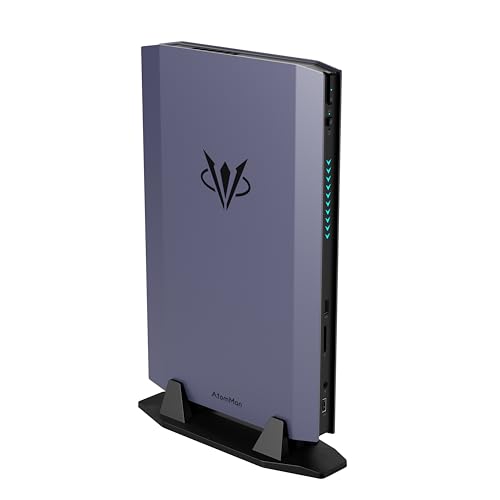
Where to buy
Check the latest price, availability and delivery on Amazon. Orders are placed on Amazon. We may earn a commission from qualifying purchases.
- Best overall mini gaming PC: AtomMan G7 Ti Mini PC, Core i9-14900HX, RTX 4070 Laptop, 32GB DDR5, 1TB SSD — Check on Amazon
- AtomMan G7 Pt Mini PC, Ryzen 9 7945HX, RX 7600M XT, 32GB DDR5, 1TB SSD — Check on Amazon
- AtomMan G1 Pro Mini PC, Ryzen 9 8945HX, Desktop RTX 5060, 32GB DDR5, 1TB SSD — Check on Amazon
- Beelink SER9 Pro Mini PC, Ryzen AI 9 HX 370, Radeon 890M, 32GB LPDDR5X, 1TB SSD — Check on Amazon
See 2 more Amazon options
- GMKtec EVO-X1 Mini PC, Ryzen AI 9 HX 370, Radeon 890M, 32GB LPDDR5X, 1TB SSD, OCuLink — Check on Amazon
- ASUS NUC 14 Performance Barebone Kit, Core Ultra 7 155H, RTX 4060 Laptop, No RAM/SSD/OS — Check on Amazon
Read the full guide ↓
Disclosure: As an Amazon Associate, reviewstook.com earns from qualifying purchases. Links to Amazon on this page are affiliate links; they cost you nothing extra. Listing details such as price and availability change often, so check the current Amazon listing before you buy.
Fifteen hundred dollars is where the mini PC premium is steepest, and this guide will not pretend otherwise. The same money, spent on a tower, buys a desktop RTX 4070 SUPER system — a Skytech Omega with that card, 32GB of DDR5 and a 1TB SSD is sold on Amazon as a tower alternative in this same budget class. No mini PC in this guide matches that machine’s graphics hardware, and none comes close on price per frame. What the six machines below sell instead is measured in liters and watts: the largest is under four liters, the smallest is 0.82 liters, and all of them together would fit inside the empty space of a mid-tower case. You are paying for a gaming PC that mounts behind a monitor, rides in a backpack, sips power from a laptop-style brick and stays quiet in a bedroom or a dorm. If that trade is the one you want, $1,500 is the tier where minis stop being toys — two of these machines carry full-power laptop GPUs that independent reviewers aim at 1440p, one carries an actual desktop graphics card, and two carry the strongest integrated graphics AMD sells. If the trade is not the one you want, the honest advice is in this guide too, with the tower named and priced.
One naming rule runs through every review below, because the mini category abuses it: a GPU with a familiar name in a mini PC is usually the laptop version of that GPU. The RTX 4070 in our top pick is the RTX 4070 Laptop — 4,608 CUDA cores and 8GB of memory on NVIDIA’s own published specification, against the desktop card’s 5,888 cores and 12GB. The RX 7600M XT in the second pick is a mobile chip and is named as one every time it appears. The one exception — a genuine desktop RTX 5060 in a 3.8-liter box — is flagged as the exception, along with the catch that its price only sometimes fits this budget. Prices change often: mini PC pricing has been volatile through the current memory shortage, so check price on Amazon on the day you look, and note that two picks below are explicitly conditional on the price on the day you look. Below are the quick picks, detailed reviews of all six machines, a comparison table, the tower math done openly, a section on what an eGPU really costs on top of a mini, the mistakes that waste money at this tier, and the questions buyers ask before choosing small on purpose.
In this guide
Quick Picks
Short on time, or comparing several options at once? Each row below names a buyer type and the machine that suits it, with a link to the listing.
| Buyer type | Pick | Why it stands out | Link |
|---|---|---|---|
| Best overall | AtomMan G7 Ti | Full-power RTX 4070 Laptop in about 2.55 liters — check price on Amazon | Check on Amazon |
| Best value with a discrete GPU | AtomMan G7 Pt | 16-core Ryzen 9 and RX 7600M XT — check price on Amazon | Check on Amazon |
| Best desktop GPU in a mini — deal only | AtomMan G1 Pro | A real desktop RTX 5060 in 3.8 liters; buy only when it falls within this budget — check price on Amazon | Check on Amazon |
| Best integrated graphics, smallest box | Beelink SER9 Pro | Radeon 890M in 0.82 liters — check price on Amazon | Check on Amazon |
| Best eGPU upgrade path | GMKtec EVO-X1 | Radeon 890M today, a real OCuLink port for a desktop card later | Check on Amazon |
| Best for parts owners | ASUS NUC 14 Performance Barebone | RTX 4060 Laptop kit from a major brand; you supply RAM, SSD and OS | Check on Amazon |
How These Picks Were Chosen
The budget was applied the way a buyer experiences it: the price of a machine you can actually game on. Configured machines had to fit this budget on Amazon for the configuration named — check price on Amazon to confirm the configuration in front of you. The one barebone kit in the guide is labeled a kit in every place it appears, its completion cost is discussed openly in its review, and it earns its place only for buyers who already own the parts it lacks — at current memory prices, completing it with new parts takes the total over this budget, and the review says so openly rather than in footnotes. Two machines are conditional picks and are framed that way wherever they are mentioned: the G1 Pro, whose everyday Amazon pricing sits above this budget and which qualifies only when it is on promotion, and the ROG NUC kit, whose math only works with parts on hand or when the kit itself is on promotion.
We did not use these machines ourselves. We read the maker listings and specification pages and the independent reviews, and compared graphics hardware by class — core counts, memory capacity and power limits from the chip makers’ published specifications — rather than by the names on the box. That discipline excluded some tempting inclusions. The AtomMan G7 Pro, with an RTX 5070 Laptop, is the category’s current flagship, but even its barebone version is a premium-tier purchase and configured versions sit higher still: there is no honest way to put it in a $1,500 guide, so it is named here as the ceiling instead. The Strix Halo machines built on AMD’s Ryzen AI Max+ 395 and its Radeon 8060S graphics — the GMKtec EVO-X2 and its rivals — were the other hoped-for inclusion, and they fail on price, not merit: after the memory shortage repriced the category, even the cheapest in-stock 64GB configuration on Amazon sits well above this budget. An 8060S mini is a premium purchase well above this tier today, and any guide that implies otherwise is working from launch-era pricing. Finally, no mini with a desktop RTX 4070 SUPER has been verified on Amazon under $1,500 — that card at this money exists only in towers, which is the subject of the comparison section below.
Two filters specific to this category sat on top of the budget. The first is the honesty filter on graphics naming: laptop GPUs are called laptop GPUs, power limits are stated where makers publish them, and performance is described by the class independent reviewers place each chip in — no frame-rate figures are claimed for any machine. The second is the permanence filter: at $1,500, what cannot be upgraded matters as much as what ships in the box. Soldered memory is flagged wherever it appears, because a mini PC’s graphics share that memory, and the machines with socketed RAM and a real expansion path — including one with an OCuLink port — are credited for it.
The 6 Best Mini Gaming PCs Under $1,500
AtomMan G7 Ti Mini PC — Core i9-14900HX, RTX 4070 Laptop, 32GB DDR5, 1TB SSD
Who it suits: Buyers who want the most gaming performance that fits in a mini PC at this budget — a machine for a desk with no floor space, a living-room TV, or a setup that has to travel — and who accept laptop silicon as the price of the size.
The G7 Ti is what the top of this category looks like when a maker stops compromising. The processor is Intel’s Core i9-14900HX, a 24-core laptop flagship, and the graphics are an RTX 4070 Laptop run at up to its full 140W power limit, which is the detail that separates this machine from the many minis and thin laptops that carry the same GPU name at half the wattage and deliver a fraction of the performance. Independent review coverage places a full-power 4070 Laptop in the desktop RTX 4060 Ti class and aims it at 1440p gaming — in a chassis of roughly 2.55 liters that stands vertically like a small console. Around the silicon, the specification is the grown-up one: 32GB of DDR5 in two SO-DIMM slots that can grow to 96GB, two M.2 slots for storage, Wi-Fi 7, and switchable silent and performance modes so the same box can be a quiet desktop by day and a games machine by night. Configured with 32GB and 1TB, it is sold on Amazon — check price on Amazon — and a barebone version is also offered for buyers with their own memory and storage.
The honest limitation is in the GPU’s full name. This is the RTX 4070 Laptop: NVIDIA’s published specification gives it 4,608 CUDA cores and 8GB of GDDR6, where the desktop RTX 4070 has 5,888 cores and 12GB — and the desktop 4070 SUPER in a same-money tower is faster again, with memory to spare. Eight gigabytes of VRAM is the ceiling that will age first in this machine, and no upgrade changes it; the graphics are soldered to the board for life. The power supply is an external brick, as on most machines here, and its configured price moves with the memory market like everything else in the category, so check the live listing before you buy. Judged as a mini, though, nothing else at this budget gives you this much verified graphics power in this little space, and the socketed memory means the rest of the machine can grow even though the GPU cannot.
- RTX 4070 Laptop at up to 140W — the full-power version of the chip, in about 2.55 liters.
- Socketed DDR5 in two slots, up to 96GB, plus two M.2 storage slots.
- Silent and performance modes, Wi-Fi 7, and a 24-core Core i9 up top.
Honest limitation: The GPU is the laptop part — 8GB of VRAM and roughly desktop-4060-Ti-class performance — and it can never be upgraded.
Choose it if you want the fastest true mini at this budget and your games fit an 8GB card. Skip it if you play at 4K, mod heavily with texture packs, or do not actually need the small size — the tower in the comparison section is faster for less.

AtomMan G7 Pt Mini PC — Ryzen 9 7945HX, RX 7600M XT, 32GB DDR5, 1TB SSD
Who it suits: Value hunters who want a real discrete GPU and a flagship-class CPU in a mini, and are willing to take AMD’s mobile graphics — and its feature set — instead of NVIDIA’s.
The G7 Pt is the value argument of this guide, and it is a strong one. Its Ryzen 9 7945HX is a 16-core desktop-class processor in a mobile package, and it is paired with a Radeon RX 7600M XT running at 120W — again, the full-power version of its chip rather than a cut-down variant. The machine around them mirrors the G7 Ti’s formula: 32GB of socketed DDR5 up to 96GB, room for fast NVMe storage with PCIe 5.0 support, switchable power modes, and a chassis of about two and a half liters. It was the first mini PC certified under AMD’s Advantage program, and its configured 32GB/1TB version is sold on Amazon as the value pick of this guide — check price on Amazon — for a machine whose processor is arguably the stronger of the two. For 1080p gaming at high settings and 1440p with upscaling, this is the most hardware per dollar in the guide.
Now the name, because it matters here more than anywhere: the RX 7600M XT is a mobile GPU. The “M” is doing real work — this is an 8GB laptop chip, not the desktop RX 7600 XT, which is a different card with twice the memory. Buyers cross-shopping a desktop 7600 XT build will be misled by the family resemblance, so be clear about what is in the box: a capable 1080p-and-upscaling GPU with 8GB, fed by FSR upscaling rather than NVIDIA’s DLSS, and ray tracing that is present but modest, as it is on all of AMD’s mobile parts of this class. The power supply is a 300W external brick — the largest in this guide — which is the physical price of feeding a 16-core CPU and a 120W GPU in a small box. None of that dents the value case; it simply defines it. This is the pick for the buyer who reads specifications rather than badges.
- Ryzen 9 7945HX — 16 full-performance cores, the strongest CPU in this guide.
- RX 7600M XT at 120W, with socketed DDR5 to 96GB and PCIe 5.0 storage support.
- Configured 32GB/1TB version sold on Amazon — check price on Amazon.
Honest limitation: The GPU is the 8GB mobile 7600M XT, not the 16GB desktop card its name echoes, and upscaling means FSR, not DLSS.
Choose it if you want discrete graphics and a flagship CPU for the least money in a mini. Skip it if your games lean on DLSS or heavy ray tracing, or you need more than 8GB of VRAM.

AtomMan G1 Pro Mini PC — Ryzen 9 8945HX, Desktop RTX 5060, 32GB DDR5, 1TB SSD
Who it suits: Buyers who refuse laptop graphics on principle and want a genuine desktop graphics card in a mini PC — and who are disciplined enough to buy it only when its price behaves.
The G1 Pro exists to answer the objection that runs through this whole guide. Inside its 3.8-liter chassis sits an actual desktop RTX 5060 — a low-profile Gigabyte card, drawing 145W, in a real PCIe slot — driven by a Ryzen 9 8945HX, 32GB of DDR5 and a 1TB SSD, with a 350W internal power supply instead of a brick. It is the only machine here whose graphics card is the same silicon, with the same 8GB of GDDR7, that you would buy off a shelf for a tower. That makes it the natural pick for buyers who want desktop-driver familiarity, DLSS with frame generation, and a card form factor that at least theoretically exists outside this one machine. It is also, not coincidentally, the largest mini in the guide: 3.8 liters is the physical cost of a desktop card, and this is where the mini category shades into small-form-factor territory.
The condition attached to this pick is not fine print; it is the pick. The configuration sits in a premium tier, its everyday Amazon pricing sits above this budget, and it only drops into this tier during promotions. In other words, at the price you will most often see, this is not an under-$1,500 product at all — it only becomes one during promotions. Buy it when it falls within this budget and it is a legitimate, distinctive choice; buy it at its everyday premium pricing and you have paid flagship-mini money for a desktop 5060 while the G7 Ti above offers a faster laptop GPU — check price on Amazon for both before you decide. Two further honest notes from hands-on coverage: the machine ships in an 80W gaming mode that holds back roughly a fifth of its performance until you change a setting, which you should do on day one; and while the card sits in a standard slot, its low-profile form means a future swap is not realistic in the way a tower swap is. Treat this as a desktop GPU you cannot upgrade, bought only on sale.
- A genuine desktop RTX 5060 — the only non-laptop GPU among the configured picks.
- Internal 350W power supply, Wi-Fi 7, 5GbE networking, Windows 11 Pro.
- Ryzen 9 8945HX and 32GB of DDR5 keep the rest of the machine in class.
Honest limitation: Everyday pricing is above this budget — it qualifies only on promotion — and the low-profile card is not a practical upgrade path.
Choose it if the listing in front of you falls within this budget and you want desktop graphics silicon. Skip it if the price has drifted back up — at that point the G7 Ti is faster and the G7 Pt is cheaper.

Beelink SER9 Pro Mini PC — Ryzen AI 9 HX 370, Radeon 890M, 32GB LPDDR5X, 1TB SSD
Who it suits: Buyers for whom size is the whole point — a gaming-capable PC that hides behind a monitor or disappears into a media console — and whose gaming runs to esports titles, indies and the back catalogue rather than this year’s flagship releases.
The SER9 Pro is the smallest machine in this guide by a wide margin: 0.82 liters, a metal slab that mounts behind a display and is forgotten. Inside is AMD’s Ryzen AI 9 HX 370, a 12-core Zen 5 processor whose Radeon 890M is the strongest integrated graphics you can buy in a mini PC — 16 RDNA 3.5 compute units fed by fast LPDDR5X memory, a combination independent reviewers consistently place at the top of the iGPU class, in the territory of entry-level discrete cards of a few years ago. For 1080p gaming in lighter and older titles, emulation, and the enormous library of games that never needed a big GPU, this is a complete, quiet, genuinely small computer. It is sold on Amazon in the 32GB/1TB configuration as a mid-range option in this guide — check price on Amazon — though pricing during the memory shortage has drifted higher, which is why the review that follows this one exists.
The limitations are structural, and they are the two every buyer must accept with eyes open. The 32GB of memory is soldered. On an integrated-graphics machine that matters twice, because the 890M has no memory of its own — it shares the system RAM — so the capacity you buy is both your memory ceiling and your graphics budget, forever. Beelink sells a 64GB version, and if you keep machines for years, it is the one to hunt for. Second, there is no OCuLink port, so the clean eGPU upgrade path described later in this guide is not really open to this machine; what the SER9 Pro is on delivery day is what it will always be. That is a fair trade for 0.82 liters — no discrete-GPU mini comes close to this size — but it makes this the pick for buyers whose gaming is settled and light, not for buyers planning to grow into heavier titles. For a smaller desk footprint still, the Best Mini Gaming PC For Small Spaces Under $1500 guide applies the same honesty at stricter sizes.
- Radeon 890M — the strongest integrated graphics in the category, in a 0.82-liter box.
- Sold on Amazon in 32GB/1TB form — check price on Amazon.
- Metal chassis, USB4 and 2.5GbE, quiet enough for a bedroom or console shelf.
Honest limitation: Memory is soldered at purchase — 32GB is permanent, and the iGPU shares it — and there is no OCuLink port for a realistic eGPU upgrade.
Choose it if the smallest possible gaming PC matters more than maximum frame rates. Skip it if you play current AAA releases at high settings, or you expect to upgrade anything but the SSD.
GMKtec EVO-X1 Mini PC — Ryzen AI 9 HX 370, Radeon 890M, 32GB LPDDR5X, 1TB SSD, OCuLink
Who it suits: Planners — buyers who want a strong integrated-graphics mini today and a genuine, wired path to desktop graphics tomorrow, without replacing the computer.
On paper the EVO-X1 is the SER9 Pro’s twin: the same Ryzen AI 9 HX 370, the same Radeon 890M, the same 32GB of soldered LPDDR5X and a 1TB SSD. What justifies its separate place in this guide is a single port. The EVO-X1 has OCuLink — a direct PCIe connection that lets an external dock turn a desktop graphics card into this machine’s GPU with far less performance lost than the USB4 connections most minis rely on. That changes the ownership story completely. Bought on its own, this is a top-class iGPU mini sold on Amazon as a mid-range option — check price on Amazon. Bought as a platform, it is the first half of a two-stage gaming PC: play on the 890M now, add a dock and a desktop card when a game finally demands it, and the small box on your desk never gets replaced.
Two honest costs attach to that story, and this guide prices both. The first is that the memory is soldered here too — the eGPU path upgrades your graphics, never your RAM, so the 32GB ceiling is permanent. The second is the eGPU invoice itself, itemized in its own section below: a dock, a power supply for it, and the desktop card add up to several hundred dollars more, at which point your total spend has quietly become tower money — tower money spent, deliberately, on keeping the computer small. There is also a practical note: OCuLink is a raw PCIe link, not a friendly hot-plug connector, so the dock is a desk fixture you connect and leave, not a travel accessory. None of this diminishes the machine; the EVO-X1 is arguably the smartest buy in this guide. It simply asks you to decide now whether future-you will actually buy the dock, because an OCuLink port you never use is just a spec-sheet line.
- OCuLink port — the real eGPU path, rare among integrated-graphics minis.
- Same HX 370 and 890M as the SER9 Pro, with dual 2.5GbE and two M.2 slots.
- Sold on Amazon — check price on Amazon for the current listing.
Honest limitation: Memory is soldered, and the eGPU future it promises costs several hundred dollars more when you actually buy it.
Choose it if you want top integrated graphics now and a credible graphics upgrade later. Skip it if you know you will never buy a dock — the SER9 Pro is smaller, and the G7 Pt has a discrete GPU already.

ASUS NUC 14 Performance Barebone Kit — Core Ultra 7 155H, RTX 4060 Laptop, No RAM/SSD/OS
Who it suits: Buyers who already own DDR5 SO-DIMM memory and an NVMe SSD — from a laptop upgrade, a previous mini, a parts shelf — and who want a major brand’s warranty and support behind a compact gaming machine.
This pick is a kit, and it is labeled one everywhere in this guide: the box contains the chassis, the Core Ultra 7 155H processor and an RTX 4060 Laptop that ASUS’s specification runs at up to the full 140W, in about two and a half liters. There is no memory, no storage and no operating system, and nothing about the listing pretends otherwise. What the kit offers in exchange is the one thing the Chinese mini brands cannot: ASUS’s ROG NUC line, with a global brand’s warranty, documentation and resale value, in the smallest discrete-GPU form factor the big brands sell. The kit is sold on Amazon — check price on Amazon — which is why this pick is addressed to parts owners. If the memory and SSD are already on your shelf, the kit is a complete RTX 4060 Laptop gaming mini once completed, and the strongest brand-backed route in this guide.
The completion math is the limitation, and at November 2026 memory prices it is severe. A 32GB DDR5-5600 SO-DIMM kit is a premium purchase during the shortage; add an SSD and a Windows license and a completed kit lands well over this guide’s budget, for a machine whose 4060 Laptop is a clear step below the G7 Ti’s 4070 Laptop. The arithmetic only closes if you catch the kit on promotion and complete it modestly, or if the parts genuinely cost you nothing because you own them. Buyers starting from an empty parts shelf should read this pick as a warning disguised as a recommendation: in a memory shortage, a barebone kit is a coupon for people who already bought the expensive parts. Everyone else is better served by every configured machine above this one.
- RTX 4060 Laptop at up to 140W in about 2.5 liters, from ASUS’s ROG NUC line.
- Barebone kit sold on Amazon — check price on Amazon; best value if your parts shelf is stocked.
- Brand warranty, documentation and support that the mini specialists do not match.
Honest limitation: It is not a computer until you add memory, storage and an OS — and at current DDR5 prices that completion takes the total well past this budget with new parts.
Choose it if you already own DDR5 SO-DIMMs and an SSD, or you find the kit on promotion. Skip it if you are starting from zero parts — a configured G7 Pt costs less and games harder.

Comparison Table
| Product | Graphics | Best use | Link |
|---|---|---|---|
| AtomMan G7 Ti | RTX 4070 Laptop, 8GB, up to 140W | Most gaming performance in a true mini | Check on Amazon |
| AtomMan G7 Pt | RX 7600M XT mobile, 8GB, 120W | Discrete graphics and 16 cores for the least money | Check on Amazon |
| AtomMan G1 Pro | Desktop RTX 5060, 8GB — deal only | Desktop GPU silicon in 3.8 liters, when within this budget | Check on Amazon |
| Beelink SER9 Pro | Radeon 890M integrated | Smallest gaming PC here — 0.82 liters | Check on Amazon |
| GMKtec EVO-X1 | Radeon 890M integrated + OCuLink | Strong iGPU now, desktop GPU by dock later | Check on Amazon |
| ASUS NUC 14 Performance Kit | RTX 4060 Laptop, 8GB, up to 140W | Parts owners who want a major brand’s kit | Check on Amazon |
How to Choose a Mini Gaming PC Under $1,500
- Decide what the money is for before you shop. At this budget, frames and liters are in direct competition. If the PC will sit in one place for years and size is a preference rather than a constraint, a tower is the rational buy and this guide’s comparison section proves it. Minis earn their premium when the space, the noise or the travel is real.
- Read the GPU’s full name, including the suffix. “RTX 4070” in a mini is the Laptop GPU: 4,608 cores and 8GB against the desktop card’s 5,888 and 12GB. “7600M XT” is a mobile chip, not the 16GB desktop 7600 XT. The name on the box is a family name; the specification is the product.
- Ask for the GPU’s power limit. The same laptop GPU at 140W and at 80W are different products in practice. Makers who publish a full-power figure — as the G7 Ti, G7 Pt and ROG NUC do — are telling you something; listings that hide the wattage are also telling you something.
- Check whether the memory is socketed or soldered. Socketed DDR5, as in the two discrete-GPU AtomMan machines, lets the PC grow to 96GB. Soldered LPDDR5X, as in both 890M machines, is faster per watt and permanent — and on an iGPU machine it is also your graphics memory budget, so buy the larger capacity if you buy soldered.
- Match the graphics class to your actual library. The 890M machines are excellent for esports, indies, emulation and older AAA titles at 1080p. Current AAA games at high settings want the discrete machines; 1440p as a home resolution wants the G7 Ti’s full-power 4070 Laptop — the Best Mini Gaming PC For 1440p Gaming Under $1500 guide works through that case in full.
- Price the whole purchase, not the headline. A barebone kit needs memory, storage and an OS; an eGPU plan needs a dock, a power supply and a card; a deal-conditional machine needs the discipline to wait. The honest total is the only total that fits a budget.
- Count the watts and the brick. These machines run from laptop-style adapters — up to a 300W brick on the G7 Pt — and draw a fraction of what a tower with a 750W power supply pulls from the wall. In a dorm, a bedroom or a room that is already warm, that is a feature with real value.
- Check the exact configuration behind the price. Mini listings mix barebone and configured versions, and different memory capacities, under one product page. The price that qualifies a machine for this guide belongs to a named configuration; confirm the style selected on the listing is that configuration before you check out.
What $1,500 Buys in a Tower — the Comparison This Guide Owes You
Every mini PC guide should contain this section, and most do not, because the numbers are unflattering. A Skytech Omega tower — Ryzen 7 7700X, a desktop RTX 4070 SUPER with 12GB of memory, 32GB of DDR5, a 1TB SSD and a published 750W Gold power supply — is sold on Amazon as a tower alternative in this same budget class. That sits within this guide’s budget, alongside the G7 Ti at the top of it, and the graphics card alone outclasses everything here: more cores than the laptop 4070, half again the memory, and a power budget no mini can feed. The tower also upgrades like furniture — the GPU swaps in minutes, the memory doubles for the price of a kit, a second and third drive drop in — and it will still be a viable gaming PC two graphics generations from now with one card change. On performance per dollar, it is not close, and it will never be close. Small costs money at every size, and at $1,500 the exchange rate is at its worst.
So the case for the mini has to be made in its own units, and it can be. The Omega is a tower: it occupies floor or desk measured in tens of liters, it is not traveling anywhere, and its power supply is rated at 750W because the machine can draw like one. The largest mini in this guide is 3.8 liters; the SER9 Pro is 0.82 liters and 780 grams, mounts behind the monitor it serves, and runs from a laptop adapter. A mini goes in a backpack to a friend’s house or a tournament, lives on a TV console without looking like office equipment, shares a bedroom without sounding like one, and sips power in a dorm room with a metered allowance. Those are real goods, and for the buyers who need them, they are worth more than the frames surrendered. The mistake is not buying a mini at $1,500 — it is buying one by accident, believing the GPU names meant the same thing they mean in towers. Buy small on purpose, with the exchange rate in front of you, and every machine in this guide is a defensible purchase.
The eGPU Invoice: What the OCuLink Future Actually Costs
The EVO-X1’s OCuLink port is the most interesting line in this guide’s specifications, and the most commonly oversold. An OCuLink dock is not a graphics upgrade by itself; it is one line on an invoice. Docks of the DEG1 type are sold through retailers such as Amazon — and that dock arrives without a power supply, so a PSU joins the list. Then the graphics card itself: a new desktop RTX 4060 is a further mid-range purchase in the current market. Add those to an EVO-X1 and the two-stage gaming PC ends up costing tower money in total — which is to say, the same tier of spend as a 4070 SUPER tower, spent across two purchases. None of this makes the path foolish: the staging is the point, since the mini alone buys a complete, capable computer today, and the upgrade arrives only when a game demands it. It does mean the eGPU route should be chosen for its shape — small now, bigger later, one machine throughout — and never sold to yourself as the cheap route to desktop graphics. It is the flexible route. Price it as such.
Common Buying Mistakes
- Believing a mini’s “RTX 4070” is the desktop card. It is the Laptop GPU — fewer cores, 8GB instead of 12GB — and the same discount applies to every familiar name in this category.
- Paying the G1 Pro’s everyday price. Above $1,500 it stops being this guide’s pick and becomes an expensive way to buy a desktop RTX 5060; the machine only makes sense on promotion.
- Buying a barebone kit during a memory shortage without pricing the completion. Expensive DDR5 SO-DIMM kits during a shortage turn a barebone kit into a computer that lands well over this budget.
- Choosing soldered memory at 32GB for a machine you plan to keep for years — especially an iGPU machine, where that memory is also the graphics memory.
- Counting an eGPU dock as the whole upgrade cost. Dock, power supply and card together rival the price of the mini itself.
- Assuming the Strix Halo machines fit this budget because their launch coverage said so. Post-shortage, even the cheapest 64GB AI Max+ 395 mini sits well above this budget.
- Ordering from a listing without checking which configuration is selected. Mini listings mix barebone and configured styles under one page, and the cheap price is often the kit.
- Buying a mini for a fixed desk, then paying tower money to work around its limits. If the size was never a requirement, the tower was the answer all along.
Final Recommendation
- Most buyers who truly need a mini: AtomMan G7 Ti.
- Best value with a discrete GPU: AtomMan G7 Pt.
- Desktop graphics, bought on promotion only: AtomMan G1 Pro.
- Smallest possible gaming PC: Beelink SER9 Pro.
- Buy now, upgrade graphics later: GMKtec EVO-X1.
- Parts owners who want a big brand: ASUS NUC 14 Performance Barebone.
Our top two are the G7 Ti, for the most verified graphics power that fits in a mini at this budget, and the G7 Pt, which gives up some of that power while keeping the flagship CPU and the socketed memory. Between them they cover the two honest shapes of this search: the fastest small machine, and the smartest-priced one. If your space constraint is softer than a true mini — a shelf, a small desk, a compact case — the neighboring Best Compact Gaming PC Under $1500 guide covers the size class above this one, and if the budget itself is the flexible part, Best Mini Gaming PC Under $1200 shows what survives the cut and Best Gaming PC Under $1500 shows what the same money does without the size constraint at all. Measure your space, read the GPU’s full name, price the whole purchase including the parts the headline leaves out, and check the live price and configuration before you order — at $1,500, that homework is the difference between buying small on purpose and paying the mini premium by accident.
Frequently Asked Questions
Is a mini gaming PC worth $1,500 when a tower is faster for less?
Only when the size itself is worth money to you. A desktop RTX 4070 SUPER tower is sold on Amazon in this same budget class — and no mini matches it. The mini buys liters, watts, quiet and portability: a machine under four liters (or under one) that mounts behind a monitor, travels in a bag and runs from a laptop-style adapter. If none of that is a real requirement, buy the tower and keep the change.
What does “RTX 4070” mean in a mini PC?
It means the RTX 4070 Laptop GPU. On NVIDIA’s published specification it has 4,608 CUDA cores and 8GB of GDDR6, against the desktop RTX 4070’s 5,888 cores and 12GB of GDDR6X. Run at its full 140W power limit, as in the G7 Ti, independent reviewers place it around the desktop RTX 4060 Ti class and aim it at 1440p. Run at lower wattage in thinner machines, it is less. Always ask for the wattage.
Can these mini PCs play games at 1440p?
The discrete-GPU machines can, with the class expectations set by their chips: the full-power 4070 Laptop in the G7 Ti is the guide’s 1440p pick, the 7600M XT and desktop 5060 machines work at 1440p with upscaling in heavier titles, and the 890M integrated machines are 1080p computers that can upscale to a 1440p screen. None of them is a 4K gaming PC, and any listing that describes a mini at this price as one deserves a slow read.
Why is there no Ryzen AI Max+ 395 (Radeon 8060S) mini in this guide?
Because of its price, not its performance. The 8060S is the strongest integrated graphics AMD makes, but the memory shortage repriced its machines: even the cheapest in-stock 64GB AI Max+ 395 mini on Amazon sits well above this budget. At $1,500 the strongest integrated graphics actually available is the Radeon 890M in the SER9 Pro and EVO-X1. If your budget stretches into a higher premium tier, the Strix Halo machines become the interesting comparison.
What about the AtomMan G7 Pro with the RTX 5070 Laptop?
It is the category’s flagship and it does not fit this budget in any honest accounting: the barebone version alone is a premium-tier purchase before memory, storage and an operating system, and configured versions sit higher still. It is named in this guide as the ceiling. If its configured price ever falls under $1,500, it would displace the G7 Ti at the top of this list.
Can I upgrade a mini gaming PC later?
Storage, almost always — most of these machines have a second M.2 slot or an accessible one. Memory, only where it is socketed: the G7 Ti and G7 Pt take DDR5 SO-DIMMs up to 96GB, while the SER9 Pro and EVO-X1 are soldered at the capacity you buy. Graphics, essentially never — the GPU is part of the board — with one exception: the EVO-X1’s OCuLink port lets an external dock and a desktop card take over graphics duty, at the itemized cost described in this guide.
Is the barebone ROG NUC a cheaper way to get a gaming mini?
Only if you already own the parts it lacks. Check price on Amazon for the kit, but a 32GB DDR5 SO-DIMM kit alone is a premium purchase in the current shortage, so a from-scratch completion lands well over this budget — more than the configured G7 Pt, for a weaker GPU. For parts owners it is a genuinely good buy; for everyone else it is the most expensive route in this guide.
- Best Mini Gaming PC Under $1500
- Best Mini Gaming PC Under $1200
- Best Mini Gaming PC Under $2500
- Best Mini Gaming PC For Small Spaces Under $1500
- Best Mini Gaming PC For Streaming Under $1500
- Best Mini Gaming PC For Beginners Under $1500
- Best Compact Gaming PC Under $1500
- Best Small Form Factor Gaming PC Under $1500
- Best Mini PC Under $1500
- Best Barebones Mini PC Under $1500
- Best Prebuilt Gaming PC Under $1500
- Best Gaming PC Under $1500


