Disclosure: As an Amazon Associate, reviewstook.com earns from qualifying purchases. Links to Amazon on this page are affiliate links; they cost you nothing extra.
“Waterproof” on a product page does not always mean you can swim with the watch. Ratings describe specific tests. This guide explains the common labels and what they mean for daily use.
This guide is based on product listings and general knowledge rather than our own testing. Features vary by model and year, so confirm the details on the product page. Smartwatch health readings are estimates and are not medical advice.
By the Reviewstook Editorial Team. Last updated: November 1, 2026.
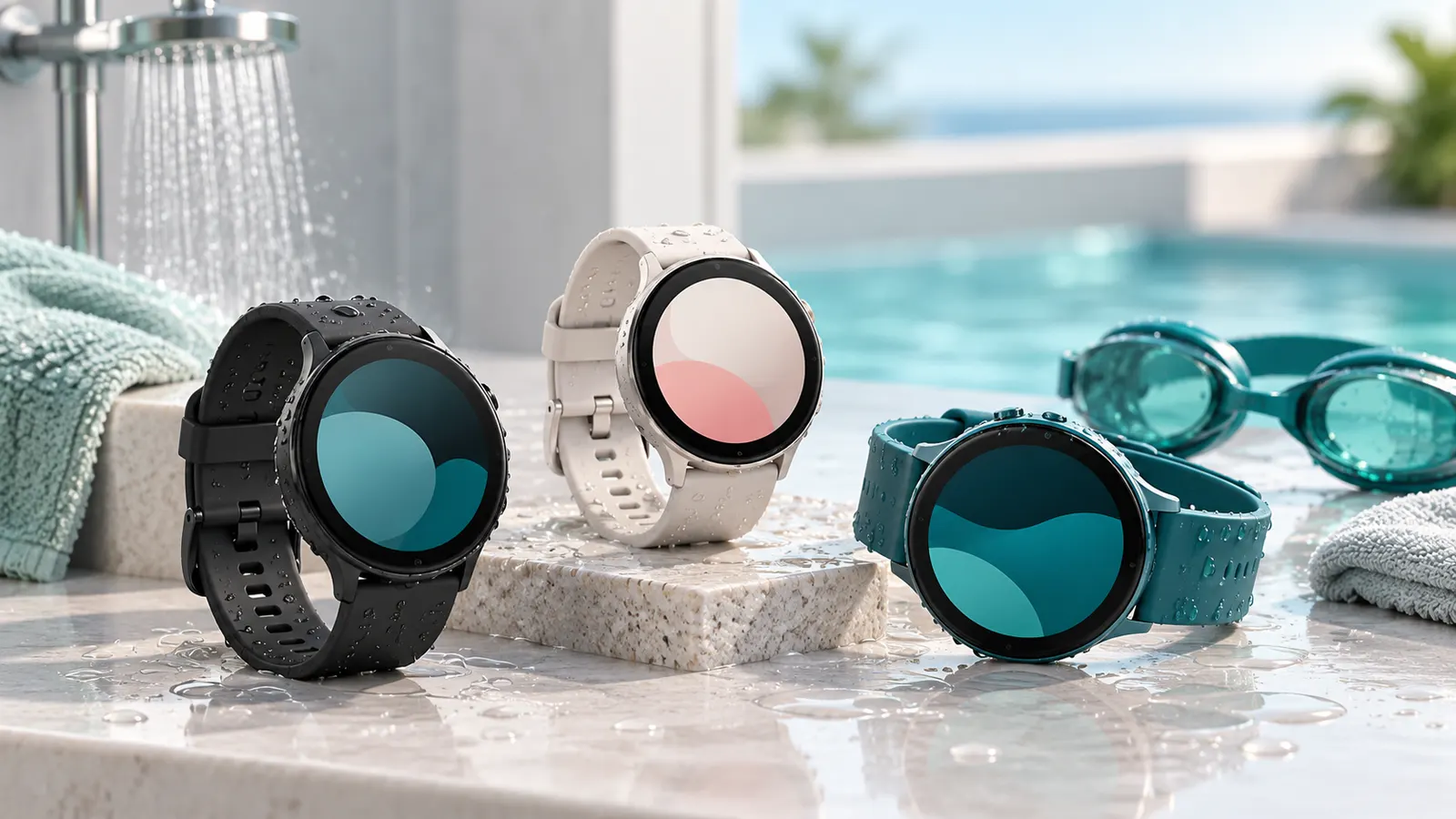
IP Ratings
IP ratings, such as IP67 or IP68, describe protection against dust and water. The first number covers dust and the second covers water. They are tests for still water at a set depth and time, and they do not cover moving water well. IP67 and IP68 usually mean the watch can handle splashes and brief immersion.
In this guide
ATM and Water Depth
ATM ratings, such as 3 ATM or 5 ATM, come from pressure tests. A 5 ATM rating is often described as suitable for swimming in shallow water. Higher ratings suit more water activity. The exact meaning depends on the maker’s guidance, so read it.
Showers, Hot Water and Soap
Hot water, steam and soaps can damage seals over time. Many makers advise against wearing the watch in a sauna or hot shower. Check the manual.
Salt Water and Pools
Rinse with fresh water after a swim and dry the watch. Chlorine and salt can damage straps and seals.
Care Tips
- Keep the charging port dry before charging.
- Do not press buttons underwater unless the maker says it is safe.
- Replace worn straps and seals if the maker offers a service.
- Water resistance can fade with age and impact.
Matching the Rating to the Activity
- Handwashing and rain: IP67, IP68 or 3 ATM.
- Swimming laps: 5 ATM or higher, if the maker states it is suitable.
- Surfing and water sports: look for higher ratings and the maker’s statement.
- Scuba diving: use a watch specifically made for diving.
What Voids Water Resistance
- Dropping or hitting the watch hard.
- Chemicals such as perfume, solvents or strong cleaners.
- Hot tubs, saunas and steam.
- Damaged seals or cracked glass.
Strap Materials in Water
Silicone and nylon dry quickly and suit pools. Leather and metal bands can be damaged by water or chlorine. Many watches let you swap bands in seconds.
Reading the Fine Print on Product Listings
Product pages use a mix of marketing words and technical ratings, and it pays to separate them. Terms such as water-resistant, splash-proof, sweat-proof and waterproof do not carry one shared definition, so a word on its own tells you little. The rating, the test conditions and the maker’s instructions are what count. Look for a specific code, like IP68 or 5 ATM, and then look for a sentence that explains what activities the maker says it is suitable for.
Be careful with depth numbers. A rating written as meters, such as a figure in meters on the case, does not mean you can take the watch to that depth. It comes from a laboratory pressure test on a still watch, and real activities create extra pressure through movement. Treat a stated depth as a way to compare watches, not as a safe depth.
- Check whether the rating applies to the watch only or also to the strap and charger.
- Look for notes about fresh water; many tests are done in fresh water and do not cover salt water, chlorine or soap.
- If a listing says water-resistant but gives no rating, look for the manual or maker’s page for details.
- Be cautious with ratings quoted for a different model or generation of the same watch.
- Read any statements about hot water, saunas, diving and high-speed water, since many makers exclude them.
When the listing and the manual disagree, follow the more cautious statement. If the maker is silent about the activity you want to do, assume it is not covered and choose a different model or avoid the activity.
Why Movement and Pressure Matter
A water rating is measured under controlled conditions, while real use involves motion. When you swim, your arm moves through water, which creates pressure well beyond what the watch would experience at rest at the same depth. Diving into a pool from a height, or hitting the water with your wrist, can produce a short spike in pressure that is greater than many ratings assume. Water from a tap or shower head hits the watch with force, which is another case where pressure can exceed the test’s conditions.
This is the reason many makers recommend against high-speed water sports or using a running tap with a watch unless it is clearly rated for it. A watch rated for shallow swimming may still be unsuitable for jet skis, waterskiing or surfing, where impact and speed are high. If you take part in those activities, look for a model whose maker explicitly states that it is suitable for them.
- Use the watch within the activities the maker names, not those that merely seem similar.
- Avoid pressing buttons while the watch is wet or underwater unless the manual allows it.
- Temperature changes, such as moving from a warm room to cold water, can stress seals.
- Remember that dust, sand and sunscreen can sit in seals and gaps, wearing them over time.
The more extreme the activity, the more important it is to use equipment designed for it, such as a dedicated dive watch or computer for diving, instead of relying on a general-purpose smartwatch.
Ports, Speakers and Sensors After Water Exposure
A smartwatch has openings that a traditional watch does not: a charging port or contacts, a speaker, a microphone and sensors. These areas can trap water even when the case is sealed against ingress. After swimming, showering or heavy sweating, rinse the watch with fresh water if the manual recommends it, and dry it with a soft cloth. Pay attention to the strap, the buttons and the space around the sensors on the back.
Some watches have a feature that clears water from the speaker, using sound or vibration. If your model offers it, use it according to the instructions. Do not blow into the openings, use compressed air, or insert pins or tools, as this can push water deeper or damage parts. Allow the watch to air dry in a place with good airflow, not near a heater or in direct sun.
- Do not charge the watch until the port and contacts are completely dry, as moisture can cause corrosion or short circuits.
- Wait for the watch to dry before wearing it again, if you notice water trapped under the screen or around the sensors.
- Clean the back and the charging contacts gently with a dry or slightly damp cloth and let them dry.
- If the speaker sounds muffled, give it time to dry before using the clear-water feature again.
- Check whether the maker recommends turning on a water lock mode during swimming, which locks the touchscreen to avoid accidental taps.
Heart rate readings can be less accurate while wet, so check how the maker treats swim tracking and whether the measurements are limited.
Warranty and What to Do After Water Damage
It is worth reading the warranty before you rely on a rating. Many makers state that water damage is not covered, even for water-resistant models, or cover it only under particular conditions. Some warranties may exclude damage from soaps, chemicals, hot water or use outside the stated guidance. The rating tells you how the watch was tested, not what the maker will repair for free.
If water gets into a watch, act quickly and calmly. Turn it off if you can, remove it from your wrist and take off any strap that could trap water. Dry the outside with a cloth, and let it sit in a dry, ventilated place. Do not use rice, a hair dryer, an oven or a heat source, as these can damage the watch or push moisture around. Do not try to charge it. If it fails to work, or if you see fogging under the glass, contact the maker or an authorized service center.
- Keep your proof of purchase and warranty information in a safe place.
- Take note of the date and the circumstances, as support teams may ask about them.
- Ask about water resistance testing if the service center replaces seals or screens.
- Remember that repairs may not restore the original rating, so ask about it.
Treat the rating as protection against accidents, not permission to ignore the care steps.
Choosing by Activity and Knowing When Seals Are Worn
Start with what you actually do, and choose the rating that covers it with margin. If you mainly wash your hands, walk in the rain and sweat at the gym, a splash-level rating may be enough. If you swim laps, look for a rating that the maker says is suitable for swimming, and read the instructions on how to use it. For water sports, check that the maker names them. For diving, choose a device designed for diving rather than adapting a casual smartwatch.
Seals and gaskets age. Heat, soap, sunscreen, oils, impacts and normal wear all reduce their effectiveness, so a watch that was fine when new may be less protected after a year or two. Watch for signs such as fogging under the glass, moisture beads, a loose or cracked case back, a damaged crown or button, a cracked screen or a loose strap lug. Any of these suggests that the watch is no longer reliable around water.
- Which activities do you actually do, and how often?
- Does the maker mention those activities by name?
- Is the strap suited to the water you will be in?
- Does the warranty cover accidental water exposure?
- Can the maker or a service center replace seals?
When in doubt, keep the watch away from water or choose a model with a stronger, clearly stated rating. Retire a watch from water use once there are signs of seal wear, even if it still seems to work.
A Quick Checklist Before You Get a Smartwatch Wet
Water resistance claims are easy to misread, so a few checks before the first splash can save you a repair. Go through this list with your watch and its manual in front of you.
- Find the water resistance statement in the maker’s manual or on its official support page, and note exactly what it covers.
- Check whether the claim applies to the watch only, or also to the band and charging parts.
- Make sure the crown, buttons and any covers are fully closed or pressed in as the maker describes.
- Inspect the case, glass and seals for cracks, gaps or damage.
- Confirm that the charging contacts are dry and clean before you plug in.
- Read any notes on the activities the maker approves, such as swimming or showering.
- Check whether the claim may change over time, for example after a drop or a repair.
If the manual is vague, contact the maker. A direct answer about your exact model is more reliable than a general rule.
Mistakes People Make With Water Resistance
The most common mistake is treating a number as a promise that applies to every use. A figure in a lab test says how a watch performed under specific conditions, which may differ from real life. Moving water, hot water, soap and pressure from a dive or a jump can create stronger forces than still water at rest. Follow the maker’s advice about which activities are suitable.
Another mistake is forgetting that seals can age. Gaskets can wear or dry out, and impacts can loosen parts, so a watch that once resisted water may do so less well after years of use. If you rely on water resistance, ask the maker or a service center about checking the seals.
People also put watches through hot showers, saunas or baths, where heat and steam may stress the seals. Check the manual before doing so. Finally, avoid charging a damp watch. Dry the contacts and the area around them thoroughly, and wait before connecting a charger, following the maker’s directions.
Comparing Two Ways Water Resistance Is Described
| Labeling style | What it generally describes | Things to remember |
|---|---|---|
| IP code | Protection against dust and water under defined test conditions | The second digit relates to water; read what the maker says it allows |
| ATM or meter figure | A pressure value from standard test methods | It is not a direct guide to the depth you can safely dive to |
| Marketing wording such as splash proof | A general description with no standard test behind it | Ask the maker for specifics |
The labels are useful signs, but each depends on the maker’s own explanation. If an activity is not covered, treat it as unsupported.
A Short Glossary of Water Resistance Terms
| Term | Meaning |
|---|---|
| Ingress | The entry of water or dust into a device. |
| Gasket | A rubber or similar seal that blocks gaps. |
| Crown | The knob on the side of a watch that can be turned or pressed. |
| Static pressure | Pressure applied by still water at a given depth. |
| Dynamic pressure | Pressure caused by movement through water or by a splash. |
| Submersion | Being fully underwater. |
If a term is unclear, check the maker’s glossary or support page.
A Decision Guide by Activity
Handwashing and rain
These are generally light exposures, but check the manual and dry the watch afterward.
Swimming
Only wear the watch in water if the maker states that it is suitable for swimming, and rinse it with fresh water afterward as directed.
Showers and hot water
Check the manual. Heat, steam and soap may be excluded, and some makers advise taking the watch off.
Water sports and diving
Look for specific guidance. If the maker does not clearly support the activity, use a purpose-built device.
Care After Exposure
Rinse the watch with clean water if it has been in salt, chlorine or soap, as the maker advises. Dry it with a soft cloth, including around the band and the charging area. Let the sensors and speaker ports dry fully, and avoid blowing compressed air into them. If water seems to have entered, or the screen fogs, stop using the watch and contact the maker.
Reading the Fine Print on a Product Page
Look for a clear statement of the test standard, the conditions it applies to and any limits. Check whether the charging cable and band share the same claim. Read the warranty to learn whether water damage is covered, since many warranties exclude it. Keep the receipt and the manual in case you need to contact the maker.
Follow the Maker’s Manual Before You Get Wet
Water resistance figures are easy to misread, and the maker’s own statement for your exact model is the only reliable source. Treat the points below as general prompts, not promises.
| Question | Where to look |
|---|---|
| Is swimming allowed? | The maker’s manual and product page for your model |
| Can I wear it in a hot shower or sauna? | The maker’s care guidance, which often gives specific warnings |
| Is saltwater use permitted? | The maker’s notes on rinsing and care |
| Does the strap change anything? | The manual, since some materials differ |
| Does water resistance fade over time? | The maker’s statement about seals and wear |
If the watch is damaged, dropped or opened for repairs, ask the maker or a repair center whether its resistance still applies.
Glossary of Water Resistance Terms
- IP code: a code that describes protection against dust and water, where the digits mean different things.
- ATM: a unit used on many watches to describe pressure in a lab test, which does not equal a depth you can safely dive to.
- Water resistant: a general phrase, not a promise that no water will ever enter.
- Waterproof: a word many makers avoid, because no seal lasts forever.
- Splash resistant: protection meant for rain or hand washing only.
- Crown or button seal: a part that can wear and let moisture in.
Rinse the watch with fresh water after salt or chlorine, if the maker allows it, and dry it gently. Avoid pressing the buttons under water unless the manual says it is fine.
Soap, lotions and heat can wear seals, so follow the maker’s care instructions. If you see moisture under the glass, stop using the watch and contact the maker.
Water Resistance Across a Year of Real Life
Ratings are earned in a lab, but watches live through seasons. A year of ownership includes chlorinated pools in summer, salt water on holiday, steamy bathrooms in winter, sunscreen, insect repellent, soap, and the occasional knock against a pool ladder or a door frame that no rating accounts for. Understanding water resistance as a condition that changes over time, rather than a permanent property stamped on the box, is the mindset that keeps watches alive. Seals age, adhesives fatigue, and every impact is a small test. The rating tells you what the watch could do when new and undamaged; your habits decide how much of that ability remains in year two and three.
The holiday scenario, step by step
Consider the most common water-resistance failure story: a watch that survived two years of showers dies on holiday. The holiday adds variables the shower never did — salt water that dries into crystals around buttons, sunscreen that attacks strap materials and can degrade seals, sand that works into crowns, and long, hot, wet days with no drying interval. The protective routine is simple and worth memorising. Rinse the watch in fresh water after sea or pool sessions, and do it the same day rather than at the end of the trip. Work buttons and crowns only when the watch is dry or fully submerged in still water, never under a running tap or shower jet, because directed pressure is exactly what ratings do not test. Let the watch air-dry fully overnight rather than sealing it damp into a wash bag. None of this requires caution that ruins a holiday; it requires ninety seconds of rinsing and a dry windowsill, and it is the difference between a watch that shrugs off a decade of summers and one that fogs up in year two.
Hot tubs, saunas and the steam problem
Heat is the quiet enemy in this topic. Warm water and steam reduce surface tension and help moisture find paths that cold water cannot, while heat also softens adhesives and expands materials unevenly. This is why makers who happily rate a watch for swimming often warn against hot tubs, saunas and hot showers in the same manual. Treat those warnings as part of the rating, not legal decoration. If you are a regular sauna or hot-tub user, the honest options are to remove the watch for those sessions or to accept that you are spending its water resistance faster than a swimmer does. Steam rooms are the harshest common environment of all: hot, saturated and prolonged. A watch left on a bench outside the sauna loses nothing; a watch worn inside for twenty minutes, three times a week, is living a much harder life than its owner realises.
Children, pools and borrowed watches
Kids’ watches and trackers face a rougher water life than adult devices: they are worn into pools without a thought, left damp in swim bags, and pressed, twisted and chewed in ways no lab simulates. If a child’s device will live at the pool, choose the rating for the activity as this guide describes, then add the habits a child can actually keep: rinse when the adult rinses, dry on the same towel rail, and never charge while damp. For borrowed or hand-me-down watches, assume the water resistance is unknown rather than original; seals and service history are invisible, so a second-hand watch that was once swim-proof should be treated as splash-proof until a maker or watchmaker pressure-tests it. That caution costs little — the watch still handles rain, handwashing and workouts — and it prevents the classic second-hand heartbreak of a first swim killing a watch that seemed perfect.
What To Do in the First Hour After Water Gets Inside
If the screen fogs, droplets appear under the glass, or the watch behaves oddly after exposure, act promptly and skip the folklore. Do not put the watch in rice; rice does little for a sealed device and its dust can enter ports. Do not charge it, do not press buttons repeatedly to test it, and do not apply heat from a hairdryer, which can drive moisture deeper and damage seals. Instead, dry the outside with a soft cloth, leave the watch powered off in a dry, ventilated place, and contact the maker or a watchmaker promptly, because internal corrosion is a clock that starts immediately. If the watch is under warranty, report the exposure honestly and quickly; water indicators inside the device will tell the story anyway, and prompt reporting gives you the best outcome the policy allows. The realistic goal in that first hour is not a home cure — it is preventing a repaiable problem from becoming a total loss.
Choosing a Watch When Water Is Central to Your Training
Pool swimmers
If structured pool swimming is your main sport, water resistance is a starting point and the swim features are the real purchase: lap counting that tolerates your turns, stroke recognition you can sanity-check against your own count, and a screen or button scheme you can operate with wet hands and goggles on. Confirm the rating covers pool swimming explicitly in the maker’s materials, choose a strap that does not stretch or slip when wet — silicone and fluoroelastomer styles are the usual answer — and build the rinse-and-dry habit from the first session, because chlorine is a slow, cumulative exposure rather than an occasional one. Swimmers who train most days should also expect straps to be consumables and budget for replacements, since a strap that fails in the water is the most common way a swim watch is lost.
Open-water swimmers, surfers and sailors
Open water adds impact, cold, salt and the real possibility of losing the device entirely. Beyond the rating, look at strap security — a strap that can release under a knock is a liability in surf — and at whether the watch offers a water-lock or equivalent mode that prevents wave and wetsuit touches from ending your workout or calling contacts. Cold water deserves respect in the other direction too: very cold exposure followed by a hot shower is a thermal swing that stresses seals, so let the watch return to room temperature before steamy environments. Sailors and paddlers should weigh screen readability in glare and the ability to operate the watch with gloves or wet hands, because a watch you cannot pause at a buoy turn is a logbook with gaps.
Triathletes and multi-sport owners
For triathletes the water question is really a transitions question: the same watch must survive the swim, be readable on the bike and stay put on the run, and its water rating must coexist with buttons you will press with wet, shaking hands in transition. Favour positive, tactile buttons over touch-only control, a strap that drains and dries quickly, and a rating with genuine headroom above pool depth because race-day water is chaotic — other swimmers, kicks, and hurried exits all add pressure spikes no calm lap swim produces. After the race, the full routine matters: fresh-water rinse, complete dry, and a check of the strap and spring bars before the next session, since race day is also when small damage happens unnoticed.
Reading Warranty Language Without a Law Degree
Most water disputes come from a gap between what owners think the rating promises and what the warranty actually covers, so read the warranty’s water paragraph before you need it. Many makers rate a watch for water exposure yet exclude water damage from warranty coverage, treating the rating as a capability statement rather than an insurance policy. Note the exclusions that recur across brands: exposure beyond the stated rating, hot water and steam, water entry with a cracked screen or damaged case, button or crown use while wet where the manual forbids it, and devices whose seals have been disturbed by unauthorised repair. Knowing these in advance changes behaviour in useful ways — you get cracks repaired before swimming season, you keep repairs official, and you treat an ageing watch’s rating as reduced. If water performance genuinely matters to your sport, that warranty paragraph is as much a buying criterion as the rating number itself, and a brand that stands behind its rating in writing is offering something real.
Everyday Water: The Exposures That Actually Add Up
Most watches never see a dive or a triathlon. Their water life is dishwashing splashes, rain on the school run, a toddler’s bath time, gardening with a hose, and the gym shower. These exposures are individually trivial and collectively decisive, because they happen hundreds of times across ownership and because they involve the two things ratings handle worst: soap and warm water. Detergents and shampoos reduce water’s surface tension, letting it creep past seals that plain cold water would never trouble, and warm water accelerates the process. This is why a watch can be honestly rated for swimming yet still be a poor candidate for daily hot showers: the rating test uses clean, still, cool water, and your bathroom does not. The practical takeaway is not anxiety but ranking. Rain, splashes, handwashing and cold showers sit at the gentle end; swimming sits in the middle; hot showers, baths and steam sit at the harsh end regardless of depth, because chemistry and heat matter more than metres in daily life.
Handwashing, sanitiser and workplace exposures
Some jobs multiply water contact beyond anything a leisure user sees: healthcare, food service, childcare, cleaning and laboratory work can mean dozens of handwashes a day plus alcohol-based sanitiser, which is unkind to some strap materials and screen coatings over time. If your work looks like this, choose the strap for the exposure — smooth silicone-style straps rinse clean and tolerate sanitiser better than leather, fabric or metal link styles that trap moisture against the skin — and expect to replace straps more often than a desk worker does. Position matters too: wearing the watch slightly higher on the forearm keeps it out of the worst of the splashing at deep sinks. And build in a daily dry interval, because skin kept damp under a strap all week will complain before the watch does; most work-related irritation blamed on watches is simply skin that never fully dries.
Rain, sweat and the myth of the invincible rating
Rain is the easiest exposure of all and needs no rating anxiety for any modern watch, yet it produces a surprising share of complaints because rain arrives with wind, cold and wet sleeves that hold moisture against the case for hours. Sweat is the other constant: it is salty, slightly acidic and delivered daily, and it is the main reason charging contacts corrode and straps smell long before any seal fails. The countermeasures are unglamorous — wipe the watch down after workouts, rinse straps regularly, dry before charging — and they protect the parts of water ownership that actually wear out. A high rating does not exempt a watch from any of this housekeeping. Think of the rating as the roof on a house: essential in a storm, but the house still needs its gutters cleared, and most water damage in real homes, like most water trouble in real watches, comes from neglected maintenance rather than dramatic events.
A Sensible Water Routine to Adopt From Day One
Pulling the whole topic together, a workable routine looks like this. Know your watch’s rating and the maker’s specific warnings, and treat the warnings as part of the rating. Keep the watch out of hot tubs, saunas and steam unless the maker explicitly approves them for your model. Rinse after salt water, pool sessions and heavy sunscreen, and dry fully before charging or storing. Never operate crowns or buttons under running water or in the shower. Get cracks and case damage repaired before water exposure, and treat any watch with an unknown service history as splash-resistant only. Replace tired straps, because strap failure loses more watches in water than seal failure does. Follow that routine and the rating on the box becomes a fair promise rather than a gamble — which is all any owner can reasonably ask of a number earned in a laboratory.
Water Resistance Questions That Deserve Longer Answers
My watch survived the pool for a year, then fogged after a battery service. Why?
Because water resistance is restored, or not, every time a watch is opened. Seals are replaced or reseated during proper servicing, and a maker-authorised service should return the watch to its rated condition, ideally verified by a pressure test. A third-party repair that reused tired seals, mis-seated a gasket or skipped the test can leave the watch looking identical and behaving like a splash-proof device. This is why the guidance in this article treats unknown service history as unknown water resistance: the rating belongs to the watch as manufactured and properly maintained, not to the case shape forever. If water matters to you, ask any repairer directly whether the watch will be pressure-tested after the work and whether they will stand behind the rating. Their answer tells you whether to swim in it afterwards.
Can I wear my watch in the sea if I rinse it afterwards?
If the rating and the maker’s guidance cover swimming, sea water is acceptable for many models provided the afterwards actually happens: rinse in fresh water the same day, work no buttons while it is salty and wet, and let it dry completely before charging. The failure pattern is rarely the swim itself; it is the watch spending the following week in a damp wash bag while salt dries into the button gaps and strap hardware, quietly corroding and crystallising. Treat the rinse as part of the swim, like rinsing a wetsuit, and the sea becomes one of the pleasures a properly rated watch is genuinely for. If the maker’s guidance for your exact model discourages salt water regardless of rating, follow the maker — their caution usually reflects strap, coating or sensor details that the headline rating does not capture.
Why do two watches with the same rating have different instructions?
Because the rating describes a test the case passed, while the instructions describe everything the maker knows about that specific product: its button seals, its speaker and microphone membranes, its strap materials, its charging contacts and the environments its warranty is prepared to stand behind. One model may use the rating headroom conservatively and invite swimming; another may pass the same test with a design whose speaker mesh or crown seal the maker trusts less across years of use, and its manual will say so. This is also why generational advice ages badly — a rule of thumb learned on one model should not be carried unquestioned to its successor. The manual for your exact watch outranks every general guide, including this one, and the five minutes spent reading its water pages is the cheapest insurance in this entire topic.
Does a screen protector or case change water resistance?
A film protector on the glass does not materially change the case’s sealing, though protectors can lift at the edges after repeated wetting and should be checked. A snap-on protective case is a different matter: it can trap water and grit against the case, interfere with button seals, and hold moisture against charging contacts long after the swim ends. If you use a protective case for work or sport, remove it during your rinse-and-dry routine so both the watch and the case dry fully, and never charge the watch while moisture is trapped inside the case. Neither accessory upgrades the rating, whatever the packaging implies; protection against scratches and knocks is a separate virtue from sealing, and confusing the two is how owners end up swimming confidently in a watch that was only ever splash-proof.
A closing note on confidence
The goal of everything in this guide is not caution for its own sake but confidence: the confidence to wear your watch into the pool, the sea and the working day without a flicker of doubt, because you know what its rating means, what its maker actually promises, and which handful of habits keep the promise intact. Owners who understand water resistance this way use their watches more, not less — they swim in them, train in them and stop performing the anxious rituals of people who treat the rating as either magic or marketing. Read your manual, keep the seals’ side of the bargain with rinses and drying and honest repairs, and let the watch do the job it was rated for. Water is where some of the best hours of a watch’s life happen; a little knowledge is all that stands between those hours and the fogged screen that ends them.
One habit that protects every rating
If this guide leaves you with a single behaviour, let it be the rinse-and-dry: fresh water after the sea and the pool, a full dry before charging or storage, and a strap and seal check whenever the seasons change. That minute of housekeeping defends the rating against the slow enemies — salt, chlorine, grit, trapped moisture — that cause far more water failures than any single dramatic dunk. Ratings are earned in laboratories, but they are kept on bathroom shelves and beside kitchen sinks, by owners who treat water resistance as a partnership between the maker’s engineering and their own routine. Keep your side of that partnership and the number on the box will still be true when the watch is old, which is the only version of the promise that ever mattered.
Frequently Asked Questions
Can I swim with an IP68 watch?
Not necessarily. IP ratings do not cover swimming well; check the ATM rating and the maker’s guidance.
Is 5 ATM enough for swimming?
Often yes for shallow swimming, but follow the maker’s instructions.
Can I shower with my smartwatch?
Many can, but hot water and soap can wear seals.
Does water resistance last?
It can decline over time and with damage.
Is IPX7 the same as 1 ATM?
No. They are different tests; read the maker’s guidance.
Can I wear my watch in the ocean?
Rinse with fresh water afterward, and only if the rating supports it.
Is water resistant the same as waterproof?
No. Water-resistant means the watch can handle water under specific tested conditions, while waterproof is a broad marketing word that has no single standard. Look for the rating and the maker's guidance.
Can I wear a smartwatch in a hot tub or sauna?
Many makers advise against it, since heat and steam can harm seals and the battery. Check your manual before taking the watch into hot or steamy places.
What does the water lock feature do?
It turns off the touchscreen so water droplets do not cause accidental taps. You usually need to unlock it with a button or crown, so check how your watch does it.
Do I need to rinse my watch after swimming in a pool?
Rinsing with fresh water and drying is a common recommendation after chlorine or salt exposure. Check your manual for the maker's guidance on your specific model.
Can water resistance be restored once it has faded?
Sometimes a service center can replace seals and test the watch, but not every maker offers it, and the original rating may not be guaranteed. Ask about the service before paying.
Are sports bands better for water?
Silicone and similar materials dry quickly and tolerate water and sweat better than leather. Check the material listed on the product page and the care instructions.
Does the charger need to be water resistant too?
Chargers are generally not water resistant. Keep the watch's charging area dry and make sure the charger and the contacts are dry before connecting.
Bottom Line
Check the exact rating, follow the maker’s guidance, and rinse and dry the watch after water. Choose a 5 ATM or higher watch if you swim.
Related Reading
- Best Waterproof Smartwatches
- Best Smartwatches with GPS
- Smartwatch Buying Guide: Compatibility, Features, Battery
- Best Fitness Smartwatches
- All Smartwatch guides