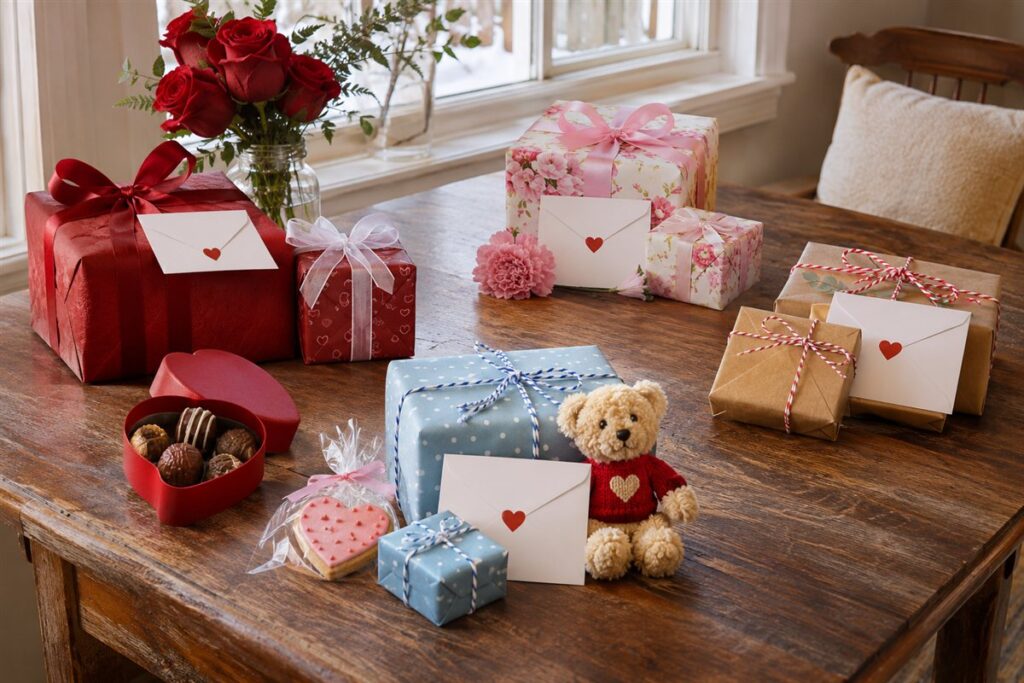
Selecting gifts for several loved ones is easier when you sort them into groups first and decide on a tone for each. A framework of three questions, who, what and when, keeps you from buying the same thing for everyone. The sections below walk through it.
Question 1: Who Is Each Person to You?
Write down the names of everyone you want to remember, then label each one by relationship: partner, parent, child, sibling or friend. The label tells you how personal and how large the gesture should be.
- Partner: Most personal, with a note and a keepsake or shared plan.
- Parents and grandparents: Warm and respectful, such as a photo print and a call or visit.
- Children: Playful and simple, such as a treat and a drawing session.
- Friends: Light and appreciative, such as a card and a coffee date.
In this guide
Question 2: What Do They Enjoy?
- Write one interest beside each name.
- Decide whether they prefer objects, experiences or words.
- Look for overlap. If three people love food, you can plan a shared meal instead of three separate gifts.
- Note any dislikes, such as sweets or crowded places.
Question 3: When and How Will You Give It?
Consider whether you will see each person on the day or need to send something. Printed items and parcels need extra time, so list the earliest date you can order for each. Hand-delivered gifts need a time slot, and messages need only a quiet minute.
Planning Table
| Person | Preference | Gift direction | Delivery |
|---|---|---|---|
| Partner | Words and memories | Letter and framed photo | In person |
| Parent | Family moments | Small photo album | Visit or post |
| Friend | Shared fun | Card and outing | In person |
Saving Time With Shared Materials
If you are buying for several people, reuse materials to save effort. Take one afternoon to write all your notes together, so you are already in the right mood. If you plan to give photo prints, select pictures for everyone in one sitting, then order them in a single batch to simplify delivery. Wrap everything with the same paper and ribbon, and vary only the tag and the contents. This keeps the work manageable and the result tidy, while each person still receives something that is clearly meant for them.
Finally, keep a short list of what you gave each person this time. Next year you will avoid repeats and can build on what they enjoyed.
Setting a Fair Budget Across the Group
When you buy for several people, a rough budget keeps the season from running away from you. Start by deciding the total you are comfortable spending, then divide it by closeness and by how much the gesture will be noticed, not by how much you love each person. A partner usually receives the largest share, but a parent who lives alone or a friend who has had a hard year may deserve a gift that stretches a little further than the label suggests.
Keep the budget as tiers rather than exact figures. A simple scheme is three levels: a main gift, a medium gift and a small token. Assign each person to a level before you shop, so you are not tempted to upgrade impulsively when something shiny appears. Reserve a small buffer for postage, wrapping and last-minute extras, because these costs are easy to forget and can quietly push you over your limit.
Remember that effort can replace spending. A handwritten note, a home-cooked meal or a carefully chosen photo costs little but signals attention. If your budget is tight, move more people into the token tier and make each token specific: a favorite snack with a note naming why you chose it carries more feeling than a generic box. Avoid comparing gifts between recipients out loud, and do not hint at what others received. Fairness here means each person feels seen, not that every parcel weighs the same.
Choosing Between Objects, Experiences and Words
Most gifts fall into three families, and knowing which one a person responds to saves guesswork. Objects are things someone can keep and use, such as a book, a scarf or a framed print. Experiences are shared time, such as a walk, a class, a meal or an afternoon of games. Words are notes, letters, voice messages or a short toast, where the message itself is the gift.
Objects suit people who like tidy reminders and who enjoy having something to display or use daily. Their risk is clutter: if the person already owns a lot, a consumable or a very personal item is better than another decoration. Experiences suit people who value time together and are often the better choice for friends and older relatives who have everything they need. Their risk is logistics, since they depend on schedules, weather and energy levels, so offer a flexible date rather than a fixed one.
Words suit nearly everyone and cost almost nothing, yet they are the family people skip most often, probably because writing feels exposing. A good note names a specific memory, says what you appreciate and avoids generic phrases. For a mixed group, a useful pattern is to give every person words, then add an object or an experience matched to what you learned about their preferences. That way nobody is left with nothing, and the extra element can vary freely.
Gifts for People Who Live Far Away
Distance changes the planning more than the budget. The first decision is whether the gift will travel by post, arrive through an online order sent directly to the recipient, or be digital. Each route has different deadlines and risks, so settle on one per person early and write down the date by which you must act. Check the seller’s shipping estimates for the destination, and add a margin, because holidays, weather and customs rules can slow things down.
Fragile and perishable items deserve extra care. Flowers, baked goods and chocolates can suffer in warm weather or long transit, so ask the seller about packaging and choose sturdier options when the journey is long. If the recipient is out during the day, think about whether a parcel might sit on a doorstep; a trusted neighbor or a delivery with a signature can help.
Do not underestimate digital gifts. A recorded message, a shared playlist, a collection of photos in a simple online album, or a scheduled video call with an activity built in can feel closer than a rushed parcel. Many families pair a small physical item with a call timed for when it is opened, so you are present for the moment. If time zones make a call awkward, a short voice note sent the evening before works well. Whatever you choose, tell the person something is on its way so it is not mistaken for a delivery error.
Allergy, Taste and Cultural Checks Before You Buy
A thoughtful gift can still go wrong if it ignores practical limits. Before buying anything edible, scented or worn on the skin, run a short check on each recipient. Ask yourself whether they have food allergies or dietary habits such as vegetarian, halal, kosher, low sugar or alcohol-free. Many people avoid certain ingredients for health or belief, and a box of treats they cannot eat becomes a small embarrassment rather than a pleasure.
Scented products need similar care. Strong fragrances bother people with sensitivities, and skincare or candles are risky unless you know what they already use. If you are unsure, choose something unscented or ask a close family member quietly. Clothing and jewelry carry sizing and style risks, so include a gift receipt or choose adjustable items when you cannot confirm a fit.
Cultural and personal context matters too. Some recipients do not celebrate the day at all, or celebrate it differently, and a romantic framing may be unwelcome for a colleague or a young relative. For those cases, keep the message about appreciation and friendship, not romance. Colors, flowers and symbols can carry different meanings across communities, so if you are giving to someone from a different background, a quick search or a question to a mutual friend is worthwhile. When a check leaves you uncertain, an experience or a note is nearly always safer than an object.
Planning Mistakes and How to Fix Them
The most common mistake is starting with the product instead of the person. Browsing shops first leads to buying whatever looks appealing, and then looking for someone to give it to. Reverse the order: finish your list and interest notes, and only then start shopping. The second mistake is leaving printed or shipped items until the final days. If you realize you are late, switch that person to a hand-delivered or digital option instead of paying for rushed handling that may still miss the date.
A third mistake is giving everyone the same item to save effort. A matching gift can work for a set of siblings, but it often feels impersonal. If you want to reuse something, keep the base the same and change one visible detail, such as the note, the color or a small add-on that refers to the recipient’s interests.
Other problems are quieter. People forget to include a card, which removes the personal meaning. They overspend on one person and have nothing left for others. They also overlook the person who is easiest to take for granted, often a partner or a close friend. Build in a final review a few days before the day: check your list against what you actually have in hand, confirm delivery dates, and prepare one fallback, such as a note and a plan for a shared meal, in case a parcel is delayed. That small safety net removes most of the stress.
A One-Page Checklist for Gift Planning Week
When the date is close, even thoughtful people end up grabbing whatever is available. A short checklist, filled in a week or two ahead, keeps the process calm and leaves room to adjust if something goes wrong. Copy the list onto paper or into a note and tick the items off as you go.
- Write the names of everyone you want to remember, including friends, relatives, partners and colleagues.
- Next to each name, note one thing they enjoy, one thing they recently mentioned, and one thing they dislike.
- Decide whether each gift will be handed over in person, mailed, or delivered digitally.
- Check delivery cut-off dates on the seller pages and add a few spare days.
- Confirm sizes, tastes, allergies and household rules, such as no scented items in a shared office.
- Gather wrapping, cards and small extras in one session instead of several trips.
- Pick a backup idea for each important person in case an order is delayed.
- Set a reminder two days before the date to make sure everything is wrapped and ready.
The aim is not perfection. It is to turn a vague worry into a series of small, manageable actions that you can finish without last-minute rushing.
Gift Mistakes That Are Easy to Avoid
Many disappointments come from the same few patterns. Spotting them early makes it far easier to choose something the receiver will actually enjoy.
Giving what you would want
It is natural to choose items that appeal to you. Try instead to picture the receiver on an ordinary Tuesday and think about what would make that day a little easier or brighter.
Choosing something generic for everyone
A matching gift for a whole group can be efficient, but it sometimes feels impersonal. Add a short handwritten note or a small detail that shows you thought about each person.
Leaving out the presentation
A modest gift in neat wrapping with a kind message often means more than a larger one handed over in a plain bag. A few minutes of care shows effort.
Ordering at the last moment
Shipping delays happen. Place orders early, track them, and keep a simple backup, such as a card, a homemade treat or a plan for a shared activity.
Forgetting how the person lives
A fragile item for someone who travels often, or a large item for a small apartment, may cause more stress than joy. Consider space, routines and habits.
Choosing a Format by Relationship
Different relationships call for different tones. The table below suggests directions to consider, not rules to follow, so adjust each idea to the person in front of you.
| Person | Tone to aim for | Ideas to consider |
|---|---|---|
| Partner | Personal and warm | A shared evening, a handwritten letter, a meaningful keepsake |
| Parent or grandparent | Caring and attentive | A framed family photo, a home-cooked meal, a call or visit |
| Child | Playful and simple | A small craft kit, a story book, a baking afternoon |
| Close friend | Fun and relaxed | A shared outing, a favorite snack, a funny card |
| Colleague | Light and appropriate | A card, a shared treat for the team, a kind note |
| Long-distance relative | Thoughtful and timely | A video message, a mailed letter, a shared online activity |
Whatever format you pick, keep the tone consistent with your relationship. A gesture that feels natural is nearly always better than a grand one that feels forced.
A Short Glossary for Gift Planning
- Love language: a popular way of describing how people prefer to give and receive affection, such as words, time, touch, acts of service or gifts. Use it as an opening for conversation, not a strict label.
- Cut-off date: the last day a seller says an order can be placed to arrive on time.
- Gift receipt: a slip that lets the receiver exchange an item without showing the amount paid.
- Handmade gift: an item you create yourself, such as baked goods, a card or a small craft.
- Experience gift: a ticket, class or outing that gives time together instead of an object.
- Digital gift: something delivered by message or email, such as a playlist, an e-card or a recorded greeting.
Knowing these terms helps when you compare options on seller pages or talk plans over with family.
A Decision Guide for Tight Schedules
Some years leave you with very little time. If that describes this one, a short decision path helps you act quickly without guessing.
- Under two days: choose something you can make or arrange yourself, such as a cooked meal, a letter or a planned outing.
- Three to five days: look for local pickup or in-store options, and confirm opening hours before you set out.
- A week or more: shipped items are realistic, though you should still track them and keep a backup.
- No obvious idea: ask a mutual friend or family member for a hint, or choose a shared activity that does not depend on knowing a person tastes.
Keep notes on what worked this year, including what people truly enjoyed. Next February, those notes will turn planning from a scramble into a pleasant ritual, and they will help you spot patterns in what each person values most.
Care Notes for Perishable and Delicate Gifts
Flowers, baked goods and fragile items need a little attention after they are bought. Keep fresh flowers in a cool place and in water until the moment of delivery, and follow the seller care card for trimming and feeding. For homemade or purchased food, store it according to the maker instructions and let the receiver know about ingredients so they can check for allergies. Pack delicate items with plenty of soft padding, and write handling notes on the outside of the parcel. If you are mailing something, check the carrier rules for restricted items and expected delivery windows, particularly around busy holiday periods.
Wrapping, Cards and the Moment of Giving
How a gift arrives shapes how it feels. Choose a quiet moment when the receiver is relaxed, instead of handing something over while they are rushing out the door. Write a short note by hand, even if it is only two or three sentences about something you appreciate. Specific memories land better than general phrases, so mention a shared trip, a kind act or a joke only the two of you understand. If you are giving to a group, such as a classroom or an office, prepare a small label for each item so nobody feels overlooked. When gifts travel by post, include a message inside the parcel so the receiver sees your words right away, and mark the box clearly if it must be opened with care.
Working the Framework for Each Relationship in Turn
The three questions — who, what, when — repay being worked relationship by relationship, because each category of loved one fails in its own characteristic way. Partners fail by assumption: we stop researching the person we know best. Parents fail by habit: the same category of gift yearly, long after tastes have moved. Children fail by projection: the toy we wanted at their age, offered to a child who is not us. Friends fail by vagueness: a generic kindness where a specific one was available. Walking the framework per person, on paper, exposes which failure is queuing up for each name on your list — while there is still time to route around it.
Write the working down. A single page with names, one interest each, one idea each and a delivery note is the entire apparatus, and it converts a swirling obligation into a checklist that can be finished. Photograph the page for next year before you file it; the framework compounds, because next year’s answers start from this year’s evidence instead of from a blank and guilty memory. Households that keep such a page describe gift occasions as administration — brief, calm, occasionally delightful — which is exactly the emotional register that leaves room for the celebration itself.
- Work who, what and when separately for every name on the list.
- Watch each relationship’s characteristic failure: assumption, habit, projection, vagueness.
- Keep the working on one page and photograph it for next year.
- Treat the list as finishable administration, not as an emotional exam.
Revisit the page once mid-preparation. Interests surface late — a mention in a phone call, a photograph liked, a complaint about something broken — and a framework that cannot absorb late evidence is just stationery. The mid-way review is where good lists become accurate ones, and accuracy, as every section of this guide keeps concluding, is the whole substance of a gift that feels chosen.
Reading Preferences: Objects, Experiences, Words and Time
Most people receive love most fluently in one or two registers, and the framework’s “what” question is really asking which register each person speaks. Object-keepers display, use and treasure things; their gifts should be chosen for keeping quality — well-made, personal, connected to their collections or rituals. Experience-collectors light up at plans and tickets and are quietly unmoved by parcels; give them dates, routes and reservations. Word-keepers reread cards and letters for years; for them the written part is not packaging but the gift itself, and it deserves the largest share of your effort.
Time-and-help receivers are the fourth register, often missed because their gifts look like chores from outside: the repaired gate, the organised photographs, the weekend of obligations lifted. For a tired parent or an overstretched friend, an act of service chosen with knowledge of their actual burdens can outweigh every object on a shelf. The framework catches these people only if “what do they enjoy” is widened to “what would they love to have done, made, said or given” — so widen it, per person, in writing.
- Identify each person’s fluent register: objects, experiences, words, or time and help.
- Give keepers keeping-quality things; give collectors dates and plans.
- For word-keepers, invest the largest effort in the card or letter.
- Widen the “what” question to include acts of service.
Mismatched registers explain most disappointing gifts between loving people. The object-giver hands a beautiful thing to an experience-collector and both feel the flatness without naming it. A season of observing which register each loved one actually responds to — from evidence, not from your own preference — upgrades every occasion that follows, permanently.
Children, Elders and the People Between
Children reward specificity about their current passion, which changes faster than any other on your list. Ask what they are collecting, building, watching or practising this month — through them or through their parents — and give inside the passion’s world rather than adjacent to it. A modest gift exactly on the current obsession defeats an expensive one a season out of date. For children you do not know well, experiences shared with you — a trip, a game, a baking afternoon — build the knowledge that makes next year’s gift easy, which is a return no object pays.
Elders often invert the young pattern: their houses are full, their wants are few, and what they value is presence, photographs of the family’s current life, and help with the specific frictions of their days. A framed recent photograph, a recorded conversation about their memories, a visit with a task quietly completed while you are there — these are the gifts elders describe months later. Ask what would help, believe the answer even when it sounds small, and write it into the framework where an object would otherwise have gone by default.
- For children, give inside this month’s passion, learned fresh.
- Shared experiences with children buy next year’s knowledge.
- For elders, favour presence, current photographs and practical help.
- Believe small answers about what would help; give exactly that.
The people between — siblings, cousins, the friends who are family — usually want the lightest touch on the list: evidence that the relationship is current. A gift that references this year’s shared joke, project or hardship tells them the friendship is being lived, not merely maintained, and those are the gifts that keep adult relationships warm across distance and busy decades.
Delivery as Part of the Gift
The framework’s third question — when and how — deserves more respect than it usually gets, because delivery can halve or double a gift’s effect. In-person delivery carries your presence as part of the present; schedule it where the person can actually receive it, not across a doorway in a rush. Posted gifts need their timing worked backwards from the day, with the card inside rather than in a separate envelope that arrives on a different morning. Digital delivery — the letter as photographs, the experience as an invitation — should still be staged: sent at an hour when they can attend to it, not fired into a busy afternoon.
Group occasions need choreography. At a family gathering, a rhythm of giving that lets each person be attended to briefly beats a simultaneous scramble, especially for children and elders at opposite ends of the noise tolerance scale. If you are the organiser, your framework page is also the running order: who is given first, whose moment needs quiet, whose gift opens a story the table will enjoy. These are small stage directions, and they are the difference between gifts received and gifts merely distributed.
- Deliver in person where presence adds value; protect the moment’s calm.
- Work postal timing backwards and keep the card with the gift.
- Stage digital gifts at an hour the receiver can attend to them.
- Choreograph group giving so each person gets a moment.
Follow-through closes the delivery. A message the next day — enjoying the photograph, thinking about your words — is not part of the gift you give but of the culture you are building, in which gifts are acknowledged specifically. Model it, and the whole circle’s giving improves, because people give better to those who visibly receive well.
After the Day: The Review That Makes Next Year Easy
Spend ten minutes, within the week, annotating your framework page: what landed, what fell flat, what each person mentioned wanting since. Note sizes, collections, current passions and new circumstances while they are fresh. This review is the least romantic and most valuable ten minutes in the entire system, because it converts one year’s improvisation into next year’s knowledge — the same alchemy this guide has recommended for couples, applied to the whole circle of loved ones.
File the annotated page where next year’s you will find it — with the decorations, in the calendar’s recurring reminder, in the note that holds the family’s practical knowledge. When the next occasion approaches, the framework’s three questions will already be half answered, and your effort can go where it belongs: into the one or two gifts that deserve real invention, and into being present, unhurried, at the celebration itself. That presence, finally, is what the framework exists to protect.
- Annotate the list within the week: landings, misses, new mentions.
- Record practical facts — sizes, collections, passions, circumstances.
- File the page where next year’s planning will actually look.
- Spend the saved effort on presence at the celebration itself.
A framework sounds like a cold tool for a warm occasion, until you have used one. Then it reveals its nature: it is how attention survives a busy life — how the things your loved ones told you in passing, across a whole year, are still there, written down and acted on, when the day arrives to say what they mean to you.
Gifts for Loved Ones in Hard Years
Some years, someone on your list is grieving, ill, exhausted or broke, and the framework’s questions change their meaning for that person. “What do they enjoy” may have no current answer; ask instead what would lighten a week. Presence without demands, food that requires nothing of them, help with the specific task their situation has made impossible, words that acknowledge the year honestly rather than performing cheer — these are the gifts hard years call for, and they are remembered with a gratitude that outlasts any celebration gift. Do not let the occasion’s brightness bully you into a tone the person’s life cannot meet.
Scale the delivery to their strength. A short visit that ends while it is still good beats a long one that depletes; a gift left with a note respects a person who cannot host gratitude today. And follow through in the following weeks, when the occasion’s attention has moved on — the framework’s “when” extends past the day for people in hard years, and the second, quieter delivery is often the one that matters most. Your annotated list should mark these names specially, because their needs will still be evolving at the next occasion.
- In hard years, ask what would lighten a week, not what would delight.
- Acknowledge the year honestly in words; skip performed cheer.
- Keep visits short and gifts effortless to receive.
- Follow through weeks later, when attention has moved on.
The Framework Applied to Yourself
One name belongs on the list that nobody adds: yours. A small, deliberate gift to yourself — the book, the afternoon, the tool for the hobby — is not indulgence in this context; it is maintenance of the giver. People who are depleted give depleted gifts, mechanically, and the framework’s calm depends on a planner who is not running on resentment. Budget the self-gift with the same honesty as the rest, keep it proportionate, and receive it properly when it comes. The celebration’s organiser deserves a place in the celebration.
There is a second self-gift hidden in the system itself: the hour of calm the framework buys back. Every year that the list is finished early, the organiser experiences the occasion as a participant rather than as staff. That experience — being present at your own family’s celebration, unhurried and unworried — compounds across years into the thing the whole apparatus was for. Guard it as deliberately as any present on the page.
- Put yourself on the list, proportionately and without apology.
- Treat the giver’s energy as a resource the framework manages.
- Finish early enough to attend your own celebration.
- Let presence, yours included, be the system’s final product.
When the Framework Meets a Surprise Occasion
Occasions do not always arrive on schedule: a recovery to celebrate, a farewell, a piece of news that deserves marking this week. The framework serves surprises well precisely because its knowledge is stored rather than improvised. The page tells you each person’s register, current passion and last gift; the note of mentions tells you what they have been wishing for in passing. From that stored attention, a thoughtful gift can be assembled in a day that looks, to the receiver, like intuition. This is the system’s quiet dividend — it makes you look like a person who simply always knows, when in fact you are a person who writes things down.
FAQ
Do I need to give everyone a physical gift?
No. A sincere message or a shared activity can mean more than an object.
How do I keep things fair among family members?
Match effort, not size. A thoughtful note for each person feels equal even when the items differ.
How much should I spend on each person?
There is no correct amount. Set a total you are comfortable with, then split it into tiers by closeness and circumstances. Remember that a specific note or shared plan can carry as much feeling as a costly item.
What if I do not know what someone likes?
Ask a mutual friend or family member, or look at what the person already uses and talks about. If you are still unsure, choose a note, a shared activity or a consumable they can use up, which carries little risk.
Is it acceptable to send a digital gift only?
Yes, especially for people far away or those who dislike clutter. A recorded message, a shared photo album or a planned call can feel personal, particularly when you tell them it is coming.
How early should I order shipped items?
Check the seller's delivery estimate for the destination, then add extra days as a margin. Printed and personalized items usually take longer to prepare, so order those first.
What should I do about coworkers or acquaintances?
Keep it light and general: a card or a small shared treat is usually enough. Avoid romantic framing and check for dietary restrictions before offering food.
Should I tell family members what I plan to give?
Only if coordination helps, such as avoiding duplicates among relatives. Otherwise keep it private, so that no one compares gifts.
What is a good backup if a parcel is late?
Prepare a handwritten note and a simple plan, such as a call or a meal together, so the day still feels marked. You can give the delayed item when it arrives.
How do I choose for someone who insists they want nothing?
Believe them about objects and disbelieve them about acknowledgement. Most “nothing” means no spending and no clutter; it rarely means “let the day pass unmarked”. Give in the registers that leave no residue: a letter, a meal, an experience, an act of help. If the person is an elder or a tired parent, help is usually the true answer — a task completed, a visit with photographs of the grandchildren, an afternoon of their obligations carried by you. Ask once, specifically, what would help, and honour the answer exactly.
What if my list is very long and my budget is not?
Let the framework ration honestly: decide the total first, then weight it by closeness and by who will actually notice, rather than spreading a uniform thinness that satisfies nobody. For the wider circle, words carry the day at almost no cost — a specific card, a photograph from a shared moment, a message that names what they did for you this year. People remember being specifically acknowledged far longer than they remember object values, which is the budget-giver’s great consolation and, used deliberately, their strategy.
How do I avoid giving duplicates within a family?
Coordinate lightly and early. A short message among the adults — who is giving what to whom — prevents the two identical gifts that embarrass givers more than receivers. Where coordination is impossible, your framework page protects you across years: last year’s annotated list shows what each person already received from you, and a gift that builds on a previous one — the next volume, the frame that matches — turns potential duplication into a collection, which reads as intention rather than accident.
Should children receive the same framework as adults?
The same questions, at higher speed. Who they are changes term by term; what they enjoy must be learned fresh each season, ideally from the child or their parents in the month before; when and how matters because a child’s occasion is easily swamped. The framework’s gift to children is accuracy about the present child rather than the remembered one. Adults, by contrast, mostly need the framework to notice slow changes — the new hobby, the new house, the new tiredness — that habit overlooks.
What is the best universal fallback gift in this system?
A specific letter plus a shared plan. The letter can be written for anyone on the list, in their register, from evidence you already hold; the plan — a meal, a walk, a call, a visit — gives the occasion a shape. Together they satisfy the framework’s tests for every relationship: personal in the “what”, honest in the “who”, and deliverable in any “when”. Keep the fallback in reserve without shame; it has outperformed many expensive improvisations, because specificity, not novelty, is what loved ones are actually measuring.
How early should the framework be started?
The list itself takes an evening, a few weeks ahead; the knowledge it organises takes all year. Start the page whenever you read this, with what you know today, and let the year’s mentions fill its gaps at the mid-way review. For the next occasion after that, you will start from an annotated page rather than a blank one, and the difference will feel like a talent for gift-giving that you suddenly possess. It is not a talent. It is the framework, doing quietly what memory alone could not.
Can the framework handle gifts for colleagues and teachers?
Yes, with the “who” answered at professional distance: warm, grateful, and modest in scale, with the “what” drawn from their public preferences — the coffee they drink, the subject they teach, the kindness they showed your family. Words carry these gifts almost entirely; a specific thank-you note is remembered in staffrooms long after edible gifts are shared and forgotten. Keep the register professional and the specificity personal, and the framework extends gracefully to the edge of your circle.
What do I do when two loved ones want the same single item?
Decide by the framework’s evidence: whose passion is current, whose year has been harder, whose occasion is nearer — and give the other person the adjacent gift of equal thought, perhaps the experience that pairs with the item or the promise, dated, of the next one. Then be transparent with neither about the contest; gift-giving is not an auction, and the loser should never know there was one. What each person should know is only that their gift was chosen for them, which, handled this way, remains true.
What if a loved one’s tastes change completely?
Believe the new evidence over the old file. People reinvent themselves — new sobriety, new faith, new hobby, new city — and gifts addressed to the former person announce that you have not noticed. Update the framework page without nostalgia, ask one good question about the new life, and give inside it. Being gifted accurately in a new identity is a profound experience of being seen, and it costs you nothing but the willingness to retire last year’s answers, however reliable they once were.
How do I give to someone I have fallen out with?
Decide first whether the gift is a bridge or an obligation. A bridge should be small, warm and free of demands — a card that names something true and kind, with no request attached and no score kept about the reply. An obligation gift, sent coldly to discharge a duty, usually communicates exactly that; sometimes the honest choice is a courteous card alone, or nothing, rather than an object performing a warmth nobody feels. The framework’s “who” question, answered honestly, tells you which situation you are in.
What is a good gift for a whole household at once?
Something that improves a shared ritual: the game the family will actually play, the ingredients and recipe for a meal cooked together, the photograph of all of them framed for the hall, the experience booked for a date everyone can make. Household gifts succeed when they create a next occasion rather than decorating a shelf. Check the household’s real rituals first — the framework’s research again — because a gift fitted to an existing ritual is used weekly, while a gift proposing a new one usually needs more energy than a busy household has.
How do I keep gift-giving from becoming competitive?
Refuse the scoreboard explicitly, first in your own head and then, if needed, in a gentle conversation: occasions in this family are for acknowledgement, not for ranking. Give at the level your framework sets — closeness and notice, not last year’s receipts — and receive other people’s gifts without auditing them aloud. Where competition has already taken hold between households, proposing a shared format — experiences together, a spending understanding, a draw of names — can reset the culture. The framework supports any of these, because its currency was never money; it was attention.
How do I choose a gift for someone I barely know but must include?
Ask the person who knows them, briefly and specifically — one question about what they enjoy is usually answered happily and accurately. Failing that, give in the safest warm register: words and something consumable or shared, chosen at good quality, with a card that is honest about the newness of the acquaintance and warm about the wish to know them better. A modest, accurate gift to a near-stranger is remembered as grace; an expensive guess is remembered as awkwardness. The framework’s humility scales down as gracefully as its ambition scales up.
The Short Version
Sort your loved ones by relationship, note what each enjoys and plan how and when to deliver. A short framework prevents repeats and rushed choices, and personal notes keep every gift warm.
