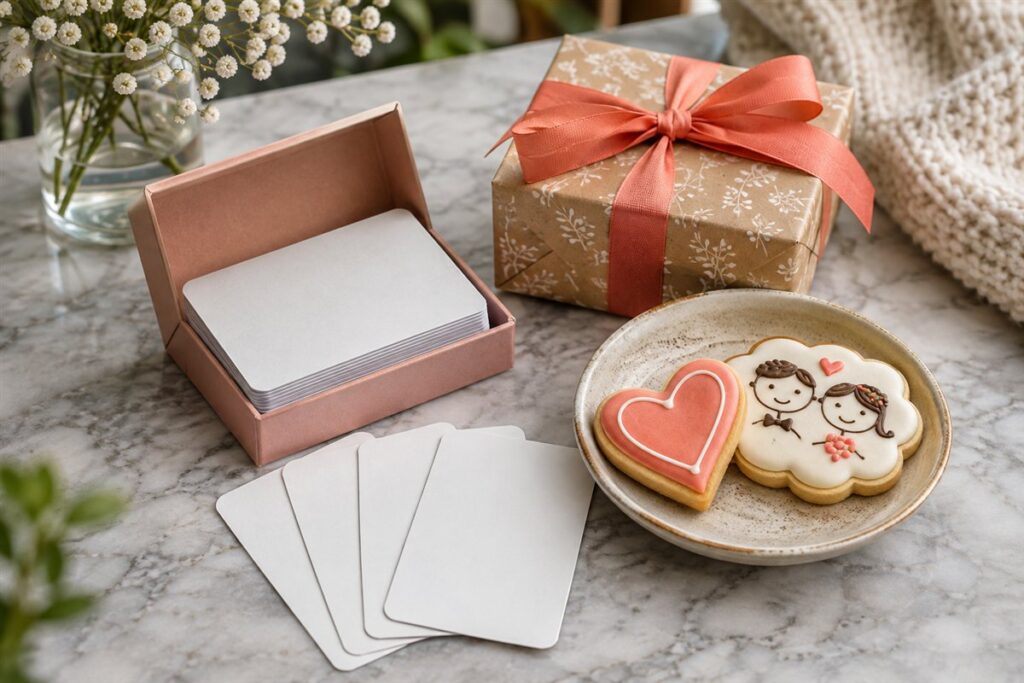
When a relationship is new, the best Valentine’s Day gift is playful, small and easy to receive. You want to show that you care without making the moment heavy. Think teasing notes, shared snacks, a little game and a tiny keepsake rather than anything that feels like a big declaration.
The Golden Rule: Keep the Pressure Low
New couples often have different expectations, and a large gift can leave the other person feeling they owe something back. Choose gifts that are warm but proportionate. A good test is to ask whether you would be comfortable if they gave you something of the same size in return.
In this guide
Flirty Ideas That Feel Light
- A teasing note: Write a short, witty message referencing something funny from your first dates.
- A snack with a story: Bring the treat you shared on your first outing, with a label that says so.
- A coupon set: Handmade vouchers for a coffee, a walk or a movie night, redeemable whenever they like.
- A shared playlist: Fill it with songs that remind you of each other and send the link with a card.
- A mini photo strip: Take silly pictures together and print a few, so each of you keeps one.
Date Ideas Instead of Objects
An activity can be the whole gift. It gives you something to talk about and lets you get to know each other better.
- Pick something neither of you has done, like pottery, bowling or an escape room.
- Agree on a casual dress code so nobody feels overdressed.
- Bring a camera or use a phone to take a couple of fun pictures.
- Afterward, share the best photo as a keepsake.
Things to Avoid Early On
- Overly expensive or very personal items, which can feel intense.
- Gifts that assume a long future together.
- Jokes that rely on sensitive topics or private information.
- Surprising them in front of colleagues or family unless you know they enjoy it.
Reading signals is part of the fun. If they respond to your teasing with their own jokes, you can turn up the playfulness a little. If they seem more reserved, keep the tone gentle and let them set the pace. Either way, the goal is a shared laugh, and a gift that makes both of you comfortable will help the relationship grow naturally into the next stage.
Match the Gift to How Far Along You Are
Not all new relationships are the same. A few weeks of dating, a few months of seeing each other regularly and a recent agreement to be exclusive each call for a slightly different level of gesture. The safest approach is to scale your gift to the stage you are really at, not the stage you hope for.
- Just getting to know each other: Keep it to something you could hand over in a moment, such as a single treat, a card with a joke or a small item connected to something they mentioned.
- Dating regularly: A shared activity, a small themed bundle or a thoughtful keepsake from a place you visited together fits well.
- Clearly a couple: You can add a little more personal detail, such as a framed picture or a playlist with notes about each song, while still staying light.
If you are unsure about the stage, ask yourself whether you have talked openly about what you are to each other. If the conversation has not happened, a lighter gift avoids implying more than you have both agreed. If it has, you have more freedom to be affectionate. Another useful sign is how they behave about plans: someone who talks about next month with you is probably comfortable with a warmer gesture than someone who keeps plans short. None of this is a rule, but it helps you pick a gift that will feel natural rather than awkward.
Writing a Note That Sounds Like You
A card or note often matters more than the object it comes with, and it costs only time. Many people freeze at the blank page, so use a simple structure and keep it short.
- Start with a specific memory. A detail from a date, such as the song that played or the dish you both ordered, shows you pay attention.
- Add one honest compliment. Choose something true and concrete, like their laugh or the way they tell stories, rather than a vague statement.
- Finish with an easy invitation. Suggest a small next plan, such as dinner next week, which gives them an easy way to respond.
Avoid copying a famous poem or a generic quote unless it genuinely suits you both. Avoid heavy declarations, long promises and anything that would be uncomfortable to read out loud on a first-month date. Handwriting adds warmth, but a typed message is fine if your handwriting is hard to read. If you tend to be shy, a joke is a good shield: playful teasing lets you be affectionate without being heavy. Read your note once as if you were the receiver and ask whether it would make you smile or make you feel pressured. Remove any line that does the second.
Check Tastes, Habits and Sensitivities First
A gift that ignores someone’s real life can miss the mark, however sweet the intention. In a new relationship you know less than you think, so do a little quiet research before you buy.
- Food and drink: Find out about allergies, dietary choices, religious practices and whether they drink alcohol. A chocolate gift is risky if they avoid sugar or dairy.
- Scents and products: Strong perfumes, candles or skincare can be unwelcome. Many people react badly to fragrance, and personal products can feel too intimate this early.
- Clothing and jewelry: Sizes and style are tricky, and such gifts can feel presumptuous at this stage.
- Hobbies: A small item related to something they love shows you listened, but avoid buying equipment that requires expertise you do not have.
- Culture and occasion: Not everyone celebrates this holiday or enjoys public attention. If you are unsure, ask what they like to do on the day.
You can gather clues casually. Remember what they order, what they talk about when they are excited and what they roll their eyes at. If you share friends, ask one of them for a quiet hint. When in doubt, choose a gift that can be shared, like a snack to open together, because it removes the burden of liking something personal.
Gifts for Long-Distance or Busy Schedules
Not every new couple can meet on the day. Distance, shifts and family commitments may mean a shared evening is not possible. A delayed or remote gift can still feel thoughtful if you plan it well.
For long distance, consider something that arrives or happens on the same day: a note in the post sent early enough to account for delivery delays, a surprise message at a time you know they are free, or a video call with a shared activity such as cooking the same simple recipe. Order any physical item well ahead and check the delivery estimate on the seller’s page, because holiday shipping can be slow. Avoid asking for their home address too early if they seem hesitant; offer a workplace or a friend’s address only if they suggest it.
For busy schedules, agree on a different day for a proper date and use the actual day for a small gesture. A message in the morning and a promise of a relaxed plan the following weekend is perfectly lovely. Do not make anyone feel guilty about working or studying. If one of you is busier, let that person choose the date. Flexibility signals that you care about them, not just the calendar.
When the Moment Feels Awkward
Even with careful planning, you might hand over a gift and find the other person did not bring one, or that their reaction is more muted than you hoped. This is common and not a sign that the relationship is doomed. A few small habits help you handle it gracefully.
- Say it is small. A short line such as “I saw this and thought of you” sets a casual tone.
- Do not ask for a gift back. If they did not prepare anything, move on with a smile and enjoy the plan.
- Give them room to react. Some people are shy about receiving. Offer to open it later if they prefer.
- Keep the conversation going. Ask about their day or share a funny story so the moment does not hang on the gift.
- Note what lands. If they love one thing, you have learned something useful for later occasions.
If the gift truly misses, for instance because of an allergy or a mismatch of taste, apologize briefly, laugh about it and do not push them to pretend. Being gracious about a miss is more attractive than getting everything perfect.
Reading the Situation Before You Spend Anything
New relationships have a delicate balance. Valentine’s Day arrives with a lot of social weight, and a gesture that feels sweet to one person can feel overwhelming to another. Before you decide what to do, think about how long you have been seeing each other, how you usually talk about feelings, and whether either of you has mentioned the day. A couple who has been together for a few weeks sits in a very different place from one that has been dating for several months.
Listen for clues in everyday conversation. Does your partner enjoy surprises or prefer to know what is happening? Do they love public attention, or would a quiet evening mean more? These small observations are worth more than any list of gift ideas.
Experience-Based Ideas That Create Stories
Shared experiences give a new couple something to remember without the awkwardness of an expensive object. Think of a tiny adventure that suits both of you: a sunset walk with hot drinks, a cooking class for beginners, a mini golf match with a silly forfeit, or a visit to a market where you each choose a snack for the other. Keep the plan flexible so the evening feels easy rather than staged.
- Pick something that fits within a few hours.
- Have a backup in case of bad weather or long queues.
- Take one photograph if both of you are comfortable with it.
Little Handmade Touches
Handmade gestures show thought without implying a heavy commitment. A playlist with a short note explaining why each song is on it, a small framed drawing, a baked treat in a pretty tin or a hand-written list of ten things you enjoyed so far can all land well. The key is sincerity and light humor. Avoid anything that reads like a grand declaration, and keep the tone playful enough that your partner can respond easily.
Gifts That Fit Different Personalities
| Personality | What often works | What to skip |
|---|---|---|
| Private and reserved | A quiet shared evening, a thoughtful note | Public displays or crowded surprises |
| Outgoing and playful | A game night, a themed outing | Anything stiff or formal |
| Practical | Something useful tied to a hobby they mentioned | Novelty items with no purpose |
| Sentimental | A memory-based gift such as a ticket stub in a small frame | Generic mass-produced items |
Use this as a rough guide rather than a rule, since people rarely fit neatly into one category.
Timing, Delivery and Presentation
How you present a gift matters nearly as much as what it is. Choose a moment when your partner is relaxed and has time to react, rather than as they rush out of the door. Keep the wrapping simple and pleasant. Say a sentence or two about why you picked it, which turns a small item into a personal gesture. If you cannot be together on the day, send a message in the morning and plan a catch-up that weekend rather than forcing something rushed.
Managing Budgets Without Awkwardness
Money can create unspoken pressure. If you spend far more than your partner expects, they may feel they owe you something equally grand. Try to keep your plan within a modest range and consider talking casually beforehand, perhaps agreeing to keep the day low-key. Thoughtful beats expensive, and a clear conversation avoids the sinking feeling of mismatched effort.
- Decide a comfortable limit for yourself.
- Choose one main gesture and one tiny extra.
- Skip anything that you would hesitate to explain.
If Plans Go Wrong
Dinner reservations get lost, trains run late and surprises fall flat. Meet those moments with humor. A cheerful attitude turns a mishap into a story, whereas visible frustration can sour a perfectly decent evening. Keep a simple fallback in mind, such as a favorite takeaway meal and a film at home.
After the Day Has Passed
A short message the next day, saying you enjoyed the time together, keeps the warmth going. If your partner gave you something, thank them specifically for what you liked about it. Use the experience to learn what suits you both for future occasions, from birthdays to ordinary weekends.
Playful Challenges and Games for Two
Games are a gentle way to be flirty without pressure. A scavenger hunt around a neighborhood, with clues written on small cards, gives you both a reason to laugh and move around. A trivia contest about each other, where wrong answers earn a silly dare, shows you how much you have learned in a short time. A cooking duel with a shared ingredient and a theme works well at home, and it ends with a meal. Choose something that suits your relationship stage and avoid anything that forces too much personal disclosure too early.
- Set a time limit so it does not drag on.
- Make the prize something silly, like choosing the next movie.
- Keep rules simple enough to explain in one minute.
Thoughtful Small Objects
If you prefer to give something physical, think small and personal. A book by an author your partner mentioned, a plant for their desk, a mug that references an inside joke, or a candle in a scent they said they liked will all feel considerate. The aim is to show that you listen. Avoid jewelry, clothing sizes and anything that suggests a long future together unless you are certain it matches the mood.
Attach a short card in your own words. One honest sentence about why you picked the item is more charming than a long poem borrowed from the internet.
Digital and Remote Gestures
If distance or schedules keep you apart, digital gestures can still carry warmth. Send a voice message, share a playlist, watch the same film over a video call, or order a small treat to be delivered to their door. Ask beforehand whether they are comfortable sharing an address. Respect time zones and work hours so the gesture feels welcome rather than demanding.
Respecting Boundaries and Comfort Levels
Everyone has limits around public attention, physical affection and expectations. If you are unsure, ask lightly. A message such as asking what sounds fun for the day gives your partner space to say what they prefer. Notice their reaction to the idea and be ready to adjust. Comfort grows when each person feels free to say no without any awkward consequences.
Gentle Closing Thoughts
A new couple does not need grand statements on the fourteenth of February. A relaxed, warm evening, a small gesture and a smile do far more than a lavish display. Trust your instincts about your partner and let the day be one pleasant memory among many.
A Simple Evening Plan You Can Copy
If you freeze when it comes to planning, borrow a framework. Begin with a casual meeting place at a comfortable hour, perhaps a cafe or a park bench, so that the evening opens without the weight of a formal reservation. Move on to a shared activity that keeps both of you talking, such as sharing small plates, browsing a bookshop or trying a few songs at a karaoke booth. End with a relaxed finish, a stroll home or a hot drink, and let the conversation decide how long it lasts.
The advantage of a loose plan is that either of you can adjust without disappointment. If one of you is tired, shorten it. If you are both having fun, add a stop. Flexibility itself communicates care.
Words That Work in a Note
Many people stall when writing a card. Keep it concrete. Mention a specific moment you enjoyed, like a joke that made you laugh or a place you discovered together. Add one forward-looking line that is light, such as hoping to try a new restaurant soon. Avoid heavy declarations, over-the-top compliments and promises about the future. Read it aloud once; if it sounds like you, it is ready.
- Open with a friendly greeting.
- Mention one shared memory.
- Say what you are looking forward to.
- Sign off warmly and simply.
Calibrating Flirtation: Playful Without Presuming
Flirty gifts walk a line that serious gifts never approach: they suggest a direction for the relationship and invite the other person to agree that the direction is fun. The calibration skill is to suggest lightly. A playful gift should be easy to laugh about, easy to accept and easy to decline gracefully — the three eases that keep early romance comfortable. Think of the difference between a wink and a speech: the wink can be returned or ignored without either person losing face, and your gift should work the same way. If accepting it would commit them to a level of intimacy they have not yet chosen, it is not flirty; it is pressure wearing a bow.
Read their signals the way you would in conversation. Someone who jokes back, initiates plans and shares small personal things is giving you a warmer light than someone who is still deciding how they feel. Match your gift to the temperature they have actually shown, not the one you hope for — a gift aimed one step ahead of the relationship’s real warmth is charming, while a gift aimed five steps ahead is a story they will tell friends, and not fondly. When in doubt, go smaller and wittier; in early dating, wit is the safest form of boldness.
The shared joke is your safest material
Nothing flirts more safely than proof that you remember what made them laugh. The snack from the place you discovered together, the silly object that references the disastrous first date, the book of the subject you debated for an hour — these gifts are intimate in the way that matters early, because they are built from shared history rather than from a shop’s idea of romance. They also scale perfectly: as the relationship grows, the archive of jokes grows with it, and your gifts can deepen on exactly the same principle that started them.
Dates Disguised as Gifts, and Gifts Disguised as Dates
For new couples, the most successful Valentine’s presents are often plans with a small object attached. Two tickets to something you will both enjoy, with a card and a packet of the sweets they like, gives the day a future as well as a present — and shared anticipation is a genuinely flirtatious gift, because it says you want more of their company without saying anything heavier. Choose the event for both of you honestly: something in the overlap of your tastes, at a scale that suits a new relationship, on a date close enough to feel real.
The reverse works too: a small object whose real content is an invitation. The board game is a second evening. The ingredients are a cooking date. The map or the guidebook is a walk you are proposing. Such gifts succeed because the object is modest and the invitation is the romance — and they fail only when the invitation is one-sided, a plan the giver loves imposed on the other. Check the overlap of your pleasures before you wrap anything with a future inside it.
First Valentine’s together, in a relationship that started recently
If the relationship began within the last few weeks, treat the day as a delightful excuse rather than a milestone. Acknowledge it — ignoring it entirely reads as a statement too — but keep everything at the scale of a good date rather than a ceremony: flowers in a modest bunch or none, a card that is warm and funny rather than fervent, a plan you would both enjoy even if the calendar said nothing. The couples who navigate a first Valentine’s best are the ones who treat it as play, and your gift should be the most playful thing in the day.
Group Settings, Public Moments and Other Traps
New couples often spend Valentine’s Day semi-publicly — with friends, at work events, in family reach — and a flirty gift must be able to survive daylight. Ask yourself whether they would happily show it to a friend in the room; if not, save it for a private moment or choose the version of the idea that passes the daylight test. Public grand gestures are especially risky early: what feels cinematic to the giver can feel like an ambush to the receiver, who must perform a reaction in front of an audience before they have decided what they feel.
The same care applies to social media. Do not let the gift debut online before it has landed in person, and do not choose anything whose main stage is a photograph of them receiving it. Early relationships are tender about their public shape; a gift that respects that tenderness will be remembered as attractive in itself. Confidence that does not need witnesses is, not coincidentally, the quality most people are hoping to find.
When you receive more, or less, than you gave
Mismatches happen constantly in new relationships and they are only awkward if you make them so. If their gift outscales yours, receive it with pleasure rather than apology — scrambling to equalise turns a sweet moment into accounting. If yours outscales theirs, be light about it and change the subject to the part of the day you will share. The couples who last are not the ones who matched perfectly in February; they are the ones who discovered they could be slightly out of step without either person keeping score.
Ideas by Energy Level: Matching the Gift to the People You Actually Are
Not every couple wants the same Valentine’s temperature. The high-energy pair will love the playful challenge, the game, the plan with movement in it. The quiet pair will love the small object, the food, the evening in with a film they have been saving. The adventurous pair wants the new experience; the comfort-loving pair wants the beloved thing done perfectly. None of these is more romantic than the others, and copying another couple’s Valentine’s is the fastest route to a day that fits nobody. Choose from your own shared pleasures — the ones already proven on ordinary weekends — and simply dress the best of them for the occasion.
The two-person gift audit
Before you buy, run three questions. Have we laughed about this, or near it, together. Does it ask anything of them beyond enjoying it. Would I still be pleased to give it if nobody ever knew. A gift that passes all three is calibrated; a gift that fails one is telling you which way to adjust — usually smaller, kinder or more clearly rooted in something you have actually shared.
After Valentine’s: What New Couples Actually Remember
Ask couples a year later and a pattern emerges: they rarely remember the object precisely, but they remember the feeling of the day — whether it was easy, whether they laughed, whether the other person seemed to see them accurately. That is liberating news for the giver. Your real product is an evening where a new person felt noticed without being overwhelmed, amused without being teased, and wanted without being cornered. Choose the gift that serves that evening, and you have understood everything this guide knows.
A Few Complete Evenings, Assembled From the Principles
For the couple who met over food: cook or order the dish from the date that went best, add the small ridiculous dessert you joked about, and give a card that names the evening you are quoting. The gift is the quotation itself — proof that the early dates are already becoming a shared mythology worth referencing. For the couple who met through friends: let the plan include the friends lightly — drinks together early — then peel away for the private hour, where a tiny gift drawn from a shared joke changes hands. The structure mirrors how the relationship actually formed, which is why it feels so natural.
For the couple who met online and are still translating messages into a person: choose the gift that closes one small distance — the book they mentioned in chat, in physical form; the food from the neighbourhood they described; the plan that visits the place they kept photographing. Early gifts that say I read you carefully, in every sense, build trust faster than any declaration. And for the couple separated by distance this February: synchronise a small ritual — the same meal ordered in two cities, the same film started at the same minute, a parcel timed to be opened on a call — and let the gift be the shared hour itself, with one modest object as its souvenir.
Notice what none of these evenings contains: expense as a strategy, surprise as a weapon, or romance performed for an audience. They are all built from the same three materials — a shared joke, a shared pleasure, a little forethought — arranged at the temperature the relationship has actually reached. That is not a limitation of new-couple Valentine’s; it is the discovery that the day works best, at every stage, when it is built from the relationship itself.
One final permission, in case you need it: a small Valentine’s, done warmly, is not a lesser Valentine’s. For a new couple it is usually the correct one — the first page of a story that grand gestures would only rush.
Reading the Day Itself: Small Signals, Honest Adjustments
Even a well-chosen gift meets a real day, with its weather, moods and small accidents. Stay loose. If they are tired, shrink the plan without commentary and let the gift carry the day at home. If the playful idea lands flat, laugh at it yourself first and move on — a giver who can drop a bit gracefully is more attractive than the bit ever was. If the moment turns unexpectedly sincere, do not flee back into jokes; let the sincere sentence stand, give the card, and enjoy the discovery that the relationship was warmer than your caution assumed. Calibration is not a decision made once in a shop; it is a way of paying attention all evening.
When flirty becomes fond: letting gifts grow with you
Across a first year, the same principles scale quietly. The jokes get richer because the archive is bigger. The gifts can carry a little more meaning because the meaning has been earned in person. Nothing about the method changes — specific, light, easy to accept — only the depth of shared history it draws on. Couples who keep that method rarely struggle with Valentine’s Day in later years, because they never taught each other to expect performances; they taught each other to expect attention.
Keep it light, keep it specific, keep it easy to accept — and let the relationship, not the calendar, set the pace of everything else.
FAQ
Should I give a gift at all in a new relationship?
A small gesture is usually welcome. If you are unsure, talk about plans for the day in advance, then choose something that matches the energy of that conversation.
What is a safe flirty gift?
A handwritten note with a favorite treat is hard to get wrong. It is personal, light and easy to return in kind.
Is it okay to give nothing at all?
Yes, if you both agreed to skip it or the relationship is very new. A kind message or a casual meetup can be enough. If you are unsure, ask what they would like to do.
Should I buy something for their friends or family?
No. Keep the focus on the two of you, since gifts for others can feel like a leap in commitment.
What if they do not celebrate this holiday?
Respect that and drop the theme. You can still do something kind on another day, such as a small treat or a relaxed outing, without calling it a holiday gift.
How do I avoid giving something too personal?
Avoid clothing, jewelry, strong scents and anything that suggests a long future. Choose items you could share, like food, an activity or a playlist.
Can I give a gift in person at work or school?
Only if you know they are comfortable with attention. Many people prefer privacy, so a quiet moment after the day is usually better.
What if I cannot decide between two ideas?
Pick the lighter one. It is easier to add a gesture later than to take back one that felt too heavy.
How flirty is too flirty for a new relationship?
Use the daylight-and-decline test: if the gift can be shown to a friend without embarrassment and declined or laughed off without a scene, it is inside the line. Gifts that assume physical intimacy, claim a future, or require a public performance of feeling are outside it for most new couples. When you cannot decide, choose the wittier, smaller version of the same idea — flirtation survives being understated far better than it survives being overstated.
Is it better to give the gift before, during or after our date?
During or after usually works best early on, because the gift then crowns time already enjoyed rather than setting a tone the date must live up to. A small thing produced at the right moment — the sweets after the film, the book when the conversation reaches its subject — feels like timing, and timing is flirtation’s native language. If logistics force an earlier handover, keep it casual and move quickly to the shared part of the day.
What if we have not defined the relationship yet?
Then let the gift be as undefined as the relationship, in the best way: warm, light and without labels. A card that says you are enjoying getting to know them is honest at every stage and commits nobody to anything. Avoid anything that functions as a question — the gift that asks where is this going will be answered under pressure, which helps nobody. Enjoyment stated plainly is the most attractive position available to you, and a playful gift states it perfectly.
Can a funny gift backfire?
Yes, when the joke is at their expense, about their body, their past relationships, their family or anything they are privately unsure about. Aim humour at shared situations, at yourself, or at the occasion’s own absurdity — the industrial scale of the card shop, the pressure of the day — all of which are safe targets you can enjoy together. If you have to ask whether a joke is too sharp, it is; choose the kinder version and be the person whose humour never needs an apology attached.
What are good gifts when we are dating but not exclusive?
Keep it at the scale of a great date: something small and specific to your shared jokes, an invitation to do something fun, food you will enjoy together. The gift should be honest about what it is — a sign that you like their company — without performing a claim. Generosity of spirit at modest scale is exactly the register; anything grander creates a debt neither of you agreed to, and debts are the opposite of flirtation.
How do I sign the card without sounding too serious?
Write like you talk on your best evenings: one line about something you have enjoyed with them, one line looking forward to the plan, your name. Skip declarations, skip poetry you did not write unless it is a shared joke, and skip the analysis of what they mean to you — that conversation deserves its own moment, unhurried and unwrapped. A light card with one true sentence in it will be kept longer than a fervent one.
Should I buy a gift if we only met recently but really like each other?
Yes — a small one, chosen from the little you already know: the drink they ordered twice, the subject they lit up about, the joke from your second conversation. Intensity of feeling does not license intensity of gift; it licenses accuracy. A tiny, precise present says I am paying attention, which is the most exciting sentence available at this stage, and it leaves the relationship room to grow into the larger gifts later.
What if they give me a gift and I have nothing for them?
Receive it beautifully — that is a gift in itself — and do not spoil their moment with panic or a rushed IOU. Then, within days, answer in kind at the same light scale: the invitation, the small specific thing, the note that says you have been thinking about it since. A graceful delay reads as thoughtfulness; a desperate same-day scramble reads as exactly what it is.
Yours starts tonight, enjoyably.
Trust the small gift, the true joke and your own timing — they have started more love stories than any grand gesture in history.
And it is an assignment at which you, having read this far and thought this carefully, are already better than you fear.
Buy that one, write the light card, and spend the evening being the easiest person in the world to be with. It is, at this stage, the whole assignment.
Many Februaries, each a little less nervous than the last, each gift a little more fluent in the two of you. That fluency starts here, with one light, well-aimed, easily loved present.
The evening will talk, if you let it, in the language new couples understand best: laughter first, sincerity in small doses, and the growing suspicion — welcome on both sides — that this might be the first of many Februaries.
Still together and still silly is not a bad ambition to wrap in a card. Choose the gift that points that way — light, specific, easy to love — and let the evening do the rest of the talking.
Decorations are allowed to be silly, by the way. The heart-shaped everything, the terrible card you both laughed at in the shop, the dessert shaped like something anatomically optimistic — silliness shared is intimacy at this stage, and the couples who can be silly together in February are usually still together, and still silly, in December.
So let the day be what it is at this stage: an excuse, gladly taken, to pay one person a little extra attention in public view of nobody. Handled that way, it stops being a test couples dread and becomes what it should have been all along — a good evening with decorations.
What if Valentine’s Day falls very early in our dating?
Acknowledge it with humour and a token at most: the card that jokes about the calendar’s timing, the coffee and pastry from the place you both like, the plan for a normal good date that happens to fall on the day. Pretending the day does not exist is stranger than marking it lightly, and marking it lightly is itself attractive — it shows you are neither frightened of romance nor trying to fast-forward it. The couples who laugh about the timing together have already passed the only test the day sets at this stage.
How do I know if the gift landed well?
By the ease after it: laughter that includes you, the object used or displayed without being made a shrine of, the conversation moving on happily to the rest of the evening. A gift has landed when it joins the day rather than dominating it. If you find yourself monitoring their reaction for minutes afterwards, that is your cue to relax — the work was done in the choosing, and the rest is just an evening with someone you like.
What should I do if I am nervous about the whole day?
Shrink it to a size you can enjoy: one small gift you are confident about, one simple plan, one honest line in a card. Nervousness usually comes from imagining an examination; there is none — there is only a person who likes you, hoping you both have a nice evening. Prepare the few things in advance, then spend the day itself paying attention to them rather than to your performance, which is, not coincidentally, the entire skill this article has been describing.
Are flowers appropriate for a new relationship?
A modest bunch, chosen for colour or for a joke — the flower from the market stall where you met, the ones in the colour they always wear — is pitch-perfect. The enormous arrangement is the risky version, because scale speaks, and early on it says more than you may mean. Let the card keep the flowers’ message light, and the oldest gift in the world becomes a new-relationship natural.
Is a group activity a good Valentine’s plan for a new couple?
It can be the perfect pressure valve: friends around you lowers the ceremony, shared laughter does the bonding, and nobody has to sustain intense one-to-one romance for hours before the relationship is ready. Balance it with a small private moment at the edge of the day — the walk to the station, the quiet drink afterwards — where the card changes hands and the day gets its one sincere sentence.
The Short Version
For new couples, keep gifts playful and proportionate. Notes, shared snacks, a playlist, an activity and a few photos all show interest without pressure. Aim to leave them smiling, not wondering what to say.
Related Guides
- Last-Minute Valentine's Gifts for Couples That Still Feel Real
- Meaningful Valentine's Gifts for New Love, Soulmates, Friends
- Last-Minute Valentine Day Gifts for Your Sweetheart Guide
- Classic vs Modern Gifts: What Works Best for Valentine's Day
- Fantastic Valentine's Day Gifts for Him by Interest Type
