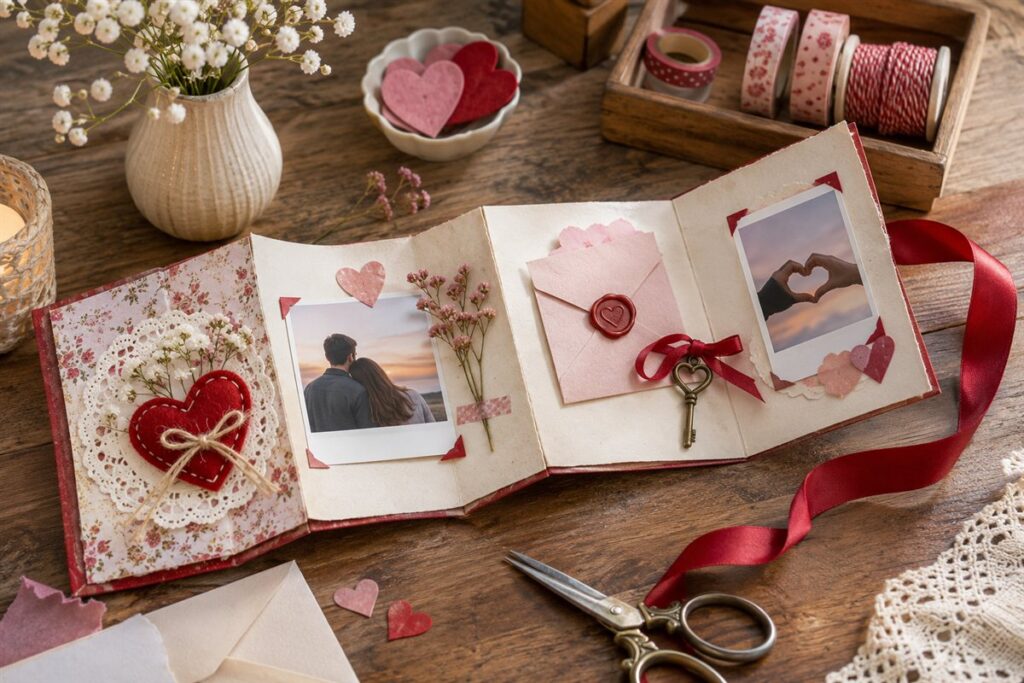
The most creative Valentine gifts are invented from your own shared material rather than found in a catalog. Use the prompts below to turn memories, photos and jokes into something nobody else could give. You do not need artistic skill, only a willingness to notice details.
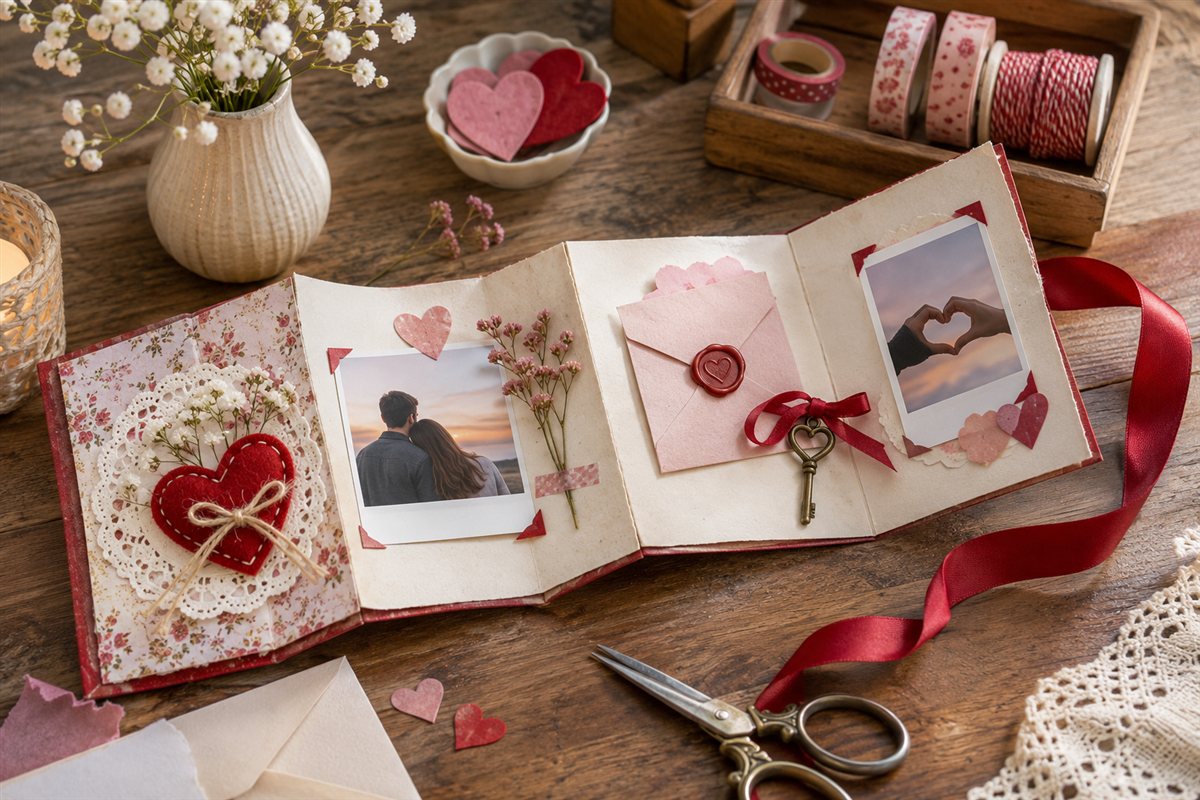
Prompt 1: Turn a Memory Into an Object
Pick a memory that makes you both laugh. Then ask what physical item could represent it.
- A ticket stub, framed with the date and a caption.
- A map of a trip with your route marked by hand.
- A recipe card from a meal you cooked on a special night.
In this guide
Prompt 2: Make a Collection
Collections are creative because they show patterns over time.
- Choose a theme, such as sunsets, doorways or coffee cups from places you visited.
- Gather photos you have already taken that fit the theme.
- Select around a dozen with matching tones or subjects.
- Print them as a small series or a simple book, and write a one-line caption for each.
Prompt 3: Create a Game or Quest
Turn the gift into an experience. Write a series of clues leading to different places that matter to you both, ending with a small prize or a planned dinner. Add photos at each stop so the route feels like a story. Keep each clue short and easy to follow.
Prompt 4: Gift a Future Moment
- A sealed letter to open on a later anniversary.
- A jar of notes, one for each day of a month.
- A booked class, trip or concert, presented with a handmade invitation.
Making It Look Good
Presentation helps creative ideas land. Use clean layouts, consistent colors and legible handwriting. If you are using photos, choose sharp, well-lit images and check how they will crop in the print size you select. A simple frame or folder can make homemade items look polished.
A Simple Planning Routine
- Spend ten minutes listing shared jokes, places and songs.
- Circle the three that make you smile most.
- Pair each with one prompt above and sketch a rough idea.
- Choose the one you can finish comfortably before the day.
Working this way keeps creativity from turning into stress. A modest idea finished well beats an ambitious one left half done.
Spotting the Raw Material for an Original Gift
Original gifts start with observation, not shopping. Before you pick a prompt, spend a week collecting small details about the person you are buying for. Keep a note on your phone and add anything that makes them light up, annoys them in a funny way or comes up again and again in conversation. The more specific the detail, the more personal the gift will feel.
- Phrases they repeat: a favorite saying, a nickname or a running joke can become a title for a book, a print or a card.
- Routines: a morning coffee ritual, a Sunday walk or a regular market stop shows what they value.
- Small complaints: a drawer that never closes or a phone cable that always goes missing hints at a practical improvement you can make thoughtful.
- Things they keep: postcards, tickets and old photos tell you what they treasure.
- Things they admire: a style of music, a painter or a type of food can guide the theme.
Try to notice what they enjoy giving as well as receiving. Someone who loves planning outings may appreciate an experience, while someone who collects keepsakes may prefer a physical object. Ask friends or family a casual question if you are stuck, but avoid revealing the plan. Once you have a short list, choose the idea that connects the most details and that you can finish well before the day.
Matching the Idea to the Personality
A creative gift only works if it fits the person who receives it. A brilliant idea for a sentimental partner can feel uncomfortable to someone who dislikes attention, so test each concept against their temperament before you commit.
Think in broad types. A sentimental person tends to love letters, albums and recreated moments. A playful person enjoys puzzles, scavenger hunts and inside jokes. A practical person may prefer a handmade version of something they will actually use, such as a custom recipe book or a labeled toolkit. An adventurous person might enjoy a planned outing, a mystery day or a skill class. A private person usually prefers a quiet gesture at home to anything public.
- Avoid gifts that put them on the spot, such as public announcements, unless you know they enjoy that.
- Avoid jokes that touch on sensitive topics like appearance, age or money.
- Avoid ideas that require them to perform, such as reading something aloud, unless they like it.
- Consider how they respond to surprise. Some people love it, while others prefer a hint beforehand.
If you are unsure, combine a safe element with an inventive one. A favorite meal served in a new way, or a handwritten letter placed inside a book they have been meaning to read, adds creativity without risk. The goal is for them to feel seen, not to feel judged by how clever you are.
Working Within Time and Budget
Creative does not have to mean expensive or time-consuming. In fact, constraints often improve the result because they force you to choose one clear idea. Decide early how much time and money you can spend, and select a prompt that fits inside those limits.
For a tight budget, lean on what you already have: photos on your phone, handwriting, a printer at home or a local print shop, and basic materials like card stock, string and envelopes. For limited time, pick something that takes an evening, such as a short letter paired with a framed photo or a jar of notes. For more time, a booklet, a quest with several stops or a small scrapbook can be built over a few weeks.
- Set a firm deadline a few days before the occasion, so printing or delivery delays do not ruin the plan.
- Write your steps in order and note what each one needs, such as photos, paper or a booking.
- Order anything that must be printed or shipped first, since turnaround times vary by service.
- Leave a small buffer for mistakes, because handmade work often takes longer than expected.
Choose a materials list you can afford without stress. A modest gift made with care and finished on time will mean more than a lavish one that arrives late or leaves you tired and anxious on the day itself.
Turning Ideas into Keepsakes That Last
If you want the gift to be kept for years, think about durability while you plan. Paper fades, photos yellow and handwriting smudges if you do not handle them well, so a few simple choices make a real difference.
- Paper and printing: choose thicker paper for cards and notes, and ask a print shop about archival or long-lasting options if you are printing photos. Check the shop’s listing for what each paper type offers.
- Ink: test your pen on a scrap, since some inks bleed or smear. Let them dry before stacking pages.
- Framing: use a mat so the print does not touch the glass, and hang it away from direct sunlight.
- Digital backups: scan or photograph handmade pieces so you have a copy if the original is damaged.
- Containers: a simple box or folder protects letters and small items from bends and spills.
Add a dated note to each piece, even something as simple as a line on the back. Years later, that detail turns a pleasant object into a record of a particular moment. If the gift includes food or fragile items, plan how it will be stored and when it should be eaten or used. Small decisions like these show care without adding much cost.
Mistakes That Spoil a Creative Gift
Most failed homemade gifts share a few predictable problems, and they are easy to avoid once you know them.
Starting too late. Rushed work looks rushed. Begin at least a week earlier than you think you need to, especially if printing or posting is involved.
Doing too much. Five ideas in one package can feel cluttered. Pick one clear concept and polish it.
Ignoring practical details. Clues in a quest that rely on shops being open, weather being fine or a place being quiet can fall apart. Walk through the route beforehand, and prepare a backup plan.
Forgetting the recipient’s comfort. A romantic gesture that embarrasses them in front of others will not be received as intended. Keep it private if you are not sure.
Making it about the effort. Do not announce how long it took. Let them discover the care in the details.
Skipping a personal note. Even the cleverest object feels incomplete without a few honest words. A brief line explaining why you chose it, or what it reminds you of, ties everything together.
If something goes wrong on the day, such as a missing item or a late delivery, stay relaxed. Explain it with humor and offer a simple backup, like a handwritten promise. Often the story of the hiccup becomes part of the memory, and the gift still carries the thought behind it.
Which Creative Valentine’s Day Gift Idea Should You Choose?
Choose the memory object for a sentimental partner, the collection for someone who loves photos, the quest for a playful partner and the future moment for someone who enjoys anticipation. The best unique Valentine’s Day gift is the one that matches the person and fits your time.
Use this guide to map the four prompts to the person you are buying for.
- Sentimental and nostalgic: go for Prompt 1, turning a memory into an object, such as a framed ticket stub with a caption.
- Visual or photo-loving: choose Prompt 2, a collection built around a theme like doorways or coffee cups.
- Playful and curious: pick Prompt 3, a quest with short clues that end in a prize or dinner.
- Adventurous or future-minded: try Prompt 4, a booked class, trip or concert with a handmade invitation.
- Private or modest: pick a quiet version of Prompt 1 or 4, such as a letter to open later.
If two prompts fit, combine them lightly rather than doing both in full. A single framed photo with a sealed letter is better than a stack of half-finished projects. The idea should leave the person feeling that you paid attention, not that you worked hard to impress them.
What to Check Before You Start a Handmade Gift
Before starting a handmade Valentine’s Day gift, check your deadline, your materials, any printing or shipping times and the recipient’s taste. A few minutes of checking prevents most last-minute problems.
- Deadline. Count backward from the day and leave a buffer of several days for printing, delivery and mistakes.
- Materials list. Write down paper, pens, frames, envelopes and boxes, and check what you already own.
- Print size and photo quality. Make sure your photos are sharp and will crop well at the size you choose. Check the print service’s listing for sizes and paper options.
- Shipping and return terms. If you order items online, confirm delivery estimates and what happens if something arrives damaged.
- Bookings. If the gift includes a class, trip or dinner, confirm availability, cancellation terms and what the booking includes.
- Allergies and preferences. For anything edible, check dietary needs. For items worn or used, check size and taste.
- Privacy. Make sure photos and stories are ones your partner is happy to see shared or displayed.
Do a quick dry run of any plan with several steps, such as a quest. Walk through the route, test the clues and prepare a backup in case of weather or closed shops. A dry run takes little time and removes most surprises.
Is a Homemade Gift Better Than a Store-Bought One?
A homemade gift is not automatically better than a store-bought one, but it can feel more personal because it shows attention to details only you know. The best choice depends on the person and on how well you can finish the project.
Here is a fair comparison.
- Homemade strengths: it can be unique, costs little if you use what you have, and carries stories and inside jokes that a shop cannot sell.
- Homemade risks: it can look rushed, take more time than expected and fall flat if it ignores the person’s taste.
- Store-bought strengths: it is predictable, polished and quick, and works well if you know exactly what the person wants.
- Store-bought risks: it can feel generic unless you add something personal.
Many good gifts mix both. Buy a book they have been meaning to read and place a handwritten letter inside. Buy a nice frame and fill it with a photo that has meaning. This approach gives you polish and personality, and it is safer if you worry about your craft skills.
Who should skip the elaborate route? Anyone short on time, anyone who dislikes crafts and anyone whose partner prefers practical presents. A short, honest note with a well-chosen item still says a great deal, and there is no shame in choosing a simpler path.
Turning a Unique Gift Idea Into a Personal Story
A unique Valentine’s Day gift feels personal when it carries a story, so write a few honest lines that explain why you chose it. The note is often what the person remembers most.
Keep your words short and specific. Rather than writing a generic message, mention a real moment, such as the first trip you took or the joke you still repeat. Specific details prove that you were paying attention.
- Start with the moment. Name where you were or what happened.
- Say what it meant. One sentence about how you felt is enough.
- Link it to the gift. Explain why this object, collection or plan reminds you of it.
- End with a wish. Look forward to something you want to do together.
Think about how you present the gift as well. Choose a quiet moment, hand it over without a long speech, and let the person take their time. If the gift is a quest or a surprise outing, tell them only what they need to know, such as the time to be ready and what to wear.
Avoid pressure. Do not ask them to react in a certain way, and do not compare your gift with others. A calm, warm presentation lets the thought show for itself.
What Are Some Low-Stress Ways to Add a Surprise?
The lowest-stress way to add a surprise is to hide one small element inside something ordinary. A surprise does not need an elaborate reveal to feel special.
- Tuck a short note into a coat pocket, a book or a lunch bag.
- Replace a familiar object, such as a mug or a bookmark, with a personalized version.
- Set a message as a phone alarm labeled with an inside joke.
- Leave the first clue of a quest beside their morning coffee.
- Plan a favorite meal and add one new detail, such as a handwritten menu.
Keep the logistics simple. The fewer people and bookings involved, the less likely something is to go wrong. If your partner is shy, make the surprise private, and if they love a show, let yourself be a little theatrical.
Afterward, ask what they enjoyed. Their answer teaches you what to repeat next year and shows how a small, thoughtful idea can outweigh an expensive one.
Your Next Step for a Creative Valentine’s Day Gift
Your next step is to choose one idea today, set a deadline and gather the first materials. Starting small is the best way to finish well.
Use this short plan to move from ideas to a finished gift.
- Pick the prompt that best fits the person, using the guide above.
- Write down the three details that make it personal.
- List the materials, bookings or prints you need, and check delivery and return terms on any listing.
- Set a finish date a few days before the occasion.
- Prepare a simple backup, such as a handwritten promise, in case something is late.
If you feel stuck, choose the simplest idea that still feels like them. A framed photo with a caption, a sealed letter or a booked evening can be done well in a short time, and a modest gift finished with care beats an ambitious one left half done.
Compare the four prompts above, check the details for any item or booking you need, then choose the one that fits the person and your schedule.
From Prompt to Finished Object: A Working Method
Prompts start ideas; a small method finishes them. Once you have chosen a prompt and a rough idea, write down the finished form in one sentence — a framed map with our route marked, a jar of thirty notes, a quest of five clues ending at dinner. Then list what the sentence requires: materials, photographs, words, bookings. Working backwards from the finished form exposes the one step most likely to fail — usually printing or booking — so schedule that step first and let the enjoyable crafting fill the remaining time.
Set a finish line earlier than the day itself. A gift completed two evenings ahead can be wrapped calmly, photographed for your own records, and even remade in part if a flaw appears. A gift completed in the final hour arrives with the maker’s stress attached, and stress is contagious at a celebration. The method sounds unromantic; in practice it protects the romance, because the person who finishes early spends the day itself relaxed and present, which the receiver experiences as part of the gift.
- Describe the finished gift in one sentence before starting.
- List its requirements and schedule the riskiest step first.
- Aim to finish two evenings before the day.
- Wrap and set aside; let the day itself be for the person, not the project.
Keep the scope honest while you plan. Creative gifts fail upward — each addition looks small, and the sum becomes a weekend of labour that breeds resentment instead of delight. If the sentence describing your gift contains the word “and” three times, cut one clause. A single idea executed cleanly reads as inspired; three ideas executed frantically read as effort, and effort, oddly, is not what creative gifts are for.
Using Photographs Creatively Without a Printer
Many prompt-based gifts lean on photographs, and printing is the step that strands people. It need not: the photographs already live on your phone, and presentation can happen there too. Curate a sequence into an album with captions written in the notes, and present it on a tablet or television during the evening, narrating as it plays. Make a single photograph the lock-screen surprise on their phone, changed by you with permission and a smile. Or build the gift around one printed image only — a same-day print from a local shop — and let its singularity carry the ceremony.
The creative act is the curation, not the output medium. Choosing twelve frames from two thousand, ordering them so they tell the year’s story, and writing one honest line under each is work no shop can do for you. Receivers know this instinctively; a slideshow sequenced with intent moves people in a way a shoebox of prints does not. Treat selection as the craft and the screen as a perfectly respectable frame, and a whole family of prompt gifts becomes available at any hour.
- Curate ruthlessly: a dozen chosen frames beat a hundred dumped ones.
- Order photographs as a story with a beginning, a turn and an ending.
- Write captions in your own words; they are where the meaning lives.
- Use screens proudly when printing is impossible; intent is the craft.
For a physical keepsake without a printer, handwriting bridges the gap. A card that lists the photographs you would have printed, with the dates and one line each, and a promise — dated — to make the book together becomes both gift and plan. Couples often find the making-together session more memorable than the object, which suggests the object was always partly an excuse for the session.
Words as Raw Material: Notes, Letters and Lists
The cheapest creative material is also the most durable: your own words, arranged with intent. A jar of notes works because each note is small; writing thirty sounds daunting until you see they are single sentences — a memory, a thanks, a hope, a joke, an observation about them that you have never said aloud. Alternate the kinds so opening them stays varied across the month. Fold them identically, and let the uniformity of the outside contrast with the variety inside.
Lists are an underrated gift form. A list of reasons, of favourite moments from one trip, of things to do together before a date you name — each is quick to make and surprisingly rereadable. The secret is specificity of item: not “your laugh” but the exact occasion of the laugh, located in a place and a day. Specific items prove the list was written by a witness, and being witnessed accurately is close to the core of what romantic gifts are trying to say.
- Write notes as single sentences in rotating kinds: memory, thanks, hope, joke.
- Make every list item specific — a place, a day, a sentence they said.
- Fold or present uniformly so the contents supply the variety.
- Include one forward-looking item in every set; gifts should point somewhere.
Letters scale the same principles up. A creative letter might be sealed against future dates, written as a field guide to the receiver, or structured as the minutes of an imaginary meeting of two people planning a life. The form can play; the content must not. Keep the facts of your shared history accurate and the sentiments ones you actually hold, and playful structures become charming rather than gimmicky.
Games, Quests and Gifts That Unfold
Experience-shaped gifts solve the problem of the partner who has everything, because what they receive is an hour of your joint attention, staged. Design quests with the receiver’s temperament in mind: a puzzle-lover gets riddles tied to shared places; a sentimentalist gets stations of memory with a photograph waiting at each; a food-lover gets a route of tastes ending at a table. Five stations is plenty. More turns delight into endurance, and the final reveal should arrive while energy is still high.
Build in grace for failure. A clue that cannot be solved should have a hint sealed in an envelope, and a station that is closed or crowded should have an alternative written on the back of its card. Test the route yourself if time allows — distances on foot are always longer than they look on a map, and February weather edits many plans. The quest that survives contact with reality is the one whose maker walked it, literally or in careful imagination, before handing over the first clue.
- Match the quest’s style to the receiver: puzzles, memories or tastes.
- Five stations is enough; end while energy is high.
- Seal a hint with every hard clue and an alternative with every fragile station.
- Walk or mentally rehearse the route before the day.
Small-scale versions work indoors: a trail of notes through the home, each attached to a household object with a shared meaning, ending at a prepared meal or a wrapped book. The home is dense with shared references — the chair, the plant, the dreadful ornament you both love — and a trail that reads them aloud, one by one, turns an ordinary flat into the exhibition of a relationship, which is a genuinely creative gift hiding in plain sight.
When Creativity Falls Flat: Recovery and Taste
Not every invented gift lands, and the maker’s response decides whether a miss becomes a story or a sore point. If your partner’s face falls, do not defend the concept; ask what would have delighted them, and listen for the category underneath the answer — they wanted time, or rest, or a thing of beauty, or simply to be asked. Then, within days, act on what you heard in a small way. A recovered miss, honestly handled, often ends up meaning more than a safe success, because it proves the listening is real.
Taste is the quiet governor of all of this. Creative does not mean eccentric: the gift should be recognisably for them, in their aesthetic, at their comfort level of spectacle. A reserved partner given a public performance has received your creativity at their expense. Before finalising any idea, run the simplest test — imagine their face in the first ten seconds. If the face is delighted embarrassment, proceed; if it is managed politeness, redesign. Your imagination of that face, trained by knowing them, is the best design tool you own.
- If a gift misses, ask, listen for the category, and act on it soon.
- Keep creativity inside the receiver’s taste and comfort, not yours.
- Test every idea against their face in the first ten seconds.
- Never defend a concept against a person’s actual feelings.
Over years, a couple builds a shared sense of what their creative gifts look like — the forms that recur, the jokes that deepen, the archive that grows. That shared style is itself one of the nicest products of the prompt habit: not any single object, but a way of celebrating that belongs to exactly two people and could not be bought, borrowed or explained to anyone else.
Prompts for Couples Who Think They Are Not Creative
Every couple owns creative raw material; some just have not labelled it as such. Start from evidence: the photograph both of you have as a phone background, the place you return to without deciding to, the meal that has become “ours”, the phrase strangers would not understand. Each is a prompt wearing ordinary clothes. The exercises in this guide work for self-described uncreative couples precisely because they replace invention with recognition — you are not asked to dream something up, only to notice what is already there and give it a form.
Lower the bar deliberately for a first attempt. Choose the prompt that asks for the least making: a collection of photographs, a list, a playlist with reasons. Finish it fully, however small, because a completed modest gift teaches the method and builds the confidence that a half-finished ambitious one destroys. Next year the jar of notes or the five-station quest will look easy, because it will be standing on this year’s finished postcard of an idea.
- Start from evidence: shared photos, places, meals and phrases.
- Pick the least-making prompt first and finish it completely.
- Let one success fund the next year’s ambition.
- Remember that recognition, not invention, is the core skill.
Keeping the Habit Alive Beyond One Day
The prompt habit pays best across years. Keep the note of observations running, save unused ideas without embarrassment, and photograph each finished gift before it is given. That small archive becomes a shared creative history — and, practically, a planning tool: anniversaries, birthdays and hard weeks all draw from the same store. Couples who do this describe gift-giving as one of the easy parts of the relationship, which surprises people still treating every occasion as an invention emergency.
Share the method, too. A partner who understands prompts starts collecting material themselves, and the gifts begin flowing from a shared archive rather than one person’s vigilance. That is the mature form of the system: two people noticing their own life all year, each holding half the raw material of the other’s next celebration. Creativity, it turns out, was never a talent distribution problem. It was a filing problem, and filing can be learned by anyone.
- Keep the observation note running all year, not just before occasions.
- Photograph finished gifts; the archive plans future ones.
- Teach your partner the method so the store becomes shared.
- Treat every occasion as a withdrawal from a well-kept account.
FAQ
What if I am not artistic?
Keep the design simple. Clear writing and well-chosen photos matter more than decoration.
Can a creative gift feel too strange?
It can if it ignores their taste. Test your idea against their personality: would they enjoy puzzles, nostalgia or surprises?
How far ahead should I start a handmade gift?
Start at least one to two weeks ahead, longer if printing or shipping is involved. Turnaround times differ between services, so check them early and leave a buffer for mistakes.
What if my partner does not like sentimental things?
Choose a playful or practical version instead. A planned outing, a puzzle or a handmade version of something they use daily can carry the same thoughtfulness without heavy emotion.
Can I combine two of the prompts into one gift?
Yes, as long as the result still feels simple. A collection of photos paired with a sealed letter is a good example, because each part supports the other.
How do I keep a surprise from being spoiled?
Store materials somewhere your partner does not look, keep digital files in a private folder and avoid discussing plans on shared devices. Tell one trusted person if you need help with logistics.
What should I do if I cannot be with them on the day?
Send the gift early with clear instructions, such as when to open it, and arrange a call or message at a set time. A written note makes the gesture feel close even from a distance.
Is it fine to include a store-bought item?
Absolutely. A purchased item becomes personal when you pair it with a handwritten card, a story or a custom wrapper that connects it to a shared memory.
How do I choose between several good ideas?
Pick the one that best fits their personality and that you can finish comfortably before the day. If two ideas seem equal, choose the one that uses a detail only you would know.
What is a unique Valentine's Day gift idea that costs little?
A framed photo with a caption, a jar of handwritten notes or a recipe card from a shared meal costs little and feels personal. Use materials you already have and put your effort into the details.
How do I make a Valentine's gift feel personal?
Base it on a specific memory, joke or habit that only the two of you share. Add a short handwritten note explaining why you chose it.
What should I do if I am running out of time?
Pick a simple idea such as a letter, a framed photo or a planned evening. Skip anything that needs printing or shipping, and finish it with a clean presentation.
Are experience gifts better than physical gifts?
Neither is better for everyone. Experiences suit people who enjoy outings, while physical gifts suit people who like keepsakes, so choose based on their personality.
How can I make a scavenger hunt gift work well?
Keep clues short, use places that matter to you both and check that each location is open and safe. Prepare a backup plan in case of weather or closures.
What if my partner dislikes surprises?
Give a hint beforehand or plan the gift together in part. You can also choose a quiet gesture at home instead of a big reveal.
Should I include a card with a creative gift?
Yes, a few honest lines make the gift feel complete. Mention a real moment and say what it means to you.
How do I wrap a handmade gift neatly?
Use clean paper, a simple ribbon or string and a handwritten tag. Place fragile or paper items in a box or folder so they do not bend.
How creative is too creative for a new relationship?
Match the invention to the intimacy. Early on, choose prompts whose products are small and light — a playlist with reasons, a single framed photograph, a short quest of three clues around places you have already been together. Save the month-of-notes jars and the elaborate sealed-letter projects for relationships with the history to fill them honestly. Creativity at the wrong scale reads as intensity; the same ideas, later, read as devotion. The craft is identical — only the calibration changes.
What if I am not artistic at all?
Then lean on the forms that need selection rather than skill: collections, lists, letters, curated photographs, planned routes. None requires drawing, crafting or design talent — only attention, which you have. Presentation can be bought simply: a clean folder, a plain box, decent paper. Receivers consistently rate the choosing and the words above the finish of the making, so the unartistic giver who chooses well beats the artistic giver who chooses generically, every time.
How many prompts should I combine in one gift?
One, executed fully, with perhaps a whisper of a second. A collection presented as a small quest, or a letter that ends with a planned future moment — these pairings work because one form clearly leads. Three prompts at once usually means three half-finished ideas competing for the same evening. Depth impresses; breadth exhausts. If two ideas both excite you, note the second one down — it is next year’s gift, already half designed, which is the prompt system working as intended.
Can a creative gift be given to a group or family?
Yes, and groups reward the collection and quest forms especially. A family photo series with captions, a quiz built from shared history, a trail through a holiday house ending at a prepared meal — all scale naturally because the raw material is collective. Keep individual references balanced so nobody is the sole joke or the forgotten one, and let the final moment gather everyone rather than spotlighting one person, unless the occasion is specifically theirs.
What is the fastest creative gift that still feels real?
A list, written properly, in about twenty minutes: favourite moments from the relationship so far, each pinned to a place and a day, ending with one plan for the future. Presented in a card or read aloud over a drink, it has moved more partners than many expensive objects, because its content cannot be replicated by anyone else. Speed is not the enemy of sincerity; vagueness is. Twenty specific minutes beat two vague hours.
How do I photograph a homemade gift well for keeping?
Use window light, a plain background, and take the photograph before wrapping as well as after. Capture the details that carry the work — the handwriting, the captions, the route card — because those are what you will want to remember. Keep the images in the same album as the relationship’s other photographs. Years later, the record of gifts made becomes its own archive of the relationship, and couples who keep it find anniversaries practically plan themselves.
Should I explain the prompt or idea behind the gift?
Briefly, if at all — after it has landed. A sentence about where the idea came from can add charm (“I started with the night the train was cancelled”), but a lecture on your creative process shifts attention from the receiver to the maker. Let the gift speak first. If they ask how you thought of it, that is the moment for the story, and it will be received as part of the pleasure rather than as instructions for appreciating it.
How do I keep ideas for next year without spoiling this year’s?
Keep a private note, dated, where unused ideas and observed wishes accumulate. Write them in shorthand only you understand if the note lives somewhere shared. Review it a month before the next occasion, when there is time to execute the best one properly. The note is the quiet engine behind every apparently spontaneous creative gift: spontaneity, stored. Couples who seem to invent endlessly are usually just people who write things down all year.
What is a creative gift for a partner who values practicality?
Make the creativity serve a use. A beautifully organised version of something they rely on — the recipe collection of meals you actually cook, the map of walks you actually take with notes, the calendar of the year ahead filled with planned pleasures — is both inventive and useful. Practical people distrust decoration, not thought; a gift whose imagination went into its usefulness lands with them exactly as a poem lands with a romantic. Match the creativity to the receiver’s values, always.
How do I turn a song into a gift?
Build a small collection around it: the song itself, the story of where it attached to your life together written in a card, and one new experience paired with it — a drive at the right hour, a dance in the kitchen, a visit to the place it describes. Music carries memory more efficiently than almost any object, and framing a song with its story and a fresh moment turns something you both already love into something given, deliberately, by one of you to the other.
What if my partner prefers bought gifts?
Then buy — and spend the creativity on selection and framing. A bought object chosen from deep knowledge of them, presented with the story of why this one, outperforms a homemade item given to someone who does not value homemade things. The prompt method still applies: their mentions, your shared archive and the prompts themselves are how you find the right object. Creativity lives in the choosing as much as in the making, and respecting a preference is itself a form of attention.
Can I reuse a prompt in later years?
Yes — repetition with new material is how traditions form. The annual collection, the letter written every year in the same week, the quest whose stations change as your geography changes: these gain meaning by recurring, because each edition comments on all the previous ones. Keep the form, renew the content, and let the archive grow. The couples who do this end up with celebrations that could belong to nobody else, which was the point of the prompts from the beginning.
The Short Version
Create a unique gift by transforming a memory into an object, building a collection, designing a quest or gifting a future moment. Use your own photos and stories, keep the design clean and let the personal detail do the work.
