For regular play, wooden sets are the safer choice, while marble sets suit players who value a heavy, polished look and mostly play at home. Both can be played comfortably if the pieces are well finished and the board squares are the right size for the pieces. The details below help you decide, and you should confirm dimensions and materials on the maker’s page.

How They Feel in Play
Marble is dense, so pieces feel weighty and stay put when bumped. The surface is cool and smooth, and pieces can click loudly on a hard board. Wood is lighter and warmer to the touch, and pieces tend to make a softer sound. Many players find wood more relaxing for long sessions, but this is a matter of taste.
In this guide
Comparison at a Glance
| Trait | Marble | Wooden |
|---|---|---|
| Weight | Heavy | Light to medium |
| Sound | Sharp click on hard surfaces | Softer sound |
| Surface | Smooth and glossy | Natural grain, often satin |
| Handling risk | Can chip if dropped | Can dent or crack with rough use |
| Transport | Awkward | Easier |
| Look | Formal and polished | Classic and warm |
What Makes Either Kind Playable
- Piece bases: look for felt or a similar soft layer on the bottom, which protects the board and quiets the sound.
- Square size: squares should be a little larger than the base of the king, so pieces do not touch neighbors.
- Piece shapes: a standard Staunton design is easiest to read.
- Glare: very glossy squares can reflect lamps, so test the board under your usual lighting if possible.
- Contrast: the two sides of pieces and the two square colors should differ clearly.
Who Should Choose Which
- Choose marble if the set stays on a table at home, you enjoy a heavy feel and you handle the pieces gently.
- Choose wood if the set will travel, be used by children, or see frequent games in clubs and classrooms.
- Choose wood for a first good set, since it is more forgiving to move around and store.
Care Tips
- Keep felt bases intact and replace worn pads.
- Wipe marble gently with a soft cloth and avoid harsh cleaners that can dull the finish.
- Keep wooden sets away from damp spots and direct sun, which can change the finish.
- Store pieces in a padded box so they do not knock each other.
Sizing the Pieces and Board Together
The biggest factor in whether a set is pleasant to play is the relationship between piece size and square size, and it matters more than the material. A set can be beautifully made and still feel awkward if the pieces crowd the squares or look lost on them.
A common rule of thumb is that the base of the king should fill roughly three quarters of a square, leaving room around it so that neighboring pieces do not touch. If the base is nearly as wide as the square, pieces will bump each other when you move them. If it is far smaller, the set looks sparse and the pieces feel unstable.
- Check both the king height and the base diameter in the listing, and compare them with the square size of the board.
- Remember that heavy materials need slightly wider bases for stability, but not so wide that pieces collide.
- Buy the pieces and board as a matching set, or confirm dimensions carefully if you buy them separately.
- Avoid very tall pieces on a small board, as they topple more easily and block the view of the position.
- Measure your table. A full-size board with large pieces needs enough space for the board, your arms and a clock, if you use one.
Look for the numbers on the product page and keep a ruler handy for comparison. If the listing gives no measurements, ask the seller or choose another set. Dimensions are a basic requirement for a buying decision, and sellers who provide them are easier to trust.
Real Stone, Composite and Lookalike Materials
The word marble in a listing can mean different things. Some sets are carved from natural stone, others use crushed stone mixed with a binder, and some use a resin or other material finished to resemble stone. Each has its own weight, feel and durability, and the description should say which you are buying.
Natural stone varies in color and pattern, so no two pieces are identical, and some variation within a set is normal. Composite materials tend to be more uniform, and may be lighter or more resistant to chipping, though this depends on the product. Imitation materials are often much lighter and may feel plasticky.
- Read the description for words that specify the material, such as natural stone, composite or resin, and be cautious about vague wording.
- Look at close-up photos of the pieces, particularly the edges and bases, where quality shows.
- Check how the pieces are finished and whether the finish is polished or matte.
- Ask about the weight of a typical piece, as heavier pieces can be difficult for children and tiring for long games.
- If you are buying for display, uniformity may matter less than appearance.
The same caution applies to wood. Some wooden sets use solid carved pieces, while others use a thinner veneer or a mix of materials. Consider whether a set uses a hardwood, and if the finish is smooth and even. Confirm the material on the maker’s page, and avoid assuming that a high-end look means a particular quality.
Weight, Balance and Stability
Weight changes how a set feels in the hand and on the board. Heavier pieces feel substantial, stay in place and provide a satisfying presence. They are also tiring to move over a long game, and tougher on boards if dropped. Lighter pieces move easily but may slide if bumped and can topple when the board is jostled.
Balance matters as much as total weight. A well-weighted piece sits low, with extra mass in the base, so it stands firmly and does not wobble. Poorly balanced pieces tip easily, especially tall ones like the king and queen.
- Pick up several pieces if you can, and feel how they rest in your fingers.
- Stand each piece on a flat surface and tap the board gently. It should wobble slightly and settle, not topple.
- Check that the base is flat and even. A slightly uneven base will rock on the board.
- Examine the felt or underside. It should be firmly attached and cover the full base.
- Move a few pieces along the board to listen to the sound and check for scraping.
If you cannot handle the set before buying, read independent descriptions and reviews that discuss weight and stability, and check the return policy. Consider how and where you will play. A heavy set on a sturdy table is a pleasure. The same set on a wobbly table or in a moving vehicle is not.
Board Surface, Glare and Reading the Position
The board is half of the set, and its surface affects comfort. Polished stone can look elegant, but strong shine can reflect light and make it harder to read the pieces. Matte or satin finishes reduce glare, which helps during long sessions, especially under bright lamps.
Contrast is another important point. Both the squares and the two sides of pieces should be clearly distinguishable. A board with squares in two similar tones can be hard to read in dim light. Pieces that are too close in color are even worse, as they lead to mistakes.
- Check if the board has coordinates, such as letters and numbers around the edge. They help beginners learn notation and read games.
- Look at the border. A wide border gives space to rest your hand, while a narrow one saves room.
- Think about whether the board lies flat. Warped or uneven boards cause pieces to rock.
- If the board is folding, check the hinge and whether the squares stay aligned when open.
- For stone, consider the surface temperature and the effect on your hands in cold rooms.
- Test the set under your usual lamp, with a clear view of all squares.
The aim is a position you can read at a glance. If you need to squint or move your head to avoid reflections, the set will be less enjoyable no matter how good it looks.
Durability, Repairs and Safe Handling
All chess sets age with use, and the way they age differs by material. Knowing what to expect helps you choose and maintain a set.
Stone can chip at edges and points, and a dropped piece may crack. Small chips can sometimes be smoothed, but repairs are difficult to hide. Wood can scratch, dent or split if it dries out, and changes in humidity may cause warping or cracks in boards. A good finish helps protect against both, and felt bases protect surfaces from scratches.
- Keep pieces in a padded box or tray, separated from each other.
- Don’t store wood in very dry or damp places, or near direct heat.
- Wipe stone gently and avoid harsh chemicals or abrasive pads.
- Replace felt as soon as it wears or peels, since exposed bases can scratch boards.
- Take care with children. Heavy pieces can hurt a foot or hand if dropped, and small pieces may be a hazard for very young children.
- Ask about spare pieces. Sets that sell spares or matching replacements are easier to keep complete.
If a piece goes missing, a replacement from a different set may not match in size or color. Check whether the seller offers replacement pieces.
Think about the way you will use the set. A set for gentle home play can be more delicate than one for classroom or club use. Choose the material and finish that match your handling, and treat the pieces with care.
Which Chess Set Should You Buy: Marble or Wooden?
Buy a wooden chess set if you want an everyday set that is forgiving, easier to move and comfortable for long games; buy a marble chess set if you want a heavy, polished centerpiece that stays on a table at home. The right choice depends on who plays and where the set lives.
Match your situation to a material:
- If you are buying a first good set, choose wood. It is easier to handle, store and replace parts for.
- If the set is for children or a classroom, choose wood. Heavy stone pieces can chip or hurt a foot when dropped.
- If you want a display piece and play gently, choose marble. The weight and polish give it a formal look.
- If you travel or play away from home, choose wood, ideally with a padded case or a folding board.
- If you play in a club or tournament, check the organizer’s rules on piece and square size before choosing either material.
If you are still undecided, think about the sound and weight you enjoy. Hold a few pieces in a shop if you can. Many players find that wood is the better long-term companion, while marble is the better ornament.
What to Check Before Buying a Chess Set
Before buying any chess set, check the king height, the base diameter, the square size, the material description, what is in the box and the return terms. These details tell you whether the set is playable, not just attractive.
- Piece style: A standard Staunton design is the easiest to read, and it is the style used in most clubs.
- Dimensions: Compare the king base with the square size on the listing so pieces do not crowd each other.
- Weighting: Look for weighted bases that help pieces stand firmly. Check whether the description says so.
- Felt or baize: Confirm that the bases are covered, so the board is protected and the sound is softer.
- Extra pieces: Some sets include extra queens, which are handy for promotion. Check the listing.
- Storage: Look for a box, tray or case that keeps the pieces from touching each other.
- Returns and damage terms: Heavy items can arrive damaged, so read the seller’s terms before buying.
It also helps to measure your table. A large board with big pieces needs room for your arms, and a clock if you play timed games. Matching the board to the pieces is the simplest way to avoid disappointment.
Is a Marble Chess Set Worth It? Downsides and Who Should Skip It
A marble chess set is worth it if you value its look and weight and will handle it carefully; it is not worth it if you want a rugged, portable or child-friendly set. The material has real appeal, and real drawbacks.
The trade-offs to weigh:
- Weight: The set is harder to carry, and heavy pieces can tire hands during long games.
- Chipping risk: A dropped piece may chip or crack, and repairs are hard to hide.
- Sound: Stone on a hard surface can click loudly unless the bases are felted.
- Glare: Polished squares can reflect lamps and make the position harder to read.
- Cleaning: Some stone reacts to acidic spills or harsh cleaners, so follow the maker’s care advice.
- Uncertain material: The word marble can describe natural stone, composite or imitation, so read the listing carefully.
Who should skip it: families with young children, players who travel, beginners who want a low-risk first set, and anyone who plays quick, energetic games.
Who may love it: adults who play calmly at home, collectors, and people who want a conversation piece. Paying more for stone mainly buys appearance and heft. If playability is your priority, spend on good proportions and finish, which matter regardless of material.
How Do You Choose a Wooden Chess Set That Plays Well?
Choose a wooden chess set by looking at the wood type, the finish, the weighting and the proportions, because these decide how it plays far more than the price tag or the box. A well-made wooden set feels balanced, quiet and consistent from piece to piece.
Start with construction. Solid carved pieces are different from pieces with thin veneer or mixed materials, and the listing should say which you are buying. Look for smooth turning on the pieces, clean edges and an even finish without sticky or rough patches.
- Contrast: Check that light and dark pieces differ clearly, and that board squares do too.
- Finish: A satin finish usually reduces glare compared with a high-gloss one.
- Board type: A solid or well-made folding board should lie flat. Check hinges and alignment.
- Grain variation: Wood varies naturally, so small differences between pieces are normal.
- Humidity: Keep the set away from damp spots, heat and direct sun to prevent warping.
Wooden sets suit a wide range of players because they are warm in the hand and moderate in weight. For clubs, schools and regular play, a wooden set with felted bases and standard proportions is a reliable choice.
Common Mistakes When Buying a Chess Set Online
The most common mistake is buying on looks alone and ignoring the measurements. Photos can make small pieces look large, and a beautiful board can feel awkward if the squares do not match the pieces.
Avoid these other errors:
- Not checking the material: Imitation stone can feel light and plasticky, so read descriptions carefully.
- Ignoring base felt: Bare bases scratch boards and are noisy.
- Buying pieces and board separately without measuring: Proportions can end up wrong.
- Choosing a very glossy board: Glare may tire your eyes in long sessions.
- Forgetting storage: Loose pieces chip and scratch each other.
- Overlooking returns: Check the policy before you buy a heavy item.
If a listing gives no dimensions, ask the seller or pick a set that does. Good sellers are happy to share them.
Compare the two materials against the checklist above, check the current listing for size and what is included, then choose the set that fits who will play it and where.
How Do Marble and Wooden Chess Sets Compare for Children and Clubs?
For children and clubs, wooden sets are the safer fit because they are lighter, quieter and less likely to cause injury or breakage. Marble is better kept for adult play at home.
Children handle pieces quickly and sometimes drop them. A wooden piece may dent, but a stone piece can chip, crack or land hard on a foot. Wooden pieces are also easier for small hands to grip, and a lighter board is easier to carry to a lesson or a friend’s house.
Clubs and classrooms add other needs. Many players share one set, so durability and clear contrast matter, and spare pieces should be easy to find. Event organizers usually expect standard proportions, so a decorative set with oversized pieces may not be accepted.
- Choose clear contrast between the two piece colors.
- Check that the board has visible squares and, ideally, coordinates for learning notation.
- Keep a padded box so pieces are not lost or chipped in transit.
- Ask the organizer about size rules before bringing a set to an event.
Compare the options above, check the current listing for size and what is included, then choose the set that fits who will play it.


Products Worth a Look
As an Amazon Associate, Reviews Took earns from qualifying purchases. These picks come from our guide: 8 Best Folding Wooden Chess Sets for Adults and Kids (2026).
-
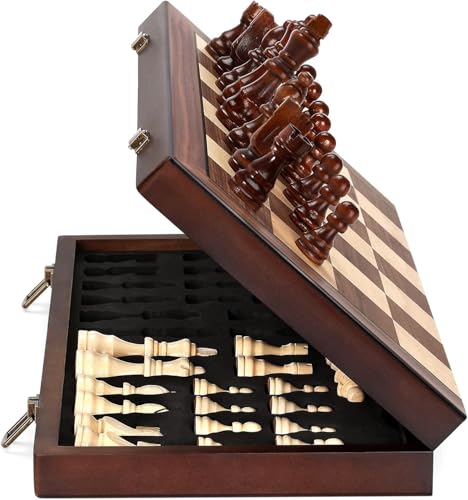
Magnetic 15-inch Wooden Chess Set (Portable Folding)
 Rinten Magnetic 15" Wooden Chess Set
-
17-inch Large Folding Wooden Chess Set (Weighted Acrylic Pieces)
 Metal Chess Set for Adults
-
Magnetic Wooden Chess Set 17-inch
 17" Magnetic Wooden Chess Set for Adults Kids
How Material Changes the Rhythm of a Real Game
Most comparisons stop at looks, but the material quietly changes how a game unfolds minute by minute. With marble, every move tends to be a little more deliberate. You lift a piece, feel its weight, set it down, and hear that contact with the board. That small pause can be pleasant in a slow, thoughtful game at home, where the ritual is part of the enjoyment. It can also become tiring when you are replaying a long opening line over and over, resetting pieces many times in one study session, or playing a series of quick friendly games where pieces move constantly.
Wood usually keeps the rhythm lighter. Pieces are quicker to pick up, quicker to reset, and kinder when you are setting up the same position again to try a different idea. If you like to work through variations on a physical board rather than on a screen, that ease adds up. You are more likely to actually do the extra repetition, try one more line, and put the board away properly afterwards, simply because none of it feels like heavy work. Over months of regular play, that convenience often matters more than the first impression the set made when you unboxed it.
Think, too, about who sits on the other side of the board. A guest who plays once a year may enjoy the novelty of stone and treat every move gently. A regular partner who plays fast, laughs, knocks a piece over now and then, and reaches across the board for captured pieces is a different test. Wood forgives that kind of relaxed, social play. Marble asks everyone at the table to slow down and be careful, which suits some households and quietly frustrates others.
Captured pieces deserve a thought as well. In a lively game, taken pieces collect beside the board, sometimes in a loose pile. Wooden pieces resting against each other rarely come to harm. Stone pieces piled together can chip at thin edges and fine points, especially the more delicate shapes. If you choose marble, give captured pieces a tray, a cloth, or simply a little breathing room on the table. That one small habit prevents a surprising share of the damage owners later regret.
Finally, consider game length honestly. A short casual game asks little of your hands and eyes either way. A long session, with analysis afterwards, asks a lot. Heavier pieces, louder contact, and a glossier board all add small amounts of effort that compound over an evening. Lighter pieces, a softer sound, and a calmer surface tend to disappear into the background, leaving your attention on the position itself, which is where most players want it.
Learning, Practising and Analysing on Each Material
If you are learning chess, or helping someone else learn, the board is a teaching tool, and the material affects how well it teaches. Beginners need to recognise pieces instantly, see the whole position clearly, and handle pieces without worrying about them. That is why the earlier advice in this guide favours clear Staunton shapes, strong contrast, and a board with coordinates. Both materials can meet those needs, but wood meets them with less risk attached, so a learner can focus on the game instead of on being careful.
Practice habits are repetitive by nature. You set up a position, play it out, reset it, and play it again. You slide pieces around while you think out loud. You move a piece, take the move back, and try another. On wood, all of that is unremarkable everyday use. On marble, the same routine means many more lifts, placements, and small contacts between hard surfaces. Felt bases help a great deal, and gentle handling helps more, but the basic point stands: a study set earns its keep through thousands of small movements, and the more forgiving material handles that workload with less wear on both the set and your patience.
Analysing a finished game is a different kind of session. Here marble can genuinely shine for adults who enjoy it. The game is over, the pace is slow, and there is pleasure in rebuilding the key position on a beautiful board and talking it through. Nothing about analysis requires speed, so the weight that felt like a drawback during fast play becomes part of a calm, deliberate review. If your chess life is mostly quiet analysis and occasional slow games at home, the balance of pros and cons shifts noticeably toward stone.
For children learning the game, add one more consideration: ownership and confidence. A child who is afraid of breaking an expensive or fragile piece plays hesitantly, and hesitation is the enemy of experimentation. A sturdy wooden set invites a child to try moves, set up puzzles, and even invent little training games with the pieces. That freedom to experiment is worth more, in learning terms, than any difference in appearance between the two materials.
Whichever material you choose, build one simple study routine around it. Keep the set somewhere it can be reached without unpacking half a cupboard, keep captured and spare pieces together, and leave the board ready for a quick position whenever you have a spare few minutes. The best practice set is the one that is actually out and in use, and ease of handling is what keeps a set out.
Sound, Light and the Room You Play In
Chess is a quiet game, but the set itself makes noise, and the room decides whether that noise is charming or annoying. Marble on a hard board in a bare room with hard floors produces a distinct, carrying click. In a study or living room during the day, many people like it. Late in the evening, in a flat with thin walls, or beside someone trying to read or sleep, the same sound can become the reason the set stops being used. Felt bases soften the contact considerably, so if you love stone, treat good felt as essential rather than optional, and check it regularly as described earlier in this guide.
Wood is naturally quieter, and on a wooden or inlaid board the sound of a move is more of a soft tap. That makes wooden sets easier housemates for shared spaces: family rooms, classrooms, libraries, and club halls where several boards are in use at once. In a room full of games, the combined noise of many hard sets would be genuinely distracting, which is one practical reason group settings lean so strongly toward wood.
Light deserves the same room-by-room thinking. A polished stone board under a bright overhead light can throw reflections right where you are trying to read the position, while the same board in soft, indirect light looks rich and calm. A satin wooden finish is more forgiving across different lamps and times of day. Before you commit to a glossy set, picture exactly where it will sit: near a window with strong afternoon sun, under a single bright ceiling light, or in a corner with a warm lamp. The guide above already advises testing under your usual lighting, and it is worth repeating because glare is one of the most common reasons a beautiful set disappoints in daily use.
Temperature and comfort play a smaller part. Stone feels cool to the touch, which some players enjoy and others find chilly during long winter sessions. Wood quickly feels neutral in the hand. Neither point should decide a purchase on its own, but if you play long games in a cold room, it is another small vote for the material that disappears into the background while you think.
Comparing the Wooden Picks in This Guide With Marble in Mind
The wooden sets listed in this guide are useful reference points even if you arrived here leaning toward marble, because they show what everyday playability looks like in practice. Each of them was chosen for folding, portable wooden play, and comparing them against a typical marble set clarifies what you gain and give up with each direction.
The Magnetic 15-inch Wooden Chess Set, described in this guide as a portable folding set, represents the travel-friendly end of the wooden range. Its appeal is that it folds, moves easily, and uses magnetism to help pieces stay in place, which is the opposite experience from a heavy stone set that anchors itself to one table. If your games happen in more than one place — a kitchen table one day, a garden or a friend’s house the next — this is the kind of set that actually comes along. Choose this direction over marble if portability and quick setup matter more to you than a formal, stay-in-place presence.
The 17-inch Large Folding Wooden Chess Set, listed here with weighted acrylic pieces, sits closer to a home set while still folding away. The larger board gives pieces more room, which helps reading the position and suits players who find smaller boards cramped, while the weighted pieces address the one advantage marble usually claims, namely a settled, stable feel on the board. If you like the idea of weight but worry about chipping, noise, and carrying a stone set, a larger weighted wooden set like this is the natural middle path to consider. Skip it only if you specifically want the cool, polished character of real stone and are happy for the set to live permanently on one table.
The Magnetic Wooden Chess Set 17-inch combines the larger size with the magnetic, folding format. Compared with marble, it trades heft and formality for steadiness in transit and convenience in storage: pieces that hold their place when the board is moved, and a set that folds rather than demanding a dedicated display spot. For families, that combination is often the deciding one, because a set that stores easily is a set that survives busy household life. Choose marble instead only when the set is genuinely for calm adult play in one room, and choose this kind of wooden set when the same board must serve learners, guests, and everyday games.
None of these wooden options tries to imitate the look of stone, and that honesty is part of their value. They are built around being handled, folded, carried, and played often. Marble is built around being admired and played carefully. Naming which of those two jobs you are actually hiring the set to do is the simplest way to choose between the picks above and a stone alternative, and it prevents the common regret of buying a display set for a playing life, or a plain playing set for a display spot.
Storage, Moving House and Living With the Set Long Term
A chess set is a long-term household object, and the years matter as much as the first month. Storage is where the two materials diverge most in daily life. A wooden folding set, or a wooden set in a padded box, can go in a drawer, on a shelf, or in a cupboard without ceremony. A marble set needs its storage thought through: pieces separated so hard surfaces do not knock together, a box strong enough for the weight, and a shelf that can comfortably bear that weight without bowing. None of this is difficult, but all of it must actually happen every time the set is put away, or chips accumulate quietly.
Moving house brings the difference into sharp focus. Wooden sets travel well with ordinary careful packing. Stone sets need individual wrapping, padding between pieces, and a box you can lift safely, and even then the move is the moment when most damage happens. If you move often, lend your set to others, or expect the set to travel between homes — for example between parents, or between a home and a holiday place — treat that as a strong practical argument for wood.
Long-term appearance changes differ, too. Wood tends to develop a gentle patina and may pick up small dents that most owners read as character, especially on a set that has hosted years of family games. A good finish, kept away from damp and direct sun as this guide advises, keeps it looking warm rather than worn. Marble keeps its polish when it is protected, but chips and dull patches from acidic spills are harder to forgive, because they interrupt the smooth, formal surface that was the reason for choosing it. In other words, wood tends to age gracefully under honest use, while marble rewards protection and punishes neglect more visibly.
Completeness is the quiet long-term risk for both. A lost or broken piece can spoil a set, and replacements rarely match perfectly. Reduce the risk with habits rather than hope: always return pieces to the same box or tray, count pieces back in after games with children or guests, keep any spare queens and extra pieces the set came with in the same place, and ask about replacement availability before you buy, as the checklist above suggests. A set that stays complete stays playable, whatever it is made from.
Finally, think about who inherits the set, in the everyday sense. A wooden set bought for yourself may become the set your children learn on and your guests play on, precisely because nobody is precious about it. A marble set may stay a personal, admired object that comes out for particular occasions. Both are perfectly good lives for a chess set. Just buy for the life you actually expect, not the one in the product photograph.
A Simple First-Week Test for Any Set You Buy
Whichever material you choose, use the first week to test the set properly while returns are still straightforward. Start with a full game at your normal pace, on the table and under the lighting where the set will usually live. Notice whether you can read every square at a glance, whether reflections force you to shift position, and whether the sound of the moves settles into the background or keeps drawing your attention.
Next, run a practice session. Set up the same position several times, play it out, reset it, and try again. This is the test that reveals handling truth: how the pieces feel after many lifts, whether bases slide or scrape, whether anything wobbles, and whether resetting the board feels easy or like a chore. A set that passes a single game can still fail this session, and this session is the better picture of your life with the set if you study at all.
Then test the household realities. Put the set away and get it out again the next day, timing nothing but noticing the friction: the weight of the box, the space it needs, whether pieces stayed separated, and whether getting set up felt inviting. If children or guests will use the set, watch one relaxed game and see how the set handles dropped, stacked, or hurriedly moved pieces. You are not trying to damage anything; you are learning whether normal life and this set are compatible.
Check the details from the buying checklist while you can still act on them. Run a finger over piece bases to confirm the felt is complete and firmly attached. Stand the tallest pieces on the board and tap the table gently to see how they settle. Confirm the board lies flat, that folding hinges align the squares if it folds, and that the colours of pieces and squares stay clearly distinct in both daylight and evening light. Photograph any flaw that arrived with the set before you play further, so you can describe it accurately if you contact the seller.
End the week with the only verdict that matters: did you play more, or less, than you expected? A set that invites play — easy to reach, pleasant to handle, calm to look at — is the right set, even if another option looked finer in photographs. A set that you hesitate to unpack, worry about damaging, or find tiring to read has told you something important, and the first week is the cheapest time to learn it.
FAQ
Are marble sets good for children?
They can be, but a dropped piece may chip or hurt a toe. Many families prefer wood or plastic for younger players.
Can a marble set be used in a club or tournament?
Organizers usually expect standard-size pieces and a board that matches. A heavy decorative set may not meet event rules, so check with the organizer.
How heavy is too heavy for a chess set?
It depends on who plays. Adults used to heavy pieces may enjoy them, but children and long sessions favor lighter pieces. Handle a few pieces if you can before buying.
Do I need a matching board?
A matching board is the easiest way to get the right proportions. If you buy separately, compare king base and square size carefully.
Can marble stain?
Some stone can absorb liquids or react to acids, which may stain or dull the surface. Wipe spills promptly and check the maker's care advice.
Are weighted pieces important?
Weighted bases make pieces stand firmly and feel balanced. They are helpful for any material, especially for taller pieces.
What is a good size for beginners?
Choose pieces that are easy to grip and a board with clearly visible squares. Pieces that are too small or too crowded make learning harder.
Is a glossy finish bad for play?
Not necessarily, but glare can be tiring. Test the board under your normal lights, and choose a satin finish if reflections bother you.
How should I store a set for travel?
Use a padded case or box with separate sections. Avoid loose storage where pieces can knock together and chip or scratch.
Is a wooden chess set better than a marble one for beginners?
For most beginners, yes, because wood is lighter, quieter and more forgiving if a piece is dropped. The most important thing is clear piece shapes and a board with visible squares. Marble can work if the beginner is an adult who plays gently.
What is a Staunton chess set?
A Staunton set uses the standard piece design that most players and clubs recognize. The shapes are easy to tell apart, which helps reading the position quickly. It is the safest style to choose if you want to play seriously.
How big should the squares on a chess board be?
Squares should be a little larger than the base of the king, so pieces do not touch neighbors. A common rule is for the king base to fill about three quarters of a square. Check the dimensions on the listing before buying.
Why do chess pieces have felt on the bottom?
Felt protects the board from scratches and makes moves quieter. It also helps pieces slide smoothly instead of scraping. Replace worn felt so bare material does not damage the board.
How do you clean a marble chess set?
Wipe it gently with a soft, slightly damp cloth and dry it afterward. Avoid harsh cleaners and abrasive pads that can dull the finish. Check the maker's care advice, since stone can react to acids.
Can a wooden chess set warp?
Yes, especially boards, if they are stored in damp, very dry or hot places. Keep the set in a stable room away from direct sun and heaters. A good finish and a flat storage position help.
Do I need a chess clock?
Not for casual play, but a clock is useful for timed games and club events. If you plan to use one, make sure the table has room for the board and the clock. Choose a board size that leaves space.
Should I buy a second, cheaper set for travel and guests?
Many households do exactly that, and it works well. Keep the set you care most about — especially a marble set — for calm play at home, and use a sturdy wooden folding set for travel, guests, and games with children. That way no single set has to be both precious and hard-wearing.
Does a heavier set always mean better quality?
No. Weight helps stability when it sits low in the base, but quality also depends on proportions, finish, felt, and how clearly the pieces can be told apart. A well-balanced wooden set can play better than a heavy set with crowded squares or uneven bases.
How do I stop pieces sliding on a polished board?
Start by checking the felt on every base and replacing worn pads, since good felt grips gently and protects the surface. Keep the board clean and dry, place the set on a level table, and avoid bumping the table during play. If sliding persists, the board and piece bases may simply be a poor match.
Is it sensible to mix a wooden board with stone pieces, or the other way round?
It can work, but only if the proportions match: compare the king base with the square size, check contrast between pieces and squares, and make sure the board can bear the weight and the bases will not scratch its surface. Buying a matched set is simpler, and separate purchases need careful measuring.
What should I do the first time a piece is chipped or dented?
Stop the damage spreading first: keep the piece out of loose storage with the others, and check whether any sharp edge could scratch the board. Small marks on wood are often just cosmetic, while chips in stone are hard to hide, so ask the maker or seller about repair or replacement options rather than experimenting with harsh products.
How often should I check the felt on the bases?
Give the bases a quick look whenever you put the set away after a run of games, and a closer check every few months if the set is in regular use. Replace a pad as soon as it peels, thins, or leaves part of the base exposed, because exposed material is what scratches boards and makes moves noisy.
The Short Version
Marble gives a weighty, formal look and wood gives an easier, warmer everyday set. For a set you will actually play often, choose wood, and keep marble for home use where it will be handled with care.
Related Guides
- Wooden vs Plastic Chess Sets: Which Material Suits You?
- How to Refinish a Scratched Wooden Chess Board at Home
- How to Store a Wooden Chess Set So Pieces Do Not Warp or Crack
- 8 Best Folding Wooden Chess Sets for Adults and Kids (2026)
- Aimchess: Does Personalized Chess Training Actually Work?