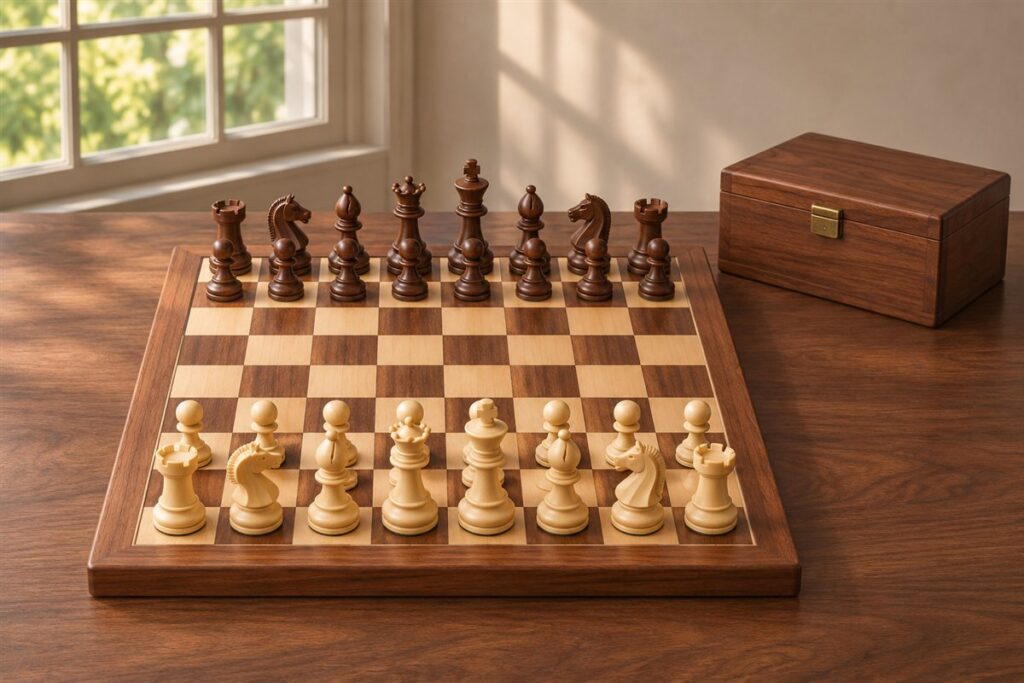
Themed chess sets such as brick-built boards, wizard-style figures and movie-inspired armies are fun to own, but only some of them end up in regular games. The sets that get played are usually the ones with pieces you can tell apart quickly and a board that stays put on the table. Confirm exact contents and dimensions on each maker’s page before you buy.
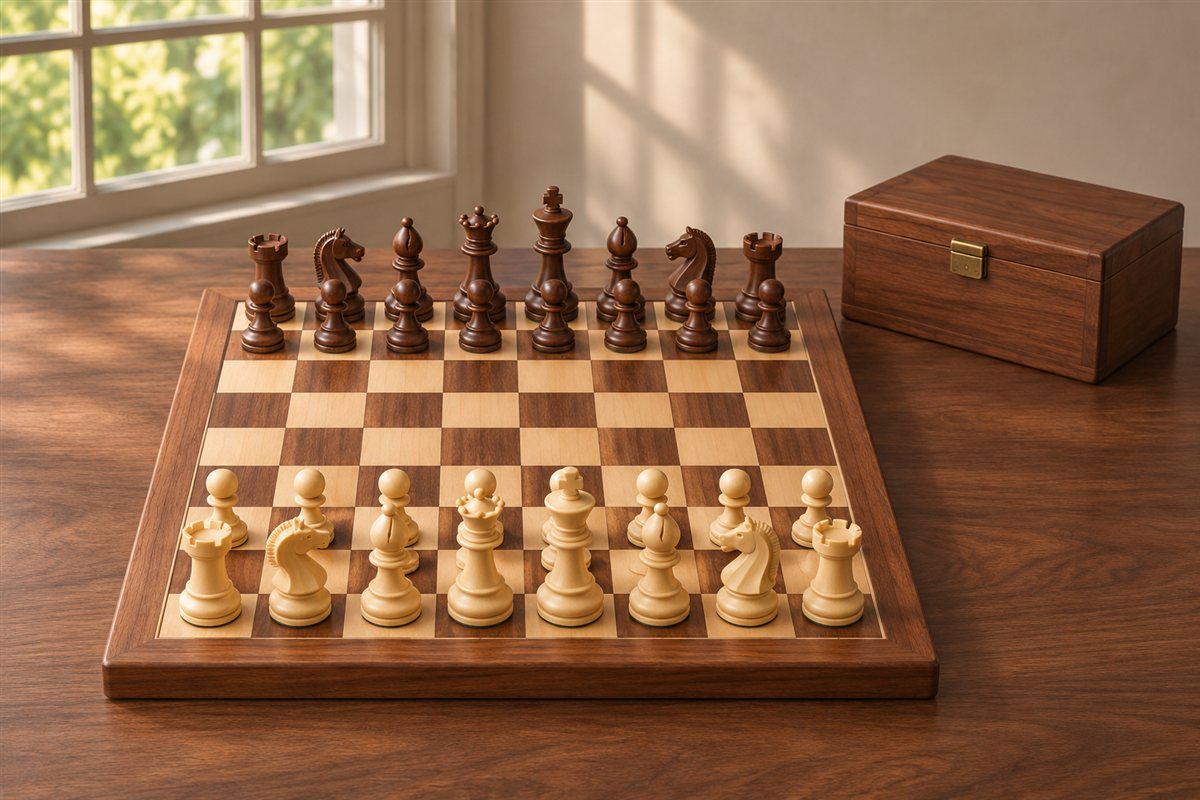
What Each Type Is For
Brick-built chess sets come as kits you assemble and then play with. The building is half the appeal, and the pieces are often small characters or blocky shapes. Wizard-themed sets use figures from a popular book and film series, usually sculpted to look like characters rather than classic Staunton shapes. The wider group of themed sets covers everything from medieval armies to superheroes and animals.
All three can work for casual play. The real question is whether the pieces stay readable when a game gets crowded.
What Decides Whether a Set Gets Played
- Readability: can you tell a bishop from a pawn at arm’s length? Character pieces with similar outlines cause mistakes.
- Piece weight and stability: very light pieces slide or tip when touched, which annoys younger players.
- Board size: squares should be large enough that each base fits with room to spare.
- Storage: sets that pack away quickly get used more often than sets that need rebuilding.
- Replacement: small pieces are easy to lose, so think about whether one missing piece would end the set.
- Audience: a child who loves the theme will play longer than one handed a plain set.
Side-by-Side Comparison
| Trait | Brick-built | Wizard-style | Other themed |
|---|---|---|---|
| Main appeal | Building the set | Familiar characters | Wide range of subjects |
| Readability | Depends on the kit | Often needs a learning period | Varies widely |
| Handling | Pieces can come apart | Sculpted details can be delicate | Varies |
| Typical use | Project plus play | Gift, shelf and light play | Casual and collector play |
These are general tendencies, not claims about any one product.
Who Should Choose Which
- Choose brick-built if the player enjoys building. The assembly gives the set a story, and rebuilding a lost piece is often possible with spare bricks.
- Choose wizard-style if the theme is the reason the child wants to play at all. Motivation matters more than perfect piece shapes.
- Choose another themed set when you want a particular subject, and look for a clear difference in height and shape between the king, queen and pawns.
- Choose a plain Staunton set if the goal is serious study, club play or tournaments.
A Quick Way to Judge a Set Before Buying
- Find a photo of the full set in its opening position and check whether you can name every piece.
- Look at the two sides. If both armies look alike apart from color, mix-ups are likely.
- Check whether the board is printed, folded or built, and how it stores.
- Read the maker’s description for piece count and board size, and confirm nothing is missing from the listing.
Why Sets End Up on the Shelf
Many novelty chess sets are bought with enthusiasm and then used only a few times. The reasons are usually practical, not about the theme. A set that takes ten minutes to arrange, whose pieces fall over, or whose armies are confusing will lose to a plain set that is ready to play in a minute. Looking at why sets are abandoned helps you choose one that stays in use.
The first cause is friction at setup. If pieces need to be rebuilt or posed carefully each time, only the most dedicated player will bother. The second is confusion mid-game. When two sides look nearly the same, or when the knight and bishop have similar silhouettes, players make mistakes and lose enjoyment. The third is fragility, where thin swords, wands or tiny parts break or vanish. The fourth is the board: a board that is too small, slides around or is hard to store becomes a nuisance.
- Ask whether the set can be reset in a couple of minutes.
- Check whether there is a place to keep it that is easy to reach, such as a shelf where it can stay set up between games.
- Think about the real players: a young child, a mixed-age family or two adults may all want different things.
The most useful test is to imagine an ordinary Tuesday evening. If someone says “let’s play a quick game” and the set is easy to open and use, it will be played. If the answer is “it takes a while to set up,” it probably will not be. That test is more reliable than the appeal of the theme in a product photo.
Piece Design and Board Legibility
Chess is a game of recognising pieces at a glance, and themed designs make that harder. Standard Staunton shapes are used because their silhouettes are distinct: the knight has a clear head, the bishop a slit mitre, the rook a battlement. Character pieces swap those cues for faces and costumes, which are fun but not always easy to read from across a table.
When looking at a themed set, check these points in photos of the full set at game start.
- Height ladder: the king should be visibly tallest, then queen, then bishop, knight and rook, with pawns clearly smallest.
- Silhouette: cover the details with your hand and see whether the outlines still differ.
- Colour contrast: the two sides should be separated by strong contrast, not by tone differences only visible in good light.
- Base size: bases should be wide enough for stability but fit comfortably inside a square.
The board matters as much. Squares need enough contrast to tell light from dark in dim rooms, and a printed or built board should lie flat. Folding boards need to open fully without a bump in the middle. If pieces are decorative and the board is tiny, the pieces will crowd and topple. A themed set with a larger board often plays better than one with a beautiful board that is cramped.
For brick-built sets, confirm how the pieces connect to the board. Studs or plates that hold pieces in place are useful for younger players, while loose pieces are more convenient for fast play. Read the maker’s description for what is included, as board size and piece counts vary between products.
Matching a Set to the Age of the Player
The same set can be perfect for one child and a disappointment for another. Age and experience change what matters most. For a child who is just learning the moves, motivation is the priority. A familiar character on each piece can make the pieces memorable, and some children enjoy telling stories as they play. At this stage a set that makes the child want to open the box is more valuable than perfect chess shapes.
For children who are starting to play seriously, the balance changes. They benefit from seeing standard shapes, because books, apps and online boards all use them. Moving to a standard set when interest grows is a normal path, and the themed set can stay for casual games with friends.
- Younger children: choose sturdy pieces, avoid tiny detachable parts that could be a hazard, and check the maker’s age guidance on the listing.
- Older children and teens: look for a set that matches an interest, but still reads clearly for longer games.
- Adults: themed sets work well as display pieces and for social games, but check comfort of handling for longer sessions.
- Mixed families: a board with large squares and clear height differences works across ages.
Also think about care. Brick-built pieces can be pulled apart by curious hands, and sculpted figures may chip. If the set will be played by several children, durability and easy replacement matter more than fine detail. Whatever the age, a short first game with a new set tells you quickly whether the pieces will cause confusion.
Care, Storage and Keeping the Set Complete
A set that is complete and tidy gets used. Losing one pawn from a themed set can be difficult to fix because replacement pieces may not be sold separately. Before buying, think about how you would handle a missing piece. A brick-built set may let you substitute spare bricks, while a sculpted figure usually cannot be replaced. Some families keep a spare pawn from a different set, and a coin or token works as a temporary stand-in.
Storage is the practical key. A box with fitted compartments, or a bag that keeps each side separate, makes cleanup quick. Sets that stay assembled on a shelf are convenient but collect dust, which you can remove with a soft dry cloth. For painted or detailed figures, avoid harsh cleaners and check the maker’s care guidance.
- Count pieces after every game for the first few weeks, until the habit sticks.
- Keep small parts away from very young children and pets.
- Store folding boards flat rather than rolled or bent.
- Keep the original box if it is sturdy, so the set travels well.
If you give the set as a gift, mention how to rebuild or store it, and keep the instructions where the recipient can find them. A small amount of care keeps the set looking good and ensures that the next family game night starts with every piece present and the board ready.
Budget Tiers and What to Expect
Themed sets span a wide range, and what you pay for is not always playability. In the lower tier, you generally get lighter pieces, simpler printing and a basic board. These can work well for casual play, especially for children, but check that the pieces are stable and that markings are clear. In the middle tier, expect better materials, a larger board and more detail. At the higher end, sets are often aimed at collectors, with more elaborate sculpting that suits display more than daily play.
Instead of price alone, use a list of questions to compare options.
- Is the board large enough that the biggest piece fits within a square with room to spare?
- Do the pieces have weight or a base that keeps them upright?
- Does the maker describe the contents clearly, including piece count?
- Is there a straightforward return policy if the set arrives damaged or incomplete?
- Could you play a full game without the pieces blending together?
It also helps to separate two goals. If you want a display piece, spend on appearance and accept that it will be played gently. If you want a set for daily games, prefer sturdiness and clarity over fine detail. If you want both, consider owning a plain set for serious play and a themed set for fun, which costs less than a single elaborate collector’s item and gives you the best of each.
FAQ
Are themed sets fine for learning chess?
Yes, for casual learning. A child who is excited by the pieces will practice more. Later, switching to a standard Staunton set helps with the shapes used in books, videos and tournaments.
Can themed sets be used in tournaments?
Events usually expect standard pieces, so check the rules of the organizer. Themed sets are better suited to home, family and casual club play.
Are brick-built chess sets sturdy enough for regular play?
It depends on the design and how the pieces are connected. Check whether pieces are held on studs and read the maker's description for age guidance and contents.
Will my child learn chess properly on a themed set?
Yes, the rules are the same. The main difference is that piece shapes will not match books and apps, so moving to a standard set later is helpful.
How can I tell if two armies are too similar?
Look at a photo of the starting position and cover the colours. If you cannot tell which pieces are the king and queen, or the bishop and knight, confusion is likely.
What board size should I look for?
Choose squares comfortably larger than the base of your biggest piece. Check the dimensions on the listing, since sizes vary between products.
Can I mix pieces from different sets?
You can for casual games if the pieces are similar in size and the squares fit them. Mixing is not suited to formal events.
Is a themed set a good gift for a beginner?
Often yes, because enthusiasm for the theme keeps players coming back. Pair it with a simple rules sheet or a beginner guide.
What should I do if a piece goes missing?
Check whether the maker sells replacements, and use a coin or a spare piece in the meantime. For brick-built sets, spare bricks may be enough to rebuild it.
The Short Version
A themed set gets played when its pieces are easy to read, stable on the board and loved by the player. Choose brick-built for builders, wizard-style for fans and a plain Staunton set for serious practice, and confirm the details on the maker’s page.