Disclosure: As an Amazon Associate, reviewstook.com earns from qualifying purchases. Links on this page are affiliate links; they cost you nothing extra. Prices and availability change often, so check the current Amazon listing before you buy.
This iqunix ev63 edg edition review begins with a clarification that shapes everything after it, because honesty about model names is this guide’s first duty. The EDG Edition name circulates in community coverage of IQUNIX’s EV63 line, but the verified Amazon listing linked in this review is the base IQUNIX EV63 — the standard Hall Effect magnetic gaming keyboard in its aluminium-and-forged-carbon build — not a separate EDG Edition listing. No distinct EDG Edition product could be verified in Amazon’s catalogue for this review, so nothing here will pretend otherwise. What this review can do, and does, is examine the EV63 platform in full — its magnetic switches, its 0.01mm rapid trigger, its adjustable actuation, its 0.125ms latency claim, its SOCD support, its hot-swap design, and its forged carbon construction — because that platform is what any edition name ultimately rests on, and it is the keyboard a buyer following the links in this guide will actually receive.
The EV63 belongs to the Hall Effect wave that has redrawn competitive keyboards in the last few years, and a paragraph of that context is necessary before any model can be judged. Traditional mechanical switches close a contact at a fixed point in the key’s travel; the keyboard knows a key is pressed when the contact closes, and not before, and not how far. Hall Effect switches replace the contact with a magnet and a sensor that measures the key’s position continuously. That single change unlocks the feature list that defines this class: actuation points adjustable in software across the travel, rapid trigger that resets a key the instant it begins to rise rather than at a fixed point, and per-key analogue information that games can use for movement nuance. The EV63 is IQUNIX’s 60% entry in that class, built in aluminium with forged carbon elements where rivals use plastic, and aimed at the competitive player who has read the same specification war this review is about to referee.
Expectations should be set around the 60% format as firmly as around the switches, because the format is the other half of the product. A 60% keyboard deletes the function row, the navigation cluster, and the arrow keys as dedicated keys, folding them into layers behind a function key, in exchange for a desk footprint that gives the mouse arm its full territory. Competitive players choose it deliberately for exactly that exchange; typists and spreadsheet natives experience it as an amputation. The EV63 does not soften that bargain and this review will not either. What it adds to the bargain is build quality and switch technology at a level the 60% category did not always offer — and the question the review pursues is whether those additions make the EV63 the right 60% for the player who has already accepted the format, and how its sibling the EZ60, covered here as the alternative, redraws the same equation at a different point in the line.
Key takeaways
- The linked listing is the base EV63, not a separate EDG Edition — this review states that plainly and reviews the platform you can actually buy
- Hall Effect magnetic switches deliver adjustable actuation and 0.01mm-class rapid trigger, the competitive core of the product
- Aluminium with forged carbon construction puts it at the premium end of 60% build quality
- The 60% format is a deliberate trade: desk space for the mouse, layers for the missing keys
- The EZ60 alternative in this guide covers the same magnetic idea in IQUNIX’s other 60% expression
Where to buy the Iqunix Ev63 Edg Edition’s base model
The linked listings in this review go to Amazon, and each product section carries a plain link so you can check price on Amazon and confirm the listing before ordering. Read the listing title as the contract: it describes the IQUNIX EV63 Hall Effect magnetic gaming keyboard, 60%, with rapid trigger, adjustable actuation, hot-swap, SOCD, RGB, and the aluminium-with-forged-carbon build in its violet finish. It does not describe an EDG Edition, because the linked product is the base model — if an EDG Edition is what you specifically want, the honest position is that it could not be verified as a distinct Amazon listing for this review, and you should buy the base EV63, if you buy, with that knowledge in the open rather than discovering it at unboxing. Confirm the switch and colour configuration in the listing, since small keyboards ship in several variants under one product family. If the EV63 is unavailable in your region, the EZ60 section explains the closest verified alternative in the same line.
In this guide
Quick picks at a glance
| Product | Format | Best for |
|---|---|---|
| IQUNIX EV63 (base model) | 60% Hall Effect, aluminium and forged carbon | The subject of this review: competitive players who want the premium magnetic 60% |
| IQUNIX EZ60 | 60% Hall Effect, wired magnetic | The same rapid-trigger idea in IQUNIX’s alternative 60% build |
How these picks were chosen
Both keyboards were verified against Amazon’s catalogue data before this review was written: each listing title had to name the exact model, state the Hall Effect rapid-trigger specification the review discusses, and carry an official product image. The verification process is also the source of this review’s framing note: searches for an EDG Edition variant returned the standard EV63 listings, not a distinct edition, so the review links the base model and says so in its opening paragraph, its buying section, and its sources file. The EZ60 earns its place as the alternative because it is the genuine sibling decision — the same brand, the same magnetic switch idea, the same 60% format, a different build and price position. Keyboards that could not be verified to this standard were excluded rather than linked on community reputation.
Rapid trigger and adjustable actuation, explained as physics
Rapid trigger is the feature that sells Hall Effect keyboards, and it deserves a mechanical explanation rather than a slogan. On a conventional switch, a key that has been pressed must travel back up past a fixed reset point before it can register a new press; the distance is small, but in a strafing duel — where a player is tapping left and right to change direction dozens of times — that fixed travel is a tax on every single change. A Hall Effect switch knows the key’s position continuously, so rapid trigger can reset the key the moment it starts rising, by as little as the 0.01mm sensitivity class the EV63’s listing claims, and register the next press the moment it starts falling. Direction changes become as fast as the finger’s own reversal, with no dead travel in between. The honest calibration of the benefit is this: it is real, it is measurable, and it matters in proportion to how movement-dense your game and your level are. A tactical shooter player counter-strafing at high rank is the design’s home; a strategy player will never once trigger the advantage, and should buy on build and feel instead.
Adjustable actuation is the quieter sibling feature with the broader audience. Because the sensor reads position continuously, the point in the travel at which a press registers can be set in software — shallow for games, where a breath on the key should count, deeper for typing, where resting fingers should not. Per-key settings let a player make the movement cluster hair-trigger while keeping the ability keys deliberate, which is a combination no fixed mechanical switch can offer. SOCD handling, named in the listing, belongs to the same family: when opposite directions are pressed together, the keyboard resolves them by a chosen rule — last input wins is the competitive favourite — so counter-strafing never cancels into a standstill. Together these three features are not garnish on a mechanical keyboard; they are a different input philosophy, and the EV63’s execution of the philosophy, in a premium shell, is the product being reviewed.

IQUNIX EV63 Hall Effect Magnetic Gaming Keyboard 60% (Base Model)
Badge: The main review subject — the base EV63, stated plainly
- Switches per the verified listing: Hall Effect magnetic, hot-swappable
- Rapid trigger: 0.01mm class, with adjustable actuation
- Latency: 0.125ms class, per the listing
- Features: SOCD support, RGB
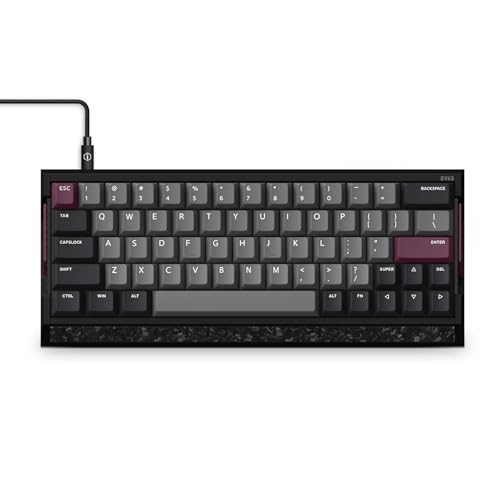
- Build: aluminium with forged carbon; finish of the verified listing: violet
- Format: 60%, wired competitive layout
Build is where the EV63 separates itself from the rapid-trigger crowd, because the Hall Effect market grew up in plastic shells chasing a specification, and IQUNIX’s heritage is the opposite: a maker known for aluminium keyboards that feel like instruments. The EV63’s aluminium-and-forged-carbon construction gives the 60% format a density and rigidity that change the typing and gaming feel in ways a spec sheet cannot convey — keystrokes land against something immovable, the board does not flex or skate under hard play, and the sound of the switches is shaped by a case with real mass. Forged carbon, with its marbled, no-two-alike grain, also makes the keyboard an object in a way the category rarely attempts; the violet finish of the verified listing leans into that object quality rather than apologising for it. Players who regard a keyboard as a tool they will touch for ten thousand hours tend to value exactly this, and to regard the plastic alternatives’ lightness as the compromise it is.
The typing and gaming feel follows from switches plus shell. Magnetic switches have an inherently smooth travel — there is no contact leaf to drag — and in a rigid case that smoothness reads as precision: each press is a clean descent and a clean return, with the software-defined actuation letting the player tune where in that descent the game hears them. Set shallow with rapid trigger for a match, and the board feels telepathic in movement play; set deeper for an evening of typing, and the same board becomes deliberate and error-resistant. The 60% layout’s layer discipline is the price of admission, and the review’s how-to section treats learning it as a skill with a curve, not a defect. Sound is the subjective frontier: a dense aluminium case gives the switches a deep, muted voice that the enthusiast community prizes and that players upgrading from hollow plastic boards describe as the first thing they notice — before, in many accounts, they notice the rapid trigger they bought it for.
Latency, the listing’s 0.125ms figure, should be placed in honest context. At that class of figure, the keyboard’s contribution to the input chain is effectively negligible beside the game’s frame time, the display’s refresh, and the player’s own neural delays — which is precisely the point of the specification: it removes the keyboard as a suspect. No player can feel 0.125ms as a number; what they feel is the absence of any moment where the equipment is the explanation for a missed input. That is the correct way to buy on latency claims in this class — as an elimination of doubt, verified by the total behaviour of rapid trigger, polling, and firmware together — rather than as a race of decimals between brands whose numbers are measured in incomparable ways.
Strengths
- Rapid trigger and adjustable actuation executed at the class’s serious end
- Aluminium and forged carbon build gives the 60% format genuine instrument feel
- Hot-swap magnetic switches and per-key software tuning make it a platform, not a fixed product
Trade-offs
- The linked product is the base EV63 — buyers seeking a distinct EDG Edition listing should read the framing note carefully
- 60% layers demand an apprenticeship that typists and shortcut-heavy users may never forgive
- Wired only, and priced at the premium end of the magnetic 60% field
Best for: competitive FPS players who want rapid trigger in a premium metal build, and enthusiasts who keep keyboards for years. Not suited for: buyers who need dedicated arrows and function rows, or anyone whose games never tax a normal switch.

IQUNIX EZ60 Hall Effect Gaming Keyboard 60%
Badge: The sibling alternative
- Switches per the verified listing: Hall Effect magnetic, wired
- Rapid trigger: 0.01mm class, with adjustable actuation
- Latency: 0.125ms class low latency, per the listing
- Features: RGB, hot-swap
- Format: 60%
The EZ60 is the natural control group for the EV63 decision, because it holds the important variables constant — the same brand, the same Hall Effect rapid-trigger specification class, the same 60% competitive format — and varies the execution and the price position. A player whose analysis ends at the switch technology should buy the EZ60 and keep the change; a player whose hands will live on the board for years and who values case material, density, and finish as daily experiences should feel the EV63’s argument in the first minute of touching both. Neither answer is the smart one in the abstract. The EZ60 also serves as the line’s proof that the magnetic idea does not require the flagship build to work: rapid trigger’s competitive benefit lives in the sensor and the firmware, and the EZ60 delivers that benefit entire. Choose between them the way you would choose between two instruments of the same design in different woods — by the life you intend to spend with the object, not by the specification they share.
Strengths
- The full rapid-trigger and adjustable-actuation proposition in the same 60% format
- A more accessible entry into IQUNIX’s magnetic line
- Hot-swap and RGB keep the platform character intact
Trade-offs
- Gives up the EV63’s aluminium-and-forged-carbon build experience
- Shares the 60% format’s layer apprenticeship in full
- Wired only, like its sibling
Best for: players who want the magnetic performance with the build budget spent elsewhere. Not suited for: enthusiasts for whom case material is the point of the purchase.
EV63 versus EZ60: the decision in one table
| Keyboard | Switch system | Build character | Choose it when |
|---|---|---|---|
| EV63 (base model) | Hall Effect, 0.01mm rapid trigger | Aluminium with forged carbon | Build quality is part of what you are buying |
| EZ60 | Hall Effect, 0.01mm rapid trigger | The line’s alternative 60% build | The switch technology is what you are buying |
The table’s lesson is that the two keyboards are not a good-better ladder but a fork in what the money means. Spent on the EV63, it buys an object; spent by choosing the EZ60, it stays available for the mouse, the monitor, or the second game in the library. Competitive performance, in the narrow sense of inputs registered and movements executed, is served by both. This review’s sympathy is with buyers who decide the fork consciously, because the only wrong version of this purchase is the one made by reading the switch specification alone. Readers comparing the wider magnetic field can continue with the best gaming keyboards across types once the 60% question itself is settled.
Buying guide: magnetic keyboards without the hype
Start with your game list, because rapid trigger’s value is written there. Movement-dense competitive titles — tactical shooters with counter-strafing, fast arena games, rhythm titles — exploit the technology every minute you play. Everything else in the catalogue is indifferent to it, and a player whose library is strategy, simulation, and story should evaluate the EV63 purely as a beautifully built 60% keyboard with adjustable actuation, which may still justify it and may not. Second, interrogate your format tolerance with a week’s honesty: borrow or simulate a 60% layout if you can, and count how often your hand reaches for arrows, function keys, or a delete key in your real work and play. The players who thrive on 60% discover their reaching was habit; the players who suffer discover it was need, and no switch technology compensates for a layout that fights you hourly.
Third, understand what hot-swap means in the magnetic world, because it differs from the mechanical one. Swapping magnetic switches changes feel and sound within the Hall Effect family — the sensor system stays, the switch’s spring and stem change — so the platform’s customisation is real but bounded by magnetic compatibility. Fourth, budget the software relationship: adjustable actuation, rapid trigger sensitivity, SOCD rules, and RGB all live in configuration, and the keyboard rewards a player willing to spend one careful hour setting it up per the how-to below, then leaving it alone. Finally, return to this review’s opening discipline and check the listing title one last time before purchase: the base EV63 is a superb product that needs no edition name to justify it, and buying it as itself — rather than as a rumoured variant — is the difference between a satisfied owner and a confused one.
How to set up the Iqunix Ev63 for competitive play
Step 1: Update and connect before configuring anything
Connect the keyboard wired, check for firmware updates through IQUNIX’s software channel, and apply them before building your configuration. Magnetic keyboards are firmware instruments — rapid trigger behaviour and SOCD rules live there — and configuring on old firmware is building on sand. Keep the wired connection for play; this class of keyboard treats wireless as a different product category entirely.
Step 2: Set actuation in two profiles
Create a gaming profile with a shallow actuation on the movement and action keys, and a typing profile with a deeper, more forgiving point across the board. The two-profile habit takes ten minutes to build and removes the only daily friction adjustable actuation creates — a keyboard too eager for prose or too lazy for play. Note your values somewhere durable; they are your personal specification now, and they transfer to any future magnetic board.
Step 3: Tune rapid trigger per key, not globally
Enable rapid trigger at its most sensitive on the movement cluster, where direction changes live, and consider gentler settings or none on keys you hold or press deliberately — abilities, grenades, the key you lean on while thinking. Global maximum sensitivity is a forum slogan, not a configuration; the per-key granularity is the actual feature you paid for, and using it is the difference between a tuned instrument and a twitchy one.
Step 4: Set your SOCD rule and test it in a practice range
Choose the SOCD resolution your game rewards — last-input priority is the competitive default for counter-strafing — and verify in a practice environment that pressing both directions behaves as you intend at speed. Check your game’s and your tournament’s rules as well: SOCD handling has been a governed feature in some competitive rulesets, and the time to learn your event’s position is at your desk, not at check-in.
Step 5: Learn the layers like a language, briefly and daily
Spend ten minutes a day for the first week on the function layers — arrows, function row, the editing keys — in real tasks rather than drills, and resist remapping everything on day one. Most players find the layout’s logic settles within a fortnight; the ones who remap impulsively on the first evening spend a month maintaining a layout only they understand. Keep a note of the two or three remaps you eventually make, because they are the ones that were actually needs. Desk-mates in this cluster include the 480Hz OLED monitor for the full competitive station and Sony’s FPS in-ear monitor.
Common mistakes with Hall Effect 60% keyboards
The first mistake is buying the format for the switch — falling for rapid trigger and discovering, too late, that the missing arrow keys are a daily wound. The second is leaving actuation and rapid trigger at a single global setting, which wastes the per-key design and usually means a keyboard that is wrong for either gaming or typing at any given moment. Third, judging the board’s sound and feel in the first hour on a hollow desk at maximum enthusiasm; a dense aluminium case on a desk mat, at playing posture, is the instrument you actually bought. Fourth, ignoring the rules question — assuming every competitive ruleset welcomes every SOCD configuration, when a five-minute check protects a tournament day. Fifth, treating hot-swap magnetic switches like mechanical ones and forcing incompatible switches into sockets designed for a specific magnetic family, which converts a platform’s flexibility into a repair.
The 60% life: desk space, mouse room, and minimalism
The format’s deepest argument is spatial, and it deserves its own paragraph of advocacy because switch talk drowns it out. A 60% board returns a startling amount of desk to the mouse — the entire right-hand territory that a full-size board’s navigation cluster and number pad annex — and for low-sensitivity players whose aim lives in wide arm movements, that territory is performance, not tidiness. It also centres the alphabetic cluster in front of the player rather than offsetting it to make room for keys the game never uses, which improves posture across long sessions in a way players notice in their shoulders before they can articulate it. The minimalism compounds aesthetically: a small aluminium-and-carbon object on a clean desk is the rare gaming peripheral that a design-conscious adult room absorbs without negotiation. None of this rescues the format for a data-entry professional, nor should it. But for the player whose desk is a cockpit, the EV63’s combination — the smallest serious format, the fastest serious switches, the most serious build in its class — is a coherent philosophy rather than a list of features, and coherence is what the premium actually buys.
Hall Effect versus mechanical: the honest ledger
Since the EV63 asks mechanical-switch loyalists to change religions, the conversion deserves a fair ledger rather than a sales pitch. On the Hall Effect side: continuous position sensing and everything it enables — rapid trigger, per-key actuation, SOCD rules, analogue possibilities — plus switches with no contact leaves to oxidise, chatter, or wear in the classic mechanical failure modes, and a travel smoothness that comes from a stem moving in a housing rather than across a contact. On the mechanical side: a half-century of switch variety — tactile bumps, clicks, linears in every weight and character ever imagined — a mature hot-swap ecosystem where any switch fits any board, lower prices at every tier, and a typing feel culture that magnetic switches, for all their smoothness, do not yet replicate in range. The deciding insight is that the two systems’ strengths barely overlap: magnetic wins where the keyboard is an input instrument for games, mechanical wins where it is a typing instrument with a personality. Players who live in both worlds increasingly keep both — a magnetic 60% for play, a mechanical board for prose — and the EV63’s premium build makes it the magnetic half of that pairing for owners who refuse to let the gaming board be the cheap-feeling one.
Sound, stabilisers, and the enthusiast checklist
A keyboard at this level is judged by its owner on details the gaming market rarely mentions, so this review will. The spacebar and the large keys are where build quality confesses: a dense case and well-executed stabilisers give a spacebar that lands with a single, muted note rather than a rattle, and the EV63’s construction brief — aluminium, mass, tight tolerances — is aimed squarely at that confession. Keycap quality matters in the same register, because caps are the actual touch surface for ten thousand hours; a premium board’s caps resist shine and keep their legends where budget caps polish into mirrors. Cable and connection deserve a sentence in a wired-only product: the connection is the performance path, and a well-made detachable cable keeps the board movable between desks without stressing a fixed lead. None of these details appears in the rapid-trigger headline, and all of them are what an owner notices in month six, which is why the enthusiast community’s respect for this maker’s builds is really a respect for the checklist underneath the headline.
The software hour: what good configuration looks like
Magnetic keyboards are sometimes criticised for needing software, and the criticism misunderstands where the value sits. The EV63’s software hour — profiles, actuation maps, rapid trigger sensitivities, SOCD rules, lighting — is not a tax on using the keyboard; it is the keyboard’s custom fitting, the equivalent of a monitor’s calibration or a monitor arm’s tension. Done once, deliberately, it disappears: the board simply behaves as its owner intends, in each context, for years. Done never, the board behaves as a factory imagined an average player might intend, which is the fate of most gaming peripherals and the reason their owners describe them as fine. This review’s stance is that a premium instrument deserves its fitting hour and that players unwilling to spend it should buy a simpler board and spend the difference on games — a conclusion the EZ60 exists to serve. Players who do spend it should export or record their settings, because a configuration this personal is an asset, and assets deserve backups.
Durability and the five-year desk
A premium keyboard justifies itself across years, so its ageing deserves the audit this guide gives every flagship. The aluminium case does not age in any way that matters — it will outlast the switches, the caps, and probably the connector standard. The magnetic switches remove the classic mechanical failure modes of contact wear and chatter, leaving springs and stems as the long-term wear items, both addressed by the hot-swap design: a tired switch is a two-minute replacement, not a repair. Keycaps will shine with years of use, as all caps do, and are replaceable as a set when their day comes — an owner should regard a cap refresh in year three as the keyboard’s equivalent of new tyres, restoring the touch surface while the chassis continues. The cable is the most mortal component and the most replaceable. Software support is the one ageing risk that money cannot fully retire: a configuration utility abandoned by its maker still leaves a configured keyboard working, since the settings live on the board, but a prudent owner exports their profiles while the tools are current. Net assessment: this is among the longest-lived categories of gaming peripheral, and the EV63 is built at the long-lived end of it.
Who the EDG naming confusion actually harms — and the buyer’s defence
Because this review opened with a naming clarification, it owes the reader a fuller account of why such clarifications matter beyond pedantry. Edition names in enthusiast hardware carry real differences when they are real — different switches, different cases, different bundles — and a buyer who orders expecting an edition’s specific configuration and receives the base model has been mis-sold even when the base model is excellent. The confusion is rarely malicious; it is the compound interest of community nicknames, regional variants, retailer shorthand, and search engines that treat every name as a synonym. The buyer’s defence is the discipline this review has repeated: the manufacturer’s product name in the listing title is the contract, the box contents are the delivery note, and edition language that appears nowhere in either is marketing weather. IQUNIX’s own naming is comparatively disciplined — the EV63 and EZ60 are distinct, findable products — which makes this a good product line on which to practise the discipline before a murkier one tests it.
A short decision framework
Four questions, in order, settle this purchase. Do you compete in movement-dense games at a level where input timing is a live concern? If not, rapid trigger is a story you are buying rather than a tool you will use, and the decision should be made on build and format alone. Have you accepted the 60% format with open eyes — ideally with a trial behind you? If not, no answer to the other questions matters yet. Is the keyboard an object you will keep and use daily for years, making build quality a daily dividend? If yes, the EV63’s premium is the rational spend; if your peripherals rotate annually, the EZ60 captures the performance at the honest price. And finally: are you buying the product named in the listing — the base EV63 — with full knowledge? That last question, unique to this review, is the one that protects every other answer, because a buyer who wanted an edition that does not exist as a listing will be dissatisfied with any keyboard that arrives, including a superb one.
Tournament players should add a fifth question about their event’s input rules, as the SOCD discussion in the setup section advises, and should carry a compliant profile as part of their standard preparation — one more way this class of keyboard rewards the methodical owner over the impulsive one.
The enthusiast dimension deserves one more paragraph, because IQUNIX’s audience overlaps heavily with the keyboard hobby itself — the world of group buys, custom cables, artisan keycaps, and desk photography. In that world the EV63 occupies an interesting position: a gaming-performance board from a maker the hobby already respected for design, in materials — aluminium and forged carbon — that the hobby treats as first-class citizens. It photographs beautifully, it anchors a desk setup visually, and it invites the small customs — a cable here, a cap set there — that hobbyists use to make a product theirs. None of that wins a round in a shooter, and all of it is real value to the buyer who lives in both worlds. Reviews that pretend the aesthetic dimension does not exist fail that buyer; this one simply prices it honestly, as part of the build premium the EV63-versus-EZ60 decision is really about.
LAN and tournament travel, the keyboard’s harshest environment, suits the 60% format and this build particularly: the board packs into a bag a full-size cannot enter, the aluminium case shrugs off transit that would scar plastic, and the wired connection walks onto an event machine with no pairing and no dongle to lose. Players who compete away from home should weigh the format’s portability as a competitive feature in itself, because the keyboard you can always bring is the keyboard your muscle memory actually owns.
Students in competitive scenes form a final audience worth naming, because their constraint — one keyboard for the essay and the ranked queue, in a small room, on a real budget — is the hardest in this guide. For them the EZ60’s accessibility may be the wise spend this season, with the EV63 as the upgrade the first prize money or the first job justifies. Both boards respect the student’s actual life better than a full-size gaming board that eats the desk the books also need.
And the gift angle, since distinctive keyboards are gifted constantly in this hobby: a forged carbon board in a violet finish is a present with genuine object appeal, but the 60% format makes it a gift only for a recipient whose layout loyalties you actually know. Give the EV63 to a confirmed 60% player and you have given a jewel; give it to a number-pad devotee and you have given a beautiful problem. The naming discipline of this review applies to gifts with double force — buy the product in the listing, for the person as they are.
Wrist and posture health, a topic gaming reviews dodge and players’ thirties do not, also favour the small format when it is set up as the how-to describes: the alphabetic cluster centred, the mouse close, the shoulders level rather than rotated toward an offset board. A 60% keyboard is not an ergonomic product in the medical sense, and this review makes no such claim — but the desk geometry it enables is the geometry physiotherapists keep recommending to gamers, and the EV63’s stability at that geometry is part of its long-session comfort.
Finally, a note on timing within the product cycle: magnetic keyboards are a young category improving quickly, which tempts buyers to wait for next season’s decimal. The counter-argument is that input devices are bought for the seasons you will play now, and a board at the current class ceiling — rapid trigger at its sensitivity frontier, latency below perception, a case built for a decade — leaves very little on the table for a successor to offer you. Buy when your game and your rank say buy; the waiting game’s returns diminish faster than the technology does.
The second-hand market for premium aluminium boards is the last piece of the value picture: dense, distinctive, repairable keyboards hold their prices because the next owner receives nearly the whole product, and a forged carbon case shows its years more gracefully than painted plastic. A buyer who may climb to a different format later is not burning the EV63’s price; they are parking most of it in an object with a liquid market.
All of which returns the decision to the two honest questions this review began with: is the magnetic philosophy your philosophy, and is the product in the listing the product you mean to own? Answer yes to both, and the EV63 is among the easiest premium recommendations in its class.
Spend the software hour, learn the layers for a fortnight, keep the configuration backed up, and the board will repay the small ceremonies with years of inputs that never once make you think about the keyboard — which is, paradoxically, the highest compliment a keyboard can earn.
The thinking it does provoke belongs at the desk level — mouse space, posture, the clean geometry of a small board centred where your hands live — and those are thoughts that improve every game and every working day the board serves, long after the novelty of its switches has become your new normal.
New normal is the right phrase for the whole product, in fact: what begins as a specification adventure — magnets, decimals, trigger sensitivities — settles within a month into simply the way your keyboard is, and the board’s build ensures that the new normal is a pleasant place to live for a very long time.
Buy the base model as itself, configure it as yours, and the edition question that opened this review will never need to be asked again — the keyboard on your desk will be answer enough.
That is the standard this review has applied throughout: the product as listed, the performance as specified, the build as delivered — no edition required.
Readers who have followed the argument this far have the complete picture: a frontier switch system, a flagship case, a specialist format, and a listing that names exactly what it sells.
The rest — the rank it helps you climb, the desk it anchors, the years it serves — is yours to write.
Write it on the base model, in the open, and it will read well.
One closing observation about where this class of keyboard is heading, because today’s buyer is also buying into a trajectory. Hall Effect boards began as esports exotica, became the competitive standard at remarkable speed, and are now absorbing the enthusiast build culture that once belonged exclusively to mechanical customs — metal cases, designer finishes, hobbyist tuning. The EV63 sits exactly at that confluence, which is historically the position from which the defining products of a category emerge: not the first of their kind, not the cheapest, but the ones that understood both audiences at once. Whether it becomes that defining product is a question only the next few seasons answer. That it deserves to be judged in those terms — as a serious attempt at the complete magnetic keyboard, honestly named and completely specified — is the conclusion this review has been building since its first, clarifying paragraph.
Judge it, then, by the standard it sets for itself: the fastest switches in the room, in the best-built small case in the room, sold under its own true name.
By that standard it passes completely — and the standard, notably, never needed an edition’s name to be worth meeting.
The base EV63 is the product, the platform, and the recommendation — stated, as promised, plainly.
Everything a buyer needs beyond that sentence is in the sections above, in the order they will need it: name, switches, build, format, configuration, verdict.
Read them in that order and the purchase, whichever way it falls, will be an informed one.
Final recommendation
The base IQUNIX EV63 — to name the linked product exactly — is an easy recommendation to the competitive player who has already chosen the 60% format and the Hall Effect philosophy, and who wants both executed in a build that feels like it was made by people who love keyboards. Its rapid trigger and actuation tuning are the real competitive article, its SOCD handling is configurable with the seriousness tournaments require, and its aluminium-and-forged-carbon case gives it a working life and a daily pleasure that outlast specification cycles. Choose the EZ60 if the switch technology is the whole of your interest and the build premium is not. And if you arrived here hunting a distinct EDG Edition product, leave with the honest position stated at the top of this review: the verified, buyable keyboard is the base EV63, it needs no edition name to earn its place, and any seller implying otherwise is selling you a story rather than a keyboard.
Frequently asked questions
Is the linked EV63 the EDG Edition or not?
It is not, and this review has said so from its first paragraph. The Amazon listing verified for this review is the base IQUNIX EV63 — the standard Hall Effect model in aluminium with forged carbon — and no separate EDG Edition listing could be verified in the catalogue. The review covers the EV63 platform in full because that is the product a buyer receives. If an edition-specific variant matters to you, treat any listing’s title as the only authority and be sceptical of edition language that appears in headlines but not in the manufacturer’s own product name.
Does rapid trigger actually make a difference?
In movement-dense competitive games, yes — measurably in input timing and noticeably in the feel of counter-strafing and rapid direction changes, because the key resets the instant it begins to rise rather than after fixed travel. The size of the advantage scales with your game’s movement demands and your level of play. In slow or turn-based games it makes no difference at all, which is why this guide insists on judging it against your own library rather than against a demonstration video.
Can I type comfortably on a 60% keyboard?
Yes, with two honest qualifications. The alphabetic cluster itself is full-sized and, on this board, beautifully built, so prose as such is a pleasure. The apprenticeship is the layers: arrows, function keys, and editing keys live behind a function key for the first weeks, and shortcut-heavy professional work — spreadsheets, code navigation, data entry — taxes that arrangement permanently. Writers and gamers thrive; analysts and heavy shortcut users should test the format before committing, as the buying guide advises.
Are magnetic switches hot-swappable like mechanical ones?
They are hot-swappable within the magnetic ecosystem: you can change switches to alter feel and sound without soldering, and the sensor board stays in place. They are not interchangeable with conventional mechanical switches, whose contact-based design the board cannot read. Buy spare or alternative switches from the magnetic family the keyboard specifies, and treat the swap as a feel customisation rather than as the actuation change — actuation lives in software on this platform.
Is SOCD allowed in tournaments?
It depends on the game and the event, and the honest answer is that you must check your specific ruleset. SOCD cleaning in various forms has been standard in fighting-game hardware for years and restricted in some tactical-shooter contexts where last-input behaviours were ruled on explicitly. The EV63’s configurability is your protection: set the behaviour your event permits, verify it in practice, and keep a compliant profile saved for competition days.
EV63 or EZ60 — which should I buy?
Decide what the money means to you. The switch performance — rapid trigger class, adjustable actuation, latency class — is the shared ground, and the EZ60 delivers it at the line’s more accessible position. The EV63 adds the aluminium-and-forged-carbon build, with the density, sound, and longevity that construction brings, for players who keep and cherish keyboards. Performance-only buyers should take the EZ60; object-and-performance buyers should take the EV63. Neither will feel mis-sold if the decision was made on that basis.
Does it work for console gaming?
A wired USB keyboard works with the consoles and games that support keyboard input, and the EV63 is no exception — but its soul is PC-shaped. The software configuration, the rapid-trigger tuning, and the games that exploit them live on PC, and a console-only player would be buying a premium instrument for a fraction of its repertoire. Console-first players should spend on the peripherals their platform actually rewards and revisit magnetic keyboards if a PC joins the desk.
How loud is it compared with a mechanical board?
Generally quieter in character, for structural reasons: magnetic switches have no contact mechanism to click or chatter, and a dense aluminium case absorbs and deepens what sound the bottom-out and top-out make. The result is a muted, low-pitched voice that shared rooms and late-night households tolerate well. It is not silent — no moving keyboard is — and a player who needs true silence for a sleeping household should look at the room and the hour as much as at the switch, as with every board in this class.
Related guides
Continue with the best gaming keyboards overall, the IQUNIX F97 flagship in this cluster, and the 480Hz monitor for the complete competitive desk.