Disclosure: As an Amazon Associate, reviewstook.com earns from qualifying purchases. Links on this page are affiliate links; they cost you nothing extra. Prices and availability change often, so check the current Amazon listing before you buy.
The iqunix f97 is the keyboard that taught a generation of enthusiasts that a nearly full-size layout did not have to mean a full-size desk footprint — a 96% board that keeps the number pad, the function row, and the arrow keys while compressing the spaces between them into something barely wider than a tenkeyless. It comes from IQUNIX, a maker whose reputation rests on aluminium cases and design-led limited runs, and the F97 is among the models that built that reputation. This guide is written in a specific and openly declared situation: despite repeated checks, no exact-match Amazon listing for the IQUNIX F97 could be verified at the standard this site requires, so this article contains no purchase links for it at all. What follows is a prose-only guide — what the F97 is, what its layout philosophy means in daily use, who it suits, how to evaluate one wherever you find it sold, and what to verify before paying anyone for one. No other model is substituted as its subject anywhere in this guide.
That editorial situation deserves one more sentence of explanation, because it is also useful buying advice. IQUNIX sells through several channels — its own storefront, regional distributors, group-buy and limited-run events, and marketplace sellers of varying officialdom — and the F97’s availability has always moved in waves rather than in the steady stream of a mass-market product. A keyboard can be genuine, current, and desirable while being absent from any given marketplace at any given moment. The honest response to that absence is what this guide models: discuss the product completely, link nothing, and arm the reader to evaluate any listing they encounter elsewhere — including the possibility that a listing using the F97’s name is selling something else, which is the standing risk with sought-after enthusiast hardware.
Context for the product itself, then. The 96% layout — sometimes called the 980 layout after an earlier famous board — exists to answer a complaint every other layout provokes. Full-size boards waste desk width on bezels and spacing; tenkeyless boards delete the number pad that accountants, engineers, data workers, and simulation players genuinely use; 75% boards keep the function row but crowd the arrows into the main cluster. The 96% answer is compression without deletion: every key a full-size board offers, arranged in a tight block where the navigation keys nestle against the main cluster and the number pad sits directly beside it. The F97 wraps that layout in IQUNIX’s signature materials and finishes, which turned a layout exercise into an object of desire — and made it one of the boards that carried enthusiast design language into the wider market’s awareness.
Key takeaways
- The F97 is a 96% keyboard: number pad, function row, and arrows kept, bezels and wasted space removed
- This guide is prose-only by verification, not by omission — no exact-match listing could be confirmed, so nothing is linked
- IQUNIX’s aluminium build culture is the other half of the product’s identity
- The compressed layout has a real learning curve around the relocated navigation keys
- Buying one safely means evaluating channel, variant, and completeness with the checklist in this guide
In this guide
About buying the Iqunix F97 — read this first
There are no Amazon links for the F97 in this guide, deliberately. The verification standard applied across this site requires a listing whose title exactly matches the product, confirmed through Amazon’s own catalogue data with an official image, and the F97 did not meet that standard despite repeated searches — the catalogue returned other IQUNIX models and other brands, but not the F97 itself. Rather than link a neighbouring model and let a reader mistake it for the subject, this guide links nothing and says why. If you are shopping for an F97, the practical channels are the maker’s own storefront and its authorised distributors, where the model name, switch options, and finishes can be confirmed against the manufacturer’s own product page. Wherever you buy, apply the verification checklist in the buying guide below: exact model, exact variant, complete contents, and a seller whose returns process you have actually read. Enthusiast keyboards reward that discipline more than most purchases, because variant names in this hobby are dense and a single letter can separate two different products.
At a glance: what the F97 is
| Attribute | The F97’s answer |
|---|---|
| Layout | 96% — full key count, compressed footprint |
| Maker’s design language | Aluminium case construction and design-led finishes |
| Audience | Number-pad users who want their desk back |
| Availability character | Wave-based: storefront runs, distributors, and the secondary market |
| This guide’s links | None — prose-only, for the verification reasons stated above |
How this guide handles an unverifiable product
The approach taken here is the one this site applies whenever a product cannot be verified to its linking standard: the article is written from the product’s established public identity — its layout class, its maker’s documented design language, and the well-understood behaviour of its category — and it makes no claim that depends on a listing it could not confirm. No price is quoted, because no verified listing supplied one. No specific retail configuration is asserted as currently buyable, because availability in waves is the product’s known character. Where the guide discusses ownership, it discusses the durable things: layout ergonomics, build culture, maintenance, the secondary market, and the checks a buyer performs at any point of sale. Readers who find that restraint unusual are invited to consider the alternative — a page of confident links to products that are not quite this one — and to judge which page respects them more.
The 96% layout, examined key by key
Walk the board as a typist meets it. The alphabetic cluster is full-size and uncompromised, which is the layout’s founding promise: no shortened shift keys, no displaced punctuation, none of the small cruelties that compact boards inflict on touch-typists. The function row survives intact across the top, a row that 75% boards keep and 60% boards bury, and its survival matters to anyone whose software speaks in F-keys — developers, engineers, simulation and strategy players, and the entire population of workers whose muscle memory predates the layer era. The arrow keys and navigation keys are where the compression shows: they are present, dedicated, and physical, but they sit in a tightened arrangement against the main cluster, without the generous moat of empty case that a full-size board gives them. The number pad completes the right side in the same compressed spirit — full-height, fully functional, and directly adjacent rather than separated.
The consequence of that arrangement is a specific and learnable geography. For the first weeks, your right hand will occasionally land one key off when reaching for delete or the arrows, because the landmarks your fingers navigate by — gaps, edges, empty space — have been redrawn. This is the layout’s only real tax, and it is temporary in a way that a missing number pad is not: geography can be learned, absence cannot. Players and workers who make the adjustment describe the end state as the best of the standard compromises — a board that asks nothing of their software habits while returning a hand’s breadth of desk to the mouse. Those who cannot abide the adjustment usually discover it within a fortnight, which is why this guide’s buying advice includes a trial discipline for any compressed layout, this one included.
IQUNIX’s design language and what it means for the F97
The subject in prose: a flagship-format board from a design-led maker
- Layout: 96%, approximately one hundred keys in a compressed aluminium footprint
- Design identity: machined-metal case culture, themed and limited finishes across the maker’s range
- Position in the line: the full-capability counterpart to the maker’s smaller gaming and compact boards
- Ownership character: an enthusiast product with wave-based availability
IQUNIX built its name by treating keyboards as designed objects at a time when the gaming market treated them as spec sheets with lighting. The signatures are consistent across the maker’s work: aluminium cases with real machining and real weight, colourways and themed editions that treat the keyboard as desk furniture with a point of view, and a willingness to serve layout niches — small gaming boards at one end, the F97’s everything-board at the other — that larger makers ignored. Applied to the F97, that language means the 96% layout arrives in a case that feels like equipment from a hi-fi rack rather than like a peripheral: dense, rigid, and finished to be looked at. The practical consequences are the ones this site keeps returning to in premium boards — keystrokes that land against something immovable, a typing sound shaped by mass rather than by hollowness, and a product that ages as an object rather than as a gadget.
The typing experience a layout like this delivers, in a case like this, is best described as unhurried competence. Nothing is missing, so the board never interrupts a working day with a layer or a workaround; the case’s rigidity means long sessions feel consistent from the first keystroke to the ten-thousandth; and the compressed right side keeps the mouse closer to the body’s centreline than a full-size board allows, a small ergonomic dividend paid hourly. For gaming, the same board is a different tool than a 60% rapid-trigger specialist — it is the board for the strategy player, the simulation pilot with a hundred mapped keys, the MMO player whose number pad is a second action bar, and the gamer who works at the same desk and refuses to own two keyboards. Judged as that tool, the F97’s proposition is completeness without sprawl, and it is a proposition no smaller board can honestly make.
Strengths of the concept
- Nothing deleted: the only layout class that keeps every key while shrinking the board
- Premium case culture turns a utility layout into a long-term desk object
- One board serves work and play without format compromises in either direction
Trade-offs of the concept
- Compressed navigation geography costs a fortnight of finger retraining
- Wave-based availability makes buying one an exercise in patience and channel discipline
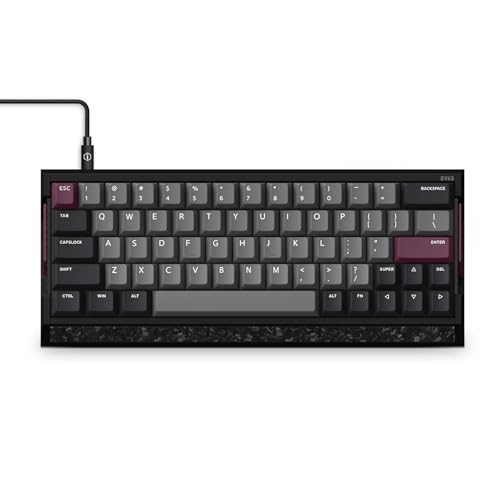
- It is not a specialist: competitive players chasing magnetic rapid trigger should look at the maker’s gaming line instead — see the IQUNIX EV63 review in this cluster
Best for: number-pad professionals, simulation and strategy players, and enthusiasts who want one complete, beautiful board. Not suited for: minimalists, layer-fluent 60% devotees, or buyers who need a purchase completed this week from a mainstream listing.
The F97 among layouts: a prose comparison
| Layout | What it keeps | What it costs |
|---|---|---|
| Full-size (100%) | Everything, with classic spacing | The widest desk footprint of any board |
| 96% — the F97’s class | Everything, compressed | A relearned right-hand geography |
| Tenkeyless | Function row and navigation, classic spacing | The number pad, entirely |
| 75% | Function row, compressed | The number pad, and some navigation keys |
| 60% | The alphabetic core only | Everything else, folded into layers |
The table is really a map of what different workers refuse to surrender. The F97’s class exists for the people who answered every smaller layout’s offer with the same sentence — I still need the pad — and its compression is the only answer that does not ask them to surrender anything except a fortnight of adaptation. That is a narrower and more honourable niche than the everything-board label suggests, and the F97’s reputation rests on serving it in a case worthy of the desk it sits on. Readers still choosing a format can browse the best gaming keyboards by layout and type for the wider field, keeping in mind that the F97 itself remains, per this guide’s verification note, a prose-only subject.
Buying guide: how to evaluate an F97 wherever you find one
Because this guide links no seller, its buying guide is a field kit for evaluating any offer you encounter — the maker’s storefront, a distributor, a marketplace listing, or the secondary market. First, confirm the exact model and variant from the manufacturer’s own product information: IQUNIX’s range contains many similarly named boards across sizes and switch types, and the F97 name should appear in the seller’s own specification, not merely in a headline or a photograph’s caption. Second, establish the switch and connectivity variant being offered, since boards of this class are commonly sold in multiple configurations whose names differ by a suffix; the variant decides the typing feel and the desk cabling, and a listing vague about it is a listing to leave. Third, inventory the contents: the board, its cable or receiver as the variant requires, any included tools or spare parts the maker bundles, and the documentation — completeness matters doubly on the secondary market, where a missing accessory can be the difference between a fair price and a quiet overpayment.
Fourth, price the offer against the product’s wave-based character. Scarcity between runs inflates secondary prices, sometimes beyond reason; a buyer who can wait for a maker’s restock or a distributor’s allocation usually pays the honest figure, while a buyer paying a scarcity premium should do so knowingly, for a specific finish or variant, rather than by accident. Fifth, read the returns and warranty terms as they apply to your region and channel, because enthusiast hardware bought across borders can carry support arrangements very different from a domestic retail purchase. And sixth — the check this whole guide is built around — never let a seller’s use of the F97 name substitute for the manufacturer’s specification of the F97 product. The name is sought after, and sought-after names attract approximate listings the way bright finishes attract fingerprints.
How to adapt to and set up a 96% board like the F97
Step 1: Give the right hand its fortnight
Use the board for everything — work, messages, play — rather than reserving it for one context, because geography is learned by volume. Expect the navigation cluster and the number pad’s left edge to collect your errors in week one and to feel native by the end of week two. Players who dual-wield a full-size board at work and a 96% at home prolong the apprenticeship indefinitely; consistency is the teacher.
Step 2: Centre the alphabetic cluster, not the board
Position the board so the letter keys sit at your body’s centreline and let the number pad extend to the right, rather than centring the whole board and sitting twisted toward the letters. On a compressed board this discipline is easier than on a full-size — the pad is closer — but the habit is the same one every layout rewards: type from the centre, reach for the pad, return.
Step 3: Reclaim the desk the layout saved
Spend the recovered width deliberately: bring the mouse closer and lower your sensitivity a notch if your aim allows, or move the monitor and speakers into the geometry the smaller footprint permits. A compressed board bought for desk space that is never actually reclaimed is a layout tax paid for no dividend — the dividend is the point.
Step 4: Configure the board’s own options methodically
Boards of this class commonly offer remapping, lighting, and connection options through the maker’s software or onboard controls. Set them once, in one sitting, with your real applications open: the function-layer behaviours you actually use, the lighting you can live with at midnight, and the connection mode your desk prefers. Record your choices. An enthusiast board’s configurability is an asset only when it is configured, and a liability of small mysteries when it is half-configured by accident.
Step 5: Maintain it like the object it is
Keep the case dusted, the keycaps cleaned on a schedule, and the cable or receiver stored with the board when it travels. Aluminium rewards this minimal care by ageing gracefully — the small marks of use read as patina rather than as damage — and a board maintained as an object holds both its feel and its value across the years its build quality was designed for. Owners comparing the maker’s smaller gaming boards can read the EV63 magnetic 60% review for the other end of the same design culture.
Common mistakes when buying enthusiast keyboards like this one
The first mistake is buying a name rather than a variant — paying F97 money for a listing whose specification, read closely, describes a different board in the same maker’s range. The second is paying a scarcity premium in ignorance: not knowing the product sells in waves, and therefore not knowing that patience is a pricing strategy. Third, judging the 96% layout in the first three days and returning a board whose geography would have become invisible in a fortnight. Fourth, neglecting the channel question — buying across borders or from unofficial sellers without reading the support terms, then discovering the discount was the warranty. Fifth, treating an aluminium enthusiast board like a disposable peripheral in daily care, and then blaming the category when a neglected board’s cable or caps let the experience down. Each of these is a process error rather than a product error, and the field kit above exists to make all five avoidable.
The secondary market and the limited-run reality
Sought-after enthusiast boards develop a second life that buyers should understand before entering it. Between availability waves, a used F97-class board in complete, cared-for condition is a rational purchase — the build quality that defines the product also defines its used value, since an aluminium case and a sound switch set age in years rather than in product cycles. The used buyer’s checklist mirrors the new buyer’s with additions: photograph-verified condition of the case’s edges and the keycaps’ legends, confirmation that every key registers, the cable or receiver present and working, and a price that reflects the wave cycle — a board bought at a scarcity peak should be bought because the specific unit is wanted, not because the market’s temperature was mistaken for the product’s value. Sellers, symmetrically, should know that completeness and documented care are what the market pays for. None of this is exotic; it is the ordinary economics of durable goods, applied to a category that mass-market habits have trained buyers to treat as disposable.
Who uses a number pad, really — the F97’s constituency in detail
The number pad is the most argued-over territory in keyboard design, and the F97 exists because its defenders are neither few nor nostalgic. Accountants and bookkeepers enter figures at speeds that turn the pad into a musical instrument, and for them the top row’s numbers are not a substitute but a different, slower language. Engineers and CAD users feed coordinates, dimensions, and parameters through it all day. Data analysts live in spreadsheets whose navigation and entry patterns were designed around the pad’s cluster. Simulation players — flight, racing, space — bind its grid of keys to systems controls precisely because it is a grid: nine-plus keys in a spatial arrangement a hand can learn blind. MMO players use it as a second action bar for the same reason. Streamers bind it to scene switches and soundboards. What unites this constituency is that the pad is not a legacy habit but a working tool with a spatial logic, and every layout that deletes it asks these users to amputate a skill. The 96% layout is the only mainstream answer that refuses to ask, and the F97 is that answer in its most desirable clothing. If you are in this constituency, no review of a smaller board — however glowing — is addressed to you, and this guide’s existence is partly an acknowledgement of that.
The constituency has a second, quieter wing: the ambidextrous desk. Some workers keep the mouse on the left or alternate hands, and for them a full-size board pushes the mouse into another postcode while a 96% keeps the whole apparatus within a reasonable span. Others run a separate standalone number pad beside a small board — a legitimate modular answer the F97’s buyers have usually already considered and rejected, because a separate pad drifts, needs its own cable or charge, and breaks the single-object integrity that a machined aluminium board promises. The F97’s pitch to this wing is consolidation: one object, one connection, one geography, nothing to drift.
The enthusiast context: why this maker and this model matter
To understand the F97’s reputation you have to understand the keyboard hobby’s arc across the last decade, because the model sits at one of its hinge points. The hobby began in forums and group buys, where aluminium cases, custom layouts, and themed keycap sets were commissioned in small runs by communities who could not buy what they wanted at retail. Makers like IQUNIX carried that culture into something closer to retail — designed objects, sold in editions, with the hobby’s materials and layout pluralism intact — and the F97 became one of the reference points for what that translation could achieve: a genuinely useful layout, executed as an object, available without joining a two-year group buy. Its themed and finished variants across the maker’s range taught the wider market that a keyboard could be a piece of industrial design with a point of view, a lesson now visible in every design-led board on the market. Buying an F97 in that context is partly buying into a design lineage, and owners who know the lineage get more from the object than its key count — they get the sense, rare in peripherals, of owning the considered version of a thing.
That context also explains the availability pattern this guide keeps noting. Edition-based production — runs, colourways, restocks — is the hobby’s native rhythm, carried into retail. It frustrates the buy-it-tonight expectation that mass-market electronics taught, and it rewards the hobby’s own virtues: patience, channel awareness, and knowing exactly which variant you want before the window opens. A buyer approaching the F97 with a retail mindset will find the process strange; a buyer approaching it as the enthusiast object it is will find the process familiar, and will also find that the discipline this guide’s buying section teaches — variant literacy, completeness, wave-aware pricing — is simply the hobby’s standard practice, written down.
Switch feel and sound in a metal case: what to expect
Boards of this class are offered across switch options over their production life, and this guide will not pretend to a specific current configuration it could not verify — but the durable truths of the category can be stated, because they follow from the construction. A rigid aluminium case gives any switch a consistent, grounded feel: the keystroke’s energy meets an immovable floor, so the switch’s own character — its weight, its travel, its tactility or linearity — is presented without case flex muddying it. Sound follows the same logic: mass and rigidity deepen and quiet the board’s voice, which is why metal-cased boards are described in the hobby’s vocabulary as sounding expensive. For the buyer, the practical advice is to choose switch character by workload rather than by fashion: linear switches for gaming-leaning and high-volume typing, tactile for writers who navigate by feel, and to remember that in a well-made board the case will flatter any of them. If a specific unit’s switch set is unknown in a listing, that unknown is itself the finding — return to the variant discipline and resolve it before purchase.
Desk setups the F97 completes
Picture three desks the model was born for. The first is the analyst’s: two monitors, a spreadsheet glowing, a mouse that needs room to sweep across columns, and a board that must feed the model numbers all day without exiling the mouse to the desk’s edge — the 96% was drawn on this desk. The second is the simulation rig: a yoke or a wheel occupying the centre, a keyboard that must offer a hundred bindable keys in the remaining span, and a case handsome enough to sit among equipment its owner chose with care. The third is the design-conscious home office, where the keyboard is the most-touched object in the room and the owner has decided it should be a pleasure to touch and to see — aluminium, a considered finish, a footprint that lets the desk breathe. In each picture the same two properties do the work: completeness and compression, in a case with presence. A board that is merely complete sprawls; a board that is merely compact deletes; the F97’s whole identity is refusing both failures at once.
Long-term ownership: a board built to be kept
Enthusiast aluminium boards occupy a different ownership universe from gaming peripherals, and the F97 should be bought — and judged — inside that universe. The case is effectively permanent: machined metal does not yellow, crack, or date the way plastic shells do, and its finish ages into patina rather than into shabbiness. The switches and keycaps are the renewable surfaces, replaceable as taste and wear dictate, so the board’s feel can be refreshed across years without replacing the board. That renewability is why the secondary market for such boards is civilised: a five-year-old example, maintained, is most of a new one. The ownership disciplines are correspondingly light and pleasurable — keep it clean, store it properly when it travels, treat the cable and connectors kindly, and refresh caps when their legends or shine eventually ask. Buyers accustomed to a two-year peripheral replacement cycle should recalibrate their cost thinking entirely: this category is priced like furniture because it behaves like furniture, and the cost-per-year arithmetic of a kept board routinely beats the cheaper board replaced three times.
A short decision framework
Four questions settle whether the F97 is your board. First: do you use a number pad weekly, in work or in play, as a practised skill rather than an occasional reach? If not, smaller layouts will serve you better and this model’s founding compromise buys you nothing. Second: is your desk’s width a real constraint — mouse room, monitor span, a small room’s furniture? If your desk is a hangar, a classic full-size board gives you the same keys with the geography your fingers already own. Third: do you keep and value objects — is a keyboard you will touch for a decade worth a premium case to you? If your peripherals are consumables by temperament, the enthusiast premium is wasted on you however good it is. Fourth: can you buy through a verifiable channel, at a wave-aware price, with the patience the product’s availability rhythm requires? If the purchase must happen tonight from a mainstream listing, this is not tonight’s keyboard, and the honest move is to buy a verifiable alternative now and let the F97 be a considered purchase later. Four yeses describe the F97’s owner precisely; the guide’s work is done if it has helped you count yours.
A word for the reader who arrived here from a search box expecting a buy button, because this guide owes them a direct closing address. The missing button is not a failure of the page; it is the page’s most honest feature. Somewhere in your search results there are pages that will happily sell you something under this keyboard’s name, and the difference between those pages and this one is the difference between a shop and a guide. Take the checklist, take the layout education, take the decision framework — and then, if the F97 is your board, go and buy it from the maker or a channel you have verified, at a price the wave justifies, with the variant confirmed in writing. You will own a better keyboard for having bought it that way, and you will own it with the confidence that no part of the purchase was an accident of naming.
And for the reader who is simply layout-curious — who came to learn what 96% means and whether their next board should speak it — the F97 has done its work for you even if you never buy one. You now know the question the layout answers, the tax it charges, and the constituency it serves. Whichever board you choose next, you will choose its format knowingly, and in a category where most purchases are inherited habits, a knowing choice is the entire upgrade.
Teams and offices standardising on a board deserve a final practical note, since a 96% aluminium model is occasionally proposed as a small-office standard for number-heavy work. The case for it is real — one board for every desk, completeness for every role, a footprint that suits modern bench desking, and durability that outlasts the usual procurement cycle. The case against is the wave-based supply itself: standardising on a product bought in runs requires a purchaser who plans ahead and holds a spare or two. Offices that can plan that way get an unusually civilised standard; offices that buy reactively should choose a board whose supply is as boring as their process.
Gift-buyers in the keyboard hobby will recognise the F97’s specific position in their world: it is the board you give the person who has everything smaller — the enthusiast whose collection lacks a complete, beautiful, full-capability board because their taste ran to compacts. Given through a verified channel, in a finish chosen with knowledge of their desk, it lands as a considered object rather than as another gadget. Given carelessly, through an unverified listing with an approximate name, it lands as a cautionary tale — which is, one last time, why this guide is written the way it is.
Left-handed mouse users, a small population with outsized layout opinions, should note one more time that compression helps them disproportionately: every centimetre removed from a board’s width is a centimetre returned to whichever side the mouse lives on, and a full-size board’s sprawl is paid by the left-side mouser in shoulder reach all day. For that reader, the 96% class is not a compromise at all — it is the first standard layout that was ever drawn with their desk in mind, even if nobody marketed it that way.
Writers and editors, who rarely appear in keyboard marketing, form another quiet constituency for completeness: their shortcut dialects — navigation clusters, function-key macros in their tools, the pad as a custom command grid in some editing suites — are exactly what compact boards tax. A writer who has priced the layer life and declined it will find the F97’s proposition familiar and its case a daily pleasure at the desk where they spend their working life. The board does not care what the keys are used for; it simply refuses to make any of them somebody else’s problem.
That refusal — to delete, to layer, to apologise — is the shortest honest summary of the product this guide can offer. The F97 keeps everything, in less space, in a better case, and asks only for a fortnight and a verified seller in return.
Buyers who meet those two small conditions tend to keep the board for a very long time, which is the outcome its maker designed for and the outcome this guide — links or no links — is happy to recommend.
And if the wave is against you today — the maker’s shelf empty, the distributors between allocations — the guide’s last counsel is the hobby’s oldest: set the alert, keep the checklist, and let the board come to you at its honest price. Enthusiast hardware rewards the patient with a completeness that haste rarely buys at any price.
Patience, in this corner of the market, is not a consolation for missing out. It is the purchasing strategy itself — the difference between owning the exact board, in the exact variant, at the maker’s price, and owning an approximation bought in a hurry from a listing that traded on a famous name.
The F97 deserves the exact purchase. Everything in this guide — the layout education, the field kit, the framework — exists to make sure that is the purchase its next owner makes.
Readers who take only one sentence from this entire guide should take that one, because it generalises far beyond a single keyboard: in enthusiast hardware, the verified exact purchase is the only bargain there is.
Everything else — the aluminium, the layout, the decade of service the board is built to give — follows from getting that one decision right at the start.
Get it right, and the F97 becomes what its owners describe: the last full-size decision their desk ever required, because there was finally nothing left to compromise.
No deletion, no sprawl, no substitute — the product, the layout, and this guide all make the same promise, and keep it the same way: completely, and in the open.
That is the whole of the case, and it needs no link to stand.
One more constituency should be acknowledged before the guide closes, because it explains a surprising share of this model’s enduring demand: the returning enthusiast. Keyboards are a hobby people leave and re-enter — a house move, a new job, a decade of laptops — and the returner typically arrives with old knowledge and a specific hunger for the board they admired and never bought. The F97 is disproportionately that board, because its proposition never depended on a fashion cycle: completeness, compression, and aluminium were the argument in its first year and remain the argument now. A product that can wait a decade for its buyer, unchanged in relevance, has passed a test that faster-moving categories never sit. If you are that returning reader, the guide’s advice compresses to its essentials — verify the variant, buy through the maker or a channel you trust, budget the fortnight — and the board you admired from a distance will finally be the board on your desk, which is where this model has always belonged.
Students of product design, finally, might note the F97 as a case study in constraint as identity. Every interesting decision in it is a refusal to relax a constraint: the key count could not drop, the footprint could not sprawl, the case could not be plastic, the name could not be borrowed. Products designed by accumulating features are forgotten in a season; products designed by honouring constraints acquire the kind of clarity that survives in a market’s memory. Whether or not you ever own one, the F97 is worth understanding for that reason — and understanding it, as this guide has tried to ensure, requires no purchase at all.
That may be the most useful thing a prose-only guide can give any reader: not a transaction, but an understanding durable enough to survive until the right transaction presents itself.
When it does — a restock, a distributor’s allocation, a complete and fairly priced used example — you will recognise it instantly, because you will know exactly what the real thing is, and exactly what it is not.
Recognition, in a market of approximate listings and borrowed names, is the buyer’s whole armour — and it is the one thing this guide could give you that no checkout button ever could.
Wear it well, spend it wisely, and the F97 — when it reaches your desk by the honest route — will do the rest for a decade.
A decade of complete, unhurried, aluminium service — the entire proposition, and a fair one.
Buy the real one, keep it forever, and let every smaller keyboard argue with somebody else’s desk.
That is the recommendation, complete at last — like the keyboard.
Nothing deleted, nothing padded, nothing substituted — in the guide as in the product.
The symmetry is intentional, and the reader’s trust is its entire reward.
Trust, once given to a guide that refused to sell you the wrong keyboard, tends to be remembered longer than any discount.
Remember the checklist, then, longer than the discount too.
Final recommendation
The IQUNIX F97 earns its reputation honestly: it is the complete keyboard — every key a full-size board offers — compressed into a footprint that respects the modern desk, built in the materials and finishes of a maker that treats keyboards as objects. Buy it if you are a number-pad loyalist, a simulation or strategy player, or a one-board worker-player, and buy it through a channel whose specification you can verify against the manufacturer’s own, at a wave-aware price, with the fortnight of adaptation budgeted. Do not buy it — or anything — from a listing that merely borrows its name, and do not expect this guide to link you to one that does: the absence of links here is the review’s integrity made visible, and the F97, of all products, is good enough to be recommended in prose alone.
Frequently asked questions
Why are there no purchase links for the Iqunix F97 in this guide?
Because no exact-match listing for the F97 could be verified through Amazon’s catalogue data to this site’s standard, despite repeated checks — the searches returned other IQUNIX models and other brands, but not the F97. The site’s rule is that an unverifiable product is discussed in prose only, never substituted with a neighbouring model dressed as the subject. The guide therefore covers the F97 completely and links nothing, and its buying section is a checklist for evaluating the maker’s own channels and any other seller you find.
What does 96% actually mean in daily use?
It means every key of a full-size keyboard — letters, function row, navigation, arrows, number pad — arranged in a tightened block with the wasted space removed. In daily use the board feels full-size at the fingers and tenkeyless on the desk. The only apprenticeship is the right hand’s geography: the navigation keys sit closer to the main cluster than classic spacing taught your fingers to expect, and a fortnight of full-time use redraws the map permanently.
Is the F97 a gaming keyboard or a work keyboard?
It is the refusal of that distinction, which is its identity. Its completeness serves number-heavy work without compromise, and the same completeness serves simulation, strategy, and MMO play where key count is capability. What it is not is a competitive-FPS specialist: players chasing magnetic rapid trigger and the smallest possible footprint are served by the maker’s gaming line — the EV63 reviewed in this cluster — while the F97 serves the player-worker who wants one complete board for the whole desk day.
Where should I look to buy one, if not here?
Start with the manufacturer’s own storefront and its authorised distributors, where the model and variant can be confirmed against the maker’s specification, and be prepared for the product’s wave-based availability — restocks and runs rather than a permanent shelf presence. The secondary market is the other legitimate channel, evaluated with the completeness and condition checklist in this guide’s buying section. In every channel, the discipline is identical: exact model, exact variant, complete contents, terms read before money moves.
How does it compare with a tenkeyless board?
The tenkeyless deletes the number pad and keeps classic spacing everywhere else; the 96% keeps the pad and compresses the spacing. Choose the tenkeyless if you never touch the pad and value familiar geography above desk width. Choose the 96% if the pad is part of your work or play and you are willing to relearn a tighter right-hand map in exchange for keeping it. The F97’s specific claim within its class is build and design — the layout idea in an aluminium, object-grade execution.
Will it suit a small desk?
It was designed for exactly that tension: a small desk that still needs a complete keyboard. Its footprint is dramatically narrower than a full-size board’s while surrendering no keys, which is why the layout class exists. Measure your desk’s keyboard zone against a 96% board’s approximate width — roughly a tenkeyless span — and remember the dividend is spent on mouse room, so plan the whole zone rather than the board alone, as the setup section advises.
How is a 96% board different from a full-size board with a small bezel?
In geography, not just in millimetres. A small-bezel full-size board keeps the classic gaps between the main cluster, the navigation block, and the pad — your fingers’ landmarks survive intact, and only the outer case shrinks. A 96% board removes those internal gaps, nesting the blocks together, which is where its real width saving comes from and also where its fortnight of finger retraining is spent. Buyers who prize their existing muscle memory above desk space should choose the former; buyers who want the full saving should choose the latter with their eyes open, as this guide has advised throughout.
Can I game seriously on a board like the F97?
Seriously, yes; specially, no — and the distinction is the product’s honesty. For strategy, simulation, MMO, and the vast majority of play, a complete board is an advantage: every bind exists, nothing hides in a layer mid-match, and the build quality serves long sessions. For elite competitive FPS, the specialist instruments — small magnetic boards like the maker’s own EV63, reviewed in this cluster — exist because their players surrender key count for switch speed and mouse territory. Most players are not that specialist, and for them the F97’s completeness is the more useful form of seriousness.
Related guides
Continue with the best gaming keyboards across layouts, the IQUNIX EV63 magnetic gaming board in this cluster, and gaming monitors to complete the desk.