Disclosure: As an Amazon Associate, reviewstook.com earns from qualifying purchases. Links on this page are affiliate links at no extra cost to you; prices and availability change frequently, so check Amazon for the latest.
High End Gaming PC Pros and Cons: The Honest Ledger Before You Spend
Every high end gaming PC review will tell you the machines are fast. What buyers actually need, before committing flagship money, is the other half of the story: what that speed costs in money, heat, noise, space, and future flexibility, and which of those costs apply to their life specifically. This breakdown of high end gaming PC pros and cons weighs the tier as a whole — not one model — because the strengths and weaknesses belong to the category: the same physics and economics govern a boutique flagship and a value builder’s top configuration alike. Read it as a ledger. If the left column describes your gaming life and the right column describes costs you can shrug off, the tier is for you. If the reverse is true, the honest answer is to buy a tier down and enjoy the savings — a conclusion this page will help you reach without a hint of sales pressure.
In this guide
The Pros: What the High End Actually Delivers
| Pro | What it means in practice |
|---|---|
| Resolution headroom | 4K and high-refresh 1440p stop being settings-menu negotiations; you play at the panel’s native quality. |
| Frame pacing quality | Flagship CPU/GPU pairings raise minimum frame rates, which is the smoothness you actually feel. |
| Ray tracing without apology | Full ray-traced lighting at playable rates, with upscaling as an enhancer rather than a crutch. |
| Longevity | A flagship bought today remains a strong machine through several game generations. |
| Dual-purpose muscle | The same hardware streams, records, edits, renders, and runs local AI workloads credibly. |
| Resale and upgrade value | Named flagship components retain value and accept mid-life GPU swaps gracefully. |
Pro: the settings menu stops being a negotiation
On a mainstream machine, every new release opens with fifteen minutes of settings archaeology: which shadows to cut, whether textures fit the memory budget, whether the frame rate survives the first big set piece. A high end gaming PC deletes that ritual. You set the resolution to native, the preset to high or ultra, and you play — and when a game is genuinely unoptimized, you have the headroom to absorb it rather than a reason to refund it. That convenience sounds minor until you multiply it across years of releases; it is, quietly, the thing owners cite most when asked whether the purchase was worth it, a theme explored from the buyer’s side in Is A High End Gaming PC Worth It.
Pro: minimum frame rates, not average ones
Benchmarks advertise averages, but players feel minimums — the dip when the screen fills with effects, the stutter in the busy hub city, the hitch that costs a competitive round. Flagship pairings such as an X3D processor behind an RTX 5080 raise those floors disproportionately, because both the CPU cache and the GPU have reserves exactly where mainstream hardware runs dry. The result is a quality of smoothness that spec comparisons undersell and that is hard to give up once experienced.
Pro: one machine, several jobs
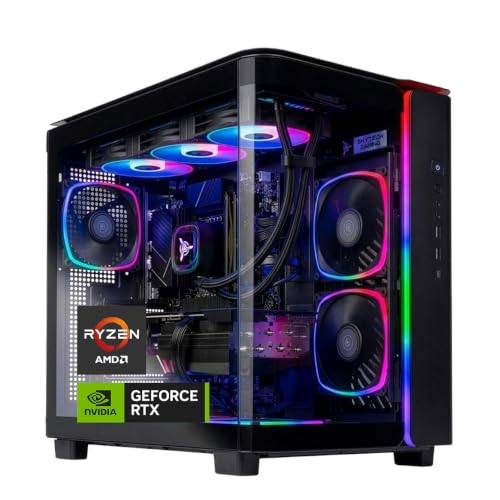
The modern high end PC is rarely only a games machine. It is the streaming rig whose encoder never touches gameplay performance, the editing station that scrubs 4K timelines, the VR host, and increasingly the local AI workstation. A build like the Skytech Gaming PC with Ryzen 9 9950X3D and RTX 5090 — 64GB of memory, 4TB of storage, a 1000W Gold supply, Wi-Fi 7 — is specified like a small workstation that happens to be phenomenal at games. If your household or your work uses even two of those capabilities, the tier’s economics improve dramatically, because the alternative is two lesser machines instead of one excellent one.
The Cons: What the High End Quietly Charges You
| Con | What it means in practice |
|---|---|
| Diminishing returns | Each tier step costs proportionally more than the performance it adds; the last step costs the most and adds the least for pure gaming. |
| Heat and noise | Flagship parts convert serious wattage into warm rooms and audible cooling under load. |
| Power draw | Sustained flagship gaming is a real line item in electricity and a real load on household circuits. |
| Size and weight | Full towers with 360mm radiators are furniture; small rooms and small desks feel them. |
| Depreciation | Flagships lose absolute value fastest in the first product cycle, however well they age in capability. |
| Ecosystem spending | The machine demands a monitor, peripherals, and desk that match it — the tower is the beginning of the bill, not the end. |
Con: diminishing returns are the tier’s defining tax
Be brutally clear about the shape of the curve. The step from a mainstream card to an RTX 5070 Ti transforms what is playable. The step from a 5080 to a 5090 costs dramatically more and, at 1440p, can be nearly invisible. Flagship pricing buys the last slice of performance at the highest rate per frame in the industry, plus capability — 4K high-refresh, heavy ray tracing, GPU compute — that only specific users will ever touch. The extreme illustration is a machine like the ArsenalPC APC Helios GX601, which pairs a 16-core Ryzen 9 9950X3D with an RTX 5090, 128GB of DDR5, and a 1200W supply: a magnificent specification that exists for buyers whose workloads genuinely reach for it, and an expensive ornament for anyone whose does not. The tier is honest value only when your display and your software can cash the cheque its hardware writes — which is the entire subject of How To Choose A High End Gaming PC.
Con: heat, noise, and the room itself
A flagship under load converts several hundred watts into heat, continuously, in the room where you sit. In summer, in a small room, that is air-conditioning load and personal discomfort, not an abstraction. Cooling that heat is audible: 360mm radiators and multiple fans do their work politely at idle and unmistakably at full tilt. Headphones solve the noise for the player; they do nothing for a partner trying to sleep in the next room or a microphone trying to record clean audio. None of this is a defect — it is physics — but it belongs in the purchase decision, and it is the most common source of “I love it, but…” in owner reports gathered in High End Gaming PC Reviews.
Con: the tower is the start of the spending
A high end PC on a mediocre monitor is a sports car on economy tires. The honest budget includes the 4K or high-refresh panel the machine exists to feed, a mouse and keyboard that do not bottleneck it — readers typically continue to Best Gaming Mouse For Fps for that half of the desk — and often the desk and chair to hold it all. Buyers who stretch to afford the tower alone end up under-using it for a year, which is the worst of both ledgers. Price the ecosystem, then choose the tier that leaves the ecosystem funded.
The Middle Ground: Where the Ledger Balances Differently
Between the poles sit the judgment calls. Consider the entry point to the tier: a configuration like the MSI Codex Z2 with Ryzen 7 8700F and RTX 5070 — 32GB of DDR5, 2TB of storage, VR-ready, in a mainstream-friendly chassis. It carries the high end badge at its lower edge, and its ledger reads differently: the longevity pro shrinks (its GPU tier will feel its age sooner), the heat and noise cons shrink too, and the diminishing-returns con barely applies because you never climbed to the steep part of the curve. For a 1440p player, this shape of machine may be the rational maximum, and calling it a compromise misses the point — it is the tier sized to a real display and a real library.
At the other end, abundance itself becomes a variable. A system like the Horizon Autherium Dragon — Core i9 power, 64GB of memory, 5TB of storage, Windows 11 Pro — illustrates how flagship builds increasingly sell capacity and presence alongside speed: storage you may fill in year three, memory a pure gamer may never pressure, a showpiece case that is part furniture. The pro is real (one purchase, no upgrades, nothing rationed); the con is equally real (you prepaid for capacity on a schedule your usage may never meet). Neither reading is wrong. The ledger method simply insists you know which one is yours before the order, not after.
Who the Pros Outweigh the Cons For
- 4K and ultrawide players. Your display can cash every cheque the hardware writes; the pros are daily, the cons are theoretical.
- High-refresh competitors. Frame-pacing quality is a competitive input, not a luxury, at 240Hz and above.
- Streamers and creators. The second job transforms the economics; one flagship replaces a gaming PC plus a workstation.
- Long-cycle buyers. If you replace a PC every five or six years, flagship longevity is the cheapest cost-per-year in the market.
- VR enthusiasts. Headsets punish weak minimum frame rates with physical discomfort; headroom is a health feature here.
Who Should Honestly Buy a Tier Down
- 1080p players with no monitor upgrade planned. The pros literally cannot appear on your screen.
- Single-game players. If one well-optimized title is your whole library, size the machine to it, not to the tier’s marketing.
- Small-room and shared-space players. Heat and noise are social costs; a smaller, cooler machine may serve your life better.
- Budget-stretched buyers. A flagship tower with no monitor budget is a worse purchase than a mid-tier tower with the full ecosystem funded.
- Frequent upgraders. If you enjoy swapping hardware yearly, flagship depreciation is a recurring tax you will keep paying.
How to Run This Ledger on a Specific Machine
Take any candidate listing and score it against the tables above, line by line, writing your own entries where your life differs — a home office in a cool climate deletes the heat con; a rendering side-business strengthens the dual-purpose pro. Then verify the machine’s actual specification with the method in High End Gaming PC Buying Guide, because a pros-and-cons analysis built on a misread spec sheet is fiction. Finally, sanity-check the result against ownership reality in High End Gaming PC Review, where the daily experience of the tier gets its say. The three reads together take less than an hour and stand between you and the most expensive casual purchase in gaming.
Common Mistakes in Weighing the Decision
- Counting benchmark averages as the whole pro column. Minimum frame rates and settings freedom are the lived benefits; averages are the advertised ones.
- Forgetting the room. Heat and noise are the cons owners mention most and shoppers consider least.
- Letting the tower consume the ecosystem budget. An under-monitored flagship is the tier’s most expensive irony.
- Assuming flagship means future-proof forever. It means a longer runway, not an infinite one — GPUs age on schedule regardless of tier.
- Treating the decision as permanent. A tier-down purchase today plus a monitor upgrade next year is a legitimate sequence, not a failure of ambition.
Final Recommendation
The high end’s pros are genuine and its cons are priced in physics and economics rather than in any model’s defects. Buy the tier if your display, your library, and ideally a second workload can use it, and if the full ecosystem fits the budget without strain. Decline it — cheerfully, and with our blessing — if the honest ledger says your gaming life happens at 1080p, in a small warm room, on one beloved game. Either way, decide with the ledger open: it is a better instrument than any single review, including the ones on this site.
Frequently Asked Questions
What is the biggest advantage of a high end gaming PC?
Freedom from negotiation. Native resolution, high settings, smooth minimum frame rates, and ray tracing stop being trade-offs you manage per game and become defaults you forget about — across years of releases, not just this season’s.
What is the biggest disadvantage?
Diminishing returns. The top tier charges the highest price per unit of performance in the market, and much of what it buys — 4K high-refresh capability, extreme ray tracing, GPU compute headroom — only materializes for users with the displays and workloads to demand it.
Are high end gaming PCs loud?
Under full load, audibly so — flagship components produce flagship heat, and moving that heat takes fans. At idle and in light play, a well-cooled modern build is quiet. The honest summary: you will hear it working when it is working hard, and mostly not otherwise.
Do high end gaming PCs use a lot of electricity?
Under sustained gaming load, yes — several hundred watts for the tower alone, before the monitor. In cost terms that is a modest but real addition to a heavy player’s electricity bill, and in a small room it is also a meaningful amount of heat to live with.
How long does the “high end” advantage last?
A flagship typically delivers four to six years of strong performance, with the graphics card aging fastest. The platform around it — processor, DDR5 memory, storage, power supply — usually outlasts one GPU generation, which is why upgrade-friendly builds hold their value proposition longest.
Is a high end gaming PC a good choice for a first PC?
It can be, for a buyer certain about their display and their commitment to the hobby. For everyone else, the middle of the market teaches the same lessons at half the tuition, and the upgrade path remains open. Certainty, not experience, is the real prerequisite.
Do the pros change if I also work on the machine?
Substantially, and in your favor. Editing, rendering, compiling, streaming, and AI workloads convert idle gaming headroom into daily productivity, which is why creator-gamers are the tier’s most satisfied owners and why the dual-purpose pro sits so high in the ledger.
The Genre Ledger: Where the Pros Land Hardest
The tier’s value is not evenly distributed across gaming itself, and an honest pros-and-cons account should say where it concentrates. Competitive esports titles are the surprise entry: they are not demanding in the brochure sense, but at 240Hz and above they convert flagship frame pacing into a genuine competitive input, and the X3D-class processors in machines across this cluster exist largely because of them. Open-world and flagship single-player releases are the obvious beneficiaries — the settings freedom pro in its purest form, ray tracing included. Simulation is the connoisseur’s case: flight and racing simulators punish weak minimum frame rates and reward cache-rich CPUs and abundant GPU memory more than any benchmark suite admits, which is why sim rigs cluster at the flagship step regardless of their owners’ budgets elsewhere. Strategy and MMO players sit in the processor’s ledger column — their games bottleneck on the CPU in crowded scenes, so the tier pays them through the chip more than the card. And the retro or indie-focused library is the honest negative space: a player whose year is pixel art and decade-old classics gains almost nothing from the tier beyond load times, and the ledger should tell them so plainly. Data gathered through reviewstook.com reader research keeps confirming the same pattern — satisfaction with a high end purchase tracks the match between library and hardware more closely than it tracks the hardware’s absolute tier.
The Upgradeability Question, Weighed Properly
Upgradeability sits in both columns, which is why it confuses buyers. The pro: a well-chosen high end platform — current socket, DDR5, spare slots, power headroom — is the most upgradeable computer you can buy, and its mid-life GPU refresh is the cheapest performance jump in the industry. The con: the tier’s polish tempts builders toward proprietary shapes and sealed aesthetics that tax exactly that future flexibility, and the flagship premium means the parts being obsoleted by time are the most expensive ones you own. The resolution is to treat upgradeability as a per-machine property, not a tier property. Standard-layout towers from builders who also sell components score highest; design-led flagships score lower and compensate with support. Neither is a defect — but a buyer planning a five-year platform story should weight the layout heavily, while a buyer planning to replace the whole machine in four years should weight it barely at all. The ledger method survives because it prices your intentions, not the internet’s.
The Environmental and Practical Ledger
Three practical entries rarely make review pages and always make ownership. The first is physical: flagship towers are heavy enough that moving house, rearranging a room, or shipping the machine for service becomes a planned event rather than an impulse, and the glass panels that make them beautiful make them fragile in transit — keep the box. The second is electrical: a flagship under load plus a high-end monitor plus peripherals is a meaningful draw on one circuit, and older housing stock occasionally has opinions about that which express themselves at the breaker. The third is environmental in the plainest sense: several hundred watts of heat and the electricity behind it, multiplied across years of evening play, is a real footprint that a smaller machine simply does not have. None of these entries is an argument against the tier. All of them are arguments for entering it with a room, a circuit, and a storage plan for the packaging — the unglamorous logistics that separate a flagship that settles into a life from one that keeps negotiating with it.
Pro and Con: The Prebuilt Premium Itself
One ledger belongs specifically to buying the tier as a prebuilt rather than assembling it. On the pro side: a single warranty covering the whole system, professional assembly and cable work, a machine stress-tested before it ships, and your own evenings returned to you. On the con side: a premium over the parts sum, a configuration chosen from a menu rather than from the whole market, and the occasional proprietary decision that complicates the upgrade story told above. The balance shifts with the buyer’s skills. For a confident builder, the con column is mostly real and the pro column is mostly convenience. For a first-time flagship buyer, the columns invert: the warranty alone can be worth the premium the first time a several-hundred-watt machine misbehaves, because the alternative to a support call is diagnosing a fault among the most expensive components in consumer computing with a search engine and a sinking feeling. The tier does not decide this one. Your toolbox does.
Two Owners, Two Ledgers: The Same Machine, Opposite Answers
The cleanest way to see why this decision resists universal answers is to hand the same flagship to two owners. The first is a 4K OLED player with a six-year replacement cycle, a streaming hobby, and a study with a door that closes. Her ledger is almost comically one-sided: settings freedom daily, frame pacing nightly, a second workload weekly, longevity amortizing the price across the longest horizon in the market, and the cons — heat, noise, draw — absorbed by a room built for the purpose. The second owner plays one competitive title at 1080p in a shared flat, replaces hardware every two years out of enthusiasm, and games at a desk in the corner of a bedroom. His ledger inverts: the flagship’s pros cannot appear on his panel, its heat and noise tax his living situation nightly, and its depreciation meets his upgrade habit like a toll booth. The machine did not change. The lives did. Every pros-and-cons page on the internet, this one included, is a template; the decision happens when you write your own entries in the margins — which genres dominate your library, which room hosts the machine, which cycle governs your replacements. Do that writing honestly and the answer is rarely close, in either direction.
The Con That Isn’t: “You Could Have Built It Cheaper”
One entry deserves eviction from the con column, because it is usually miscounted. The claim that a prebuilt flagship “wastes” the difference between its price and its parts sum treats assembly, testing, warranty consolidation, and the buyer’s time as worth zero — an accounting trick no one applies to restaurants or tailoring. The honest con is narrower: you pay a premium, and you should know its size and what it buys, per machine. Where the premium buys a multi-year whole-system warranty and a tested, verified configuration, it is a price for a service, competitively charged by some builders and extravagantly by others. Where it buys nothing but a badge, the ledger catches it — which is the entire reason to run the numbers per model instead of inheriting an opinion about the category. Judge the premium like any other line in the specification: present, sized, and justified, or not.
The Social Ledger: Gaming as a Shared Activity
A high end machine changes its owner’s social gaming life in ways neither benchmark nor brochure captures, and the ledger should record them. On the pro side, the flagship owner becomes the household’s and the group’s natural host: the machine that runs the session, records the clips, streams the event, and renders the montage afterward. Local multiplayer and couch sessions inherit the settings freedom too — a 4K television fed by a flagship is a social instrument in a way a struggling console-era setup never was, and the split-screen or party titles that punish weak hardware simply stop being a negotiation. On the con side, the flagship can quietly become a standard its owner then misses everywhere else: hotel televisions, a friend’s mid-range rig, a laptop on a trip all feel worse by contrast, a hedonic tax that is real if rarely itemized. There is also the group’s hardware gravity to consider — one flagship in a friend group tends to raise everyone’s ambitions, which is either community enrichment or an arms race, depending on the group’s budgets and honesty. None of this decides a purchase alone. All of it belongs in a complete accounting, because machines this capable are never only appliances; they are venues, and venues have social economics.
Pro and Con: The Learning Curve and the Knowledge Dividend
Owning the tier teaches its owner things, and the teaching cuts both ways. The pro is a genuine knowledge dividend: a flagship owner learns what frame pacing feels like, what cooling discipline does, what a specification sheet hides, and that education permanently improves every later technology purchase they make — the machine is tuition in a subject the modern world keeps examining. Owners consistently report that their second high end purchase is dramatically better judged than their first, and the difference is the first machine’s lessons. The con is the accompanying restlessness: knowledge of what the next tier, the next panel, the next peripheral would add can convert contentment into a standing upgrade list, and the tier’s marketing is engineered to water exactly that plant. The honest ledger entry is therefore double-sided — the flagship educates its owner and tempts them, often in the same week. Buyers who name the temptation in advance tend to enjoy the education without funding the restlessness; the machine stays a tool that teaches, rather than becoming a subscription to dissatisfaction.
The Reliability Ledger: Fewer, Larger Bets
One structural difference between the high end and the tiers below it rarely gets its own line: concentration. A mainstream setup distributes its value across replaceable parts, any one of which can fail cheaply. A flagship concentrates value — the graphics card alone can represent a household appliance’s worth of money — which changes the reliability calculus in both directions. The pro: flagship components are typically built to higher standards, with better power delivery, better cooling, and more validation, and whole-system prebuilt warranties convert a component failure into a service event rather than a diagnosis you fund. The con: when something does fail, it fails expensively, and the machine is down entirely rather than degraded gracefully — there is no limp mode for a dead flagship GPU. The practical conclusions are the ones this cluster keeps reaching from different directions: buy the warranty as seriously as the silicon, keep the backup current, keep the box for a possible service journey, and let the return window do its diagnostic work early. Concentration is not a flaw in the tier’s design; it is the design, and it rewards owners who insure it accordingly.
How the Ledger Shifts With the Price of Electricity and the Climate You Live In
Two owners with identical machines and identical libraries can run different ledgers on geography alone. In a cool climate with inexpensive electricity, the heat con shrinks toward trivia — the flagship warms a room its owner wanted warmed, for most of the year, and the running cost is a rounding error in the household budget. In a hot climate with expensive power, the same machine taxes twice: once at the meter for its own draw, and again at the meter for the air conditioning that must remove its heat from the room, in the months when gaming hours are longest. Neither owner bought the wrong machine, but the second owner’s honest ledger has a line the first owner’s does not, and at the margin — between the 5080 step and the 5090 step, say — that line can be the one that tips a close decision. The generalizable point is that pros and cons are not properties of products; they are properties of products in places, in lives, in rooms. This page can enumerate the candidates. Only your postcode can weight them, and a decision that skips the weighting has used the ledger as decoration rather than as the instrument it is meant to be.
The Opportunity-Cost Entry, Stated Plainly
Every ledger in this cluster has circled one entry without naming it in full: the flagship’s price is also other things. It is a year of a hobby funded elsewhere, a holiday, a course, a contribution to savings — and a complete pros-and-cons account should let that entry sit in the con column at full size rather than disguising it as “price.” The reason is not to argue against the purchase; it is that a decision which survives an honest statement of its alternatives is a decision its owner will not relitigate at month six. High end owners who report the deepest satisfaction share a trait that has nothing to do with hardware: they can say, without flinching, what the money would otherwise have done, and they chose the machine anyway. Owners who report regret usually cannot — the purchase happened in a fog of benchmarks, and the alternatives arrived later, as thoughts. Run this entry deliberately. If the machine still wins against the named alternative, buy it with a clear conscience and our blessing; if it does not, the ledger has just saved you the most expensive lesson in the hobby, at the cost of one honest paragraph.
The Time Ledger: Hours Given and Hours Taken
Time is the currency every other entry in this ledger is secretly denominated in, and the high end trades in it in both directions. The pros give time back in small, constant denominations: installs and loads that stop being intervals, updates that finish inside a coffee rather than across an evening, settings menus that no longer consume the first session of every new game, troubleshooting that rarely happens because headroom forgives what marginal hardware cannot. Multiplied across years of daily use, these minutes compound into the tier’s least advertised and most honestly felt return — the machine disappears as an object of management and survives only as the place games happen. The cons take time in larger, rarer denominations: the research before purchase, which this tier genuinely demands; the setup and verification ritual, which flagship prices justify and flagship complexity requires; the dust and filter discipline; and, when something fails, the service interval during which a concentrated machine is wholly absent rather than partially useful. Weigh the exchange at your own exchange rate. A player whose evenings are scarce and precious will find the small constant returns priceless and the rare costs trivial. A hobbyist who enjoys the management itself may experience the pros as a loss — the tinkering was the point — and the ledger, faithfully kept, will tell them that too.
Pro and Con: The Flagship as a Creative Instrument
One population runs a ledger this page has touched only in passing: the players for whom gaming is raw material. Video essayists, modders, screenshot artists, machinima makers, and the growing class of players who build things inside games — cities, circuits, entire simulated worlds — use a flagship differently from everyone else, and their pros and cons reweight accordingly. For them the GPU’s memory and the processor’s patience are not headroom but canvas: the city that keeps simulating, the render that finishes before the idea cools, the capture that never costs the moment it records. The dual-purpose pro, a pleasant bonus for ordinary owners, is for this population the entire purchase, and the gaming performance is almost the by-product. Their con column has a distinctive entry too: creative work raises the cost of downtime from inconvenience to deadline, which pushes their ledger hard toward the warranty-rich, support-deep end of the market and away from the value builders their gaming-only twins rationally choose. If you recognize yourself in this paragraph, weight accordingly — your flagship is a studio that games, and it should be bought, warranted, and backed up like one.
How the Ledger Reads at Each Step of the Tier
It is worth stating explicitly what the earlier sections imply: the pros and cons do not merely belong to the tier, they migrate within it. At the entry step — the 5070-class machines — the ledger is at its most forgiving: the diminishing-returns con barely applies, heat and noise are at their mildest, the ecosystem is at its most affordable, and only the longevity pro is slightly rationed, since the GPU will feel its years sooner. At the center step, the 5070 Ti and 5080 machines, every pro stands at full strength and every con at moderate strength; this is the step where the ledger balances for the largest number of real buyers, which is not a coincidence but a description of where the market’s value has pooled. At the ceiling step, the 5090 flagships, the pros become absolute and narrow — total settings freedom, total workload range — while the cons become absolute and broad: price, heat, draw, depreciation, and the ecosystem’s full demands all peak together. A buyer who understands the migration understands the tier, because the decision was never “high end, yes or no” but always “which step’s particular balance of blessings and bills matches my life.” The ledger’s final service is to make that matching explicit — after which the choice, in our experience of watching readers make it, tends to feel less like a gamble and more like a signature.
The Second-Hand Ledger: Buying the Tier Used, and Selling Into It
The pros and cons rearrange themselves intriguingly when the flagship is bought used, and a complete ledger should run that version too. The pros strengthen on price — the first owner’s depreciation becomes the second owner’s discount, and a verified two-year-old flagship often delivers the tier’s experience at the tier-below’s money — while weakening on certainty: no return window worth the name, a warranty partly spent, a history written by someone else’s dust discipline and overclocking habits. The cons of new ownership mostly evaporate with the depreciation already taken by someone else, replaced by a single dominant con, risk, which the buyer manages with the verification skills this cluster teaches: full specification checks, temperature baselines, storage health, and a seller whose documentation survives scrutiny. Selling into the same market inverts the entry — the honest specification and kept records that made a machine good to own make it good to sell, and the flagship’s named components hold a floor that anonymous builds do not. The meta-lesson is the ledger’s own thesis restated: the tier’s value lives in verifiable quality, and verifiable quality is the one asset that survives every transfer of ownership intact.
A Note on the Con That Ages Best: Buyer’s Remorse, Examined
Ask owners of flagships, a year on, what the cons turned out to be, and a pattern emerges that this page wants to honor with its own entry: the cons that dominate the first month are rarely the cons that dominate the first year. Price anxiety, the loudest early entry, fades fastest — absorbed into the household budget and the cost-per-year arithmetic within a season. Heat and noise persist but domesticate; owners rearrange a vent, adjust a curve, and stop hearing what visitors notice. The entries that grow instead are the quiet ones this ledger has tried to surface: the ecosystem’s ongoing appetite, the standards recalibration that makes every other machine feel broken, the restlessness that knowledge brings. None of these is a reason to decline the tier. All of them are reasons the honest pre-purchase ledger — the one that includes the psychological and social lines alongside the thermal ones — predicts satisfaction better than any benchmark roundup, because satisfaction is a year-two property and benchmarks are a day-one measurement. Keep the ledger you ran before buying. In year two, grade it. The exercise will teach you more about your own buying than any review, including this one, ever could.
The Accessibility Ledger: An Entry Too Often Skipped
One column of the ledger belongs to players for whom gaming hardware is also accessibility equipment, and for them the high end’s entries reweight dramatically. Performance headroom is, for many players with motor or processing differences, not a luxury but an accommodation: consistent frame pacing reduces the visual unpredictability that makes some titles exhausting or unplayable, high refresh rates smooth the motion that certain sensitivities punish, and a machine that never stutters is a machine whose behavior a player can learn completely and trust. The settings freedom pro acquires a second meaning here — the ability to tune a game’s visuals, effects density, and interface without performance penalty is an accessibility feature wearing a graphics menu’s clothes. On the con side, the tier’s physical defaults deserve scrutiny: heavy towers, stiff case latches, and setup rituals that assume two strong hands and perfect reach are real barriers, and they argue for delivery-and-setup services, for the tidier brand machines, and for households planning the machine’s placement as a permanent installation rather than a movable appliance. The ledger method’s deepest virtue is that it prices the buyer’s actual life; for this population, the flagship is frequently not the extravagant option in the comparison at all, but the first option that fully works — and an honest pros-and-cons page should say so in the main text, not in a footnote.
Keeping the Ledger: A Post-Purchase Habit
The final entry is a practice rather than a property. Owners who keep a light ledger after purchase — a note, revisited at six months and a year, recording what the machine actually delivered against the pros they bought and what it actually charged against the cons they accepted — report a benefit that has nothing to do with the machine: their next technology decision, of any kind, gets dramatically better. The reason is calibration. Most buyers carry a private theory of their own usage — how much they play, what they play, how long they keep things — that has never been tested against a record, and the flagship’s price makes it the most expensive untested theory in the house. The ledger tests it. Perhaps the settings freedom was worth everything and the second workload never materialized; perhaps the reverse. Either finding reprices the next purchase precisely, in a way no review — however honest, however long — can do from outside your life. This page has argued throughout that pros and cons are properties of products in lives rather than of products alone. The kept ledger is how a life talks back, and the owners who listen to it are the ones whose second flagship, or whose cheerful decision to skip one, is bought with the confidence this entire cluster exists to create.