Disclosure: As an Amazon Associate, reviewstook.com earns from qualifying purchases. Links on this page are affiliate links; they cost you nothing extra. Prices and availability change often, so check the current Amazon listing before you buy.
The best pc racing wheels divide the world into three kinds of force feedback, and understanding that divide matters more than any brand loyalty. Gear and belt-driven wheels translate the road through machinery that is affordable, proven and slightly filtered, while direct-drive bases connect the wheel to the motor with nothing in between, delivering detail the older designs physically cannot reproduce. This guide covers four verified wheels that span that landscape honestly: two Logitech classics that have introduced more players to sim racing than everything else combined, a Thrustmaster belt-driven favourite with a serious pedal set, and a MOZA direct-drive bundle that shows where the hobby’s centre of gravity is moving. Each is the right answer for somebody, and the reviews will tell you plainly who.
Key Takeaways for Wheel Shoppers
- Force feedback type, gear, belt or direct drive, is the decision everything else hangs from.
- Pedals matter more than newcomers expect; a load-cell brake is the single biggest driving upgrade in the hobby.
- Your desk or rig must survive the wheel’s torque, so mounting is a purchase criterion, not an afterthought.
- All four wheels here were verified against live listings before being linked.
- Buy for the racing you actually do weekly, not for the simulator you admire from a distance.
Where Can You Buy, and What Needs Checking First?
Each wheel below is sold through Amazon, where the exact bundle composition can and should be verified on the listing, because racing hardware is sold in combinations that photographs blur together. Confirm whether pedals are included and which pedal set they are, confirm platform compatibility even for PC use, since some bundles are console-led, and check the clamp and mounting provisions against your desk’s thickness and material. Sim racing hardware is heavy, so delivery and returns terms deserve a read before the box arrives, and players planning a cockpit should confirm the base’s bolt pattern matches the rig they own or intend to buy.
In this guide
Quick Picks Across the Tiers
| Wheel | Badge | Drive type | Link |
|---|---|---|---|
| Logitech G923 | Best starter with modern feedback | Gear drive with TRUEFORCE | Check price on Amazon |
| Logitech G29 | Best proven value classic | Gear drive, helical gears | Check price on Amazon |
| MOZA R5 Bundle | Best direct-drive entry | Direct drive, 5.5 Nm | Check price on Amazon |
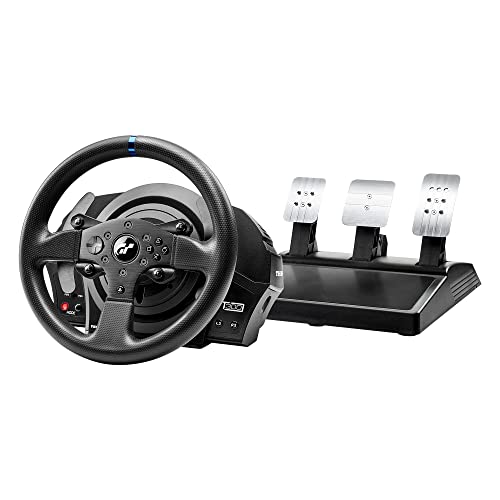
| Thrustmaster T300RS GT | Best belt-drive smoothness | Belt drive, GT pedal set | Check price on Amazon |
The G923 is the modern starter, refining the classic Logitech formula with its TRUEFORCE layer that pipes game audio and physics vibrations into the wheel. The G29 is its legendary predecessor, the wheel a generation of sim racers learned on, still sold, still supported, still honest. The MOZA R5 jumps the technology gap entirely, putting a direct-drive motor and a complete pedal package in one box at the point where belt wheels used to rule. The T300RS GT remains the belt-driven connoisseur’s choice, smoother than gears and backed by an ecosystem of interchangeable rims and a three-pedal GT set. Read the reviews by your ambitions, not by the table’s order.
How Were These Wheels Chosen?
The shortlist required a verifiable listing for the exact bundle, a force-feedback system with a proven record in PC titles, pedals included or clearly specified, and a mounting story that works at an ordinary desk as well as in a cockpit. It also required honesty about tiers: rather than pretending one wheel wins, the guide presents the gear, belt and direct-drive philosophies with their strongest mainstream representatives, because the most common expensive mistake in this hobby is buying the wrong tier confidently. Wheels that could not be verified cleanly, and exotic high-torque bases that belong in a specialist guide, were left out on purpose.
desk height and sturdiness for a clamped wheel
chairs that hold you through a stint
Logitech G923 — Best Modern Starter Wheel
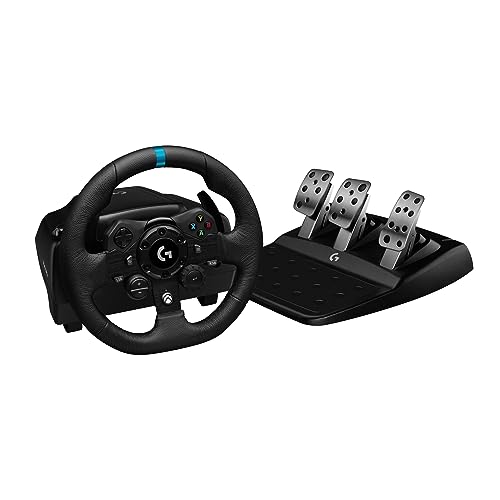
Badge: Best starter with modern feedback. The G923 takes Logitech’s proven gear-driven platform and adds TRUEFORCE, a system that connects directly to game physics and audio engines to deliver higher-frequency vibration detail through the wheel. The verified listing describes a racing wheel and pedals set with TRUEFORCE feedback up to a thousand hertz, a responsive pedal, dual-clutch launch control and a genuine leather wheel cover, for Xbox and PC in this variant. For a newcomer, the package’s completeness is the point: wheel, pedals, a desk clamp that works, and software that every major title recognises instantly, so the first evening is spent driving rather than configuring.
Mini spec box — G923
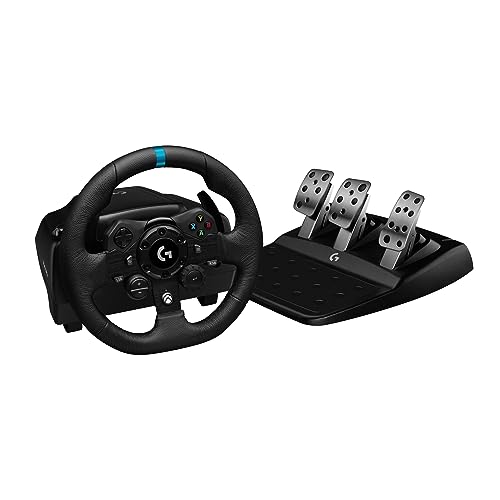
- Drive: gear-driven force feedback with TRUEFORCE
- Pedals: included, with dual-clutch launch feature
- Wheel cover: genuine leather per the listing
- Platforms on this listing: Xbox and PC
- Character: plug-in-and-drive completeness
Gear drive has a feel its owners should know in advance: a slight mechanical notchiness at centre and a faint gear soundtrack under hard lock, the honest texture of a system that has introduced millions to the hobby. TRUEFORCE’s extra vibration layer divides opinion, thrilling players who like engine and surface texture arriving through their hands and distracting those who prefer pure steering forces, and it can be tamed in settings. The pedals are the package’s ceiling, serviceable potentiometer units that teach the basics and eventually invite the load-cell upgrade this guide keeps recommending. As a first wheel that might also be a last wheel for a casual player, the G923 is the safest pair of hands in the business.
Strengths
- Complete, compatible and friendly from the first evening.
- TRUEFORCE adds texture that gear rivals cannot offer.
- Leather rim and build feel above the starter stereotype.
Trade-offs
- Gear feel and noise will eventually tempt an upgrade.
- Pedals are the bundle’s weakest component over time.
- TRUEFORCE support varies by title, so check your games.
Best for: newcomers and casual league racers wanting a complete, modern start. / Not suited for: detail hunters who already know they want direct drive.
Logitech G29 — Best Proven Value Classic
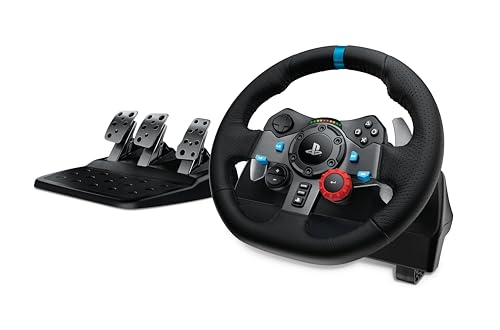
Badge: Best proven classic. The G29 is the wheel that built modern sim racing’s population, and its continued presence in this guide is earned rather than nostalgic. The verified listing describes a Driving Force wheel and floor pedals with real force feedback, stainless steel paddle shifters and a leather wheel cover, compatible with PC and Mac alongside its PlayStation heritage. Its helical gear system delivers the classic Logitech feel, direct, slightly gritty, utterly dependable, and its mountain of community knowledge means every game setting, every modification and every repair question has been answered publicly a hundred times over.
Mini spec box — G29
- Drive: helical gear force feedback
- Shifters: stainless steel paddles per the listing
- Pedals: floor pedal set included
- Wheel cover: leather
- Platforms: PC and Mac, with PlayStation roots
Choosing the G29 today is choosing maturity over novelty. It lacks the G923’s TRUEFORCE layer and carries an older design’s manners, but it counters with the deepest second-hand market, the widest accessory knowledge and a reliability record written across a decade of desks. For a player testing whether sim racing is a hobby or a passing enthusiasm, that maturity is a financial strategy: buy the classic, learn the craft, and if the bug bites, sell it into a market that always has buyers. If the bug does not bite, the G29 remains a perfectly enjoyable wheel for the occasional racing night, which is more than can be said for exotic hardware bought on a whim.
Strengths
- A decade of community knowledge surrounds every question.
- Dependable gear feedback and a proper leather rim.
- Strong resale makes it a low-risk first step.
Trade-offs
- No TRUEFORCE layer and an ageing design language.
- Gear notchiness is part of the permanent experience.
- Pedals share the starter-class ceiling of its sibling.
Best for: cautious newcomers and value hunters who prize proven hardware. / Not suited for: players who want the newest feedback technology in the box.

MOZA R5 Bundle — Best Direct-Drive Entry Point
Badge: Best direct drive for the money-minded. The R5 bundle is the product that redrew the hobby’s map, putting a direct-drive base into a complete, ready-to-race box. The verified listing describes a direct-drive base and pedal simulator kit for PC with five and a half newton-metres of peak torque, direct-drive force feedback, a quick-release wheel and everything needed to race out of the box. Direct drive’s advantage is not raw strength at this level but fidelity: the motor is the steering shaft, so kerbs, grip loss and surface changes arrive unfiltered, and the wheel can be perfectly smooth and silent at centre in a way gear systems cannot imitate.
Mini spec box — MOZA R5 Bundle
- Drive: direct drive, 5.5 Nm peak torque per the listing
- Package: base, wheel and pedals as a complete kit
- Quick release: real quick-release system
- Platform: PC
- Character: the modern ecosystem entry point
Five and a half newton-metres sounds modest beside the hobby’s flagship bases, and in a desk-clamp context it is honestly well judged: strong enough to communicate everything a car is doing, gentle enough not to wage war on your furniture. The bundle’s pedals are its acknowledged starting point rather than its finale, and MOZA’s ecosystem, with load-cell pedal upgrades and alternative rims, is designed to grow with the driver, which is the correct way to think about this purchase: not as a starter wheel to be discarded, but as the foundation of a rig that upgrades piece by piece. Players who know they are serious, or who have already owned a gear wheel and felt its ceiling, should start their reading here.
Strengths
- Direct-drive fidelity at a bundle’s convenience.
- Torque level suits desks and modest cockpits alike.
- An ecosystem built for staged upgrades.
Trade-offs
- Costs more than the gear-driven starters, as it should.
- Included pedals are a beginning, not a destination.
- Desk mounting deserves respect at this torque level.
Best for: committed newcomers and gear-wheel graduates ready for direct drive. / Not suited for: the merely curious, who should spend less to find out.
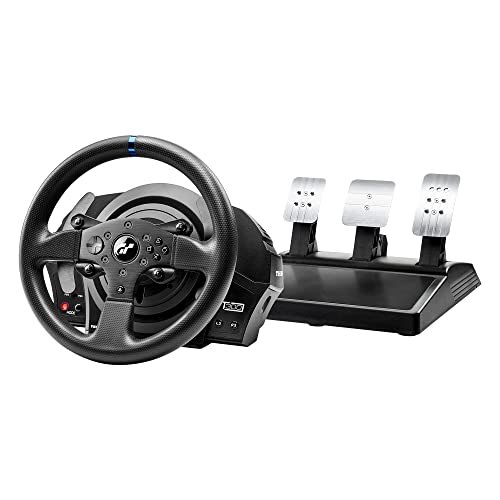
Thrustmaster T300RS GT — Best Belt-Driven Smoothness
Badge: Best belt-drive pick. Between the gears and the direct drives sits the belt, and the T300RS GT is its enduring ambassador. The verified listing describes a force-feedback wheel and three-pedal set for PS5 and PC, officially licensed for Gran Turismo, with a belt-driven motor, thirteen action buttons and a detachable wheel. Belt drive trades the gears’ notchiness for a smooth, damped sweep that many drivers still prefer for long stints, and the GT edition’s three-pedal set, with a clutch, opens the door to H-pattern shifting and heel-and-toe technique that two-pedal bundles cannot teach.
Mini spec box — T300RS GT
- Drive: belt-driven force feedback
- Pedals: three-pedal GT set with clutch
- Wheel: detachable, within an interchangeable ecosystem
- Buttons: thirteen action buttons per the listing
- Platforms: PC and PlayStation
The T300’s ecosystem is its long game: alternative rims, from open-wheel to classic round, swap onto the same base, letting one purchase serve a varied garage. Its known compromises are equally documented, a cooling fan that makes its presence heard and a stock rim that feels less premium than the base beneath it, inviting the ecosystem’s upgrades sooner than a budget might wish. For the driver who values smoothness and a clutch pedal today, and who likes the idea of a wheel collection tomorrow, it remains a deeply satisfying middle path, and for PlayStation-and-PC households it carries a compatibility the PC-only MOZA cannot offer.
Strengths
- Belt smoothness flatters long stints and road cars.
- Three pedals unlock clutch and H-pattern driving.
- Interchangeable rims give the base a long future.
Trade-offs
- Cooling fan is audible in a quiet room.
- Stock rim invites an ecosystem upgrade spend.
- Direct drive has overtaken belt on pure fidelity.
Best for: smoothness lovers, clutch-pedal drivers and PlayStation-plus-PC homes. / Not suited for: silence seekers or buyers finished with upgrade paths.
How Do the Four Wheels Compare?
| Wheel | Feedback character | Pedals | Upgrade path | Best first question |
|---|---|---|---|---|
| G923 | Gear plus vibration layer | Two-pedal starter set | Replace whole unit later | Do I want it simple and modern? |
| G29 | Classic gear feel | Two-pedal starter set | Resell and step up | Do I want the proven classic? |
| MOZA R5 | Direct-drive fidelity | Bundle pedals, upgradable | Pedals, rims, bases within brand | Am I serious already? |
| T300RS GT | Smooth belt sweep | Three pedals with clutch | Rims and pedals within brand | Do I want smoothness and a clutch? |
The pattern to notice is that the two Logitechs are destinations for casual players and starting points for serious ones, while the MOZA and the Thrustmaster are platforms, purchases whose value compounds as ecosystems grow around them. Neither philosophy is superior; they answer different levels of certainty about the hobby. The most expensive mistake available is buying a platform for a passing curiosity, and the second most expensive is buying a destination three times in three years on the way to the platform you wanted at the start. This guide’s job is to help you know which certainty is yours before the box arrives.
What Should You Prioritise When Buying a PC Racing Wheel?
Begin with the feedback system, because it decides the wheel’s character for its entire life. Gear drive is affordable, robust and textured; belt drive is smoother and quieter in feel; direct drive is the fidelity ceiling and the ecosystem future. Then interrogate the pedals with unusual severity, because braking decides lap times more than steering does at every level above the first month. A brake pedal that measures travel will always be outgrown by a driver who improves; a load-cell brake, which measures pressure, matches how real braking and human muscle memory actually work, and upgrading to one, within the MOZA ecosystem or as a later step elsewhere, is the hobby’s worst-kept secret for finding seconds.
Mounting comes third and is not glamorous enough for most marketing, which is exactly why it ruins evenings. A wheel’s torque will exploit a thin desk, a wobbly table or a chair on casters with comic inevitability. Measure your desk’s thickness against the clamp, consider whether the desk can be bolted or must stay pristine, and plan the chair situation, because a driver who rolls backwards under braking cannot brake consistently. Rotation range, button counts and rim diameter matter, in descending order of daily consequence, and all of them matter less than the three decisions above. Budget honestly across the whole system, wheel, mounting, pedals and the games themselves, because a mid-tier wheel on a solid desk will out-drive a flagship on a card table every single lap.
How Do You Set Up a Racing Wheel at a Desk?
Mount the wheel so its rim sits at chest height with your arms bent comfortably, the way a road car’s wheel meets a driver, and clamp it with the seriousness of a person who will shortly pull on it with real force. Position the pedals squarely under your feet, braced against a wall or a stop so braking cannot push them away, and set your chair so it cannot roll or swivel under braking, by locking casters, using a mat or linking chair and pedals in a frame if the hobby grows that way. In software, begin with the wheel manufacturer’s recommended settings for your main title, set the rotation to match the car class you drive, and resist the internet’s thousand conflicting force-feedback recipes until you have a baseline of your own laps to judge them against.
Then calibrate your expectations over a fortnight. The first sessions on any wheel are slower than a controller for most players, because the body is learning a new instrument, and the correct response is shorter stints, easier cars and patience, not a returns label. Braking points move, smoothness arrives before speed does, and the day the wheel stops feeling like equipment and starts feeling like the car is the day the purchase justifies itself. Keep notes on settings per game as you settle them, because sim titles each speak to hardware in their own dialect and your future self will not remember which dialect belonged to which title.
gaming mice for when the race ends
vr headsets, the other way to sit in the car
What Mistakes Do New Sim Racers Make?
Overbuying the base and underbuying everything else is the signature error: a mighty wheel on a folding table, with pedals sliding on carpet, teaches nothing except frustration. The second error is chasing torque numbers, when fidelity and smoothness serve a learner far better than strength that must then be tamed in settings. Third is neglecting the brake, spending on rims and gloves while the travel-based brake pedal quietly caps every lap time. Fourth is setting force feedback by a stranger’s recipe before developing a baseline, which produces a wheel configured for someone else’s hands, car and taste.
Fifth, newcomers quit during the slow fortnight, mistaking the learning curve for a verdict on the hardware or on themselves. Every sim racer alive was slower on a wheel before they were faster, and the ones who stayed describe the same turning point, usually a single clean lap where the car did exactly what their hands asked. Buy the right tier, mount it like you mean it, and give that lap time to arrive.
Gear, Belt and Direct Drive: The Honest Physics
Force feedback is a conversation between the game and your hands, and each drive type is a different translator. A gear system interposes toothed wheels between motor and rim; it is cheap, strong for its size and slightly lossy, adding a grainy texture and a little play at centre that experienced drivers can feel and newcomers cannot yet name. A belt system interposes a toothed belt, which smooths the translation, removes most of the grain and adds a faint elasticity that many drivers experience as realism, since real steering columns are not perfectly rigid either. A direct-drive system abolishes the translator: the rim bolts to the motor’s own shaft, so every signal the game sends arrives with its timing and detail intact, and the only texture in the wheel is the texture the game intended.
Why, then, does anyone buy the older systems? Because translation losses are small at the forces most driving uses, because budgets are real, and because a complete gear package costs what a direct-drive base alone can cost before pedals and a rim join the bill. The R5 bundle in this guide is significant precisely because it attacks that arithmetic, but it does not repeal it for every household. Judge the systems by your stage: a learner is limited by their hands, not by their translator, for at least the first year, which is why this guide can recommend the classics with a straight face while still naming direct drive as the destination for the committed.
Pedals Deserve Their Own Manifesto
Ask experienced sim racers what made them faster and most will not mention their wheel. Braking is where lap time hides, because a braking zone is the one place every lap where a large, repeatable physical skill decides everything downstream, and the pedal is that skill’s instrument. Bundled pedals measure travel with a potentiometer and cushion it with a spring or a rubber block, which teaches a beginner the geography of braking without teaching its pressure language. A load-cell pedal speaks pressure natively, and the transition, though it costs money and a week of recalibration, is the closest thing the hobby has to a guaranteed improvement, because human legs are simply better at repeating a force than a distance.
Throttle and clutch matter in their supporting roles. A smooth, slightly resistant throttle lets a driver feed power out of slow corners without the binary lurches that unsettle a car, and a clutch pedal, as in the T300RS GT’s set, unlocks the full manual ritual for those who want it. Whatever your bundle, spend setup time on pedal placement and bracing before spending money on replacements: pedals that cannot move under your hardest stop are worth seconds that no shopping can buy, and a pedal set wedged against a wall on a grippy surface is the cheapest performance part in this entire guide.
Which Games Will You Actually Drive?
Your library should arbitrate the tier argument, because different titles reward different hardware. Arcade-leaning racers forgive everything and delight on any wheel here, their generous handling models translating happily through gears. The big simulation titles, the ones with tyre models that punish a clumsy brake and reward a felt one, are where direct drive and load-cell pedals stop being luxuries and start being vocabulary: the car is speaking a language of small signals, and better hardware is literally a better translator. Rally titles add a special demand, rapid large rotations and violent surface feedback, where a quick, strong base earns its keep and a desk clamp earns its scars. Truck and farming simulators invert the brief entirely, valuing rotation range, smoothness and endurance over fidelity, a world where the belt-driven T300’s manners shine and torque is irrelevant.
Be honest about the proportions of your week. A player who drives one simulation seriously and visits arcades for fun should buy for the simulation and let the arcades be easy. A player whose week is mostly casual racing with friends should buy the friendly Logitech and spend the difference on the games themselves. Hardware guides love to assume a reader who is becoming a professional; this one assumes a reader who knows their own Friday night, which is a much better foundation for a purchase.
The Second-Hand Market and the Upgrade Ladder
Sim racing has an unusually healthy used market, because the hardware is durable, standardised and bought by adults who upgrade in stages. That market changes the buying logic in your favour at every tier. A G29 bought carefully, new or used, holds value because the next newcomer always exists. A direct-drive base holds value because ecosystems lock in loyalty. The practical consequence is that the true cost of trying this hobby is the difference between buying and reselling a classic, which is small, while the true cost of overbuying exotic hardware for a curiosity is the same difference computed on a much larger number. Climb the ladder one rung at a time, wheel, then mounting, then brake, then base, and let each rung be paid for partly by the last. The drivers with the finest rigs in any community rarely bought them in one year; they accumulated them, which is why their setups look inevitable and their advice sounds patient.
Force Feedback Settings Without the Superstition
Every sim community circulates settings recipes with the confidence of scripture, and a new owner’s first discipline is to treat them as starting points rather than scripture. Begin with the manufacturer’s own recommended profile for your title, drive an hour, and learn what each major control actually does by changing one at a time in exaggerated amounts on a test lap: overall strength, the smoothing or filter that trades detail for calm, and the damper that decides how the wheel behaves when the car is still. The goal is a wheel that communicates grip changes without clipping, the flattening that occurs when strength is set so high that big signals all feel identical, because a clipped wheel is a loud wheel saying nothing.
Keep a small settings notebook per title, physical or digital, and record what you changed and what the car did differently. Within a month you will own something no forum can give you, a settings intuition calibrated to your hands and your hardware, and the recipes of strangers will become what they should have been all along, suggestions to be tested rather than instructions to be obeyed. This is the same lesson the audio guide in this family teaches about sound, transposed to torque: your senses, patiently consulted, outrank every copied number.
Sharing the Wheel: Families, Friends and Hot-Seating
Racing wheels are unusually social hardware, because a driving setup invites an audience and a queue of people wanting a lap. Households should plan for that reality: a desk setup that assembles in two minutes will be shared happily, while a cockpit that requires a technician’s blessing before a friend can sit in it will quietly become a solo shrine. Adjustability is the social feature nobody lists: a seat or chair position that suits a tall parent and a small teenager, pedal reach that can be fudged with a cushion, and difficulty settings per driver profile in the game itself. The G29 and G923 earn a specific recommendation here, since their friendliness to a first-time driver, strong automatic settings in most titles, forgiving feedback, makes them the wheels most likely to convert a visiting sceptic into next week’s league opponent.
Maintaining a Wheel So It Feels New for Years
Racing hardware ages in specific, preventable ways. Dust is the universal enemy, working into pedal pivots and button contacts, so a soft brush and a cover, even a towel, over the rig between sessions repay their trivial cost. Pedal potentiometers in starter sets can grow scratchy with grit; keeping the floor around them swept and the pedals themselves clean postpones the day. Belts and gears ask for nothing but reasonable force settings and freedom from being used as furniture; a wheel is not a handle for standing up, and rims crack at the hub in households that forget it. Cables deserve strain relief and a route that no chair caster patrols, because the most common catastrophic failure in the hobby is a cable injury, not a motor death.
Software maintenance matters as much. Keep firmware current when the maker recommends it, save your per-game profiles somewhere backed up, and after any major game update, expect to spend one session re-verifying settings rather than assuming betrayal by the hardware. Owners who treat their wheel this way routinely report a decade of service from the classics in this guide, which reframes their prices entirely: the cheapest wheel is the one bought once, and the maintenance that achieves that is measured in minutes per month.
A Word on Noise, Neighbours and Late Sessions
Force feedback is physical, and physical means audible in the next room. Gear wheels chatter under hard correction, belt wheels hum and fan, direct drives thump a desk that acts as a sounding board, and pedals braced against a wall transmit braking to the building itself. Late-night drivers in flats should plan for this as seriously as for torque: a mat under the rig, a desk that does not touch the party wall, force settings trimmed for the small hours and a household that has been consulted rather than surprised. None of the wheels in this guide is antisocial by design, but the hobby rewards the driver who thinks about the whole house, because a rig that can be used at midnight without diplomacy gets used twice as much as one that cannot.
Learning to Drive All Over Again: The First Month
New wheel owners deserve a map of the first month, because its emotional weather is predictable and widely misread. Week one is humiliation: lap times worse than the controller’s, arms tired in unfamiliar places, and a suspicion that the internet lied. Week two brings the first clean laps and the discovery that smoothness, not aggression, is what the wheel rewards, as braking becomes a squeeze rather than a stomp and the throttle learns patience. Week three is where car control starts to feel like a language, corrections arriving before slides finish forming, and week four is where most drivers pass their controller times and never look back, wondering why the first week felt like evidence of anything.
Structure helps the month along. Pick one car and one track and live there until the combination is boring, because consistency of context is how the body isolates what the wheel is teaching. Turn the assists down gradually rather than all at once, keep sessions short enough that fatigue does not practise sloppy inputs into habit, and watch one replay a week with the pedals’ traces visible if your title offers them, since your braking will confess things your memory edits out. Above all, do not shop during this month. Every frustration in it is educational, none of them is a hardware defect, and the driver who emerges at the end will judge wheels with an authority the shopper at the start did not possess.
Wheels and VR: A Combination Worth Planning For
Many PC racers eventually pair their wheel with a virtual-reality headset, and the pairing is close to transformative, because the wheel gives the hands a true object to hold while the headset puts the eyes inside the car. If that future interests you, it argues quietly for the ecosystem purchases in this guide, since a direct-drive base and a solid mount do not care whether the screen is a monitor or a headset, and for keeping your button knowledge tactile, because in VR you will operate the wheel blind and every control must be findable by touch. The VR guide linked from this page covers the headsets themselves; the wheel-side lesson is simply to buy hardware whose controls you can learn by feel, and to arrange the desk so that reaching for a keyboard you cannot see never becomes part of the ritual.
What Do League Racers Know That Casual Buyers Do Not?
Regular league drivers, the hobby’s backbone, buy hardware with a different instinct: they prize boring reliability and next-day replaceability over exotic performance, because a season is ruined by a dead wheel in week six far more surely than by a tenth of fidelity. That is why so many league grids are full of Logitech classics and mid-tier ecosystems rather than flagship exotica, and why their owners speak about their wheels the way tradespeople speak about vans. If your ambitions include organised racing on a schedule, let that instinct govern you early: choose the platform whose parts, knowledge and replacements are everywhere, set it up once with great care, and then spend your evenings on racecraft, which is the only upgrade that compounds forever.
The Purchase, Sequenced
If this guide has done its work, your decision now has an order. First, name your certainty and your main titles, and let them choose the tier. Second, audit the desk and the chair, and spend on their shortcomings before the wheel arrives to expose them. Third, buy the wheel itself, from the verified listings above, checking the bundle’s contents against your audit. Fourth, spend the first month learning rather than upgrading, with a notebook for settings and a moratorium on accessories. Fifth, let the felt absence, a brake that will not repeat itself, a rim your favourite car class dislikes, choose the first upgrade, in the full knowledge that it will be the right one because your hands, rather than a catalogue, requested it. That sequence is the whole hobby in miniature, and drivers who follow it tend to own less hardware and enjoy more of it.
A Closing Note on What the Wheel Teaches
There is a reason sim racers become evangelists, and it is not the hardware. A good wheel teaches a physical literacy that a controller cannot: weight transfer felt through the hands, grip arriving and leaving like weather, the discipline of doing less, more smoothly. Players carry that literacy back into every other driving game and, not rarely, into their real driving, where smoothness is safety. Buy the wheel that fits your certainty and your desk, mount it with respect, survive the honest first month, and the object on your desk stops being a peripheral at all. It becomes the car, and everything else in the room is just the room.
What a Season of League Racing Actually Demands
Imagine the purchase from the far end of a season rather than from the unboxing. By week ten, the wheel has survived a hundred hours of force, a spilled drink nearby, a firmware update, two game patches that each moved the settings goalposts, and one evening where a friend’s enthusiastic nephew tested the clamp with his full weight. The hardware that emerges from that season with its feel intact is rarely the most exotic; it is the platform whose parts were standard, whose settings knowledge was public and whose mounting was over-engineered from the start. This is why this guide keeps returning to unglamorous virtues, bracing, bracing and bracing, standard ecosystems, saved profiles, because a season is the true unit of sim racing, and purchases should be made by the season’s standards rather than by the first evening’s excitement.
It is also why the guide’s tier advice is symmetrical. The curious beginner is protected from the season they will never run by the classic’s low stake and easy resale. The committed driver is protected from buying the season twice by starting on the platform that can finish it. Both protections are the same sentence read in two directions: buy the wheel your actual future can justify, and let the future, rather than the catalogue, do the persuading.
Final Recommendation
New and unsure? The Logitech G29 is the low-risk classic, and the G923 is its modernised sibling if TRUEFORCE’s texture and a fresher package appeal. New and already certain? Skip a step and start with the MOZA R5 bundle, whose direct-drive base will not need replacing when your skill arrives. Smoothness devotee, clutch-pedal romantic or a PlayStation-and-PC household? The Thrustmaster T300RS GT remains your wheel. In every case, spend what remains of the budget on mounting solidity and, in time, a load-cell brake, because that is where the lap time lives.
Frequently Asked Questions About PC Racing Wheels
Is direct drive worth it for a beginner?
For a beginner who is certain about the hobby, yes, because the R5-class bundles remove the need for a second purchase and their fidelity teaches good habits early. For a beginner who is merely curious, no; a gear-driven classic answers the curiosity at lower cost and resells easily. The variable is your certainty, not your skill.
Can I use these wheels on a normal desk?
Yes, with conditions. The desk must be sturdy and thick enough for the clamp, the pedals must be braced so they cannot slide, and your chair must not roll under braking. At the MOZA’s torque level, a flimsy desk will flex and complain, so be honest about your furniture before choosing your tier.
What is a load-cell brake and why does everyone recommend one?
Most bundled pedals measure how far the brake pedal travels; a load-cell pedal measures how hard you press. Human muscle remembers pressure more consistently than travel, so braking points become repeatable and lap times fall. It is the most consequential upgrade in the hobby and the reason ecosystem upgrade paths matter.
How much rotation do I need?
Enough to cover the cars you drive: road cars use a lot, open-wheel and GT cars use far less, and modern wheels let software scale the range per car. All four wheels here provide ample range for mainstream PC titles. Set it per car class rather than maxing it globally, and the steering will feel natural instead of nautical.
Do I need a cockpit or will a desk do?
A desk does fine for the gear and belt wheels and honestly for the R5, provided it is solid. A cockpit becomes worthwhile when you play daily, when pedal pressure grows serious, or when reassembling the desk setup each session starts costing you driving time. Let your habits, not your aspirations, schedule that purchase.
What desk thickness do the clamps need?
Most clamps in this class are happiest on solid desktops in the common two-to-five centimetre range, and struggle with very thick slab desks, glass tops and hollow doors pressed into service. Measure yours before ordering, and if it falls outside the friendly range, plan for hard-mounting through bolt holes, which most bases provide, or for a wheel stand, which solves thickness, bracing and storage in a single purchase and is the natural first step towards a cockpit.
What games should a beginner start with on a wheel?
Start with the titles and cars that forgive: slower cars on familiar tracks in whichever of your games has the friendliest handling model and the clearest feedback. The goal of the first month is repetitions of clean laps, not variety, and a forgiving car on a memorised circuit teaches the hands faster than a supercar on a new one. Graduate difficulty the way driving schools do, one variable at a time, and your wheel will feel like a teacher instead of an examiner.
Is a wheel better than a controller for racing games?
For simulation titles, after the learning month, almost every driver is faster, more consistent and more immersed on a wheel, because the controls match the task’s shape. For arcade titles the advantage narrows and can reverse for casual play. The honest answer is that a wheel is better at being a car, and whether that is better for you depends on how much of your racing wants to be a car in the first place.
Do I need to recalibrate for every game?
Expect one setup session per new title: rotation, force strength and button mapping are stored per game by most titles, and each simulation interprets the same hardware through its own physics. Keep the settings notebook recommended in this guide and the second setup of any title takes minutes. The wheel itself, once mounted and recognised, should not need constant attention, and if it does, a firmware or driver check is the first stop rather than the settings page.
Can children use these wheels safely?
Yes, with supervision and sensible settings. Turn the force strength down for small drivers, teach them that the wheel can move with real authority when a game loads or a crash occurs, and keep fingers away from the mechanism during calibration, when wheels spin themselves through their range. Set up that way, a family wheel is one of gaming’s great shared pleasures, and the classics in this guide have introduced a generation of young drivers to the hobby at exactly the right strength.
How long will a racing wheel last?
With ordinary care, the classics in this guide are famous for lasting the better part of a decade, and direct-drive bases have even fewer wearing parts to fail. The components that age first are consumables and cosmetics, pedal springs, rim grips and cables, most of them replaceable. Buy the tier you need, keep it clean and braced, and the wheel will likely be retired by your ambitions rather than by its own failure.
Should I buy a shifter and handbrake too?
Only when your driving asks for them. A sequential-minded GT driver may never need either; a rally or classic-car enthusiast will want a handbrake and possibly an H-pattern shifter early. Let a month of driving tell you which rituals you miss, because accessories bought for an imagined style of driving mostly become desk ornaments, while the ones bought for a felt absence get used every session.
Will these wheels work with my games?
All four are mainstream PC hardware recognised by the major racing titles, though the depth of features, such as TRUEFORCE or specific button mapping, varies by game. Check your main title’s supported-hardware notes for the features you care about, and expect to spend one evening per new game dialling settings to your hands.
Should a first wheel live on a desk clamp or on its own stand?
Start with the clamp if your desk is also your workplace, because a clamped wheel comes off in minutes and returns the room to ordinary life between sessions. Choose a stand when the desk is shared, unusually thin, or visibly flexing under braking, since a stand gives the pedals a fixed brace and keeps your seating position identical every time you sit down. The deciding question is repetition: drivers who must rebuild their setup before every session quietly drive less often, so pick whichever arrangement you will actually leave ready, or can assemble without sighing, on an ordinary weeknight. Neither arrangement changes what the wheel itself can do, and plenty of fast drivers began on a wobbling kitchen table, so treat this as a comfort decision rather than a performance verdict.
How strong should force feedback feel during the first month?
Set it noticeably lighter than the maximum the base can deliver, then raise it in small steps across separate sessions rather than during a single enthusiastic evening. You are listening for detail, not wrestling for exercise: kerb texture, front-tyre scrub and the first hint of rear slip should arrive as information your hands can read at speed. If every corner becomes a strength contest, the signal is being buried under effort and your inputs will get later and rougher. A useful test is a long stint at the end of the month; if your forearms ache and your lap times fade, the wheel is set for showing off, not for learning. Keep notes as you adjust, changing one setting at a time, because memory flatters whatever strength you tried most recently and a written record keeps the experiment honest across the whole first season of driving.