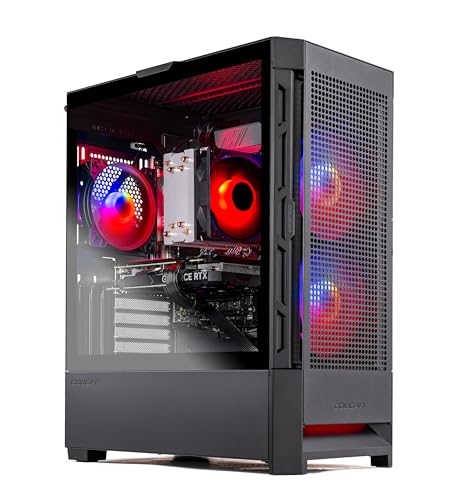
Where to buy
Check the latest price, availability and delivery on Amazon. Orders are placed on Amazon. We may earn a commission from qualifying purchases.
- Best 1440p value under $1,200: Skytech Blaze4 Mini, Ryzen 7 5700, RTX 4060 Ti, 16GB, 1TB — Check on Amazon
- Thermaltake LCGS Quartz i1460, Core i5-14400F, RTX 5060 — Check on Amazon
- CyberPowerPC Gamer Xtreme VR, Core i7-13700F, RTX 4060 Ti 16GB — Check on Amazon
- Skytech Archangel, Core i5-14400F, RTX 4060, 32GB DDR5, 2TB — Check on Amazon
See 2 more Amazon options
- CyberPowerPC Gamer Xtreme VR, Core i5-13400F, RTX 4060, DDR5 — Check on Amazon
- Skytech Nebula, Ryzen 5 5600X, RTX 4060 Ti — Check on Amazon
Read the full guide ↓
Disclosure: As an Amazon Associate, reviewstook.com earns from qualifying purchases. Links to Amazon on this page are affiliate links; they cost you nothing extra. Listing details such as price and availability change often, so check the current Amazon listing before you buy.
Before the picks, one distinction decides whether this guide — and any 1440p desktop listing — is telling you the truth. There is the resolution your monitor displays, and there is the resolution your graphics card actually renders, and at modern prices those two numbers are often different. A 1440p panel shows 2560×1440 pixels no matter what feeds it. A game rendered natively at 1440p did all of that work on the card. A game rendered at 1080p and upscaled to fill the panel also “plays at 1440p” in the loosest marketing sense, but the card did roughly half the rendering work, and the image is softer for it. Upscaling is a legitimate, useful technology — this guide recommends it in its place — but a desktop bought for 1440p gaming should be judged first on what it renders natively, and only then on how gracefully it upscales. Every pick below is graded that way.
Judged that way, $1,200 is the first budget where the honest answer is a good one. The graphics cards in this guide — the RTX 4060 Ti, the RTX 5060 and the RTX 4060 — render the great majority of current games natively at 1440p: the Ti and 5060 machines at high settings, the plain 4060 machines at medium-to-high settings, with DLSS upscaling held in reserve for the heaviest titles and for chasing high-refresh rates rather than needed to make the resolution survivable. That is a real threshold. The tiers below this one sell 1440p as an upscaling exercise; this tier sells it as a native resolution with upscaling as headroom. What this budget does not buy, and no listing at this price can honestly sell you, is native 4K — that conversation starts two price tiers up, and a “4K ready” badge here means upscaling under a false name. Prices also need their honest note: two of the six desktops below regularly drift above this budget between deal events, so their reviews tell you plainly when a pick only belongs here while it is priced inside the budget — check the current price on Amazon before you buy. For most buyers, start with the Skytech Blaze4 Mini, which pairs this tier’s defining graphics card with strong value inside the budget, or the Thermaltake Quartz if you would rather have the current GPU generation without playing the deal calendar. Below: the quick picks, a section on what “rendered at 1440p” really means, detailed reviews of all six desktops, a comparison table, monitor-pairing guidance, the mistakes that waste money at this tier, and the questions buyers ask before ordering.
In this guide
Quick Picks
Short on time, or comparing several options at once? Each row below names a buyer type and the desktop that suits it, with a link to the listing.
| Buyer type | Pick | Why it stands out | Link |
|---|---|---|---|
| Best 1440p value under $1,200 | Skytech Blaze4 Mini, Ryzen 7 5700, RTX 4060 Ti | Native-1440p card with strong value in this tier — check price on Amazon | Check on Amazon |
| Best current-generation GPU | Thermaltake LCGS Quartz i1460, RTX 5060 | The only 50-series card here — check price on Amazon | Check on Amazon |
| Best for 1440p longevity | CyberPowerPC Gamer Xtreme VR, RTX 4060 Ti 16GB | Double the VRAM of the field — a buy when priced within this budget; check price on Amazon | Check on Amazon |
| Best memory and storage | Skytech Archangel, 32GB DDR5, 2TB SSD | Double the RAM and storage of the field, on a DDR5 platform | Check on Amazon |
| Best under $800 | CyberPowerPC Gamer Xtreme VR, RTX 4060, DDR5 | Native 1440p at medium-to-high, positioned a tier below the rest — check price on Amazon | Check on Amazon |
| Best when the price dips | Skytech Nebula, Ryzen 5 5600X, RTX 4060 Ti | Pricing swings widely on this listing — timing is everything; check price on Amazon | Check on Amazon |
How These Picks Were Chosen
The first filter was the one this keyword demands: the graphics card had to render 1440p natively as its normal mode of operation. That excluded the RTX 3050 towers and the laptop-class machines that pad out this price band on Amazon — desktops that reach a 1440p panel only by rendering far below it and upscaling everything, all the time. Every pick below renders most current games at a true 2560×1440. Within that bar, the cards separate honestly: the RTX 4060 Ti and RTX 5060 machines do it at high settings in most titles; the RTX 4060 machines do it at medium-to-high settings and reach for DLSS sooner in the demanding tail of the catalog. Both are genuine 1440p desktops. They are not the same amount of 1440p desktop, and each review says which one it is describing.
The second filter was about what surrounds the card. A desktop bought for a 1440p monitor is a machine you keep — the panel will outlast a console generation — so we compared VRAM, memory generation and capacity, storage, power supply wattage and rating where the listing publishes it, and platform, favoring listings that state their numbers in full. VRAM deserves its sentence here because 1440p is where it starts to bite: textures are rendered for the resolution you play at, and 8GB cards already meet a small set of recent titles that prefer more at 1440p. That is a longevity caveat, not a speed difference, and it is why one pick below carries double the field’s VRAM. The machine also had to be a genuine tower built from standard parts — a retail-style motherboard, a standard ATX power supply, a case with room to work — because the honest 1440p upgrade path, when this card class eventually ages, is a graphics card swap, and that swap has to be physically possible.
We did not use these desktops ourselves. We read the maker listings and specification pages and compared the components above. Platform honesty mattered alongside parts: this tier straddles two memory generations, and DDR4 machines game identically to DDR5 machines today while costing less, whereas DDR5 is the standard a future platform will reuse. Two picks sit on AMD’s finished AM4 socket — a dead end for processor upgrades, and a bargain precisely because of it. Each review states which trade its machine is making. Finally, the budget was applied as a ceiling with a condition: a desktop belongs here if it is priced at or under $1,200 as a normal, recurring event. Two picks drift above the ceiling for weeks at a time between sales; they are included because they return inside the budget regularly, and their reviews say plainly that when they sit above the ceiling they belong to a higher guide. Because listing prices move, this guide does not print them — check the current price on Amazon for every pick before you buy.
Rendered vs Displayed: What “1440p Gaming” Actually Means
A 1440p monitor is a grid of 2560×1440 pixels — about 3.7 million of them, roughly 1.8 times the count of a 1080p screen. Displaying is the panel’s job and it is free: the grid lights up at that resolution whatever arrives. Rendering is the graphics card’s job and it is not free: every one of those pixels has to be computed, shaded and textured for every frame. When a game renders natively at 1440p, the card did the full computation. When a game renders at a lower resolution and the result is stretched to fill the panel — by simple scaling, or by an intelligent upscaler — the card did less work and the panel merely displays the result at 1440p size. The distinction is invisible in a listing’s headline and completely visible on the screen, which is why it leads this guide.
DLSS, NVIDIA’s upscaler, is the sophisticated version of that stretch, and on the RTX cards in this guide it is genuinely good — good enough that using it is a strategy, not an apology. But its settings are rendering resolutions wearing output-resolution clothes, and the honest numbers are worth knowing. With a 1440p panel, DLSS Quality renders internally at roughly 1707×960 and reconstructs the 2560×1440 image from there; DLSS Performance renders internally at roughly 1280×720 — a 1080p-class workload and below — and reconstructs from that. Quality is close enough to native that many players cannot tell them apart in motion, and it is the right tool for pushing a heavy game from playable to smooth, or a smooth game toward a high-refresh panel’s ceiling. Performance is a bigger reconstruction asked to do more work, and the softness shows accordingly. The rule this guide applies: a 1440p desktop should be bought on its native rendering, with DLSS Quality as its reserve and DLSS Performance as its emergency exit. A machine that needs Performance mode to reach 1440p at all is a 1080p machine with good marketing, and none of the picks below is that — but the two RTX 4060 desktops will visit Quality mode in heavy titles sooner than the Ti and 5060 machines will, and their reviews say so.
Frame generation needs the same plain treatment, because the RTX 5060 pick below advertises the newest version of it. Frame generation inserts additional frames — rendered by an AI model from the frames around them — between the frames the game actually renders. The displayed frame rate rises and motion looks smoother. The game itself is not rendering any faster, and your inputs are not being answered any sooner: input latency follows the true rendered rate, not the displayed one. On the 40-series cards here, DLSS frame generation can add one generated frame per rendered frame in supported titles; the 5060’s multi frame generation can add more. Treat all of it as a presentation feature that flatters a frame-rate counter — pleasant in a single-player game you are already running well, irrelevant to competitive play, and never a substitute for the native rendering this guide grades on. The final boundary is VRAM: at 1440p, texture data is the resolution’s tax, and the 8GB fitted to five of these six cards is the tier’s known ceiling — fine for the overwhelming majority of current games, already snug in a handful of texture-heavy recent releases, and the reason the one 16GB machine in this guide exists.
The 6 Best Gaming Desktops for 1440p Gaming Under $1,200
Skytech Blaze4 Mini — Ryzen 7 5700, RTX 4060 Ti 8GB, 16GB DDR4, 1TB SSD
Who it suits: Buyers who want this tier’s defining 1440p graphics card at a price that has repeatedly undercut the budget itself — and who can buy when the price is right rather than on a fixed day.
The Blaze4 Mini leads this guide because it is the cheapest honest route to the thing the keyword asks for. Its RTX 4060 Ti renders 1440p natively at high settings in most current games — the full 2560×1440 computed on the card, not reconstructed — and where a heavy title does ask for help, DLSS Quality is a reserve it dips into rather than a crutch it leans on. This tower has repeatedly been priced well inside this budget — low in the tier for a machine built around this card — so check the current price on Amazon, because its value case is strongest when it is sitting in the lower part of its range. The rest of the specification is sensible and standard — a Ryzen 7 5700 with eight cores, 16GB of DDR4-3200, a 1TB SSD, a 650W 80 Plus Gold power supply, WiFi and Windows 11 Home, in a compact case that is still a genuine tower with replaceable parts inside. The published 650W Gold unit matters to a 1440p buyer specifically: it has the wattage and rating to accept a meaningfully stronger graphics card when this class ages, which is the upgrade this machine will eventually want.
The limitations are platform and texture memory. The Ryzen 5700 sits on AM4, AMD’s finished socket: superb value today, but a processor upgrade later means a new motherboard and memory too, so the realistic upgrade path is graphics card and storage. The 4060 Ti’s 8GB of VRAM is the card’s known ceiling at 1440p — renders at full speed, but a small number of texture-heavy recent titles already prefer more, which is exactly the gap the 16GB CyberPowerPC further down exists to fill. And the price discipline is real: this listing’s price moves around, and its value depends on where it is sitting when you look. Check the current price on Amazon before you click: priced low in its range it is the best value in the guide; priced at the top of it, it is merely a good desktop, and the steadier picks below compete hard. Skytech also notes on its listings that the graphics card brand may vary — the model and VRAM are the contracted spec, not the badge on the cooler.
- RTX 4060 Ti 8GB — native 1440p at high settings in most games, in a tower positioned as this tier’s value route to the card — check price on Amazon.
- DLSS held as headroom: Quality mode for the heaviest titles and high-refresh chasing, not a daily necessity.
- 650W 80 Plus Gold power supply leaves genuine room for a future GPU upgrade.
Honest limitation: AM4 is a finished platform, so a future CPU upgrade means replacing the motherboard and memory too, and the 8GB of VRAM is the snuggest fit here for texture-heavy 1440p titles.
Choose it if you can time the purchase to a deal and want maximum native-1440p performance for the money. Skip it if you must buy today and its current price is sitting high in its range — check the current price on Amazon for both this and the Thermaltake below, which is the steadier buy.

Thermaltake LCGS Quartz i1460 — Core i5-14400F, RTX 5060 8GB, 16GB DDR4, 1TB NVMe
Who it suits: Buyers who want the current graphics generation — the newest DLSS feature set and the longest driver support runway — rendering their 1440p panel, at a price that has stayed honestly inside the budget.
The Quartz is the only desktop here built around a 50-series card, and judged on native rendering — the standard this guide applies — the RTX 5060 performs in the same class as the 4060 Ti machines around it: 1440p rendered at full resolution, at high settings, in most current games. What the newer generation adds is the newest DLSS, including multi frame generation in the titles that support it, and that feature gets its honest description here rather than its marketing one: it inserts AI-generated frames to raise the displayed frame rate, which makes motion look smoother; it does not render the game any faster and it does not reduce input latency, so it is a presentation feature to enjoy in single-player games, not performance to count. The machine around the card is current and standard: a Core i5-14400F with ten cores, 16GB of Thermaltake’s ToughRam DDR4-3600, a 1TB NVMe drive, a 600W 80 Plus Gold power supply, WiFi and Windows 11, in Thermaltake’s own airflow-first case. Its pricing has stayed honestly inside this budget as an everyday matter, not as a once-a-quarter dip — check the current price on Amazon — which makes it the 1440p pick for buyers who do not want to play the deal calendar.
Two trade-offs define it. Thermaltake paired Intel’s LGA1700 platform with DDR4 rather than DDR5: nothing is lost in games today, but the memory will not carry into a future platform the way the DDR5 picks’ memory can, and the socket is at the end of its road — like the AM4 machines, this tower’s big future upgrade is the graphics card. The 600W power supply, properly rated as it is, offers the least upgrade headroom in the guide: fine for this card and its successor class, not the unit you would choose ahead of a flagship swap. Neither point dents what the Quartz is — the current-generation 1440p desktop at an honest, standing price, from a builder whose cases and power supplies are retail products in their own right.
- RTX 5060 — the only current-generation card in the guide, native 1440p with the longest driver runway.
- Priced inside this budget in ordinary pricing, not as a one-off dip — check price on Amazon.
- Newest DLSS generation, including multi frame generation in supported titles — a presentation feature, honestly framed.
Honest limitation: The DDR4 memory and end-of-road socket cap the platform’s lifespan, and the 600W PSU leaves adequate rather than generous upgrade room.
Choose it if the newest GPU generation matters to you and you would rather not hunt deals. Skip it if DDR5 and the widest upgrade headroom matter more than the GPU’s generation — the Archangel below is your pick.

CyberPowerPC Gamer Xtreme VR — Core i7-13700F, RTX 4060 Ti 16GB, 16GB DDR5, 1TB NVMe
Who it suits: 1440p players planning to keep the machine for years — especially anyone whose games are the texture-heavy kind that punish 8GB of VRAM — provided they buy it while it is priced within this budget and not above it.
One specification is this machine’s whole argument, and at 1440p it is a strong one: 16GB of VRAM, double every other desktop in this guide. The RTX 4060 Ti 16GB renders at exactly the same speed as its 8GB sibling — the extra memory buys no frames today. What it buys is texture headroom at the resolution where textures cost the most: the small but growing set of recent titles that stutter or quietly downgrade their textures on 8GB cards at 1440p simply do not on this one, and that set grows every year of the machine’s life. Its native-1440p rendering is otherwise the Ti class’s — high settings in most games, DLSS Quality in reserve. Around the card, CyberPowerPC has fitted a Core i7-13700F, the strongest processor in this guide with sixteen cores, 16GB of DDR5, and a 1TB NVMe drive, in a standard full-size tower. On specification alone, nothing here is built to stay relevant longer.
No pick in this guide has a more split pricing personality. It is regularly priced inside this budget during deal events, and sits above the ceiling the rest of the time, where it is a different guide’s machine and worse value than several desktops in this one. The rule is therefore printed on the pick itself: while it is priced within the budget, it jumps the queue for any buyer who prioritizes 1440p longevity; when it sits above $1,200, walk away without regret and buy the Blaze4 or the Quartz instead. Check the current price on Amazon before you buy. With DDR5 underneath and standard-parts construction throughout, the platform side is as durable as the graphics side — the only apology this machine owes is about its price, not its structure.
- 16GB of VRAM — double the field, and the single best 1440p longevity feature at this budget.
- The Core i7-13700F is the guide’s strongest processor, on a DDR5 platform.
- When priced within this budget, it has a real claim to being the best buy in this guide — check price on Amazon.
Honest limitation: Between deals it sits entirely outside this budget. The recommendation applies only while it is priced within the budget; above the ceiling it has no place here.
Choose it if texture-heavy 1440p games are your library, you keep a machine four years or more, and you can wait for its deal. Skip it if you are buying this week and the listing shows above $1,200 — no specification makes that price honest.

Skytech Archangel — Core i5-14400F, RTX 4060 8GB, 32GB DDR5, 2TB SSD
Who it suits: Buyers whose bottleneck is not frames but everything around them — big game libraries, a dozen launcher and browser tabs, streaming or recording while playing — and who would rather pay for capacity now than open the case twice in the first year.
The Archangel trades one headline spec for the specs people actually run out of. Its RTX 4060 is a step below the 4060 Ti machines: still a genuine native-1440p card — most games rendered at the full 2560×1440 at medium-to-high settings — but with less headroom in the heaviest titles, where it will reach for DLSS Quality while the Ti picks are still rendering natively. What the trade buys is double everything else: 32GB of DDR5-5600 where the field has 16GB, and a 2TB SSD where the field has 1TB. Those numbers are not decorative. Modern game installs run 70–150GB, so the 1TB drives in this guide hold perhaps eight large games before the deleting starts; the Archangel holds twice that, and 32GB of memory ends the quiet performance tax of browsers, chat apps and launchers competing with your game for the other 16GB. The platform is the modern one — a Core i5-14400F on DDR5, a 650W 80 Plus Gold power supply, WiFi and Windows 11 Home in Skytech’s standard-parts tower. Its pricing has generally lived inside this budget, toward the upper part of the tier — one of the more honestly positioned machines in the guide, without the wide swings some picks here show. Check the current price on Amazon before you buy.
The limitation is the mirror of the pitch. If your library is three games and your browser discipline is good, you paid for capacity you will not touch, and the Blaze4’s stronger card serves your 1440p panel better at similar money. The 8GB of VRAM carries the same 1440p texture caveat as the Ti card’s. Judge this pick by your storage and multitasking habits, not by the tier’s fashion.
- 32GB of DDR5 and a 2TB SSD: twice the field’s memory and storage, closing out the two upgrades owners usually make first.
- Native 1440p at medium-to-high settings in most games; DLSS Quality as the heavy-title reserve.
- Its pricing stays comparatively steady inside the budget, so no deal lottery is involved — check price on Amazon.
Honest limitation: Its RTX 4060 is the guide’s second-strongest card, and heavy 1440p titles will call on DLSS earlier than they do on the 4060 Ti machines.
Choose it if a big library and genuine multitasking describe your desk, and you want nothing left to add. Skip it if a small rotation of games is all you play — the Blaze4’s stronger card serves that better.

CyberPowerPC Gamer Xtreme VR — Core i5-13400F, RTX 4060 8GB, 16GB DDR5, 1TB Gen4 SSD
Who it suits: Buyers whose 1440p monitor is coming rather than already on the desk — or whose panel is 1440p but whose games are the lighter, older or esports end of the catalog — and who would rather leave this guide with a desktop and money left over.
Every $1,200 guide should contain one machine that asks whether you need to spend $1,200, and for a 1440p buyer this one asks the question in a specific way: how much of your gaming actually needs the Ti? This CyberPowerPC is positioned a full price tier below the rest of the guide, with the specification kept honest: a Core i5-13400F, an RTX 4060, 16GB of DDR5 and a 1TB PCIe Gen4 SSD, with WiFi and Windows 11 Home in a standard tower. The RTX 4060 renders 1440p natively at medium-to-high settings in most titles, which covers esports, older games and the bulk of a typical library at full resolution; it is in the heaviest current releases that it reaches for DLSS Quality where the Ti picks render natively, and reaches sooner. The DDR5 platform is the quiet headline: unlike the DDR4 towers that usually own the lower shelves of this market, this machine’s memory standard is the current one, so the platform is not the part you will replace first.
What you surrender against the rest of the guide is 1440p headroom — and nothing about the machine’s structure. If your monitor is a 1440p high-refresh panel and your library is this year’s heaviest releases, that headroom is worth real money — take a Ti pick. If your panel is 1080p today, the money this pick leaves in your pocket goes a long way toward the 1440p monitor itself, and when the card eventually becomes the bottleneck, the honest upgrade is a graphics card this tower’s standard construction accepts. It is the desktop argument distilled: buy the platform now, upgrade the single part later.
- The guide’s value pick, positioned well below the rest of the tier on a DDR5 platform — check price on Amazon.
- RTX 4060 renders native 1440p at medium-to-high settings in most titles.
- Standard-parts tower with a real upgrade path when the card ages.
Honest limitation: In heavy titles at 1440p it leans on DLSS earlier than the 4060 Ti machines, and its 8GB of VRAM is the tier’s familiar ceiling.
Choose it if your 1440p gaming is esports, older or lighter titles, or your panel upgrade is still ahead of you. Skip it if a 1440p high-refresh monitor is already on your desk and your library is the heaviest current releases — spend the full budget on a Ti.
Skytech Nebula — Ryzen 5 5600X, RTX 4060 Ti 8GB, 16GB DDR4, 1TB NVMe
Who it suits: Patient buyers who understand that some listings have two prices — the one for people buying today and the one for people buying well — and who want 4060 Ti rendering when this listing is being the second kind.
There is nothing to apologize for in the Nebula’s specification: Skytech’s standard tower carries a Ryzen 5 5600X, an RTX 4060 Ti 8GB, 16GB of DDR4-3200, a 1TB NVMe drive, a 600W 80 Plus Gold power supply and Windows 11 Home. That is the same graphics card as the guide’s leading pick — the same native 1440p at high settings in most games, the same DLSS reserve — behind a slightly older six-core processor that costs it little in games. Everything interesting about it lives in its pricing, which swings wider than any other pick in this guide — from well inside this budget to well above the ceiling. That spread makes the Nebula as much a lesson as a pick. Priced low in its range, it stands alongside the Blaze4 as the best value in the guide. Priced in the middle of its range, it is an honest but unremarkable 4060 Ti tower. Priced at the top, it stops being this guide’s machine at all — close the tab. Check the current price on Amazon before you judge it.
Its platform story mirrors the Blaze4’s: AM4 is finished, leaving graphics and storage as the upgrade path; 8GB of VRAM is the 1440p texture ceiling; and Skytech’s note that the graphics card brand may vary applies here too. What distinguishes the Nebula is purely discipline. Decide your walk-away line before you open the listing — ours is simple: buy it only while it is priced comfortably inside this budget, and pass the moment it approaches or crosses the ceiling — because a spread like this one is built to catch buyers who shop by specification alone.
- RTX 4060 Ti native-1440p performance, at its best when the listing is priced low in its range — check price on Amazon.
- A standard-parts Skytech tower with a 600W Gold PSU and 1TB NVMe storage.
- The guide’s clearest case for checking the live price rather than trusting a headline.
Honest limitation: The top of its price range sits outside this budget and represents poor value; the pick only exists in the bottom half of its range.
Choose it if the listing is priced well inside the budget when you are ready — check the current price on Amazon. Skip it if it is anywhere near the top of its range — that money is better spent on the 16GB CyberPowerPC on deal, or the Quartz on any day.

Comparison Table
| Product | Graphics card | Native 1440p verdict | Link |
|---|---|---|---|
| Skytech Blaze4 Mini (Ryzen 7 5700) | RTX 4060 Ti 8GB | Native at high settings in most games — check price on Amazon | Check on Amazon |
| Thermaltake LCGS Quartz i1460 | RTX 5060 8GB | Native at high settings in most games; current generation | Check on Amazon |
| CyberPowerPC Gamer Xtreme VR (i7-13700F) | RTX 4060 Ti 16GB | Native at high settings, with double the texture headroom; a buy only while priced within this budget | Check on Amazon |
| Skytech Archangel (32GB / 2TB) | RTX 4060 8GB | Native at medium-to-high settings; DLSS sooner in heavy titles | Check on Amazon |
| CyberPowerPC Gamer Xtreme VR (i5-13400F) | RTX 4060 8GB | Native at medium-to-high settings; positioned a tier below the rest | Check on Amazon |
| Skytech Nebula (Ryzen 5 5600X) | RTX 4060 Ti 8GB | Native at high settings — when its price dips well inside the budget | Check on Amazon |
Pairing a 1440p Monitor With These Desktops
The desktop is only half of a 1440p setup, and the panel half deserves the same honesty about what matters. Size first: 27 inches is the resolution’s sweet spot, where 2560×1440 gives you a visibly sharper image than 1080p without the tiny interface text of a smaller panel or the diluted density of a much larger one. Refresh rate second: every card in this guide can push frame rates well past what a 60Hz panel can show at 1440p in a large share of games, so a 144Hz-or-higher panel is what turns that rendering into motion you can actually see — a 60Hz 1440p screen paired with a 4060 Ti is headroom paid for and never displayed. Adaptive sync is the third item and the one that makes the other two behave: look for a panel with variable refresh (sold as G-Sync Compatible or FreeSync), which lets the monitor’s refresh follow the game’s frame rate instead of tearing or stuttering when the two disagree. All six cards here drive adaptive-sync 1440p panels over DisplayPort, and DisplayPort is the cable to use — it is the connection that carries the panel’s full refresh rate at this resolution on the widest range of monitors.
Two pairings to avoid. The first is a 4K panel “for later”: these desktops render 1440p, and a 4K screen fed a 1440p render is an upscaling chain you chose on purpose, softer than the native 1440p panel the same money buys. If 4K is genuinely your destination, it needs a different desktop budget, not a hopeful monitor. The second is keeping an old 1080p 60Hz office monitor and spending the whole budget on the tower: the Blaze4 and its siblings will render beautifully into a screen that cannot show you most of it. The honest split for a from-scratch setup is the cheaper CyberPowerPC pick plus a good 1440p high-refresh panel, rather than the dearest tower plus a tired display — the screen is where the frames go. One setup habit matters on day one: after connecting the panel, set its full refresh rate in your display settings and confirm the in-game resolution is the panel’s native 2560×1440 before judging any game’s performance, because a desktop left at a default 60Hz or a game left rendering at 1080p will both disguise what you actually bought.
How to Choose a Gaming Desktop for 1440p Gaming Under $1,200
- Grade on native rendering first. Ask what the card renders at 2560×1440 before any upscaler is switched on. In this guide that is high settings for the 4060 Ti and RTX 5060 picks, medium-to-high for the 4060 picks. Upscaling quality is the tiebreaker, never the headline.
- Know the DLSS numbers. At 1440p output, DLSS Quality renders internally around 1707×960 and Performance around 1280×720. Quality is a legitimate everyday tool on the heavier titles; a machine that lives in Performance mode at its own target resolution is underpowered for it.
- Treat VRAM as a longevity spec rather than a speed spec. 8GB and 16GB versions of the same card render at the same speed today; the 16GB card holds its texture settings at 1440p years longer. Keep machines a long time? That difference outranks a processor tier.
- Buy the graphics card class first. The hierarchy that matters at this money puts the 4060 Ti and RTX 5060 above the RTX 4060, with everything else — processor generation, RGB, case glass — a distant second. A newer CPU behind a weaker card is a worse 1440p desktop, full stop.
- Treat frame generation as presentation, not performance. It raises the displayed frame rate without rendering faster or answering inputs sooner. Enjoy it in single-player games; never let it substitute for native rendering in a buying decision.
- Decide what DDR5 is worth to you. DDR4 machines are cheaper and game identically today. DDR5 costs more because it is the standard your next platform will reuse. Neither answer is wrong — just know which one you bought, because it decides whether your memory survives your next upgrade.
- Check the power supply like an adult. Wattage and an 80 Plus rating, published in the listing — the documented picks here run 600–650W Gold units, enough for their cards and the next class up. A listing that will not state its PSU is telling you something by the omission.
- Judge by the live price, not the headline. Two of these picks drift above $1,200 between deal events, and listing prices in this tier move often — which is why this guide prints none of them. Check the current price on Amazon, buy when a pick is priced well inside the budget, and walk away when it sits above the ceiling.
- Budget for the panel as part of the machine. A $1,200 desktop in front of a 60Hz monitor is a worse 1440p experience than the value CyberPowerPC pick in front of a good 144Hz 1440p screen. The tower is the largest line in the budget, not the only one.
Common Buying Mistakes
- Believing “plays at 1440p” means “renders at 1440p.” A desktop rendering 1080p and upscaling fills the same panel with a softer picture. At this budget you can have the real thing — insist on it.
- Buying a desktop for its frame-generation numbers. Generated frames smooth the counter, not the rendering. Judge the card on the frames it actually computes.
- Paying the full ceiling for a machine that is regularly priced well below it. For at least two of these six picks, the deal price is the real price in this tier, and impatience carries a real premium — check the current price on Amazon and, where the pick allows it, wait for the dip.
- Choosing by processor. An i7 behind an RTX 4060 is a worse 1440p gaming desktop than an i5 behind a 4060 Ti at the same money. The card renders the game.
- Reading “16GB” without asking of what. 16GB of system RAM and 16GB of VRAM are different specs living on different parts, and listings blur the two on purpose. For 1440p longevity, the 16GB that counts is the one on the graphics card.
- Believing the 4K claim. Every “4K gaming” desktop at this price is upscaling from a lower render. Native 4K starts two price tiers up.
- Pairing the tower with a 60Hz panel, or a 4K panel it cannot feed natively. Both waste the same purchase from opposite directions.
- Skipping the configuration check at checkout. Integrators revise components under the same model name, and Skytech notes the graphics card brand may vary; the listing in front of you, not the review you read, is what ships.
Final Recommendation
- Most 1440p buyers: Skytech Blaze4 Mini — buy it at its deal pricing.
- Current-generation GPU, no deal-hunting: Thermaltake LCGS Quartz i1460.
- 1440p for the long term: CyberPowerPC Gamer Xtreme VR with the RTX 4060 Ti 16GB — while it is priced within the budget, not above it.
- Big libraries and multitaskers: Skytech Archangel.
- Lighter 1440p libraries, money kept back for the panel: CyberPowerPC Gamer Xtreme VR with the RTX 4060.
- Patient deal-watchers: Skytech Nebula, only while it is priced well inside the budget.
Our top two for a 1440p panel are the Blaze4 Mini, which pairs the tier’s defining native-1440p card with the strongest value in the guide when it is priced low in its range, and the Thermaltake Quartz, the current-generation machine for buyers who would rather pay a fair everyday price than play the deal calendar. Between them they cover the two shapes this search usually takes: maximum native rendering for the money, and the newest platform at an honest, steady position in the tier. For the buyer who keeps a desktop for years and plays the texture-heavy end of the catalog, the 16GB CyberPowerPC on its deal weeks outranks both; for the buyer whose problem is library size rather than frame rate, the Archangel is the grown-up pick. First-time buyers should also see Best Gaming Desktop For Beginners Under $1200, players who stream from the same machine should compare Best Gaming Desktop For Streaming Under $1200, and those ready to step up a tier can look at Best Gaming Desktop For 1440p Gaming Under $1500. Before ordering, check the current price on Amazon for the pick you chose and hold it against the guidance in its review — at this budget, the gap between a good buy and a great one is usually the week you chose to click.
Frequently Asked Questions
Can a desktop under $1,200 really render games at native 1440p?
Yes — that is exactly the threshold this budget crosses. The RTX 4060 Ti and RTX 5060 desktops in this guide render 1440p natively at high settings in most current games, and the RTX 4060 desktops do it at medium-to-high settings in most titles. DLSS exists in these machines as reserve headroom for the heaviest releases and for high-refresh play, not as a life-support system the resolution depends on.
What is the difference between rendering at 1440p and displaying at 1440p?
Displaying is the monitor’s job: a 1440p panel shows a 2560×1440 grid whatever it is fed. Rendering is the graphics card’s job: the resolution the game is actually computed at. A game rendered at 1080p and upscaled is displayed at 1440p but rendered at 1080p, and it looks accordingly softer. This guide grades desktops on rendering, because that is the part you are paying the card for.
Is DLSS Quality at 1440p basically the same as native?
Close, and honestly labeled it is a fair tool. DLSS Quality with a 1440p output renders internally at roughly 1707×960 and reconstructs the full image; in motion, many players cannot separate it from native, and it buys real headroom in heavy games. DLSS Performance renders internally around 1280×720, which is a much larger reconstruction and visibly softer — a reserve setting, not a daily one. What neither mode changes is the buying rule: purchase on native rendering, upscale for headroom.
RTX 4060 Ti 8GB or 16GB — does the extra memory matter at 1440p?
Not for speed — the two render at the same rate today. It matters for texture headroom over the machine’s life — a small, growing set of recent games already prefers more than 8GB at 1440p, and that set only grows. If you replace your desktop every two years, save the money. If you keep one for four or five, the 16GB card is the safer buy — which is why it earns its place here despite its deal-dependent pricing.
Does frame generation make a weaker card a 1440p card?
No. Frame generation inserts AI-created frames between rendered ones, raising the displayed rate and smoothing motion, but the game renders no faster and your inputs are answered no sooner. It is a pleasant presentation feature on a machine that already renders 1440p well — the RTX 5060 pick’s multi frame generation included — and it should never be the reason a desktop passes a native-rendering test it would otherwise fail.
Which monitor should I pair with one of these desktops?
A 27-inch 1440p panel with a refresh rate of 144Hz or higher and adaptive sync (G-Sync Compatible or FreeSync), connected over DisplayPort. That combination shows you the native rendering these cards produce, at the smoothness they can sustain. Avoid a 4K panel — these desktops would feed it an upscaled 1440p render — and avoid keeping a 60Hz screen, which hides most of what you paid for. Remember to set the panel’s full refresh rate in your display settings on day one.
Why doesn’t this guide print prices — and how should I judge them?
Because prices in this tier move too much for a printed number to stay honest: listings swing widely between deal events — the Nebula’s spread is the widest in this guide, and the CyberPowerPC 16GB machine regularly crosses this budget’s ceiling in both directions. So instead of printing prices, every review states the condition under which its pick makes sense — inside the budget, low in its range, or on a deal. Check the current price on Amazon, hold it against the review’s line, and let that comparison — not urgency — make the decision. Buyers comparing this tier with its neighbors should also see Best Gaming Desktop Under $1200 and Best Budget Gaming PC Under $1200.


