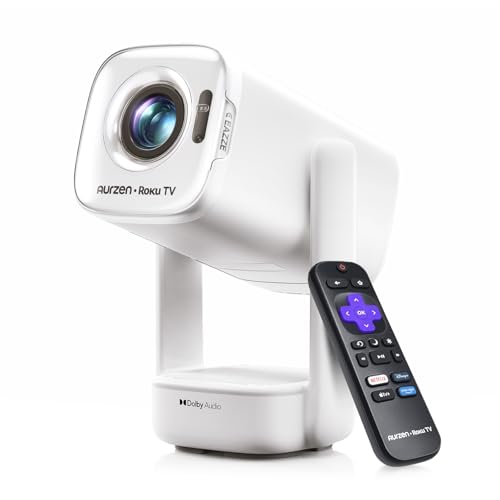
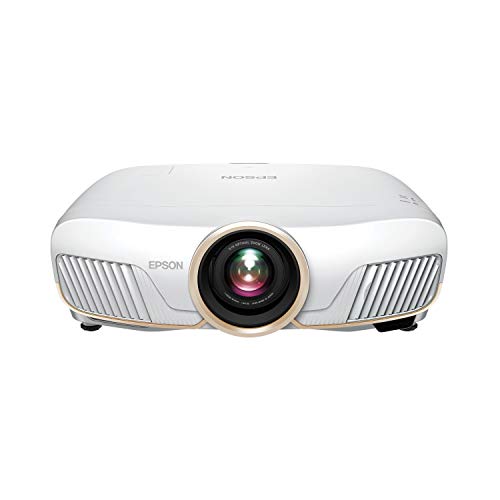
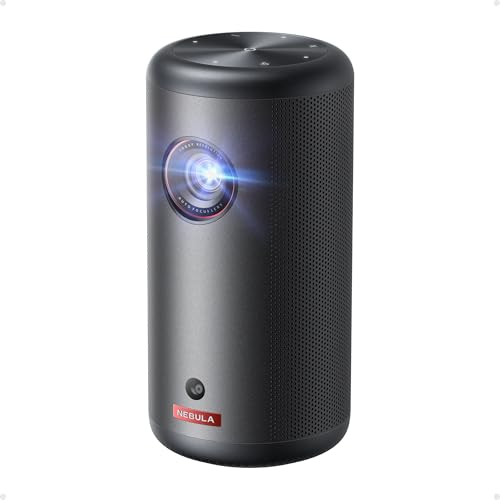
The best Full HD 1080 projectors are the ones that make a big picture look good in a real room: bright enough for the evening, sharp enough for text, and quiet enough to forget. A 1080p projector shows a picture up to ten times the size of a television for less money, and the best ones do it with honest brightness, good colour, and a lens that fits the room. The six projectors in this guide were picked because their listing titles state the exact brand, model, resolution, and brightness, and every listing was checked in full before it was linked.
Full HD means 1920 by 1080 pixels, and it is still the sensible resolution for most rooms. A 4K projector costs more, needs a larger screen to show the difference, and needs 4K content to matter. A 1080p projector plays every streaming service, every console, and every laptop at full quality, and it does it at a size no television can match for the money. The choice is not about the highest number on the box; it is about brightness, throw distance, and the room the picture will fill.
This guide covers six 1080p projectors: a laser projector for bright rooms, two Epson 3LCD models for movies and streaming, and three BenQ models for home entertainment and gaming. All six are native 1080p, all six are sold as new listings, and all six have their brightness stated in the listing title, so the comparison is honest.
A projector also changes how a room is used. A television is a piece of furniture that stays on the wall, while a projector appears when it is wanted and disappears when it is not, leaving the wall free. That flexibility is part of the appeal: a living room can be a cinema in the evening and an ordinary room in the day, and a bedroom can show a film on the ceiling without a screen taking up the wall. The projectors below were chosen with that flexibility in mind, and each one fits a different kind of room and a different kind of evening.
In this guide
Quick picks: best full hd 1080 projectors
| # | Product | Where to buy |
|---|---|---|
| 1 | ViewSonic LS740HD laser projector | Check on Amazon |
| 2 | Epson Home Cinema 980 projector | Check on Amazon |
| 3 | BenQ TH671ST short throw projector | Check on Amazon |
| 4 | BenQ TH575 home projector | Check on Amazon |
| 5 | Epson EpiqVision Flex CO-FH02 projector | Check on Amazon |
| 6 | BenQ TH685P gaming projector | Check on Amazon |
How the picks were chosen for the best Full HD 1080 projectors
Every projector below started as a listing returned by the reviewstook.com product lookup, and every listing was checked the same way. First, the title had to name the exact brand and the exact model, including every number and letter, because a BenQ TH575 is not a BenQ TH575i, and an Epson Home Cinema 980 is not an Epson Pro EX11000. Second, the title had to state native 1080p resolution, because many cheap projectors claim 1080p support while their real panel is lower, and those were left out. Third, the listing had to be a new product, not a used or renewed one, since a used projector can arrive with a tired lamp or a worn fan.
The projectors were also checked for the numbers that decide the picture. Brightness in lumens decides whether the picture survives room light, and the titles here state it plainly, from 3000 lumens to 5500 lumens. Throw distance decides whether the projector fits the room: a short throw model such as the BenQ TH671ST makes a big picture from close up, while a standard throw model needs more distance. The lens features matter as well: keystone correction, zoom, and lens shift decide how easy the picture is to square up on the wall.
One more check shaped the list: the projector must be a projector, not an accessory. Listings for screens, mounts, lamps, and cases were left out, because a buyer needs the projector itself. The six projectors below are all complete projectors, sold as new listings, with the model and the brightness stated in the title.
What a Full HD 1080 projector is, and who should buy one
A Full HD 1080 projector shows a picture of 1920 by 1080 pixels, which is the standard for high definition video. It takes a signal from a streaming stick, a laptop, a console, or a Blu-ray player, and it throws that picture onto a wall or a screen at sizes from 60 inches to 300 inches. The picture is larger than any television most people own, and the projector itself is smaller than a shoebox.
A 1080p projector suits a living room movie night, a bedroom cinema, a classroom, and a gaming setup where a big picture matters more than the last bit of sharpness. It is the right choice when the room is dark or dim, when the screen will be large, and when the budget does not stretch to 4K. It is not the right choice for a bright sunlit room, because even the brightest projector in this guide works best with the curtains drawn.
The six projectors in this guide cover the main uses. The ViewSonic LS740HD is the laser model for bright rooms and long life. The Epson Home Cinema 980 and EpiqVision Flex CO-FH02 are the 3LCD models for movies and streaming. The BenQ TH671ST is the short throw model for small rooms, the TH575 is the bright all-rounder, and the TH685P is the gaming model with low input lag.
What makes a good Full HD 1080 projector
Brightness is the first test, and it is measured in lumens. A projector with 3000 lumens works in a dim room, a projector with 3800 lumens works with some lamps on, and a projector with 5500 lumens, like the ViewSonic LS740HD, works in a room with real light. The numbers in this guide come from the listing titles, so they can be compared directly, and a buyer should match the brightness to the room, not to the highest number available.
The light source is the second test. A laser projector such as the LS740HD lasts longer than a lamp projector and keeps its brightness over time, while a lamp projector is cheaper to buy and the lamp can be replaced. The Epson 3LCD models use three LCD panels for colour, which gives bright, accurate colour without the rainbow effect some single-chip projectors show. The BenQ models use DLP, which gives sharp images and low input lag for gaming.
The lens and the connections decide the rest. A short throw lens makes a big picture from a short distance, which suits a small room. Keystone correction squares up a picture when the projector sits off centre, and zoom lets the picture size be adjusted without moving the projector. For connections, two HDMI ports are better than one, because a streaming stick and a console can stay connected at once. The projectors below were picked because they cover these needs at different sizes and budgets.
Quick picks at a glance
| Projector | Resolution and brightness | Light source and use | Best for |
|---|---|---|---|
| ViewSonic LS740HD | 1080p, 5500 lumens | Laser, bright rooms | Brightest pick |
| Epson Home Cinema 980 | 1080p, 3LCD | 3-chip colour, movies | Movie pick |
| BenQ TH671ST | 1080p, 3000 lumens | Short throw, low lag | Small rooms |
| BenQ TH575 | 1080p, 3800 lumens | Low lag, game mode | All-rounder |
| Epson EpiqVision CO-FH02 | 1080p, 3000 lumens | Android TV, 3LCD | Smart streaming |
| BenQ TH685P | 1080p, 3500 lumens | 8.3ms lag, 120Hz | Gaming pick |
The best Full HD 1080 projectors

ViewSonic LS740HD 1080p Laser Projector
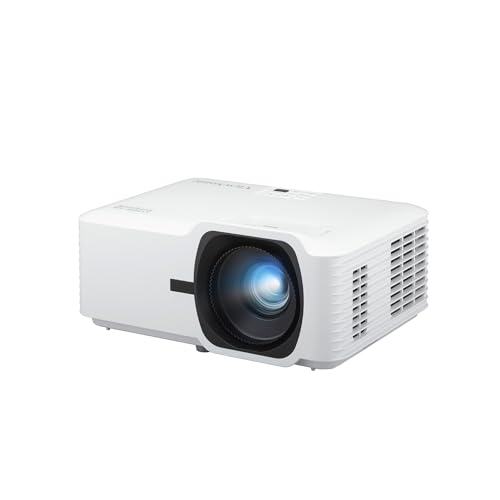
The ViewSonic LS740HD is the brightest projector in this guide, and it is the projector for a room with real light. It is a 1080p laser projector with 5500 lumens, full HD home theatre picture, optical zoom, keystone and corner adjustment, and 360 degree projection, which means it can be mounted in almost any position. Its laser light source lasts far longer than a lamp, and it keeps its brightness over years of use.
The LS740HD suits a classroom, an auditorium, a bright living room, and a golf simulator setup, which the listing names as a use. Its 5500 lumens cut through room light that would wash out a dimmer projector, its zoom and corner adjustment make setup easy, and its laser source means no lamp changes. It is the projector for a big picture in a bright room.
Key specs:
- ViewSonic LS740HD
- 1080p, 5500 lumens
- Laser light source
- Optical zoom, keystone, corner adjustment
- 360 degree projection, quick setup
Strengths:
- Brightest projector here at 5500 lumens
- Laser source lasts far longer than a lamp
- Zoom and corner adjustment for easy setup
Trade-offs:
- A business and classroom design, not a compact home model
- No smart streaming built in
- Laser costs more than a lamp projector
The LS740HD fits a classroom, an auditorium, a bright living room, and a golf simulator. It is the projector for bright rooms.
Best for: bright rooms, classrooms, and large venues. Not suited for: a small dark bedroom, or a buyer who wants built-in streaming apps.
Check price on Amazon: ViewSonic LS740HD laser projector

Epson Home Cinema 980 1080p Movie Projector
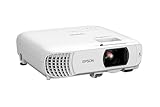
The Epson Home Cinema 980 is the movie projector in this guide, and it is the projector for a living room cinema. It is a 3-chip 3LCD 1080p movie projector, which means it uses three LCD panels for colour, and that gives bright, accurate colour without the rainbow effect some single-chip projectors show. It is made for movies, and its picture is the warm, film-like image that suits a dark room.
The Home Cinema 980 suits a family movie night, a bedroom cinema, and a buyer who wants Epson colour at a fair size. Its 3LCD technology keeps colours bright even in a room with some light, and its 1080p resolution shows every streaming film at full quality. It is the projector for movies first, and everything else second.
Key specs:
- Epson Home Cinema 980
- 3-chip 3LCD, 1080p
- Movie projector for home theatre
- Bright, accurate colour
- Full HD resolution
Strengths:
- 3LCD colour is bright and accurate
- Made for movies, with a film-like picture
- Epson reliability and support
Trade-offs:
- No brightness figure in the short title, so check the room light
- No smart streaming built in
- Standard throw needs room distance
The Home Cinema 980 fits a family movie night, a bedroom cinema, and a buyer who wants Epson colour. It is the projector for movies.
Best for: movie nights with bright, accurate colour. Not suited for: a bright sunlit room, or a gaming setup that needs low input lag.
Check price on Amazon: Epson Home Cinema 980 projector

BenQ TH671ST 1080p Short Throw Projector
The BenQ TH671ST is the short throw projector in this guide, and it is the projector for a small room. It is a 3000 lumens 1080p short throw home entertainment projector with low input lag, auto vertical keystone, dual HDMI ports, and a built-in speaker. Its short throw lens makes a big picture from close up, so it fits rooms where a standard projector would sit too far from the wall.
The TH671ST suits a small living room, a bedroom, and a gaming setup in a tight space. Its low input lag makes console games feel responsive, its dual HDMI ports keep a streaming stick and a console connected at once, and its built-in speaker covers casual viewing without extra sound. It is the projector for a big picture in a small room.
Key specs:
- BenQ TH671ST
- 1080p, 3000 lumens
- Short throw lens
- Low input lag, auto vertical keystone
- Dual HDMI, built-in speaker, 3 year warranty
Strengths:
- Short throw fits small rooms
- Low input lag for console gaming
- Dual HDMI keeps stick and console connected
Trade-offs:
- 3000 lumens needs a dim room
- Built-in speaker will not fill a large room
- Short throw limits placement options
The TH671ST fits a small living room, a bedroom, and a tight gaming setup. It is the projector for small rooms.
Best for: small rooms and console gaming close to the wall. Not suited for: a bright room, or a large venue that needs more brightness.
Check price on Amazon: BenQ TH671ST short throw projector

BenQ TH575 1080p Home Entertainment Projector
The BenQ TH575 is the all-rounder in this guide, and it is the projector for a buyer who wants one model that does movies and games well. It is a 1080p projector with 3800 lumens, 16ms low latency, an enhanced game mode, dual HDMI ports, 1.1x zoom, and 3D readiness. Its brightness works with some lamps on, and its low latency makes games feel responsive.
The TH575 suits a living room cinema, a family gaming setup, and a buyer who wants a bright picture without paying for laser. Its 3800 lumens handle a room with light, its game mode sharpens fast action, and its dual HDMI ports keep the streaming stick and the console connected. It is the projector for most living rooms.
Key specs:
- BenQ TH575
- 1080p, 3800 lumens
- 16ms low latency, enhanced game mode
- Dual HDMI, 1.1x zoom, 3D ready
- Auto vertical keystone, 3 year warranty
Strengths:
- Bright at 3800 lumens for rooms with light
- 16ms low latency for gaming
- Dual HDMI and 1.1x zoom for easy setup
Trade-offs:
- Lamp, not laser, so the lamp will need replacing one day
- Built-in sound is basic
- No smart streaming built in
The TH575 fits a living room cinema, a family gaming setup, and a buyer who wants a bright all-rounder. It is the projector for most rooms.
Best for: living rooms that mix movies and games. Not suited for: a very bright sunlit room, or a dedicated dark cinema that wants laser.
Check price on Amazon: BenQ TH575 home projector

Epson EpiqVision Flex CO-FH02 Smart Streaming Projector
The Epson EpiqVision Flex CO-FH02 is the smart streaming projector in this guide, and it is the projector for a buyer who wants to plug in and watch. It is a Full HD 1080p smart streaming projector with Android TV, Wi-Fi, and Bluetooth, 3000 lumens of colour and white brightness, and 3-chip 3LCD technology. Its Android TV plays streaming apps directly, so no extra stick is needed.
The CO-FH02 suits a bedroom, a portable movie setup, and a buyer who wants streaming without extra boxes. Its 3LCD colour is bright and accurate, its Wi-Fi and Bluetooth connect to speakers and headphones, and its portable design moves between rooms. It is the projector for easy streaming.
Key specs:
- Epson EpiqVision Flex CO-FH02
- Full HD 1080p, smart streaming
- Android TV, Wi-Fi, Bluetooth
- 3000 lumens, 3-chip 3LCD
- Portable, home theatre
Strengths:
- Android TV built in, no stick needed
- 3LCD colour is bright and accurate
- Wi-Fi and Bluetooth for easy connections
Trade-offs:
- 3000 lumens needs a dim room
- Portable design, not a fixed cinema model
- Built-in sound is basic
The CO-FH02 fits a bedroom, a portable movie setup, and a buyer who wants streaming without extra boxes. It is the projector for easy streaming.
Best for: bedrooms and portable streaming with Android TV. Not suited for: a bright room, or a fixed home cinema that needs more brightness.
Check price on Amazon: Epson EpiqVision Flex CO-FH02 projector

BenQ TH685P 1080p Gaming Projector
The BenQ TH685P is the gaming projector in this guide, and it is the projector for a console setup that needs speed. It is a 1080p gaming projector with 4K support, a 120Hz refresh rate, 3500 lumens, 8.3ms low latency, an enhanced game mode, auto keystone, and a built-in speaker. Its 8.3ms latency is the lowest in this guide, and its 120Hz refresh makes fast games look smooth.
The TH685P suits a console gaming room, a competitive player, and a buyer who wants a big screen without giving up responsiveness. Its 3500 lumens work with some light on, its 4K supported input accepts a 4K signal from a modern console, and its game mode sharpens fast action. It is the projector for gaming on a big screen.
Key specs:
- BenQ TH685P
- 1080p, 3500 lumens
- 120Hz refresh rate, 8.3ms low latency
- HDMI, 4K supported, enhanced game mode
- Auto keystone, built-in speaker, 3 year warranty
Strengths:
- Lowest input lag here at 8.3ms
- 120Hz refresh for smooth fast games
- 3500 lumens for rooms with light
Trade-offs:
- Made for gaming, so movie colour is secondary
- Built-in speaker will not fill a large room
- No smart streaming built in
The TH685P fits a console gaming room, a competitive player, and a buyer who wants a big screen for games. It is the projector for gaming.
Best for: console gaming with low lag on a big screen. Not suited for: a dedicated movie cinema, or a very bright room.
Check price on Amazon: BenQ TH685P gaming projector
Buying guide for the best Full HD 1080 projectors
Match the brightness to the room
Brightness decides whether the picture is watchable, so measure the room light before buying. A dark room needs only 3000 lumens, and the BenQ TH671ST and the Epson CO-FH02 are enough there. A room with lamps on needs 3500 to 3800 lumens, which is where the BenQ TH575 and TH685P sit. A room with real daylight needs the ViewSonic LS740HD at 5500 lumens, and even then the curtains help. Buy brightness for the worst light the room will have, not for the best.
Do not trust brightness numbers from different brands without checking the measurement. The numbers in this guide come from the listing titles, and they are the numbers the makers state. A projector that claims high brightness but shows a dim picture in reviews is a sign of an inflated number, and the models here are all from established brands with honest ratings.
Throw distance: measure before you buy
Throw distance is the distance from the projector to the screen, and it decides the picture size. A standard throw projector needs about 10 feet for a 100 inch picture, while a short throw projector such as the BenQ TH671ST makes the same picture from much closer. Measure the room, decide the screen size, and check the throw ratio in the listing before buying, because a projector that cannot fill the screen from the available distance is a return.
Zoom and keystone help, but they do not fix a wrong throw distance. A 1.1x zoom, like the one on the BenQ TH575, adjusts the picture size by a small amount, and keystone correction squares up a picture when the projector is off centre, but both work best when the projector is already close to the right place. Put the projector where it belongs, and use zoom and keystone only for fine tuning.
Lamp or laser, and what it costs to run
A lamp projector is cheaper to buy, and the lamp can be replaced when it dims, usually after several thousand hours. A laser projector such as the ViewSonic LS740HD costs more at first, but the laser lasts far longer than a lamp and keeps its brightness, so it costs less over years of use. For a projector that runs every evening, laser is the better long-term choice. For occasional movie nights, a lamp projector is fine.
Check the lamp life in the listing and the cost of a replacement lamp before buying. A cheap projector with an expensive lamp is not a bargain. The BenQ models in this guide carry a 3 year warranty, which is a good sign, and the Epson models use 3LCD technology, which keeps colour bright for the life of the lamp.
Gaming: input lag matters more than resolution
For gaming, input lag is the number that matters. Input lag is the delay between pressing a button and seeing the result, and a projector with high lag makes fast games feel slow. The BenQ TH685P has 8.3ms low latency, and the BenQ TH575 has 16.7ms, which are both good for gaming. The BenQ TH671ST also states low input lag, and it is the short throw choice for a gaming room.
A 120Hz refresh rate, like the one on the TH685P, also helps fast games look smooth, and a 4K supported input means the projector accepts a 4K signal and shows it at 1080p. For movies, input lag does not matter, so a buyer who only watches films should choose brightness and colour instead.
Sound, streaming, and connections
A built-in speaker is useful for a bedroom or a portable setup, but it will not match a soundbar or a home theatre system. The BenQ TH671ST and TH685P have built-in speakers, and the Epson Pro EX11000, a related model, has a 16W speaker. For a living room cinema, plan for external sound, and check that the projector has an audio output for it.
For streaming, a projector with Android TV built in, like the Epson EpiqVision Flex CO-FH02, plays streaming apps without an extra stick. A projector without smart features needs a streaming stick or a laptop, so check the HDMI ports: two ports are better than one, because the stick and the console can both stay connected.
Using and caring for a 1080p projector
Set it up straight, and let it warm up
Put the projector on a stable surface or a ceiling mount, level it, and centre it on the screen before turning it on. Use the zoom and the keystone correction to square the picture, and do it once, carefully, rather than adjusting it every time. A projector that is set up well stays set up, and the picture stays sharp.
Let the projector warm up for a minute before judging the picture, because the lamp or laser reaches full brightness after a short warm-up. Turn it off with the power button and let the fan cool it down, rather than pulling the plug, because the fan protects the lamp and the panels from heat.
Keep the lens and the filter clean
Clean the lens with a soft microfibre cloth, and do it gently, because a scratched lens shows in the picture. Do not use paper towels or harsh cleaners on the lens. Clean the air filter regularly, following the manual, because a clogged filter makes the projector run hot and shortens the lamp life.
Keep the projector out of direct sunlight when it is not in use, and keep drinks away from it. A projector is a precision optical device, and a spill or a knock can misalign the lens. Store it in a cool, dry place if it is portable, and use the carrying case when moving it.
Mind the lamp hours
A lamp projector dims slowly over its life, so the picture that looked bright in the first year will look dimmer later. Check the lamp hours in the menu now and then, and plan for a replacement lamp when the picture dims. Use the eco mode when full brightness is not needed, because it extends the lamp life and makes the fan quieter.
A laser projector does not need lamp changes, but it still needs clean air and a cool room. Keep the vents clear, and do not block the exhaust, because heat is the enemy of every projector, lamp or laser alike.
Common mistakes when buying a 1080p projector
Buying a projector that is not really 1080p
The most common mistake is buying a projector that claims 1080p support but has a lower native resolution. These projectors accept a 1080p signal and show it on a lower resolution panel, and the picture looks soft. Check the listing title for the words native 1080p, and buy from an established brand. Every projector in this guide is native 1080p, with the resolution stated in the title.
A related mistake is trusting a brightness number from an unknown brand. A projector that claims very high brightness at a very low cost is usually inflating the number. The models here are from ViewSonic, Epson, and BenQ, and their brightness numbers are honest.
Forgetting the throw distance
A projector that cannot fill the screen from the available distance is a return, not a cinema. Measure the room before buying, and check the throw ratio. A short throw model such as the BenQ TH671ST suits a small room, while a standard throw model needs more space. Do not buy first and measure later.
Also check the screen. A plain white wall works, but a proper screen gives a brighter, more even picture. Budget for a screen if the wall is coloured or textured, because the wall colour shows through the picture.
Ignoring the sound
A projector built-in speaker is small, and it will not fill a living room. Buyers who plan a cinema setup and forget the sound end up with a big picture and a thin voice. Plan for a soundbar or speakers, and check that the projector has an audio output. The Epson Pro EX11000 has a 16W speaker, which is better than most, but even it benefits from external sound.
Also check the fan noise. A projector with a loud fan distracts from quiet scenes. The models in this guide are all from brands that keep fan noise reasonable, and eco mode makes them quieter still.
Buying a used projector by accident
Projectors are often sold used or renewed, and a used projector can arrive with a tired lamp that dims the picture. Read the full listing title before buying, and do not buy a listing that describes the projector as used or renewed. Every projector in this guide is a new listing, with the exact model in the title.
Check the warranty as well. The BenQ models in this guide carry a 3 year warranty, which is a good sign. A projector with no warranty and no returns is a risk, because a lamp problem only shows up after weeks of use.
Final recommendation
For most buyers, the BenQ TH575 is the projector to buy: it is bright at 3800 lumens, it has 16.7ms low latency for gaming, it has dual HDMI ports, and it works in a living room with some lamps on. It is the balanced choice for movies and games alike, and its 3 year warranty is a good sign.
For a bright room or a classroom, the ViewSonic LS740HD is the strongest choice, with 5500 lumens and a laser light source that lasts. For movies, the Epson Home Cinema 980 is the 3LCD pick, with bright, accurate colour. For a small room, the BenQ TH671ST is the short throw pick, and for gaming, the BenQ TH685P is the low-lag pick at 8.3ms. Any of the six projectors in this guide is a sound buy for Full HD viewing, as long as the brightness matches the room.
Before ordering, measure the room once more: the distance from the projector to the wall, the size of the picture wanted, and the light at the time of day the projector will actually be used. Those three numbers decide more than any feature list, and they are the reason the same projector can be perfect in one room and wrong in another. Buy the brightness for the worst light, the throw for the real distance, and the model whose listing title states the exact brand and model, and the projector will do what it promises for years.
Related reading on Reviewstook: see our guides to the best conference room projectors, the best high lumen projectors, the best home TV projectors for more on this topic.
Frequently asked questions about the best Full HD 1080 projectors
Is a 1080p projector good enough for movies?
Yes. A 1080p projector shows Full HD video at its full quality, and at the screen sizes projectors make, the picture looks sharp from a normal viewing distance. A 4K projector shows more detail, but it costs more and needs 4K content, and for most movies and streaming, 1080p is the sensible choice.
How bright should a 1080p projector be?
A dark room needs about 3000 lumens, a room with lamps on needs 3500 to 3800 lumens, and a bright room needs 5000 lumens or more. The ViewSonic LS740HD in this guide is the brightest at 5500 lumens, while the BenQ TH671ST and the Epson CO-FH02 are 3000 lumens models for dim rooms.
What is the difference between a lamp and a laser projector?
A lamp projector uses a replaceable bulb that dims over several thousand hours, while a laser projector uses a laser light source that lasts far longer and keeps its brightness. Laser costs more at first but costs less over years of use, and it is the better choice for a projector that runs every day.
Can a 1080p projector play games?
Yes, and the BenQ TH685P in this guide is made for it, with 8.3ms low latency and a 120Hz refresh rate. The BenQ TH575 has 16.7ms low latency, which is also good for gaming. Input lag matters more than resolution for games, so check the lag before buying a projector for a console.
Do I need a screen, or is a wall enough?
A plain white wall works, but a proper screen gives a brighter and more even picture, especially if the wall is coloured or textured. A screen is worth budgeting for, and it makes the biggest difference after brightness. A short throw projector such as the BenQ TH671ST pairs well with a fixed screen.
How long does a projector lamp last?
A lamp usually lasts several thousand hours, and the exact life depends on the mode: eco mode extends it, and full brightness shortens it. The InFocus P123, a related model, states 15000 hours, which shows how long modern lamps can run. A laser projector lasts longer still, and it does not need lamp changes.