The best 12V LCD projectors are small portable projectors that run from low-voltage DC power instead of a wall socket, so they work in a campervan, a tent, a boat cabin, or a garden without mains electricity nearby. A projector that needs a wall outlet is tied to the house, but a projector that runs from a USB-C power bank, a 12V vehicle supply, or its own rechargeable battery can throw a big picture onto a wall, a sheet, or the side of a van almost anywhere. This guide covers six portable LCD projectors that fit that kind of use, and every one of them is a mini projector with a low-voltage power option stated in its listing.
The six projectors in this guide are the Aurzen Roku TV D1R air, which runs from USB-C power and has Roku TV built in; the HP MC475, which is compatible with a USB-C power bank and carries licensed streaming apps; the CAMWORLD mini projector with a built-in battery and a 300 ANSI brightness rating; the Magcubic HY300Pro, a compact projector with Wi-Fi 6 and 4K input support; the DBPOWER E2, a native 1080p smart projector with hundreds of built-in apps; and the DBPOWER Smart Mini Projector, a compact model with Wi-Fi 6 and a 200 ANSI rating. Each one is a small LCD projector rather than a large home theatre unit, which is exactly what a 12V setup needs, because a small projector draws far less power than a big one.
A 12V projector is a different purchase from an ordinary home projector, even though the picture looks similar on a wall. A home projector is designed to sit on a shelf, plug into the wall, and stay there, while a 12V projector is designed to travel: it is light enough to carry in a bag, it accepts power from a bank or a vehicle outlet, and it sets itself up quickly with automatic focus and keystone correction. The brightness ratings in this class are modest, usually 200 to 300 ANSI lumens, so these projectors are at their best after dark or in a darkened room, and a buyer who expects a bright living-room picture in daylight will be disappointed.
This guide treats 12V as a power class, not as a single plug shape. Some projectors in this guide take power through USB-C, which a power bank or a 12V vehicle adapter can supply; one has its own battery, so it needs no external power at all while it runs; and all of them are small enough to run for hours from a portable power station. The comparison table below gives the short version, and the sections after it give the detail for each projector, including who each one fits and where each one falls short.
A word about the screen is worth adding before the picks, because the screen matters as much as the projector in a 12V setup. A smooth white wall works well, and a portable screen works better, because a proper screen reflects more light back to the viewer than a painted wall or a bed sheet. A sheet can work in a pinch, but it must be pulled tight and flat, because every wrinkle shows in the picture. The projectors in this guide throw a picture of about 100 inches at a few metres of distance, which is a cinema-sized image from a box the size of a lunchbox, and that is the whole point of a 12V projector: a big picture where there is no television at all.
In this guide
Quick picks: best 12v lcd projectors
| # | Product | Where to buy |
|---|---|---|
| 1 | Aurzen Roku TV D1R air | Check on Amazon |
| 2 | HP MC475 Projector | Check on Amazon |
| 3 | CAMWORLD Mini Projector with Battery | Check on Amazon |
| 4 | Magcubic HY300Pro Mini Projector | Check on Amazon |
| 5 | DBPOWER E2 Smart Projector | Check on Amazon |
| 6 | DBPOWER Smart Mini Projector | Check on Amazon |
How the picks were chosen for the best 12V LCD projectors
The picks were chosen from the product listings returned by the site product search, and only projectors with a low-voltage power option made the list. Each listing title was checked for the brand and the model, and a projector was only linked when both matched the listing. The power option had to be stated in the listing: USB-C power, power-bank compatibility, or a built-in battery. Mains-only projectors were not counted, because the article is about 12V and off-grid use, not about home theatre projectors in general.
Size and weight were the second filter, because a projector for a campervan or a tent has to travel. Every pick in this guide is a mini projector that fits in a bag beside a power bank, and none of them is a full-size home theatre unit. A small projector also draws less power, which matters when the power comes from a battery: a projector that draws a little power runs for hours, while a big projector would drain the same battery before the film ends.
The third filter was the listing itself. Every pick is a new listing from a named brand, with the model stated in the title. Listings for used or renewed projectors were excluded, and listings whose titles named a different model were excluded too. One listing in the search results named a 12V power-bank feature but carried no brand in its title at all, so it was left out: a pick needs a brand a buyer can check.
What makes a projector good for 12V and off-grid use
The first quality that matters is the power input. A good 12V projector accepts low-voltage DC power through USB-C, through a 12V adapter, or from its own battery, and the listing says so plainly. A projector that only accepts mains power through a fixed brick is not a 12V projector, whatever its size. The picks in this guide cover all three options: the Aurzen D1R air and the HP MC475 run from USB-C power banks, the CAMWORLD has its own battery, and the rest are compact models built for portable power.
The second quality is brightness in the dark. The projectors in this class are rated around 200 to 300 ANSI lumens, which is enough for a clear picture on a dark wall or a screen after sunset, but not enough for a sunlit room. A buyer should plan for evening viewing, a darkened tent, or a shaded canopy, and should keep the picture size modest: a smaller picture looks brighter than a large one from the same projector. The 300 ANSI rating of the CAMWORLD is the highest in this guide, and the 200 ANSI rating of the DBPOWER Smart Mini is the lowest.
The third quality is quick setup. A projector used outdoors is set up and packed away often, so automatic focus and automatic keystone correction matter far more than they do in a fixed home theatre. The picks in this guide that state these features, such as the HP MC475 with auto focus and keystone and the Magcubic HY300Pro with auto vertical keystone, save minutes at every setup and keep the picture square even when the projector sits at an angle on a camping table.
USB-C projectors, battery projectors, and how to choose between them
USB-C projectors are the most flexible kind in this guide: the Aurzen D1R air and the HP MC475 take power through a USB-C connection, so they can run from a power bank, a portable power station, or a 12V vehicle adapter with a USB-C output. The advantage is that the power source is separate from the projector, so a bigger bank means a longer film night, and the same bank can also charge a phone. The trade-off is that the projector is useless without a charged bank, so the bank has to be part of the packing list.
Battery projectors carry their own power, and the CAMWORLD mini projector is the one in this guide with a built-in rechargeable battery. The advantage is simplicity: the projector works with nothing else attached, which suits a quick film in a tent or a garden. The trade-off is that the run time is fixed by the battery inside, and a dead battery ends the evening unless a power bank is also along.
Compact smart projectors are the third kind: the Magcubic HY300Pro, the DBPOWER E2, and the DBPOWER Smart Mini Projector are small projectors with built-in streaming apps and wireless connections. Their advantage is that they need no separate streaming stick: the apps are already inside, and the projector connects to a phone hotspot or a campsite Wi-Fi network. The trade-off is that built-in apps depend on the projector software, so a buyer who wants a particular service should check that it is among the licensed apps before ordering.
Quick picks at a glance
| Projector | Power | Resolution | Best for |
|---|---|---|---|
| Aurzen D1R air | USB-C powered | Native 1080p | Streaming on the road |
| HP MC475 | USB-C power bank | Native 1080p | Easy setup |
| CAMWORLD battery | Built-in battery | 4K supported | No power bank needed |
| Magcubic HY300Pro | Compact portable | 4K support | Compact travel pick |
| DBPOWER E2 | Smart, 386+ apps | Native 1080p | Most built-in apps |
| DBPOWER Smart Mini | Compact smart | 1080p support | Budget smart pick |
The best 12V LCD projectors
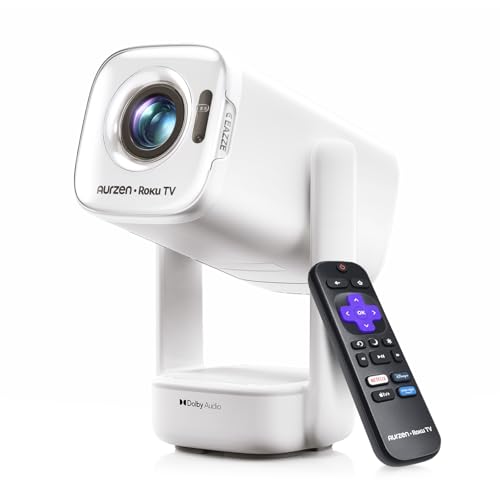
Aurzen Roku TV D1R air
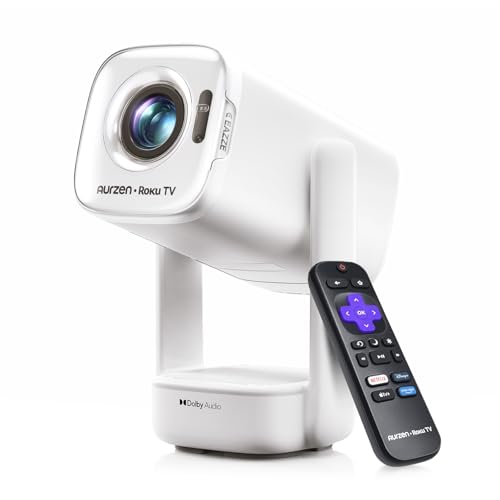
The Aurzen Roku TV D1R air is the streaming pick in this guide, and it is the only one with a full smart TV system built in. The listing title states the brand, the model D1R air, the USB-C power input, the Roku TV system, Wi-Fi and Bluetooth, power-bank support, and native 1080p resolution, so a buyer knows exactly what is in the box. It is a portable outdoor projector in white, built for home and outdoor films, and its USB-C power input is what makes it a 12V projector: it runs from a power bank or a portable power station instead of a wall socket.
Roku TV built in is the feature that sets this projector apart from the others here. The streaming apps are part of the projector, so there is no stick to pack, no extra cable, and no separate power draw for a streaming device. A phone hotspot or a campsite network supplies the connection, and the projector supplies the picture. The listing also notes Dolby Audio, which is a welcome extra in a small projector, because the built-in speaker is the only sound in a tent or a van unless a Bluetooth speaker is paired.
Key specs:
- Power: USB-C powered, power bank supported
- Resolution: native 1080p
- System: Roku TV built-in
- Connections: Wi-Fi and Bluetooth
- Audio: Dolby Audio
Strengths:
- USB-C power runs from a power bank
- Roku TV built in, no stick needed
- Native 1080p picture in a small body
Trade-offs:
- Brightness is not stated in the title
- Roku apps depend on a Wi-Fi connection
- White body shows dirt on the road
The Aurzen D1R air fits the traveller who wants streaming without extra hardware. It is the pick for a campervan evening, a garden film night, or a holiday let where the only screen is the wall, and where a power bank is already in the bag.
Best for: streaming films on the road from a power bank. Not suited for: a bright room, where a 12V mini projector is out of its depth.
Check price on Amazon: Aurzen Roku TV D1R air

HP MC475 Projector
The HP MC475 is the easy-setup pick in this guide. The listing title states the brand HP, the model MC475, Netflix support, USB-C power-bank compatibility, 4K input support, native 1080p resolution, Wi-Fi and Bluetooth, officially licensed apps, and auto focus with keystone correction. The 90-degree rotatable design is also stated, which lets the projector aim at a wall or a ceiling from a table or a shelf. It is a mini projector for home and outdoor use, and its USB-C power-bank compatibility is what qualifies it for a 12V setup.
Auto focus and keystone correction are the features that matter most for a projector that moves. A projector set up on a camping table is rarely square to the wall, and a manual focus ring is fiddly in the dark, so automatic correction saves the evening. The officially licensed apps are the other advantage: Netflix and the other named services run on the projector itself, so there is no stick to carry and no second device to power from the same bank.
Key specs:
- Power: USB-C power bank compatible
- Resolution: native 1080p, 4K supported
- Apps: officially licensed apps, Netflix
- Setup: auto focus and keystone
- Design: 90-degree rotatable
Strengths:
- USB-C power bank compatible
- Auto focus and keystone for quick setup
- Licensed apps built in, no stick needed
Trade-offs:
- Brightness is not stated in the title
- Streaming apps need a Wi-Fi connection
- A power bank is required, it is not built in
The HP MC475 fits the buyer who sets up in a different place every night. It is the pick for a campervan tour, a garden, or a cabin, where the projector goes up after dark and comes down in the morning.
Best for: quick setup and streaming from a power bank. Not suited for: a fixed home theatre, where a mains projector gives more brightness.
Check price on Amazon: HP MC475 Projector

CAMWORLD Mini Projector with Battery
The CAMWORLD mini projector is the battery pick in this guide, and it is the only one here that carries its own power. The listing title states the brand CAMWORLD, the built-in battery, Wi-Fi 6 and Bluetooth 5.2, auto keystone, a 300 ANSI brightness rating, rechargeable operation, 4K input support, and a 220-degree rotatable design. It is a portable projector for phones, laptops, and TV sticks, and the battery is what makes it a true 12V projector: it runs with nothing plugged in at all.
The 300 ANSI brightness rating is the highest stated rating in this guide, which gives this projector the clearest picture of the six in a dark room. Wi-Fi 6 is the other advantage, because a faster wireless connection means smoother streaming from a phone hotspot, which is the usual connection on the road. The 220-degree rotation lets the projector aim at a ceiling from a bed or a camp bed, which is a small comfort that matters more than it sounds after a long day outdoors.
Key specs:
- Power: built-in rechargeable battery
- Brightness: 300 ANSI
- Wireless: Wi-Fi 6 and Bluetooth 5.2
- Resolution: 4K supported
- Design: 220-degree rotatable, auto keystone
Strengths:
- Built-in battery, no bank needed
- Highest stated brightness in this guide
- Wi-Fi 6 for smoother hotspot streaming
Trade-offs:
- Run time is fixed by the internal battery
- Battery adds weight to a small projector
- No native resolution stated in the title
The CAMWORLD fits the buyer who wants the simplest setup of all: one projector, nothing else. It is the pick for a tent, a garden, or a boat cabin where a power bank is one more thing to forget.
Best for: a film with no cables and no power bank. Not suited for: a long film marathon, where a USB-C projector and a big bank last longer.
Check price on Amazon: CAMWORLD Mini Projector with Battery


Magcubic HY300Pro Mini Projector
The Magcubic HY300Pro is the compact travel pick in this guide. The listing title states the brand Magcubic, the model HY300Pro, Wi-Fi 6 and Bluetooth 5.4, 4K input support, auto vertical keystone, and a 180-degree rotation. It is a mini projector for home and outdoor use, and its small size is what makes it a good 12V companion: it packs beside a power bank and a phone, and it draws little power from a portable station.
The 180-degree rotation is the practical feature here, because it lets the projector sit on a table and aim at a wall, or tilt up toward a ceiling, without a tripod. Auto vertical keystone keeps the picture square when the projector is tilted, which is the usual position on a camping table. Wi-Fi 6 and Bluetooth 5.4 are the current wireless standards, so the projector pairs cleanly with a phone hotspot for streaming and with a Bluetooth speaker for better sound.
Key specs:
- Model: HY300Pro
- Wireless: Wi-Fi 6 and Bluetooth 5.4
- Resolution: 4K support
- Setup: auto vertical keystone
- Design: 180-degree rotation
Strengths:
- Very compact, easy to pack
- Wi-Fi 6 and Bluetooth 5.4
- 180-degree rotation for flexible aiming
Trade-offs:
- Brightness is not stated in the title
- No battery or USB-C power stated
- Small body means a small built-in speaker
The Magcubic HY300Pro fits the buyer who packs light and values a small projector above all. It is the pick for a backpack, a small campervan, or a weekend bag where space is the limit.
Best for: packing light with a compact projector. Not suited for: a buyer who needs a stated battery or USB-C power option.
Check price on Amazon: Magcubic HY300Pro Mini Projector

DBPOWER E2 Smart Projector
The DBPOWER E2 is the apps pick in this guide. The listing title states the brand DBPOWER, the model E2, more than 386 built-in apps, Wi-Fi and Bluetooth, native 1080p resolution, compatibility with Netflix, YouTube, and other named services, and electric focus, with a carry case included. It is a mini projector for bedroom and outdoor films, and its built-in apps are the reason it belongs in a 12V kit: the projector is its own streaming device, so the whole setup is one box, one power cable, and one screen.
More than 386 built-in apps is the largest app count stated in this guide, which means a buyer is unlikely to miss a service. Electric focus is the other useful feature, because it sharpens the picture at the touch of a button instead of a manual ring, which is easier when the projector sits on an uneven surface outdoors. The carry case is a practical extra for a projector that travels, because a lens kept clean and safe is a lens that gives a sharp picture.
Key specs:
- Model: E2
- Resolution: native 1080p
- Apps: 386+ built-in apps
- Focus: electric focus
- Included: carry case
Strengths:
- Most built-in apps in this guide
- Electric focus for easy sharpening
- Carry case included for travel
Trade-offs:
- Brightness is not stated in the title
- No battery or USB-C power stated
- Apps depend on a Wi-Fi connection
The DBPOWER E2 fits the buyer who wants the projector to be the whole entertainment system. It is the pick for a holiday let, a garden room, or a campsite where the projector is the television.
Best for: a projector that is also the streaming box. Not suited for: a buyer who wants a stated 12V or battery power option.
Check price on Amazon: DBPOWER E2 Smart Projector

DBPOWER Smart Mini Projector
The DBPOWER Smart Mini Projector is the budget smart pick in this guide. The listing title states the brand DBPOWER, compatibility with Netflix, a 360-degree stand, built-in licensed apps, Wi-Fi 6, two-way Bluetooth, 1080p support, a 200 ANSI brightness rating, and auto focus, auto keystone, screen fit, and screen avoidance. It is a smart mini projector, and its small size and low power draw are what suit it to a 12V setup, where a portable power station supplies the projector for the evening.
The 360-degree stand is the feature that sets this projector apart, because it lets the projector aim in any direction from a table or a shelf without a separate mount. Auto focus and auto keystone, with screen fit and avoidance, do the setup work: the projector finds the wall, squares the picture, and avoids obstacles on its own. Two-way Bluetooth is a useful extra, because it lets the projector send sound to a Bluetooth speaker or receive sound from a phone.
Key specs:
- Apps: built-in licensed apps, Netflix
- Wireless: Wi-Fi 6, two-way Bluetooth
- Brightness: 200 ANSI
- Setup: auto focus, auto keystone, screen fit
- Design: 360-degree stand
Strengths:
- 360-degree stand aims anywhere
- Auto setup with screen fit
- Wi-Fi 6 and two-way Bluetooth
Trade-offs:
- 200 ANSI is the lowest rating in this guide
- No battery or USB-C power stated
- 1080p support, not native 1080p
The DBPOWER Smart Mini Projector fits the buyer who wants the cheapest smart projector in this guide with automatic setup. It is the pick for a first outdoor projector, a child bedroom, or a garden test before spending more.
Best for: a budget smart projector with automatic setup. Not suited for: a dark-room picture, where a brighter pick shows more.
Check price on Amazon: DBPOWER Smart Mini Projector
Buying guide for 12V LCD projectors
Start with the power source, not the picture
A 12V projector is bought for its power first and its picture second, because a projector that cannot run where it is needed is useless whatever its resolution. Check the listing for USB-C power, power-bank compatibility, or a built-in battery, and check what the projector needs to run: a USB-C projector needs a bank or a station with a USB-C output, a battery projector needs charging before the trip, and a compact projector needs a portable station with enough capacity for a film. Buy the power source with the projector, not after it.
Plan for darkness
The projectors in this class are rated around 200 to 300 ANSI lumens, which gives a clear picture after dark and a washed-out picture in daylight. Plan film nights for the evening, choose a shaded spot, and keep the picture size modest, because a smaller picture looks brighter than a large one from the same projector. A white wall or a proper screen helps more than a brighter projector, and a dark room helps more than either.
Check the apps before you travel
A smart projector is only as good as its apps, and a service that is missing cannot be added on the road. Check that the services the household uses are among the licensed or built-in apps in the listing, and test the projector at home on the house Wi-Fi before taking it away. A phone hotspot is the usual connection on the road, so test that too, and download films to a phone or a stick as a backup for places with no signal.
Mind the sound
A mini projector has a small built-in speaker, and outdoors that speaker competes with wind, insects, and distance. The projectors in this guide with Bluetooth can pair with a portable speaker, which is the simplest upgrade a 12V film night can have. Pack a small Bluetooth speaker with the projector, and test the pairing at home, because a film with clear sound feels twice as big as the same film through a tiny speaker.
Choose the screen and the throw distance
A white wall is the simplest screen, and a portable screen is the best one, because a proper screen surface reflects more light than a painted wall and far more than a wrinkled sheet. Set the projector back far enough for the picture size wanted, and keep the picture modest: a 60 to 80 inch picture from a 200 ANSI projector looks brighter and sharper than a 120 inch picture from the same unit. Measure the distance at home, mark it with a piece of tape on the table, and the setup on the road takes seconds instead of minutes.
Using and caring for a 12V LCD projector
Keep the lens clean and covered
A projector lens collects dust in a bag and fingerprints from handling, and a dirty lens gives a soft picture whatever the resolution. Wipe the lens with a soft cloth before each use, keep the lens cap on in transit, and use the carry case when one is included. A clean lens is the cheapest picture upgrade there is.
Let the projector cool before packing
A projector that has run for two hours is warm inside, and packing it hot into a closed bag traps the heat. Let it cool for a few minutes after switching off, and do not pack it against a power bank that is also warm from charging. A cool projector lasts longer, and a projector that is packed hot is a projector that ages fast.
Charge the bank before the film
A USB-C projector is only as good as its power bank, and a bank that is half empty ends the film halfway. Charge the bank fully before the evening, and check that the bank can supply the projector while it runs: a bank that only charges phones slowly may not keep up with a projector. A portable power station with a stated wattage is the safer choice for a long film.
Keep the projector dry
A projector is an electronic device with a lens and a fan, and it does not like rain or heavy dew. Use it under a canopy or an awning outdoors, and bring it inside if the weather turns. A damp projector should be dried before it is packed away, because moisture in a closed bag encourages mould on the lens and corrosion on the contacts.
Common mistakes when buying a 12V LCD projector
Buying a mains-only projector for the road
The most common mistake is buying a projector that needs a wall socket and discovering it on the first trip. Check the listing for USB-C power, power-bank compatibility, or a battery before ordering, and do not assume that a small projector runs from a low voltage. A projector that only takes mains power belongs in the house, not in the van.
Expecting daylight brightness
A 200 or 300 ANSI projector is a night projector, and a buyer who expects a bright picture at noon will be disappointed. Plan for evening viewing, a darkened room, or a shaded canopy, and keep the picture modest in size. A projector is not a television, and a 12V projector least of all.
Forgetting the sound
A film watched through a tiny built-in speaker outdoors is a film half heard. Pack a Bluetooth speaker, test the pairing at home, and bring the speaker charger. Sound is half the film, and a small speaker upgrade changes the evening more than a brighter projector.
Final recommendation
For most buyers, the Aurzen Roku TV D1R air is the best 12V LCD projector to buy first, because it combines USB-C power with a full Roku TV system, so the whole film night is one projector and one power bank. The HP MC475 is the pick for buyers who want the easiest setup, because its auto focus and keystone correction do the work, and the CAMWORLD is the pick for buyers who want no cables at all, because its battery runs the film on its own.
Buyers who pack light should choose the Magcubic HY300Pro, because it is the most compact projector in this guide, and buyers who want the most apps built in should choose the DBPOWER E2, because its app count is the largest here. Whatever the choice, the rule is the same: buy the power source with the projector, plan for darkness, and test the whole setup at home before the first trip.
Related reading on Reviewstook: see our guides to best portable projectors, best mini projectors, best 4K projectors for more on this topic.
Frequently asked questions about 12V LCD projectors
What does 12V mean for a projector?
It means the projector runs from low-voltage DC power instead of a wall socket: a USB-C power bank, a 12V vehicle supply through an adapter, a portable power station, or its own rechargeable battery. The projectors in this guide take USB-C power, run from a power bank, or carry a battery, which is what makes them usable in a campervan, a tent, or a garden.
Can a 12V projector run all night from a power bank?
It depends on the projector and the bank. A small projector draws far less power than a full-size home theatre unit, so a large power bank or a portable power station can run one for a film or two, but a small phone bank may not keep up. Check the bank output and the projector needs before the trip, and charge the bank fully.
Are 12V LCD projectors bright enough for outdoor films?
They are bright enough after dark. The projectors in this guide are rated around 200 to 300 ANSI lumens, which gives a clear picture on a wall or a screen in the evening, but not in daylight. Plan for night viewing, keep the picture modest in size, and use a white wall or a screen for the best result.
Do I need a separate streaming stick with a 12V projector?
Not with the smart picks in this guide. The Aurzen D1R air has Roku TV built in, the HP MC475 and the DBPOWER models have licensed or built-in apps, so the projector is its own streaming device. A phone hotspot or a campsite network supplies the connection, and a stick is only needed for a service the projector does not carry.
What is the difference between native 1080p and 4K supported?
Native 1080p means the imaging chip itself has 1920 by 1080 pixels, so the picture is true 1080p. 4K supported means the projector accepts a 4K signal and shows it downscaled to its own resolution, which is useful for compatibility but does not make the picture 4K. The Aurzen D1R air, the HP MC475, and the DBPOWER E2 are native 1080p picks in this guide.
What screen should I use with a 12V projector outdoors?
A smooth white wall is the simplest screen, and a portable projector screen is the best one, because a proper screen reflects more light than a wall and far more than a bed sheet. A sheet can work if it is pulled tight and flat, but wrinkles show in the picture. Keep the picture modest in size, around 60 to 80 inches, because a smaller picture looks brighter from a 200 or 300 ANSI projector.