Where to buy
Check the latest price, availability and delivery on Amazon. Orders are placed on Amazon. We may earn a commission from qualifying purchases.
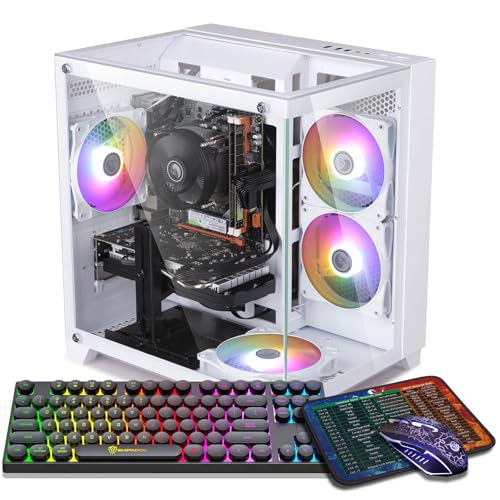
- Best graphics card in a white case: ZER-LON Gaming PC, Ryzen 5 5500, RTX 4060, White — Check on Amazon
- STGAubron Gaming PC, White, Ryzen 5 5500, RTX 3050 6GB, RGB Fan x6, RGB Keyboard & Mouse — Check on Amazon
- LXZ Gaming PC, White, Ryzen 5 5500, RTX 3050 8GB, 32GB DDR4, 1TB NVMe SSD — Check on Amazon
- LXZ Gaming PC, White, Ryzen 5 5500, RTX 3050 8GB, 16GB DDR4, 512GB NVMe SSD — Check on Amazon
- LXZ Gaming PC, Sea View White, Ryzen 5 5600GT, 16GB DDR4, 1TB NVMe SSD — Check on Amazon
See 1 more Amazon option
- STGAubron Gaming PC, White, Ryzen 7 5700X, RTX 3060 12GB — the white 3060, currently a deal-watch pick — Check on Amazon
Read the full guide ↓
Disclosure: As an Amazon Associate, reviewstook.com earns from qualifying purchases. Links to Amazon on this page are affiliate links; they cost you nothing extra. Listing details such as price and availability change often, so check the current Amazon listing before you buy.
This search makes two promises at once — a white gaming PC, and one that fits a small space — and the honest starting point is that the verified market under $700 only keeps one of them. Every machine in this guide is a full-size desktop tower. Not one of the six is a mini PC, not one mounts behind a monitor, and the small white gaming PC, as a verified product under $700, does not currently exist: tower cases are the only shape the budget white market sells. A guide that pretended otherwise would be grading photographs instead of computers.
So this guide grades what is actually decidable: the installation. A tower in a small room is not a specification problem, it is a placement problem — one good spot, usually on the floor beside the desk, with open air on the sides that breathe, a cable drop that reaches without tension, and exhaust heat going somewhere that is not back into the machine. The six picks below are the verified white towers under $700, re-graded on exactly that: form-factor class, where each can honestly live, how much heat and light it adds to the room, and what its placement demands before you order. Readers who need a computer that disappears — behind a screen, on a shelf, inside a media unit — are in the wrong guide, and the mini PC guides linked at the end are the honest detour.
There is one genuine way in which the color helps the room. A white tower carries less visual weight than a black one: in a small room a black tower reads as a dark block that pulls the corner toward it, while a white case reads as furniture, reflects the room’s light, and lets a floor-standing PC sit in view without shrinking the space around it. That is the white premium’s best justification in a small room — and its costs are real: the documented white tax (small at the RTX 3050 level, steep at the RTX 3060 level), glass that shows dust and fingerprints sooner than steel does, and RGB light a bedroom notices at night.
What follows: the quick picks, how the six were chosen, what an installed tower actually occupies once air and cables are counted, reviews with an installation grade for each machine, a comparison table, a five-step measure-before-you-buy checklist, how to choose, the mistakes that waste money and floor space in this niche, our final recommendation, and a FAQ. Check the live price on Amazon as you read, because two picks qualify only at sale prices and one is a labeled over-budget exception; each rule is printed where the pick appears.
In this guide
Quick Picks
Short on time, or comparing several options at once? Each row below names a buyer type and the product that suits it, with a link to the listing. Every pick is a floor-or-desk tower; what differs is what each asks of the room.
| Buyer type | Pick | Why it stands out | Link |
|---|---|---|---|
| Best graphics card in white | ZER-LON Gaming PC, Ryzen 5 5500, RTX 4060, White | The strongest card in a verified white case — and the most heat to place carefully | Check on Amazon |
| Best complete white package | STGAubron Gaming PC, White, RTX 3050 6GB | Six RGB fans plus keyboard and mouse in the box — one delivery, one install | Check on Amazon |
| Best memory and storage | LXZ Gaming PC, White, RTX 3050 8GB, 32GB DDR4 | Double the RAM of the rest — place it once, keep it | Check on Amazon |
| Best value RTX 3050 8GB | LXZ Gaming PC, White, RTX 3050 8GB, 512GB SSD | The 8GB card in white — plan the second drive before the final placement | Check on Amazon |
| Best white platform to upgrade | LXZ Gaming PC, Sea View White, Ryzen 5 5600GT | A glass showcase case that wants the desk — the coolest, quietest install here today | Check on Amazon |
| Best white RTX 3060 — deal-watch | STGAubron Gaming PC, White, Ryzen 7 5700X, RTX 3060 12GB | The card this tier deserves, in white — but check its live price, as it usually sits above this budget | Check on Amazon |
How These Picks Were Chosen
The budget was applied as a ceiling and the color as a verified fact. Every product below is a real Amazon listing whose own data states a white case, and where a price drifts, the review points you to the live listing rather than printing a number you should hold us to. Two picks are worth buying only when a sale brings the live price into budget and carry printed walk-away rules; one pick, the white RTX 3060, usually sits above this budget and is included as a labeled exception, because hiding the machine most readers want would be less honest than showing it with its warning attached. The performance floor stands: with one deliberate exception — the platform pick, sold with no discrete graphics card and labeled as such everywhere — every pick plays modern games at 1080p today.
The installation grading needs its method stated plainly, because it rests on a refusal. The base research for this set documents no case dimensions, no volumes and no weights for any of the six picks — so this guide prints none. No figure has been imported from any other guide’s research or any other machine’s listing, and no pick is credited with a size advantage its own listing does not document. What can be graded honestly is form-factor class: all six are towers with internal power supplies, all six stand on a floor or a desk, none has an external power brick to place, and none is documented with a VESA mount or any other mounting — towers in this class do not mount, and every mounting mention here is an explicit non-claim. Within that shared class, the reviews grade what genuinely differs: each machine’s heat, its documented light load at night, whether its purchase plan involves opening the case later, and how much verification homework the listing leaves you.
One more discipline matters more in a small room, not less. A white case is not a white build: none of the six listings publishes the color of its graphics card shroud, power supply cables or motherboard, so through the glass you should expect a white room with mostly dark furniture in it — and in a small space that glass is closer to your eye, which makes the gap between the listing photograph and the delivered interior more visible. The reviews grade the documented layer — case color, glass where stated, fan counts, included peripherals — and flag the undocumented layer as the thing to verify in listing photos before you order.
None of these machines was used by us. The grading rests on maker listings and specification pages — graphics cards, memory, storage, fan counts and connectivity compared across all six, with listings that publish their numbers in full favored over those that do not. Where a listing leaves something out — and the budget brands leave out much, from power supply wattage to the colors inside the case — the review names the gap instead of guessing across it.
The Installed Footprint Is Bigger Than the Box
The measurement that decides whether a tower works in a small room is not the case. It is the case plus everything around it: open air at the panels that breathe, the bend of cables leaving the back, the exhaust heat leaving the top and rear, and the chair and knee space the tower must not steal. A tower placed with its side against one wall and its rear against another has an installed footprint problem no spec sheet will warn you about — it will fit, and it will cook. Every pick here is graded against that installed footprint.
Floor-standing beside the desk is the recommended class for all six picks, and in most small rooms the only honest one. The tower stands at the desk’s side, intake and exhaust in open room air, its white case visible enough to earn the color’s visual discount without taking any desk surface. The costs are a longer cable drop down to the machine and dust arriving from the floor’s level — on a white interior, floor dust announces itself sooner, which is a cleaning rhythm, not a defect.
On the desk is the class the listing photographs always show and small rooms can rarely afford. It puts the glass at eye level and the white finish in the room’s light, and spends the scarcest surface in the room to do it, with fan noise at ear height and exhaust heat at sitting height. Only the sea-view platform pick is designed to argue for the desk, and its review grades that argument honestly. For the other five, on-desk placement is a compromise to choose knowingly, not a default.
Inside furniture — a media cabinet, a TV unit, an enclosed desk cubby, a closet — is refused for every pick in this guide, without exception. A gaming tower under load is a heater with a computer attached; sealed furniture traps its exhaust, feeds the hot air back to its intakes, and shortens every component’s life while the fans run louder. The refusal appears again in the checklist, the mistakes and the FAQ because it is the most common way small-room buyers ruin a good PC: the tidiest placement is the one that cooks it. If the only spot in the room is inside a cabinet, the answer is not a different pick from this guide — it is a different form factor entirely.
Two smaller placement facts apply to all six. First, there is no external power brick anywhere in this set — every pick runs an internal power supply — so the checklist’s brick step becomes a question about the power cord’s address: which outlet, on which wall, reached without crossing a walkway. Second, heat is a roommate: a tower rendering games for an evening raises a small room’s temperature as it never raises a large one’s, and the stronger cards do it more. Where you sit relative to the exhaust is an installation decision.
The 6 Best White Gaming PCs for Small Spaces Under $700
ZER-LON Gaming PC, Ryzen 5 5500, RTX 4060, White (Model AOV4060)
Who it suits: The small-room buyer who wants the strongest graphics card the white market offers at this money — and has one good floor spot with open air around it.
The hardware case is unchanged from the base guide: the RTX 4060 is a full generation ahead of every other card here, with comfortable 1080p at high settings, entry 1440p through DLSS upscaling, and DLSS 3 Frame Generation no 30-series pick can offer. Around it sits the standard budget platform — Ryzen 5 5500, 16GB of DDR4, a 1TB NVMe SSD — in a white case with four RGB fans. The price rule is the pick’s defining condition: its live price often sits above this budget, and it belongs in an under-$700 guide only when a sale brings it down to the line. Buy the dip, and check the price on Amazon before ordering; when it sits above budget, the black-case guides serve you better.
Its installation grade follows from its card. The 4060 is the hardest-working hardware here, which makes this pick the largest heat source of the six — in a small room, a placement fact before it is a performance fact. It wants the floor-standing class with genuinely open air: not the corner where two walls meet, and never inside furniture. Its four RGB fans are a moderate light load — visible in a dark bedroom, not a light show — and the white finish does its visual work from the floor, reading as part of the room rather than a hole in it. Two caveats ride along: Wi-Fi 5, a generation behind pick two’s Wi-Fi 6 (minor, for a desktop that should be wired where the room allows), and 8GB of VRAM that will age sooner on texture-heavy games than the 12GB card in the deal-watch pick below.
- RTX 4060 — no other verified white case at this budget holds a current-generation card.
- DLSS 3 Frame Generation — a feature the 30-series picks below simply do not have.
- 1TB NVMe SSD and 16GB DDR4 — the standard specification in full, nothing trimmed.
Honest limitation: It is a sale-only pick (its live price often runs above this budget) and the guide’s biggest heat source, so its one good spot has to be a genuinely ventilated one.
Choose it if graphics come first, your floor spot has open air on the breathing sides, and you will buy only at $700 or under. Skip it if the only available spot is enclosed or cornered — a weaker card in open air will outlive this one in a trapped placement — or if you need to order today at whatever it costs.

STGAubron Gaming PC, White, Ryzen 5 5500, RTX 3050 6GB, RGB Fan x6
Who it suits: The buyer who wants the whole white setup — tower, lights and peripherals — installed once, from one box, in a room where every extra delivery and cable is a cost.
This is the most completely white product in the guide and the easiest install of the six. The white case carries six RGB fans, the most lighting hardware documented on any pick here, and the box includes an RGB keyboard and mouse, so desk and tower arrive as one matched purchase. Underneath is the RTX 3050 in its 6GB form on a Ryzen 5 5500, with 16GB of DDR4, a 1TB SSD, Wi-Fi 6 and Bluetooth 5.0 — a genuine 1080p card at medium-to-high settings with DLSS doing real work in demanding titles, and 6GB of VRAM as its ceiling. Its pricing is the friendliest here: it is the pick most often found inside this budget, carrying only a small white premium over its black sibling — check the price on Amazon, as this is typically the cheapest documented route to the color in this guide.
The installation grade is where this pick both wins and pays. It wins on logistics: one box, peripherals included, a mid-heat 1080p card undemanding about its air, and a floor spot beside the desk is all it asks of the room. It pays on light: six RGB fans is the brightest documented lighting load here, and in a small bedroom — the tower in your peripheral vision all evening, and in the room when you sleep — that light is a placement input, not a garnish. If the room is also where you sleep, put it on the floor on the far side of the desk from the bed. The standing STGAubron caveats apply in full: the listing does not publish the power supply’s wattage or brand, the RAM speed or the SSD’s interface, so the first-week inspection (PSU label, configuration in Windows, keep the box) is part of the purchase — and in a tight install, do it before the tower takes its final spot, not after.
- Six RGB fans, and an RGB keyboard and mouse in the box — the whole white setup in a single delivery.
- Often found inside this budget — check the price on Amazon, where it has a record of landing under the line, not teasing it with a coupon mirage.
- Wi-Fi 6 and Bluetooth 5.0 — the strongest connectivity sheet of the six.
Honest limitation: The RTX 3050 6GB is a class below the guide’s 4060, its six fans are the guide’s largest light load for a sleeping room, and the unpublished PSU is the usual STGAubron unknown.
Choose it if you want one delivery, one install and the finished white look at a documented under-budget low. Skip it if the tower will sit in a bedroom where six fans of light will bother you nightly, or if you will outgrow the 3050 within a year.

LXZ Gaming PC, White, Ryzen 5 5500, RTX 3050 8GB, 32GB DDR4, 1TB NVMe SSD
Who it suits: The multitasker in a small room — game plus Discord plus browser plus recording software — who wants the tower they install to be the tower they keep, with no second-stage upgrades planned.
Every other machine in this guide ships with 16GB of system memory; this one documents 32GB, paired with the 8GB version of the RTX 3050 and a 1TB NVMe drive, in a white case on the same Ryzen 5 5500 six-core found across the guide. Both upgrades are the durable kind: the 8GB card holds texture settings the 6GB card cannot — the difference between the 3050 aging gracefully and aging loudly — and 32GB of RAM is the specification a heavy desktop feels every day. At 1080p the 5500 is not the limiting factor; the 3050 is, a 1080p card that wants DLSS help in the heaviest current releases.
For a small room, this pick’s installation argument is negative space: it asks nothing later. No memory upgrade to plan, no storage crisis scheduled, no reason to pull the tower out of a tight floor spot in six months and open it on the bed — in a small room, every reopening of the case is a furniture rearrangement. Its heat class is the 3050’s: moderate and floor-friendly. The cautions are about the listing, not the machine. This listing family mixes its variants — data for a different configuration, an Intel i5-12400F with an RTX 4060, appears within the same family’s pages — so the cart must be checked line by line against the headline (Ryzen 5 5500, RTX 3050 8GB, 32GB, 1TB, white) before you pay, and again on arrival. And no hard price is printed for this configuration, because no reliable live price for the 32GB build could be pinned during research: at or under $700 the specification justifies it; above that, the ZER-LON’s card is the better spend.
- 32GB of DDR4 — twice the system memory of any other pick here.
- The 8GB RTX 3050 — the form of the card that holds up longer at 1080p.
- 1TB NVMe storage, matching the guide’s best — nothing to upgrade later.
Honest limitation: The listing family mixes variants, including a different CPU and card — the cart check is mandatory — and no verified price could be pinned for this exact configuration.
Choose it if you run a heavy desktop alongside your games, the live price is at or under $700, and you want an install you never have to reopen. Skip it if the cart shows anything but the headline configuration, or if the price has wandered up toward what the 4060 costs.

LXZ Gaming PC, White, Ryzen 5 5500, RTX 3050 8GB, 16GB DDR4, 512GB NVMe SSD
Who it suits: The value hunter who wants the 8GB version of the 3050 in white without paying for the 32GB configuration — and who will do the one planned upgrade before the tower takes its final spot.
This is the same white formula as the pick above, trimmed: Ryzen 5 5500, the RTX 3050 in its 8GB form, 16GB of DDR4 and a 512GB NVMe SSD, in the white case of LXZ’s R5go line. Between the two memory sizes of the 3050, the 8GB card is the one to own — the extra VRAM is headroom texture settings will spend over the next few years — and between the two LXZ configurations, this is the one that does not charge for RAM a gaming-only machine may not need. The money saved against the 32GB build can go to the monitor, the desk, or the second drive this one’s smaller SSD will eventually ask for.
That last clause is this pick’s installation condition. 512GB is half the storage of the guide’s 1TB picks, and with modern installs routinely passing 100GB it is a working constraint from the first month — a second drive is a plan, not a possibility. So plan it as part of the install: fit the second drive (or accept the delete-and-redownload discipline) before the tower goes into the floor spot you measured, because extracting a tower from a tight placement to open it is the exact friction this guide exists to help you avoid. The pricing discipline matches its sibling: no reliable live price for this exact ASIN could be pinned during research, so no price is claimed beyond the rule — this pick earns its place if, and only if, the live price lands under $700 with the headline configuration in the cart. Confirm the style on the live listing too: this brand’s families are wide, and similarly named machines differ in storage, power supply and graphics. Its heat and placement grade otherwise matches the other 3050 towers.
- The 8GB RTX 3050 — the version worth owning — inside a verified white case.
- 16GB DDR4 on a Ryzen 5 5500 — the standard platform, and sufficient for gaming.
- The leanest path to the 8GB card in white, if the live price plays along.
Honest limitation: 512GB fills fast at modern install sizes, so a second drive is a scheduled job — and no verified price could be pinned for this listing, making the under-$700 rule a condition, not a description.
Choose it if gaming is the whole job, the live price is under $700, and you will settle the storage plan before the final placement. Skip it if you multitask heavily — the 32GB build above is yours — or the price sits anywhere near the ZER-LON’s sale price.

LXZ Gaming PC, Sea View White, Ryzen 5 5600GT, 16GB DDR4, 1TB NVMe SSD
Who it suits: The patient builder in a small room — someone who wants the white showcase case now and the graphics card when the right deal arrives.
Read the specification carefully, because its most important line is the one that is not there: there is no discrete graphics card. Games here are rendered by the Ryzen 5 5600GT’s integrated Radeon graphics — independent listing analysis of this exact machine confirms there is nothing else — so what you are buying is a platform, not a finished gaming PC. The integrated chip’s work is real but bounded: esports titles and older games at 1080p on modest settings, and a desktop fully usable from the day it arrives. It does not do modern AAA gaming, and no setting changes that. The case is the point: a white tempered-glass “sea view” design — the panoramic style that wraps the view around the front corner — on a machine that typically sells well inside this budget — check the price on Amazon — with 16GB of DDR4, a full 1TB NVMe drive, Wi-Fi, and six Zen 3 cores that will not bottleneck a mid-range card added later. Bought inside this budget, a meaningful share of it stays unspent — most of the way to that card.
This is the only pick whose installation grade argues about the desk. A panoramic glass case is built to be looked at, and in a small room the desk is the scarcest surface there is — putting this tower on it spends that surface on a display object. Graded honestly: today, with no discrete card, it is also the coolest and quietest install in this guide, because integrated graphics do not produce a gaming card’s heat. The day the card goes in, its heat class becomes a tower’s again and the floor spot you measured becomes the right home — so measure for stage two even if stage one lives on the desk. The glass also carries the white finish’s costs at their most visible: fingerprints and dust show on a panoramic panel sooner than on any other surface here. Bought as a finished product, this pick disappoints; bought as stage one of two, with placement planned for both stages, it is the smartest white purchase in the guide.
- A white tempered-glass sea-view case — the best-documented showcase in this guide.
- Typically priced well inside this budget — check the price on Amazon.
- 1TB NVMe storage and a six-core Zen 3 platform waiting for a real card.
Honest limitation: No discrete graphics card. Integrated graphics means esports and older titles until you buy one — and that purchase, and the placement change it brings, are not included in the price.
Choose it if you are happy to add a graphics card as stage two and you have planned where the finished build will stand. Skip it if you need one box, finished, that plays everything on day one — that is the STGAubron 3050 above.

STGAubron Gaming PC, White, Ryzen 7 5700X, RTX 3060 12GB — the deal-watch exception
Who it suits: The reader this whole search is really for — the one who wants the resident card of the $700 tier, the RTX 3060 12GB, in a white case — and who deserves the true price of that combination before planning a room around it.
On paper this is the best-balanced PC in the guide. The Ryzen 7 5700X is the strongest CPU here — eight cores against everyone else’s six — and the RTX 3060 12GB is the card the black-case $700 guides are built around: proper 1080p at high settings, the most VRAM in this guide, the safe long-term hold of the 30-series. Four RGB fans light the white case, and the rest of the sheet is complete: Wi-Fi 6, Bluetooth 5.2, 16GB of DDR4, a 1TB SSD. Inside this budget this machine would lead the guide and reduce most of the others to footnotes.
It does not usually sell inside this budget. This white 5700X/3060 configuration typically sits well above the line — check its live price on Amazon — while its black version reaches this budget on its sale days. The gap between them is the white tax in its purest documented form, and it is why this pick is labeled an exception rather than a recommendation: a guide that never mentioned the white 3060 would leave readers to find it alone and assume the price was a mistake. It is neither — it is what the color currently costs at this card. The rule is absolute: buy it only on a documented dip to $700 or under, which has not been recorded yet, or buy it knowingly above budget with the tax itemized.
Its installation grade is the standard tower grade with one addition: sequencing. As a machine it installs like its sibling — floor-standing, open air, internal power supply, four fans of moderate light, the usual STGAubron unpublished-PSU inspection in the first week. But because the correct purchase is a dip that has not happened, this is the one pick you should not measure the room for first. Do the checklist for a machine you can actually buy; if the dip ever comes, this tower occupies the same class of spot as every other pick here, and the measurements you made for the ZER-LON or the STGAubron 3050 will serve it unchanged. Planning a small room around an over-budget machine on a $700 budget is how the tax gets paid twice.
- RTX 3060 12GB — more VRAM than any other pick here, and the tier’s resident card, in white.
- Ryzen 7 5700X — eight cores, where every other pick has six.
- Wi-Fi 6, Bluetooth 5.2 and a 1TB SSD — the full specification, with nothing cut.
Honest limitation: Its live price is consistently over budget — check the price on Amazon. Treat it as a deal-watch listing, not as an under-$700 pick having an expensive week.
Choose it if a dip to $700 or under ever reaches you, or if you have consciously decided the color is worth a substantial premium over the black equivalent. Skip it if stretching above budget means compromising elsewhere — that money buys a faster PC in the under-$800 and under-$1200 guides.

Comparison Table
| Product | Graphics | Installation grade | Best use | Link |
|---|---|---|---|---|
| ZER-LON Gaming PC, Ryzen 5 5500, RTX 4060, White | RTX 4060 8GB | Floor-standing, open air — largest heat source | Best graphics card in white — sale days only | Check on Amazon |
| STGAubron Gaming PC, White, RTX 3050 6GB | RTX 3050 6GB | Floor-standing — one-box install, brightest light load | The complete white package, peripherals included | Check on Amazon |
| LXZ Gaming PC, White, RTX 3050 8GB, 32GB | RTX 3050 8GB | Floor-standing — install once, nothing to reopen | Memory and storage headroom for multitaskers | Check on Amazon |
| LXZ Gaming PC, White, RTX 3050 8GB, 512GB | RTX 3050 8GB | Floor-standing — settle the second drive before placing | The lean value route to the 8GB card | Check on Amazon |
| LXZ Gaming PC, Sea View White, Ryzen 5 5600GT | Integrated Radeon (no card) | Desk showcase today; floor spot after the card | A white platform to finish with your own GPU | Check on Amazon |
| STGAubron Gaming PC, White, RTX 3060 12GB | RTX 3060 12GB | Floor-standing — standard tower grade, deal-watch price | The white 3060 — deal-watch only; check price on Amazon | Check on Amazon |
Measure Before You Buy: The Five-Step Checklist
Do these five steps in order, before ordering any pick in this guide. They take a tape measure and about twenty minutes, and they are the difference between a tower that lives in the room and one that fights it.
Step 1: Measure the spot
Choose the exact spot first — for five of these six, a floor position beside the desk — and measure it with a tape: the floor area, the height up to anything above it, and the knee and chair room the tower must not eat into. Then compare your numbers against the dimensions the live listing states for the exact model. This guide prints no case dimensions because the verified research behind it documents none, and it will not invent them; the listing’s stated measurements and your tape are the two sources that count. If they disagree, believe the tape.
Step 2: Check the ventilation clearance
Stand at the spot and look at where the air goes. The tower’s intake and exhaust sides need open room air — not a wall pressed close, not a curtain, and under no circumstances the inside of a cabinet, cubby or closet. Sealed placement is refused for every pick in this guide: a tower in an enclosed space rebreathes its own exhaust and cooks slowly while its fans run loud. Clearance is the first thing a tidy instinct sacrifices and the last thing it should; if the spot cannot offer open air on the breathing sides, it is not a spot, and the room needs rearranging before the PC arrives.
Step 3: Give the power cord an address
There is no external power brick to place for any pick in this guide — all six run internal power supplies — so this step is about the cord instead. Decide which outlet the tower will use, on which wall, and whether the cord reaches it without crossing a walkway. If a power strip is part of the plan, place it where you can reach its switch without moving the machine — a small step that prevents the classic fudge of a tower installed beautifully and powered shamefully.
Step 4: Walk the cable drop
A floor-standing tower means every cable between desk and machine makes a drop: the monitor cable, the keyboard and mouse leads or receiver, the Ethernet run if you wire it — and you should wire it where the room allows, because no listing’s wireless specification describes your upload stability. Check the lengths you already own against the drop from desk height to the tower’s back panel, with slack rather than tension, and check the drop lands behind the desk rather than beside your feet. Short cables do not announce themselves in the listing; they announce themselves at 11pm on install night, and a small room has no slack space to improvise with.
Step 5: Then order
Only now — spot measured, air confirmed, outlet chosen, cables walked — place the order, with your pick’s price rule in hand: the ZER-LON only at $700 or under on a sale day, the two LXZ configurations only with the headline configuration confirmed in the cart and the live price under the line, the white 3060 only on a dip not yet recorded. A tower ordered before its spot exists is a return waiting for a reason; a tower ordered after these five steps is furniture you chose.
How to Choose a White Gaming PC for a Small Space
- Choose the spot before the PC. In a small room the placement is the specification everything else hangs from. Measure first (the checklist above), then shop; a stronger card in a trapped corner loses to a weaker card in open air over the machine’s life.
- Let white earn its premium where it actually pays. The color’s real small-room benefit is visual weight — a pale tower reads as furniture and does not darken its corner. That benefit is largest when the tower stands in view, and worth least when the machine hides under a desk, where the black equivalents buy a stronger card ladder for the same money.
- Price the color explicitly. For any white machine on your shortlist, look up its black equivalent and write the difference down. The documented spread in this guide runs from a small premium at the RTX 3050 6GB level to a steep one at the RTX 3060 12GB level — and a tax you have priced is a decision, while a tax you have not is a leak.
- Put the graphics card ahead of the color. The card decides what the PC will be for the next four years; the case decides how it looks on the day it arrives. Within this guide the card order is 4060, then 3060 12GB, then 3050 8GB, then 3050 6GB — and the white market’s prices will constantly tempt you to invert it.
- Plan the second stage before the first install. Two picks here are two-stage purchases: the platform pick needs a graphics card, and the 512GB LXZ will need a second drive. Fit what you can before the tower takes its measured spot; every later opening of the case is a furniture rearrangement you could have scheduled once.
- Count VRAM, not just card names. The 3050 comes in 6GB and 8GB forms, and what separates them is longevity rather than launch-day speed. At 1080p the 8GB card holds textures the 6GB card will make you lower — and VRAM cannot be upgraded later on the same card.
- Interrogate the unpublished layer. Power supply wattage, RAM speed, SSD interface, and the colors of everything inside the case: if the spec table does not publish it, assume the budget version of it, and do the first-week inspection — PSU label, configuration in Windows — before the tower takes its final spot.
- Verify the configuration, not the headline. Budget listing families mix variants — one family here carries a different CPU and card inside its own pages. The headline is a claim; the cart is the contract.
- Refuse the cabinet, however tidy it looks. It is repeated here because it is the mistake this niche makes most: no pick in this guide goes inside furniture. If the room’s only spot is enclosed, change the form factor, not the rule — start with Best Small Form Factor Gaming PC Under $700 or Best Mini PC Under $700 instead.
Common Buying Mistakes
- Ordering the tower first and finding its spot later. In a small room the spot is a finite resource; a PC bought before it is measured is a PC negotiating with furniture.
- Sealing a tower inside a media cabinet or desk cubby for tidiness. The exhaust has nowhere to go, the intakes breathe it back, and the machine ages fast while sounding worse. This guide refuses that placement for all six picks.
- Assuming a white case means white internals. The spec tables here publish case color only; shrouds, cables and boards are standard parts, usually dark — and in a small room the glass is close enough that you will see the difference daily. Check listing photos before you order.
- Meeting the white 3060’s over-budget live price with a $700 budget’s expectations. The tax itself is documented and defensible; paying it without knowing you paid it is the mistake.
- Letting a sale-only pick’s expired deal talk you into its average price. The ZER-LON above budget is a different purchase from the ZER-LON on a sale day inside it, and its walk-away rule is part of the product.
- Treating the cart check as optional on a mixed listing family. One family in this guide carries a different CPU and graphics card within its own pages; the delivered configuration, checked in Windows in the first week, is the only one that counts.
- Planning the cables after the placement. A floor tower’s cable drop is fixed geometry; discovering a short monitor cable after the tower is wedged into its spot turns a finished install back into a project.
- Judging white builds by launch-day photographs. The color’s ongoing cost is maintenance — dust shows on white sooner, glass shows fingerprints, and a floor-standing tower collects the floor’s air. A buyer who will not dust a case should buy the black one and spend the difference on the card.
Final Recommendation
- Best graphics card in white: ZER-LON Gaming PC, RTX 4060 — at $700 or under, on its sale days, in the room’s best-ventilated floor spot.
- Best finished white build: STGAubron Gaming PC, White, RTX 3050 6GB — one box, one install, peripherals included.
- Heavy multitaskers: LXZ Gaming PC, White, RTX 3050 8GB, 32GB — the install you never reopen, if the cart and price check out.
- Patient upgraders: LXZ Sea View White 5600GT — the showcase now, the card as stage two, the floor spot measured for both.
- The one you actually want: STGAubron White RTX 3060 12GB — wait for a dip that has not happened yet, or pay the tax with your eyes open.
Our top two are the ZER-LON and the STGAubron 3050 — the two honest ways to put a white tower in a small room: graphics first, in the room’s best air, bought on the sale that makes a current-generation card possible in white; or the finished look first, in a single-box package whose pricing leaves money in your pocket. Between them, most readers of this search are covered. If your room’s constraint is absolute — no floor spot, no open air, nothing but a shelf or a screen’s back — the honest move is to leave this guide for Best Mini Gaming PC Under $700 or Best Compact Gaming PC Under $700, where the machines are actually small. If the budget is flexible, Best White Gaming PC Under $800 shows what the next tier does to the white tax; if this build is a first PC for someone else, Best White Gaming PC For Beginners Under $700 grades these same machines on support and simplicity. Measure the room first — in this niche, the room is the specification.
Frequently Asked Questions
Is there a genuinely small white gaming PC under $700?
Not in the verified record this guide is built on. Every verified white gaming PC at this budget is a full-size tower; the white market does not sell a mini or small-form-factor machine under $700 that our research could verify. If small is the non-negotiable half of the search, the machines that honor it are not white-specific: start with Best Small Form Factor Gaming PC Under $700 and give up the color, or keep the color and give up small — the trade this guide grades.
Can I put one of these towers inside a TV cabinet or desk cubby to keep the room tidy?
No — and this is the guide’s firmest placement rule. A gaming tower under load exhausts hot air continuously; inside a cabinet or enclosed cubby that air has nowhere to go, the intakes breathe it back, temperatures climb, fans run louder, and components age faster. All six picks are refused for sealed placement. If tidiness requires a door that closes, the answer is a different form factor, not a tower from this guide.
Do any of these PCs mount behind a monitor or on a wall?
No. None of the six listings documents a VESA mount or any other mounting provision, and full-size towers in this class are floor-or-desk machines — stated as an explicit non-claim rather than left for you to assume. Behind-monitor mounting is a mini PC feature; if that placement is the point of the purchase, start with the mini PC guides linked here.
Where does the power brick go in a small room?
There is not one. All six picks run internal power supplies, so no external brick needs a shelf, a cable run or a hiding place — one of the tower format’s genuine small-room mercies. What needs planning instead is the power cord’s address: which outlet, on which wall, reached without crossing a walkway. That is Step 3 of the checklist, and the whole of the brick question for this set.
Does a white case really make a difference in a small room?
Visually, yes — that is the color’s one functional argument. A white tower reflects the room’s light and reads as furniture, where a black tower reads as a dark mass; in a small room where the PC is always in view, that difference is felt daily. The costs run the other way: dust and fingerprints show sooner on white and glass, and RGB light is more noticeable in a room you also sleep in. None of the six listings publishes a finish warranty, so treat upkeep — a monthly brush and air pass, and a spot away from sustained direct sun, since white plastics can yellow slowly under years of ultraviolet light — as your own contract with the color.
How much extra does white cost compared with the same PC in black?
It depends on the card, and the sibling guides let us measure it. At the RTX 3050 6GB level the gap is small at sale prices — the white STGAubron carries only a modest premium over the black one, so check both live prices on Amazon. At the RTX 4060 level you pay mostly in patience: the white listing tends to sit near black sale prices, but it dips under $700 far less often. At the RTX 3060 12GB level the gap is steep against the black machine’s best sale prices. In short, the tax stays small on the cards you settle for and grows large on the card you actually want — which is the whole economics of this niche.
- Best White Gaming PC Under $700
- Best White Gaming PC Under $500
- Best White Gaming PC Under $800
- Best White Gaming PC For Beginners Under $700
- Best White Gaming PC For Streaming Under $700
- Best White Gaming PC For 1440p Gaming Under $700
- Best White Gaming PC For Small Spaces Under $500
- Best White Gaming PC For Small Spaces Under $800
- Best Gaming PC Under $700
- Best Prebuilt Gaming PC Under $700
- Best Budget Gaming PC Under $700


