Where to Buy the White Gaming PCs in This Guide
All six systems below are sold on Amazon, and every one is a complete, ready-to-run computer — nothing here is a kit you have to assemble. Two of the six carry a strict buy-only price rule, explained in plain language in their reviews, so check the live price on the listing before you check out.
- Best first white tower: STGAubron Gaming PC Desktop, White (Core i7, RX 580 8GB, 32GB RAM, 512GB SSD)
- Best modern hardware, deal-watch pick: suevery Desktop Computer, White (Core i5-12400F, RTX 3050 6GB, 32GB RAM, 1TB SSD)
- Best-looking white case: LXZ Gaming PC Desktop, Sea View Room White (Ryzen 5 5600GT, 16GB RAM, 1TB SSD)
- Strongest built-in graphics in a white tower: LXZ Desktop PC, White (Ryzen 7 5700G, 16GB RAM, 512GB SSD)
- Best performance per dollar (not white): Beelink SER5 MAX Mini PC (Ryzen 7 7735HS, Radeon 680M, 24GB RAM, 1TB SSD)
- Cheapest route to real gaming (not white): GMKtec M6 Mini PC (Ryzen 5 6600H, Radeon 680M, 32GB RAM, 1TB SSD)
Affiliate disclosure: reviewstook.com is a reader-supported site. When you buy through links on this page, we may earn an Amazon commission at no extra cost to you. That is how the research behind guides like this one gets paid for. It never changes which products we pick: every system below earned its place on verified specifications, and we tell you plainly when a pick is a gamble.
Your First Gaming PC, in White, for Under $500: What Is Actually Possible
If this is your first gaming PC, welcome — and here is the honest version before any sales talk. A white gaming PC under $500 is one of the hardest things to buy well in late 2026. Component prices have spiked — memory and storage cost roughly double their lows, and graphics cards sell above old launch prices — so $500 buys less computer than a year ago. Asking for white shrinks the field again, because most budget towers are black and most white towers come from small brands whose listings leave important questions unanswered.
So this guide is built for beginners: every term is defined in a glossary below the quick picks, there is a step-by-step walkthrough of your first evening with the machine, and a section on the extra costs beyond the PC itself. It also grades each machine’s whiteness honestly, because a white case wrapped around black parts is a two-tone build.
Three facts will carry you through everything that follows. First, color adds zero speed. A white graphics card and a black one with the same name render the same games at the same speed; you are paying for how the machine looks on your desk, which is a fine reason — as long as nobody sells it to you as performance. Second, the most important part for gaming is the graphics hardware, and at this budget it comes in three strengths: a separate graphics card (best), strong built-in graphics in the mini PCs (middle), and ordinary built-in graphics in two of the white towers (lightest). Third, prices here move constantly, so no price printed anywhere stays true for long. Budget listings change price and even change parts under the same title, so check the current price on Amazon before you buy, follow each review’s rule, and remember that for two picks the rule matters more than anything else in the review.
What the verified $500 white market actually contains is this: one white tower with a real graphics card genuinely selling under the line, one modern white tower that hovers just above it and is only worth buying on a dip, two white towers running on built-in graphics, and two small black mini PCs with the strongest built-in graphics at this budget, clearly labeled as not white.
In this guide
Quick Picks: The Six Systems at a Glance
Best first white tower — STGAubron White, Core i7 / RX 580 8GB / 32GB / 512GB. The only white tower with a separate graphics card verified actually selling under $500 — check the current price on Amazon — and a keyboard and mouse are in the box, making it the most complete starter package here. The catches are in its review: the listing never cleanly states its processor’s generation, and the card is a 2017 model.
Best modern hardware, if the price behaves — suevery White, Core i5-12400F / RTX 3050 6GB / 32GB / 1TB. The only genuinely up-to-date white tower near this budget: a modern six-core processor, a current entry-level card with smart upscaling, generous memory, and a full terabyte of storage. It often sits just over the line, so this is a deal-watch pick with one hard rule: check the current price on Amazon, buy only when it sits within the under-$500 budget, and walk away above it.
Best-looking white build — LXZ Sea View Room White, Ryzen 5 5600GT / 16GB / 1TB. A white panoramic glass case with seven programmable light-up fans, positioned at the top of this budget band — check price on Amazon — the prettiest machine here, and the clearest trade: no separate graphics card inside, so as delivered it plays light games, and its real value is as a platform you add a card to later.
Strongest built-in graphics in white — LXZ White, Ryzen 7 5700G / 16GB / 512GB. The 5700G’s built-in graphics are the strongest fitted to any white tower here, and its eight cores make it the best white tower for work alongside games. Check the current price on Amazon for this exact configuration — a bigger-storage sibling sits in a higher tier and has sold out — so the same hard rule applies: within the under-$500 budget, or not at all.
Best performance per dollar, wrong color — Beelink SER5 MAX, Ryzen 7 7735HS / Radeon 680M / 24GB / 1TB. Positioned at the top of this budget band — check the current price on Amazon. Its built-in Radeon 680M graphics are the strongest in this guide, full stop. It is also a small dark box, not a white tower — the honest escape hatch if smooth gaming beats matching the desk.
Cheapest real gaming, wrong color — GMKtec M6, Ryzen 5 6600H / Radeon 680M / 32GB / 1TB. The same 680M graphics as the Beelink, positioned well below the top of this budget band — check price on Amazon. Matte black and tiny — the best value on the page if your white commitment is flexible, and the savings can buy the white monitor and keyboard that make a setup look white anyway.
Beginner’s Glossary: Thirteen Terms That Unlock Every Listing
Every listing in this guide — and every listing a seller hopes will confuse you — uses the same handful of terms. Learn these and the reviews below will read like plain English.
- Prebuilt. A computer that arrives assembled, with Windows installed, ready to plug in. All six picks are prebuilts. The opposite is building your own from parts — a fine hobby and a poor first evening.
- Graphics card (GPU). The separate component whose only job is drawing the game on your screen, and the single biggest factor in how well a PC plays games. Two picks here have one (the STGAubron and the suevery); the other four rely on the next term instead.
- Integrated (built-in) graphics. Graphics circuitry built into the processor itself. The question is strength: ordinary built-in graphics (the Vega 7 and Vega 8 in the LXZ towers) handle light games; strong built-in graphics (the Radeon 680M in the mini PCs) handle a much wider library.
- APU. AMD’s name for a processor with unusually strong built-in graphics — the 5600GT and 5700G in the LXZ towers are APUs. In an APU tower with no graphics card, the monitor plugs into the motherboard, and that is correct, not a mistake.
- Processor (CPU) and cores. The computer’s general-purpose brain. Cores are parallel workers: more cores help when you run a game, a browser, and chat at once. For gaming alone, a newer processor with fewer cores usually beats an older one with more.
- The “F” in a processor name. On Intel chips, a name ending in F (like the suevery’s Core i5-12400F) means the processor has no built-in graphics at all. Fine while its graphics card works — but it makes one setup mistake fatal, as the walkthrough explains: plug the monitor into the wrong sockets on an F-chip machine and you get a black screen, not a slow one.
- RAM (memory). The computer’s short-term workspace, measured in gigabytes (GB). 16GB is the workable minimum for gaming today; 32GB is comfortable headroom. Four of the six picks ship 32GB, removing the first upgrade most budget buyers end up needing.
- SSD and NVMe. Storage — where your games and files live. An SSD is the fast modern kind (all six picks have one); NVMe is the fastest common variety. Capacity is what beginners feel: 512GB fills after a handful of big modern games, while 1TB breathes easier. When a review flags 512GB as a catch, the fix is a second or larger drive later — budget for the machine plus that fix.
- PCIe slot. The long socket inside a tower where a graphics card plugs in. An empty PCIe slot is a promise: this machine can accept a card later. Both LXZ towers have one. The mini PCs do not — their graphics are fixed for life.
- Power supply (PSU), measured in watts (W). The box that feeds electricity to everything else. It matters the day you upgrade: a bigger card needs a supply that can feed it. Only one pick here states its wattage in verified material — the LXZ 5700G tower’s 400W — and 400W is modest, capping any future card to low-power models unless the supply is replaced too.
- DLSS and upscaling. A trick where the card renders the game at a lower resolution, then intelligently stretches it to fill your screen, so games run faster at a small cost in sharpness. NVIDIA’s version is DLSS, and only its RTX cards have it — here, only the suevery’s RTX 3050. The RX 580 and all the built-in graphics here have no DLSS, one reason their honest game expectations are set lower.
- Ray tracing. A lighting technique that makes reflections and shadows more realistic, at a heavy speed cost. None of the graphics hardware here does it usefully; if a budget listing brags about it, it is decorating the box.
- Renewed, barebones, soldered — three labels worth knowing before you buy. Renewed means a used machine cleaned and resold; all six picks are sold new. Barebones means a partial kit missing parts you must add; all six arrive complete, with Windows installed. Soldered means a part is permanently attached and can never be swapped — and it does apply on this page, twice over: the mini PCs’ graphics (the 680M is part of the processor itself, so it can never be upgraded) and the Beelink SER5 MAX’s memory, which is soldered LPDDR5, fixed at 24GB for the life of the machine.
How We Chose These Six (and What We Rejected)
We started with every white or white-listed gaming desktop we could find on Amazon at or near $500, then checked each against its actual listing: the color stated in the specification block and the exact configuration in the title. Anything we could not verify was rejected or carried with an explicit buy-only rule.
How whiteness was graded. Three layers, graded separately. Layer one is the case: actually white, per the listing’s own spec block, rather than photographed under bright light? Layer two is the graphics card’s cover, where a separate card exists: genuinely white cards are premium parts and none of the towers here document one, so the cards inside should be assumed standard dark covers unless the listing photos prove otherwise. Layer three is the extras in the box: only the STGAubron documents a matching keyboard and mouse.
Rejected: white towers that never reach $500. The pattern is consistent enough to be a rule of the market. STGAubron’s own white line shows the cliff: its white GTX 1660 Ti tower, its white RTX 3050 tower, and the white ZER-LON tower with an RTX 4060 all sit in higher tiers above this budget. ViprTech’s white Stryker 1.0 sits above this budget too; LXZ’s white 5700G in a bigger-storage configuration sits in a higher tier and sold out, and its white 5600G tower sits above this budget as well. Step above this budget and white towers with near-modern cards exist; at $500 and below, they do not — which is why this guide’s white towers ask you to accept older cards or built-in graphics.
Rejected: white in name only. Some listings surface in white-PC searches while failing the color check — STGAubron’s i5/RX 550 tower appears in budget roundups constantly, but its spec block reads Color: Black — and a white HP all-in-one in this budget band runs a weak processor with minimal memory and storage: a kitchen computer, not a gaming PC. The lesson: the spec block’s color field is the only color promise a listing makes.
Rejected: the white mini PC that does not exist. We looked hard for a truly white mini PC with Radeon 680M graphics at this price — it would have been the perfect beginner pick. It is not there: the GMKtec M6 is matte black, Minisforum’s small 680M machines are silver, with no current verified listing, and the Beelink and ACEMAGIC 680M minis are dark grey and black. So the class is represented by its two best verified members, graded zero for whiteness, rather than by a silver machine relabeled to fit the headline.
The “white tax,” measured. Where a true black-and-white pair exists, we compared both. The cleanest pair is STGAubron’s i7/RX 580 tower: the white version ships with 32GB of memory, while the black sibling with the same processor class and card ships with 16GB of memory — and the two sit in the same position within this budget band rather than the white one commanding a premium. On the one pair we could compare end to end, the white tax is effectively zero — at this budget you pay for the configuration lottery, not the color. Anyone who tells you a sub-$500 white tower automatically costs meaningfully more than black has not compared the pair.
Your First Evening: A Step-by-Step Setup Walkthrough
Every pick in this guide arrives assembled with Windows installed. Your first evening is about connecting things in the right order — and avoiding the one mistake that makes new owners think their PC arrived broken.
- Unbox and check the paperwork against the listing. Compare what arrived with the spec block you ordered from: memory size, storage size, color. Budget listings occasionally ship a sibling configuration, and if the box is wrong, you want to know tonight, not after setting everything up.
- Give it air. Place the tower where air can move around it — not inside a closed cabinet, not flush against a wall. The white towers’ light-up fans are also the cooling: they need room to breathe. The mini PCs need only a shelf’s worth of space, and can even mount behind a monitor.
- Find the right sockets for the monitor cable — this is the step that matters. A tower has two clusters of screen sockets: a set on the graphics card (lower down, horizontal, on the card itself) and a set on the motherboard (higher up, near the other plugs). If your machine has a graphics card — the STGAubron and the suevery — the cable goes into the card’s sockets, never the motherboard’s. If it has no card — the two LXZ towers, whose graphics live inside the processor — the motherboard sockets are the graphics, and those are the right ones.
- Know the two ways the wrong socket bites. On the suevery, the mistake is total: its Core i5-12400F has no built-in graphics at all (that is what the F means), so a monitor plugged into the motherboard gets no picture whatsoever — a black screen and a moment of panic on an otherwise healthy machine. On a machine whose processor does have basic built-in graphics, the same mistake is sneakier: you get a picture, the PC seems fine, and games quietly run on the weak built-in graphics instead of the card you paid for.
- Connect the rest. Keyboard and mouse (the STGAubron includes a matching set; for the other picks, anything with a USB plug works). Then the power cable, then the power switch on the back of the tower if it has one, then the button on the front.
- Walk through Windows setup slowly. The first boot takes you through language, Wi-Fi, and account screens; nothing here can be broken by reading before clicking. Connect to your home Wi-Fi when asked — several picks document Wi-Fi 6 — or use a wired cable, the steadier choice for online games.
- Let it update, then restart. A new PC will want a pile of Windows updates. Let them all finish before judging anything — a machine mid-update feels slow and strange, and it is neither. This is also the moment to install the free game stores (Steam, the Epic Games Store, the Xbox app) and queue your first download, since big games take a while.
- Use the return window as a stress test. Small budget brands save money partly on quality control, and buyer reports on the STGAubron family include early failures and Wi-Fi trouble. So for the first two weeks, use the machine hard: long game sessions, big downloads, video calls. If a game runs far worse than the reviews below led you to expect, revisit step 3 first — the cable is the most common cause. A PC that survives two heavy weeks has cleared its highest-risk period, and Amazon’s return window is your safety net only while it is open.
The Detailed Reviews
1. STGAubron White (Core i7, RX 580 8GB, 32GB RAM, 512GB SSD) — Best First White Tower
Who it suits: the beginner who wants the complete white starter package — white tower, real graphics card, keyboard and mouse in the box — at a price verified under $500, and accepts older hardware and one unanswered question to get it.
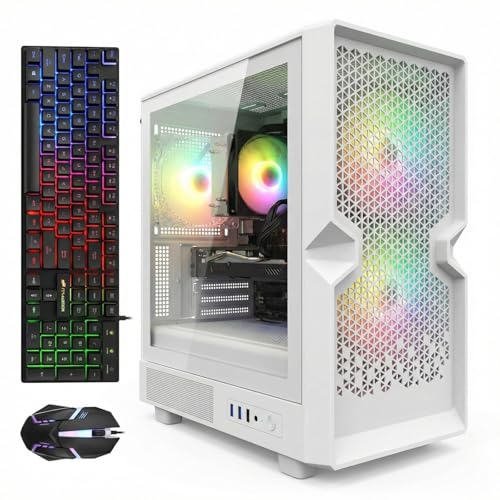
Whiteness grade: case yes, card undocumented, extras yes. The spec block states Color: White; the case is a white tower with three light-up fans, and the box includes an RGB keyboard and mouse. The honest gap is behind the glass: the listing never documents the RX 580’s cover color, and cards at this price are normally dark — expect a white shell around a two-tone interior.
What you are actually getting. An Intel Core i7 processor (the listing says up to 3.9GHz), a Radeon RX 580 8GB graphics card, 32GB of memory, a 512GB SSD, Wi-Fi 6, Bluetooth 5.0, and Windows 11 Home, sold by STG USA — check price on Amazon for this exact configuration. The RX 580 dates from 2017, so set expectations at 1080p: esports titles like Fortnite, Valorant, Rocket League, and Minecraft run capably at medium-to-high settings, recent big-budget games need low settings, and there is no ray tracing and no DLSS to lean on.
The honest limitation: the listing cannot tell you which i7 you are buying. One field of its own spec block reads “Core i7 4th” — a 2014-era design — while the headline just says Core i7. An i7 of that vintage still keeps up with an RX 580 in esports games, but the platform is a dead end — no worthwhile processor upgrade exists for it. Buyer reports across STGAubron’s related models also mention shutdowns, Wi-Fi instability, and early failures, so verify the 32GB configuration before ordering (sibling listings wear 16GB) and stress-test hard during the return window.
- Pros: only verified white tower with a graphics card under $500; 32GB of memory at a tier where 16GB is standard; keyboard and mouse included; white tax measured at zero against its black sibling
- Cons: processor generation ambiguous, possibly 2014-era; RX 580 is 2017 hardware with no ray tracing or DLSS; 512GB of storage fills fast; brand reliability reports are mixed
Choose it if white is non-negotiable, your games are esports and older favorites, and you will verify the configuration and stress-test on arrival. Skip it if you want a platform that grows with you — the suevery below is the modern answer when its price cooperates.

2. suevery Desktop, White (Core i5-12400F, RTX 3050 6GB, 32GB RAM, 1TB SSD) — Best Hardware, Deal-Watch Only
Who it suits: the patient beginner. If you can watch a listing and buy when it dips, this is the only white tower near $500 whose insides belong to the current era.
Whiteness grade: the strongest claim in the guide, partially documented. The listing (series SUV9W3) states Color: white, advertises a pure white theme, and fits five light-up fans in the white case, with Wi-Fi 6 on board. But it does not separately document the RTX 3050’s cover color, so read “pure white theme” as the seller’s framing and check the listing photos for the card before you buy.
What you are actually getting. An Intel Core i5-12400F — a six-core 12th-generation processor that remains a legitimately good gaming chip — an RTX 3050 6GB graphics card, 32GB of DDR4 memory, and a 1TB NVMe SSD. Every element sits a class above the STGAubron: a far newer, stronger processor, double the storage, and an RTX 3050 whose DLSS upscaling and current drivers stretch comfortable 1080p gaming across esports and mainstream titles at medium-to-high settings.
The honest limitation: the price. This listing often sits over this guide’s budget, and no enthusiasm changes that — check the current price on Amazon before you buy. Pricing for this listing family swings in both directions, so the rule is therefore absolute: buy it only when the live price sits within the under-$500 budget. A little over the line it is a good PC but a broken promise; a little under it, it becomes the best pick in this guide by a wide margin. Set a price alert and wait for the dip.
- Pros: only modern platform in the guide (12th-generation i5); RTX 3050 with DLSS; 32GB of memory and 1TB of storage as standard; strongest white presentation of any tower here
- Cons: often sits over budget — check the current price on Amazon before buying; pricing is volatile; graphics card cover color not separately documented; small brand with a thin track record
Choose it if you can wait for a dip and want the white tower you will not outgrow in eighteen months. Skip it if you need to buy today at a verified under-$500 price — that is the STGAubron above, or the LXZ below if the panoramic look matters more than a graphics card.

3. LXZ Sea View Room White (Ryzen 5 5600GT, 16GB RAM, 1TB SSD) — The Look, Bought as a Platform
Who it suits: the beginner whose priority is honestly the look — a white glass showpiece for a white desk — and whose gaming is light, or whose plan already includes adding a graphics card later. It is also the pick positioned within budget today, with no deal-watch rule attached — check price on Amazon; it is sold by Romiromi.
Whiteness grade: the best in the guide. The Sea View Room case is a white panoramic design — glass arranged to show the interior rather than hide it — fitted with seven programmable light-up fans per the seller’s listing copy. With no graphics card, no dark cover breaks the theme. No keyboard or mouse carrying the theme is documented, so budget for your own white peripherals.
What you are actually getting. A Ryzen 5 5600GT — a six-core processor with built-in Radeon Vega 7 graphics — 16GB of DDR4 memory (the listing notes headroom to 64GB), and a 1TB NVMe SSD. On the Vega 7 alone, today’s gaming means esports and indie titles at modest settings and older games turned down — buyer feedback on this listing agrees, with owners praising the machine while noting that built-in graphics cap gaming until a card goes in. The empty PCIe slot is the most important component in the box: drop in a previous-generation card later and the weakest gamer in this guide becomes a balanced 1080p system.
The honest limitation: as delivered, this is the least capable gaming machine among the towers, and it sits at the top of this budget band. You are paying top-of-band money for a case, a platform, and built-in graphics, when the STGAubron above delivers a graphics card and double the memory within the same band. One more caution: towers of this type ship with modest power supplies, so check the listing’s stated wattage before ordering — it caps how ambitious a future card can be without a supply replacement too. Buy this with the upgrade already planned and budgeted, as machine plus future card, or do not buy it.
- Pros: best white presentation in the guide, panoramic glass and seven programmable fans; positioned within this budget band — check price on Amazon; 1TB of storage; memory headroom and an empty graphics card slot for later
- Cons: built-in Vega 7 graphics only — light gaming as delivered; the graphics card upgrade is a cost still ahead of you; modest power supply limits card choices; no included peripherals carrying the theme
Choose it if the white showpiece look is the point and a graphics card upgrade within the year is genuinely in your budget. Skip it if you need the strongest gaming you can get on day one for $500 — every other pick in this guide out-games it as delivered.

4. LXZ Desktop, White (Ryzen 7 5700G, 16GB RAM, 512GB SSD) — Strongest Built-In Graphics in a White Tower
Who it suits: the beginner who wants one white tower that splits its time between games and everything else — homework, office work, browsing, video calls. This is the white tower form of the 5700G, the chip that defined its generation of strong built-in graphics.
Whiteness grade: case yes, interior standard. The spec block states Color: White for this LXZ-R7pro configuration, in a white case with glass presentation. With no graphics card, no dark cover interrupts the theme; this is a conventional tower rather than the panoramic showpiece. No peripherals are documented, so the theme is the case itself.
What you are actually getting. A Ryzen 7 5700G: eight cores and sixteen threads, with Radeon Vega 8 built-in graphics — a step up from the 5600GT’s Vega 7 and the strongest built-in graphics fitted to any tower here — plus 16GB of DDR4 memory, a 512GB NVMe SSD, and a 400W power supply. Those eight cores make it the best multitasking and everyday-work machine among the white towers, and the Vega 8 takes the esports catalog at 1080p low-to-medium settings more comfortably than the Vega 7. It is still built-in graphics — no ray tracing, no DLSS, new big-budget titles only at low settings. An empty slot waits for a future card, as on the 5600GT pick, but the documented 400W supply restricts that card to low-power models unless the supply is replaced too.
The honest limitation: check the current price on Amazon for this exact 512GB configuration before you buy, because the evidence around it calls for caution. Its own sibling tells the cautionary tale: the same model with 1TB and a 650W supply sits in a higher tier and sold out. Configurations under one model number drift independently, so the 512GB version may sit within the under-$500 budget on a given day — but only the live listing can tell you. The rule matches the suevery’s, for the opposite reason: buy it only when its live price sits within the under-$500 budget. Above that, the STGAubron’s card wins the comparison outright.
- Pros: strongest built-in graphics in a white tower (Vega 8); eight cores — best multitasking and everyday work of the white picks; real graphics card upgrade path; white case confirmed in the spec block
- Cons: price needs a live check for this configuration — strict buy-only within the under-$500 budget rule; 512GB of storage is the tier’s floor; 400W power supply caps upgrades; built-in graphics ceiling applies to every new big-budget title
Choose it if your games suit built-in graphics, you value the eight-core processor for work alongside play, and the live price is within budget when you check. Skip it if the price sits above this budget on the day — at that point the suevery’s card, when it dips, is the better white buy, and the minis below are the better buy at any price.

5. Beelink SER5 MAX (Ryzen 7 7735HS, Radeon 680M, 24GB RAM, 1TB SSD) — The Performance Escape Hatch
Who it suits: the beginner who came in wanting white, read the four reviews above, and decided what they actually want is the best gaming $500 buys, full stop. Positioned at the top of this budget band — check price on Amazon — it is the resident Radeon 680M pick from our plain under-$500 guide.
Whiteness grade: zero. The SER5 MAX is a dark mini PC that will not match a white desk setup. What it offers instead is disappearance: small enough to mount behind a monitor or tuck out of sight entirely.
What you are actually getting. A Ryzen 7 7735HS processor with Radeon 680M built-in graphics — the strongest built-in graphics in this guide, a full class above the Vega systems in the white towers — 24GB of LPDDR5 memory, and a 1TB SSD, in a mini PC that uses little power and makes little noise. In plain terms: esports at 1080p with real headroom, plus mainstream titles at 1080p low-to-medium settings the Vega machines cannot attempt. The no-ray-tracing ceiling still applies, but it doubles the STGAubron’s storage and out-games both LXZ towers, even though its 24GB of memory is a little less than that tower’s 32GB.
The honest limitation: two of them. First, it fails the brief — this guide is about white gaming PCs, and this is not one; it is included because hiding the best-performing option at the budget, over a color, would serve the headline instead of you. Second, its graphics can never be upgraded: the 680M is part of the processor, so day one’s graphics are forever’s graphics. If the white look is the point, skip it without regret; if performance per dollar is the point, this is the pick and the white towers are the compromise.
- Pros: strongest built-in graphics in the guide (Radeon 680M); 24GB of memory and 1TB of storage; positioned at the top of this budget band — check price on Amazon; tiny, quiet, and mountable out of sight
- Cons: not white — fails the brief outright; graphics can never be upgraded; memory is soldered at 24GB and can never be added to; laptop-class processor in a desktop comparison; no included peripherals
Choose it if smooth gaming beats color and you want the strongest all-round performance this budget verifies. Skip it if the white setup is the actual goal — in which case the STGAubron is your graphics-card answer and the LXZ 5600GT is your showpiece.

6. GMKtec M6 (Ryzen 5 6600H, Radeon 680M, 32GB RAM, 1TB SSD) — The Value Anchor
Who it suits: the beginner who wants 680M-class gaming for the least money possible and treats the white requirement as a preference rather than a rule. Also anyone who wants a small second machine — a living-room or travel gaming box — alongside a main setup.
Whiteness grade: zero, and not close. The M6 is matte black, with no white variant. Like the Beelink, it answers the color problem with size: it occupies less desk than the keyboard in front of it.
What you are actually getting. A Ryzen 5 6600H with the same Radeon 680M graphics as the SER5 MAX, 32GB of memory, and a 1TB SSD, positioned well below the top of this budget band — check price on Amazon. The 6600H gives up two processor cores to the Beelink’s 7735HS — but the graphics, which are what games actually feel, are the same silicon. That makes the M6 this guide’s value story: pick five’s gaming class at a lower position in this budget band — leaving more of the budget for the white monitor and peripherals that make a desk setup read as white.
The honest limitation: the same as the Beelink’s, squared. It is not white, its graphics can never be upgraded, and its processor is the weaker of the two 680M minis for everyday work. Its pricing is also the most volatile in the guide, so check the current price on Amazon before you buy. Positioned lower in the band, it is the smartest buy here for anyone whose white commitment is negotiable; near the top of the band, it is merely good.
- Pros: Radeon 680M gaming at the value end of this guide — check price on Amazon; 32GB of memory and 1TB of storage; leaves budget for a white monitor and peripherals
- Cons: matte black — the opposite of the brief; six-core processor trails the Beelink; graphics can never be upgraded; value case depends on its position in the band when you check
Choose it if you want the most gaming per dollar and can build the white theme around the desk instead of inside the case. Skip it if the PC itself must be white — that is what picks one through four are for.

Comparison Table: All Six Picks Side by Side
| Pick | Processor | Graphics | Memory / Storage | Whiteness grade | Price |
|---|---|---|---|---|---|
| STGAubron White | Core i7, up to 3.9GHz (generation not cleanly stated; one spec field reads “Core i7 4th”) | RX 580 8GB (separate card) | 32GB / 512GB SSD | White case + included RGB keyboard & mouse; card cover undocumented | Check price on Amazon |
| suevery White | Core i5-12400F (no built-in graphics) | RTX 3050 6GB (separate card) | 32GB DDR4 / 1TB NVMe | “Pure white theme” per listing; card cover not separately documented | Check price on Amazon — buy only within the under-$500 budget |
| LXZ Sea View Room White | Ryzen 5 5600GT | Radeon Vega 7 (built-in) | 16GB DDR4 / 1TB NVMe | Best in guide: white panoramic glass case, 7 programmable fans | Check price on Amazon |
| LXZ 5700G White | Ryzen 7 5700G | Radeon Vega 8 (built-in) | 16GB DDR4 / 512GB NVMe | White case per spec block; no card to break the theme | Check price on Amazon — buy only within the under-$500 budget (1TB sibling sits in a higher tier) |
| Beelink SER5 MAX | Ryzen 7 7735HS | Radeon 680M (built-in) | 24GB / 1TB SSD | Zero — dark mini PC | Check price on Amazon |
| GMKtec M6 | Ryzen 5 6600H | Radeon 680M (built-in) | 32GB / 1TB SSD | Zero — matte black mini PC | Check price on Amazon |
What Else You Will Spend: The Costs Beyond the PC
The PC is not the whole purchase, and beginners are the readers most often surprised by that. Budget for these in roughly this order.
A monitor, first. None of the six systems includes a screen. Any monitor with an HDMI or DisplayPort input works, and a basic 1080p monitor is the natural partner for every pick here — their graphics are all aimed at that resolution. If you already own a monitor, or a TV with an HDMI socket, start there and upgrade later. What the PC does care about is which sockets you plug the cable into, per step 3 of the walkthrough.
A keyboard and mouse, unless you buy pick one. The STGAubron is the only pick that documents a keyboard and mouse in the box — a matching RGB set, no less. For the other five, nothing in the verified material promises peripherals, so assume you need your own. Any USB or wireless set works to start.
The catch attached to your pick, priced as machine plus fix. Every budget PC has one known future cost, and honest budgeting names it now. The LXZ Sea View Room’s catch is a graphics card: the machine is a platform, and the card that completes it is a second purchase to plan from day one. The STGAubron’s and the LXZ 5700G’s catch is storage: 512GB fills after a handful of large games, and a bigger or second drive is the fix. The mini PCs have no catch and no fix: what you buy is what they will always be.
Sound and small things. None of these systems documents speakers or a headset, so games stay silent until you add something — a headset is the usual beginner answer, and it doubles as your microphone for voice chat. That completes the honest list: screen, keys, sound, and your pick’s one catch.
How to Choose Your First White Gaming PC
Decide what “white” has to mean before you shop. Three standards hide inside the same search term. Standard one is a white case: four picks meet it. Standard two is a white build — white case, light interior parts, white cables — and at $500 essentially nothing meets it, because white graphics cards and motherboards are premium parts. Standard three is a white setup: the PC plus a white monitor, keyboard, mouse, and desk accessories — achievable at this budget only by spending less on the PC itself (the real argument for the GMKtec M6 at the value end of the band) or by taking the STGAubron’s included peripherals as a head start.
Rank graphics before everything else, color included. The performance ladder here is strict: the separate cards (the suevery’s RTX 3050, then the STGAubron’s RX 580) play real games at 1080p; the Radeon 680M in the minis is the strongest built-in graphics, a half-step below them; the Vega 8 and Vega 7 in the LXZ towers are a full step below that, suited to esports and older titles. Color moves no machine up or down that ladder. Pick your rung first; shop for whiteness second.
Price the black sibling before paying any white tax. On our one verified pair the tax was zero (see How We Chose, above). Compare like for like on memory and storage, and refuse to pay much for color alone.
Treat configuration drift as the default. Budget listings change components under a stable title: the STGAubron family sells the same headline configuration with 16GB and 32GB under different listings, and LXZ sells the 5700G in two configurations under one model name. Before ordering, read the spec block on the live listing — memory, storage, color — and screenshot it. If what arrives differs, the screenshot is your return case.
Plan the second purchase. Every tower here has a known next step: a graphics card for the LXZ pair (with a power-supply check first), storage for the 512GB machines, nothing for the suevery beyond time. The minis have no second purchase. Buy the machine whose next step you can actually afford.
Common Beginner Mistakes When Buying a White Gaming PC
Believing the render. White-PC listing photos are shot under bright lights, and the interiors are often renders rather than photographs. The gleaming all-white machine in the hero image may be a white case wrapped around entirely standard dark components. The spec block’s color field describes the case; nothing else is promised unless it is written down.
Plugging the monitor into the wrong sockets. The most common first-evening panic in PC gaming. On a tower with a graphics card, the cable belongs in the card’s sockets. On the suevery, the wrong sockets mean a black screen, because its processor has no built-in graphics.
Buying built-in graphics for big new games because the case was pretty. The LXZ 5600GT pairs this guide’s best looks with its weakest tower gaming. Panoramic glass does not render frames. If your library is new releases, the graphics-card picks or the 680M minis are your list, whatever color they come in.
Ignoring the power supply in the upgrade plan. The LXZ towers ship with modest wattage — 400W is the documented figure on the 5700G configuration. A future card that ignores the power supply becomes two purchases instead of one. Check the stated wattage on the live listing and plan the card around it, or budget the supply replacement honestly.
Skipping the stress test. Small-brand budget towers keep prices low partly through variable quality control, and buyer reports on the STGAubron family include early failures. Whatever you buy, work it hard — games, updates, Wi-Fi — while the return window is open. A machine that survives two weeks of heavy use has cleared the highest-risk period of its life.
Final Recommendation
If you are a beginner buying a white gaming PC under $500 today, buy the STGAubron White. It is the only pick that satisfies every word of the brief at once — white case, real graphics card, keyboard and mouse in the box, verified under the line — check price on Amazon — and its flaws (an ambiguous, possibly 2014-era processor and a 2017 graphics card) are the honest price of the brief itself. Verify the 32GB configuration, plug the monitor into the card, and stress-test it on arrival.
If you can wait for a dip, wait for the suevery: a generation ahead of everything else here, often close enough to the line that a routine sale settles it — within the under-$500 budget it becomes the recommendation, no caveats beyond the brand’s youth. And if performance matters more than color, the Beelink SER5 MAX at the top of this band and the GMKtec M6 at the value end are waiting, in black, with the strongest built-in graphics this budget buys. Color adds zero speed — so spend on it deliberately, and not a dollar more.
Frequently Asked Questions
I plugged everything in and the screen is black. Is my PC broken? Almost certainly not — check the monitor cable first. On a tower with a graphics card, the cable must sit in the card’s sockets, not the motherboard’s. This matters most on the suevery: its Core i5-12400F has no built-in graphics at all, so the motherboard sockets output nothing, and a healthy machine shows a black screen until the cable moves. Shut down, move the cable to the card, restart. On the LXZ towers the reverse is true — the motherboard sockets are the correct ones.
Is built-in graphics enough for gaming? It depends on the chip and the games. The 5700G’s Vega 8 and the 5600GT’s Vega 7 handle esports, indie, and older titles at 1080p low-to-medium settings; they do not handle new big-budget releases comfortably. The mini PCs’ Radeon 680M is a clear step stronger — but those machines are not white, which is the central trade of this entire guide.
What should I check on the listing before ordering a budget white tower? Four fields: the color field in the spec block (case color is all it certifies), the memory capacity (16GB and 32GB versions of the same headline configuration both exist), the storage size, and the power supply wattage if you plan a graphics card upgrade. Screenshot the spec block when you order: listings drift, and the screenshot is your evidence if the delivered machine differs.
Is $500 enough for a white gaming PC that plays new games? For new big-budget releases at native settings, honestly no — in any color. At $500 you are choosing among previous-generation graphics cards (RX 580 class), entry current cards on a deal watch (RTX 3050 class), and strong built-in graphics (680M class). That menu plays esports beautifully and older releases well; new games at high settings start a tier or two higher.
Keep Reading
- Best Gaming PC For Beginners Under $500 — the beginner guide at this budget, with no color filter
- Best Prebuilt Gaming PC For Beginners Under $500 — every ready-to-run route at this budget
- Best Budget Gaming PC For Beginners Under $500 — the strictest value cut of the same market
- Best Gaming PC Under $500 — the plain under-$500 guide this one branches from
- Best 1080p Gaming PC Under $500 — ranked purely by 1080p gaming capability
- Best RGB Gaming PC Under $500 — if lighting matters as much as case color
- Best White Gaming PC Under $400 — the white brief on a tighter budget
- Best White Gaming PC Under $700 — where white towers with stronger cards begin
- Best White Gaming PC Under $800 — the white tier with modern mid-range graphics
- Best Mini Gaming PC Under $500 — the 680M mini PC field in full
- Best Compact Gaming PC Under $500 — small-footprint alternatives
- Best Gaming PC Under $700 — what the next $200 buys


