
Where to buy
Check the latest price, availability and delivery on Amazon. Orders are placed on Amazon. We may earn a commission from qualifying purchases.
- Best overall small form factor gaming PC: GMKtec NucBox K8 Plus, Ryzen 7 8845HS, Radeon 780M, 32GB, 1TB, OCuLink — Check on Amazon
- Beelink SER8, Ryzen 7 8745HS, Radeon 780M, 32GB, 1TB — Check on Amazon
- GMKtec NucBox K11, Ryzen 9 8945HS, Radeon 780M, 32GB, 1TB, OCuLink — Check on Amazon
- AOOSTAR GEM12+ PRO Barebone, Ryzen 7 PRO 8845HS, Radeon 780M, OCuLink — Check on Amazon
- Minisforum UM890 Pro Barebone, Ryzen 9 8945HS, Radeon 780M — Check on Amazon
See 1 more Amazon option
- Minisforum UM880 Plus Barebone, Ryzen 7 8845HS, Radeon 780M — Check on Amazon
Read the full guide ↓
Disclosure: As an Amazon Associate, reviewstook.com earns from qualifying purchases. Links to Amazon on this page are affiliate links; they cost you nothing extra. Listing details such as price and availability change often, so check the current Amazon listing before you buy.
Small form factor means different things to different shoppers, so let us define it the way this guide measures it: in liters, from the maker’s published dimensions, not from the word “mini” in a listing title. A classic small-form-factor build — a mini-ITX case with a real graphics card inside — runs about 7 to 20 liters. A typical mid-tower runs 40 liters and up. Every machine in this guide measures between 0.81 and 1.10 liters. The largest pick here is roughly one-fortieth the volume of a mid-tower and about a tenth the volume of the smallest console-style gaming PCs from the big brands. That is the honest shape of this budget in late 2026: the parts market has made a new ITX build with a discrete graphics card impossible at $800 — memory and SSD costs have roughly doubled, and a new RTX 4060 card alone takes a large share of the budget on its own — so the small-form-factor field at $800 is mini PCs, measured honestly, plus a clear account of what they can and cannot do.
What they can do is more than their size suggests. Every pick runs AMD’s Radeon 780M integrated graphics, the strongest iGPU class that lives at this price, fed by 32GB of dual-channel memory in the complete machines. That is a genuine 1080p gaming specification for esports titles, indie games and older AAA releases, with newer demanding games playable at reduced settings with upscaling. What they cannot do is match a desktop graphics card, and this guide will not pretend otherwise: a full-size RTX 4060 tower has been offered on Amazon on sale, inside this budget, and it out-games everything below by a wide margin. It is named in its own section further down, in prose, because it is the right answer for anyone whose priority is frames per dollar. The six machines here are the right answer for a different priority — a gaming PC that fits behind a monitor, inside a TV stand, in a dorm room or in a carry-on — and three of them carry an OCuLink port that leaves an itemized path to desktop graphics later. That path adds a substantial further outlay on top of the machine, and this guide sets it out in the open rather than folding it into the $800 headline.
In this guide
Quick Picks
Short on time, or comparing several options at once? Each row below names a buyer type and the machine that suits it, with the measured volume that defines this category and a link to the listing.
| Buyer type | Pick | Volume | Why it stands out | Link |
|---|---|---|---|---|
| Best overall | GMKtec NucBox K8 Plus (complete, 32GB/1TB) | ~0.98 L | Native OCuLink, socketed RAM to 96GB — check price on Amazon | Check on Amazon |
| Quietest and smallest complete PC | Beelink SER8 (8745HS, 32GB/1TB) | ~0.81 L | Measured around 32 dBA under load; the flattest box here | Check on Amazon |
| Fastest 780M tune (buy on sale) | GMKtec NucBox K11 (8945HS, 32GB/1TB) | ~0.98 L | Reviewers measured its 780M up to 15% faster than rival systems — check the current price on Amazon | Check on Amazon |
| Best barebone for an eGPU plan | AOOSTAR GEM12+ PRO Barebone | ~1.01 L | Native OCuLink on its own channel — it never costs you an SSD slot | Check on Amazon |
| Most expandable barebone | Minisforum UM890 Pro Barebone | ~1.10 L | Two M.2 slots, dual USB4, RAM to 96GB; add memory and storage to complete — check price on Amazon | Check on Amazon |
| Smallest barebone | Minisforum UM880 Plus Barebone | ~0.83 L | Kit positioned at the lower end of this guide — check price on Amazon; wins when you already own DDR5 and an SSD | Check on Amazon |
How These Picks Were Chosen
The first filter was a tape measure. Every pick’s volume was computed from its maker’s published dimensions — width times depth times height — and anything that could not publish dimensions, or whose dimensions put it outside a genuinely small footprint, was excluded. That rule removed some famous names. The current ZOTAC MEK line, which wears compact styling in its photos, measures roughly 38 liters as a micro-ATX tower; it is a fine machine and not a small-form-factor PC by any honest arithmetic, so it is not here. Console-sized brand machines such as MSI’s Trident series and ASUS’s ROG G22CH are genuinely compact discrete-GPU PCs, but no Amazon listing at or under $800 could be verified for either, so they are named here as landmarks rather than picks. The one discrete-GPU mini PC with a verified Amazon presence, Minisforum’s AtomMan G7 Pt with its mobile Radeon RX 7600M XT in a roughly 2.7-liter body, sits above this budget on Amazon, so it belongs to the $1,200 guides, not this one.
The second filter was the graphics class. At $800, the resident integrated GPU is AMD’s Radeon 780M, and all six picks carry it, on Ryzen 8000-series processors with eight cores. We make no per-game frame-rate claims for any machine in this guide, because we did not test them; expectations are stated the way reviewers who have tested this GPU class state them — strong esports performance at 1080p, demanding recent titles at low-to-medium settings with upscaling, and no native 1440p in heavy games. Anything in a listing headline promising more than that from integrated graphics should be read as marketing.
The third filter was honest totals. Three picks are complete PCs with memory, storage and Windows included. Three are barebones — a chassis, motherboard and processor with no RAM, no SSD and no operating system — and for those, the review describes completion in terms of the parts required — a completion kit of 32GB of DDR5-5600 SO-DIMM memory and a 1TB PCIe 4.0 SSD — rather than a fixed total, because memory and storage are the most volatile costs in this guide: late 2026 has a memory and NAND shortage, and the cost of a single memory stick can swing sharply. Where a barebone’s completed total stops making sense against a complete machine, the review says so and names the complete machine instead.
We did not use these PCs ourselves. We read maker listings, specification pages, manuals and reviewer measurements, and we favored products whose makers publish their dimensions, port layouts and memory configurations in full. Check the current price on Amazon before you buy, because this category’s prices are swinging weekly with the component shortage. Several picks are in this guide with an explicit condition, stated in their reviews: they make sense only while their live listing sits inside this guide’s $800 budget, above which you should wait or choose differently.
The 6 Best Small Form Factor Gaming PCs Under $800
GMKtec NucBox K8 Plus (Complete, 32GB/1TB) — Best Overall
Who it suits: The small-space gamer who wants one finished machine — nothing to assemble, nothing to add — with the strongest expansion port in the class and room to grow into it.
The K8 Plus is the complete package this category is judged against. Inside its 132.08 × 127 × 58.42 mm body — about 0.98 liters, roughly the footprint of a paperback book stood on edge — sits a Ryzen 7 8845HS with Radeon 780M graphics, 32GB of DDR5 in two SO-DIMM slots (upgradeable to 96GB), a 1TB PCIe 4.0 SSD with a second M.2 slot free, dual 2.5GbE networking, dual USB4, HDMI 2.1 and DisplayPort 2.1, Wi-Fi 6 and Windows 11 Pro installed. For gaming, the specification that matters most after the GPU is the memory configuration: the 780M shares system memory, and 32GB in dual channel is what lets it run at its full pace while leaving Windows and your games room to breathe. This is the configuration the cheaper 16GB versions of rival machines quietly compromise.
The port that earns it the top spot is OCuLink, fitted natively on the back panel: a PCIe connection to an external graphics dock that no USB port can match, and the only honest route by which a sub-liter PC becomes a desktop-graphics PC later. Two honest qualifications ride with it. GMKtec states the port is not hot-pluggable — you connect the dock with the machine off — and the full eGPU invoice is set out in its own section below: dock, power supply and card together add a substantial further outlay beyond the machine. On price, this listing has lived a double life in the shortage market, dipping inside this budget at times and spiking well above it at others — check the current price on Amazon. The machine is a strong buy when its live listing sits inside the budget and a poor one at a spike, and the review’s rule is simple — at $800 or less, buy it; above that, wait for the dip that this listing’s own history says will come.
- Native OCuLink port — the real eGPU path, no adapter board required.
- 32GB socketed DDR5 (to 96GB) and two M.2 slots: nothing about it is sealed.
- Dual 2.5GbE, dual USB4 and quad-display output in under a liter.
Honest limitation: Its live price is volatile during the shortage, dipping inside this budget and spiking well above it — check the current price on Amazon. It is only a pick at $800 or less, and the OCuLink port is not hot-pluggable.
Choose it if you want the complete, expandable center of a small desk setup. Skip it if the listing is sitting at its spike price, or you know you will never use an eGPU and would rather pay less for the same 780M.

Beelink SER8 (Ryzen 7 8745HS, 32GB/1TB) — Quietest and Smallest Complete PC
Who it suits: Anyone whose gaming PC will live in a shared room, a bedroom or a living-room TV stand — places where fan noise is a household issue, not a spec-sheet footnote.
The SER8 is the smallest complete machine here: 134.87 × 134.87 × 44.7 mm, about 0.81 liters, a flat square slab less than two inches tall that slides under a monitor stand or into a media console shelf where no tower of any size could go. Its party trick is acoustic. Reviewers measured roughly 32 dBA at about 18 inches under sustained load — quieter than a typical room’s background noise floor in the evening — and one respected reviewer roundup recorded its fan noise being called the best of any mini PC the tester had tried. For a small-form-factor machine this matters more than it would in a tower: a PC this size sits on the desk beside you or beside the television, not under the desk in another acoustic world, and the SER8 is the pick engineered for exactly that placement.
The specification is the tier standard done cleanly: Ryzen 7 8745HS, Radeon 780M, 32GB of DDR5 upgradeable to 64GB, a 1TB PCIe 4.0 SSD with a second M.2 slot, USB4, HDMI 2.1, DisplayPort 1.4, 2.5GbE and Windows 11 Pro. What it deliberately lacks is OCuLink — there is no eGPU port, so the 780M is this machine’s permanent graphics ceiling, and buyers who dream of a dock later should take the K8 Plus instead. Two further honest notes: it has no VESA mount in the box, so behind-monitor mounting is not its trick, and reviewers have reported Wi-Fi dropouts traced to its internal antenna arrangement inside the metal case, for which Beelink has offered updated antennas. On price it needs discipline: check the current price on Amazon, because the 32GB/1TB configuration has often sat above this budget while other configurations have sat inside it. Buy only a configuration showing at $800 or less on the live listing — inside that budget it is the most livable machine in this guide.
- Smallest complete pick at about 0.81 L, and the flattest — fits shelves towers cannot.
- Measured around 32 dBA under load: genuinely living-room quiet.
- Full tier-standard spec — 780M, 32GB, 1TB, second M.2 slot — with nothing sealed.
Honest limitation: No OCuLink, so no eGPU future; the 32GB configuration has often sat above budget, so it is a buy-only-at-$800-or-less pick — check the current price on Amazon.
Choose it if silence and the smallest finished footprint are the point. Skip it if you want an eGPU path, or the live price is above $800 — wait, or take the K8 Plus on its next dip.

GMKtec NucBox K11 (Ryzen 9 8945HS, 32GB/1TB) — Fastest 780M Tune, Buy on Sale
Who it suits: The patient bargain-hunter who wants the hardest-running version of this graphics class and is willing to watch a listing until it dips.
The K11 shares its chassis with the K8 Plus — the same 132.08 × 127 × 58.42 mm, about 0.98 liters — and fills it with the stronger processor, a Ryzen 9 8945HS, run at a higher power budget. That power budget is the whole story: reviewers measured its Radeon 780M running up to 15% faster than rival systems carrying the identical GPU, because GMKtec lets the chip spend more watts. In a category where every pick has the same graphics silicon, the tune is the differentiation, and the K11’s tune is the most aggressive here. The rest of the specification matches or betters the class standard: 32GB of dual-channel DDR5 to 96GB, a 1TB PCIe 4.0 SSD plus a second M.2 slot, a front-mounted OCuLink port, dual USB4, dual 2.5GbE, HDMI 2.1 and DisplayPort 2.1, Wi-Fi 6 and Windows 11 Pro.
Everything else about the K11 is a trade, and the trades are stated plainly. The same power budget that buys the faster tune buys noise: measured fan noise runs about 36 to 39 dB(A) under load against the SER8’s roughly 32, and owners have reported high temperatures in its 65W performance mode on the factory thermal paste. The RGB lighting ring on top cannot be turned off, which disqualifies it for some bedrooms outright, and there is no VESA mount. Then there is the price, which is why this pick carries its warning in its title. Its live listing has swung widely — at times sitting inside this budget on sale and at other times sitting well above it, on the same marketplace within a short span. Inside the budget on sale it is arguably the best value in this guide. Well above the budget it is the worst. Buy the dip at $800 or less, and never, under any circumstances, while it sits well above the budget — check the current price on Amazon.
- Fastest 780M implementation here — reviewers measured up to 15% over same-GPU rivals.
- Front OCuLink, dual USB4, dual 2.5GbE: the fullest port set in the guide.
- Strong value when its live listing dips inside the budget on sale — check the current price on Amazon.
Honest limitation: Its live price has swung both inside and well above this budget. This is a sale-watch pick only — check the current price on Amazon — and it runs audibly louder than the SER8 under load, with RGB that cannot be switched off.
Choose it if you will genuinely wait for the sale price and want maximum pace from integrated graphics. Skip it if you need to buy today at whatever price is showing — take the K8 Plus instead.
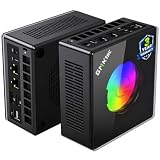
AOOSTAR GEM12+ PRO Barebone — Best Barebone for an eGPU Plan
Who it suits: The builder who knows an external graphics dock is in their future and wants the one small chassis whose OCuLink port never has to steal anything to work.
Every OCuLink implementation in this guide involves a compromise except this one. On the GEM12+ PRO — 130 × 130 × 60 mm, about 1.01 liters, in an aluminum body — the OCuLink port runs on its own independent channel. It does not occupy an M.2 slot, it does not share a lane with your storage, and both of the machine’s two M.2 2280 PCIe 4.0 slots stay free for SSDs whether or not a dock is attached. If the eGPU path is the plan rather than a possibility, that architecture is the correct foundation, and it is why this barebone leads the three kit machines here. The rest of the platform is equally deliberate: a Ryzen 7 PRO 8845HS with the 780M, two DDR5-5600 SO-DIMM slots, dual USB4, dual Intel 2.5GbE, HDMI 2.1 and DisplayPort output, Wi-Fi 6, and BIOS power modes that run up to 70W for buyers who want the harder tune.
It is a barebone, so the completion comes first: the kit is positioned toward the lower end of this guide’s barebone field — check price on Amazon — and completing it means adding a kit of 32GB DDR5 and a 1TB SSD, plus an operating system if you do not already own a Windows licence, which the kit does not include. Even after allowing for those parts, it finishes as one of the more affordable routes in this guide to a native-OCuLink machine with 32GB of memory. The honest debits are about polish rather than platform: the 2.68-inch status screen on top is a genuine convenience whose control software draws complaints from owners, the driver bundle is disorganized, and at least one Amazon buyer in reviewer roundups reported receiving a previously opened unit sold as new — check your seals on delivery and use the return window if they are broken. None of that changes the architecture, and the architecture is the recommendation.
- Native OCuLink on an independent channel — both M.2 slots stay free with a dock attached.
- Among the more affordable completed native-OCuLink routes here, before an OS — check price on Amazon.
- Status screen, fingerprint reader and 70W BIOS modes for tinkerers.
Honest limitation: Barebone — the headline price buys no RAM, no SSD and no operating system, and the screen software and driver bundle are the rough edges owners report.
Choose it if an eGPU dock is a plan, not a daydream, and you are comfortable fitting memory and storage. Skip it if you want a machine that games the evening it arrives — that is the K8 Plus.

Minisforum UM890 Pro Barebone — Most Expandable Barebone
Who it suits: The upgrader who treats a small PC as a platform: maximum memory ceiling, two fast SSDs, dual USB4, and a dock connection — and who reads the fine print before celebrating the last one.
The UM890 Pro is the largest pick here at roughly 130 × 127 × 66.6 mm, about 1.10 liters, and it spends that extra height on headroom. Its Ryzen 9 8945HS drives the 780M at the top of the class’s clock range; its two SO-DIMM slots take DDR5 to 96GB; its two M.2 PCIe 4.0 slots take serious storage; and its port set — dual USB4 with power delivery in, dual 2.5GbE, quad-display output, Wi-Fi 6E — is the most complete in the guide. As a barebone it sits in the middle of this guide’s barebone field — check price on Amazon — and completing it means adding a memory-and-storage kit, plus an operating system if you need one. Set that against the complete factory version of the same machine, which sits above this budget, and the barebone is not just the more affordable route into this platform, it is close to the only route under $800.
Now the fine print, because this machine has the guide’s most important one. Its OCuLink connection runs through an included M.2-to-OCuLink adapter plate, and fitting it consumes one of the two M.2 slots. The dock path therefore costs you half your internal storage expansion — a real architectural tax that the GEM12+ PRO above does not charge, and the reason that machine, not this one, is the eGPU pick despite this one’s stronger spec sheet elsewhere. Reviewer measurements also put its fan at roughly 43 dB in performance mode, the loudest figure in this guide, which matters for a machine designed to sit within arm’s reach. None of this makes it a bad buy; it makes it a specific one. If your future is memory, storage and displays rather than a dock, this is the most expandable liter in the guide. If your future is a dock, buy the AOOSTAR.
- Highest ceilings here: RAM to 96GB, two PCIe 4.0 M.2 slots, dual USB4 with PD-in.
- Completes as the more affordable route — the complete version sits above this budget. Check price on Amazon.
- Quad-display output and Wi-Fi 6E for a serious desk setup in 1.10 liters.
Honest limitation: OCuLink arrives via an M.2 adapter that consumes one of the two SSD slots, and performance mode is the loudest here at roughly 43 dB measured.
Choose it if expansion means RAM, storage and screens. Skip it if expansion means an eGPU — the GEM12+ PRO’s native port is the better foundation.
Minisforum UM880 Plus Barebone — Smallest Barebone, for Parts Owners
Who it suits: The buyer with DDR5 SO-DIMMs and an NVMe drive already in a drawer — spares from a laptop upgrade or a previous mini — who wants the smallest possible chassis to put them in.
At 130 × 126.5 × 50.4 mm, about 0.83 liters and roughly two-thirds of a kilogram, the UM880 Plus is nearly as small as the SER8 while remaining a fully socketed machine: Ryzen 7 8845HS, 780M graphics, two DDR5 SO-DIMM slots to 96GB, two M.2 2280 PCIe 4.0 slots, USB4, 2.5GbE and Wi-Fi 6E. The kit itself is positioned at the lower end of this guide — check price on Amazon — among the most affordable entry points here by a wide margin. For the parts owner, the completed machine costs the kit plus an evening’s assembly, and nothing in this guide touches that value.
For everyone else, this review carries the guide’s most useful warning, because the UM880 Plus is the machine a market survey used to prove the point. An Amazon pricing survey completed this exact barebone with a new 32GB DDR5 kit and a 1TB NVMe drive and found the total came out above the complete version of the same machine — a clear penalty for building it yourself, in a market where a single memory stick could carry a shortage-era premium. Kit prices are not computer prices, and in a shortage they can invert completely. The same caution applies to its OCuLink, which is provided through an adapter board rather than a native port — workable, but not the equal of the GEM12+ PRO’s implementation. Buy this machine for the right reason — parts on hand, or parts caught on a genuine sale — and it is the smallest bargain here. Buy it on the assumption that barebone always means cheaper, in this market, and it can be the most expensive pick in the guide.
- Smallest socketed machine here at about 0.83 L; kit positioned at the lower end of this guide — check price on Amazon.
- Full platform despite the size: RAM to 96GB, two M.2 slots, USB4, Wi-Fi 6E.
- Unbeatable value when the memory and SSD are already yours.
Honest limitation: With new parts at shortage pricing, a surveyed completion of this kit totaled more than the complete machine — and its OCuLink runs through an adapter board, not a native port.
Choose it if you own the parts or can buy them on a real dip. Skip it if you are pricing a from-scratch build at today’s memory prices — buy a complete machine instead.

Comparison Table
| Product | Volume | Graphics | As sold | OCuLink | Price | Link |
|---|---|---|---|---|---|---|
| GMKtec NucBox K8 Plus | ~0.98 L | Radeon 780M | Complete, 32GB/1TB | Native | Check price on Amazon | Check on Amazon |
| Beelink SER8 | ~0.81 L | Radeon 780M | Complete, 32GB/1TB | None | Check price on Amazon | Check on Amazon |
| GMKtec NucBox K11 | ~0.98 L | Radeon 780M, fastest tune | Complete, 32GB/1TB | Native, front | Check price on Amazon | Check on Amazon |
| AOOSTAR GEM12+ PRO | ~1.01 L | Radeon 780M | Barebone — add RAM, SSD and OS | Native, own channel | Check price on Amazon | Check on Amazon |
| Minisforum UM890 Pro | ~1.10 L | Radeon 780M | Barebone — add RAM, SSD and OS | Via M.2 adapter (uses a slot) | Check price on Amazon | Check on Amazon |
| Minisforum UM880 Plus | ~0.83 L | Radeon 780M | Barebone — kit + your parts | Via adapter board | Check price on Amazon | Check on Amazon |
The OCuLink Invoice, Priced in Full
Three picks carry OCuLink and two more offer it through adapters, so the dock question deserves its own arithmetic rather than a footnote. An OCuLink port by itself renders nothing. To turn one of these machines into a desktop-graphics PC you need three further purchases: an OCuLink dock — Minisforum’s DEG1 is the reference unit; a power supply for the dock, which ships without one — a basic 500W unit is the usual choice; and the graphics card itself, such as a new desktop RTX 4060. Together they add a substantial further outlay on top of the mini PC, taking a docked setup well beyond this guide’s budget — check the current price for each part before you plan. That total never appears in this guide’s headline, and any guide that quotes you an “$800 eGPU gaming PC” by adding a port to a price is hiding two-thirds of the invoice.
Is the path worth it at that total? Honestly assessed: as a day-one purchase, no — the same money buys a stronger complete tower, as the next section shows. As an upgrade in year two, it is the most rational route in this category, because it lets the small machine you already own borrow a desktop card without replacing the machine, and the card and dock carry forward to whatever you buy next. What matters at purchase time is only that the path exists in the right form: native OCuLink on the K8 Plus and K11, native on its own channel on the GEM12+ PRO, and adapter-based — with a storage slot or a board as the toll — on the two Minisforum barebones. The SER8, by design, has no path at all; its silence is what it offers instead.
The Tower You Are Not Buying
Every small-form-factor guide owes its reader one plain paragraph, and this is it. A full-size CyberPowerPC tower with a desktop RTX 4060 — the Gamer Xtreme GXiVR8060A24, with a Core i5-13400F, 16GB of DDR5 and a 1TB SSD — has been offered on Amazon on sale, inside this budget, and on raw gaming performance it is not close: a desktop 4060 out-games the Radeon 780M in every pick above by a margin no tune, dock-free setup or memory configuration can argue with. If frames per dollar is your first priority, stop reading and buy the tower; our guides to the Best Gaming PC Under $800 and the Best Budget Gaming PC Under $800 cover that field properly.
What the liters buy, for the reader still here, is everything the tower cannot do. A 0.81 to 1.10 liter machine mounts behind a monitor, shelves inside a TV stand, travels in a backpack, sips power beside a television and — in the SER8’s case — plays at roughly 32 dBA in a room where a tower’s fans would be part of the evening. The trade is explicit and, for the right room, worth it: you are paying tower money for a tenth of the tower’s volume and accepting integrated graphics as the price. This guide exists for buyers who have measured their space and made that trade with open eyes — not for buyers who were told a mini PC is a tower in disguise. It is not, and at $800 nothing is.
How to Choose a Small Form Factor Gaming PC Under $800
- Measure your space in liters, then check the maker’s dimensions. Compute volume yourself — width × depth × height — from the published specification. Every pick here sits between 0.81 and 1.10 liters; a “compact” tower at 15 to 38 liters is a different product wearing the same adjective, and listing photos will not tell you which you are buying.
- Decide what small is for. Behind a monitor or inside a TV stand, the flattest machines (SER8, UM880 Plus) win. On a desk where ports get used daily, the K8 Plus and K11 put OCuLink and dual LAN within reach. The right liter count follows the furniture, not the spec sheet.
- Treat the 780M as the tier, not a stepping stone. Every pick shares the same graphics class, so choose on noise, ports, memory and price discipline — not on promises that one 780M is a different GPU from another. The K11’s harder tune is worth up to about 15% by reviewer measurement; nothing here is worth 100%.
- Complete or barebone: run the full total before deciding. Add a 32GB DDR5 kit, a 1TB SSD and an operating system to any barebone headline. In the current shortage that sum can exceed a complete machine’s price — a surveyed UM880 Plus completion totaled more than the complete version. Barebone wins with parts on hand or parts on sale, and loses as a reflex.
- If a dock is in your future, buy the port in its best form now. Native OCuLink (K8 Plus, K11) is good; native on an independent channel (GEM12+ PRO) is best; adapter implementations (UM890 Pro, UM880 Plus) work but charge a slot or a board. Retrofitting later is not an option — the port is the platform decision.
- Socketed memory is the longevity divider. All six picks use SO-DIMM slots rather than soldered memory, which is why they are here. A small PC whose RAM cannot change is a finished appliance; these can grow from 32GB to 64GB or 96GB when prices normalize.
- Budget the brick. The liter figure is the computer; every pick also carries an external power adapter that needs a home on or under the desk. Plan its placement — ventilated, off carpet — when you plan the machine’s.
- Apply the buy-at rule, not the list price. This category’s prices swing widely with the component shortage. Each review states the condition under which its machine makes sense — while its live listing sits inside this guide’s budget. A pick above that condition is not a worse machine; it is a machine to buy later, when its live listing returns to the budget.
Common Buying Mistakes
- Trusting the word “mini” or “compact” in a listing title instead of computing the volume from published dimensions — the current ZOTAC MEK line is a roughly 38-liter tower in compact clothing.
- Comparing a barebone’s kit price against complete PCs. The kit has no memory, no storage and no operating system; completed honestly, it can cost more than the finished machine in a shortage market.
- Counting an OCuLink port as a graphics upgrade. The port is the beginning of a substantial further invoice — dock, power supply and card — and any budget that omits it is fiction.
- Assuming all OCuLink is equal. On the UM890 Pro it consumes an M.2 slot through an adapter; on the GEM12+ PRO it runs on its own channel. The distinction decides your storage future.
- Paying the spike. The K8 Plus and the K11 have both sat well above this budget within the same season as dips that placed them inside it. In this category, timing is a specification.
- Buying the SER8 for a future eGPU build. It has no OCuLink port and never will; its virtues are silence and size, and the dock plan belongs to the GMKtec and AOOSTAR picks.
- Expecting native 1440p or ray-traced performance from integrated graphics. The 780M is an excellent 1080p iGPU; listings implying otherwise are describing a different, more expensive machine.
- Ignoring noise because the PC is small. Small fans work harder and sit closer to your ears; the measured gap between roughly 32 dBA (SER8) and roughly 43 dB (UM890 Pro in performance mode) is the difference between a living-room machine and a desk-only one.
Final Recommendation
- Best overall: GMKtec NucBox K8 Plus.
- Quietest, smallest complete PC: Beelink SER8.
- Fastest tune, on sale only: GMKtec NucBox K11.
- Best eGPU foundation: AOOSTAR GEM12+ PRO Barebone.
- Most expandable platform: Minisforum UM890 Pro Barebone.
- Best for parts owners: Minisforum UM880 Plus Barebone.
Our top two for most small-space buyers are the K8 Plus and the SER8, because they answer the two honest shapes this search takes. The K8 Plus is the grower’s machine: complete today, socketed everywhere, with a native OCuLink port keeping the desktop-graphics door open at a known, itemized extra cost. The SER8 is the settler’s machine: the smallest and quietest finished PC here, bought by people who know the 780M is their graphics and are content for it to stay that way. Builders should start from the dock question — GEM12+ PRO if a dock is planned, UM890 Pro if memory and storage are the plan, UM880 Plus if the parts are already in a drawer. Readers whose space allows a tower should weigh the Best Compact Gaming PC Under $800 and Best Mini Gaming PC Under $800 guides alongside this one, step down to the Best Small Form Factor Gaming PC Under $500 tier if the budget tightens, or step up to the Best Small Form Factor Gaming PC Under $1200 tier, where discrete graphics in genuinely small bodies begins. Measure your shelf, run the full totals, respect the budget condition in each review, and check the live listing before you order.
Frequently Asked Questions
What actually counts as a small form factor gaming PC at this price?
By measured volume, the honest field under $800 is mini PCs between about 0.8 and 1.1 liters. A classic mini-ITX build with a discrete graphics card occupies 7 to 20 liters and cannot currently be built new for $800 — component prices, especially memory, storage and graphics cards, have seen to that. Console-sized brand PCs with real GPUs exist, but no verifiable Amazon listing puts one at this budget. This guide therefore measures “small form factor” the strict way and says plainly where the ITX version of the dream now lives: at higher budgets.
Can a Radeon 780M mini PC really game?
Yes, within stated limits. The 780M is the strongest integrated graphics class at this price, and reviewer consensus puts it at strong 1080p performance in esports and indie titles, with demanding recent releases playable at low-to-medium settings using upscaling. It is not a native-1440p GPU and it does not ray-trace in any meaningful sense. Every pick here pairs it with 32GB of dual-channel memory or the slots to fit it, because shared-memory graphics are only as fast as the memory feeding them.
Is a barebone mini PC cheaper than a complete one?
Not automatically, and in late 2026 often not at all. A barebone needs memory, storage and usually an operating system before it is a computer. One Amazon survey completed the UM880 Plus barebone with new parts for more than the complete machine. Barebones win when you already own DDR5 and an SSD, or buy them on a genuine dip; the GEM12+ PRO in this guide sits toward the lower end of the barebone field, so its completed route stays comparatively affordable even allowing for shortage-era parts pricing — check price on Amazon.
What does an OCuLink eGPU setup really cost?
A substantial amount beyond the PC: an OCuLink dock, a separate power supply, and a desktop graphics card such as an RTX 4060 bought new each add their own cost — check the current price on Amazon and at other retailers for each part before you plan. All-in, a docked setup lands well beyond this guide’s budget. That is a sensible year-two upgrade for a machine you already own; it is not an $800 gaming PC, and this guide never presents it as one.
Why is there no RTX 4060 tower in the picks if one has been offered on sale inside this budget?
Because it is not a small form factor PC — it is a full-size mid-tower that happens to share the budget. It is named in this guide, in its own section, as the raw-performance winner, because honesty requires it. But a buyer searching for a small-form-factor machine has a space constraint the tower cannot meet, and filling the picks with it would answer a question nobody here asked. The tower field is covered in our gaming PC guides under this same budget.
Which pick is best for a living room or bedroom?
The Beelink SER8, bought at $800 or less. It is the smallest complete machine here at about 0.81 liters, it was measured at roughly 32 dBA under load — the quietest figure in this guide — and its flat shape fits the shelves and TV stands that define living-room computing. The K11 is the one to avoid for a bedroom: its RGB ring cannot be turned off and its performance tune is audibly busier.
Should I wait for prices to fall?
If your need is not urgent, the budget condition in each review is your friend: the K8 Plus has a history of dipping well below its spikes, and the K11 is at its best when its live listing dips on sale — check the current price on Amazon for either. Memory and SSD costs are the volatile element, and they drive both complete-PC prices and barebone completion costs. Buy a complete machine while its live listing sits inside the $800 budget; do not pay a spike price for any pick in this guide.
- Best Small Form Factor Gaming PC Under $800
- Best Small Form Factor Gaming PC Under $700
- Best Small Form Factor Gaming PC Under $1200
- Best Small Form Factor Gaming PC For Small Spaces Under $800
- Best Small Form Factor Gaming PC For Beginners Under $800
- Best Small Form Factor Gaming PC For Streaming Under $800
- Best Small Form Factor Gaming PC For 1440p Gaming Under $800


