Where to buy
Check the latest price, availability and delivery on Amazon. Orders are placed on Amazon. We may earn a commission from qualifying purchases.
- Best overall compact gaming PC: ASUS ROG G22CH, Core i7-13700KF, Desktop RTX 4070, 32GB DDR5, 1TB SSD — Check on Amazon
- ASUS ROG NUC (2025), Core Ultra 9 275HX, RTX 5070 Ti Mobile, 16GB DDR5, 1TB SSD — Check on Amazon
- Minisforum AtomMan G7 Pro, Core i9-14900HX, RTX 5070 Laptop GPU, 32GB DDR5, 1TB SSD — Check on Amazon
- ASUS ROG NUC 970, Core Ultra 9 185H, RTX 4070 Laptop GPU, 32GB DDR5, 1TB SSD — Check on Amazon
See 2 more Amazon options
- Minisforum AtomMan G7 Ti, Core i9-14900HX, RTX 4070 Laptop GPU, 32GB DDR5, 1TB SSD — Check on Amazon
- Minisforum AtomMan G1 Pro, Ryzen 9 8945HX, Desktop RTX 5060, 32GB DDR5, 1TB SSD — Check on Amazon
Read the full guide ↓
Disclosure: As an Amazon Associate, reviewstook.com earns from qualifying purchases. Links to Amazon on this page are affiliate links; they cost you nothing extra. Listing details such as price and availability change often, so check the current Amazon listing before you buy.
“Compact” is the most abused word in gaming PC listings. Search Amazon with a $2,500 budget and most of what comes back is a standard mid-tower — 40-plus liters of case, 35 to 40 pounds, a desk footprint like a carry-on suitcase — wearing the word compact in its title because the seller needed the keyword. A genuinely compact gaming PC, by the definition this guide enforces, is under 20 liters: small enough to stand beside a monitor, lie under a TV, or ride in a backpack to a LAN. Every machine below passes that test with its dimensions published and checked, and the range is dramatic — from a 2.5-liter ASUS box that weighs less than a gaming laptop to a 10-liter ASUS desktop that keeps a full-size desktop graphics card. That spread is the real story of this category: at $2,500, compact stops meaning weak, but it never stops meaning trade-offs, and the trade-offs are different at every size.
Two honesty notes before the picks. First, the graphics cards: in boxes under about 4 liters, a desktop GPU physically does not fit, so the smallest machines here use laptop GPUs — an RTX 5070 Ti Mobile or RTX 4070 Laptop is a different, slower part than the desktop card of the same name, with less memory and a lower power limit, and each review below says which kind of GPU you are actually getting. Second, the ceiling: there is no RTX 5080 in a true small-form-factor PC under $2,500 on Amazon. The one genuine sub-4-liter RTX 5080 machine, ASUS’s ROG NUC (2025) in its top configuration, sits well above this budget tier. What $2,500 buys instead is the strongest tier below that: one RTX 5070 Ti Mobile flagship whose place in this tier depends on its current price on Amazon, one desktop RTX 4070 in a 10-liter case, and a field of RTX 5070/4070 laptop-GPU machines between 2.5 and 4 liters that play modern games at 1440p from a box smaller than a shoebox. If small is the point of the purchase, start with the ROG G22CH for desktop parts or the AtomMan G7 Pro for value; the details, dimensions and compromises of all six are below.
In this guide
Quick Picks
Short on time, or comparing several options at once? Each row below names a buyer type and the product that suits it, with a link to the listing.
| Buyer type | Pick | Why it stands out | Link |
|---|---|---|---|
| Best overall | ASUS ROG G22CH (DB779) | A real desktop RTX 4070 in a ~10-liter case — the only pick with full-size parts | Check on Amazon |
| Most powerful, when on deal | ASUS ROG NUC (2025), RTX 5070 Ti Mobile | The strongest GPU that fits in ~3 liters; its place in this tier depends on the current price on Amazon | Check on Amazon |
| Best value current generation | Minisforum AtomMan G7 Pro | RTX 5070 Laptop GPU and a 24-core i9 for notably less than the ASUS equivalent | Check on Amazon |
| Smallest serious gaming PC | ASUS ROG NUC 970 | 2.5 liters, backpack-sized, with a full-power 140W RTX 4070 Laptop GPU | Check on Amazon |
| Best living-room slab | Minisforum AtomMan G7 Ti | An upright, book-thin box that out-reviewed the ROG NUC 970 for less money | Check on Amazon |
| Best upgradable mini PC | Minisforum AtomMan G1 Pro | A swappable desktop graphics card and an internal power supply in 3.8 liters | Check on Amazon |
How These Picks Were Chosen
The first filter was a tape measure. Every pick has published dimensions from the maker or the Amazon listing, and we converted them to liters ourselves: width × depth × height, divided by 1,000. Anything over 20 liters was excluded no matter what its title claimed, which removed most of the famous names in this price band — the big-brand RTX 5070 Ti and 5080 prebuilts under $2,500 are competent machines, but at 35 to 45 liters they are mid-towers, and they have their own guides, such as Best Gaming PC Under $2500. What survived the tape measure is the genuine small-form-factor market as it actually exists on Amazon: two ASUS ROG NUC mini PCs, one ASUS small-form-factor desktop, and three Minisforum AtomMan machines.
The second filter was the graphics card, read carefully. A desktop RTX 4070, an RTX 4070 Laptop GPU at its full 140W limit, and an RTX 4070 Laptop GPU throttled to 80W are three different products wearing one name, so we recorded the GPU type and, where reviewers or makers publish it, the wattage for every pick. We did not use these products ourselves; we read the maker listings and specification pages and the independent reviews that publish measurements — Notebookcheck, Digital Trends, Tom’s Guide, PC Gamer and others — and where a review exposed a catch the listing does not mention, such as a performance mode left off by default or a single stick of memory in a dual-channel machine, the catch is in the review below, not buried. Prices change often: several of these machines move between sellers and seasons, one pick belongs in this guide only when its current Amazon price places it in this tier, and the reviews say so wherever that is true — check the current price on Amazon for each pick before you buy.
The third filter was what happens after the purchase. In a compact PC, the upgrade path is part of the product: memory and storage can be changed on all six machines here, but the graphics card can be changed on only two, and the processor on none. We weighted honest headroom — a second SSD slot, memory that can grow past 32GB, a power supply with watts to spare — because a $2,500 machine you cannot improve is a machine with an expiry date, and at this size the expiry dates arrive sooner than they do in a tower.
The 6 Best Compact Gaming PCs Under $2,500
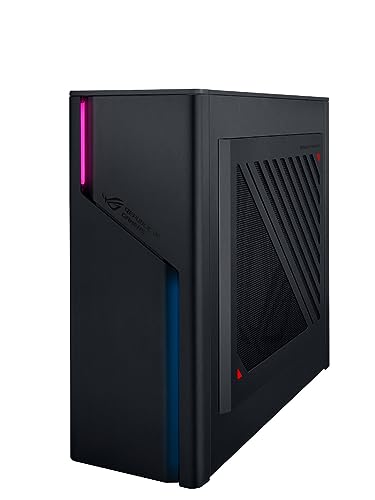
ASUS ROG G22CH (DB779) — Core i7-13700KF, Desktop RTX 4070, 32GB DDR5, 1TB SSD
Who it suits: Buyers who want compact without the laptop-parts compromise — a real desktop graphics card and a desktop processor in a case a third the size of a normal tower.
The G22CH is the answer to a fair question: why accept a laptop GPU at all? At roughly 10 liters — ASUS publishes dimensions of 11.5 × 32.3 × 28.7 cm — it is the largest machine in this guide and still smaller than many speaker stands, and inside it sits a proper desktop GeForce RTX 4070 DUAL card with 12GB of GDDR6X, a 16-core Core i7-13700KF desktop processor, 32GB of DDR5 and a 1TB PCIe 4.0 SSD, fed by a 600W 80+ Gold power supply. That combination is a strong 1440p machine by any measure and a credible entry-level 4K machine with DLSS, and it holds its performance the way desktops do: the card runs at desktop power, the cooling has volume to work with, and nothing about the performance depends on a “mode” being switched on. It looks the part, too — an angular, RGB-lit wedge that reads as a games console scaled up rather than a tower scaled down, and it includes a wired keyboard and mouse in the box.
The fine print is about ceilings rather than flaws. Memory is laptop-style SO-DIMM, two slots, and ASUS rates the platform at 32GB maximum — what you buy is what you keep. The graphics card can technically be replaced, but the replacement must fit the case’s length and the 600W supply’s budget, which in practice means dual-fan cards of the same class, not a future flagship. The platform itself is Intel’s LGA1700 at the end of its road, so the processor is a final answer too. Pricing needs care: reseller listings for lesser G22CH variants — a 13700F with 16GB — can sit alongside the DB779 in the same search results, so check the model number and the sold-by line before you buy, and check the current price on Amazon for the exact configuration. Judged on its hardware and its position in this tier, though, this is the compact pick with the fewest asterisks: desktop parts, desktop behavior, console footprint.
- A genuine desktop RTX 4070 12GB — no mobile-GPU discount on performance.
- 600W 80+ Gold power supply: real headroom, no external brick.
- About 10 liters and console-shaped — fits a media unit or a small desk corner.
Honest limitation: Memory is capped at 32GB of SO-DIMM and the LGA1700 platform has no processor upgrade path; GPU swaps are limited to cards that fit the case and the 600W budget.
Choose it if you want the compact machine that behaves most like a normal gaming desktop. Skip it if every liter matters — at ~10L it is three to four times the size of the mini PCs below.

ASUS ROG NUC (2025) — Core Ultra 9 275HX, RTX 5070 Ti Mobile, 16GB DDR5, 1TB SSD
Who it suits: Buyers who want the most graphics power that exists in a roughly 3-liter box, and who are willing to buy it at the right moment rather than on any given day.
This is the flagship of small. The 2025 ROG NUC stands 282.4 × 187.7 × 56.5 mm — almost exactly 3 liters — and this configuration (model RNUC15JNK9X369AU) pairs Intel’s 24-core Core Ultra 9 275HX with an RTX 5070 Ti Mobile GPU carrying 12GB of GDDR7, cooled by three fans and dual vapor chambers. In performance terms that GPU sits a clear step above everything else in this guide: it is a 1440p high-refresh part with DLSS 4 and frame generation, and it makes this 3-liter slab faster in games than the 10-liter desktop above it. The port selection is the best here as well, with dual Thunderbolt 4, and the build is ASUS’s premium ROG line, with the fit and finish that implies. As a demonstration of what compact can mean at the top of the market, nothing else on Amazon is close.
Now the two catches, and they are both real. The first is memory: this configuration ships with 16GB of RAM, which is the minimum a gaming PC in this tier should carry in 2026 and the first thing a serious buyer should budget to change — the two SO-DIMM slots make it an easy upgrade, but it is an upgrade the price should have included. The second is positioning. This configuration sits at the top of this budget tier, and the wider ROG NUC (2025) family — including the RTX 5080 configuration of the same chassis — sits in higher tiers through ASUS’s own store and other sellers. In other words, this pick belongs in an under-$2,500 guide only while its current Amazon price keeps it in this tier — when the listing places it higher, it belongs in the under-$3,000 guide, and the article will not pretend otherwise. Check the current price on Amazon before you buy, and treat this as a pick to catch when its pricing lines up with this budget. Note also what “5070 Ti” means here: the mobile card’s 12GB and lower power limit put it a step below the desktop RTX 5070 Ti, a card that in prebuilt form only comes in mid-towers at this money.
- RTX 5070 Ti Mobile with 12GB GDDR7 — the strongest GPU in a ~3L chassis on Amazon.
- 24-core Core Ultra 9 275HX and dual Thunderbolt 4: a creator-grade port and CPU package.
- Triple-fan, dual-vapor-chamber cooling engineered for the full power envelope.
Honest limitation: Only 16GB of RAM as configured, the GPU can never be upgraded, and its place in this tier depends on its current price on Amazon — when that price moves it into a higher tier, this machine is over budget for this guide.
Choose it if its current price on Amazon keeps it in this tier and you want maximum power per liter. Skip it if the listing currently places it in a higher tier, or you will not accept upgrading the RAM yourself.

Minisforum AtomMan G7 Pro — Core i9-14900HX, RTX 5070 Laptop GPU, 32GB DDR5, 1TB SSD
Who it suits: Buyers who want current-generation graphics in a slim, upright mini PC, without the premium that ASUS’s badge typically carries.
The G7 Pro is Minisforum’s direct answer to the ROG NUC: the same recipe — a flagship laptop processor, a laptop RTX GPU, an ultra-thin vertical chassis that stands on a desk like a hardback book — executed for markedly less money. The processor is Intel’s Core i9-14900HX, 24 cores boosting to 5.8GHz; the graphics card is an RTX 5070 Laptop GPU with 8GB of GDDR7, tested at around 115W, which makes this a genuine 1440p machine with DLSS 4. The configured version carries 32GB of DDR5 and a 1TB SSD, memory can grow to 96GB across two SO-DIMM slots, a second M.2 slot waits empty, and connectivity is modern throughout: Wi-Fi 7, USB4, HDMI 2.1. Through Minisforum’s own channels the configured machine has been positioned well below ASUS models with the same GPU generation, and on Amazon it likewise sits comfortably inside this budget tier — check the current price on Amazon for the configured style.
Two warnings from the review record belong in this review. First, check the style selector on the Amazon listing before anything else: the same listing sells a barebone version with no memory, no storage and no operating system, and the price difference between the two styles has fooled buyers before — the pick here is the configured 32GB + 1TB style. Second, reviewers found their test units shipped with a single 32GB memory stick, which runs the memory in single-channel mode and leaves performance on the table until a second stick is added; if your unit arrives that way, a matched SO-DIMM is the cheapest upgrade in this entire guide. The structural limits are the usual ones for the class: the RTX 5070 Laptop GPU’s 8GB of VRAM is the ceiling that will age first at 1440p ultra settings, and neither CPU nor GPU can ever be changed. What you are buying is the current generation’s power at last generation’s price, in a box that disappears behind a monitor.
- RTX 5070 Laptop GPU and 24-core i9-14900HX: current-generation 1440p performance.
- Positioned as the value benchmark of this guide for its GPU generation.
- Memory to 96GB and a second SSD slot: real headroom for a mini PC.
Honest limitation: 8GB of VRAM is the long-term ceiling, review units shipped with single-channel memory, and the listing’s barebone style is a trap for anyone who does not read the style name.
Choose it if you want the newest GPU generation in a mini PC without the ROG premium. Skip it if you need more than 8GB of VRAM for heavy texture packs or modded games at 1440p.

ASUS ROG NUC 970 — Core Ultra 9 185H, RTX 4070 Laptop GPU, 32GB DDR5, 1TB SSD
Who it suits: Buyers for whom size is the first specification — the smallest brand-name gaming PC in this guide, small enough to travel in a backpack and hide behind a monitor.
The NUC 970 is the machine that defined this category: 2.5 liters, 270 × 180 × 50 mm, light enough to carry between home, office and LAN without thinking about it. Inside, a Core Ultra 9 185H and an RTX 4070 Laptop GPU running at its full 140W limit — the same wattage as the G7 Ti below, which is why this little box performs like a good 4070 gaming laptop: strong at 1080p, genuinely capable at 1440p with DLSS. You get 32GB of DDR5-5600, a 1TB SSD, Thunderbolt 4, an SD card reader, a vertical stand in the box, and ASUS’s three-year ecosystem of BIOS updates and support behind it. On Amazon it sits in the upper part of this tier — check the current price on Amazon — and it is the most portable route into 4070-class gaming that carries a major brand’s badge.
The honest problem is arithmetic. The AtomMan G7 Ti further down this guide matches this machine’s GPU wattage, matches or beats it in independent testing, and has been positioned notably lower through Minisforum’s channels — Digital Trends’ reviewer found the G7 Ti outclassed the NUC 970 outright. What the ASUS premium buys is the smaller chassis (2.5 liters against a larger slab), Thunderbolt, the brand’s support network and resale value; whether that is worth the difference is a judgment about how much the last liter and the badge matter to you. The platform is also the 2024 generation: the Core Ultra 9 185H is a capable chip, but it gives up cores and clocks to the 14900HX machines here, and as with every NUC, the GPU is soldered down for life. Buy it for the size and the badge and it earns its place; if performance per dollar is the priority while the G7 Ti is available, that machine is the stronger value.
- 2.5 liters — the smallest chassis in this guide, with a stand included.
- Full-power 140W RTX 4070 Laptop GPU: no wattage compromise for the size.
- Thunderbolt 4, SD reader and ASUS support: the polished, travel-ready package.
Honest limitation: The G7 Ti matches its GPU class for less money; you are paying for the final liter, the ports and the brand — and the GPU is soldered for life.
Choose it if the PC must disappear into a backpack or behind a monitor and you value ASUS support. Skip it if performance per dollar is the priority — that is the G7 Pro and G7 Ti.

Minisforum AtomMan G7 Ti — Core i9-14900HX, RTX 4070 Laptop GPU, 32GB DDR5, 1TB SSD
Who it suits: Living-room and small-desk gamers who want a slim, upright box that stands beside the TV or monitor like a console — and the strongest reviewed performance of the RTX 4070 laptop-GPU class.
The G7 Ti is a gaming laptop’s best hardware with the screen and keyboard removed: a 24-core Core i9-14900HX and an RTX 4070 Laptop GPU at its full 140W power limit, in a slim vertical slab about 80mm thick and 2.6kg in weight. Reviewers have been unusually kind to it. Digital Trends scored it near-perfectly and found it outclassing the ROG NUC 970; Notebookcheck measured strong, sustained performance; Tom’s Guide calls it great for 1080p and 1440p gaming while noting, correctly, that 4K is beyond it. The configured style on the Amazon listing carries 32GB of DDR5-5600 — expandable to 96GB — a 1TB SSD with a second M.2 slot free, Wi-Fi 7 and USB4. Through Minisforum’s own channels the configured machine sits in the lower part of this tier, with Amazon pricing typically running higher than direct — check the current price on Amazon. In that position it is the performance-per-dollar benchmark of the 4070 class, and it leaves a large part of this budget unspent.
The catches are the ones its shape dictates. A slim slab cooling a 140W GPU and a 24-core HX processor uses small fans spinning fast, and under sustained load it is audible in a quiet room in a way the 10-liter G22CH is not — on a TV stand across the room that is a footnote; on a desk beside your monitor it is a character trait. The port selection is thin for the price: reviewers counted just two USB-A ports, so a hub belongs in the budget from day one. And like the G7 Pro, the listing sells both configured and barebone styles — confirm the style name says 32GB + 1TB before ordering, because the barebone arrives without memory, storage or Windows. None of this displaces it: as a reviewed, measured, full-wattage 1440p machine that stands upright in the space a hardback book would take, it is the pick the NUC 970 has to justify itself against.
- Full 140W RTX 4070 Laptop GPU — the wattage that separates it from throttled rivals.
- The strongest independent review record in this guide, including wins over the ROG NUC 970.
- Memory to 96GB and a free second SSD slot, in a slab ~80mm thick.
Honest limitation: Fan noise under load is the price of the slim shape, the two USB-A ports make a hub mandatory, and the GPU’s 8GB of VRAM caps its 1440p ultra-settings future.
Choose it if you want console-style placement and the best-reviewed 4070-class performance per dollar. Skip it if a silent desk matters more than a slim one, or you want the newer 50-series GPU in the G7 Pro.

Minisforum AtomMan G1 Pro — Ryzen 9 8945HX, Desktop RTX 5060, 32GB DDR5, 1TB SSD
Who it suits: Buyers who refuse to accept a soldered GPU — the one mini PC in this guide whose graphics card can be unplugged and replaced, built for a TV stand and a long life.
Every other small machine in this guide treats the GPU as a life sentence. The G1 Pro does not. Its 3.8-liter vertical chassis — measured by Tom’s Guide at 12.4 × 8.5 × 2.25 inches, smaller than a PS5 standing on its side — contains a genuine desktop graphics card, a low-profile GeForce RTX 5060 running at 145W, seated in a real PCIe x16 slot. When a faster low-profile card exists in three years, this is the one sub-4-liter machine here that can take it. Around that slot: a 16-core Ryzen 9 8945HX, 32GB of DDR5-5200 expandable to 96GB, a 1TB SSD with a second M.2 slot, 5-gigabit Ethernet, Wi-Fi 7, and an internal 350W power supply — no laptop-style brick cluttering the floor, a detail every other mini PC here gets wrong. On Amazon it sits in the middle of this tier — check the current price on Amazon — and Minisforum also sells a sibling configuration with a 16GB Radeon RX 9060 XT in the same chassis in a similar tier, which VRAM-hungry buyers should know exists even though it is a separate listing.
The review record adds three honest footnotes. The machine ships in an 80W gaming mode that hides a fifth of its performance behind a toggle in Minisforum’s software — set it to its full-performance mode on day one, or you will benchmark a slower PC than you bought. Under heavy load it gets loud, as 3.8 liters moving this much heat tends to, and Tom’s Guide noted the noise as the machine’s main manners problem. Reviewers also flagged that Minisforum’s control utility ships a system driver that Windows Defender identifies as vulnerable — a fixable software wart, but one a careful buyer should know about before, not after, setup. And the GPU class itself is the compromise: the RTX 5060 is a step below the 4070-class machines above it, an honest 1080p-and-1440p card rather than a flagship. You are paying for the chassis, the slot and the internal power supply — for the right to upgrade later — and at its position in this tier that is a defensible thing to buy, as long as you buy it with your eyes open.
- A swappable desktop graphics card in a PCIe x16 slot — unique in this guide at this size.
- Internal 350W power supply: no external brick, console-clean setup.
- Ryzen 9 8945HX 16-core processor and memory up to 96GB for creator workloads.
Honest limitation: The RTX 5060 is a class below the 4070/5070 machines here, it ships in a low-power mode you must switch off, and it is loud under sustained load.
Choose it if upgradability and a TV-stand footprint matter more than this year’s GPU class. Skip it if you want the most frames per dollar today — the G7 Pro and G7 Ti are faster for similar money.
Comparison Table
| Product | Size | Graphics | Best use | Link |
|---|---|---|---|---|
| ASUS ROG G22CH (DB779) | ~10.7 L | Desktop RTX 4070 12GB | Desktop parts, console footprint | Check on Amazon |
| ASUS ROG NUC (2025) | ~3 L | RTX 5070 Ti Mobile 12GB | Maximum power per liter — check price on Amazon | Check on Amazon |
| Minisforum AtomMan G7 Pro | Slim slab, ~80mm thick class | RTX 5070 Laptop 8GB | Current-gen value | Check on Amazon |
| ASUS ROG NUC 970 | 2.5 L | RTX 4070 Laptop 8GB, 140W | Smallest brand-name gaming PC | Check on Amazon |
| Minisforum AtomMan G7 Ti | Slim slab, ~80mm thick, 2.6kg | RTX 4070 Laptop 8GB, 140W | Living-room slab, best reviews | Check on Amazon |
| Minisforum AtomMan G1 Pro | 3.8 L | Desktop RTX 5060 8GB, swappable | Upgradeable mini PC for the TV stand | Check on Amazon |
How to Choose a Compact Gaming PC Under $2,500
- Measure in liters, never in adjectives. Multiply the published width × depth × height in centimeters and divide by 1,000. Under 5 liters is mini-PC territory, 5–15 is true small form factor, 15–20 is a compact tower, and anything above that is a mid-tower in a costume, whatever the listing title says.
- Ask which GPU it really is. Desktop, laptop at full wattage, and laptop at reduced wattage are three different products under one name. Look for the words “Laptop GPU” or “Mobile” and a wattage figure; an RTX 4070 Laptop at 140W and the same chip at 80W are not the same purchase.
- Budget the compact tax honestly. Per frame, small costs more: the same GPU class in a tower is cheaper. You are paying for liters removed. Decide what a liter is worth to you before the listings decide for you.
- Check the memory as shipped, not as supported. A machine that “supports 96GB” may ship with 16GB, or with a single stick running in single-channel mode. Both appear in this guide. The fix is cheap, but only if you know to make it.
- Read the style selector like a contract. Mini-PC listings commonly sell barebone and configured versions side by side. Barebone means no memory, no storage, no Windows. The price that caught your eye may belong to the empty version.
- Count the power brick. Most mini PCs hide a laptop-style external adapter that adds a brick to your floor and a cable to your desk. An internal power supply, as on the G1 Pro and G22CH, is a genuine quality-of-life feature at this size.
- Plan the upgrade you will actually make. On five of these six machines the GPU is forever. If a graphics upgrade in three years matters to you, the choice narrows to the G1 Pro’s low-profile slot or the G22CH’s desktop bay — decide now, not then.
- Match the box to the room. A slim slab belongs on a TV stand; a 2.5-liter NUC disappears behind a monitor; a 10-liter desktop needs a desk corner or a media shelf with real depth. Measure the shelf before the PC, not after.
- Leave airflow its margin. Every machine here breathes through its sides or top. A compact PC wedged into a closed cabinet will throttle and roar; a few centimeters of clearance is part of the purchase.
- Price the whole setup. At this tier the PC is not the whole spend: a USB hub for the port-poor machines, a second memory stick for the single-channel ones, and possibly a second SSD belong in the same basket as the machine itself.
The Compact Tax: What Small Actually Costs
It is worth stating plainly what this guide’s own numbers show: at $2,500, a full-size tower buys an RTX 5070 Ti desktop card with 16GB of memory, 32GB of RAM and room for everything you will ever add — the picks in Best 1440p Gaming PC Under $2500 are exactly that. The compact machines here buy less graphics per dollar, on purpose. The ROG NUC (2025) spends the same money on a mobile 5070 Ti with 12GB and 16GB of system memory. The G7 Pro puts its share of the budget into a laptop 5070 in a slim slab. Even the G22CH, the value outlier, pairs its desktop 4070 with a capped memory platform. That gap is the compact tax, and it is not a scam — it is the price of engineering a gaming PC into the volume of a lunchbox, with vapor chambers and custom boards where a tower uses air and standard parts.
The tax is worth paying when the space is real: a studio apartment, a TV stand, a desk shared with work, a machine that travels. It is not worth paying for a PC that will sit under a desk in a spare room, where a tower would be faster, quieter and cheaper to upgrade for the same money. The shoppers who regret compact purchases are almost never the ones who measured their space; they are the ones who bought small as an aesthetic and then discovered the noise, the soldered GPU and the upgrade ceiling in a room that had space for a tower all along. Measure the room first. If the room truly says small, this guide’s six are the honest best of what small currently offers — and the tax buys machines that are, by the standards of five years ago, absurdly capable for their size.
Heat and Noise: The Physics Nobody Escapes
A gaming PC turns electricity into heat at a rate set by its parts, and a small case has less air, smaller fans and shorter distances between hot components. The consequences are predictable and worth planning around. Fans in a 3-liter machine are small, and small fans move air by spinning fast, which is why the slim machines here — the G7 Ti, the G7 Pro, the G1 Pro — are all noted by reviewers as audible under sustained gaming load, while the 10-liter G22CH, with desktop cooling volume, is the quietest machine in this guide under the same games. None of them is defective; they are obeying physics. Vapor chambers and triple-fan arrays, like the ROG NUC’s, manage temperatures well, but managing temperature and managing noise are different problems, and in a small box you usually solve one with the other.
Three habits get the best from any of them. Give the machine its rated power mode: several compact PCs ship in a reduced-power profile for noise or efficiency — the G1 Pro’s 80W default is the documented example — and the full-performance setting is a deliberate choice you make once, in the maker’s software. Give it air: vertical orientation where a stand is provided, clearance on the intake side, and never a closed cabinet door between the PC and the room. And set expectations by placement: across a living room, under a TV, these machines fade into the soundtrack; on a desk, at arm’s length, in a quiet room at night, headphones are part of the compact-PC kit. Buyers for whom silence is a first-rank requirement should take the hint the physics is giving and look at the largest machine in this guide — or accept a tower.
Common Buying Mistakes
- Trusting the word “compact” in a listing title. Many are 35–45 liter mid-towers. Do the liter math from the published dimensions before anything else.
- Assuming an RTX 5070 Ti is an RTX 5070 Ti. In a mini PC it is the Mobile version — fewer cores, 12GB instead of 16GB, a lower power limit. Still fast; not the same card.
- Paying for the wrong RTX 5080 configuration by accident. The compact 5080 machines exist in a higher tier above this budget. If an offer on one appears to place it in this tier, read the configuration very carefully before believing it.
- Ordering the barebone style of a Minisforum listing and discovering that no memory, storage or Windows is included. The style name is the product.
- Leaving the shipping power mode on. A compact PC left in its 80W or “quiet” default can give away a fifth of the performance you paid for.
- Ignoring memory configuration. 16GB in a machine at the top of this tier, or a single stick in a dual-channel design, are both real configurations in this guide — check what ships, not what is supported.
- Expecting a GPU upgrade that physics forbids. Soldered laptop GPUs do not come out. If upgrading matters, buy the machine with the slot.
- Sealing the PC in a cabinet. Compact machines throttle and roar when their intakes are boxed in; the smallest PC still needs to breathe.
- Forgetting the hub. Two USB-A ports is a real specification in this category. Keyboards, mice, headsets and controllers need somewhere to go.
Final Recommendation
- Most buyers: ASUS ROG G22CH — desktop RTX 4070 performance in a console-sized case, positioned well under this budget — check price on Amazon.
- Maximum power per liter: ASUS ROG NUC (2025) with RTX 5070 Ti Mobile — but only when its current price on Amazon keeps it in this tier.
- Best value, current generation: Minisforum AtomMan G7 Pro.
- Smallest and most portable: ASUS ROG NUC 970.
- Living-room slab with the best reviews: Minisforum AtomMan G7 Ti.
- The upgradable mini PC: Minisforum AtomMan G1 Pro.
Our top two are the G22CH and the G7 Pro, because they sit at the two ends of what compact honestly means: the ASUS keeps desktop parts and desktop behavior in the smallest case that can hold them, and the Minisforum delivers the current GPU generation in a book-thin slab for the least money. The ROG NUC (2025) is the better machine than both on paper and the worse buy when its current price places it in a higher tier — when its price on Amazon keeps it in this budget, it jumps the queue. Shoppers whose space allows a step up in size should also see Best Compact Gaming PC Under $3000, and those working with less money will find the same machines’ smaller siblings in Best Compact Gaming PC Under $1500. Whichever you choose: do the liter math, read the style selector, check the memory configuration, switch on the full power mode, and check the live price before you order.
Frequently Asked Questions
What actually counts as a compact gaming PC?
By volume, not by marketing. Under 5 liters is a mini PC, 5–15 liters is true small form factor, and up to about 20 liters is a compact tower. Every pick in this guide is 10.7 liters or smaller. Many Amazon listings titled “compact” are standard mid-towers of 35–45 liters — multiply the dimensions yourself before believing the adjective.
Can I get an RTX 5080 in a compact PC under $2,500?
No — not a genuine small-form-factor one. The compact RTX 5080 machine on Amazon, ASUS’s ROG NUC (2025) in its top configuration, sits in a higher tier above this budget. Desktop RTX 5080 prebuilts in this budget tier do not exist either; those systems start higher. Under $2,500, compact tops out at the RTX 5070 Ti Mobile in this guide, and only when its current price on Amazon keeps it in this tier.
Is a laptop GPU in a mini PC as fast as the desktop card with the same name?
No. The RTX 5070 Ti Mobile has 12GB of memory against the desktop card’s 16GB and runs at a lower power limit; the RTX 4070 Laptop GPU trails the desktop 4070 by a similar margin. At their full 140W limits, as in the NUC 970 and G7 Ti, they are strong 1440p parts — but they are a step down from the desktop namesakes, and this guide labels every one of them.
Which of these can I upgrade later?
Memory and storage on all six. The graphics card on two: the G1 Pro takes replacement low-profile desktop cards in its PCIe slot, and the G22CH can swap its desktop card within the case’s size and 600W limits. The two ROG NUCs and the two other AtomMan machines have soldered GPUs and processors — what you buy is what you keep.
Are compact gaming PCs loud?
Under gaming load, louder than towers of the same power — small fans spin faster to move the same air. The slim machines here are all reviewer-noted as audible under sustained load; the 10-liter G22CH is the quietest of the six. Placement helps: across a room they fade into the game audio, and every machine should be switched out of its shipping power mode only with the noise trade-off understood.
Which compact PC is best for a TV and living room?
The G1 Pro and the G7 Ti are the natural TV-stand machines: both stand vertically, both are console-sized, and the G1 Pro’s internal power supply keeps the setup cleanest. The NUC 970 is the pick if the PC must hide entirely — behind the TV or in a backpack between rooms. For more on fitting a PC into tight rooms, see Best Compact Gaming PC For Small Spaces Under $2500.
Why are there no desktop RTX 5070 or 5070 Ti small-form-factor prebuilts here?
Because, at the time of research, the major brands sell their desktop 5070-class prebuilts in mid-tower cases; the true small-form-factor market at this budget runs on laptop GPUs, one previous-generation desktop 4070 design, and Minisforum’s low-profile-card machines. Rather than relabel a 40-liter tower as compact, this guide covers the machines that actually fit the word — and says so.
- Best Compact Gaming PC Under $3000
- Best Compact Gaming PC Under $1500
- Best Compact Gaming PC For Small Spaces Under $2500
- Best Compact Gaming PC For Streaming Under $2500
- Best Small Form Factor Gaming PC Under $2500
- Best Mini Gaming PC Under $2500
- Best Compact Gaming PC For 1440p Gaming Under $2500
- Best Compact Gaming PC For Beginners Under $2500


