Disclosure: As an Amazon Associate, reviewstook.com earns from qualifying purchases. Links on this page are affiliate links; they cost you nothing extra. Prices and availability change often, so check the current Amazon listing before you buy.
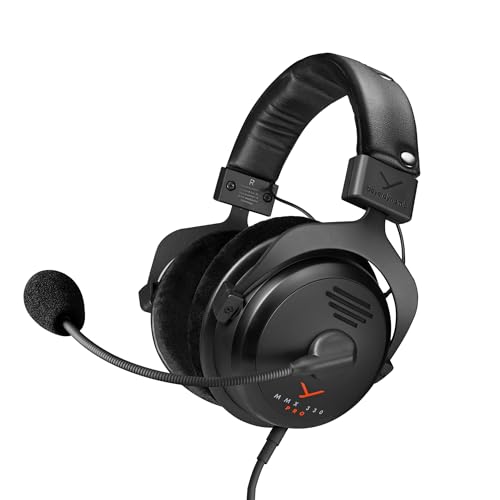
The mmx 330 pro is beyerdynamic’s argument that a gaming headset should be built like a studio headphone that happens to carry a microphone — because that is, almost literally, what it is. Handmade in Germany, wired, open-backed, and fitted with a broadcast-grade condenser microphone, the MMX 330 Pro descends from the DT series of studio headphones that recording engineers have trusted for decades, and it asks a pointed question of the gaming market: what if the headset on your head during a ranked match were engineered with the same seriousness as the headphones in the studio where the game’s soundtrack was mixed? This review examines the open-back gamble at the heart of the design, the microphone that justifies the headset format, and the comparison that defines the product — against its own closed-back sibling, the MMX 300 Pro.
Open-back is the decision everything else follows from. An open earcup lets air — and sound — pass through, which produces the spacious, natural soundstage competitive players describe as hearing the map rather than hearing the headphones, at the cost of isolation in both directions: your room leaks in, your game leaks out. Beyerdynamic’s listing states the proposition without blushing: hear enemies first, with open-back spatial audio, on PC, PlayStation and Switch. Whether that proposition is a gift or a liability depends entirely on the room you play in, and this review will keep returning to that room, because it is the true specification of this headset.
Key takeaways
- The MMX 330 Pro is a wired, open-back gaming headset handmade in Germany, with a condenser broadcast-grade microphone.
- Open-back sound gives it a wide, natural soundstage for positional play — and zero isolation from a noisy room.
- The closed-back MMX 300 Pro is the same family with the opposite acoustic choice, for shared rooms, commutes and late-night households.
- Wired means no battery, no wireless latency and no charging ritual; it also means a cable, always.
- Beyerdynamic’s studio heritage shows in build, repairability and a tuning that respects music as much as games.
In this guide
Who the MMX 330 Pro is for
The ideal owner plays in a room of their own, at a desk that stays a desk, in sessions where sound is the information channel that matters most. Tactical shooter players are the headline audience — the listing’s promise about hearing enemies first is aimed at them — but the headset suits any player whose games reward spatial awareness: battle royales with vertical audio, racing titles with engine placement, single-player adventures whose sound design deserves a stage rather than a tunnel. Streamers and creators form the second audience, because the condenser microphone is not an accessory on this headset; it is half the product, and it will be judged in the microphone section below.
The wrong owner is equally clear. If your gaming happens in a shared living room, a dorm, an open-plan office’s after-hours corner or beside a sleeping partner, an open-back headset is a diplomatic incident with drivers. If your sessions move between rooms and devices constantly, the cable will negotiate with every doorway. And if you want wireless freedom, surround processing and RGB from your headset, this product is a polite refusal of all three — beyerdynamic built a headphone first, and the gaming features it includes are the ones that survive that priority.
How the comparison was set up
Two headsets are linked here, both beyerdynamic, both verified against Amazon catalogue data before drafting. The subject is the MMX 330 Pro, whose listing confirms the open-back design, wired connection, condenser microphone, handmade-in-Germany construction and compatibility with PC, PlayStation and Switch. The alternative is the MMX 300 Pro, whose listing confirms the closed-back version of the same proposition — shutting out the room so you stay locked in — with the same broadcast-grade microphone family and platform support. No other headset is linked; rival products are discussed in prose only, because this page links only what it checked. The comparison is therefore the honest one most buyers actually face: not which brand, but which acoustic philosophy, inside one maker’s line.

beyerdynamic MMX 330 Pro review: the open-back instrument
Badge: The soundstage pick
Put the MMX 330 Pro on and the first impression is of a studio headphone that forgot to be austere. The build is the DT lineage’s familiar recipe — a robust headband, replaceable ear pads, cups that feel engineered rather than moulded — scaled and finished for a gaming desk. Comfort across long sessions is the open-back design’s second gift: air circulates, ears stay cooler than in sealed cups, and the clamp and padding distribute the weight so that the headset’s presence fades during play. Beyerdynamic’s handmade-in-Germany claim is not romance; it correlates with the things owners notice in year two, like consistent tolerances, available spare parts and a product designed to be serviced rather than replaced.
Mini spec box — beyerdynamic MMX 330 Pro
- Design: wired, open-back gaming headset
- Microphone: condenser, broadcast-grade per the listing
- Platforms: PC, PlayStation and Switch per the listing
- Construction: handmade in Germany
- Sound character: open-back spatial audio, per the listing
The sound is where the review must slow down, because the MMX 330 Pro’s soundstage is its reason to exist. Open-back presentation places sounds in a space that extends beyond the earcups: footsteps have direction and distance rather than merely left and right, a reload behind a wall reads as behind a wall, and the artificial closeness that makes closed headsets fatiguing across a long session is absent. The tuning underneath is beyerdynamic’s — detailed, honest, with treble clarity that serves footsteps and dialogue alike — and it treats music with the same respect, which matters more than gaming brands admit: most owners listen to more music than matches on any headset they own. Bass, judged fairly, is accurate rather than theatrical; players raised on exaggerated low end should expect an adjustment period, after which the accuracy usually wins, because explosions stop masking the footsteps the listing promised you would hear first.
The microphone completes the instrument. A condenser capsule of broadcast grade captures the voice with a clarity that dynamic headset mics rarely approach — the difference your teammates hear as presence, and your stream audience hears as professionalism. It asks for reasonable placement and a room that is not echoing, and in return it makes the separate desk microphone a harder purchase to justify. For a creator, that consolidation — reference headphone and broadcast voice in one wired object — is the MMX 330 Pro’s most practical argument.
Strengths
- Open-back soundstage gives positional audio a spaciousness closed headsets cannot imitate.
- Broadcast-grade condenser microphone is genuinely creator-capable, not a gaming afterthought.
- Studio-lineage build, comfort and serviceability promise years rather than seasons of use.
Trade-offs
- Zero isolation in both directions: your room enters the game and your game enters the room.
- Wired only — no wireless mode, no Bluetooth for a phone, a cable to manage forever.
- Accurate bass will initially feel restrained to players accustomed to exaggerated gaming tuning.
Best for: solo-room competitive players, streamers and music lovers who want one serious wired headset. Not suited for: shared rooms, LAN crowds, commuters or anyone whose household sleeps while they play.

beyerdynamic MMX 300 Pro review: the closed-back sibling
Badge: The isolation pick
The MMX 300 Pro answers the same brief with the opposite acoustic decision, and its listing says so in as many words: it shuts out the room so you stay locked in. The closed-back cups isolate passively — your household’s television stays out of your match, your match stays out of the household — and the sound presentation trades the 330’s open stage for a more intimate, sealed-in focus with the low end presented more forcefully, as closed designs naturally do. The microphone is the same broadcast-grade family, the platforms are the same PC, PlayStation and Switch, and the build carries the same German studio lineage.
Mini spec box — beyerdynamic MMX 300 Pro
- Design: wired, closed-back gaming headset
- Microphone: condenser, broadcast-grade per the listing
- Platforms: PC, PlayStation and Switch per the listing
- Character: isolation-first, per the listing
Daily life with the 300 Pro is the 330 Pro’s mirror. It is the headset for the shared flat, the late-night session, the open-plan room and the LAN event; it is also the safer travel companion of the two, since a closed headset on a train leaks nothing and admits little. What it cannot do is reproduce its sibling’s sense of space, and owners choosing it should do so knowingly: they are buying peace — theirs and their household’s — at the price of stage width.
Strengths
- Real passive isolation makes it the household-friendly and travel-friendly sibling.
- Closed-back presentation delivers focused, forceful low end for cinematic play.
- Same microphone quality and build lineage as the flagship open-back model.
Trade-offs
- Soundstage is narrower and more in-the-head than the 330 Pro’s open presentation.
- Sealed cups warm the ears across long sessions in summer rooms.
- It cannot be auditioned as an open-back; the choice between the siblings is philosophical and final.
Best for: shared rooms, late-night players and anyone whose games must not become the household’s soundtrack. Not suited for: players whose priority is the widest possible soundstage in a quiet room of their own.
Open-back vs closed-back: the decision that defines this family
Everything else about these two headsets is shared, so the decision deserves a clean framework. Ask first about your room’s noise: a quiet, private room feeds an open-back headset nothing to fight, while a busy room taxes it constantly. Ask second about your room’s people: open-back leakage is a social fact before it is an acoustic one. Ask third about your games: competitive spatial play rewards the 330’s stage, cinematic immersion forgives the 300’s narrower one. Ask last about heat and session length, where open-back quietly wins long summer sessions. Score your honest answers and the sibling chooses itself. Players still torn can read how the wider headset market frames the same choice in Sennheiser Momentum True Wireless earbuds reviewed for the portable side, and Cambridge Audio Melomania P100 SE headphones for closed over-ear listening.
Buying guide: what to check before buying a wired studio-grade headset
Connection first: a wired headset lives or dies by its cable and its termination, so confirm the cable suits your desk geometry and that your controller, console or PC provides a jack or an adapter path with enough clean power for the microphone. Platform second: the listings here cover PC, PlayStation and Switch, and owners should confirm their specific console generation’s headset support. Microphone third: a condenser capsule rewards a reasonably quiet, soft-furnished room and punishes a bare echoing one, so your room is part of the microphone’s specification. Comfort fourth: weight, clamp and pad material decide hour three more than any driver specification, and replaceable pads — a beyerdynamic tradition — convert wear into maintenance instead of replacement. Finally, interrogate your isolation needs with the framework above, because it is the one choice in this category that cannot be equalised away later.
How to set up the MMX 330 Pro for competitive play and streaming
Begin with the fit: position the cups so the drivers align with your ears and the headband carries the weight on the crown, then play a familiar game scene and adjust until the soundstage feels centred — a stage that leans is usually a cup that sits unevenly. Set your system’s output to plain stereo without virtual surround processing for competitive play, because the open-back stage does its own spatial work and processing layers usually smear it. Position the microphone a few centimetres from the corner of your mouth, off the breath’s direct path, and set its input level by speaking at match-day volume, not by whispering at the setup screen. Record a minute of your own voice and listen back on speakers: you are checking for echo, fan noise and the room’s honesty, and it is better to learn those lessons in a recording than on a teammate’s stream. Streamers should then set a gentle noise gate, because a sensitive condenser in an open-back ecosystem hears the whole room, including the keyboard — a board like the one in the GravaStar Mercury K1 keyboard review is mercifully soft-voiced company.
Common mistakes headset buyers make
Buying open-back for a noisy room is the signature error of this category, and buying closed-back for a silent one is its quieter twin — both are room mistakes, not product mistakes. The second error is judging a microphone from a shop’s recording rather than your own room’s acoustics. The third is adding virtual surround to a headset whose stage was the reason for purchase. The fourth is ignoring the cable until it has tangled itself into the chair’s armrest economy. The fifth is forgetting that a headset this revealing exposes your sources: compressed audio, a noisy onboard jack or a game’s poor mix will all be presented faithfully, and the headset will be blamed for the honesty.
Music, films and the life between matches
A gaming headset that only games is a poor household citizen, and the MMX 330 Pro’s studio blood shows most clearly outside matches. Music arrives with the tuning’s characteristic clarity and the open stage’s air, making long listening sessions a pleasure rather than a compromise accepted for the microphone’s sake. Films benefit from the same spaciousness — dialogue sits naturally in a room-like space — with the caveat that blockbuster bass is presented accurately rather than theatrically, which purists applaud and explosion enthusiasts adjust to. The 300 Pro, sealed and forceful, is arguably the better cinema sibling late at night. Either way, this family’s refusal to tune solely for gunfire is its most adult trait, and the one that will matter most across the years you will own it.
Care, parts and the decade view
Beyerdynamic’s service tradition is a purchasing argument in itself: ear pads, cables and headband components on studio-lineage products are treated as replaceable parts, so the headset ages by maintenance rather than by decay. Wipe pads after long sessions, store the headset on a stand rather than on the desk’s battlefield, route the cable so it never bears the headset’s weight, and keep the microphone’s windscreen clean. Do those small things and the MMX 330 Pro is a five-to-ten-year object in a category where two years is a common lifespan — a fact that reframes its price more honestly than any feature comparison can.
Final recommendation
Buy the MMX 330 Pro if your room is yours, your games reward spatial hearing and your voice matters — to teammates, to an audience or to your own recordings. Buy the MMX 300 Pro if your room is shared and your household’s peace is part of the specification. Both are verified above; both carry the same microphone and lineage; the choice is your room’s, and this review has tried to make that choice an informed one. For portable listening between desk sessions, readers can continue with Moondrop Space Travel earbuds reviewed and the Moondrop Aria story and its successor.
Soundstage, imaging and the vocabulary of hearing a map
Two words dominate headset discussions and are often confused. Soundstage is the perceived size of the acoustic space — the difference between sounds happening inside your skull and sounds happening in a room around you. Imaging is the precision with which individual sounds occupy positions in that space. The MMX 330 Pro’s open-back design enlarges the stage; beyerdynamic’s driver discipline keeps the imaging honest within it. The practical test is a familiar multiplayer map: a good stage with good imaging lets you distinguish the enemy on the stairs from the enemy on the landing, and lets a distant fight sound distant rather than merely quiet. Players upgrading from a typical closed gaming headset usually describe the first evening with an open-back stage as the moment positional audio stopped being a feature they read about and became information they used.
There is a training effect worth knowing. Brains calibrate to a headset’s presentation over days, so positional accuracy improves across the first week with any new headset — and improves most when the presentation is spacious and consistent. Changing headsets frequently, like changing mouse sensitivity frequently, taxes that calibration. A serious player should therefore treat the 330 Pro as a commitment for a season, not a rotation piece, and let the calibration compound.
The condenser microphone, in depth
Condenser capsules work by sensing the vibration of an electrically charged diaphragm, which makes them sensitive, detailed and honest about their surroundings — the three traits that define broadcast sound. In the MMX family that capsule is the reason the headset can face a creator audience without apology. Sensitivity is a discipline as much as a feature: the microphone will hear your keyboard, your chair and your room’s hard surfaces, so its owner owes it a soft-furnished corner, a sensible distance and a gain setting chosen at real speaking volume. In exchange, the voice it returns has the proximity and clarity that make listeners stay. Teammates benefit too — callouts arrive intelligible the first time, which in a fast game is a competitive feature disguised as an audio one.
Compared with the separate-microphone route, the headset’s capsule trades a little ultimate quality for total convenience: it is always positioned, always connected, always the same distance from your mouth. For most streamers below the professional tier, that consistency beats a superior microphone placed carelessly — a lesson the audio world teaches expensively and this headset teaches cheaply.
Comfort science: clamp, pads and the third hour
Headset comfort is decided by pressure distribution, and pressure distribution is decided by design choices owners can evaluate. The headband must carry weight across the crown rather than at a point. The clamp must seal the pads’ purpose — on the open-back 330, merely to position the drivers — without squeezing the jaw. The pads must breathe, which open-back construction assists by letting air move. Beyerdynamic’s studio lineage is essentially decades of iteration on exactly these variables for professionals who wear headphones as a job. The result is a headset whose comfort strategy is unglamorous and cumulative: nothing about the first minute is remarkable, and everything about the third hour is. Shoppers auditioning headsets in a shop should weight that asymmetry — the headset that wows in minute one with plush softness sometimes clamps its way into a headache by hour two, while the honest design simply disappears.
Driving the headset: sources, volume and clean power
A revealing wired headset is a diagnostic tool for your audio chain. A clean source — a decent motherboard output, a console controller in good health or a modest dedicated DAC and amplifier — lets the MMX 330 Pro show its stage and its microphone at their best. A noisy source adds hiss that the headset will faithfully present, and the correct response is to fix the source rather than blame the messenger. Volume deserves a grown-up paragraph: open-back listening tempts owners to raise levels to compete with room noise, which is both an argument for playing in a quiet room and a reminder that hearing is a non-renewable resource. Set levels for the quietest detail you need — a footstep, a whispered callout — and let the loud moments be loud relative to that, not absolute.
The German studio lineage, and why it matters to a gamer
Beyerdynamic’s DT headphones became studio furniture by surviving: sessions, tours, careless handling and decades. That heritage gives the MMX line three gamer-relevant traits that marketing cannot fake. First, consistency — a tuning philosophy refined across generations rather than reinvented per product cycle. Second, parts — a manufacturer accustomed to servicing professional tools keeps pads and cables available. Third, restraint — a company that sells to engineers does not tune for a showroom’s thirty seconds. A gamer may never record an album, but they benefit from all three traits every day they own the headset, which is the real content of the handmade-in-Germany line in the listing.
Game by game: where the 330 Pro earns its keep
Tactical shooters are the headline case, because their audio design treats footsteps, reloads and ability sounds as information with addresses, and the 330 Pro’s stage delivers those addresses readably. Battle royale titles extend the same logic vertically and at range — the difference between a fight in the building and a fight on the roof is an open-back party trick. Horror games are the surprise beneficiary: their sound design is cinema-grade, and a spacious, honest headset turns dread from a volume trick into a spatial experience. Racing and flight simulation reward the stage differently, through engine placement and environmental width. The genres that gain least are those whose audio is primarily music and voice — visual novels, turn-based strategy — and even there, the comfort and microphone keep the headset employed. A one-headset household plays everything; this one plays everything well and some things exceptionally.
Team communication as a competitive system
Clubs and regular squads underestimate the microphone’s contribution to results. Information in a fast game has a half-life of seconds, and a callout that must be repeated is information that arrives dead. A clear capsule, consistently positioned, reduces repeats, reduces the volume at which a team must speak to itself, and reduces the fatigue of a long scrim block. Captains notice this first: their own voice, broadcast-grade and effortless, carries authority in a channel the way a good chair carries a meeting. The MMX 330 Pro’s microphone is therefore not a streaming luxury bolted onto a gaming product; for organised play it is a team-performance component, and squads shopping together should audition headsets by recording the same callouts on each and listening as the enemy would — once, at speed, under game noise.
When to choose neither: the honest exits
Some readers should close this review and buy something else entirely. Wireless-first players who game from a sofa across the room need a radio, not a philosophy. Players who need active noise cancelling for a genuinely loud environment need a different technology, because passive open-back is the opposite of cancelling. Buyers on a tight budget who play socially rather than competitively will be served better by a good mainstream wireless headset than by saving for a studio instrument they cannot yet feed with a quiet room and a clean source. Naming these exits protects the recommendation’s value for the readers who remain: if your room is private, your desk is fixed and your games speak in footsteps, the MMX 330 Pro is not merely a good choice — it is the choice its category has been pointing at for years.
The first week: an owner’s diary in outline
Day one is adjustment: the bass seems polite, the stage seems wide to the point of strangeness, and the cable announces itself. Day three is recalibration: the brain has mapped the stage, callouts land without translation, and the polite bass reveals itself as the reason footsteps were audible under the explosion. Day five is the microphone’s day — a teammate or a viewer comments on your voice unprompted, which is the condenser capsule’s signature. Day seven is the quiet verdict: the old headset, tried once for comparison, sounds like listening through a door. That arc is why this review advises judging the MMX 330 Pro across a week rather than an unboxing, and why shops’ thirty-second auditions systematically underrate open-back studio headsets.
Pairing the headset with the rest of the desk
A headset of this character asks its desk for three things. A stand, because an instrument should not live in the tangle where cables go to die. A clean audio path, because the headset will report a noisy one without mercy. And a keyboard with manners, because the condenser microphone hears every keystroke your audience hears — soft, damped boards are the natural companions, and the split and gasket-mounted boards elsewhere in this cluster’s reading list both qualify. None of this is required spending; it is the order in which a serious desk assembles itself around a serious headset, one honest component at a time.
Value, reframed by lifespan
Studio-grade headsets look expensive in a comparison table of gaming headsets and inexpensive in a comparison table of years. Divide the MMX 330 Pro’s tier by a conservative five years of daily use and the daily cost is trivial; divide a budget headset by its realistic two years and add the replacement already looming, and the gap narrows to a rounding error with worse sound. This arithmetic only works if the owner actually keeps the headset — which is why fit, room and philosophy matter more than price in this review. A 330 Pro bought for the right room is a bargain renewed daily. The same headset bought for the wrong room is an expensive lesson in acoustics, and its closed sibling exists precisely to spare you that tuition.
What we would change
A detachable cable with an included shorter travel length would make the wired life easier without compromising it, and a hard case in the box would suit a product built to travel between desks and venues for a decade. A second set of pads with a slightly different character — one airier, one plusher — would let owners tune comfort the way the family already lets them tune isolation by choosing a sibling. None of these wishes touches the sound, the microphone or the build, which is the review’s way of saying the fundamentals are settled: the next MMX generation’s work is hospitality, not engineering.
Hearing health and session design
An honest headset review should spend a paragraph on the listener. Long sessions at high volume damage hearing cumulatively and quietly, and open-back headsets carry a specific temptation: raising the level to mask a room that should instead be quieted, or the session rescheduled, or the closed sibling chosen. Build your sessions with breaks, set your level by the quietest cue you need to hear, and treat any post-session ringing as the warning it is. None of this is medical advice — persistent symptoms belong with a professional — but a review that celebrates hearing enemies first owes its readers a reminder that the hearing itself is the asset being spent.
The verdict in one sitting
If you have read this far, the shape of the answer is already clear, because this is a product whose virtues and limits are the same fact viewed from two sides: it is a studio headphone with a broadcast microphone, open to the world, wired to the desk, built to be serviced and tuned to tell the truth. In the right room that fact is a triumph. In the wrong room it is a mismatch no discount can repair. The MMX 330 Pro therefore earns this review’s strongest recommendation with its condition attached, plainly: own your room first, and this headset will own its category.
For buyers upgrading from a mainstream gaming headset
The upgrade path into the MMX family usually begins with a frustration: a battery that died mid-match, a microphone teammates complain about, a plastic hinge that gave up in year two, or sound that made music feel like a chore. The 330 Pro answers each frustration with its opposite — wired permanence, a broadcast capsule, a serviceable build, a tuning that respects every source. What it will not do is preserve the conveniences of the old headset: the wireless freedom, the onboard controls, the software surround. Upgraders should list what they actually used on the old headset, honestly, and check the list against this review’s trade-offs. If the used features are the ones the MMX keeps, the upgrade is a homecoming. If they are the ones it discards, the upgrade is a trade, and trades should be made with both columns visible.
A short glossary for headset shoppers
Open-back and closed-back describe whether the earcup’s outer shell vents to the room or seals against it — the single most consequential design choice in this category. A condenser microphone senses sound with a charged diaphragm and favours detail and sensitivity; a dynamic microphone is hardier and less revealing. A soundstage is the perceived space of the audio; imaging is the placement precision inside it. A DAC converts digital audio to analogue, and its quality sets the ceiling for everything downstream of it. Impedance and sensitivity together describe how demanding a headphone is to drive — worth a check against your source if you listen at high levels from a weak output. With those six terms, every claim in this review, and most claims in any headset listing, can be translated into plain consequences.
Recording with the MMX microphone: three starter settings
Creators opening a recording application with this headset for the first time should begin with placement, then level, then processing — in that order, because each stage forgives less than the one before. Placement: capsule near the mouth’s corner, a hand’s breadth away, angled slightly off the breath. Level: speak at performance volume and set the input so your loudest laugh stays below distortion with room to spare; quiet confidence records better than hot signals. Processing: begin with none, add a gentle gate only if the room demands it, and resist stacking effects in the first week, because you cannot judge a microphone through a chain of corrections. Keep one raw recording from day one as your baseline. Months later, when your settings have drifted through a dozen tutorials, that baseline is the evidence of what the capsule alone could do — which, on this headset, is most of the work.
The household diplomacy chapter
Every open-back headset purchase is also a negotiation with the people who share your walls, and the MMX 330 Pro rewards owners who conduct that negotiation in advance. Agree the hours when leakage is welcome and the hours when the closed sibling — or speakers at low volume, or a handheld with its own audio — takes over. A headset that respects a household’s rhythm gets worn for years; a headset that becomes a nightly argument gets sold by spring. This is not a soft consideration appended to a technical review. It is, for most buyers, the actual determinant of whether the 330 Pro’s soundstage is a feature they live with or a feature they apologise for, and it belongs in the decision framework beside the room’s noise and the games’ demands.
Closing note on categories
The MMX 330 Pro sits at the crossing of two industries that rarely trust each other: studio audio, which values accuracy and longevity, and gaming, which values immediacy and identity. Products at crossings usually compromise both sides. This one instead imports the studio side’s virtues wholesale and adds exactly the gaming features that survive the import — a microphone worthy of the headphones and platform support that asks nothing exotic. That is why the review has treated it less like a gaming headset with good sound and more like a good headphone that games. The distinction sounds like wordplay until the third year of ownership, when the pads are refreshed, the cable is unbroken, the microphone still impresses strangers, and the category the product came from has reinvented itself twice. Durability of relevance is the rarest specification in gaming hardware, and it is the one this headset most clearly holds.
Buyers who have decided on the family but not the sibling sometimes ask for a tiebreaker that is not acoustic. Here is one: choose the headset for the room you will play in most during the next two years, not the room you hope to have in five. Rooms change more slowly than product cycles, and a headset matched to the present room will be loved through every year of it, while a headset bought for a hypothetical future room spends those years apologising. If the present room is genuinely transitional — a dorm year, a renovation — the closed 300 Pro is the safer bridge, because isolation is never wasted, while openness is only sometimes usable.
Testing headsets at home: a fair method
If you are comparing the MMX siblings — or any two headsets — at home, give the comparison a method or it will reward whichever is louder. Match volumes first, because the louder headset wins almost every casual comparison regardless of quality. Use the same three test scenes: a competitive moment you can repeat, a piece of music you know intimately, and a minute of your own recorded voice. Spend at least twenty minutes per headset per scene type, across two days if you can, because first impressions overweight novelty and bass. Write down where sounds seemed to come from in the game scene rather than how impressive they felt; placement notes age better than adjectives. At the end, ask the only question that predicts ownership satisfaction: which headset did you reach for when nobody was testing anything? That reach is the review your future self would write.
The open-back afterlife: spare parts and second owners
Studio-lineage headsets have a second life that gaming headsets rarely enjoy: they resell, they get handed down, they migrate to a second desk as a music headphone when a newer gaming model arrives. The MMX 330 Pro is built for that afterlife — pads and cables refresh it, the tuning suits pure listening, and the microphone that served a squad can serve a younger sibling’s first streams. Buyers who think in product lifetimes rather than product launches will count that afterlife in the value column, where it quietly outweighs several of the features that dominate launch-day comparisons.
There is a final, unfashionable virtue to record: the MMX 330 Pro is finished. It does not promise features by firmware update, does not depend on an application’s survival, and does not change its character when a service shuts down. In a decade when gaming hardware increasingly rents its own capabilities back to its owners, a wired headset that is complete on the day it is unboxed — and identical a decade later, pads refreshed — is a quietly radical object. Buyers who value that completeness will recognise it as the deepest reason this family exists, beneath the soundstage, beneath the microphone, beneath even the German workshop: it is a tool that belongs to its owner.
A note for parents, partners and gift buyers
This family is a popular gift for a serious young player, and the sibling choice is where gift buyers most often guess wrong. If the recipient plays in a bedroom with the door closed and a household that keeps ordinary hours, the open-back 330 Pro is the dream version. If the recipient plays in a living room, shares a bedroom or keeps late hours in a thin-walled house, the closed 300 Pro is the gift that will actually be used at full volume without negotiation. When in doubt, ask the household, not the recipient — the recipient will always choose the flagship, and the household lives with the leakage.
Whichever sibling is chosen, include the stand in the gift if you can. It sounds like an accessory and functions like a message: this object is meant to be kept, displayed and maintained, not dropped on the desk among the cables. Recipients who store a serious headset properly in its first month tend to own it, working beautifully, in its fifth year — and that, more than any single specification in this long review, is the outcome the MMX family was engineered to produce.
The one-paragraph summary for the impatient
The MMX 330 Pro is a handmade German studio headphone wearing a broadcast microphone: open-backed, wired, spacious and honest, built for a private room and a player who hears games as much as sees them. Its closed-back sibling, the MMX 300 Pro, is the same instrument sealed for shared life. Choose by room, verify the current listing, set the microphone up with the care described above, and expect the headset to outlast the conversation about it. Everything else in this review is the working shown for that paragraph.
Readers who arrived here from a search for a single headset and leave with a framework — room first, philosophy second, product third — have taken the more durable prize. Headsets will keep changing; rooms, households and hearing will not, and every future audio purchase those readers make will be better for having been framed by this one.
One more use case: the MMX pair as a household’s shared instrument
Some households solve the sibling question by refusing it: the closed 300 Pro lives by the shared television for evening play, the open 330 Pro lives at the desk for the serious sessions, and the family’s gamers migrate between them by room rather than by preference. The shared microphone quality and build language make the pair feel like one instrument in two acoustic forms, and the arrangement, while indulgent, is cheaper than it looks across a decade of service. Readers furnishing a house with two gaming spots should at least price the pair before buying two unrelated headsets — coherence, in a household’s tools as in a review’s argument, is worth money.
That household arrangement points at the family’s deepest trait, which this review has circled from several directions and can now name plainly: the MMX line treats gaming audio as a branch of audio, full stop — engineered by people whose other products answer to recording studios, and offered to players without translation or apology. Buy into it, in whichever sibling your room dictates, and you are not buying a gaming accessory that sounds good. You are buying a good headphone that games, and the difference compounds every year you keep it.
Frequently asked questions
What does open-back actually do for gaming?
It gives sound a room to live in. With the earcups open to the air, the MMX 330 Pro presents audio with a sense of space and distance that sealed headsets compress: footsteps, reloads and environmental cues separate from each other, and long sessions fatigue the ears less because the presentation feels natural rather than pressurised. The cost is absolute — no isolation from your environment and no privacy from it. In a quiet room of your own, the trade is heavily in your favour; in a busy shared space, it reverses, which is precisely why the closed-back MMX 300 Pro exists in the same family.
Is the MMX 330 Pro microphone good enough for streaming?
It is the strongest argument in the headset after the soundstage. A broadcast-grade condenser capsule captures vocal detail, presence and nuance that typical gaming microphones flatten, and for most creators it removes the urgency of a separate desk microphone. Two disciplines complete the setup: place the capsule near the corner of your mouth, out of the breath stream, and tame your room’s echo and fan noise, because a sensitive microphone reports the room as faithfully as the voice. Do those two things and your audience will hear the difference in the first minute.
Can I use the MMX 330 Pro with a PlayStation or Switch?
Yes — the verified listing names PC, PlayStation and Switch as its platforms, which is one of the practical virtues of a wired design: a standard connection asks little of the host. Confirm your specific console’s audio routing for game-and-chat balance, since consoles differ in how they mix those channels, and if you play at a desk with a PC nearby, a small audio switch or a second cable path makes moving the headset between machines a ten-second habit rather than a rewiring project.
MMX 330 Pro or MMX 300 Pro if I play at night in a flat?
The 300 Pro, and it is not close. Night playing in a shared flat is an isolation problem before it is a sound-quality problem: the closed-back design keeps your game in your ears and the flat’s silence intact, while the open-back 330 Pro would share every firefight with the next room. Buy the 330 only when your nights are acoustically your own. Many households solve the dilemma across time — the closed sibling now, the open one when the room situation changes — because the family’s shared microphone and build make either a safe first purchase.
Does a wired headset still make sense in a wireless era?
For a desk-bound player, emphatically yes. Wired means zero latency without a dongle, no battery to age or die mid-session, no wireless interference to diagnose, and a connection that works identically on a PC, a console and a handheld. The costs are the cable’s management and the loss of walk-away freedom. Players whose gaming is anchored to one desk pay those costs once, in cable routing, and collect the benefits daily. Players who roam should buy wireless and accept its compromises with equal clarity — the mistake is not choosing either, it is choosing without naming what you traded.
How long will the MMX 330 Pro last?
Longer than most gaming peripherals, if you treat it as the studio-lineage product it is. The wear items — ear pads, cable, headband padding — are the parts beyerdynamic’s tradition makes replaceable, and the drivers and frame have no planned expiry. A realistic expectation is many years of daily use with periodic pad refreshes, which is why this review keeps framing the price across a decade rather than a season. Store it on a stand, keep the cable unstressed and the pads clean, and the headset will outlast several of the consoles it can connect to.